


1. Introduction
1.1. Solvability of ${T}\overline{{T}}$ deformation
1.2. Why is ${T}\overline{{T}}$ deformation solvable?
1.3. Other motivations and developments
1.4. Structure of the review
2. Definition and deformed Lagrangian
2.1. Definition
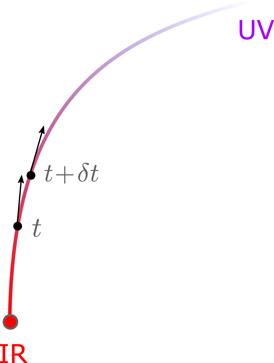
Figure 1. The |
2.2. Deformed Lagrangian
3. Deformed spectrum
3.1. The ${T}\overline{{T}}$ operator
3.2. Factorization formula
3.3. Burgers’ equation and deformed spectrum
3.4. A covariant proof
3.4.1. An invariant biscalar
3.4.2. Maximally symmetric bi-tensors
| • | Flat spacetime |
| • | Positive curvature spacetime (scalar curvature |
| • | Negative curvature spacetime (scalar curvature |
3.4.3. Ward identity and factorization
4. Modular bootstrap and uniqueness
4.1. Modular invariance of torus partition sum
4.1.1. The set-up
4.1.2. Deformed partition function
4.1.3. Some mathematics
4.1.4. Modular invariance of deformed partition function
4.2. Modular bootstrap
4.2.1. Solvable deformations
4.2.2. Perturbative expansion
| 1. The differential operator is a polynomial in terms of | |
| 2. The highest order term of | |
| 3. The lowest order term of | |
| 4. There are no terms with |
| 1. Uniqueness. Show that all Zp are uniquely determined by the modular property. | |
| 2. Existence. Give a method to construct Zp explicitly. |
4.2.3. Uniqueness
4.2.4. Existence
| • | It is clear that |
| • | From ( |
4.3. Non-perturbative features
4.3.1. Different signs and non-perturbative ambiguity
4.3.2. Asymptotic density of states and hagedorn singularity
| • | The IR limit |
| • | The UV limit |
4.4. Uniqueness of ${J}\overline{{T}}$ deformation
4.4.1. The set-up
4.4.2. Deformations and perturbative expansion
4.4.3. Uniqueness
4.4.4. Existence
| • | The coefficient of |
| • | The coefficients of the terms without |
| • | The coefficients of terms with negative powers of |
4.4.5. Non-perturbative aspects
5. Gravity and holography
5.1. Random geometry
5.1.1. From ${T}\overline{{T}}$ deformation to random geometry
| 1. We notice that the ‘gravity action’ | |
| 2. The infinitesimal parameter | |
| 3. In principle the functional integral should be performed over all possible hij, including the ones with non-zero curvature. However, as we will show, it is enough to restrict ourselves to the flat metrics. |
5.1.2. Flow equation for partition function
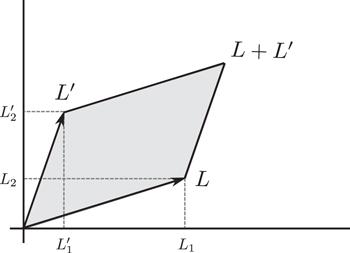
Figure 2. The parallelogram which is identified with the torus. |
5.2. 2D topological gravity
5.2.1. The proposal
5.2.2. Gravitational dressing
| 1. The spacetime geometry is fixed, we perform an irrelevant deformation of the QFT on the fixed background. This is the original definition of the | |
| 2. The spacetime is deformed in a dynamical way via a dynamical change of coordinates. The new coordinates depend on the stress energy tensor of the QFT. On the new coordinates, the theory ‘looks’ undeformed. |

Figure 3. The ordering of particles. The ordering of the rapitities are the same as the orderings of the spacetime positions. |
| 1. The deformed S-matrix still satisfies unitarity, crossing symmetry and Yang–Baxter equations, so it is still integrable. This implies that the | |
| 2. Having the deformed S-matrix, we can compute the deformed spectrum by thermodynamic Bethe ansatz. This has been done and the result is the same as the deformed spectrum we found in section | |
| 3. The connection between CDD factors and irrelevant deformations of CFTs was already noticed by Sasha Zamolodchikov in [42] when studying the RG flow between Ising and tri-cricial Ising. There he also found that at the leading order of perturbation theory, the corresponding operator is the | |
| 4. As we mentioned before, multiplying CDD factors to the S-matrix corresponds to irrelevant deformations of QFTs. Under irrelevant deformation, a QFT becomes an effective field theory and one expects that there are infinitely many terms in the Lagrangian, which is the case for |
5.2.3. Torus partition function
5.3. Holography
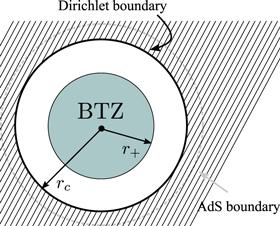


Figure 4. The cut-off geometry. Turning on |
5.3.1. The cut-off picture
5.3.2. Trace flow equation
5.3.3. Deformed spectrum from the bulk
6. New developments
6.1. Introduction
| • | Generalizations. The |
| • | Other physical quantities. In the previous sections, we have discussed a few physical quantities including the deformed classical Lagrangian, the deformed finite volume spectrum, quantum S-matrix and torus partition function. There are many other interesting physical quantities that one would like to compute in order to gain deeper understanding of |
| • | Holography. Shortly after the original papers of |
| • | Single-trace |
| • | String theory and 2D gravity. One of the early motivations for studying |