


1. Introduction
With the continuous developments of radioactive beam facilities, the study of exotic nuclei far from the β-stability line has became a hot project in nuclear physics field [1–9]. Exotic nuclei usually exhibit distinctive features that can provide a lot of information about the nuclear structure different from the well-known stable nuclei, such as new shell closures [10], coupling of bound state and unbound state and so on [11]. Proton radioactivity, the spontaneous emission of a proton by the nucleus, is an important decay mode of exotic nuclei. In 1970, this decay mode was firstly observed in an isomeric state of 53Co by Iackson et al [12, 13]. Subsequently, proton emissions from ground state of 151Lu [14] and147Tm [15] were detected by Hofmann et al and Klepper et al. Up to now, there are 44 proton emitters decaying from their ground states or isomeric states between Z = 51 and Z = 83 [11, 16–22] being identified in experiments.
Proton radioactivity shares the similar theory of barrier penetration with different kinds of charged particles' radioactivity, such as α decay, heavy ion emission, spontaneous fission, etc [23–31]. Theoretically, a great deal of methods have been proposed to deal with proton radioactivity half-life, which can be divided into two categories. One kind is theoretical models that the probability of proton penetration barrier is calculated by the Wentzel–Kramers–Brillouin approximation, such as the unified fission model [32, 33], the single-folding model [17], the modified two-potential approach [20, 34], the Gamow-like model [35], the effective interactions of density-dependent M3Y [36–38], the generalized liquid-drop model [19, 28], the Coulomb and proximity potential model, etc [21, 39, 40]. The other one is empirical formulas, which rely on the accurate released energy Qp and orbital angular momentum l taken away by emitted proton, such as universal decay law for proton radioactivity [41], the formula of Zhang and Dong [1], the New Geiger–Nuttall law [42], etc. Using these formulas, ones can estimate the half-life of proton radioactivity easily and rapidly. However, without precise Qp, we can not to predict the half-life of proton radioactivity for the certain nuclei whose proton radioactivity is energetically allowed or observed but not yet quantified. Therefore, obtaining a simple and accurate Qp formula is very necessary. In 2010, based on the macroscopic-microscopic model, a simple and local formula for calculating α-decay energies of superheavy nuclei was proposed by Dong et al [43]. They used this formula to calculate the α-decay energy, the theoretical calculations can well reproduce the experimental data. Meanwhile, they also predicted the α-decay energy of newly synthesized superheavy nuclei and obtained positive results. Refering to the shell correction form obtained by Dong et al, we propose the Qp formula including the liquid-drop part and shell correction. The liquid-drop part is the main part of our formula, which is derived from the Bethe–Weizsäcker binding energy formula.
This article is organized as follows. In the next section, the formula of released energy for proton radioactivity is briefly described. The detailed calculations and discussion are presented in section 3 . Finally, a summary is given in section 4 .
2. The formula of released energy for proton radioactivity
The relationship between the released energy of proton radioactivity and binding energy can be expressed as Qp = B(A − 1, Z − 1) − B(A, Z). If the change of binding energy with Z and A is relatively smooth, it can be replaced by
$\begin{eqnarray}{Q}_{p}={\rm{\Delta }}B\approx \displaystyle \frac{\partial B}{\partial Z}{\rm{\Delta }}Z+\displaystyle \frac{\partial B}{\partial A}{\rm{\Delta }}A,\end{eqnarray}$
with ΔA = ΔZ = −1. From the Bethe–Weizsäcker binding energy formula $\begin{eqnarray}\begin{array}{rcl}{\text{}}B(Z,A) & = & {B}_{v}+{B}_{s}+{B}_{c}+{B}_{a}+{B}_{p}\\ & = & {a}_{v}A-{a}_{s}{A}^{2/3}-{a}_{c}{Z}^{2}{A}^{-1/3}\\ & & -\,{a}_{a}{\left(\displaystyle \frac{A}{2}-Z\right)}^{2}{A}^{-1}\,+\,{a}_{p}\delta {A}^{-1/2},\end{array}\end{eqnarray}$
we obtain the following formula $\begin{eqnarray}\begin{array}{rcl}{Q}_{p} & = & 2{a}_{c}{{ZA}}^{-1/3}-\displaystyle \frac{1}{3}{a}_{c}{Z}^{2}{A}^{-4/3}-{a}_{v}+\displaystyle \frac{2}{3}{a}_{s}{A}^{-1/3}\\ & & -\,{a}_{a}(\displaystyle \frac{A}{2}-Z)(\displaystyle \frac{3A}{2}-Z){A}^{-2}+{\rm{\Delta }}{B}_{p}.\end{array}\end{eqnarray}$
Here ΔBp is the change of pairing energy terms when the parent nuclei emits a proton. Up to now, the observed nuclei with proton radioactivity are all odd-Z nuclei. Then ΔBp can be divided into the following categories $\begin{eqnarray}\begin{array}{c}{\rm{\Delta }}{B}_{p}=\left\{\begin{array}{ll}{a}_{p}{\left(A-1\right)}^{-1/2}, & {\rm{o}}{\rm{d}}{\rm{d}}\,Z-{\rm{e}}{\rm{v}}{\rm{e}}{\rm{n}}\,N\\ {a}_{p}{A}^{-1/2}, & {\rm{o}}{\rm{d}}{\rm{d}}\,Z-{\rm{o}}{\rm{d}}{\rm{d}}\,N.\end{array}\right.\end{array}\end{eqnarray}$
So, we can obtained the liquid-drop part of Qp formula as follows
$\begin{eqnarray}\begin{array}{c}{Q}_{p}=\left\{\begin{array}{l}{a}_{1}+{a}_{2}{A}^{-1/3}+{a}_{3}{ZA}^{-1/3}(2-{\textstyle \tfrac{Z}{3A}})\\ +\,{a}_{4}({\textstyle \tfrac{A}{2}}-Z)({\textstyle \tfrac{3A}{2}}-Z){A}^{-2}+{a}_{5}{\left(A-1\right)}^{-1/2},\\ {\rm{o}}{\rm{d}}{\rm{d}}\,Z-{\rm{e}}{\rm{v}}{\rm{e}}{\rm{n}}\,N\\ \,\,{a}_{1}+{a}_{2}{A}^{-1/3}+{a}_{3}{ZA}^{-1/3}(2-{\textstyle \tfrac{Z}{3A}})\\ +\,{a}_{4}({\textstyle \tfrac{A}{2}}-Z)({\textstyle \tfrac{3A}{2}}-Z){A}^{-2}+{a}_{5}{\left(A\right)}^{-1/2}\\ {\rm{o}}{\rm{d}}{\rm{d}}\,Z-{\rm{o}}{\rm{d}}{\rm{d}}\,N.\end{array}\right.\end{array}\end{eqnarray}$
However, simply considering the part of the liquid-drop in this formula, the Qp can only reflect the average trend of binding energy. While the effect of shell correction on the Qp is very important to nuclei around shell closures. Refering to the shell correction form for α-decay energies proposed by Dong et al, the final Qp formula is expressed as
$\begin{eqnarray}\begin{array}{c}{Q}_{p}=\left\{\begin{array}{l}{a}_{1}+{a}_{2}{A}^{-1/3}+{a}_{3}{ZA}^{-1/3}\left(2-{\textstyle \tfrac{Z}{3A}}\right)\\ +\,{a}_{4}\left({\textstyle \tfrac{A}{2}}-Z\right)\left({\textstyle \tfrac{3A}{2}}-Z\right){A}^{-2}+{a}_{5}{\left(A-1\right)}^{-1/2}\\ +\,{a}_{6}\left[1-{\left({\textstyle \tfrac{N-{N}_{0}}{{a}_{7}}}\right)}^{2}\right]\exp \left[-\displaystyle \frac{1}{2}{\left(\displaystyle \frac{N-{N}_{0}}{{a}_{7}}\right)}^{2}\right]\\ {\rm{o}}{\rm{d}}{\rm{d}}\,Z-{\rm{e}}{\rm{v}}{\rm{e}}{\rm{n}}\,N,\\ \,\,{a}_{1}+{a}_{2}{A}^{-1/3}+{a}_{3}{ZA}^{-1/3}\left(2-{\textstyle \tfrac{Z}{3A}}\right)\\ +\,{a}_{4}\left({\textstyle \tfrac{A}{2}}-Z\right)\left({\textstyle \tfrac{3A}{2}}-Z\right){A}^{-2}+{a}_{5}{\left(A\right)}^{-1/2}\\ +\,{a}_{6}\left[1-{\left({\textstyle \tfrac{N-{N}_{0}}{{a}_{7}}}\right)}^{2}\right]\exp \left[-{\textstyle \tfrac{1}{2}}{\left({\textstyle \tfrac{N-{N}_{0}}{{a}_{7}}}\right)}^{2}\right]\\ {\rm{o}}{\rm{d}}{\rm{d}}\,Z-{\rm{o}}{\rm{d}}{\rm{d}}\,N,\end{array}\right.\end{array}\end{eqnarray}$
where N0 is the number of neutron for the shell correction, and it will be shown in the results and discussion.3. Results and discussion
The Σ represents the deviation between the calculated value and experimental ones, in this work, which is defined as follows:
$\begin{eqnarray}\sigma ={\left[\displaystyle \sum _{i=1}^{n}[{Q}_{p}^{i}({\rm{expt}}.)-{Q}_{p}^{i}({\rm{cal}}.)]/n\right]}^{1/2},\end{eqnarray}$
where ${Q}_{p}^{i}(\mathrm{expt}.)$ and ${Q}_{p}^{i}(\mathrm{cal}.)$ denote the experimental data and calculated ones of the ith proton emitter released energy, respectively.At first, fitting the experimental data of Qp for 29 nuclei with proton radioactivity from ground state listed in table 1, we obtain the best parameters for equation (5 ) as follows:5 ) and the above parameters, we obtain the Σ = 0.179 MeV calculated by equation (7 ). For a more intuitive displaying the deviation and attempting to find N0, we plot the difference of Qp between the calculated value and experimental ones in figure 1(a). From this figure we can clearly see there is a peak around N = 76, meaning that N0 = 76 required by equation (6 ).
$\begin{eqnarray*}\left\{\begin{array}{l}{a}_{1}=-25.1625\\ {a}_{2}=71.9351\\ {a}_{3}=0.5829\\ {a}_{4}=-31.2540\\ {a}_{5}=-6.9063.\end{array}\right.\end{eqnarray*}$
Using equation (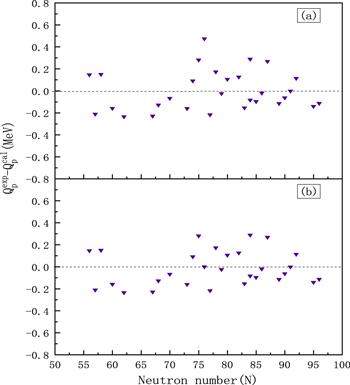
Figure 1. The part (a) is the difference of proton radioactivity released energy between the calculated value and experimental one [42] using equation ( |
Table 1. The experimental data [42] and calculated results for 29 nuclei with proton radioactivity from ground state obtained by equation ( |
| Nuclei | ${Q}_{p}^{\mathrm{Expt}.}$ (MeV) | ${Q}_{p}^{\mathrm{cal}.}$(MeV) | ΔQp(MeV) | Nuclei | ${Q}_{p}^{\mathrm{Expt}.}$ (MeV) | ${Q}_{p}^{\mathrm{cal}.}$(MeV) | ΔQp(MeV) |
|---|---|---|---|---|---|---|---|
| 109I | 0.830 | 0.683 | −0.147 | 151Lu | 1.255 | 1.149 | −0.106 |
| 112Cs | 0.830 | 1.040 | 0.210 | 155Ta | 1.466 | 1.338 | −0.127 |
| 113Cs | 0.981 | 0.830 | −0.151 | 156Ta | 1.036 | 1.190 | 0.154 |
| 117La | 0.823 | 0.981 | 0.158 | 157Ta | 0.956 | 1.039 | 0.083 |
| 121Pr | 0.901 | 1.135 | 0.234 | 159Re | 1.816 | 1.527 | −0.289 |
| 130Eu | 1.043 | 1.271 | 0.228 | 160Re | 1.286 | 1.382 | 0.096 |
| 131Eu | 0.963 | 1.090 | 0.127 | 161Re | 1.216 | 1.235 | 0.019 |
| 135Tb | 1.193 | 1.260 | 0.067 | 164Ir | 1.844 | 1.575 | −0.269 |
| 140Ho | 1.106 | 1.266 | 0.160 | 166Ir | 1.177 | 1.291 | 0.114 |
| 141Ho | 1.190 | 1.098 | −0.092 | 167Ir | 1.087 | 1.149 | 0.062 |
| 144Tm | 1.725 | 1.443 | −0.282 | 170Au | 1.487 | 1.489 | 0.001 |
| 145Tm | 1.754 | 1.753 | −0.001 | 171Au | 1.464 | 1.350 | −0.115 |
| 146Tm | 0.904 | 1.121 | 0.216 | 176Tl | 1.278 | 1.418 | 0.140 |
| 147Tm | 1.133 | 0.959 | −0.174 | 177Tl | 1.172 | 1.284 | 0.112 |
| 150Lu | 1.283 | 1.306 | 0.023 |
In the following, fixed the parameters a1 to a5 as mentioned above and let N0 in the equation (6 ) equal to 76, fitting the experimental data of the same 29 nuclei, we obtain the a6 = 0.4745 and a7 = −0.0686. Using these parameters and equation (6 ), we calculate the Qp for these 29 nuclei. The results are listed in table 1. In this table, the first three columns represent the proton emitter, the experimental Qp and the calculated result, respecttively. The last column is the difference of Qp between the calculated value and experimental data. In order to intuitively survey their deviations, we plot the difference of Qp between the calculated value and experimental ones in figure 1(b). From table 1, it is clearly seen that the deviations of Qp are almost less than 0.2 MeV except 7 nuclei. The Σ is 0.157 MeV calculated by equation (6 ). Comparing to equation (5 ), the result is slightly improved by 12.3% with considering the shell correction. From figure 1(b), we can see that the peak around N = 76 is reduced. It may be the contribution by shell correction.
Finally, as an application, we extend this formula to calculate 51 proton radioactivity candidates in region 51 ≤ Z ≤ 83 taken from the latest evaluated atomic mass table AME2016 [44, 45]. For comparison, the Qp are also evaluated using Weizsäcker–Skyrme (WS4) formula [46] and Hartree–Fock–Bogoliubov (HFB-29) model [47] In these two models, the Qp is calculated by [21]
$\begin{eqnarray}{Q}_{p}={\rm{\Delta }}{M}_{p}-({\rm{\Delta }}{M}_{d}+{\rm{\Delta }}{M}_{{\rm{pr}}})+k({Z}_{p}^{\varepsilon }\,-\,{Z}_{d}^{\varepsilon }),\end{eqnarray}$
where ΔMp, ΔMd and ΔMpr are the mass excess of parent nuclei, daughter nuclei and emitted proton, respectively. The last item $k({Z}_{p}^{\varepsilon }-{Z}_{d}^{\varepsilon })$ represents the screening effect of the atmoic electrous [48], where k = 13.6eV, ϵ = 2.408 for Z < 60 and k = 8.7 eV, ϵ = 2.517 for Z ≥ 60 [49].The detailed results are given in table 2. In this table, the first five columns represent the proton emitter, the experimental data and the calculated Qp obtained by this work, WS4 and HFB-29, respectively. The last three column are the difference of Qp between the experimental data and calculated value derived by the three models mentioned above, denoted as Δ1, Δ2, Δ3. From this table, it indicates that all of the Qp in this work are positive, while in WS4 or HFB-29 the Qp of some nuclei such as 119La, 129Pm , 145Ho, 154,155 Lu, 171Ir , 177Au are negative. To obtain further insight into the well of agreement and the systematics of results, we plot the difference of Qp between the experimental data and calculated value using these three models in figure 2. From this figure, we can clearly see that the best result is WS4 to reproduce the experimental data but the worst is HFB-29 in these three models. The evaluation abilityour of our work is between them. Furthermore, we calculate the standard deviation between experimental Qp and calculated ones for this work, WS4 and HFB-29 are 0.347, 0.231 and 0.482 MeV, respectively. The reason may be that this work and WS4 are considered the effect of shell correction, but WS4 considers more comprehensively. Due to the uncertainty of skyme force and the pairing force that its corresponding parameters are obtained by fitting the properties of less nuclei and then extend it to the unknown regions, the results of Qp calculated by the HFB-29 model are inferior to the first two models.


Figure 2. The difference of Qp between the experimental data and calculated value for this work, WS4 and HBF-29. |
Table 2. The experimental data and calculated Qp values of this work, the WS4 model and the HFB-29 model. Δ1, Δ2 and Δ3 are the deviation between experimental data and calculated value for equation ( |
| Nuclei | Qp(MeV) | Δ(MeV) | |||||
|---|---|---|---|---|---|---|---|
| Expt. | This work | WS4 [46] | HFB-29 [47] | Δ1 | Δ2 | Δ3 | |
| 103 Sb | 1.469 | 0.984 | 1.389 | 1.729 | 0.485 | 0.080 | −0.260 |
| 104 Sb | 0.519 | 0.763 | 0.787 | 0.779 | −0.244 | −0.268 | −0.260 |
| 107 I | 1.510 | 1.113 | 1.965 | 1.940 | 0.397 | −0.455 | −0.430 |
| 108 I | 0.610 | 0.900 | 1.298 | 1.070 | −0.29 | −0.688 | −0.460 |
| 111 Cs | 1.820 | 1.246 | 1.927 | 2.220 | 0.574 | −0.107 | −0.400 |
| 114 Cs | 0.244 | 0.629 | 0.423 | 0.360 | −0.385 | −0.179 | −0.116 |
| 115 Cs | 0.106 | 0.423 | 0.181 | 0.060 | −0.317 | −0.075 | 0.046 |
| 116 La | 1.091 | 1.184 | 1.412 | 1.601 | −0.093 | −0.321 | −0.510 |
| 119 La | 0.281 | 0.588 | 0.093 | −0.139 | −0.307 | 0.188 | 0.420 |
| 123 Pr | 0.361 | 0.754 | 0.221 | 0.361 | −0.393 | 0.140 | 0.000 |
| 127 Pm | 0.922 | 0.921 | 0.828 | 0.342 | 0.001 | 0.094 | 0.580 |
| 128 Pm | 0.472 | 0.741 | 0.304 | 0.082 | −0.269 | 0.168 | 0.390 |
| 129 Pm | 0.152 | 0.558 | 0.140 | −0.448 | −0.406 | 0.012 | 0.600 |
| 131 Eu | 0.963 | 1.090 | 1.155 | 1.133 | −0.127 | −0.192 | −0.170 |
| 133 Eu | 0.563 | 0.737 | 0.441 | 0.583 | −0.174 | 0.122 | −0.020 |
| 137 Tb | 0.843 | 0.917 | 0.774 | 0.703 | −0.074 | 0.069 | 0.140 |
| 142Ho | 0.854 | 0.935 | 0.692 | 0.464 | −0.081 | 0.162 | 0.390 |
| 143 Ho | 0.794 | 1.244 | 0.542 | 0.294 | −0.45 | 0.252 | 0.500 |
| 144 Ho | 0.283 | 0.610 | 0.048 | 0.134 | −0.327 | 0.235 | 0.149 |
| 145 Ho | 0.174 | 0.447 | −0.218 | −0.186 | −0.273 | 0.392 | 0.360 |
| 148 Tm | 0.569 | 0.803 | 0.268 | 0.774 | −0.234 | 0.301 | −0.205 |
| 149 Tm | 0.323 | 0.645 | 0.163 | 0.824 | −0.322 | 0.160 | −0.501 |
| 152 Lu | 0.845 | 0.997 | 0.679 | 1.005 | −0.152 | 0.166 | −0.160 |
| 153 Lu | 0.625 | 0.842 | 0.460 | 0.485 | −0.217 | 0.165 | 0.140 |
| 154 Lu | 0.215 | 0.692 | −0.007 | 2.005 | −0.477 | 0.222 | −1.790 |
| 155 Lu | 0.112 | 0.539 | −0.089 | 0.035 | −0.427 | 0.201 | 0.077 |
| 158 Ta | 0.456 | 0.892 | 0.254 | 0.286 | −0.436 | 0.202 | 0.170 |
| 159 Ta | 0.389 | 0.743 | 0.141 | 0.316 | −0.354 | 0.248 | 0.073 |
| 165 Ir | 1.557 | 1.430 | 1.636 | 1.087 | 0.127 | −0.079 | 0.470 |
| 168 Ir | 0.557 | 1.011 | 0.721 | 0.237 | −0.454 | −0.164 | 0.320 |
| 169 Ir | 0.628 | 0.870 | 0.673 | 0.217 | −0.242 | −0.045 | 0.411 |
| 170 Ir | 0.090 | 0.734 | 0.260 | 0.067 | −0.644 | −0.170 | 0.023 |
| 171 Ir | 0.243 | 0.596 | 0.249 | −0.353 | −0.353 | −0.006 | 0.596 |
| 169 Au | 1.948 | 1.626 | 2.011 | 1.428 | 0.322 | −0.063 | 0.520 |
| 173 Au | 1.003 | 1.078 | 1.028 | 0.608 | −0.075 | −0.025 | 0.395 |
| 175 Au | 0.646 | 0.809 | 0.673 | 0.508 | −0.163 | −0.027 | 0.138 |
| 177 Au | 0.117 | 0.544 | 0.152 | −0.412 | −0.427 | −0.035 | 0.529 |
| 178 Tl | 0.718 | 1.154 | 0.963 | 1.388 | −0.436 | −0.245 | −0.670 |
| 179 Tl | 0.774 | 1.021 | 1.080 | 0.708 | −0.247 | −0.306 | 0.066 |
| 180 Tl | 0.266 | 0.892 | 0.677 | 0.308 | −0.626 | −0.411 | −0.042 |
| 181 Tl | 0.179 | 0.762 | 0.677 | 0.258 | −0.583 | −0.498 | −0.079 |
| 182 Tl | 0.061 | 0.634 | 0.182 | −0.062 | −0.573 | −0.121 | 0.123 |
| 184 Bi | 1.364 | 1.106 | 1.519 | 0.669 | 0.258 | −0.155 | 0.695 |
| 186 Bi | 1.124 | 0.853 | 0.938 | 0.259 | 0.271 | 0.186 | 0.865 |
| 187 Bi | 1.028 | 0.726 | 0.845 | 0.159 | 0.302 | 0.183 | 0.869 |
| 188 Bi | 0.521 | 0.603 | 0.300 | −0.311 | −0.082 | 0.221 | 0.832 |
| 189 Bi | 0.479 | 0.478 | 0.266 | −0.571 | 0.001 | 0.213 | 1.050 |
| 162 Re | 0.786 | 1.092 | 0.616 | 0.896 | −0.306 | 0.170 | −0.110 |
| 163 Re | 0.723 | 0.946 | 0.556 | 0.536 | −0.223 | 0.167 | 0.187 |
| 164 Re | 0.166 | 0.805 | 0.083 | 0.286 | −0.639 | 0.083 | −0.120 |
| 165 Re | 0.302 | 0.662 | −0.005 | 0.146 | −0.36 | 0.307 | 0.156 |
4. Summary
In summary, based on the liquid-drop model and considered shell correction, we put forward a simple formula for the Qp. The corresponding parameters are obtained by fitting the experimental data of 29 nuclei with proton radioactivity from ground state. The standard deviation between the theoretical values and experimental ones is 0.157 MeV. In order to further test the reliability of this formula,we calculate the Qp values of 51 proton radioactivity candidates in region 51 ≤ Z ≤ 83 obtained from the latest evaluated atomic mass table AME2016 and compare with the Qp values extracted from the WS4 and HFB-29 models. It is found that the accuracy of our formula is higher than that of the HFB-29 model, although its accuracy is lower than that of the WS4 model. This indicates our formula is suitable for the predictions of Qp to some extent.