


1. Introduction
1.1. Literature survey
1.2. Novelty and unique contributions
2. Problem statement
Continuity of displacement w and shear stress σzx on the plane z = 0.
The net resultant of normal stress in the z-direction and and the shear stress in the x-direction is zero across the specified rectangular region.
The net fluid flux across the boundaries of the rectangular region must balance with the applied fluid source $\tilde{F}$.
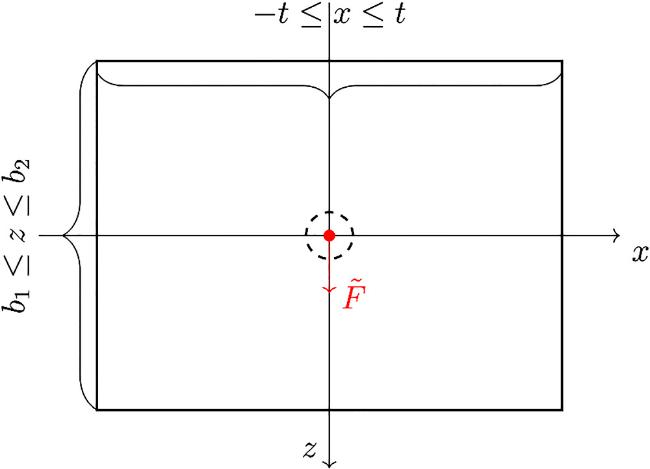
Figure 1. Illustration of the boundary value problem for a transversely isotropic poroelastic material. |
2.1. Basic equations
Constitutive Hooke’s law
Pressure law
Quasi-Laplace and Balance equations (absence of body forces)
3. General solution
4. Green’s function
5. Numerical results and discussion
5.1. Verification of the derived solutions
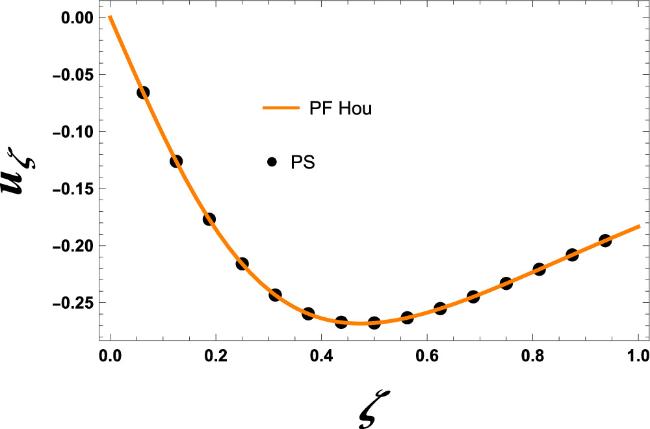
Figure 2. Comparison of the dimensionless displacement component uζ × 1012 with PF Hou at χ = 1. |
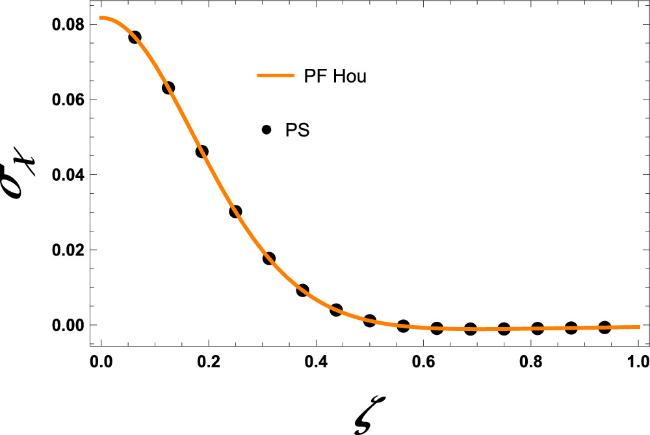
Figure 3. Comparison of the dimensionless normal stress component σχ × 1011 with PF Hou at χ = 1. |
5.2. Examining poroelastic component contours with under point fluid source
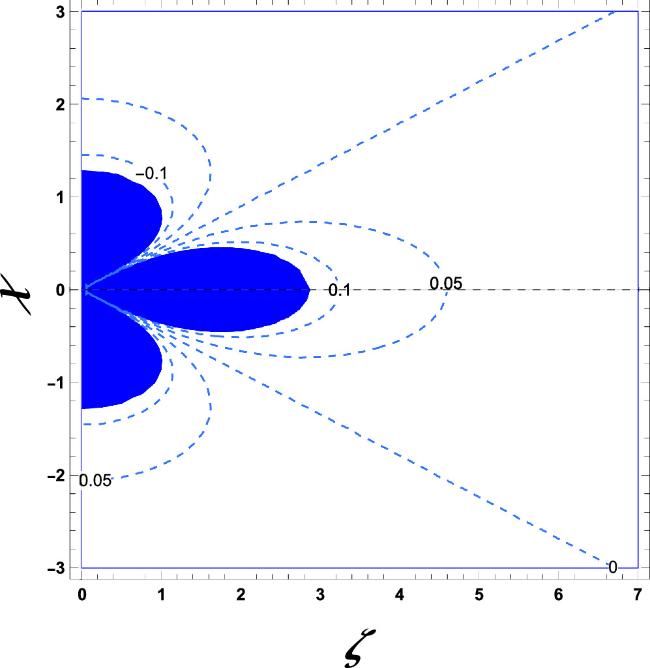
Figure 4. Contour behavior of dimensionless poro fluid pressure $\bar{P}\times 1{0}^{2}$ under point liquid source. |
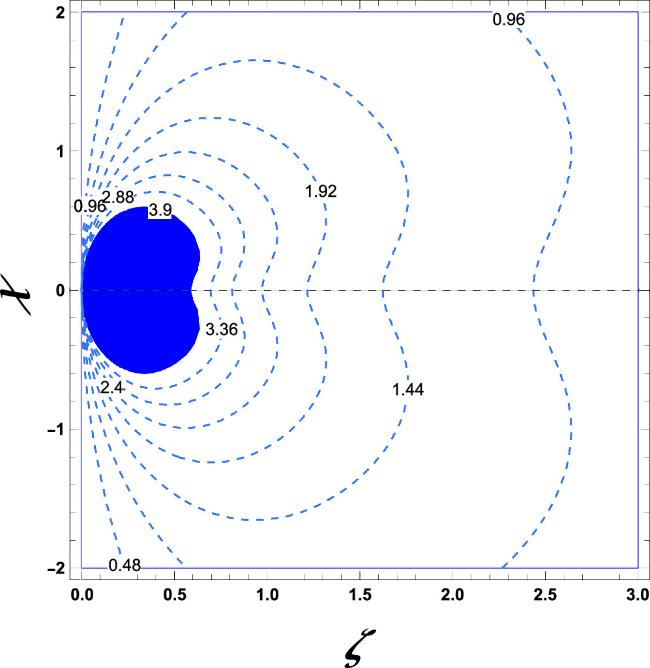
Figure 5. Contour behavior of dimensionless displacement uζ × 10−7 under point liquid source. |
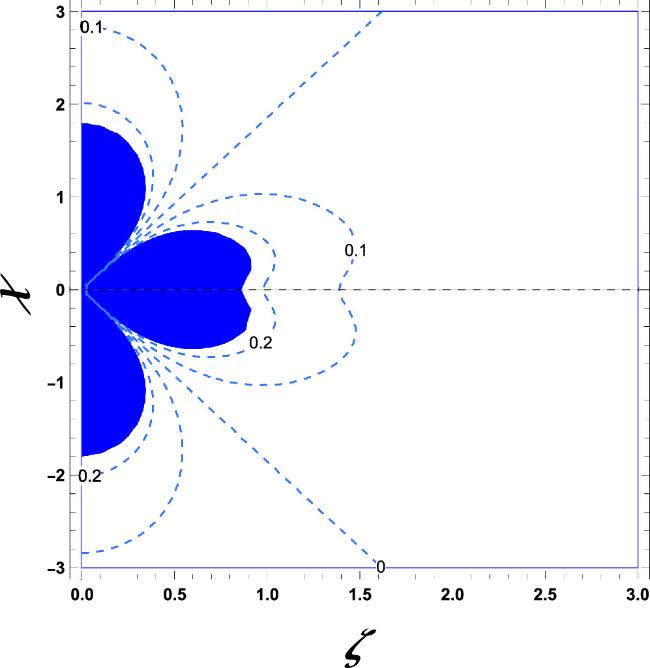
Figure 6. Contour behavior of dimensionless normal stress σχ × 10−8 under point liquid source. |
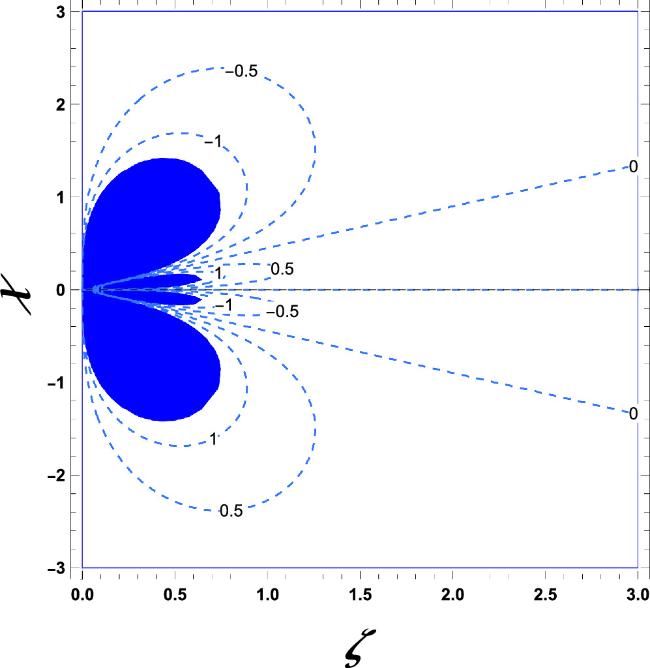


Figure 7. Contour behavior of dimensionless shear stress σχζ × 10−7 under point liquid source. |
6. Conclusion
The pore pressure contours display dense, elliptical patterns with abrupt variations near high-pressure regions, gradually smoothing as the distance increases. These patterns effectively reflect the directional fluid flow within the porous media.
The normal stress contours exhibit a symmetrical, heart-shaped pattern around the ζ-axis, featuring inflection points and zero common tangents. These characteristics provide valuable insights into stress distribution, crucial for structural analysis and design under localized loading conditions.
Higher-order singularities in shear stress are observed near the concentrated fluid source, with multiple zero common tangents along the ζ-axis, alternating between positive and negative values. This highlights regions of concentrated shear and emphasizes the fluid source’s pivotal role in stress distribution and material behavior.
Comparisons with existing literature demonstrate strong agreement, validating the accuracy and reliability of the derived solutions.