Unfortunately, all hadron collider experiments in the laboratory have not detected the above condensation signal. Considering a series of works [
13–
20] concerning the applications of the condensation-spectrum (equation (
8)), we find that the parameters ${E}_{\pi }^{GC}$ and ${E}_{\pi }^{cut}$ are target-A dependent in
pA collisions. Specifically, ${E}_{\pi }^{GC}\epsilon [100\,GeV,20\,\,TeV]$ from heavy nuclei to proton, and it corresponds to $\sqrt{S}\gg 1{0}^{6}\,GeV$ [
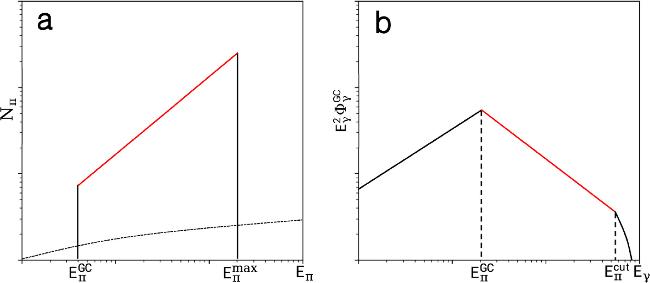
5]. It means that the pion condensation threshold is beyond the maximum energy available at the accelerator. Therefore, we turn our attention to cosmic rays because their energy may exceed the gluon condensation threshold, where we found that the condensation spectrum equation (
8) can widely interpret very high energy (VHE) gamma-ray spectra in active galactic nuclei, gamma-ray bursts, pulsars, galactic center excess, supernova remnants, even electron/positron and proton/nuclei spectra, where more than 70 astronomical events are recorded [
13–
20]. Now let us add a few more typical examples:
1. PKS 0625-354 [21, 22]
This is bright in the x-ray and gamma-ray bands, displaying very high-energy radiation, and is therefore observed and studied by a wide variety of astronomical equipment. Red-shift z ∼ 0.054. The variability observed in PKS 0625-354 can be explained by the hadronic model, since changes in the conditions inside the jet (e.g., magnetic field strength, particle density, or acceleration efficiency) lead to rapid changes in the emission. Moreover, the estimation of the radiated power favors the hadronic scenario because of the small proton radiation losses and the higher acceleration efficiency.
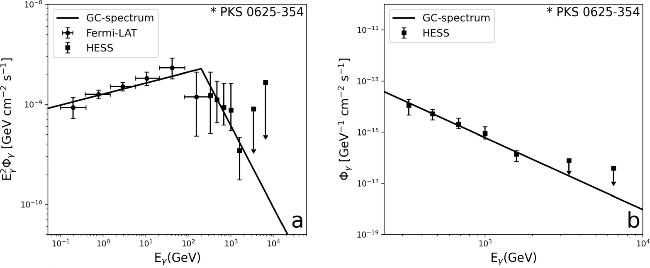
However, the traditional hadronic scenario cannot fit the observed VHE spectrum. Next there was a general preference for the lepton scenario. The PKS 0625-354 broad-band spectral energy distribution shows two humps that can be interpreted as synchrotron-self-Compton (SSC) emission products. However, a careful review of the lepton program is not satisfactory. The VHE spectra cannot be described by a single-region SSC scheme. After modification of multiple sources in the low-energy region, different models, the multi-zone SSC scheme and the lepton-hadron SSC scheme can give similar results, suggesting that the correlation between the two peaks is not necessarily inevitable, and that this is a key point in determining whether or not SSC is the radiation mechanism. Figure 4 is the condensation-spectrum of PKS 0625-354 using equation (8). It can be found a specific spectrum with sharp broken power law at 200 GeV as shown by the condensation spectrum. The data is corrected for EBL attenuation. In order to test the PL of Φγ predicted by pion condensation, figure 3(b) was not multiplied by ${E}_{\gamma }^{2}$ and we use Chi-square per degree of freedom (χ2/d. o. f. ) to assess the fitting goodness.
2. MGRO J1908+06 [23, 24]
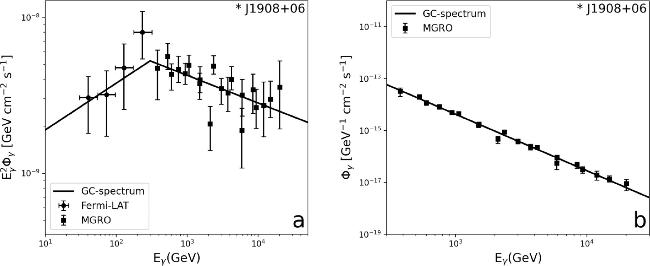
This is an ultra-high-energy gamma-ray source located in the galactic plane. It is notable for emitting ultra-high energies in excess of 200 TeV. J1908+06 has a corresponding Fermi-LAT GeV counterpart. The morphology and spectral properties of this counterpart suggest a common origin with the TeV emission, reinforcing the view that the high-energy processes of the source are complex and multifaceted. Figure 5 is an explanation of the condensation-spectrum.
3. 1ES 2344+514 [25, 26]
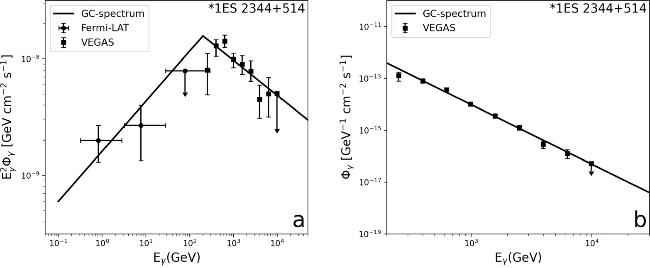
BL Lacertae 1ES 2344+514 is a member of the blazar category. It consists of extremely complex physical processes with extreme variations over time. Since its discovery in 1995, the high-energy peaked blazar 1ES 2344+514 has been observed in the multiwavelength by several other telescopes. Figure 6 shows the GC spectrum of 1ES 2344+514. One can find a clear signal of pion condensation.
4. J1356-645 [27, 28]
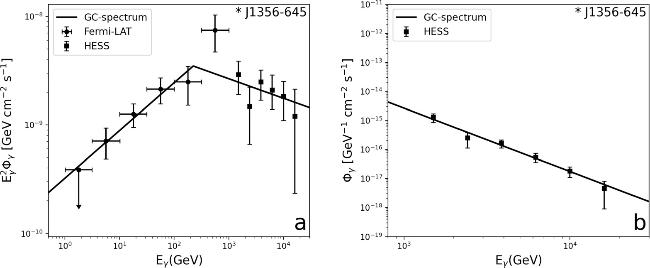
Since the pp collisions are a common phenomenon in the Universe, the pion condensation signals can occur in a variety of environments. J1356-645 is a known gamma-ray pulsar. Reference [28] reanalyzes the GeV gamma-ray emission in the direction of HESS J1356-645 with more than 13 years of Fermi Large Area Telescope (LAT) data. They find that the spectrum in the energy range in [1GeV, 1TeV] can be described by a PL. It can be explained by the condensation-spectrum (figure 7).