


Recently, Farooq et al. explored charged Casimir wormhole solutions within the framework of Einstein–Gauss–Bonnet (EGB) gravity [1]. We point out that the Casimir energy source they based their results, equations (9-14), are valid only in four-dimensional spacetime [2, 3], while the modified gravitational theory they employed requires D ≥ 5. Moreover, the contribution of the electric charge should also depend on the dimension of the spacetime, which was overlooked in their analysis. Their equation (16) and the subsequent analysis restrict the solution obtained to D = 5. However, charged Casimir wormhole solutions in EGB theory are possible for any spacetime with D ≥ 5, as we demonstrate below on considering the correct sources. Consequently, for D = 5, the correct solution should significantly deviate from that found in [1], affecting the remaining analysis presented.
If we examine the time component of Einstein’s equation for the shape function b(r), equation (15) of [1], and add both the correct D-dimensional Casimir and electric field energy densities, in the parallel plates configuration, we find 1 ) above can be readily obtained as 2 ) above, the + sign must be chosen to ensure that b(r)/r → 0 when r → ∞ (asymptotic flatness). Closer scrutiny of equation (18) in [1] reveals that their solutions fail to satisfy this condition, notwithstanding the graphs presented (figures 1 and 2).
$\begin{eqnarray}\begin{array}{l}\frac{1}{2{r}^{6}}(D-2)\left\{b(r)\left[2\mu r{b}^{{\prime} }(r)+(D-4){r}^{3}\right]+{r}^{4}{b}^{{\prime} }(r)+(D-7)\mu b{(r)}^{2}\right\}\\ \quad +\frac{{k}_{D}}{{r}^{D}}-\frac{Q}{{r}^{2(D-2)}}=0.\end{array}\end{eqnarray}$
Here, μ denotes the EGB free parameter, kD—the proportionality constant of the Casimir energy density (dependent on the spacetime dimension), and the parameter Q is associated with the electric charge. The solution to equation ( $\begin{eqnarray}b(r)=-\frac{{r}^{3}}{2\mu }\mp \frac{{r}^{3}}{2\mu }\sqrt{1+\frac{8\mu {r}^{-D}}{D-2}\left({k}_{D}-r{c}_{D}-\frac{{r}^{4-D}}{D-3}Q\right)},\end{eqnarray}$
where cD is an integration constant, determined using the boundary condition b(r0) = r0, that is, $\begin{eqnarray}{c}_{D}=\frac{{r}_{0}^{3-D}}{3-D}Q-\frac{1}{2{r}_{0}}\left[(D-2){r}_{0}^{D-2}(\mu {r}_{0}^{-2}+1)-2{k}_{D}\right].\end{eqnarray}$
In equation (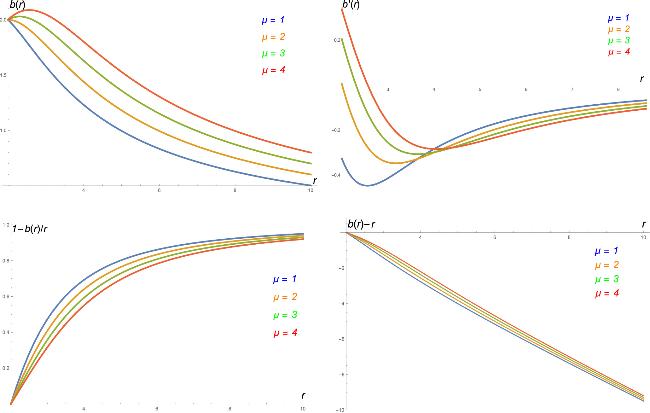
Figure 1. Behavior of b(r) (up left), ${b}^{{\prime} }(r)$ (up right), 1 − b(r)/r (down left), and b(r) − r (down right) against r for the charged Casimir wormhole between two parallel plates, for r0 = 2 and Q = 0.25. |
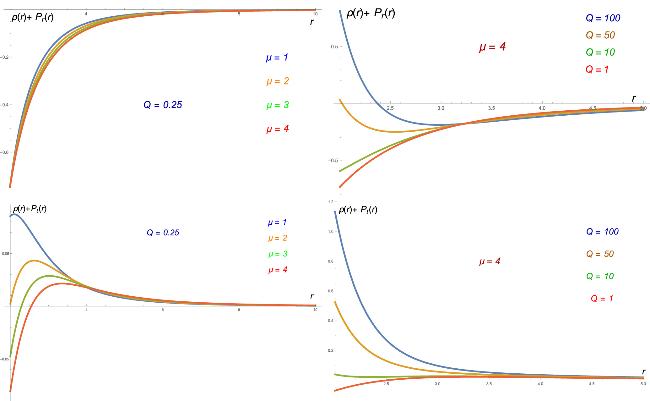
Figure 2. NEC for radial pressure (upper left) and transversal pressure (lower left) when Q = 0.25 and μ = 1, 2, 3, 4; and varying Q = 1, 10, 50, 100 when μ = 4 (upper right); and NEC for transversal pressure when Q = 0.25 (lower left) and varying Q = 1, 10, 50, 100 when μ = 4 (lower right). |
From the explicit form of Casimir energy density [4, 5], 1 ) above, it becomes evident that the dependence of the Casimir energy density on the radial coordinate in D = 5 follows an r−5 behavior, contrasting with the r−4 dependence presented in [1].
$\begin{eqnarray}{\rho }_{C}(r)=-\frac{(D-2){\rm{\Gamma }}({\,}^{D}{/}_{2}){\zeta }_{R}(D)}{{(4\pi )}^{D/2}}\frac{1}{{r}^{D}}=-\frac{{k}_{D}}{{r}^{D}},\end{eqnarray}$
where Γ(z) is the gamma function, ζR(z) is the Riemann function, and from equation (Following [5], the D − 2 factor in equation (4 ) appears due to the degrees of freedom of the electromagnetic field. The radial pressure is given by
$\begin{eqnarray}{P}_{C}(r)=-\frac{\partial [r{\rho }_{C}(r)]}{\partial r}=\omega {\rho }_{C}(r),\end{eqnarray}$
with ω = (D − 1). Thus, we get $\begin{eqnarray}{\rho }_{C}(r)+{P}_{C}(r)=f(r),\quad f(r)=D{\rho }_{C}(r)\lt 0,\,r\gt {r}_{0}\end{eqnarray}$
for any dimension. Null Energy Condition (NEC) is, therefore, always violated.When the electromagnetic energy density is included, given by
$\begin{eqnarray}{\rho }_{e}=\frac{Q}{{r}^{2(D-2)}},\end{eqnarray}$
we can no longer write a simple linear state equation relating the pressure to the density. Thus, we relax the condition for the Casimir and electromagnetic sources, deriving both the radial and lateral pressures directly from the remaining Einstein’s equations, while fixing the form of the redshift function Φ(r) = constant. Consequently, the wormhole would no longer strictly be a charged Casimir wormhole, as was realized in [1].Through the plots of figure 1, we can see that the corrected EGB charged Casimir wormhole satisfies the flaring-out and asymptotic flatness in five-dimensional spacetime, for different values of the EGB parameter μ. By figures 2 and 3, we can observe that the NEC is violated. However, for large values of the electric charge, the NEC is satisfied near the wormhole throat.
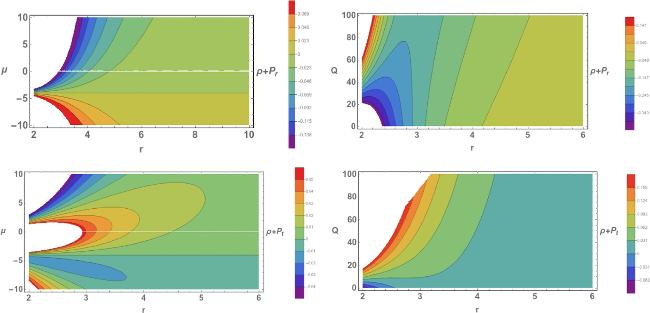


Figure 3. Contour plot illustrating NEC for the charged Casimir wormhole between two parallel plates varying μ for radial pressure (upper left) and transversal pressure (lower left) and varying charge Q for radial (upper right) and transversal (lower right) pressures for r ≥ r0. |
The problems addressed here regarding the results presented in [1] persist when the authors extend their analysis to other configurations, such as Casimir sources from parallel cylinders and spheres, along with Generalized Uncertainty Principle (GUP) corrections. Their approach remains rooted in four-dimensional sources within EGB gravity, which is inadequate. Consequently, we believe that a comprehensive reformulation of their work is necessary to accurately incorporate Casimir and electric sources, thereby advancing the understanding of quantum effects in the context of modified gravity theories.