


1. Introduction
The pursuit of high-energy particle acceleration has long been a focus of study in disciplines ranging from particle physics to medicinal therapy. Traditional acceleration techniques, such as synchrotrons and linear accelerators, are often constrained by their size and expense. Laser-driven acceleration [1–3] seems to be a potential option, since it uses the electric fields of high-intensity laser pulses to impart energy to charged particles across substantially shorter distances. This approach not only provides small acceleration systems, but it also has the potential to achieve significant energy gains with higher efficiency. Malka et al [4] have experimentally observed the electron of some MeV energies using a high-intensity sub-picosecond laser pulse in vacuum. Hartemann et al [5] have investigated the electron acceleration mechanism due to Unruh radiation and ponderomotive scattering. Sharma et al [6] have investigated the acceleration mechanism in vacuum using the Sinh-Gaussian profile. Gupta et al [7] have investigated the laser-induced acceleration of an electron moving obliquely with respect to a laser pulse, using a long-wavelength electromagnetic wave to obtain energy. Ghotra [8] has investigated the effects that are produced by polarized laser field on electron acceleration in vacuum. Sharma et al [9] have investigated into obtaining the optimized conditions for laser and electron parameters for enhanced electron acceleration in a vacuum. Singh et al [10] have investigated the role of frequency chirps, and laser spot size on electron acceleration in vacuum. Kumar et al [11] have used high order tightly focused chirped Gaussian laser beams to study their impact on electron acceleration and obtained the optimized spot size of a laser pulse for maximum energy gain for electrons in a vacuum. Rajput et al [12] have compared linear and circular polarized Hermite-cosh-Gaussian laser pulses in a vacuum and concluded that the circular polarized pulse is better suited for enhanced electron acceleration in a vacuum.
In a laser wakefield acceleration (LWFA) mechanism, an intense laser pulse interacts with plasma electrons and provides oscillatory motion to the electrons known as a plasma wave. Plasma wave results in generating a longitudinal electric field known as a laser wakefield. It can be utilized to accelerate electrons [21, 22]. In LWFA, several plasma variables are to be controlled to avoid dephasing effects, collisional loss, etc [23]. As compared to LWFA, Direct Laser Acceleration (DLA) is a much simpler and compact way to generate electrons with relativistic energy due to interaction with the intense laser pulse directly.
Tian et al [24] have investigated electron acceleration in phase locked plasma to obtain monoenergetic electron bunches. Zhou et al [25] have shown a laser streaking idea that can be used to observe the motion of free electrons when they are released from a plasma mirror at a sub-relativistic laser strength.
In this study we have used a radially polarized cosh-Gaussian laser pulse to investigate the role of frequency chirping on electron acceleration in a vacuum. The key advantage of the cosh-Gaussian beam is in its distinctive intensity profile, which provides a wider, more uniform energy distribution and less divergence. These characteristics make it optimal for the electron acceleration mechanism. The decentered parameter (b) of cosh function plays a crucial role for cosh-Gaussian laser profile. Such profiles for b = 0.5 and 1 are shown in figure 1.
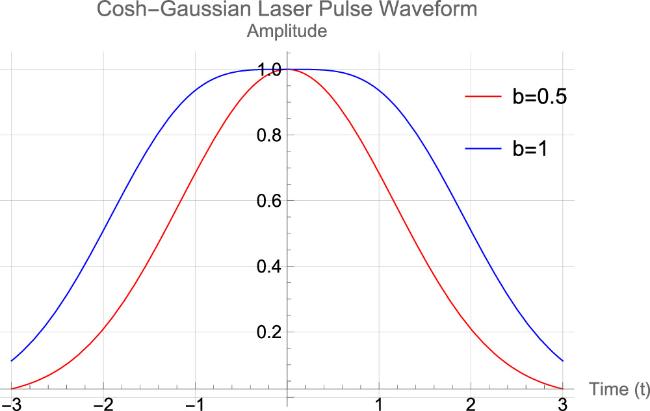
Figure 1. cosh-Gaussian laser pulse wave form for decentered parameter b = 0.5 and 0.1. |
For this analytical study, the equation of motion in relativistic form is solved for the selected laser pulse in section 2 . Using experimental feasible values, electron energy gain is calculated by solving the differential equations and curves are plotted and discussed in section 3 . The conclusions are drawn in section 3.1 .
2. Electron dynamics
Consider a radially polarized cosh-Gaussian laser pulse [26] heading in the z-direction. The radial component of the electric field is expressed as
$\begin{eqnarray}{E}_{r}=\,{E}_{0}\cosh \left(\frac{{br}}{{r}_{0}}\right){{\rm{e}}}^{-{r}^{2}/{r}_{0}^{2}}{{\rm{e}}}^{{\rm{i}}\left({kz}-\omega t\right)}.\end{eqnarray}$
Here, $\omega ={\omega }_{0}(1+\alpha t)$, where α is the frequency chirp constant, b is the decentered parameter, ${r}_{0}$ is the beam waist, k and $\omega $ are the propagation constant and angular frequency of the laser pulse. ${E}_{0}$ is the amplitude of laser electric field.The z-component of the laser electric field (${E}_{z}$) is calculated by solving Maxwell’s equation $\vec{{\rm{\nabla }}}.\vec{E}=0$ in vacuum.1 )–(3 ), the components of the forces can be obtained as
$\begin{eqnarray}{E}_{z}=\frac{{\rm{i}}{E}_{r}}{{kr}}\left[1+\frac{{rb}}{{r}_{0}}\tanh \left(\frac{{br}}{{r}_{0}}\right)-\frac{2{r}^{2}}{{r}_{0}^{2}}\right].\end{eqnarray}$
The magnetic field of the laser pulse is related to the radial component of the laser electric field as $\begin{eqnarray}{B}_{L}=\frac{{E}_{r}}{c}\hat{{\unicode{415}}}.\end{eqnarray}$
By using the Lorentz force equation $\vec{{\rm{F}}}=\frac{{\rm{d}}\vec{P}}{{\rm{d}}t}\,=-e\left\{\vec{E}+\left(\vec{V}\times \vec{B}\right)\right\},$ the dynamics of the electron under the influence of the chirped cosh-Gaussian pulse can be studied. Using equations ( $\begin{eqnarray}{\rm{Along\; radial\; direction}}\frac{{\rm{d}}{P}_{r}}{{\rm{d}}t}=-e\left\{{E}_{r}-\frac{{V}_{z}{E}_{r}}{c}\right\}.\end{eqnarray}$
$\begin{eqnarray}{\rm{Along\; z}}\rm{-}{\rm{direction}}\frac{{\rm{d}}{P}_{z}}{{\rm{d}}t}=-e\left\{{E}_{z}+\frac{{V}_{r}{E}_{r}}{c}\,\right\}.\end{eqnarray}$
$\begin{eqnarray}{\rm{Along}}\,{\unicode{415}}\rm{-}{\rm{direction}}\frac{{\rm{d}}{P}_{\unicode{415}}}{{\rm{d}}t}=0.\end{eqnarray}$
The relativistic component can be expressed as γ = $\sqrt{1+\frac{({P}_{r}^{2}+{P}_{\unicode{415}}^{2}+{P}_{z}^{2})}{{m}_{0}^{2}{c}^{2}}}$, where ${m}_{0}$ denotes the rest mass of the electron and c represents the speed of light in a vacuum. By differentiating this quantity with respect to t and using equations (4 )–(6 ), we get1 ) and (2 ),4 )5 )8 ), (9 ) and (11 ) further, which are the coupled differential equations. The energy of electron is obtained by using the formula $\gamma {m}_{0}{c}^{2}$.
$\begin{eqnarray}\frac{{\rm{d}}\gamma }{{\rm{d}}t}=-\frac{e}{{m}_{0}{c}^{2}}\left({V}_{r}{E}_{r}+{V}_{z}{E}_{z}\right).\end{eqnarray}$
Values of ${E}_{r}$ and ${E}_{z}$ are used from equations ( $\begin{eqnarray*}\begin{array}{l}\Rightarrow \,\frac{{\rm{d}}\gamma }{{\rm{d}}t}=-\frac{e}{{m}_{0}{c}^{2}}\left({V}_{r}{E}_{r}+{V}_{z}\frac{{\rm{i}}{E}_{r}}{{kr}}\right.\\ \,\times \,\left.\left[1+\frac{{rb}}{{r}_{0}}\tanh \left(\frac{{br}}{{r}_{0}}\right)-\frac{2{r}^{2}}{{r}_{0}^{2}}\right]\right),\end{array}\end{eqnarray*}$
$\begin{eqnarray*}\begin{array}{l}\Rightarrow \,\frac{{\rm{d}}\gamma }{{\rm{d}}t}=-\frac{e{E}_{r}}{{m}_{0}{c}^{2}}\left({V}_{r}+\frac{{\rm{i}}{V}_{z}}{{kr}}\right.\\ \,\times \,\left.\left[1+\frac{{rb}}{{r}_{0}}\tanh \left(\frac{{br}}{{r}_{0}}\right)-\frac{2{r}^{2}}{{r}_{0}^{2}}\right]\right),\end{array}\end{eqnarray*}$
$\begin{eqnarray*}\begin{array}{l}\Rightarrow \,\frac{{\rm{d}}\gamma }{{\rm{d}}t}=-\frac{e{E}_{0}\cosh \left(\frac{{br}}{{r}_{0}}\right){{\rm{e}}}^{-{r}^{2}/{r}_{0}^{2}}{{\rm{e}}}^{{\rm{i}}\left({kz}-\omega t\right)}}{{m}_{0}{c}^{2}}\\ \,\times \,\left({V}_{r}+\frac{{\rm{i}}{V}_{z}}{{kr}}\left[1+\frac{{rb}}{{r}_{0}}\tanh \left(\frac{{br}}{{r}_{0}}\right)-\frac{2{r}^{2}}{{r}_{0}^{2}}\right]\right).\end{array}\end{eqnarray*}$
Normalizing the parameters $\begin{eqnarray*}{t}^{{\prime} }={\omega }_{0}t,\,{a}_{0}=\frac{e{E}_{0}}{{m}_{0}c{\omega }_{0}},\,{\beta }_{r}=\frac{{V}_{r}}{c},\,{\beta }_{z}=\frac{{V}_{z}}{c},\,\end{eqnarray*}$
$\begin{eqnarray*}{r}^{{\prime} }=\frac{r{\omega }_{0}}{c},\,{{r}_{0}}^{{\prime} }=\frac{{r}_{0}{\omega }_{0}}{c},\,{k}^{{\prime} }=\frac{{kc}}{{\omega }_{0}},{z}^{{\prime} }=\frac{z{\omega }_{0}}{c},\end{eqnarray*}$
$\begin{eqnarray*}\phi ={t}^{{\prime} }\left(1+{\alpha }^{{\prime} }{t}^{{\prime} }\right)-{k}^{{\prime} }{z}^{{\prime} },{\alpha }^{{\prime} }=\frac{\alpha }{{\omega }_{0}}.\end{eqnarray*}$
We get, $\begin{eqnarray}\begin{array}{ccl}\frac{{\rm{d}}\gamma }{{\rm{d}}{t}^{{\prime} }} & = & -\,{a}_{0}\cosh \left(\frac{b\,{r}^{{\prime} }}{{{r}_{0}}^{{\prime} }}\right){{\rm{e}}}^{-{{r}^{{\prime} }}^{2}/{{r}_{0}^{{\prime} }}^{2}}\\ \Space{0ex}{0.24em}{0ex} & & \times \,\left({\beta }_{r}\cos \left(\phi \right)+\sin \left(\phi \right)\frac{{\beta }_{z}}{{k}^{{\prime} }{r}^{{\prime} }}\right.\\ \Space{0ex}{0.24em}{0ex} & & \times \left.\left\{1+\frac{b{r}^{{\prime} }}{{{r}_{0}}^{{\prime} }}\tanh \left(\frac{b{r}^{{\prime} }}{{{r}_{0}}^{{\prime} }}\right)-\frac{2{{r}^{{\prime} }}^{2}}{{{r}_{0}^{{\prime} }}^{2}}\right\}\right).\end{array}\end{eqnarray}$
From equation ( $\begin{eqnarray}\frac{{\rm{d}}{\beta }_{r}}{{\rm{d}}{t}^{{\prime} }}=-\frac{{a}_{0}}{{c}_{1}}\cosh \left(\frac{b{r}^{{\prime} }}{{{r}_{0}}^{{\prime} }}\right){{\rm{e}}}^{-{{r}^{{\prime} }}^{2}/{{r}_{0}^{{\prime} }}^{2}}\cos \left(\phi \right)\left(1-{\beta }_{z}\right).\end{eqnarray}$
Here, $\begin{eqnarray}{c}_{1}=\left\{\frac{1}{\sqrt{1-{\beta }_{r}^{2}}}+\frac{{\beta }_{r}^{2}}{{\left(1-{\beta }_{r}^{2}\right)}^{3/2}}\right\}.\end{eqnarray}$
From equation ( $\begin{eqnarray}\begin{array}{l}\Rightarrow \,\frac{{\rm{d}}{\beta }_{z}}{{\rm{d}}{t}^{{\prime} }}=-\frac{{a}_{0}}{{c}_{2}}\cosh \left(\frac{b{r}^{{\prime} }}{{{r}_{0}}^{{\prime} }}\right){{\rm{e}}}^{-{{r}^{{\prime} }}^{2}/{{r}_{0}^{{\prime} }}^{2}}\\ \,\times \left\{{\beta }_{r}\cos \left(\phi \right)-\frac{1}{{k}^{{\prime} }{r}^{{\prime} }}\sin \left(\phi \right)\right.\\ \,\times \left.\left\{1+\frac{b{r}^{{\prime} }}{{{r}_{0}}^{{\prime} }}\tanh \left(\frac{b{r}^{{\prime} }}{{{r}_{0}}^{{\prime} }}\right)-\frac{2{{r}^{{\prime} }}^{2}}{{{r}_{0}^{{\prime} }}^{2}}\right\}\right\}.\end{array}\end{eqnarray}$
Here, $\begin{eqnarray}{c}_{2}=\left\{\frac{1}{\sqrt{1-{\beta }_{z}^{2}}}+\frac{{\beta }_{r}^{2}}{{\left(1-{\beta }_{z}^{2}\right)}^{3/2}}\right\}.\end{eqnarray}$
The relativistic component (γ) may be obtained by solving equations (3. Results and discussion
The wavelength of the laser used for the analytical solutions is 1.06 μm, propagation constant k is $5.96\times {10}^{6}\,{{\rm{m}}}^{-1},$ unchirped laser frequency ${\omega }_{0}=1.78\times {10}^{15}{\rm{rad}}/\sec .\,$ The normalized laser electric field amplitude is chosen from 5 to 40. The corresponding laser intensity amplitude is from $3.05\times {10}^{19}{\rm{W}}/{{\rm{cm}}}^{2}$ to $1.96\times {10}^{21}{\rm{W}}/{{\rm{cm}}}^{2}$. The value of the decentered parameter is chosen from 0.5 to 3. The normalized values of the beam waist are chosen from 0.1 to 0.7 which corresponds to 16.87 nm to 118 nm. For such chosen parameters, the general interaction of the laser pulse with the electron is discussed in detail by Liu et al [27]. Initially the electron energy is taken as 1.07 MeV (${\gamma }_{0}=2.1$) and the initial direction of motion is taken along the z-direction. The chirp parameters chosen for this investigation are 0 for the unchirped pulse and 0.0011 to 0.0077 for the chirped laser pulses.
3.1. Effect of the laser electric field amplitude
The substantial rise in the electron’s energy acquisition with the augmentation of the normalized laser electric field amplitude is attributable to the linear correlation between the energy gain and laser electric field. The augmentation of the laser amplitudes leads to intensified electric fields that exert more work on the electron, propelling it to elevated energies of 2.80 GeV at ${a}_{0}=40$, in contrast to 0.35 GeV at ${a}_{0}=5$ as shown in figure 2. This process is also affected by relativistic effects when the electron’s motion attains relativistic speeds with elevated field strengths. The electron energy gain is directly proportional to the normalized laser electric field amplitude as shown in figure 3. The analytical solution obtained in equation (8 ) demonstrates that with the increase in laser amplitude, the time rate of change of the relativistic factor varies linearly with it. The energy of electron is obtained as $\gamma {m}_{0}{c}^{2}.$ The same variation can be seen in figure 3.
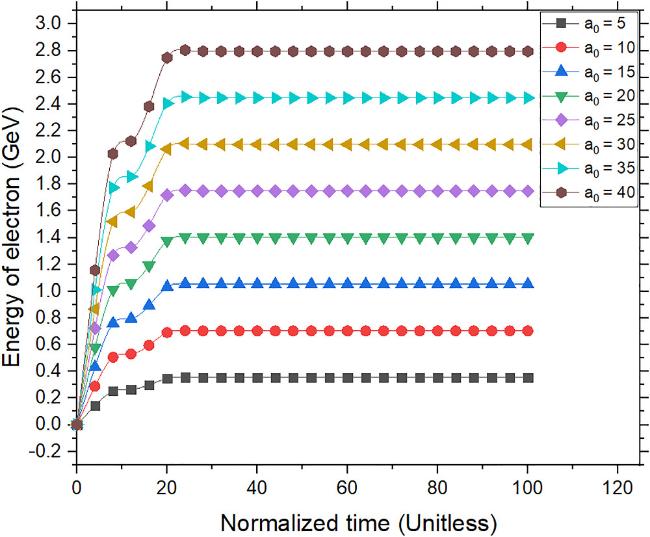
Figure 2. Variation of electron energy gain with normalized time for different laser electric field amplitude. λ = 1.06 μm, b = 3, ${r}_{0}^{1}=0.40,\,\alpha $ = 0.0077. |
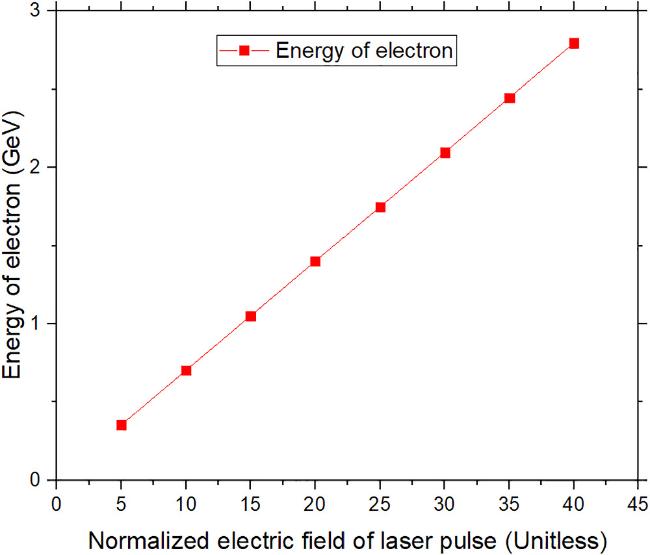
Figure 3. Variation of electron energy gain with normalized laser electric field amplitude. λ = 1.06 μm, b = 3, ${r}_{0}^{1}=0.40,\,\alpha $ = 0.0077, ${t}^{{\prime} }=100$. |
3.2. Effect of the decentered parameter of the laser pulse
The decentered parameter b of a cosh-Gaussian laser pulse is essential in determining the pulse profile and, thus, in enhancing electron acceleration. Increasing b displaces the pulse intensity off-center, enabling electrons to encounter more potent, asymmetrical electric fields throughout an extended interaction distance. This design improves energy transmission to the electrons, markedly increasing their energy from 0.31 GeV at b = 0.5 to 2.80 GeV at b = 3 as represented in figure 4. Consequently, modifying the decentered parameter provides a proficient method to customise the laser pulse for enhanced acceleration mechanisms, facilitating the generation of greater energy electron beams appropriate for sophisticated scientific and technical applications. The fluctuation of electron energy with respect to the decentered parameter of the hyperbolic cosine function is seen in figure 5. The decentered parameter alters the cosh-Gaussian pulse spatial intensity profile. Decentered pulses increase field gradients along the electron’s pathway, boosting energy transfer. As a consequence, the energy of the electron increases non-linearly with the decentered parameter.
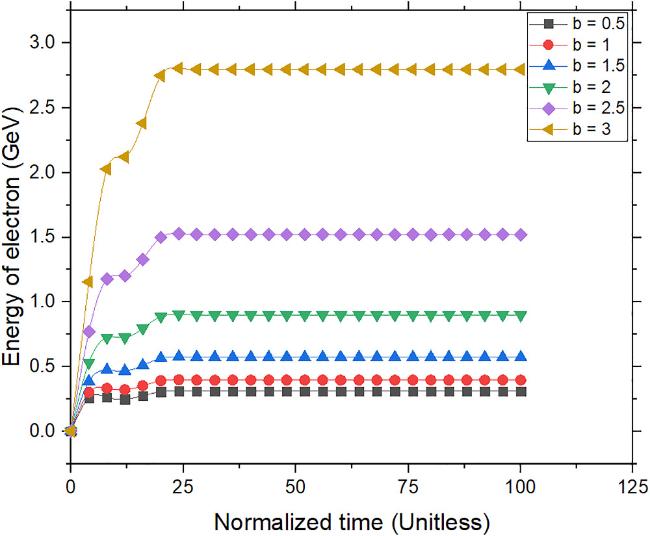
Figure 4. Variation of the electron energy gain with normalized time for different decentered parameter. λ = 1.06 μm, ${a}_{0}=40$, ${r}_{0}^{1}=0.40,\,\alpha $ = 0.0077. |
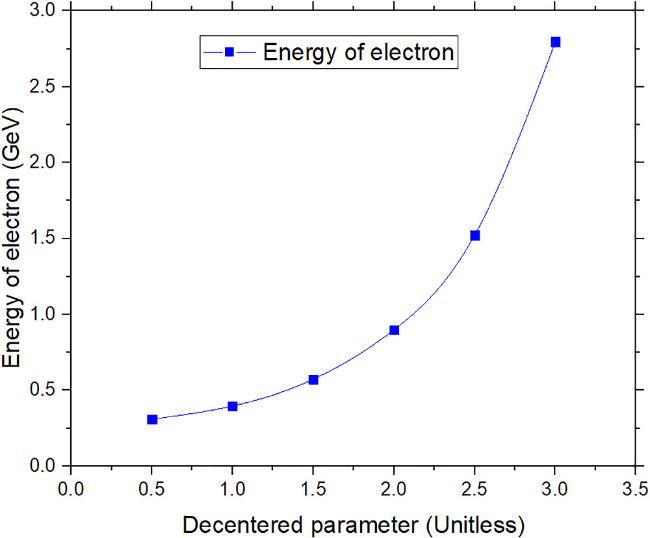
Figure 5. Variation of the electron energy gain with decentered parameter. λ = 1.06 μm, ${a}_{0}=40$, ${r}_{0}^{1}=0.40,\,\alpha $ = 0.0077, ${t}^{{\prime} }=100$. |
3.3. Effect of the beam waist of the laser pulse
The beam waist of a cosh-Gaussian laser pulse significantly affects the electron energy gain throughout the acceleration phase, as seen in figure 6. For a minimal beam waist (normalised value of 0.1), the energy increase is limited to 0.05 GeV. The diminished energy gain is probably of the inadequate spatial overlap between the laser pulse and the electron trajectory, leading to a decreased acceleration efficiency. As the beam waist expands to 0.4, the electron energy gain reaches a maximum of 2.80 GeV. This indicates that an ideal beam waist improves the interaction between the laser field and the electron, hence maximising energy transfer. At this juncture, the laser’s spatial intensity distribution is presumably optimal for efficiently propelling the electron along its trajectory, using the centre high-intensity area of the cosh-Gaussian profile. Nonetheless, further augmenting the beam waist to 0.7 results in a substantial reduction in electron energy gain, stabilising at around 0.34 GeV. The decreased energy acquisition at increased beam waists may stem from the laser pulse dispersing excessively, so reducing the peak intensity and, in turn, the electric field strength encountered by the electron. The diminished field strength resulted in decreased acceleration. This variance is seen in figure 7.
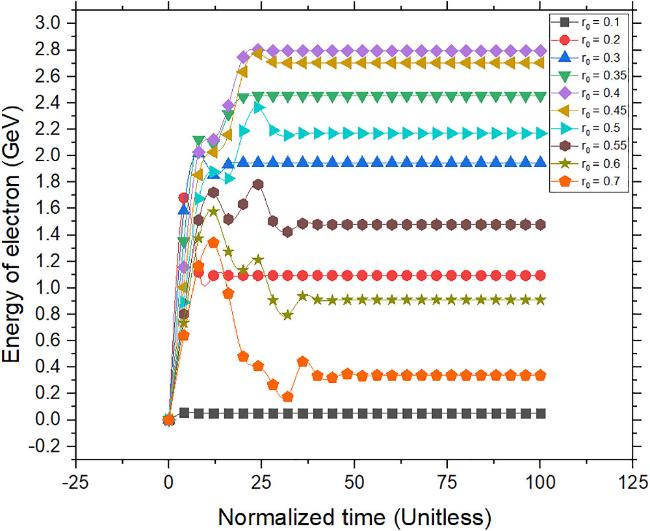
Figure 6. Variation of electron energy gain with normalized time for different normalized beam waist. λ = 1.06 μm, ${a}_{0}=40$, $b=3,\,\alpha $ = 0.0077. |
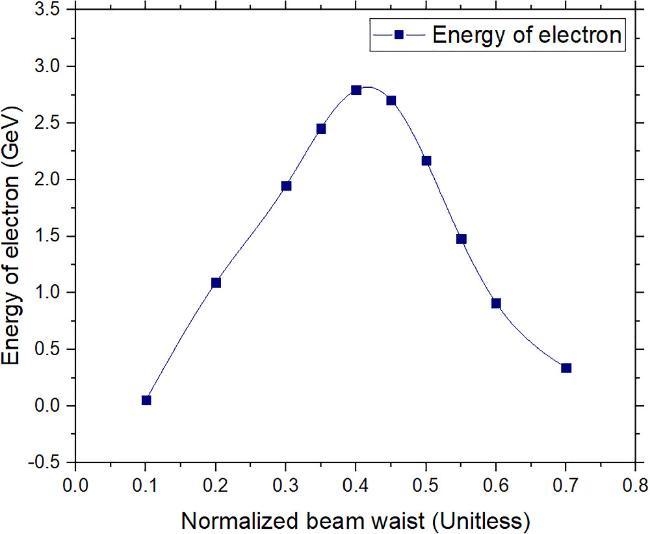
Figure 7. Variation of electron energy gain with normalized time for different normalized beam waist. λ = 1.06 μm, ${a}_{0}=40$, $b=3,\,\alpha $ = 0.0077, ${t}^{{\prime} }=100$. |
3.4. Effect of the frequency chirp of the laser pulse
The observed augmentation in electron energy acquisition corresponding to the escalation in frequency chirp of the laser pulse indicates that chirping may significantly improve the energy transfer from the laser to the electron. The energy transfer during the interaction of an unchirped laser pulse with an electron in a vacuum is constrained by the pulse’s intrinsic properties, including peak intensity, duration, and frequency. As the chirp parameter rises, the frequency of the laser pulse fluctuates with time, hence modifying the temporal structure of the pulse and prolonging its interaction duration with the electron. The asymmetry created by chirping enables the electron to maintain phase alignment with the pulse’s electric field for an extended period, hence enhancing the energy it can absorb, as seen in figures 8 and 9. The escalating chirp parameter effectively adjusts the pulse’s frequency to align more closely with the electron’s motion dynamics, resulting in an enhanced rate of energy transfer. As the chirp value increases to 0.0077, the electron energy gain attains its peak at 2.80 GeV, presumably owing to an ideal alignment between the chirped laser beam and the electron’s reaction.
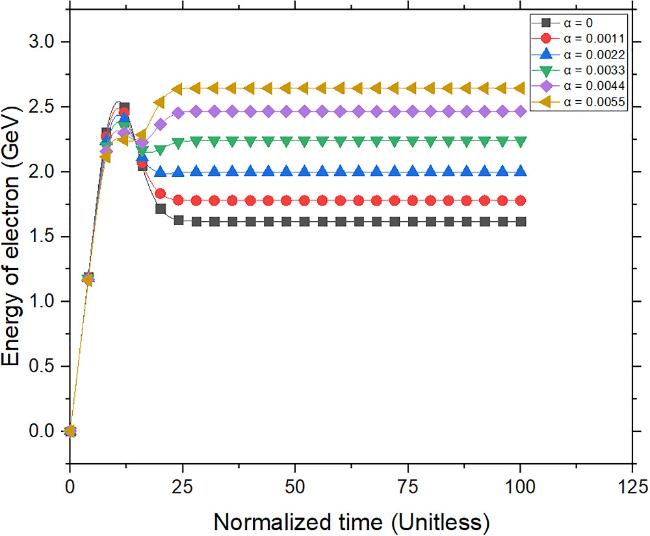
Figure 8. Variation of electron energy gain with normalized time for the different chirp parameter. λ = 1.06 μm, ${a}_{0}=40$, ${r}_{0}^{1}=0.40,\,$ b = 3. |
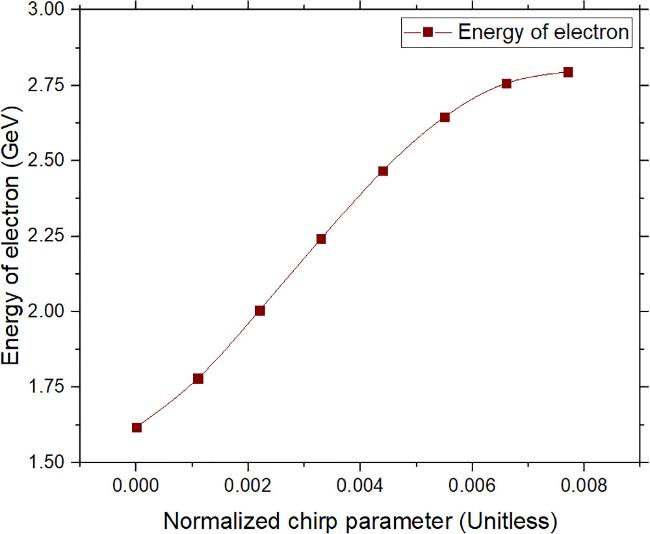


Figure 9. Variation of electron energy gain with normalized time for the different chirp parameter. λ = 1.06 μm, ${a}_{0}=40$, ${r}_{0}^{1}=0.40,\,$ b = 3, ${t}^{{\prime} }=100$. |
The results of this investigation are consistent with those of Gupta et al [28]. They investigated the influence of the chirp parameter on electron acceleration by employing a chirped laser pulse and a wiggler magnetic field. The relativistic factor has increased from 250 to 550 as a result of frequency modulation in the above-mentioned study. Our research employs a cosh-Gaussian laser beam to observe a comparable increase in electron energy gain.
4. Conclusion
This study examines the dynamics of electron acceleration in a vacuum utilising a chirped cosh-Gaussian laser beam. The findings demonstrate that electron energy acquisition is significantly influenced by the amplitude of the laser electric field, the decentered parameter, and the chirp parameter. Through precise adjustments of these parameters, a notable increase in the energy levels achieved by electrons was observed. The beam waist is a critical factor in efficient energy transfer; an optimal beam waist enables effective focusing of the laser field, maximising electron acceleration and minimising energy losses. The findings highlight the significance of parameter tuning in the design of cosh-Gaussian laser systems for vacuum electron acceleration.
Author contribution
VS: derivation, methodology, analytical modeling, graph plotting, numerical analysis and result discussion; VT: supervision, reviewing, and editing.
Data availability
The data that supports the findings of this study are available from the corresponding authors upon reasonable request.