


1. Introduction
Ultrafast electron dynamics on attosecond time scales in atoms and molecules can be observed by pump–probe experiments including attosecond pulse lasers [1–3]. Currently there are three primary means to generating the attosecond pulse light source. Firstly, isolated attosecond pulses with a width of tens of attoseconds can be achieved through high-order harmonic generation (HHG) from atoms or molecules [4]. Secondly, free-electron lasers offer the capability to produce isolated attosecond pulses with a width of hundreds of attoseconds [5]. Lastly, synthesizing coherently four carrier-envelope phase (CEP)-stabilized few-cycle femtosecond lasers is another approach to obtaining isolated attosecond pulses with widths of hundreds of attoseconds [6, 7]. HHG is the only compact device capable of generating isolated attosecond pulses with a width of tens of attoseconds on a desktop.
High-order harmonic is a coherent light source emitted when a femtosecond pulse laser interacts with atoms, molecules, and solids, with a radiation frequency that is generally an integer multiple of the incident pulse laser frequency. Due to the energy of the radiated photons being in the extreme ultraviolet or even soft x-ray range, the pulse width of the harmonics enters the sub-femtosecond or attosecond timescale. Therefore, this radiation source possesses the superior properties of both high photon energy and ultrashort pulse duration.
Research surrounding the generation of attosecond pulses using high-order harmonics, has led to be continuously broken through the limits of isolated attosecond pulse widths by driving inert gases using few-cycle Ti: sapphire pulse lasers. In 2006, Sansone et al obtained an isolated attosecond pulse with a pulse width of 130 as by using a polarization gate and a chirp compensation technique [8]. In 2008, Goulielmakis’ group obtained 80 as a short pulse using a few-cycle gating scheme [9], and in 2012, Chang’s group used a dual-optical gating scheme to obtain 67 as isolated short pulses [10]. Recently, the technological advancement of mid-infrared femtosecond pulse laser provides a new way for attosecond pulse generation [11]. As a driving light source it not only reduces the attosecond chirp of high harmonics (chirp is inversely proportional to wavelength), but also easily satisfies the phase-matching condition during the propagation process [12]. In 2014, Ishii et al successfully extended the harmonic cutoff into the soft x-ray region by using a mid-infrared femtosecond pulse laser with widths of 10 fs, a wavelength of 1.6 μm, and a phase-stabilized carrier envelope [13]. In 2015, Silva’s group generated a 227 attosecond pulse by extending the harmonic spectrum to the water window band of soft x-rays using a 13 fs/1.85 μm infrared femtosecond pulse [14]. In 2017, Chang et al achieved an isolated short pulse of 53 attoseconds (central wavelength at 7.3 nm) using a mid-infrared femtosecond pulse of 12 fs/1.7 μm, setting a new record for the shortest pulse duration in attosecond pulse generation. It is evident that the mid-infrared femtosecond pulse as a driving light source can extend the cutoff position of the harmonic spectra to the soft x-ray band, and its broadband supercontinuum spectrum is highly conducive to synthesizing isolated attosecond pulses with shorter pulse widths.
In this paper, we mainly conduct research on optimizing the generation of high-order harmonics in the frequency domain and attosecond pulses in the time domain using a tailored mid-infrared femtosecond pulse laser. In principle, to obtain a stronger and shorter isolated attosecond pulse, the mid-infrared femtosecond pulse is required to possess both ultrashort and ultra-intense characteristics, ensuring good controllability of the ionization electrons and their acceleration-collision-recombination process under intense field irradiation. It is generally believed that a single-cycle mid-infrared femtosecond laser with high intensity and stable CEP is an ideal driving light source, which poses a significant challenge to the current mid-infrared femtosecond laser technology. We propose a new method to achieve the mid-infrared femtosecond pulse with a single-cycle and high intensity by adding a Ti: sapphire pulse to the combined pulse consisting of two mid-infrared pulses, which can further generate the effective isolated attosecond pulse.
The optimization of a multi-color laser waveform for generating high harmonics and attosecond pulses has been studied for some years. By optimizing the femtosecond pulse waveform, Chipperfield et al increased the cutoff energy of harmonic spectra by a factor of 2.5 compared to a pure sinusoidal pulse while maintaining the same efficiency [15]. Balogh et al demonstrated control over attosecond-pulse generation and shaping by numerically optimizing the synthesis of few-cycle to subcycle driver waveforms [16]. Jin et al showed that harmonics can be enhanced by one to two orders of magnitude without an increase in the total laser power when the laser’s waveform is optimized by synthesizing two- or three-color fields [17]. Chou et al found that optimally shaped inhomogeneous two-color mid-infrared laser fields can greatly enhance and extend the high-order harmonic generation plateau, further obtaining an isolated 5-as pulse [18].
With the progress of laser technology, the ultrashort pulse lasers used to optimize multi-color laser waveform have changed significantly (including the laser parameters such as wavelength, pulse width, and intensity). In particular, the rapid development of mid-infrared femtosecond pulse technology, few-cycle mid-infrared femtosecond pulses with central wavelengths in the range of 1.1–4.2 μm are currently available in the laboratory (generated by fiber lasers, optical parametric amplifiers and optical parametric chirped pulse amplifiers) [19], whose pulse widths are substantially shorter and intensities are substantially higher than before. Against this backdrop, we propose to utilize the combination of femtosecond pulse lasers with different wavelengths to obtain a single-cycle mid-infrared femtosecond pulse with a higher intensity and stable carrier-envelope phase, thereby achieving higher intensity high-order harmonic generation with a central photon energy in the soft x-ray band and a broadband supercontinuum spectrum.
2. Theoretical method
In this paper, we numerically simulate the high harmonic spectra from helium atom driven by the combined laser pulse using the Lewenstein strong-field approximation theory [20–22]. The time-dependent dipole moment of an electron in an electric field [23] can be described as follows: (atomic units are used throughout this paper unless otherwise stated)
$\begin{eqnarray}\begin{array}{lll}{d}_{{\rm{nl}}}\left(t\right) & \approx & {\rm{i}}\displaystyle {\int }_{-\infty }^{t}{\rm{d}}t^{\prime} {\left(\displaystyle \frac{\pi }{\varepsilon +i\left(t-t^{\prime} \right)/2}\right)}^{3/2}\\ & & \times \,{{{d}}_{x}}^{* }\left[{{\boldsymbol{p}}}_{{\bf{s}}{\bf{t}}}\left(t^{\prime} ,t\right)-{\boldsymbol{A}}\left(t\right)\right]\\ & & \cdot \,\exp \,\left[-{\rm{i}}{S}_{{\rm{st}}}\left({{\boldsymbol{p}}}_{{\bf{s}}{\bf{t}}},t^{\prime} ,t\right)\right]\\ & & \times \,{d}\,\left[{{\boldsymbol{p}}}_{{\bf{s}}{\bf{t}}}\left(t^{\prime} ,t\right)-{\boldsymbol{A}}\left(t^{\prime} \right)\right]\cdot {\boldsymbol{E}}\left(t^{\prime} \right)g\left(t\right)+c.c.\end{array}\end{eqnarray}$
Here, $ {\mathcal E} $ is an infinitesimal positive number, and ${\boldsymbol{E}}\left(t\right){\rm{\ }}$ and ${\boldsymbol{A}}\left(t\right)$ are the electric field and vector potential of the laser pulse. The canonical momentum ${{\boldsymbol{p}}}_{{\bf{s}}{\bf{t}}}$ related to the stationary phase of the electron and the quasiclassical action ${S}_{{\rm{st}}}$ are expressed as follows: $\begin{eqnarray}{{\boldsymbol{p}}}_{{\bf{s}}{\bf{t}}}\left(t^{\prime} ,t\right)=\displaystyle \frac{1}{t-t^{\prime} }\displaystyle {\int }_{t^{\prime} }^{t}{\boldsymbol{A}}\left(t^{\prime\prime} \right){\rm{d}}t^{\prime\prime} ,\end{eqnarray}$
$\begin{eqnarray}\begin{array}{lll}{S}_{{\rm{st}}}\left({{\boldsymbol{p}}}_{{\bf{s}}{\bf{t}}},t^{\prime} ,t\right) & = & \left({t}-t^{\prime} \right){I}_{p}-\displaystyle \frac{1}{2}{{p}_{{\rm{st}}}}^{2}\left(t^{\prime} ,t\right)\left(t-t^{\prime} \right)\\ & & +\,\displaystyle \frac{1}{2}\displaystyle {\int }_{t^{\prime} }^{t}{A}^{2}\left(t^{\prime\prime} \right){\rm{d}}t^{\prime\prime} .\end{array}\end{eqnarray}$
And the hydrogen-like atomic electric dipole approximation can be expressed as1 ), the amplitude of the ground state electron $g\left(t\right)=\exp \left(-\displaystyle {\int }_{-\infty }^{t}{\omega }_{{\rm{ADK}}}\left(t^{\prime\prime} \right){\rm{d}}t^{\prime\prime} \right)$, where the ionization rate ${\omega }_{{\rm{ADK}}}\left(t^{\prime\prime} \right)$ is calculated by the Ammosov–Delone–Krainov (ADK) tunneling ionization theory as follows [21]:
$\begin{eqnarray}{\boldsymbol{d}}\left({\boldsymbol{p}}\right)={\rm{i}}\displaystyle \frac{{2}^{\displaystyle \frac{7}{2}}{\left(2{I}_{P}\right)}^{\displaystyle \frac{5}{4}}}{\pi }\displaystyle \frac{{\boldsymbol{p}}}{{\left({p}^{2}+2{I}_{P}\right)}^{3}}.\end{eqnarray}$
In equation ( $\begin{eqnarray}{\omega }_{{\rm{ADK}}}\left(t\right)={\omega }_{P}{\left|{C}_{{n}^{* }}\right|}^{2}{\left(\displaystyle \frac{4{\omega }_{P}}{{\omega }_{t}}\right)}^{2{n}^{* }-1}\exp \left(-\displaystyle \frac{4{\omega }_{P}}{3{\omega }_{t}}\right).\end{eqnarray}$
Here ${\omega }_{P}={I}_{P}$, ${n}^{* }=Z{\left(\tfrac{{I}_{{\rm{ph}}}}{{I}_{P}}\right)}^{1/2}$, ${\omega }_{t}=\tfrac{\left|E\left(t\right)\right|}{\sqrt{2{I}_{P}}}$ and ${\left|{C}_{{n}^{* }}\right|}^{2}\,=\tfrac{{2}^{2{n}^{* }}}{{n}^{* {\rm{\Gamma }}\left({n}^{* }+1\right){\rm{\Gamma }}\left({n}^{* }\right)}}$, where Z is the net charge of the helium atom, and ${I}_{{\rm{ph}}}$ is the ionization potential of the hydrogen atom.The dipole acceleration is given by the time-dependent dipole moment $a\left(t\right)=\displaystyle \frac{{{\rm{d}}}^{2}}{{\rm{d}}{t}^{2}}{d}_{{\rm{nl}}}\left(t\right)$. By performing Fourier transform on the dipole acceleration, the intensity of the harmonic spectrum for a single atom can be expressed as
$\begin{eqnarray}{P}_{A}\left(\omega \right)={\left|\displaystyle \frac{1}{{t}_{f}-{t}_{i}}\displaystyle \frac{1}{{\omega }^{2}}\displaystyle {\int }_{{t}_{i}}^{{t}_{f}}a\left(t\right){{\rm{e}}}^{-{\rm{i}}\omega t}{\rm{d}}t\right|}^{2}.\end{eqnarray}$
Finally, ultrashort attosecond pulses can be synthesized by superimposing supercontinuous harmonics on the harmonic spectrum with the equation
$\begin{eqnarray}I\left(t\right)={\left|\displaystyle \sum _{q}{a}_{q}{{\rm{e}}}^{-{\rm{i}}q\omega t}\right|}^{2},\end{eqnarray}$
where q is the harmonic order, ${a}_{q}=\displaystyle \int a\left(t\right){{\rm{e}}}^{-{\rm{i}}q\omega t}{\rm{d}}t\,$, where the lower and upper limits of integration are the starting and ending times of the laser electric field, respectively.It is worth stressing that the harmonic orders higher than the 70th are considered in this paper. The photon energy of the 70th harmonic is 48 eV, significantly larger than the ionization potential of the helium atom. The Keldysh parameter is $\gamma =\sqrt{\tfrac{{I}_{p}}{2{U}_{p}}}=0.26\lt 1$ at the center of the envelope. The Levenstein model is valid given these conditions.
3. Results and analysis
Our initial motivation is to combine two mid-infrared femtosecond laser pulses to achieve a single-cycle, high-intensity mid-infrared femtosecond pulse. Therefore, we choose a combination of two femtosecond laser pulses with wavelengths of 1800 nm and 1200 nm. Although the single-cycle pulse is achieved, the resulting high-order harmonic efficiency is low. Based on this, we add a titanium sapphire laser pulse. The selection of the pulse width and intensity of the combined pulse takes into account the experimental operability.
The red solid line in figure 1(a) shows the waveform of the combined pulse electric field, which is composed of three laser pulses: 8 fs/1200 nm/1.62 × 1014 W cm−2, 12 fs/1800 nm/2.71 × 1014 W cm−2 and 8 fs/800 nm/1.26 × 1014 W cm−2. The blue solid line in figure 1(a) is the electric field from a single 1170 nm femtosecond pulse with a peak intensity of 1.4 × 10¹⁵ W cm−2, a single-cycle pulse width, and a carrier-envelope phase of 0.25 π, which is given to fit the combined electric field. As can be seen from the figure, it is achieved by fixing the pulse width of the electric field and the values at peak points B and C of the combined field, while adjusting other parameters of the pulse. Obviously, an appropriate combination of three femtosecond pulse lasers with different wavelengths can achieve a monochromatic mid-infrared femtosecond pulse with a single cycle width and higher intensity.
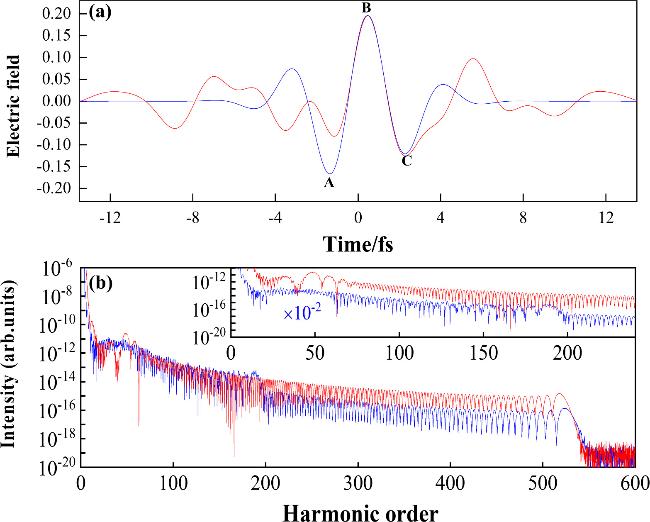
Figure 1. (a) The electric field as a function of time; (b) the HHG spectra from helium atom. The insert in Figure (b) is an enlarged version. The red solid lines are from the three-color field with additional Ti: gemstone pulse when the phase difference ${\varphi }_{1}$ and ${\varphi }_{2}$ are set as 1.60 π and 1.65 π, respectively; The blue solid lines are from a single-cycle 1170 nm pulse field with a carrier-envelope phase of 0.25 π. |
The expression forms of the combined laser field and the monochromatic field are as follows:
$\begin{eqnarray}\begin{array}{lll}E\left(t\right) & = & {E}_{1}{f}_{1}\left(t\right)\cos \left({\omega }_{1}t\right)\\ & & +\,{E}_{2}{f}_{2}\left(t\right)\cos \left({\omega }_{2}t+{\varphi }_{1}\right)\\ & & +\,{E}_{3}{f}_{3}\left(t\right)\cos \left({\omega }_{3}t+{\varphi }_{2}\right).\end{array}\end{eqnarray}$
$\begin{eqnarray}{E}_{s}\left(t\right)={E}_{0}{f}_{0}\left(t\right)\cos \left({\omega }_{0}t-\varphi \right).\end{eqnarray}$
Here ${E}_{i},{\omega }_{i}$ and ${f}_{i}\left(t\right)$ (i = 0,1,2,3) are the peak amplitude, the center frequency and the envelope function of the electric field, respectively. The envelope function is selected in the form of a Gaussian, ${f}_{i}\left(t\right)=\exp \left[-2\,\mathrm{ln}\,2{\left(t/{\tau }_{i}\right)}^{2}\right]$, where ${\tau }_{i}$ represents the full width at half maximum (FWHM) of the pulse laser. ${\varphi }_{1}$ and ${\varphi }_{2}$ are the phase differences between three pulses, respectively. φ is the carrier-envelope phase of the monochromatic field. In the case of a combined field, the carrier-envelope phases of three pulses are all 0.Figure 1(b) shows the high-order harmonic spectra under two different cases, where the red solid line represents the high-order harmonic spectrum from helium atom driven by the combined pulse laser, and the blue solid line represents the harmonic spectrum driven by a single 1170 nm mid-infrared femtosecond pulse. As can be seen from the figure, the cutoff positions of the two harmonic spectra are basically the same, and both exhibit broadband supercontinuum harmonic. The difference is that the supercontinuum harmonic bandwidth of the combined pulse extends from the 70th harmonic to the 515th harmonic at the cutoff position, with a bandwidth width of 445 harmonics, while the supercontinuum bandwidth of the monochromatic field extends from the 197th harmonic to the 520th harmonic at the cutoff position, with a bandwidth width of 323 harmonics. Supercontinuum harmonics refer to those orders of harmonics that exhibit a regular distribution within the high-order harmonic spectrum. Typically, supercontinuum harmonics originate from the interference between a long trajectory and a short trajectory. More importantly, the harmonic efficiency in the former is improved by two orders of magnitude compared to the latter. The high-intensity broadband supercontinuum harmonic spectrum in the combined pulse case will be very conducive to the generation of effectively isolated attosecond pulses.
To demonstrate the characteristics of the aforementioned high-order harmonic spectra, we have conducted a detailed semiclassical analysis of the dynamical behavior of electrons in two distinct electric fields [24]. Figures 2(a) and (b) display the variation curves of the high order harmonic with respect to the ionization time and recombination time of electrons, where the black and red dotted lines represent the ionization time and recombination time of electrons, respectively. In the figure, we only label the three main ionization-recombination peaks, A, B, and C. For the sake of clarity, figures 2(c) and (d) illustrate the waveforms of the two electric fields and the time-dependent ionization probability of helium atoms calculated using the ADK model [25]. As can be seen from figure 2(a), in the case of a monochromatic field, when electrons ionize near peak A, the highest-order harmonic radiated upon recombination with the parent ion is the 520th harmonic, which is in agreement with the cutoff position of the harmonic spectrum. When electrons are ionized near peak B, the highest-order harmonic radiated upon recombination with the parent ion is approximately the 200th order. Electrons ionized near peak C contribute only to low-order harmonics and can be ignored. The interference of harmonics generated in two different time periods leads to the broadening of the supercontinuum spectrum from the 197th to the 520th order, which is consistent with the harmonic spectrum characteristics represented by the blue solid line in figure 1(b). In the combined pulse electric field case shown in figure 2(b), when electrons are ionized near point A, the highest-order harmonic radiated upon recombination with the parent ion approaches the 870th order. However, as can be seen from the ionization curve in figure 2(d), the ionization probability at this point is almost zero, hence it does not contribute to the high-order harmonics. When electrons ionize near peak B, the highest-order harmonic radiated upon recombination with the parent ion is the 515th order, which coincides with the cutoff position of the high-order harmonic spectrum. When electrons ionize near peak C, the highest-order harmonic radiated is the 275th order. However, as can be seen from the ionization curve, the ionization probability near peak C is also almost zero, thus contributing negligibly to the high-order harmonic spectrum. From these, it can be inferred that the harmonic generation is mainly attributed to electrons ionized near peak B. Therefore, in the combined pulse case, a supercontinuous harmonic radiation spectrum with a regular distribution throughout the entire plateau region can be obtained.
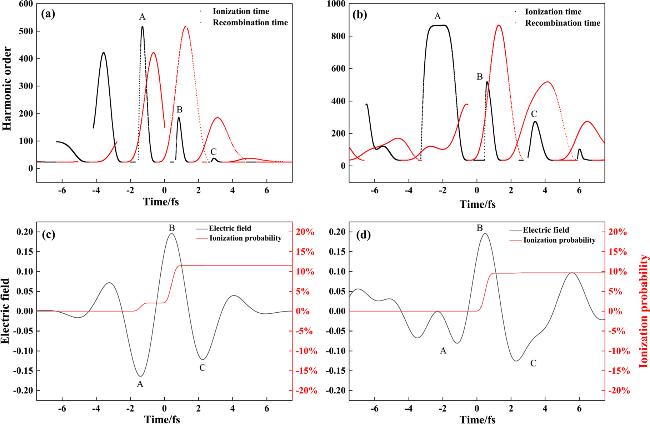
Figure 2. The curve of the variation of harmonic order with ionization (black dotted line) and recombination time (red dotted line) (a) 1170 nm electric field; (b) combined pulse electric field; (c) 1170 nm electric field (black) and ionization probability (red) curves with time; (d) Combined pulse electric field (black) and ionization probability (red) curves with time. |
The above analysis can also explain the difference in the intensity of the harmonic spectra. In the case of a monochromatic field, the supercontinuum harmonics mainly originate from electrons that are ionized near peak A and then recombined with the parent ion near peak B. Since the electric field intensity at peak A is approximately 0.15, the ionization probability at this point is 2.2%, as shown in figure 2(a). In the case of a combined pulse, the generation of high-order harmonics mainly originates from the recombination of electrons ionized near peak B with the parent ion. The electric field intensity at peak B is approximately 0.2, resulting in an ionization probability of 9.7% at this point, as shown in figure 2(b). This explains why the harmonic radiation efficiency of the combined pulse is higher than that of the monochromatic field. Finally, we explain the reason why the cutoff positions of the two harmonic spectra are close. In the case of a monochromatic field, the cutoff frequency of the harmonic spectrum is determined by the electric field intensity of peak B, while for a combined pulse, the cutoff frequency is determined by the field intensity of peak C. Although the field strength at peak C, which is 0.14, is lower than the field strength at peak B, which is 0.2, the frequency of the half-optical-cycle field near peak C in the combined pulse case is significantly reduced compared to that of the monochromatic field. According to the semiclassical three-step model formula ${E}_{{\rm{cutoff}}}={I}_{P}+3.17{U}_{p}$ (Here ${I}_{P}$ and ${U}_{p}$ = ${E}^{2}/4{\omega }^{2}$ are the ionization energy and the ponderomotive energy of the atom, respectively), a decrease in frequency leads to an increase in ponderomotive energy. Therefore, the cutoff position of the harmonic spectrum obtained in the combined pulse case extends close to that of the monochromatic field case.
To verify the rationality of the above analysis, the wavelet transform method is used to perform the time-frequency analysis of HHG in two different electric field cases, as illustrated in figures 3(a) and (b). It can be seen that, in figure 3(a), in the monochromatic field case, the highest-order harmonic reaches the 520th order, and only the peak R1 contributes to the harmonics between the 197th and 520th orders. R1 has two branches, where the left branch corresponds to the short trajectory (the electron trajectory that ionize later and recombine earlier in the electric field), and the right branch corresponds to the long trajectory (the electron trajectory that ionize earlier and recombine later in the electric field). The harmonics below the 197th order showing irregular structure come from the interference of two or more recombination trajectories. In figure 3(b), the highest harmonic in the combined field is the 515th order. It is worth pointing out that there is only one R1′ peak that contributes to the harmonics generation, regardless of the lower order or the higher order harmonics, so we obtain the harmonic spectrum with supercontinuum structure throughout the whole plateau region. In addition, the color of the R1′ peak indicates that the harmonic intensity in the combined pulse case is significantly higher than that of the monochromatic field. This is almost consistent with the characterization of the high-order harmonic spectra in figure 1(b) and the analysis of the HHG mechanism.
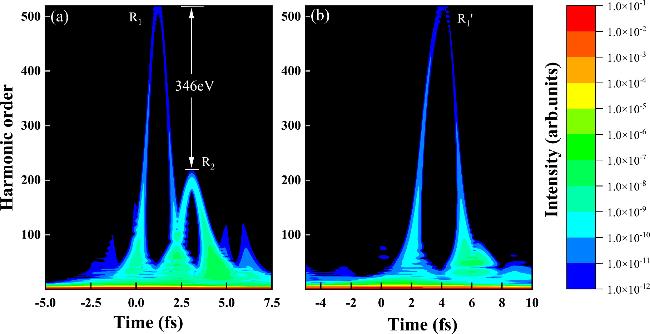
Figure 3. Time-frequency analysis of the high-order harmonic emission, (a) 1170 nm pulse field; (b) three-color field. |
To further illustrate the advantages of the combined pulse laser over the 1170 nm single cycle pulse in obtaining high-order harmonics and attosecond pulse generation, we also numerically simulate the HHG spectra from the single-cycle 1170 nm pulse laser under different carrier envelope phases. In general, all the harmonic spectra exhibit a double-plateau structure, and they display a certain regularity as the phase changes. Specifically, if the efficiency of the second plateau is higher, the cutoff position is closer; conversely, if the efficiency of the second plateau is lower, the cutoff position is further away. For comparison, the blue solid line in figure 4 depicts the high-order harmonic spectrum when the CEP is 0.7π, while the red solid line represents the high-order harmonic spectrum in the case of combined pulses. As can be seen from the figure, the harmonic spectrum of the monochromatic field with a phase of 0.7π shows a significant increase in harmonic efficiency in the plateau region, approaching that of combined pulses. However, its cutoff position is only at the 375th order, far below the 515th order of the combined pulses. Obviously, the harmonic spectrum at the CEP of 0.25π achieves a balance between the efficiency and cutoff position of the second plateau.
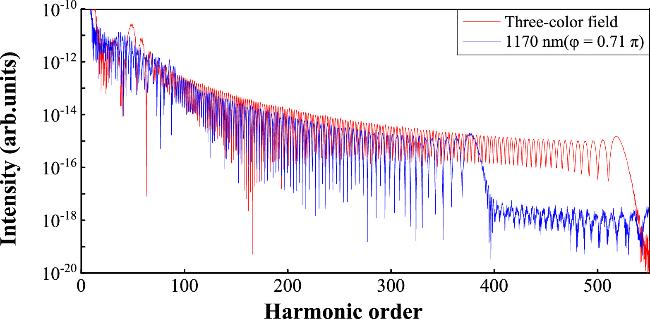
Figure 4. High-order harmonic emission spectra. Three-color field (red); a single-cycle 1170 nm pulse field with a carrier-envelope phase of 0.71 π (blue). |
Figure 5 shows attosecond pulse generation by superimposing the supercontinuous harmonics on the plateau in monochromatic and combined field schemes, respectively. The solid black line represents the superposition of harmonics ranging from the 197th to the 520th order in the monochromatic field with a CEP of 0.25π. This results in the generation of a 132-attosecond isolated pulse with an intensity on the order of 10−10. The solid blue line shows the generation of a 233 as isolated pulse by superposing 95 to 375 supercontinuous harmonics in the monochromatic field with a CEP of 0.71π. The intensity of this pulse is of the order of 10−7. In the combined pulse given in the red solid line, by superimposing the supercontinuous harmonics from the 70th to 515th order, a 66 attosecond short pulse with ideal waveform is achieved. Its intensity reaches the order of 10−5, which is approximately 5 orders of magnitude higher than the attosecond pulse intensity generated by the monochromatic field with a CEP of 0.25π and approximately 2 orders of magnitude higher than that generated by the monochromatic field with a CEP of 0.7π. This is consistent with the analysis results of the atomic ionization probability mentioned above. It is clear that the attosecond pulse intensity and pulse width obtained from the combined field scheme during the single-atom response process are significantly superior to those of the single-cycle single mid-infrared femtosecond pulse scheme.
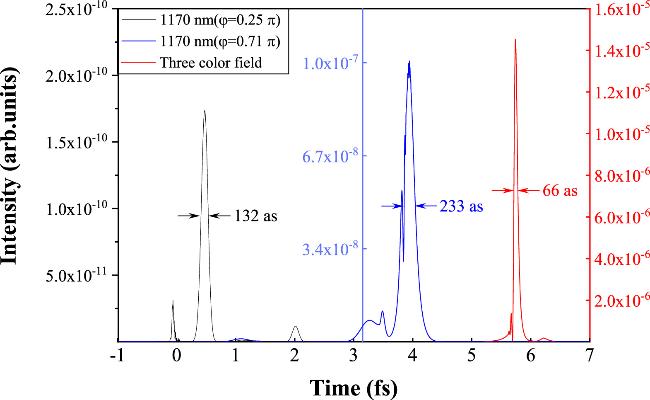
Figure 5. Time-domain diagram of attosecond pulse generation. Single-cycle 1170 nm (φ = 0.25 π) pulse field (black); single-cycle 1170 nm (φ = 0.71 π) pulse field (blue); three-color field (red). |
In the combined pulse, the phase difference ${\varphi }_{1}$ between the 1800 nm and the 1200 nm pulse and the phase difference ${\varphi }_{2}$ between the 1800 nm and the 800 nm pulse are set as 1.60π and 1.65π, respectively. Numerical simulation results reveal that the choice of these phase differences is not critical. When ${\varphi }_{1}$ is between 1.50π and 1.80π, and ${\varphi }_{2}$ is between 1.40π and 1.70π, the harmonic spectra with extended cutoff position, broadband supercontinuum structure and improved harmonic intensity can be obtained, as shown in figures 6(a) and (b). Figure 6(a) shows the harmonic spectra obtained by fixing ${\varphi }_{1}$ at 1.50π and varying ${\varphi }_{2}$ between 1.40π and 1.70π. As can be seen from the figure, all harmonic spectra exhibit a broadband supercontinuum structure with similar harmonic intensity, and their cutoff positions all fall within the range of 500 to 550 orders. Figure 6(b) presents the harmonic spectra with ${\varphi }_{1}$ at 1.80π and varying ${\varphi }_{2}$ between 1.40π and 1.70π. It can be seen although the cutoff position of the harmonic spectrum slightly decreases as ${\varphi }_{2}$ increases from 1.40π to 1.70π, all harmonic spectrum still exhibits a broadband supercontinuum structure with similar intensities. The reason for the decrease in the cutoff position is that as the relative phase value increases, the value of the synthesized field at peak C gradually decreases.
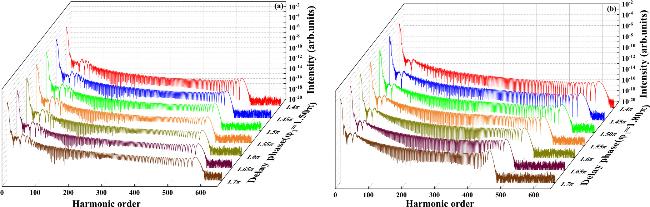


Figure 6. High-order harmonic emission spectra (a) ${\varphi }_{1}$ is taken as 1.50 π, ${\varphi }_{2}$ = 1.40 π−1.70 π; (b) ${\varphi }_{1}$ is taken as 1.80 π, ${\varphi }_{2}$ = 1.40 π−1.70 π. |
4. Conclusion
In this paper, by adding a Ti sapphire pulse to the combined pulse laser consisting of two mid-infrared pulses, a mid-infrared femtosecond pulse laser with the single cycle and high intensity is realized. Using this tailored mid-infrared femtosecond pulse, we obtain a supercontinuum high-order harmonic spectrum with high conversion efficiency, and its cutoff position has entered the ‘water window’ band of soft x-rays (2.3 nm–4.4 nm). After performing a Fourier transform on the supercontinuum harmonics, a 66 attosecond isolated pulse is obtained, whose intensity is 5 orders of magnitude higher than that of the attosecond pulse generated under a monochromatic field. In this paper, our goal is to achieve the mid-infrared femtosecond pulse with a single-cycle and high-intensity through the combination of pulses. However, in fact, the high-order harmonics and attosecond pulses obtained by using this tailored mid-infrared femtosecond pulse are far superior to the results of a single-cycle high-intensity monochromatic field. Isolated attosecond pulses with high photon energy and intensity in the water window band are of great significance in single-shot imaging in the soft x-ray region, life science, and attosecond pump-attosecond probe experiments to study the ultrafast dynamics of electrons in atoms and molecules.