


1. Introduction
Knots frequently occur in biopolymers, such as DNA molecules and proteins, and directly affect the gene regulation [1–4]. For instance, knots can be in vivo introduced into cellular DNA through biological processes, such as DNA replication, and regulated by various enzymes, such as type II topoisomerases, which could both knot and unknot DNA [3, 4]. In addition, the production of DNA knots in vitro has turned out to be a highly efficient manner to package mutant DNA into virus capsids [5]. Due to its biological functions and biophysical significance, knotted DNA serves as a minimal system to study the diffusion mechanism of molecular knots and examine the knot theory of polymer physics [6, 7].
The implementation of nanochannel techniques emerges as a powerful tool to detect the diffusion of an isolated knot, as well as the interaction between the knots in the polymer [8–15]. To this end, various computational studies on the diffusion of the knot with different complexities under tension conditions have been conducted in the literature [3, 16, 17]. From the reported experimental results, it has been found that a DNA molecule accommodating a knot can be confined in a nanochannel and stretched by divergent electric fields [18–21]. The knot in the extended DNA appeared as a region with excess fluorescent brightness. It was also demonstrated that the knot could be tuned by the increasing stretching force. As a result, a transition from a mobile state to a jammed state can take place, while the knot jamming is a reversible process [21, 22]. This diffusion behavior was further explored by a few simulation works. It was clearly identified that knot-region breathing, self-reptation, and internal friction are dominant over diffusion under different conditions with diverse confinement sizes and stretching forces [3, 5, 6, 23–25]. In contrast to the behavior of an isolated knot in an elongational field, the attractive interaction between the knots on an extended polymer was first predicted by a series of simulations [4, 7, 17, 26–28] and then proven by recent experiments [9, 13, 18]. Namely, pairs of knots in an extended polymer have the tendency to move toward each other from distant sections of the molecule. After meeting, pairs of knots fluctuate in and out of visual contact, and can remain in proximity for minutes at a time.
Current studies based on Langevin dynamics simulations focused on the swapping process of composite knots under tension in a cuboid nanochannel. The free energy profiles of knot swapping under different conditions were extracted from the overall probability distribution of the relative distance between the centers of composite knots. The impact of the stretching force, confinement size, and bending stiffness of a knot on the free energy profiles could be directly identified, while the influence of topology structure was first reported. These simulation studies can be further extended to understand the experiments related to DNA molecules by tuning the bending stiffness of the polymer.
2. Materials and methods
2.1. Coarse-grained model and Langevin dynamics simulations
As shown by figure 1(A), two macrospheres and a semi-flexible polymer accommodating composite knots were confined in a cuboid nanochannel. To prevent the unraveling of the knots, these two macrospheres were tethered to the semi-flexible polymer at both ends, and their diameter was larger than the knot size. This semi-flexible polymer carrying L monomers of diameter σ and mass m was modeled by a coarse-grained bead-spring model. In current simulations, the σ and m were set as the unit of length and mass, respectively, and the contour length of the polymer was 200σ. The interaction between two adjacent monomers in the semi-flexible polymer was described by the finite-extensible nonlinear elastic potential as follows:
$\begin{eqnarray}\begin{array}{rcl}{U}_{{\rm{FENE}}} & = & -\displaystyle \sum _{i=2}^{L}\frac{1}{2}{k}_{{\rm{FENE}}}{R}_{0}^{2}\mathrm{ln}\left\{1-{\left(\frac{{r}_{i,i-1}}{{R}_{0}}\right)}^{2}\right\},\\ ({r}_{i,i-1} & \leqslant & {R}_{0}).\end{array}\end{eqnarray}$
It illustrates a non-harmonic potential with a bond potential of ${k}_{{\rm{FENE}}}=\frac{30{k}_{{\rm{B}}}T}{{\sigma }^{2}}$ and a maximum degree of stretching of R0 = 1.5σ. These parameters were taken from the standard polymer model of Kremer and Grest [29], and the ${r}_{i,i-1}=| {\overrightarrow{r}}_{i}-{\overrightarrow{r}}_{i-1}| $ is the distance between any pairs of monomers. At the same time, the bending potential between two adjacent monomers can be introduced as follows, $\begin{eqnarray}{U}_{\mathrm{bend}}=\displaystyle \sum _{i=2}^{L-1}k(1-\cos {\theta }_{i}),\end{eqnarray}$
where ${\theta }_{i}=\arccos \left(\frac{{\overrightarrow{b}}_{i-1}\cdot {\overrightarrow{b}}_{i}}{| {\overrightarrow{b}}_{i-1}| | {\overrightarrow{b}}_{i}| }\right)$ denotes the angle between two adjacent bond vectors ${\overrightarrow{b}}_{i-1}={\overrightarrow{r}}_{i}-{\overrightarrow{r}}_{i-1}$ and ${\overrightarrow{b}}_{i}={\overrightarrow{r}}_{i+1}-{\overrightarrow{r}}_{i}$, and k refers to the bending stiffness. The equation lp = κσ that correlates the persistence length lp with the bond stiffness was applied to map the coarse-grained bead-spring model to dsDNA, and the hydrated dsDNA parameters were adopted as σ = 1.0 nm and κ = 50 kBT.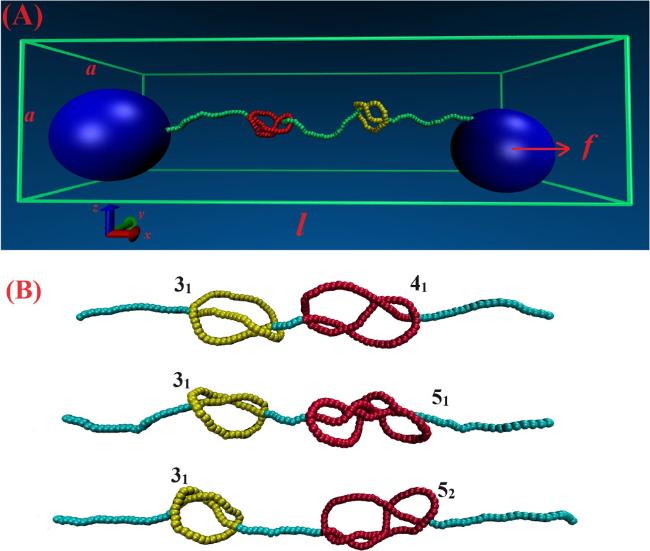
Figure 1. (A) Schematic illustration of the simulation setup: both ends of a polymer chain with 200 beads accommodating composite knots, made up of a 41 knot (highlighted in blue) and a 31 knot (highlighted in dark yellow) are anchored to a macrosphere fixed in the origin (left) and to a mobile macrosphere pulled with a stretching force along the x axis. This simulation setup is confined in a cuboid nanochannel with length l, width a, and height a scaled by σ, and the length l is parallel to the x axis. (B) Typical conformations accommodating different composite knots. From up to down, the composite knots are composed of 31♯41, 31♯51, and 41♯51, respectively. |
The spatial interactions between any two monomers i and j were given by a short range truncated and shifted Lennard–Jones (LJ) potential ULJ of strength ε with a cutoff distance ${r}_{c}={2}^{\frac{1}{6}}\sigma $ [30],
$\begin{eqnarray}{U}_{\mathrm{LJ}}=\displaystyle \sum _{i,j\gt i}^{L}4\epsilon \left\{{\left(\displaystyle \frac{\sigma }{{r}_{i,j}}\right)}^{12}-{\left(\displaystyle \frac{\sigma }{{r}_{i,j}}\right)}^{6}+\displaystyle \frac{1}{4}\right\}\vartheta ({2}^{\tfrac{1}{6}}\sigma -{r}_{i,j}),\end{eqnarray}$
where ϵ = 1 kBT is the unit of energy, and kB and T denote the Boltzmann constant and the temperature, respectively.To identify the impact of confinement on the diffusion of the knot along the semi-flexible polymer under tension, the interactions between monomers and the nanochannel were described as follows: 3 ) and (4 ) can be defined as,
$\begin{eqnarray}{U}_{\mathrm{wall}}=\displaystyle \sum _{i=1}^{L}4\epsilon \left\{{\left(\displaystyle \frac{\sigma }{{d}_{i}}\right)}^{12}-{\left(\displaystyle \frac{\sigma }{{d}_{i}}\right)}^{6}\right\}\vartheta ({2}^{\tfrac{1}{6}}\sigma -{d}_{i}),\end{eqnarray}$
where di is the orthogonal distance between the ith monomer and the nanochannel. The Heaviside function ϑ(x) used in equations ( $\begin{eqnarray}\vartheta (x)=\left\{\begin{array}{lc}0 & (x\lt 0),\\ 1 & (x\geqslant 0).\end{array}\right.\end{eqnarray}$
During the dynamics, the macrosphere center and the chain ends were constrained to move along the x-axis [31]. A scaled force f($f=\frac{{f}_{0}\sigma }{\varepsilon }=\frac{{f}_{0}\sigma }{{k}_{{\rm{B}}}T}$, in which ${f}_{0}=\frac{\varepsilon }{\sigma }$) was also applied to the semi-flexible chain via two macrospheres, and the corresponding stretching potential was defined as ${U}_{{\rm{stretch}}}=-\overrightarrow{f}\cdot {\sum }_{i=1}^{L}{\overrightarrow{b}}_{i}=-fX$. The x-axis coincides with the direction of the force f, and X is the projection of ${\sum }_{i=1}^{L}{\overrightarrow{b}}_{i}$ on the x-axis. The adimensional force f is typically varied in the range from 0.1 to 20 to characterize the mechanical tensile response of the composite knots under small and large tensions. The model can explore a wide variety of polymer molecules with different values of lp ranging from 1σ to 20σ, which correspond to polysaccharides and double-stranded DNA, and all of the simulations were performed at a constant temperature ($T=1\tfrac{\varepsilon }{{k}_{{\rm{B}}}}$). Since the rotation of macrospheres were not constrained, the torsional stresses were not considered in current simulations. The dynamics of the chain is generated by solving the Langevin equation as follows: $\begin{eqnarray}m{\ddot{\overrightarrow{r}}}_{i}(t)=-{\xi }_{0}{\dot{\overrightarrow{r}}}_{i}(t)-\frac{\partial {U}_{i}}{\partial {\overrightarrow{r}}_{i}}+\overrightarrow{R}(t),\end{eqnarray}$
where Ui is the total potential of the ith monomer, including all the potentials mentioned above, and ξ0 is the friction coefficient for each monomer and its value was set as ${\xi }_{0}=2\frac{m}{{\tau }_{{\rm{LJ}}}}=2{\left(\frac{{\sigma }^{2}}{m\varepsilon }\right)}^{-\frac{1}{2}}$, where ${\tau }_{\mathrm{LJ}}=\sigma \sqrt{\tfrac{m}{{k}_{{\rm{B}}}T}}$ is the Lennard–Jones time. The Stokes friction equation for a spherical monomer is given by the following expression: ξ0 = 3πηsolσ, in which ηsol is the viscosity of the solution. For a specified water viscosity ηsol = 1 cP, T = 300 K, and σ = 1.0 nm), the characteristic Lennard–Jones time τLJ are related to $\frac{6\pi {\eta }_{{\rm{sol}}}{\sigma }^{3}}{\varepsilon }\approx 1.14\,{\rm{ns}}$. In addition, $\overrightarrow{R}(t)$ is a stochastic force term that satisfies the fluctuation-dissipation theorem. Finally, the dynamical evolution of the system is numerically integrated with the LAMMPS package with an integration time step of 0.005τij ∼ 5.7 ps. The total simulation time was about 107τLJ.2.2. Single knot/composite knots identification
From a mathematically rigorous point of view, knots are defined only for closed chains and classified according to the minimum number of intersections in their plane projection. Such presentation of knots were referred as standard form, in which knot was designated by Ck, C refers to the minimal number of intersections in their plane projection, and k denotes a cardinal index that is used to distinguish between topologically different knots with the same C [32]. As shown by figure 2(A), which illustrates the knots of 31, 41, 51 and 51 in standard form, and the intersections in their plane projection are indexed. For this reason, detecting and identifying knots in open polymer chains is inherently ambiguous, and so is identifying the shortest polymer chain portion which embodies the knot in a linear polymer chain. As for a single knot embedded in an open polymer chain, the open polymer chain could be turned into a closed ring by joining its ends with an arc, and then the physical knot state of an open polymer chain can be established by an implementation of the Alexander polynomial, and its location and size is determined by a top-down searching scheme or a bottom-up searching scheme. As the physical state of the composite knots can not be effectively identified by the Alexander polynomial, we have to fall back on the HOMFLY polynomial [33], an expansion of the Jones and Alexander polynomials, which can resolve the physical state of the subchains of the composite knots after the implementation of the top-down searching scheme, and then their specific size and spatial location were analyzed by the KymoKnot software package [34].
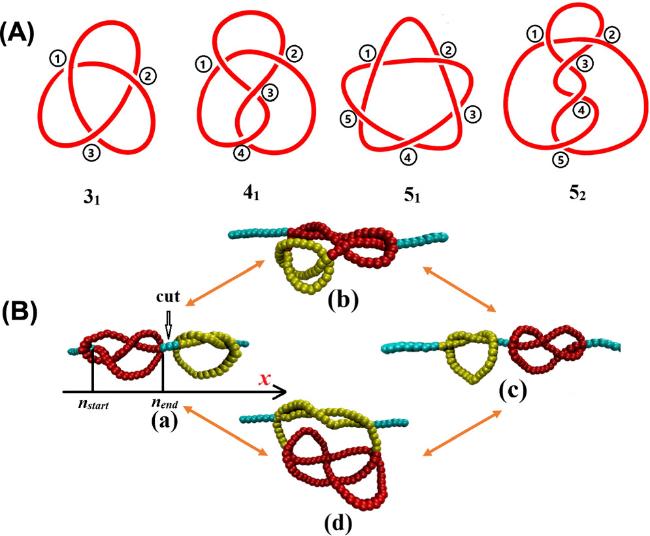
Figure 2. (A) The knots of 31, 41, 51 and 51 in standard form and the intersections in their plane projection. (B) The schematic diagram on the swapping mechanism of composite knots composed of 31 and 41. One of the two knots was embedded in the other knot ((b) and (d)) and diffused along its contour until the two knots have switched positions (c) or returned to their original positions (a) along the strand. |
As shown by figure 2(B), which demonstrates the composite knots composed of 31 and 41 knots and their interpenetration process. Initially, the monomers of the polymer chain was successively deleted from left until the independent existence of the 31 or 41 knot was ascertained by the HOMFLY polynomial, and then the KymoKnot software package was used to pinpoint the specific size and spatial location of the 31 or 41 knot within this subchain shown in figure 2(B)(a) and (c). According to the diffusion coordinate shown by figure 2(B)(a), the center of a knot and the shortest knot size can be qualified as xknot = (nstart + nend)/2 and Nknot = nend − nstart, respectively, when the monomers at the boundaries of the knotted portion are indexed as nstart and nend.
If the 31 or 41 knot is not detected throughout the searching process, it indicates that the 31 and 41 knots are in an entangled state as shown in figure 2(B)(b) or (d). The KymoKnot software package is directly applied to quantitatively analyze the size and spatial location of this composite structure, thus achieving comprehensive identification and location of all possible knot states on the polymer chain.
3. Results and discussions
3.1. Swapping process of a 31 knot and a 41 knot
As shown in figure 3(A), a 31 knot center and a 41 knot center were observed to change over the time. Most of the time, the 41 knot center was located at the diffusion coordinate of 100, with occasional transitions to 140 or 60. As a sharp comparison, the center of the 31 knot frequently transited around the diffusion coordinate of 100. The frequent transition of the 31 knot center relative to the 41 knot center and the distributions of the 31 knot center and the 41 knot center, shown in the right panel of figure 3(A), highlighted that the 31 knot frequently passed through the 41 knot during the swapping process. This could be portrayed by the following physical picture, where the small size of a 31 knot allows it to diffuse along the chain of a relatively large 41 knot and realize the frequent position exchange of the 31 knot center.
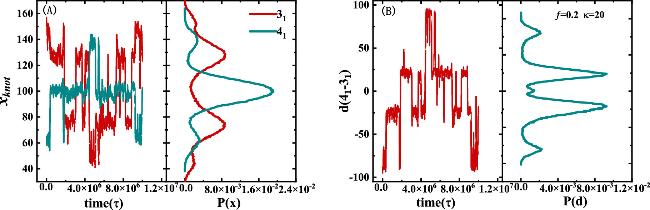
Figure 3. The swapping process of a 31 knot and a 41 knot. (A) The left panel represented the centers of the 31 knot and the 41 knot’s change over time. The dark cyan and red curves in the right panel separately indicated the distribution of the 31 knot center and the 41 knot center. (B) The relative distance between the centers of 31 knot and the 41 knot changing over time and its overall probability distribution P(d) is presented in the right panel. The stretching force and the bending stiffness of knots are 0.2 and 20, respectively. |
According to the changes in the 31 knot center and the 41 knot center over time, the relative distance between the centers of 31 knot and the 41 knot can be derived. Its changing over time was demonstrated in the left panel of figure 3(B). Its overall probability distribution P(d) can be generalized as the dark cyan curve in the right panel of figure 3(B).
3.2. Effects of the stretching force, confinement, and bending rigidity on knot swapping
The free energy profiles of knot swapping under different conditions could be extracted from their overall probability distribution P(d), as shown in figures 4(A) and (C) ∼ (D), all the free energy profiles F(d) scaled by kBT are roughly symmetric around the coincidence of two knot centers. The number of free energy barriers in each free energy profile is different and strongly dependent on the stretching force, confinement and bending rigidity, respectively. The free energy barriers essentially accounts for the obstruction caused by entanglements and need to be overcome in a knot swapping.
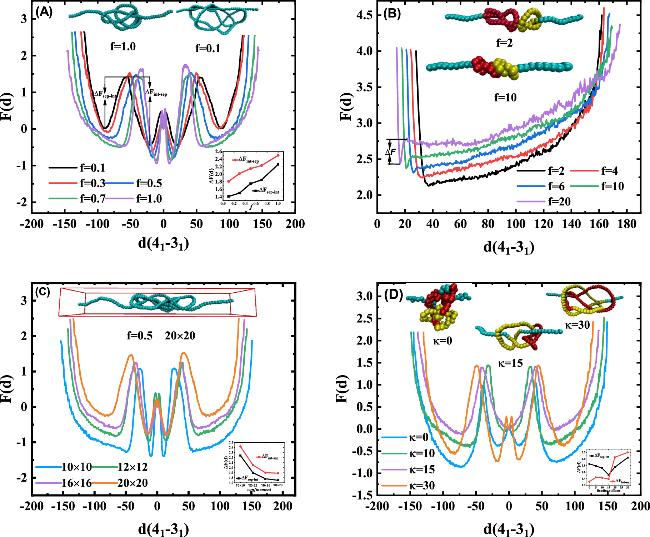
Figure 4. Free energy profiles derived from the relative position distribution in the swapping process of 31 and 41 knots. (A) Effects of the stretching forces ranging from 0.1 to 1 on the free energy profiles of the 31 knot passing through 41 knot in the confinement of 20 × 20 × 250. The entangled state’s typical conformations are located at free energy profiles with stretching forces of 0.1 and 1. The bending stiffness of knots is 20. (B) The free energy profiles with the stretching forces larger than 1 and the typical conformations at the stretching forces of 2 and 10. The 31 and 41 knots can not pass through each other and the free energy barrier ΔF increased with the stretching forces. (C) Effects of confinement ranging from 10 × 10 × 250 to 20 × 20 × 250 on the free energy profiles with bending stiffness of 20 at a stretching force of 0.5. (D) Effects of bending stiffness ranging from 0 to 30 on the free energy profiles of the 31 knot passing through 41 knot. The composite knots manipulated by a stretching force of 0.5 are confined in a cuboid nanochannel of 20 × 20 × 250. |
As shown in figure 4(A), with the stretching force ranging from 0.1 to 1, the separate knots with bending stiffness of 20 could pass through each other over and over again via the entangled intermediate state within a cuboid nanochannel of size 250 × 20 × 20. Considering the free energy profile at a stretching force of 0.1 as an example, a 31 knot in separate state could overcome the first free energy barrier of ΔFsep-int to enter the separate 41 knot while forming an entangled state. It could go back to the original separate state by overcoming the free energy barrier ΔFint-sep or overcome the second free energy barrier to reach the intertwined state between the second and the third free energy barrier, where the centers of two knots coincide with each other. As the same time, the inset in figure 4(A) demonstrats that the free energy barriers of ΔFsep-int and ΔFint-sep increased with the stretching force, and ΔFint-sep at different stretching forces was obviously larger than ΔFsep-int. It indicates that the entangled intermediate state was the most likely state. The forward and backward rate constants between the separate state and the entangled intermediate state are ${{\rm{e}}}^{-{\rm{\Delta }}{F}_{\mathrm{sep}-\mathrm{int}}}$ and ${{\rm{e}}}^{-{\rm{\Delta }}{F}_{\mathrm{int}-\mathrm{sep}}}$, respectively. If the two rates are ought to be equal, then the equilibrium populations could be determined as ${{\rm{e}}}^{-({\rm{\Delta }}{F}_{\mathrm{sep}-\mathrm{int}}-{\rm{\Delta }}{F}_{\mathrm{int}-\mathrm{sep}})}$. The constant difference of ΔFint-sep − ΔFsep-int at different stretching forces could be justified from the inset in figure 4(A). It means that the equilibrium populations at two states were not dependent on the stretching forces in a fixed confinement. If the stretching forces increase to larger than 1, two separate knots could not pass through each other and fall in a compact state, as indicated by the typical conformations shown in figure 4(B). Their corresponding free energy barriers ΔF increased with the increasing stretching forces.
As a comparison with the effects of the stretching forces on the knot swapping, the effects of the confinement on the free energy profile at a constant stretching force of f = 0.5 are demonstrated in figure 4(C), where its inset indicates that the free energy barriers are obviously stretching with the increase in confinement size from 10 × 10 × 250 to 20 × 20 × 250. At the same time, the difference of ΔFint-sep − ΔFsep-int corresponding to different confinement size remains constant, which further highlighted that the equilibrium populations at two states are not dependent on the confinement size.
Effects of bending stiffness on the free energy profile are completely different from those of stretching forces and confinement. While the composites knots were confined in the confinement of 20 × 20 × 250 and manipulated by a stretching force of 0.5, their corresponding free energy profiles were demonstrated in figure 4(D). Its the inset indicated that the free energy barriers of ΔFsep-int and ΔFint-sep non-monotonically depend on the increasing bending stiffness from 0 to 30. When effects of stretching forces were further considered, their combined effects on the free energy barriers of ΔFsep-int and ΔFint-sep were generalized in a phase diagram shown in figures 5(A) and (B). Their comparison indicated that the sign of the difference of the free energy barriers ΔFsep-int − ΔFint-sep transited from negative to positive while the bending stiffness increased from less than 15 to larger than 15. It indicates that the increase in bending stiffness resulted in the transition of the mostly likely state from the separate state with bending stiffness less than 15 to the entangled state with bending stiffness larger than 15. All of which highlighted that the bending stiffness larger than 15 assisted the entrance of a 31 knot into a 41 knot and enhanced the formation of the entangled state.
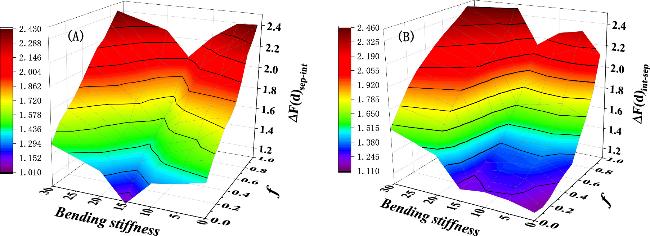
Figure 5. The free energy barriers of ΔFsep-int and ΔFint-sep as a function of bending stiffness and stretching force during the swapping process of a 31 and a 41 knot. |
3.3. Effects of topology structure of knot on the swapping process
Knots are classified according to the minimum number of intersections in their plane projection. Such presentation of knots were referred as standard form. The comparison of the free energy profiles demonstrated in figures 6(A) and (B) makes it evident that the topological structure of the knots 51 and 52 with five intersections in the standard form differs, which affects on how the 31 knot pass through the 51 or 52 under different forces ranging from 0.1 to 1. As indicated by their insets, the differences in topological structure of the 51 knot and the 52 knot do not alter the monotonic dependence of the free energy barriers of ΔFsep-int and ΔFint-sep on the increasing stretching forces and the dominance of the free energy barrier ΔFint-sep over ΔFsep-int. Figure 6(A) demonstrates the free energy profiles of a 31 knot passing through a 51 knot with the increase in stretching force from 0.1 to 1, where the topological structure of 51 knot results in the appearance of a metastable state and its following free energy barrier in the free energy profiles. As pointed by the cyan arrows in free energy profile at the stretching force of 1, the metastable state could reach the entangled state by overcoming its following free energy barrier. However, the metastable state and its following free energy barrier were not observed in the free energy profiles of a 31 knot passing through a 52 knot with the increase in stretching forces from 0.1 to 1.
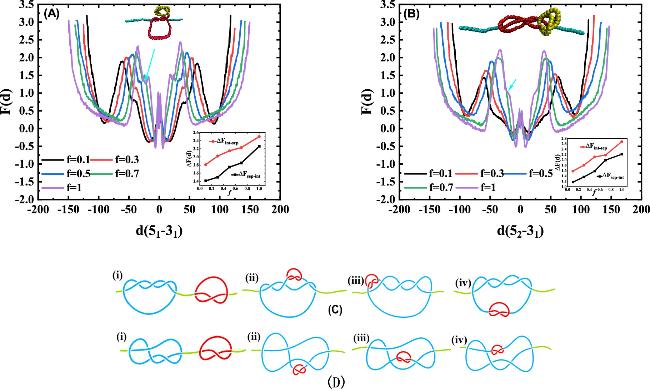


Figure 6. The free energy profiles of a 31 knot passing through a 51 knot (A) and a 52 knot (B), respectively. The composite knots with bending stiffness of 20 were confined in a cuboid nanochannel with 20 × 20 × 250, and the stretching forces ranged from 0.1 to 1. (C) ∼ (D) are the schematic diagrams of 31 knot passing through a 51 knot and a 52 knot, respectively. The schematic diagram (i) were the composite knots composed of a 31 and a 51 knot or 52 knot, and the schematic diagram (ii) ∼ (iv) separately indicated the metastable state, entangled state and the state with the coincidence of two knot centers. |
Whether the metastable state and its following free energy barrier appear was determined by the topological structure of 51 knot, it can be further understood based on the schematic diagrams in figure 6(C), in which the sketch maps (i) ∼ (iii) indicated that the separate 31 knot entered the separate 51 knot at one end of rope-like section by overcoming the free energy barrier ΔFsep-int and then reach the metastable state shown as the schematic diagrams (ii) and the direct conformation in figure 6(A). The metastable state could further transit into the entangled state with the 31 knot located at the other end of the rod-like section by overcoming its following free energy barrier, which account for the obstruction that the 31 knot encountered when it crawl along the rope-like section. Thus the free energy barrier that followed the metastable state was gradually enhanced by increasing stretching force from 0.1 to 1. It could be justified that the obstruction was intensified with increasing stretching force. During the process of the 31 knot passing through the 52 knot, the 31 knot did not encounter the obstruction from the compact rod-like structure that existed in the 51 knot. Therefore the metastable state (ii) in figure 6(D) directly transited to its corresponding entangled state (iii).
4. Conclusion
In the current work, Langevin dynamics simulations were applied to detect the swapping process of composite knots in a semi-flexible polymer, such as a 31 knot and a 41 knot. In comparison with other simulation designs having two ends of semi-flexible polymer grafted to two confining walls of varying distance, current simulation design connected the semi-flexible polymer accommodating composite knots to two macrospheres at both ends. Moreover, the rotation of two macrospheres was not constrained, which was totally consistent with the wet experiments that identified the interaction of two knots on a DNA molecule confined in a nanochannel.
The simulation results indicated that the composite knots could pass through each other over and over again when the stretching force was not larger than 1. The free energy as a function of the relative distance between centers of two knots can be derived from their overall probability distribution. Effects of the stretching force, spatial confinement, bending stiffness and topology of knot on the swapping process were systematically identified. In the free energy profiles of the composite knots with bending stiffness of 20 confined in the cuboid nanochannel with 20 × 20 × 250, the free energy barriers of ΔFint-sep and ΔFsep-int linearly pertained to the increasing stretching forces. However the difference of free energy barriers ΔFint-sep − ΔFsep-int at different stretching forces was roughly constant, which highlighted that the equilibrium populations at separate state and the entangled intermediate state were not dependent on the stretching force in a fixed confinement. Considering the composite knots with bending stiffness of 20 manipulated by a stretching force of 0.5, the enlargement of confinement size from 10 × 10 × 250 to 20 × 20 × 250 resulted in a gradual reduction in the free energy barrier of ΔFint-sep and ΔFsep-int and a constant difference of ΔFint-sep − ΔFsep-int. Therefore, equilibrium populations at separate state and the entangled intermediate state were not dependent on the confinement size under a stretching force of 0.5 was determined. When the composite knots manipulated by a stretching force of 0.5 were confined in a cuboid nanochannel of 20 × 20 × 250, the free energy barriers of ΔFint-sep and ΔFsep-int as a function of the increasing bending stiffness was found to be non-monotonic, and the increase in bending stiffness resulted in the transition of the mostly likely state from the separate state with bending stiffness less than 15 to the entangled state with bending stiffness larger than 15. Therefore, the formation of the entangled intermediate state was enhanced with the bending stiffness larger than 15.
To the best of our knowledge, effects of the difference in topology structure of a 51 knot and a 52 knot on the swapping process of composite knots were first detected by current simulations. Contrast to the topology structure of 52, the rod-like structure of 51 knot resulted in a relatively high free energy barrier which has to be overcome by the metastable state in its transition to the entangled state. This barrier was enhanced by the increasing stretching force. When the stretching force was increased to larger than 1, the swapping process of composite knots in a polymer was prohibited, and the separated knots in close proximity experienced an attractive interaction. Additionally, the attractive interaction experienced by the two separated knots was enhanced by the increasing stretching force. This result was consistent with the experimental investigation that shows that composite knots on an extended polymer experience an attractive interaction.
In conclusion, a comprehensive understanding about the effects of the stretching force, bending stiffness, confinement, and topology of knot on the swapping process of composite knots, especially those of the topology state on the swapping process have been obtained. The wet experiments mainly focused on the detection of the attractive interaction between two knots in a DNA molecule under relatively large stretching force, as the swapping process of two knots in a DNA molecule under relatively small stretching force was rarely reported. It is now possible to introduce of knots into a DNA molecule, which could provide an opportunity to identify the swapping process of two knots at single-molecule level, such as the magnetic tweezers in combination with fluorescent techniques.