


1. Introduction
The memristor is a two-terminal passive circuit electronic element with unique memory properties. Its resistance state changes with the amount of charge passed through, and it is able to ‘remember’ these changes [1]. Due to the unique characteristics of memristors, they are widely used in the fields of memory, logic, analog circuits, and neuromorphic systems. A magnetic flux-controlled memristor (MFCM) [2–6] and a charge-controlled memristor (CCM) [7–11] are two different realization methods based on the concept of a memristor, and they have their own characteristics in circuit design, dynamic characteristics, and application fields.
MFCM is defined based on the relationship between magnetic flux and resistance, and its working principle involves the effect of magnetic flux changes in the circuit on the resistance value. The research and application of MFCM mainly focuses on the design and simulation of chaotic circuits. For example, chaotic systems designed by MFCM can produce complex dynamic behaviors such as hidden attractors [12–14], coexisting attractors [15], multi-scroll attractors [16–19], and multi-stable [20–24]. CCM memristor is defined based on the relationship between charge and resistance, and its working principle involves the effect of the change of charge in the circuit on the resistance value. The research and application of CCM is also extensive, such as the design of chaotic circuits [25, 26], the design of the memristor simulator, the application of memristors in memory, neural networks, and other fields
The memristor has the characteristics of memory and non-volatility. Therefore, memristors can simulate brain synapses, and they can be used to construct neural networks based on memristors. These networks not only inherit the advantages of low power consumption and nano size of memristors but they also contribute to improving the performance of neural networks. There is plenty of research on memristor applications in neurons, synapses, and networks. For example, memristive neurons [27–32], dual memristors neurons [33, 34], memristive map neurons [35–38], neurons with memristive membrane [39–41] synchronizing characteristics of memristive synapse coupling neurons [42–45], collective behaviors of memristive neuron network [46, 47], the learning in memristor networks [48, 49]. With the research on memristor-based neurons and networks, readers can read the reviews [50].
The change in resistance of the memristor can lead to a change in resistance state through ion transport, a process similar to the opening and closing mechanism of ion channels in biological neurons. Therefore, the memristor can be considered to describe ion channels in the neurons. In this work, a hybrid ion channel is built by connecting a CCM with an inductor in series, and an MFCM, capacitor, and nonlinear resistor are connected in parallel with the mixed ion channel to obtain the memristor neural circuit. Furthermore, the oscillator model with a hybrid ion channel and its energy function are calculated, and a map neuron is obtained by linearizing the neuron oscillator model. The highlights and contributions of this study are summarized as follows:
(1) A hybrid ion channel is built by connecting a CCM with an inductor in series
(2) A map neuron with a hybrid ion channel is obtained by linearizing the neuron oscillator model.
(3) An adaptive regulation method based on energy is designed.
The structure of this study is arranged as follows: the model of map neuron with a hybrid ion channel is built in section 2 . In section 3 , the dynamical behaviors of the map neuron are estimated. The conclusion is described in section 4 .
2. Model of map neuron
The activation and deactivation characteristics of neuron ion channels can be affected by the electric and magnetic fields, and the firing activity and network behavior of neurons are regulated by changing the distribution and flow of ions. Therefore, in this paper, a hybrid ion channel of a neuron is built by connecting an induction coil with a CCM in series for estimating the effects of electric and magnetic fields on ion channels. A neural circuit with a hybrid ion channel is shown in figure 1.
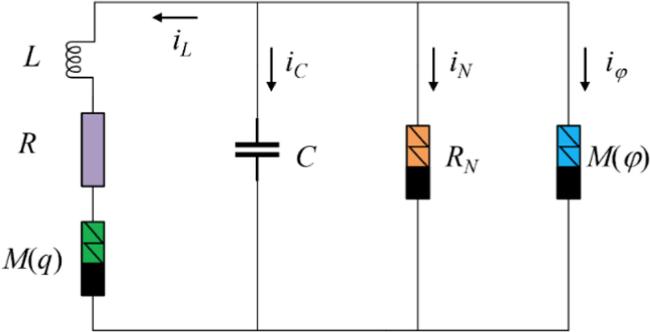
Figure 1. A nonlinear circuit with a hybrid ion channel. |
The neural circuit with a hybrid ion channel is designed by applying a capacitor (C), an inductor (L), a nonlinear resistor (RN), a linear resistor (R), a CCM, and an MFCM. In figure 1, the current iN in the RN is approached by
$\begin{eqnarray}{i}_{N}=-\displaystyle \frac{r}{\rho }\left(V-\displaystyle \frac{{V}^{2}}{{V}_{0}}\right),\end{eqnarray}$
where ρ and V0 denote the resistance and the cut-off voltage in the nonlinear resistor RN. In addition, a CCM and an MFCM can be selected as follows $\begin{eqnarray}\left\{\begin{array}{c}{V}_{M}=M\left(q\right){i}_{M}=q{i}_{M},\displaystyle \frac{{\rm{d}}q}{{\rm{d}}t}=\alpha q+\beta {i}_{M}\\ {i}_{\varphi }=M\left(\varphi \right){V}_{\varphi }=\varphi {V}_{\varphi },\displaystyle \frac{{\rm{d}}\varphi }{{\rm{d}}t}=a\varphi +b{V}_{\varphi }\end{array}\right.,\end{eqnarray}$
where (α, β, a, b) are the relevant parameters for preparing memristor material. (iM, VM, iφ, Vφ) denote the current and voltage in the memristor. The equivalent dynamic model in figure 1 is obtained by using the Kirchhoff’s laws, and it is presented as $\begin{eqnarray}\left\{\begin{array}{c}C\displaystyle \frac{{\rm{d}}V}{{\rm{d}}t}=-{i}_{L}+\displaystyle \frac{r}{\rho }\left(V-\displaystyle \frac{{V}^{2}}{{V}_{0}}\right)-\varphi V\\ L\displaystyle \frac{{\rm{d}}{i}_{L}}{{\rm{d}}t}=V-q{i}_{M}-R{i}_{L}\\ \displaystyle \frac{{\rm{d}}q}{{\rm{d}}t}=\alpha q+\beta {i}_{M}\\ \displaystyle \frac{{\rm{d}}\varphi }{{\rm{d}}t}=a\varphi +b{V}_{\varphi }\end{array}\right..\end{eqnarray}$
To further numerical simulation, the variables in equation (3 ) are replaced as follows
$\begin{eqnarray}x=\displaystyle \frac{V}{{V}_{0}};y=\displaystyle \frac{\rho {i}_{L}}{{V}_{0}};z=\displaystyle \frac{q}{C{V}_{0}};w=\displaystyle \frac{\varphi }{\rho C{V}_{0}};\tau =\displaystyle \frac{t}{\rho C}.\end{eqnarray}$
As a result, the model in equation (3 ) can be expressed by5 ) are defined as follows
$\begin{eqnarray}\left\{\begin{array}{c}\displaystyle \frac{{\rm{d}}x}{{\rm{d}}\tau }=-y+r\left(x-{x}^{2}\right)-cwx\\ \displaystyle \frac{{\rm{d}}y}{{\rm{d}}\tau }=d\left(x-ezy-gy\right)\\ \displaystyle \frac{{\rm{d}}z}{{\rm{d}}\tau }=\alpha ^{\prime} z+\beta y\\ \displaystyle \frac{{\rm{d}}w}{{\rm{d}}\tau }=a^{\prime} w+bx\end{array}\right.,\end{eqnarray}$
where parameters in equation ( $\begin{eqnarray}\begin{array}{c}c={\rho }^{2}C{V}_{0};d=\displaystyle \frac{{\rho }^{2}C}{L};e=\displaystyle \frac{C{V}_{0}}{\rho };\\ g=\displaystyle \frac{R}{\rho };\alpha ^{\prime} =\rho \alpha C;a^{\prime} =a\rho C.\end{array}\end{eqnarray}$
The circuit in figure 1 has four energy storage elements, and the corresponding field energy can be approached by
$\begin{eqnarray}\begin{array}{c}W={W}_{C}+{W}_{L}+{W}_{M}+{W}_{\varphi }\\ =\,\displaystyle \frac{1}{2}C{V}^{2}+\displaystyle \frac{1}{2}L{i}_{L}^{2}+\displaystyle \frac{1}{2}{q}^{2}{i}_{L}+\displaystyle \frac{1}{2}{\varphi }^{2}V.\end{array}\end{eqnarray}$
Furthermore, the dimensionless Hamilton energy is calculated as follows
$\begin{eqnarray}\begin{array}{c}H=\displaystyle \frac{W}{C{V}_{0}^{2}}={H}_{C}+{H}_{L}+{H}_{M}+{H}_{\varphi }\\ =\,\displaystyle \frac{1}{2}{x}^{2}+\displaystyle \frac{1}{2d}{y}^{2}+\displaystyle \frac{1}{2}e{z}^{2}y+\displaystyle \frac{1}{2}c{w}^{2}x.\end{array}\end{eqnarray}$
In fact, the energy function in equation (8 ) is also obtained by applying the Helmholtz’s theorem, the process is described in the following.
$\begin{eqnarray*}\left(\begin{array}{c}\dot{x}\\ \dot{y}\\ \dot{z}\\ \dot{w}\end{array}\right)=\left(\begin{array}{c}-y+r\left(x-{x}^{2}\right)-cwx\\ d\left(x-ezy-gy\right)\\ \alpha \mbox{'}z+\beta y\\ a\mbox{'}w+bx\end{array}\right)={F}_{c}+{F}_{d}\end{eqnarray*}$
$\begin{eqnarray*}=\left(\begin{array}{c}-y-0.5de{z}^{2}-cwx\\ dx+0.5cd{w}^{2}-de\beta zy\\ \beta y+0.5de\beta {z}^{2}\\ x+0.5c{w}^{2}\end{array}\right)\end{eqnarray*}$
$\begin{eqnarray*}+\,\left(\begin{array}{c}r\left(x-{x}^{2}\right)+0.5de{z}^{2}\\ dezy(\beta -1)-dgy+0.5cd{w}^{2}\\ \alpha \mbox{'}z-0.5de\beta {z}^{2}\\ \left(b-1\right)x+a\mbox{'}w-0.5c{w}^{2}\end{array}\right)\end{eqnarray*}$
$\begin{eqnarray*}=\left(\begin{array}{cccc}0 & -d & 0 & -1\\ d & 0 & -\beta d & 0\\ 0 & \beta d & 0 & 0\\ 1 & 0 & 0 & 0\end{array}\right)\left(\begin{array}{c}x+0.5c{w}^{2}\\ y/d+0.5e{z}^{2}\\ ezy\\ cwx\end{array}\right)\end{eqnarray*}$
$\begin{eqnarray}+\,\left(\begin{array}{cccc}{n}_{1} & 0 & 0 & 0\\ 0 & {n}_{2} & 0 & 0\\ 0 & 0 & {n}_{3} & 0\\ 0 & 0 & 0 & {n}_{4}\end{array}\right)\left(\begin{array}{c}x+0.5c{w}^{2}\\ y/d+0.5e{z}^{2}\\ ezy\\ cwx\end{array}\right),\end{eqnarray}$
where $\begin{eqnarray}\left\{\begin{array}{c}{n}_{1}=\displaystyle \frac{r\left(x-{x}^{2}\right)+0.5de{z}^{2}}{x+0.5c{w}^{2}};{n}_{2}=\displaystyle \frac{dezy(\beta -1)-dgy+0.5cd{w}^{2}}{y/d+0.5e{z}^{2}}\\ {n}_{3}=\displaystyle \frac{\alpha \mbox{'}z-0.5de\beta {z}^{2}}{ezy};{n}_{4}=\displaystyle \frac{\left(b-1\right)x+a\mbox{'}w-0.5c{w}^{2}}{cwx}\end{array}\right..\end{eqnarray}$
In fact, the energy function in equation (8 ) needs to meet equation (11 ).
$\begin{eqnarray}{\rm{\nabla }}{H}^{T}{F}_{c}=0;{\rm{\nabla }}{H}^{T}{F}_{d}=\displaystyle \frac{\partial H}{d\tau }.\end{eqnarray}$
The energy function in equation (8 ) can be obtained by solving the solution in the following equation.
$\begin{eqnarray}\begin{array}{c}{\rm{\nabla }}{H}^{T}{F}_{c}=(-y-0.5de{z}^{2}-cwx)\displaystyle \frac{\partial H}{\partial x}\\ +\,(dx+0.5cd{w}^{2}-de\beta zy)\displaystyle \frac{\partial H}{\partial y}\\ +\,(\beta y+0.5de\beta {z}^{2})\displaystyle \frac{\partial H}{\partial z}\\ +\,(x+0.5c{w}^{2})\displaystyle \frac{\partial H}{\partial w}=0.\end{array}\end{eqnarray}$
A suitable solution in equation (12 ) is the energy function in equation (8 ). In a genetic way, the oscillator model can be transformed into a discrete form using the Euler difference algorithm. However, this discretization process introduces a time step parameter, the value of which significantly influences the dynamics of the resulting map. Therefore, a linear transformation combined with the time step is employed to establish a set of new discrete variables and parameters. Furthermore, the variables in equation (5 ) are linearly transformed by5 ), as a result, a map neuron can be obtained as follows14 ) are defined by
$\begin{eqnarray}\begin{array}{c}{x^{\prime} }_{n}=\displaystyle \frac{r{\rm{\Delta }}\tau }{1+r{\rm{\Delta }}\tau }{x}_{n};{y^{\prime} }_{n}=\displaystyle \frac{r{\rm{\Delta }}\tau }{1+r{\rm{\Delta }}\tau }{y}_{n};\\ {z^{\prime} }_{n}=\displaystyle \frac{r{\rm{\Delta }}\tau }{1+r{\rm{\Delta }}\tau }{z}_{n};{w^{\prime} }_{n}=\displaystyle \frac{r{\rm{\Delta }}\tau }{1+r{\rm{\Delta }}\tau }{w}_{n},\end{array}\end{eqnarray}$
where Δτ denotes the time step in equation ( $\begin{eqnarray}\left\{\begin{array}{c}{x^{\prime} }_{n+1}=-{\lambda }_{1}{y^{\prime} }_{n}+{r}_{1}\left({x^{\prime} }_{n}-{{x^{\prime} }_{n}}^{2}\right)-{c}_{1}{w^{\prime} }_{n}{x^{\prime} }_{n}\\ {y^{\prime} }_{n+1}={d}_{1}\left({x^{\prime} }_{n}-{e}_{1}{z^{\prime} }_{n}{y^{\prime} }_{n}-{g}_{1}{y^{\prime} }_{n}\right)\\ {z^{\prime} }_{n+1}={\alpha }_{1}{z^{\prime} }_{n}+{\beta }_{1}{y^{\prime} }_{n}\\ {w^{\prime} }_{n+1}={a}_{1}{w^{\prime} }_{n}+{b}_{1}{x^{\prime} }_{n}\end{array}\right.,\end{eqnarray}$
where the parameters in equation ( $\begin{eqnarray}\left\{\begin{array}{c}{\lambda }_{1}={\rm{\Delta }}\tau ;{r}_{1}=1+r{\rm{\Delta }}\tau ;{c}_{1}=c\displaystyle \frac{1+r{\rm{\Delta }}\tau }{r};{d}_{1}=d{\rm{\Delta }}\tau ;{e}_{1}=e\displaystyle \frac{1+r{\rm{\Delta }}\tau }{r{\rm{\Delta }}\tau };\\ {g}_{1}=g-\displaystyle \frac{1}{d{\rm{\Delta }}\tau };{\alpha }_{1}=1+\alpha ^{\prime} {\rm{\Delta }}\tau ;{\beta }_{1}=\beta {\rm{\Delta }}\tau ;{a}_{1}=1+a^{\prime} {\rm{\Delta }}\tau ;{b}_{1}=b{\rm{\Delta }}\tau .\end{array}\right..\end{eqnarray}$
Similarly, the energy function in equation (8 ) is updated as follows
$\begin{eqnarray}{H}_{n}=\displaystyle \frac{1}{2}{x^{\prime} }_{n}^{2}+\displaystyle \frac{1}{2{d}_{1}}{y^{\prime} }_{n}^{2}+\displaystyle \frac{1}{2}{e}_{1}{z^{\prime} }_{n}^{2}{y^{\prime} }_{n}+\displaystyle \frac{1}{2}{c}_{1}{w^{\prime} }_{n}^{2}{x^{\prime} }_{n}.\end{eqnarray}$
3. Numerical simulation estimations
The dynamic of the map neuron in equation (14 ) is estimated by using the numerical simulation with the iterative method on the MATLAB. At first, parameters of the map neuron with a hybrid ion channel are set at r1 = 3.8, c1 = 0.1, d1 = 0.1, e1 = 3.6316, g1 = 0.1, α1 = 0.1, β1 = 0.2, λ1 = 0.1, and its initial value is (0.01, 0.1, 0.1, 0.1). For parameter b1 = 1.5, a1 is changed from 0 to 0.98, the largest Lyapunov exponent (LLE) and bifurcation diagram can be obtained, and the results are shown in figure 2.
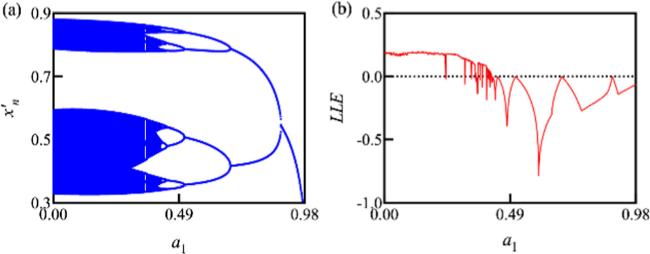
Figure 2. Bifurcation diagram and LLE with different parameter a1. For (a) bifurcation diagram for parameter a1; (b) LLE for parameter a1. |
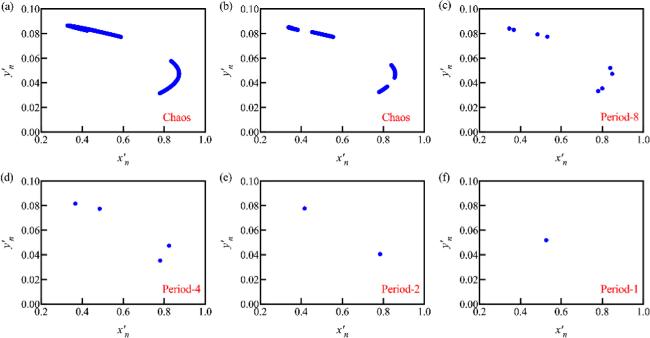
Figure 3. Attractor phase of the map neuron with different parameter a1. For (a) a1 = 0.2; (b) a1 = 0.392; (c) a1 = 0.47; (d) a1 = 0.6; (e) a1 = 0.7; (f) a1 = 0.9. |
Figure 3 illustrates that the different attractors can be formed by adjusting parameter a1, such as chaotic patterns, period-8, period-4, period-2 and period-1 states. In figure 4, according to the energy function in equation (16 ), the evolution of energy with different dynamic behaviors in figure 3 is obtained in figure 4.
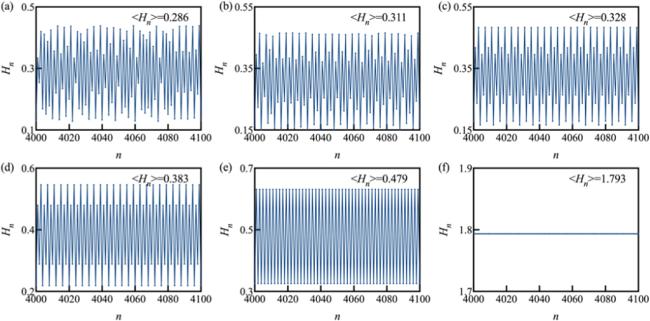
Figure 4. Evolution of Hn for different parameter a1. For (a) a1 = 0.2; (b) a1 = 0.392; (c) a1 = 0.47; (d) a1 = 0.6; (e) a1 = 0.7; (f) a1 = 0.9. <Hn> is a mean value of energy within 100 iterations. |
The result in figure 4 indicates that the chaotic map neuron keeps a lower average value of energy, while the period map neuron has a higher mean energy value. Especially, when the number of the periodic is further decreased, the value of the <Hn> can be increased. Similarly, parameter a1 = 0.2, the effect of parameter b1 on the dynamical characteristics of the map neuron in equation (14 ) is discussed. Parameters and initial value in the map neuron are kept as above, and the results are displayed in figure 5.
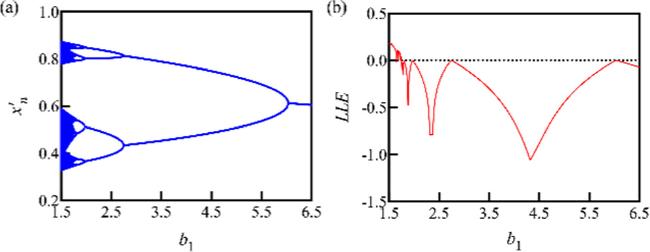
Figure 5. Bifurcation diagram and LLE with different parameter b1. For (a) bifurcation diagram for parameter b1; (b) LLE for parameter b1. |
Similar to the results of the case of parameter a1, parameter b1 is increased, chaotic modes of the map neuron with a hybrid ion channel will show the periodic patterns. Furthermore, the phase diagrams of a map neuron with different parameter b1 are plotted in figure 6.
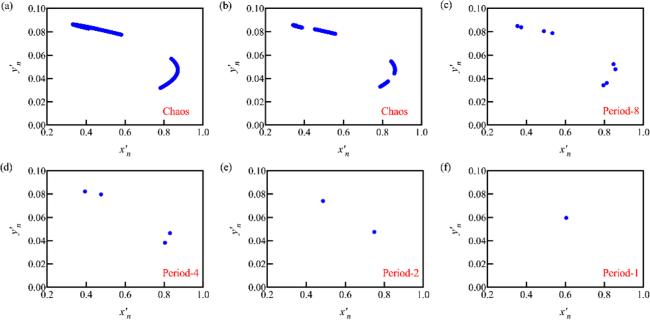
Figure 6. Phase portraits of the map neuron for different parameter b1. For (a) b1 = 1.55; (b) b1 = 1.7; (c) b1 = 1.88; (d) b1 = 2.5; (e) b1 = 4.5; (f) b1 = 6.5. a1 = 0.2. |
It is found that the chaotic and periodic attractors can be developed by changing parameter b1. Figure 7 displayed the evolution of energy with different parameter values of b1.
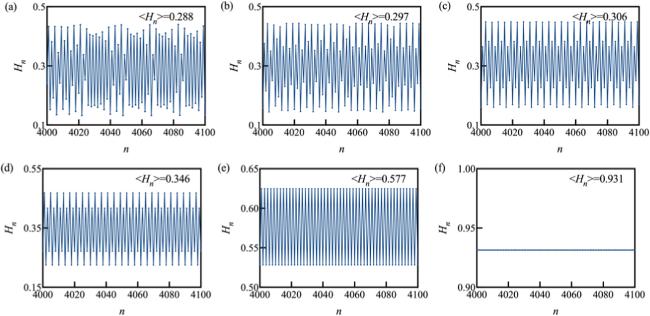
Figure 7. Evolution of Hn for different parameter b1. For (a) b1 = 1.55; (b) b1 = 1.7; (c) b1 = 1.88; (d) b1 = 2.5; (e) b1 = 4.5; (f) b1 = 6.5; Setting a1 = 0.2. <Hn> is a mean energy value within 100 iterations. |
Similarly, the number of the periodic is further decreased, the value of <Hn> can be increased. To research the influence of external magnetic fields on the nonlinear behaviors of a map neuron, the map neuron with a hybrid ion channel can be presented as follows17 ) with different parameter b1 under different φext is calculated. The parameter and initial value are kept as above, and the results are displayed in figure 8.
$\begin{eqnarray}\left\{\begin{array}{c}{x^{\prime} }_{n+1}=-{\lambda }_{1}{y^{\prime} }_{n}+{r}_{1}\left({x^{\prime} }_{n}-{{x^{\prime} }_{n}}^{2}\right)-{c}_{1}{w^{\prime} }_{n}{x^{\prime} }_{n}\\ {y^{\prime} }_{n+1}={d}_{1}\left({x^{\prime} }_{n}-{e}_{1}{z^{\prime} }_{n}{y^{\prime} }_{n}-{g}_{1}{y^{\prime} }_{n}\right)\\ {z^{\prime} }_{n+1}={\alpha }_{1}{z^{\prime} }_{n}+{\beta }_{1}{y^{\prime} }_{n}\\ {w^{\prime} }_{n+1}={a}_{1}{w^{\prime} }_{n}+{b}_{1}{x^{\prime} }_{n}+{\varphi }_{ext}\end{array}\right.,\end{eqnarray}$
where φext is the external magnetic field. In this case, the bifurcation diagram of the map neuron in (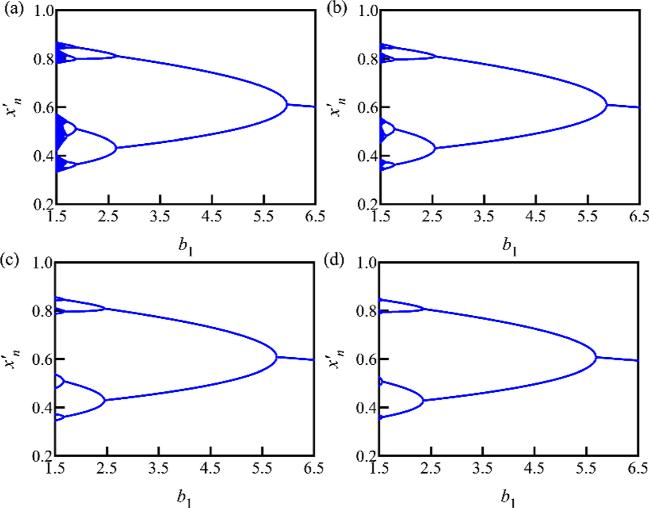
Figure 8. Bifurcation diagram of the map neuron in equation ( |
Figure 8 shows that the nonlinear behavior of a map neuron with a hybrid ion channel can be controlled by the magnetic fields. In addition, the strength of the magnetic field is increased, the chaotic states of a map neuron can be suppressed and the periodic states induced. In addition, to analyze adaptive regulation of the energy on the nonlinear behavior of the map neuron, an adaptive growth method of parameter can be designed as follows
$\begin{eqnarray}\left\{\begin{array}{c}{b}_{1}\left(n+1\right)={b}_{1}\left(n\right)+{\kappa }_{0}\cdot \theta \left(\varepsilon -{H}_{n}\right),\\ \theta \left(P\right)=1,P\geqslant 0,\theta \left(P\right)=0,P\lt 0,\end{array}\right.\end{eqnarray}$
where (κ0, ϵ) denote the gain and energy threshold, the Heaviside function θ can control parameter b1. The initial value for the parameter b1 is 1.5, a1 = 0.2, ϵ = 0.306, the other parameters and initial value remain as above, the evolution of parameter b1 and the variable with different gain is a gain κ0 is as shown in figure 9.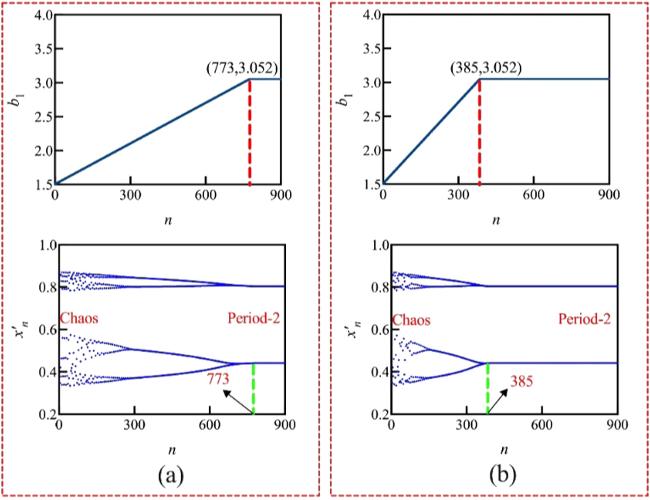
Figure 9. Evolution of parameter b1 and variable x′n. For (a) κ0 = 0.004; (b) κ0 = 0.008. |
The results in figure 9 illustrate that the chaotic map neuron can be controlled to period-2 patterns by the adaptive growth method in equation (18 ), and parameter b1 is also to reach a stable value. The gain is increased, and the parameter reaches a stable value in fewer iterations. Furthermore, the gain κ0 = 0.004, the case of the different threshold ϵ is figure 10.
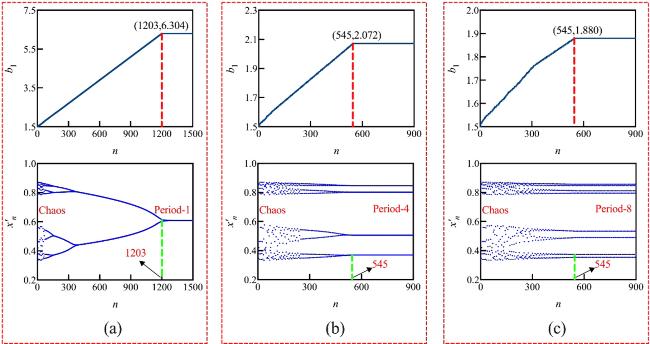


Figure 10. Evolution of parameter b1 and variable x′n. For (a) ϵ = 0.9; (b) ϵ = 0.18; (c) ϵ = 0.16. |
Figure 10 shows that the chaotic map neuron can be developed to different periodic states by applying an energy threshold to control the parameter b1. In fact, the other parameters in the map neuron with a hybrid ion channel can be also used to research the adaptive regulation.
4. Conclusion
In this paper, a hybrid ion channel is obtained by connecting a CCM with an inductor in series, and an MFCM, capacitor and nonlinear resistor are connected in parallel with the mixed ion channel to obtain the memristor neural circuit. Furthermore, the oscillator model with a hybrid ion channel and its energy function are calculated, and a map neuron is obtained by linearizing the neuron oscillator model. The results illustrate that the map neuron with a hybrid ion channel evolve from a chaotic state to a periodic state by period-doubling bifurcation in the process of parameter enlargement, and the chaotic map neuron keeps a lower average value of energy, while the period map neuron has a higher mean energy value. Especially, when the number of the periodic is further decreased, the value of the <Hn> can be increased. The nonlinear behavior of a map neuron with a hybrid ion channel is controlled by the magnetic fields. Furthermore, the chaotic map neuron can be controlled to period-2 patterns by the adaptive growth method, and the chaotic map neuron can be developed to different periodic states by applying an energy threshold to control the parameter. This study is helpful for building an ion channel of the Artificial neuron.
Acknowledgments
This research is supported by the National Science Basic Research Program of Shaanxi (Grant No. 2023-JC-QN-0087).
Authorship contribution statement
XS: Writing-original draft, formal analysis, investigation. YW: Numerical. FY: Methodology, formal analysis, investigation, writing-final version.
Declaration of competing interest
There are no competing interests in this study.