


1. Introduction
Due to the well-known cubic nonlinear term, representing the atom-atom interaction, in the Gross-Pitaevskii equation (GPE), Bose-Einstein condensates (BECs) exhibit rich nonlinear phenomena. One of the significant nonlinear phenomena is chaos. It had been pointed out that chaos in BECs may have a close relationship with the instability and collapse of BECs, which will have a negative impact on BEC manipulations [1,2]. Various dynamical behaviors of BECs can be influenced by chaos. This can lead to chaotic BEC collapse [1], chaotic atomic populations [2-6], chaotic Bogoliubov excitations [7] and chaotic BEC solitons [8,9].
In recent years, temporal chaos has been the main research topic with regard to BEC chaos [1-6,8-17]. Undoubtedly, the temporal dynamical behavior of BECs is heavily influenced by the spatial distribution of BEC atoms, namely, the spatial structures in BECs. Spatial structure is one of the BEC system's most important properties. Chaotic spatial structures, often referred to as spatial chaos, can seriously affect the stability and manipulation of BECs. Consequently, studies on the spatial structures of BECs are of great importance and the spatial structures of BECs in various traps with different configurations have received considerable attention [18-25].
In [18] the spatially chaotic attractor in an elongated BEC perturbed by a weak optical lattice potential had been studied. For a 1D attractive BEC interacting with a Gaussian-like laser barrier and perturbed by a weak optical lattice, the existence of Smale horseshoe chaos is demonstrated and Melnikov chaotic regions of parameter space are displayed [19]. Under the tight-binding approximation, the spatial structure of a weakly coupled BEC array in an optical lattice was investigated [20]. In our previous papers, the chaotic spatial structures of BECs in different potential wells were analytically and numerically explored [21-25].
As is well known, chaotic behavior in physical systems is often unpredictable [26]. The unpredictability of chaotic behavior in BECs will undoubtedly lead to difficulties in precise manipulations of BECs. Fortunately, atom-atom interaction plays an important role in controlling chaos in BECs [2,4,6,10-17]. Convenient and rapid regulation of atom-atom interaction can be realized by a technique named Feshbach resonance (FR) [27-30]. The magnitude and sign of the interaction between atoms can be tuned to any value within the allowed range; large or small, repulsive or attractive. In other words, the FR technique offers a powerful and effective tool to manipulate BECs and control chaos in BECs according to demand.
To the best of our knowledge, at an early stage, magnetic-field-induced FR was used to modulate atom-atom interaction and thus the dynamical behavior of BECs [31-33]. Later, in an experiment, optical tuning of the scattering length in a BEC was reported [34,35]. In this experiment, atoms in an 87Rb BEC are exposed to two phase-locked Raman laser beams that couple pairs of colliding atoms to a molecular ground state [34,35]. By controlling the power and relative detuning of the two laser beams, the atomic scattering length can be changed considerably [34,35]. Nowadays, the optical tuning of the scattering length, often referred to as optical FR, makes it possible to achieve a local nonlinear coefficient periodically modulated as a function of the spatial coordinates [36-43]. With the spatially modulated atom-atom interaction, the dynamics of matter-wave solitons in BECs is investigated [36-40]. Here, in the present study, the spatially modulated atom-atom interaction is considered when studying BEC spatial structures.
The main purpose of this paper is to study the spatial structures of BECs with a spatially modulated atom-atom interaction and without an external trapping potential, namely, the considered BECs are supported solely by a nonlinear optical lattice (NOL) created by the superposition of two coherent laser beams inducing the optical FR [36]. These BEC systems have attracted considerable attention [36,38-40,43-45]. However, research findings on the spatial structures of these BEC systems have not been reported so far, which is our motivation for the present study.
The remainder of this manuscript is organized as follows. In section 2, the spatial structures in a BEC with a varying phase are investigated. In section 3 , we consider the spatial structures in a BEC with a constant phase. Section 4 presents a brief conclusion.
2. The spatial structures in a BEC with a varying phase
In the mean-field approximation, the dynamics of a BEC are described by the GPE. If the condensate cloud is mainly elongated in the direction x, the BEC is cigar shaped and its dynamics can be described by the effective 1D GPE in the following dimensionless form [36,38-40,43-45]:1 ) seems to be unconstrained by an external potential well, but in reality, due to the spatially modulated g(x), it is equivalent to being constrained by a NOL created by the superposition of two coherent laser beams inducing the optical FR [36]. The cubic term with a nonlinear coefficient periodically modulated as a function of the spatial coordinate x plays the role of a NOL [36]. Obviously, a system described by equation (1 ) is a typical nonlinear one and can exhibit rich nonlinear behavior, including chaos. Regulating the nonlinear coefficient means regulating the parameters of the NOL and thus the interaction between atoms. This will inevitably change the spatial structure of the BEC and even lead to a chaotic spatial structure in the system. It can also be said that equation (1 ) describes the density of atoms in a cigar-shaped BEC when it is free of external potential [44]. This BEC system can exhibit another kind of important nonlinear phenomenon, namely dark soliton [46]. In fact, [47] had pointed out that, in presence of the dc and ac parts, the temporal modulation of the nonlinear coefficient may replace the trapping potential in a certain sense. Undoubtedly, due to the dc and ac parts, the spatial modulation of the nonlinear coefficient can also play the role of an external trapping potential. So far, there is no research that discusses the chaotic and regular spatial structures in these BEC systems. In this paper, we focus our attention on this issue.
$\begin{eqnarray}{\rm{i}}{{\rm{\Psi }}}_{t}=-\frac{1}{2}{{\rm{\Psi }}}_{xx}+g(x)| {\rm{\Psi }}{| }^{2}{\rm{\Psi }}.\end{eqnarray}$
Here, $\Psi$ is the normalized wave function of the BEC, and the atom mass m and Plank's constant ℏ are set equal to 1. In this paper, we consider a spatially modulated nonlinear coefficient g(x) containing dc and ac components. The system governed by equation (As already mentioned above, the normalized 1D effective nonlinear parameter can be expressed as [41-43],
$\begin{eqnarray}g(x)={g}_{0}+{g}_{1}\cos (2kx),\end{eqnarray}$
where g0 is the nonlinear parameter in the absence of modulation and g1 is the amplitude of the modulation. g0 and g1 can be either positive or negative. k is the wave number of the laser inducing the optical FR.For a stationary state, the solution of equation (1 ) bears the well-known form $\Psi$(t, x)=e-iμtΦ(x) with μ being the chemical potential of the condensate. Applying this stationary solution to equation (1 ) leads to the following:3 ) in the form of Φ(x)=A(x)eiθ(x) with a space-dependent phase θ(x) and inserting it into equation (3 ), we reach the hydrodynamic version of the nonlinear Schrödinger equation (NLS):5 ) represents the velocity and A2=n is the number density of atoms. Thereby, equation (5 ) denotes that there exists a steady current j=2A2dθ/dx, which represents a steady superfluid in the system [48]. Substituting j=2A2dθ/dx into equation (4 ) results in the following:6 ). However, if ∣g0∣ > ∣g1∣, we can seek its perturbed solution using the perturbation method. In order to perform perturbation analysis, we expand the solution of equation (6 ) to the first order:8 ) has a solution of the form [18,21]:9 ) has two linearly independent solutions expressed as below:9 ), which is written as follows [2]:
$\begin{eqnarray}\mu {\rm{\Phi }}+\frac{1}{2}\frac{{{\rm{d}}}^{2}{\rm{\Phi }}}{{\rm{d}}{x}^{2}}-[{g}_{0}+{g}_{1}\cos (2kx)]| {\rm{\Phi }}{| }^{2}{\rm{\Phi }}=0.\end{eqnarray}$
Writing the solution of equation ( $\begin{eqnarray}\mu A(x)+\frac{1}{2}\left(\frac{{{\rm{d}}}^{2}A}{{\rm{d}}{x}^{2}}-{\left(\frac{{\rm{d}}\theta }{{\rm{d}}x}\right)}^{2}A\right)-\left[{g}_{0}+{g}_{1}\cos (2kx)\right]{A}^{3}=0,\end{eqnarray}$
$\begin{eqnarray}\frac{{\rm{d}}}{{\rm{d}}x}\left(2{A}^{2}\frac{{\rm{d}}\theta }{{\rm{d}}x}\right)=0.\end{eqnarray}$
The first derivative 2dθ/dx in equation ( $\begin{eqnarray}\frac{{{\rm{d}}}^{2}A}{{\rm{d}}{x}^{2}}-\frac{{j}^{2}}{{\rm{4}}{A}^{3}}+2\mu A-2\left[{g}_{0}+{g}_{1}\cos (2kx)\right]{A}^{3}=0.\end{eqnarray}$
Obviously, it is difficult to seek the exact solution of equation ( $\begin{eqnarray}A={A}_{0}+{A}_{1},\,\,| {A}_{0}| \gg | {A}_{1}| ,\end{eqnarray}$
where A0 and A1 satisfy the zeroth-order and first-order equations, respectively, expressed as, $\begin{eqnarray}\frac{{{\rm{d}}}^{2}{A}_{0}}{{\rm{d}}{x}^{2}}-\frac{{j}^{2}}{4{A}_{0}^{3}}+2\mu {A}_{0}-2{g}_{0}{A}_{0}^{3}=0,\end{eqnarray}$
$\begin{eqnarray}\frac{{{\rm{d}}}^{2}{A}_{1}}{{\rm{d}}{x}^{2}}+\frac{3{j}^{2}}{{\rm{4}}{A}_{{}_{0}}^{4}}{A}_{1}+2\mu {A}_{1}-6{g}_{0}{A}_{0}^{2}{A}_{1}=\varepsilon (x)\end{eqnarray}$
with $\varepsilon (x)=2{g}_{1}{A}_{0}^{3}\cos (2kx)$. For a positive chemical potential, equation ( $\begin{eqnarray}\begin{array}{rcl}{A}_{0} & =& \sqrt{b-(b-c){{\rm{{\rm{sech}} }}}^{2}\xi },\\ \xi & =& \sqrt{{g}_{0}(b-c)}x-C,\\ C & =& \sqrt{{g}_{0}(b-c)}{x}_{0}-{\rm{ar}}{\rm{{\rm{sech}} }}{\{[b-{A}_{0}^{2}({x}_{0})]/(b-c)\}}^{1/2}.\end{array}\end{eqnarray}$
Here, C is a constant determined by the initial conditions. ${x}_{0},{A}_{0}^{2}({x}_{0}),b$ and c should satisfy, $\begin{eqnarray}\begin{array}{rcl}2b+c & =& \frac{2\mu }{{g}_{0}},{b}^{2}+bc=\frac{{c}_{1}}{{g}_{0}},{b}^{2}c=\frac{{j}^{2}}{4{g}_{0}},\\ {c}_{1} & =& \frac{1}{2}{\left[\frac{{\rm{d}}{A}_{0}(x)}{{\rm{d}}x}{| }_{{x}_{0}}\right]}^{2}+\frac{{j}^{2}}{8{A}_{0}^{2}({x}_{0})}\\ & & -\frac{1}{4}{g}_{0}{A}_{0}^{4}({x}_{0})+\frac{1}{2}\mu {A}_{0}^{2}({x}_{0}).\end{array}\end{eqnarray}$
When ϵ(x)=0, equation ( $\begin{eqnarray}\displaystyle \begin{array}{rcl}{A}_{1}^{\lt 1\gt } & =& \frac{{\rm{d}}{A}_{0}}{{\rm{d}}x}=\sqrt{{g}_{0}(b-c)}(b-c)\\ & & \times \frac{{{\rm{{\rm{sech}} }}}^{2}\xi \tanh \xi }{\sqrt{b-(b-c){{\rm{{\rm{sech}} }}}^{2}\xi }},\end{array}\end{eqnarray}$
$\begin{eqnarray}\begin{array}{rcl}{A}_{1}^{\lt 2\gt } & =& {A}_{1}^{\lt 1\gt }\displaystyle \int {({A}_{1}^{\lt 1\gt })}^{-2}{\rm{d}}\xi \\ & =& {\rm{{\rm{sech}} }}\xi \sqrt{b-(b-c){{\rm{{\rm{sech}} }}}^{2}\xi }[(-8b-72c)\cosh \xi \\ & & +(7b+8c)\cosh 3\xi \\ & & +b\cosh 5\xi +(24b+9bc)\xi \sinh \xi ]/[32{(b-c)}^{2}\\ & & \times {g}_{0}(-b+2c+b\cosh 2\xi )].\end{array}\end{eqnarray}$
Careful calculation reveals that ${A}_{1}^{\lt 2\gt }$ tends to infinity with the increase in ξ. Given the two linearly independent solutions, we can construct the general solution of equation ( $\begin{eqnarray}\begin{array}{rcl}{A}_{1} & =& {A}_{1}^{\lt 2\gt }{\displaystyle \int }_{E}^{x}{A}_{1}^{\lt 1\gt }\varepsilon (x){\rm{d}}x\\ & & -{A}_{1}^{\lt 1\gt }{\displaystyle \int }_{F}^{x}{A}_{1}^{\lt 2\gt }\varepsilon (x){\rm{d}}x,\end{array}\end{eqnarray}$
where E and F are two constants determined by the initial conditions.Applying equations (10 ), (12 ) and (13 ) to equation (14 ), and calculating the limit for x →± ∞, we find14 ) is unbounded due to the inclusion of ${A}_{1}^{\lt 2\gt }$ in it. This usually means solution (14 ) is Lyapunov unstable [2]. However, it is fortunate that this kind of instability can be controlled, namely, solution (14 ) can be Lyapunov stable, if and only if the following necessary and sufficient conditions:16 ), one can see that G+-G-=0 can lead to the Melnikov function of the system:14 ). As a result, we call the general solution (14 ) obeying the conditions in equation (16 ) chaotic solution. In order to guarantee the Melnikov function M(x0) has simple zeros, the first derivative dM(x0)/dx0 ≠ 0, i.e., 11 ) and (17 ) reveals that as long as the two conditions 2μ ≠ k2 and $\sin \left[\frac{2kC}{\sqrt{(b-c){g}_{0}}}\right]=0$ (i.e. $\frac{2kC}{\sqrt{(b-c){g}_{0}}}=\pm n\pi $ with n being an integer number) are satisfied, the Melnikov function M(x0) is guaranteed to have at least one simple-zero. Conditions (17 ) and (18 ) are usually called Melnikov chaos criteria.
$\begin{eqnarray}\mathop{\mathrm{lim}}\limits_{x\to \pm \infty }{A}_{1}\to \pm \infty ,\end{eqnarray}$
which shows that the general solution ( $\begin{eqnarray}{G}_{\pm }=\mathop{\mathrm{lim}}\limits_{x\to \pm \infty }{\int }_{E}^{x}{A}_{1}^{\lt 1\gt }\varepsilon (x){\rm{d}}x=0,\end{eqnarray}$
are satisfied. After carefully inspecting equation ( $\begin{eqnarray}\begin{array}{rcl}M({x}_{0}) & =& {G}_{+}-{G}_{-}\\ & =& {\displaystyle \int }_{-\infty }^{+\infty }{A}_{1}^{\langle 1\rangle }\varepsilon (x){\rm{d}}x\\ & =& -\frac{4\pi {g}_{1}{k}^{2}(2b{g}_{0}+c{g}_{0}-{k}^{2})\sqrt{(b-c){g}_{0}}{\rm{csch}}\left[\frac{k\pi }{\sqrt{(b-c){g}_{0}}}\right]\sin \left[\frac{2kC}{\sqrt{(b-c){g}_{0}}}\right]}{3{g}_{0}^{2}}\\ & =& 0.\end{array}\end{eqnarray}$
The Melnikov function provides a good measure of the distance between the stable and unstable perturbed manifolds in the Poincaré section at the point x0. The existence of simple zeros of M(x0) implies transverse intersections between stable and unstable manifolds, which indicates that there is Smale horseshoe chaos in the system for the orbit ( $\begin{eqnarray}\displaystyle \frac{{\rm{d}}M({x}_{0})}{{\rm{d}}{x}_{0}}=-\displaystyle \frac{8\pi {g}_{1}{k}^{3}(2b{g}_{0}+c{g}_{0}-{k}^{2})\mathrm{csch}\left[\tfrac{k\pi }{\sqrt{(b-c){g}_{0}}}\right]\cos \left[\tfrac{2kC}{\sqrt{(b-c){g}_{0}}}\right]}{3{g}_{0}^{2}}\ne 0,\end{eqnarray}$
should be satisfied. To this end, we have (2bg0+cg0-k2) ≠ 0 and ${\rm{}}\cos \left[\frac{2kC}{\sqrt{(b-c){g}_{0}}}\right]\ne 0$. Combining this with equations (The above theoretical analyses are based on the perturbative condition. When the perturbative condition cannot be strictly satisfied, it is difficult to conduct theoretical analyses on the spatial structures of BECs. Under these circumstances, we can resort to numerical methods. It should be declared that we consider the case in which the BEC phase is a linear function of coordinate x. Consequently, in our subsequent numerical calculations, we treat the atomic current as a constant one. Using the numerical calculation software ‘MATHEMATICA' we numerically solve equation (6 ) and plot a phase portrait in ($A,\dot{A}$) plane and its corresponding spatial evolution curve of A(x) in figure 1. The parameters and initial conditions are set as g0=0.68, g1=0.045, μ=0.6, j=0.5, k=0.35, A(0)=0.4 and $\dot{A}(0)=0$. From the phase portrait in figure 1(a) it can be observed that the phase orbits evolve in a finite area in the ($A,\dot{A}$) plane and one cannot distinguish the periodicity of the orbits, which is a typical property of chaos. figure 1(b) also shows that the shape of the corresponding spatial evolution curve of A(x) does not periodically reappear, indicating that the system is in a chaotic state.
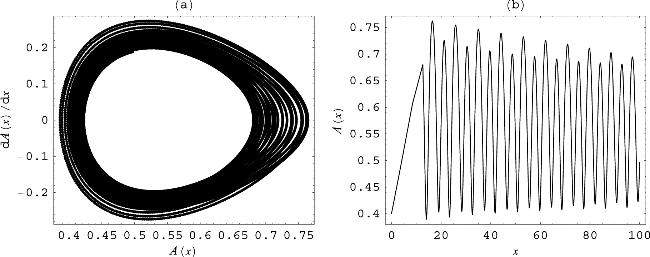
Figure 1. (a) is the phase portrait in the ($A,\dot{A}$) plane and (b) is the spatial evolution of A(x) for g0=0.68, g1=0.045, μ=0.6, j=0.5, k=0.35, A(0)=0.4 and $\dot{A}(0)=0$. |
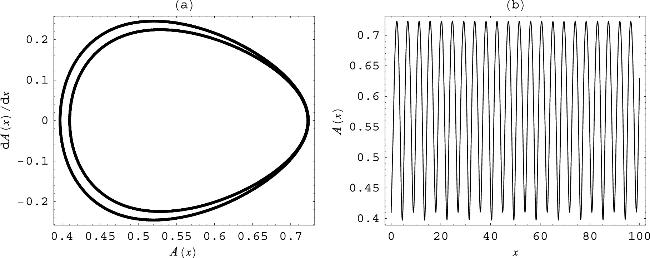
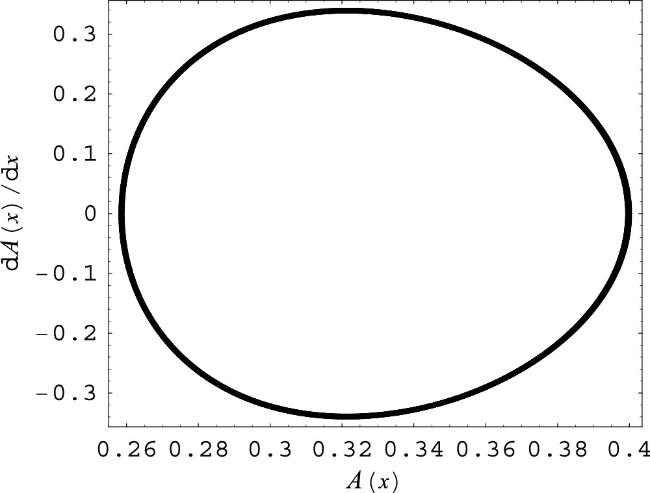
As is well known, the chaotic behavior of nonlinear systems is extremely sensitive to the initial conditions. Minor changes in the initial conditions can cause significant changes in the behavior of nonlinear systems. The sensitivity of chaos to the initial conditions is known as the butterfly effect in chaos theory [26]. This is also one of the main characteristics of chaos. To demonstrate this kind of sensitivity to the initial conditions, only changing the value of A(0) to 0.41 and keeping the other parameters the same as figure 1, we plot a phase portrait in figure 2(a) and its corresponding spatial evolution curve of A(x) in figure 2(b). figure 2(a) displays two phase orbits in the ($A,\dot{A}$) plane and figure 2(b) demonstrates that there are two repeated waveforms in the corresponding spatial evolution curve of A(x). Obviously, both the phase portrait and spatial evolution curve of A(x) indicate that the system is in a biperiodic state. Comparing figures 1 and 2, we know that a slight change in the initial conditions can cause a significant change in the spatial structure of the BEC and even lead the BEC into a regular spatial structure from a chaotic one. That is to say, under the above-given conditions, the spatial distribution of atoms is sensitive to the initial conditions. Interestingly, it is also found that regardless of how the initial conditions are adjusted, the system never exhibits a single-periodic state for the above-given conditions. However, further numerical simulations indicate that just increasing the chemical potential while keeping the other parameters the same as figure 1 can lead the system into a single-periodic state (see figure 3 with μ=3), meaning BEC atoms exhibit a single-periodic spatial distribution and the system is in a single-periodic spatial structure. For any value of the chemical potential greater than 3, only one phase orbit appears in the phase plane, which means that for μ > 3 the BEC is always in a series of single-periodic spatial structures with the selected parameters.
In our numerical simulations, we find that regulating the wave number k of the laser producing the NOL can effectively suppress chaos when the values of g0 and g1 are not significantly different. To demonstrate the suppressing effect of k on the chaotic spatial structure of BEC, we plot a series of phase portraits in figure 4 for different values of k. The other parameters and initial conditions are set as g0=0.57, g1=0.56, μ=0.6152, j=0.05, A(0)=0.4 and $\dot{A}(0)=0$. From the phase portrait pictured in figure 4(a) for k=1.1, one can see a typically chaotic phase diagram, which denotes that the BEC is in a chaotic spatial structure and the condensed atoms exhibit a chaotic spatial distribution. When the value of k increases to 1.14, figure 4(b) shows that the area occupied by the chaotic orbits in the phase plane is markedly reduced. When k is further increased to 5, only one closed orbit appears in the phase space, as can be seen in figure 4(c), denoting that the chaotic spatial structure in the BEC system has been suppressed completely and the condensed atoms have entered a single-periodic spatial distribution. It is also found that as long as k is an integer greater than 5, the system will always remain in a series of single-periodic spatial structures, namely, the condensed atoms will always be in a series of single-periodic spatial distributions.
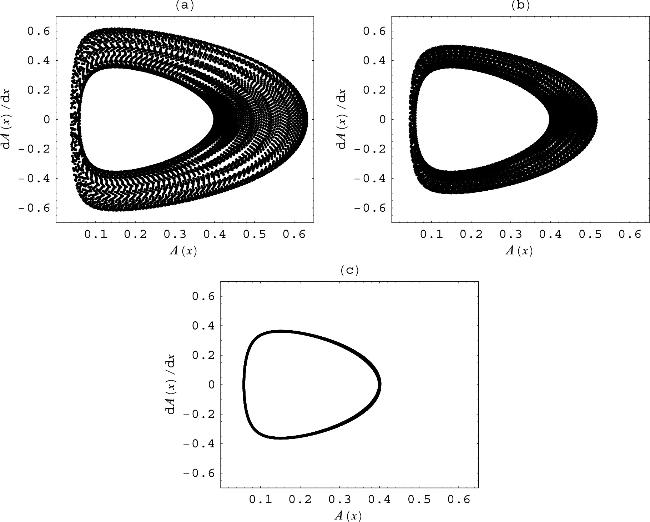
Figure 4. Phase portraits in the ($A,\dot{A}$) plane for g0=0.57, g1=0.56, μ=0.6152, j=0.05, A(0)=0.4 and $\dot{A}(0)=0$. (a) k=1.1, (b) k=1.14 and (c) k=5. |
The above numerical studies focus on a repulsive BEC, and in this section we will consider an attractive system whose nonlinear parameter g(x) representing the atom-atom interaction is negative. After setting the parameters and initial conditions as g0=-0.40, g1=-0.3995, μ=0.47, j=0.5, k=1, A(0)=0.1 and $\dot{A}(0)=0$,we plot a spatial evolution curve of A(x) in figure 5(a) and do not observe any periodicity in the spatial evolution curve, indicating that the spatial atomic distribution is chaotic and the BEC is in a chaotic spatial structure. The limited amplitude of A(x) displayed in figure 5(a) means that the atomic density is not very high. However, with the decrease in the chemical potential μ the atomic density will become very high, which may cause internal collapse in attractive BECs [27]. Keeping the other parameters and initial conditions unchangeable and only decreasing the chemical potential μ to 0.12, we plot the spatial evolution curve of A(x) in figure 5(b) from which one can observe that A(x) undergoes a chaotic spatial evolution and then tends to a very large value for x > 80. This denotes that the atomic density will become very high when x > 80. However, only increasing the wave number k to 4 and keeping the other parameters and initial conditions the same as figure 5(b), the growing trend of A(x) is suppressed and the value of A(x) falls back into the range of 0.1-1.8, see figure 5(c). Further simulations demonstrate that as long as k ≥ 4, the value of A(x) can be effectively controlled to a limited range, which means that the atomic density is not very high. Thus, increasing the wave number can suppress the growing trend of the atomic density and then prevent collapse in the system for the given parameters and initial conditions.
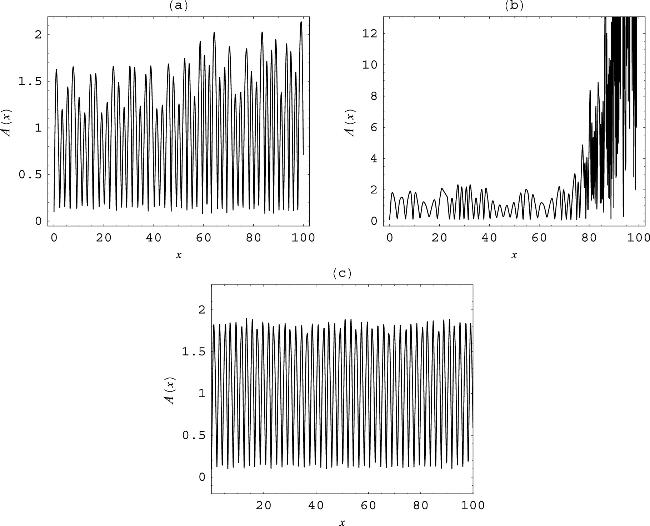
Figure 5. Spatial evolutions of A(x) for g0=-0.4, g1=-0.3995, j=0.5, A(0)=0.1 and $\dot{A}(0)=0$. (a) μ=0.47 and k=1, (b) μ=0.12 and k=1, (c) μ=0.12 and k=4 and the other parameters and initial conditions are the same as (a). |
3. The spatial structures in a BEC with a constant phase
When the BEC phase is a constant one, θc, the aforementioned atomic current will not exist in the system. In this situation the wave function Φ(x) bears the form of ${\rm{\Phi }}(x)=\tilde{A}(x){{\rm{e}}}^{{\rm{i}}{\theta }_{{\rm{c}}}}$ and function $\tilde{A}(x)$ satisfies,19 ) describes a spatially periodically modulated system similar to a Duffing oscillator whose energy is,
$\begin{eqnarray}\frac{{{\rm{d}}}^{2}\tilde{A}}{{\rm{d}}{x}^{2}}+2\mu \tilde{A}-2\left[{g}_{0}+{g}_{1}\cos (2kx)\right]{\tilde{A}}^{3}=0.\end{eqnarray}$
Obviously, equation ( $\begin{eqnarray}E=\frac{1}{2}{\left(\frac{{\rm{d}}\tilde{A}}{{\rm{d}}x}\right)}^{2}+\mu {\tilde{A}}^{2}-\frac{1}{2}\left[{g}_{0}+{g}_{1}\cos (2kx)\right]{\tilde{A}}^{4}.\end{eqnarray}$
When g1=0, the energy E is conserved and the system will become an integrable one.As in the above section, perturbation analysis will be done for ∣g0∣ > ∣g1∣ below. We expand the solution of equation (19 ) to the first order:22 ) represents the motion of a free Duffing oscillator and bears the following homoclinic solution:24 ) is just the separatrix solution of the periodically modulated system. Here, $\tilde{C}$ is a constant determined by the initial conditions.
$\begin{eqnarray}\tilde{A}={\tilde{A}}_{0}+{\tilde{A}}_{1},\,\,| {\tilde{A}}_{0}| \gg | {\tilde{A}}_{1}| ,\end{eqnarray}$
with ${\tilde{A}}_{0}$ and ${\tilde{A}}_{1}$ obeying the zeroth and first-order equations expressed as, $\begin{eqnarray}\frac{{{\rm{d}}}^{2}{\tilde{A}}_{0}}{{\rm{d}}{x}^{2}}+2\mu {\tilde{A}}_{0}-2{g}_{0}{\tilde{A}}_{0}^{3}=0,\end{eqnarray}$
$\begin{eqnarray}\frac{{{\rm{d}}}^{2}{\tilde{A}}_{1}}{{\rm{d}}{x}^{2}}+2\mu {\tilde{A}}_{1}-6{g}_{0}{\tilde{A}}_{0}^{2}{\tilde{A}}_{1}=\varepsilon (x).\end{eqnarray}$
Here, $\varepsilon (x)=2{g}_{1}{\tilde{A}}_{0}^{3}\cos (2kx)$. It is well known that equation ( $\begin{eqnarray}\begin{array}{rcl}{\tilde{A}}_{0} & =& \sqrt{\frac{\mu }{{g}_{0}}}\tanh \left[\sqrt{\mu }x-\tilde{C}\right],\\ \tilde{C} & =& \sqrt{\mu }{x}_{0}-{\rm{Ar}}\tanh \left[\sqrt{\frac{{g}_{0}}{\mu }}{\tilde{A}}_{0}({x}_{0})\right].\end{array}\end{eqnarray}$
Equation (When ϵ(x)=0, equation (23 ) has the following solution:
$\begin{eqnarray}{\tilde{A}}_{{}_{1}}^{\lt 1\gt }=\frac{{\rm{d}}{\tilde{A}}_{0}}{{\rm{d}}x}=\frac{\mu }{\sqrt{{g}_{0}}}{{\rm{{\rm{sech}} }}}^{2}\left[\sqrt{\mu }x-\tilde{C}\right].\end{eqnarray}$
Using the results obtained in the above section, we reach the Melnikov function:26 ) and (27 ), it can easily be deduced that 2μ ≠ k2 and $\frac{2k\tilde{C}}{\sqrt{\mu }}=\pm m\pi $ with m being an integer number, which can guarantee the Melnikov function has at least one simple-zero point. As has been pointed out above, the existence of a Melnikov function with simple-zero points means the existence of chaotic spatial distributions of atoms, which may harm the stability and dynamical manipulation of BECs. Therefore, given the above research findings, in experiments one can avoid chaotic situations or not according to demand.
$\begin{eqnarray}\begin{array}{rcl}{\tilde{M(x}}_{0}) & =& \frac{4\pi {g}_{1}{k}^{2}({k}^{2}-2\mu )\sqrt{\mu }}{3{g}_{0}^{2}}\\ & & \times {\rm{csch}}\left(\frac{k\pi }{\sqrt{\mu }}\right)\sin \left(\frac{2k\tilde{C}}{\sqrt{\mu }}\right)=0.\end{array}\end{eqnarray}$
A Melnikov function with at least one simple-zero should satisfy the following condition: $\begin{eqnarray}\begin{array}{rcl}\frac{{\rm{d}}{\tilde{M(x}}_{0})}{{\rm{d}}{x}_{0}} & =& \frac{8\pi {g}_{1}{k}^{3}({k}^{2}-2\mu )\sqrt{\mu }}{3{g}_{0}^{2}}\\ & & \times {\rm{csch}}\left(\frac{k\pi }{\sqrt{\mu }}\right)\cos \left(\frac{2k\tilde{C}}{\sqrt{\mu }}\right)\ne 0.\end{array}\end{eqnarray}$
From equations (For a BEC system, as long as the parameter conditions satisfy the Melnikov chaos criteria, there will be chaos in the system. As mentioned in the above section, when the system cannot strictly satisfy the perturbative conditions, it will be very difficult to find effective theoretical methods to analyze the chaotic behavior of the system. In this case, numerical simulation can be an effective method for the study of the chaotic behavior of BECs. Using the software ‘MATHEMATICA' to numerically solve equation (19 ), we plot a series of phase portraits for different values of k in ($A,\dot{A}$) plane, as can be seen in figure 6. The other parameters and initial conditions are set as g0=1.4, g1=0.12, μ=0.904, A(0)=0.62 and $\dot{A}(0)=0$. When k=1, one can see that the phase orbits evolve into a distinct chaotic attractor within a finite region, see figure 6(a). This indicates that the BEC is in a chaotic spatial structure. When k reaches 1.03, the phase diagram in figure 6(b) shows that the periodicity of the phase orbits still cannot be confirmed. When k reaches 1.2, from figure 6(c) one can clearly see two periodic orbits appear in the phase space, which denotes that the chaos in the spatial structure of the BEC has completely disappeared and BEC atoms exhibit a biperiodic spatial distribution. Finally, when the value of k is increased to 4, figure 6(d) shows that only one phase orbit appears in the phase plane, indicating that the BEC has entered into a single-periodic spatial structure. Further numerical simulations indicate that, for k ≥ 4, the BEC is always in a series of single-periodic spatial structures under the selected parameters and initial conditions. The evolution of the phase diagrams in figure 6 shows that the wave number k can be an effective controlling parameter for the spatial structure of the BEC in certain ranges of parameters and initial conditions.
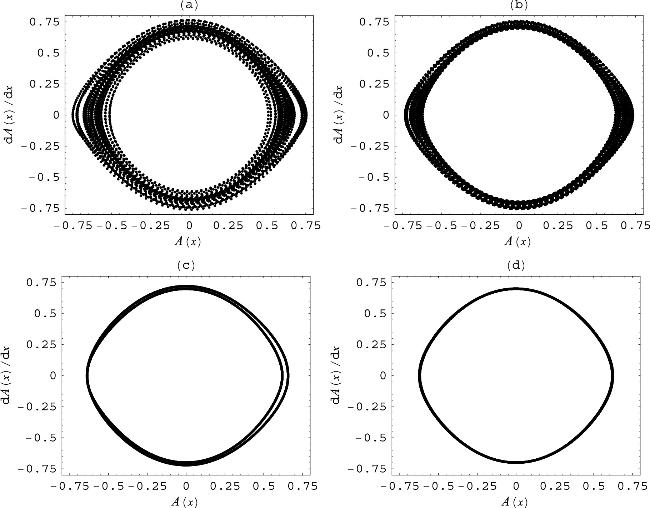


Figure 6. Phase portraits in the ($A,\dot{A}$) plane for g0=1.4, g1=0.12, μ=0.904, A(0)=0.62 and $\dot{A}(0)=0$. (a) k=1, (b) k=1.03, (c) k=1.2 and (d) k=4. |
4. Summary and conclusion
In summary, we have studied the chaotic and regular spatial structures of BECs with a spatially modulated atom-atom interaction and without an external trapping potential. However, even without the external trapping potential, it cannot be assumed that the system is free. In reality, the system is subjected to a NOL, namely the cubic term with a nonlinear coefficient periodically modulated as a function of the spatial coordinate through the optical FR [36]. The NOL plays the role of an external trapping potential. First, a BEC with a space-dependent phase is considered. Due to the space-dependent phase, there exists a steady current in the system. Under the perturbative condition, we construct the general solution of the first-order equation of the system. From the boundedness condition of the general solution, we theoretically obtain the Melnikov chaos criteria of the BEC. For a repulsive BEC that contains a space-dependent phase and cannot satisfy the perturbative conditions, we numerically demonstrate the spatial chaos and its sensitivity to the initial conditions. A small change in the initial condition can completely eliminate the spatial chaos and put the system into a biperiodic state for the selected system parameters and initial conditions. Regardless of how the initial condition is changed, the system will not move from a biperiodic state to a single-periodic one. However, this goal was achieved by increasing the chemical potential. For large values of the chemical potential, the BEC is always in a series of spatial single-periodic structures for the given system parameters and initial conditions. When the dc and ac components of the nonlinear parameter are not significantly different, increasing the wave number k of the laser inducing the optical FR can effectively suppress the chaotic spatial structures of the BEC and always keep the system in a series of single-periodic spatial structures for k ≥ 5 with k being an integer.
For an attractive BEC with a space-dependent phase, decreasing the chemical potential can lead to an increasing atomic density, which will endanger the stability of the BEC and even result in collapse in the system. However, the increasing trend of the atomic density can be effectively controlled to a limited range while the wave number k ≥ 4 for the selected parameters and initial conditions.
When the BEC phase is a constant, theoretical analyses show that the aforementioned steady current does not exist in the system. The Melnikov chaos criteria is theoretically obtained. Numerical simulations of the non-perturbative situation indicate that increasing the laser wave number can also effectively suppress the chaotic spatial structures of the BEC.
The above discussions indicate that modulating the laser wave number can achieve the transition between the chaotic and regular states, regardless of whether the BEC phase varies with space or remains a constant.
As quantum systems, BECs inevitably exhibit fluctuations. Reference [49] has pointed out that in a BEC thermal fluctuations of the quantum field are reduced so much that a long-range order appears. Theoretically, the fluctuations in a BEC are usually treated as small perturbations of the mean field [50]. If the fluctuations are too small to have a significant impact on the BEC, they are usually neglected. It cannot be denied that strong enough fluctuations may exert a significant impact on the chaotic behavior of the BEC due to the sensitivity of chaos to some factors and even result in transitions between chaotic and regular states. As is known, the standard approach to describe the nonequilibrium dynamics of BECs is to use the mean-field GP equation, which neglects the quantum and thermal fluctuations [49]. Our studies are also based on the mean-field GP equation, and so the fluctuations are not considered in this paper.
We want to point out that the emergence of chaos implies a random or even unpredictable complex spatial structure in BECs, which may have a destructive impact on the BEC dynamical behaviors, such as the stability [27,51-53], formation rate [27,54-56], size and shape [27,57,58] and collective excitations [27,59,60]. Chaos can also induce loss of coherence of BECs [61]. It is undeniable that the chaotic spatial structures in BECs, namely the chaotic spatial distribution of BEC atoms, will inevitably lead to complex dynamical behavior of the system and even lead to chaotic dynamical behavior. This will make it difficult to stably control BECs in order to conduct various studies. Therefore, studying the spatial structures of BECs, or in other words, the spatial distributions of BEC atoms, has important scientific significance.