


1. Introduction
Investigating the excitation mechanism and physical meaning dynamics of nonlinear waves to reveal nonlinear phenomena in various fields of nonlinear science, including nonlinear optics [1, 2], Bose–Einstein condensate [3], plasma physics [4], oceanography [5] and even financial markets [6], has always been a core topic in nonlinear mathematical physics. Integrable systems, due to their elegant mathematical structure and physical background, are often used as governing prototypes to describe nonlinear waves. With the improvement of mathematical theory and the rapid development of artificial intelligence, many effective techniques for studying the nonlinear waves of integrable systems have been proposed in succession, such as, Hirota bilinear method, inverse scattering transformation method, Darboux transformation (DT) method, algebro-geometric method [7–10], and the newly favoured method of deep learning [11–13].
However, the existing approaches mainly focus on the constructing and nonlinear dynamics of nonlinear waves on the constant backgrounds, mainly zero and plane wave backgrounds, including soliton, breather and rogue waves. Even the investigating on periodic background mainly concentrate on nonlinear waves on the periodic background waves of Jacobi elliptic functions by using some special techniques, including nonlinearization technique [14–17], Baker–Akhiezer function method [18, 19], DT method [20–25], numerical simulations [26, 27], nonlocal symmetry and dressing method [28, 29], deep learning method [30] and so on [31–33].
To describe more complex physical nonlinear phenomena and to generalize the mathematical integrabe systems, the (n + 1)-dimensions generalized Kadomtsev–Petviashvili (gKP) equation [34]:
$\begin{eqnarray}{\left({u}_{t}+6\beta u{u}_{{x}_{1}}+\beta {u}_{{x}_{1}{x}_{1}{x}_{1}}\right)}_{{x}_{1}}+\gamma {u}_{{x}_{2}{x}_{2}}+\displaystyle \sum _{i=2}^{n}{\sigma }_{i}{u}_{{x}_{1}{x}_{i}}=0,\end{eqnarray}$
has been proposed, which can be served as the compatibility condition of the following linear spectral problem $\begin{eqnarray}L\varphi =\left({\partial }_{{x}_{1}}^{2}+\delta {\partial }_{{x}_{2}}+u\right)\varphi =\lambda \varphi ,\end{eqnarray}$
$\begin{aligned} \varphi_{t}= & T \varphi=\left(\left(\frac{\gamma}{\delta}+\beta \delta\right) \partial_{x_{1} x_{2}}-(2 \beta u+4 \lambda \beta) \partial_{x_{1}}\right. \\ & \left.+\beta u_{x_{1}}+\frac{\gamma}{\delta} \partial_{x_{1}} u_{x_{2}}-\sum_{i=2}^{n} \sigma_{i} \partial_{x_{i}}\right) \varphi, \end{aligned}$
where n≥2, λ is a spectral parameter, β, δ, γ, σi are constant parameters and δ2 = γ/(3β). The KP equation is widely used to describe various nonlinear phenomena in physical fields such as fluid mechanics, oceanography, and plasma physics. The generalized KP equation (Recently, we investigated the nonlinear waves on the Jacobi elliptic function periodic background and their underlying physical dynamics for the (n + 1)-dimensions gKP equation (1 ) [36], whose N-fold DT has been given as
$\begin{eqnarray}\varphi [N]=\frac{{\rm{Wr}}[{\varphi }_{1},{\varphi }_{2},\ldots ,{\varphi }_{N},\varphi ]}{{\rm{Wr}}[{\varphi }_{1},{\varphi }_{2},\ldots ,{\varphi }_{N}]},\end{eqnarray}$
$\begin{eqnarray}u[N]=u+2{\left({\mathrm{ln}}\,{\rm{Wr}}[{\varphi }_{1},{\varphi }_{2},\ldots ,{\varphi }_{N}]\right)}_{{x}_{1}{x}_{1}},\end{eqnarray}$
in which, u is the solution of (n + 1)-dimensional gKP equation ( $\begin{eqnarray}-\frac{{{\rm{d}}}^{2}\varphi }{{\rm{d}}{x}^{2}}+2\wp \left(x\right)\varphi =\lambda \varphi ,\end{eqnarray}$
and the elliptic roots of unity for the Weierstrass elliptic function [38, 39] $\begin{eqnarray}\displaystyle \prod _{j=1}^{M}{{\rm{\Phi }}}_{k}({a}_{j})=\frac{1}{(M-1)!}({\wp }^{(M-2)}(-\kappa )-{\wp }^{(M-2)}({a}_{1})),\forall \kappa .\end{eqnarray}$
2. Solutions of the spectral problems with ℘(x + ct) coefficient via Lamé equation
To construct nonlinear waves on the Weierstrass elliptic periodic wave, it is necessary first to construct a seed solution in the form of Weierstrass elliptic functions, and then to solve the associated linear spectral problem with Weierstrass elliptic function as the external potential. To this end, we consider the traveling Weierstrass elliptic wave for the gKP equation (1 ) as the seed solution of DT (3a ), whose general form can be assumed as 6 ) into the gKP equation (1 ), yields
$\begin{eqnarray}u=U({x}_{1}+ct)=U(\eta ),\end{eqnarray}$
where η = x1 + ct, and c is the traveling wave velocity. Substituting ( $\begin{eqnarray}cU+\beta {U}^{{\prime\prime} }+3\beta {U}^{2}={h}_{1},\end{eqnarray}$
$\begin{eqnarray}\beta {({U}^{{\prime} })}^{2}+2\beta {U}^{3}+c{U}^{2}-2{h}_{1}U={h}_{2},\end{eqnarray}$
where h1 and h2 are constants of integration. According to the algebraic curve $\begin{eqnarray}{\left({\wp }^{{\prime} }\left(x\right)\right)}^{2}=4{\wp }^{3}\left(x\right)-{g}_{2}\wp \left(x\right)-{g}_{3}=0,\end{eqnarray}$
where g2, g3 are called Eisenstein invariants, satisfying the Weierstrass elliptic function, one exact solution for the equation ( $\begin{eqnarray}U(\eta )=-2\wp (\eta )-\frac{c}{6\beta },\end{eqnarray}$
in which, the Eisenstein invariants denoted as g2, g3 can be expressed as $\begin{eqnarray}{g}_{2}=\frac{{c}^{2}}{12{\beta }^{2}}+\frac{{h}_{1}}{\beta },\quad {g}_{3}=\frac{{c}^{3}}{216{\beta }^{3}}+\frac{{h}_{1}c}{12}-\frac{{h}_{2}}{2\beta }.\end{eqnarray}$
The solution (Substituting traveling ℘-periodic wave (9 ) into (2a ), the linear spectral problem with Weierstrass elliptic functions as coefficients can be obtained as
$\begin{eqnarray}{\varphi }_{{x}_{1}{x}_{1}}+\delta {\varphi }_{{x}_{2}}-2\wp (\eta )\varphi +{\nu }_{1}\varphi =0,\end{eqnarray}$
$\begin{eqnarray}\begin{array}{l}{\varphi }_{t}-4\beta \delta {\varphi }_{{x}_{1}{x}_{2}}+\left(4\lambda \beta -4\beta \wp (\eta )-\frac{c}{3}\right){\varphi }_{{x}_{1}}\\ +2\beta {\wp }^{{\prime} }(\eta )\varphi +\displaystyle \sum _{i=2}^{n}{\sigma }_{i}{\varphi }_{{x}_{i}}=0,\end{array}\end{eqnarray}$
where ${\nu }_{1}=-\lambda -\frac{c}{6\beta }$, in which ( $\begin{eqnarray}\varphi ={{\rm{\Phi }}}_{\alpha }\left(\eta \right){{\rm{e}}}^{-\zeta \left(\alpha \right)\eta +{\omega }_{1}t+\displaystyle \sum _{i=2}^{n}{\omega }_{i}{x}_{i}},\end{eqnarray}$
where α, ωi(i = 1, 2…n) are arbitrary constants, ζ is the Weierstrass ζ-function and ${{\rm{\Phi }}}_{\alpha }\left(\eta \right)$ is the Lamé type function [37] $\begin{eqnarray}{{\rm{\Phi }}}_{\alpha }\left(\eta \right)=\frac{\sigma \left(\eta +\alpha \right)}{\sigma \left(\eta \right)\sigma \left(\alpha \right)},\end{eqnarray}$
in which σ(x) is the Weierstrass σ-function.Substituting (13 ) into (11) and using the significant relations of the Weierstrass elliptic function 12 ) can serve as a solution to (11) if (15 ) holds, which establishes some certain constraint relations between eigenvalues λ and other correlation quantities, and the corresponding eigenfunction can be derived as
$\begin{eqnarray}\zeta \left(x+\alpha \right)-\zeta \left(x\right)-\zeta \left(\alpha \right)=\frac{{\wp }^{{\prime} }\left(x\right)-{\wp }^{{\prime} }\left(\alpha \right)}{2\left(\wp (x)-\wp (\alpha )\right)},\end{eqnarray}$
we have $\begin{eqnarray}\left\{\begin{array}{l}\lambda =\wp (\alpha )-\frac{c}{6\beta }+{\omega }_{2}\delta ,\quad \\ {\omega }_{1}+\displaystyle \sum _{i=2}^{n}{\omega }_{i}{\sigma }_{i}+2\beta {\wp }^{{\prime} }(\alpha )=0.\quad \end{array}\right.\end{eqnarray}$
In other words, ( $\begin{eqnarray}\varphi ={{\rm{\Phi }}}_{\alpha }\left(\eta \right){{\rm{e}}}^{-\zeta \left(\alpha \right)\eta -\left(2\beta {\wp }^{{\prime} }(\alpha )+\displaystyle \sum _{i=2}^{n}{\omega }_{i}{\sigma }_{i}\right)t+\displaystyle \sum _{i=2}^{n}{\omega }_{i}{x}_{i}}.\end{eqnarray}$
Nonetheless, employing seed solution (16 ) to the DT only generates a translated solution of the seed solution, which requires a more generalized solution of system (11). On the other hand, based on the definition and characteristics of the elliptic square or cube roots of unity in literature [39, 40], it is possible to construct linearly independent solutions for the system (11) linked to the specified eigenvalue λ under the constraints (15 ). Therefore, to acquire the elliptic square or cube roots of unity, our attention is directed to the following two cases:
Case 1. If ω2δ = ℘(α), namely
$\begin{eqnarray}\lambda =2\wp (\alpha )-\frac{c}{6\beta },\end{eqnarray}$
from which it is possible to develop two independent solutions for the system (11). Case 2. If ${\omega }_{2}\delta ={\wp }^{{\prime} }(\alpha )-\wp (\alpha )$, namely
$\begin{eqnarray}\lambda ={\wp }^{{\prime} }(\alpha )-\frac{c}{6\beta },\end{eqnarray}$
from which it is possible to develop three independent solutions for the system (11).Then, The resulting theorem can be presented.
There exists a generalized solution for the linear spectral system (11) associated with some given eigenvalue λl under the constraint conditions (
$\begin{eqnarray}{\varphi }_{{\lambda }_{l}}=\displaystyle \sum _{j=1}^{M}{C}_{lj}{{\rm{\Phi }}}_{{\alpha }_{lj}}\left(\eta \right){{\rm{e}}}^{-{\iota }_{lj}},\end{eqnarray}$
in which $\begin{eqnarray}\begin{array}{rcl}{\iota }_{lj} & = & \zeta \left({\alpha }_{lj}\right)\eta +\left(2\beta {\wp }^{{\prime} }({\alpha }_{lj})+\displaystyle \sum _{i=2}^{n}{\omega }_{i}{\sigma }_{i}\right)t-\displaystyle \sum _{i=2}^{n}{\omega }_{i}{x}_{i},\\ \eta & = & {x}_{1}+ct,\end{array}\end{eqnarray}$
β, Clj, ωi (i = 3, 4…n), σi (i = 2…n) are arbitrary constants. If M = 2, ${\alpha }_{lj}\left(j=1,2\right)$ are two elliptic square roots of (3. Nonlinear wave solutions on the Weierstrass elliptic function periodic background for the gKP equation
Inserting the solution (19 ) and seed solution (9 ) into the N-th DT (3b ), the N-th nonlinear wave solutions for the gKP equation (1 ) can be simplified as 20 ). It should be noted that Li and Zhang presented the same form of solutions in the bilinear framework for elliptic solitons [38]. Here, we again present the nonlinear wave solutions for the gKP equation (1 ) in this form by means of the Darboux transformation. Then, we investigate the nonlinear waves on the Weierstrass elliptic function periodic background for the gKP equation (1 ) from two cases of elliptic square and cube roots respectively, and discuss their corresponding nonlinear dynamics.
$\begin{eqnarray}u[N]=u+2{\left({\mathrm{ln}}\,\tau \right)}_{{x}_{1}{x}_{1}},\end{eqnarray}$
in which, $\begin{eqnarray}\begin{array}{rcl}\tau & = & \displaystyle \sum _{j=1}^{N}{\tau }^{{\prime} },\\ {\tau }^{{\prime} } & = & {(-1)}^{N}\frac{\sigma (x-{\sum }_{j=1}^{N}{\alpha }_{lj})}{\sigma (x)}\\ & & \times \frac{{\prod }_{1\leqslant j\leqslant i\leqslant N}\sigma ({\alpha }_{lj}-{\alpha }_{ki})}{{\sigma }^{N}({\alpha }_{l,1})\cdots {\sigma }^{N}({\alpha }_{lN})}{\rm{\exp }}\left(-\iota \right),\end{array}\end{eqnarray}$
where l, k = 1, …, M and ι is given in (3.1. The periodic background solutions for the gKP equation based on the elliptic square roots
According to theorem 1 , the properties (5 ) under the case 1 mentioned in the above section with M = 2 and l = 1 can be reduced to
$\begin{eqnarray}\begin{array}{l}{\alpha }_{1}+{\alpha }_{2}\equiv 0\,({\rm{mod\, period\, lattice}}),\\ \zeta \left({\alpha }_{1}\right)+\zeta \left({\alpha }_{2}\right)=0,\\ \wp ({\alpha }_{1})=\wp ({\alpha }_{2}),\end{array}\end{eqnarray}$
and the eigenfunction ${\varphi }_{{\lambda }_{1}}$ can be simplified as $\begin{eqnarray}{\varphi }_{{\lambda }_{1}}={C}_{1,1}{\varphi }_{{\lambda }_{1,1}}+{C}_{1,2}{\varphi }_{{\lambda }_{1,2}}.\end{eqnarray}$
Then, the nonlinear wave solutions for the gKP equation (1 ) using the Weierstrass elliptic function (9 ) as a periodic background can be deduced as
$\begin{eqnarray}u[1]=\frac{G}{D},\end{eqnarray}$
in which, $\begin{eqnarray*}\begin{array}{rcl}G & = & ({C}_{11}\sigma (\eta +{\alpha }_{11})({(\zeta (\eta +{\alpha }_{11})-\zeta ({\alpha }_{11}))}^{2}\\ & & -\wp (\eta +{\alpha }_{11})){\rm{\exp }}({\iota }_{11})+{C}_{12}\sigma (\eta +{\alpha }_{12})\\ & & \times ({(\zeta (\eta +{\alpha }_{12})-\zeta ({\alpha }_{12}))}^{2}-\wp (\eta +{\alpha }_{12}))\\ & & \times {\rm{\exp }}({\iota }_{12}))({C}_{11}\sigma (\eta +{\alpha }_{11}){\rm{\exp }}({\iota }_{11})+{C}_{12}\\ & & \times \sigma (\eta +{\alpha }_{12}){\rm{\exp }}({\iota }_{12}))+({C}_{11}\sigma (\eta +{\alpha }_{11})\\ & & \times (\wp (\eta +{\alpha }_{11})-\wp ({\alpha }_{11})){\rm{\exp }}({\iota }_{11})+{C}_{12}\\ & & \times \sigma (\eta +{\alpha }_{12})(\wp (\eta +{\alpha }_{12})-\wp ({\alpha }_{12})){\rm{\exp }}({\iota }_{12}){)}^{2},\\ D & = & {({C}_{11}\sigma (\eta +{\alpha }_{11}){\rm{\exp }}({\iota }_{11})+{C}_{12}\sigma (\eta +{\alpha }_{12}){\rm{\exp }}({\iota }_{12}))}^{2}.\end{array}\end{eqnarray*}$
Some distinct interesting nonlinear wave solutions can be constructed by choosing different parameter values for λ, C1,j(j = 1, 2) and ωi(i = 1, 2, …, n). Figures 1 and 2 illustrate the evolution and corresponding contour plots for the solution (25 ) in the space of different spatial variables x1, x2, and x3 and time variable t when g2 = 3, g3 = 1. Figures 1(a)(c) and 2(a)(c) demonstrate the structure of dark breather waves on the Weierstrass elliptic function periodic background, the periodic background waves of figures 1(a) and 2(a) move along the x1-t direction, while the periodic background waves of figures 1(c) and 2(c) move along the t-axis. Figures 1(b) and 2(b) demonstrate that a periodic background solution is obtained in this case and that this periodic background wave moves along the t-axis. Furthermore, adjusting various parameters enables the creation of distinct spatial variables xi(i = 4, …, n) that align with the circumstances at time t, offering diverse physical interpretations across various physical contexts.
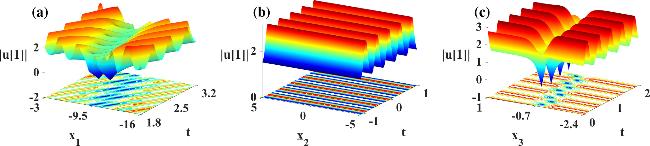
Figure 1. Propagation and contour plots for nonlinear wave solution ( |
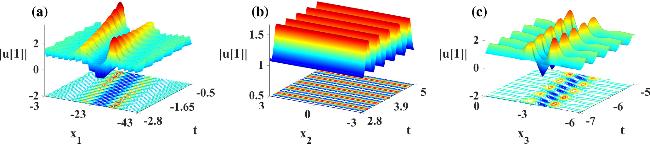
Figure 2. Propagation and contour plots for nonlinear wave solution ( |
3.2. The periodic background solutions for the gKP equation based on the elliptic cube roots
For case 2 in the above section, the elliptic cube roots of unity and associated eigenfunctions of the linear spectral problem [39, 41] should be considered, from which the properties (5 ) under M = 3 can be simplified as
$\begin{eqnarray}\begin{array}{l}{a}_{1}+{a}_{1}+{a}_{3}\equiv 0\,({\rm{m}}{\rm{o}}{\rm{d}}\,{\rm{period\, lattice}}),\\ \zeta ({a}_{1})+\zeta ({a}_{2})+\zeta ({a}_{3})=0,\\ {\wp }^{{\prime} }({a}_{1})={\wp }^{{\prime} }({a}_{2})={\wp }^{{\prime} }({a}_{3}),\end{array}\end{eqnarray}$
and the corresponding eigenfunction ${\varphi }_{{\lambda }_{1}}$ can be depicted as $\begin{eqnarray}{\varphi }_{{\lambda }_{1}}={C}_{1,1}{\varphi }_{{\lambda }_{1,1}}+{C}_{1,2}{\varphi }_{{\lambda }_{1,2}}+{C}_{1,3}{\varphi }_{{\lambda }_{1,3}}.\end{eqnarray}$
Then, the nonlinear wave solutions for the gKP equation (1 ) on the Weierstrass elliptic function (9 ) periodic background can be inferred as
$\begin{eqnarray}u[1]=\frac{{G}_{1}}{{D}_{1}},\end{eqnarray}$
in which, $\begin{eqnarray*}\begin{array}{rcl}{G}_{1} & = & ({C}_{11}\sigma (\eta +{\alpha }_{11})({(\zeta (\eta +{\alpha }_{11})-\zeta ({\alpha }_{11}))}^{2}\\ & & -\wp (\eta +{\alpha }_{11})){\rm{\exp }}({\iota }_{11})+{C}_{12}\sigma (\eta +{\alpha }_{12})\\ & & \times ({(\zeta (\eta +{\alpha }_{12})-\zeta ({\alpha }_{12}))}^{2}-\wp (\eta +{\alpha }_{12}))\\ & & \times {\rm{\exp }}({\iota }_{12})+{C}_{13}\sigma (\eta +{\alpha }_{13})((\zeta (\eta +{\alpha }_{13})\\ & & -\zeta ({\alpha }_{13}){)}^{2}-\wp (\eta +{\alpha }_{13})){\rm{\exp }}({\iota }_{13}))\\ & & \times ({C}_{11}\sigma (\eta +{\alpha }_{11}){\rm{\exp }}({\iota }_{11})+{C}_{12}\sigma (\eta +{\alpha }_{12})\\ & & \times {\rm{\exp }}({\iota }_{12})+{C}_{13}\sigma (\eta +{\alpha }_{13}){\rm{\exp }}({\iota }_{13}))\\ & & +({C}_{11}\sigma (\eta +{\alpha }_{11})(\wp (\eta +{\alpha }_{11})-\wp ({\alpha }_{11})){\rm{\exp }}({\iota }_{11})\\ & & +{C}_{12}\sigma (\eta +{\alpha }_{12})(\wp (\eta +{\alpha }_{12})-\wp ({\alpha }_{12})){\rm{\exp }}({\iota }_{12})\\ & & +{C}_{13}\sigma (\eta +{\alpha }_{13})(\wp (\eta +{\alpha }_{13})-\wp ({\alpha }_{13})){\rm{\exp }}({\iota }_{13}){)}^{2},\\ {D}_{1} & = & ({C}_{11}\sigma (\eta +{\alpha }_{11}){\rm{\exp }}({\iota }_{11})+{C}_{12}\sigma (\eta +{\alpha }_{12}){\rm{\exp }}({\iota }_{12})\\ & & +{C}_{13}\sigma (\eta +{\alpha }_{13}){\rm{\exp }}({\iota }_{13}){)}^{2},\end{array}\end{eqnarray*}$
By selecting varied parameter values for λ, C1,j(j = 1, 2, 3), and ωi(i = 1, 2, …, n), one can create unique and intriguing nonlinear wave solutions. The propagation of the breather wave (28 ) over different spatial variables x1, x2, and x3 with respect to the time variable t when g2 = 3, g3 = 1 and the corresponding contour plots are shown in figures 3 and 4. It can be observed that assigning different values of λ can yield different types of nonlinear wave solutions. Solution (28 ) displays the behavior of the bright breather wave on the Weierstrass elliptic function periodic background in all three different dimensions in figure 3 while shows the behavior of dark breather wave on the Weierstrass elliptic function periodic background in figure 4. The periodic background waves of figures 3(a) and 4(a) move along the x1-t direction, while the periodic background waves of figures 3(b)(c) and 4(b)(c) move along the t-axis. In addition, it is noticed in figure 4 that there is a difference in height on both sides of the breather wave. Additionally, setting different parameters allow for the generation of unique spatial variables xi(i = 4, …, n), which correspond to the situation at time t, providing a range of physical explanations in different physical scenarios.
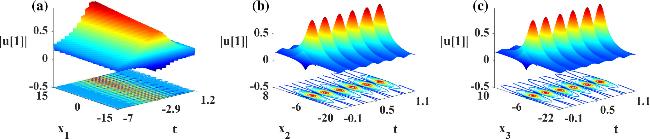
Figure 3. Propagation and contour plots for nonlinear wave solution ( |
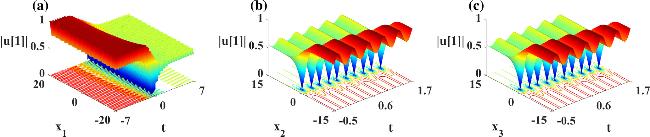
Figure 4. Propagation and contour plots for nonlinear wave solution ( |
4. Degenerate solutions
In this section, we focus on the degeneration of the Weierstrass elliptic functions with double periods of 2ω1 and 2ω2, which degenerates into hyperbolic functions. It can be verified that the values of the Weierstrass elliptic function ℘(x) at the half-periods ω1, ω2 and ω1 + ω2, that is, 8 ) [41]. In the following, we consider the degenerate solutions of the solutions (25 ) and (28 ) in this limiting case.
$\begin{eqnarray}\wp ({\omega }_{1})={e}_{1},\quad \wp ({\omega }_{1}+{\omega }_{2})={e}_{2},\quad \wp ({\omega }_{2})={e}_{3},\end{eqnarray}$
are three roots of equation (When the invariants g2 and g3 are taken as g2 = 12, g3 = − 8, that is the real period ω1 is infinitely large and the imaginary period ω2 is finite, the Weierstrass functions degenerate to 31 ) degenerates into the nonlinear waves on the plane wave background, whose expressions, can be derived by direct computation, are omitted here for brevity.
$\begin{eqnarray}\begin{array}{rcl}\sigma (x) & = & \frac{\sinh (\sqrt{3}x){{\rm{e}}}^{-\frac{{x}^{2}}{2}}}{\sqrt{3}},\\ \zeta (x) & = & -x+\sqrt{3}\coth (\sqrt{3}x),\\ \wp (x) & = & 1+3{{\rm{csch}}}^{2}(\sqrt{3}x),\end{array}\end{eqnarray}$
under which the seed solution u = − 2℘(η) − c/6β degenerate to the hyperbolic function $\begin{eqnarray}u=-6{{\rm{csch}}}^{2}(\sqrt{3}x)-2-c/3\beta .\end{eqnarray}$
Thus, the nonlinear waves on the Weierstrass elliptic function periodic background (Figures 5 and 6 depict the evolution of the solution (25 ) in x1-t, x2-t and x3-t space for different values of λ taken after the degeneracy, from which it can be observed that the breather wave (25 ) on the periodic background transforms to a two-soliton wave on the constant background. The evolution of nonlinear waves in x1-t and x2-t space demonstrates the characteristics of the soliton molecule, and this two-soliton solution interacts with each other in x3-t space when the spectral parameter is taken as λ = 3.8. The propagation of the nonlinear wave in the x1-t and x3-t space illustrates the two-soliton collision phenomenon and moves parallel along the x2 axis in x2-t space under the spectral parameter λ = 0.2.
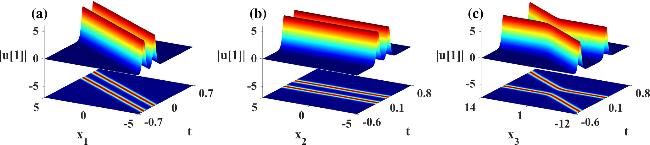
Figure 5. Propagation and density plots for the degenerate solution of nonlinear wave solution ( |
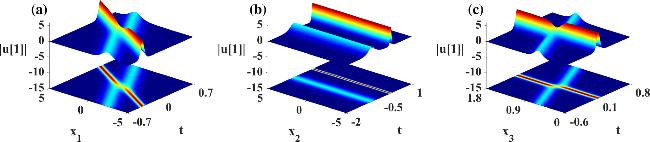
Figure 6. Propagation and density plots for the degenerate solution of nonlinear wave solution ( |
The evolution for the solution (28 ) in the x1-t, x2-t, and x3-t space for various λ values after degeneracy is illustrated in figures 7 and 8, from which it can be witnessed that the breather wave (28 ) on the Weierstrass elliptic function periodic background transforms into a three-soliton wave after degeneracy. Figures 7 and 8 both illustrate the three-soliton interaction, and the corresponding characteristic splitting and coalescence of soliton energies can be observed during the interaction.
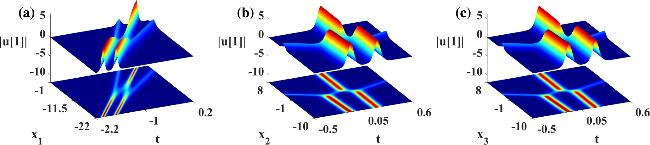
Figure 7. Propagation and density plots for the degenerate solution of nonlinear wave solution ( |
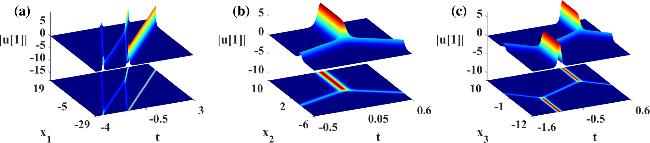
Figure 8. Propagation and density plots for the degenerate solution of nonlinear wave solution ( |
Comparing figures 5 and 7, it can be summarized that the degenerate solution obtained after construction by elliptic square root (M = 2) is a two-soliton solution, and the degenerate solution obtained by elliptic cube root (M = 3) is a three-soliton solution. In order to numerically verify the stability of nonlinear wave solutions, we take the degenerate solutions of nonlinear wave solutions (25) and (28) as examples and conduct numerical simulations using the finite difference method. Figure 9 shows the evolution for the degenerate solutions of nonlinear wave solutions (25 ) (the initial condition is taken as t = 0) and (28 ) (the initial condition is taken as t = − 2) with spatial variable x1 at three different time points. The numerical validation of other solutions, as well as more numerical solutions, and even data-driven solutions obtained from the physics informed neural network, are our next research topics to overcome the difficulty of constructing exact solutions on periodic backgrounds.
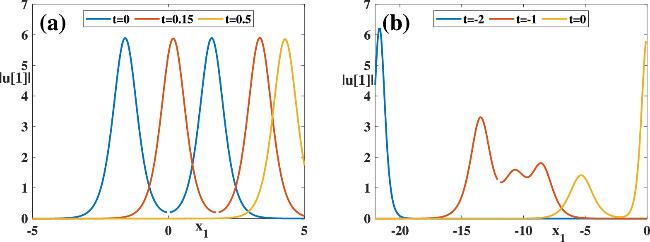


Figure 9. Propagation for the degenerate solutions of nonlinear wave solutions (a) ( |
5. Conclusions and discussions
The investigation of nonlinear waves and their underlying physical dynamics on the periodic background, especially elliptic function periodic wave background, has attracted increasing attentions. Although the computational complexity has greatly increased, nonlinear waves on periodic backgrounds have extremely rich dynamical properties and can better characterize physical reality.
In this paper, the eigenfunctions for the linear spectral problem corresponding to the gvcKP equation (1 ), with the Weierstrass function as the external potential, are constructed based on the Lamé function, from which some interesting physical meaningful nonlinear waves for the gvcKP equation (1 ) are derived by DT method. The methodology presented here exhibits a degree of generality, which can be generalized to a wide range of other soliton equations, provided the spatial part of the associated linear spectral problem is of the same form as equation (2b ). Of course, there are still a number of issues that need to be addressed and further investigation is needed. Is it possible to develop a more systematic and efficient methodology for constructing generalized solutions to linear spectral problems? Can these problems be examined under broader conditions, thereby enabling the formulation of a wider spectrum of nonlinear wave solutions with practical significance? Furthermore, is it feasible to address other linear spectral problems utilizing Weierstrass elliptic functions as coefficients, particularly those that incorporate higher-order terms, thus facilitating the solutions of a wider range soliton models characterized by higher-order dispersion and nonlinear effects? These topics are currently under consideration for investigation in the near future.