


1. Introduction
The existence of dark matter (DM) has been supported by cosmological and astrophysical observations [1]. However, its properties, including its mass and interactions, are still elusive. The majority of the current DM direct detection (DD) experiments search for nuclear recoil signals from the scatterings between the DM particles and target nucleus. Stringent constraints on the DM-nucleon scattering cross section have been established for DM particles with masses above ${ \mathcal O }(1\,{\rm{GeV}})$ through DD experiments. However, the search for light DM particles with masses below ${ \mathcal O }(1\,{\rm{GeV}})$ is generally challenging. Since the typical detection threshold of the current experiments is ${ \mathcal O }({\rm{k}}eV)$, the low kinetic energy of light DM particles leads to nuclear recoil energy that is significantly below this threshold. To address this limitation, inelastic processes are taken into account, for instance, bremsstrahlung processes [2] and the Migdal effect [3–8]. Nevertheless, even with the improvement from inelastic processes, current experimental constraints are primarily sensitive to DM particles with masses above the 40 MeV scale [9–13]. For lighter MeV scale DM particles, meaningful constraints require considerations like boosted DM scenarios [14–26] or innovative experimental approaches [27].
There are several acceleration mechanisms of light DM discussed in the literature. Among them, the cosmic rays (CRs) boosted dark matter (CRDM) is an interesting scenario [15, 20], where light sub-GeV DM particles up-scattered by high-energy CRs can be energetic and become detectable by conventional DM direct detection experiments [17, 19, 28, 29]. For non-relativistic DM, the cross section of DM scattering with nucleons is often assumed to be momentum independent. However, when the mediator mass is lower than the transferred momentum, the full propagator should be included in the scattering cross section to obtain the more accurate results. The sub-GeV CRDM framework has been investigated in previous studies [21, 30] through simplified models incorporating various mediator types, including scalar, pseudoscalar, vector, axial-vector, and gravitational mediators. However, all such constraints are necessarily model-dependent, whereas effective operators [31] provide a complementary model-independent computational framework for light DM direct detection.
If the incoming DM and target nucleons/electrons are non-relativistic, the DM-nucleus and DM-atom scattering can both be well described by the non-relativistic (NR) effective operators. Concerning the DM direct detection experiments, the NR effective operators for scalar and fermionic DM-nucleon/electron scattering have been systematically investigated in [32–38]. For vector DM case, the NR interactions induced in some simplified models were discussed in [39–41]. Recently, [42, 43] have considered the possibility that the DM particle may have spin-3/2. Although the NR effective operators provide reliable frameworks for describing non-relativistic DM scattering processes, the application of NR effective operators may encounter limitations in certain scenarios. For instance, in the CRDM scenario, DM exhibits relativistic behavior while nuclei remain non-relativistic; the relativistic properties of DM should be taken into account in the calculations.
In this work, we systematically investigate relativistic DM-nucleus spin-independent scattering. Previous studies on spin-independent DM scattering have considered the most general basis of NR effective operators for DM-nucleus interactions, encompassing DM particles with spin up to 3/2 [38, 42–44]. In this work, we extend this framework by constructing the most general operator basis for relativistic DM-nucleus interactions, including DM particles with spin up to 2. These operators can be generated from Lorentz-invariant interactions in various DM scenarios. Subsequently, we implement these operators within the CRDM framework to calculate the CRDM flux and the nuclear recoil event rate. Finally, based on this theoretical framework, we set stringent constraints on the CRDM-nucleon scattering cross section for sub-GeV DM using nuclear recoil data from the LZ experiment.
This work is organized as follows: in section 2 , we introduce relativistic operators for DM direct detection. In section 3 , we briefly review the production mechanisms of CRDM and the formalism for calculating the CRDM flux. We then discuss nuclear recoil event spectrum and data analysis process from LZ direct detection experiment in section 4 . The constraints on these operators from LZ data are also given in section 4 . We summarize the work and give some remarks in section 5 .
2. Relativistic operators for DM-nucleus interactions
In the framework of DM direct detection, the elastic scattering process between DM particles and target nuclei constitutes a fundamental interaction mechanism that determines the event rates observable in detectors. To systematically analyze this process, we usually classify the possible dark matter-nucleus interaction into the spin-independent (SI) cross section and spin-dependent (SD) ones. We mainly focus on SI elastic scattering cases. The DM particles χ scatter off a target nucleus χ(p1) + N(p2) → χ(p3) + N(p4) via exchanging a mediator particle φ. The dominant effective interaction operators governing SI elastic scattering processes take the form
$\begin{eqnarray}{O}_{i}=\frac{1}{{q}^{2}+{m}_{\phi }^{2}}(\bar{\chi }{\rm{\Gamma }}\chi )(\bar{N}{{\rm{\Gamma }}}^{{\prime} }N),\end{eqnarray}$
where q = ∣q∣ = ∣p1 − p3∣ is the 3-momentum transfer. The matrices ${\rm{\Gamma }},{{\rm{\Gamma }}}^{{\prime} }$ are written as $\begin{eqnarray}{\rm{\Gamma }},{{\rm{\Gamma }}}^{{\prime} }=\{{\bf{1}},{\gamma }^{5},{\gamma }^{\mu },{\gamma }^{\mu }{\gamma }^{5},{\sigma }^{\mu \nu }\}.\end{eqnarray}$
Previous studies have mainly focused on spin-1/2 and spin-1 DM candidates [44, 45]. We systematically investigate spin- independent effective interaction operators between different types of DM and nucleus. For example, scalar DM (complex or real scalar), spin-1/2 DM, vector DM (complex or real vector), spin-3/2 DM and spin-2 DM, respectively. For each type of DM particle, the effective operators for the DM-nucleus (χN) interaction are enumerated below.Scalar DM: If the DM particles are complex scalars (φ), possible operators up to dimension six [46] are
$\begin{eqnarray}\begin{array}{l}{O}_{1}^{(5)}=\frac{2{m}_{\chi }}{{q}^{2}+{m}_{\phi }^{2}}{\phi }^{\dagger }\phi \bar{N}N,\\ {O}_{2}^{(6)}=\frac{1}{{q}^{2}+{m}_{\phi }^{2}}({\phi }^{\dagger }{\overleftrightarrow{\partial }}_{\mu }\phi )\bar{N}{\gamma }^{\mu }N,\end{array}\end{eqnarray}$
where, the double arrow derivative is defined as $A{\overleftrightarrow{\partial }}_{\mu }B\equiv A({\partial }_{\mu }B)-({\partial }_{\mu }A)B$. For real scalar DM particle, the vector operators ${O}_{2}^{(6)}$ vanish.Spin-1/2 DM: For spin-1/2 DM particles (χ), up to dimension seven [38], the operators are written as
$\begin{eqnarray}\begin{array}{rcl}{O}_{3}^{(6)} & = & \frac{1}{{q}^{2}+{m}_{\phi }^{2}}\bar{\chi }\chi \bar{N}N,\\ {O}_{4}^{(6)} & = & \frac{1}{{q}^{2}+{m}_{\phi }^{2}}\bar{\chi }{\gamma }_{5}\chi \bar{N}N,\\ {O}_{5}^{(6)} & = & \frac{1}{{q}^{2}+{m}_{\phi }^{2}}\bar{\chi }{\gamma }_{\mu }\chi \bar{N}{\gamma }^{\mu }N,\\ {O}_{6}^{(6)} & = & \frac{1}{{q}^{2}+{m}_{\phi }^{2}}\bar{\chi }{\gamma }_{\mu }{\gamma }_{5}\chi \bar{N}{\gamma }^{\mu }N,\\ {O}_{7}^{(7)} & = & \frac{1}{{q}^{2}+{m}_{\phi }^{2}}{\partial }_{\mu }(\bar{\chi }{\sigma }^{\mu \nu }\chi )\bar{N}{\gamma }^{\nu }N,\\ {O}_{8}^{(7)} & = & \frac{1}{{q}^{2}+{m}_{\phi }^{2}}{\partial }_{\mu }(\bar{\chi }{\sigma }^{\mu \nu }{\gamma }_{5}\chi )\bar{N}{\gamma }^{\nu }N,\end{array}\end{eqnarray}$
in which, ${\sigma }^{\mu \nu }=\frac{i}{2}[{\gamma }^{\mu },{\gamma }^{\nu }]$. If the DM particles are Majorana ($\bar{\chi }=\chi $), the vector and tensor operators are vanishing identically.Vector DM: For the vector DM (Vμ), we consider separately two cases: when the DM field is represented by the four-vector potential Vμ or by the field strength tensor Vμν = ∂μVν − ∂νVμ. Here we will mainly list the operators of dimension-five, dimension six and dimension seven.
$\begin{eqnarray}\begin{array}{l}{O}_{9}^{(5)}=\frac{2{m}_{\chi }}{{q}^{2}+{m}_{\phi }^{2}}{V}_{\mu }^{\dagger }{V}^{\mu }\bar{N}N,\\ {O}_{10}^{(6)}=\frac{1}{{q}^{2}+{m}_{\phi }^{2}}({V}_{\nu }^{\dagger }{\overleftrightarrow{\partial }}_{\mu }{V}^{\nu })\bar{N}{\gamma }^{\mu }N,\end{array}\end{eqnarray}$
$\begin{eqnarray}\begin{array}{l}{O}_{11}^{(6)}=\frac{1}{{q}^{2}+{m}_{\phi }^{2}}({\epsilon }^{\mu \nu \rho \sigma }{V}_{\nu }^{\dagger }{\overleftrightarrow{\partial }}_{\rho }{V}_{\sigma })\bar{N}{\gamma }^{\mu }N,\\ {O}_{12}^{(7)}=\frac{1}{{q}^{2}+{m}_{\phi }^{2}}\frac{1}{{m}_{\chi }}{V}_{\mu \nu }^{\dagger }{\tilde{V}}^{\mu \nu }\bar{N}N,\\ {O}_{13}^{(7)}=\frac{1}{{q}^{2}+{m}_{\phi }^{2}}\frac{1}{{m}_{\chi }}{V}_{\mu \nu }^{\dagger }{V}^{\mu \nu }\bar{N}N.\end{array}\end{eqnarray}$
For real vector DM particle, the vector operators ${O}_{10}^{(6)}$ and ${O}_{11}^{(6)}$ vanish.Spin-3/2 DM: The most general operators for the spin-3/2 DM ($\Psi$) can be written as [42]
$\begin{eqnarray}\begin{array}{l}{O}_{14}^{(6)}=\frac{1}{{q}^{2}+{m}_{\phi }^{2}}{\bar{{\rm{\Psi }}}}_{\mu }{{\rm{\Psi }}}^{\mu }\bar{N}N,\\ {O}_{15}^{(6)}=\frac{1}{{q}^{2}+{m}_{\phi }^{2}}{\bar{{\rm{\Psi }}}}_{\mu }{\gamma }_{5}{{\rm{\Psi }}}^{\mu }\bar{N}N,\\ {O}_{16}^{(6)}=\frac{1}{{q}^{2}+{m}_{\phi }^{2}}{\bar{{\rm{\Psi }}}}_{\nu }{\gamma }_{\mu }{{\rm{\Psi }}}^{\nu }\bar{N}{\gamma }^{\mu }N,\\ {O}_{17}^{(6)}=\frac{1}{{q}^{2}+{m}_{\phi }^{2}}{\bar{{\rm{\Psi }}}}_{\nu }{\gamma }_{\mu }{\gamma }_{5}{{\rm{\Psi }}}^{\nu }\bar{N}{\gamma }^{\mu }N,\\ {O}_{18}^{(7)}=\frac{1}{{q}^{2}+{m}_{\phi }^{2}}{\partial }_{\mu }({\bar{{\rm{\Psi }}}}_{\rho }{\sigma }^{\mu \nu }{{\rm{\Psi }}}^{\rho })\bar{N}{\gamma }^{\nu }N,\\ {O}_{19}^{(7)}=\frac{1}{{q}^{2}+{m}_{\phi }^{2}}{\partial }_{\mu }({\bar{{\rm{\Psi }}}}_{\rho }{\sigma }^{\mu \nu }{\gamma }_{5}{{\rm{\Psi }}}^{\rho })\bar{N}{\gamma }^{\nu }N.\end{array}\end{eqnarray}$
Spin-2 DM: Similarly, for spin-2 DM particles (Tμν), let us consider a typical scenario as an illustration
$\begin{eqnarray}{O}_{20}^{(7)}=\frac{2{m}_{\chi }}{{q}^{2}+{m}_{\phi }^{2}}{T}_{\mu \nu }{T}^{\mu \nu }\bar{N}N.\end{eqnarray}$
Throughout this work, for simplicity, we assume that one of the operators dominates the scattering processes at a time. It is straightforward to extend the analysis to the processes involving multiple operators simultaneously.In the relativistic limit, the differential cross section for χN elastic scattering can be written as A .
$\begin{eqnarray}\frac{{\rm{d}}{\sigma }_{\chi N}}{{\rm{d}}{q}^{2}}=\frac{\overline{| {M}_{\chi N}{| }^{2}}}{16\pi [{(s-{m}_{\chi }^{2}-{m}_{N}^{2})}^{2}-4{m}_{\chi }^{2}{m}_{N}^{2}]},\end{eqnarray}$
where $\overline{| {M}_{\chi N}{| }^{2}}$ is the squared matrix element averaged over the spins of initial states, $s={({m}_{N}+{m}_{\chi })}^{2}+2{m}_{N}{T}_{\chi }$ is the center-of-mass energy squared (CMS) of the process and q2 = 2mNTN. In this work, we mainly focus on analyzing scattering cross sections dσχN/dTN that converge to the non-relativistic limit, while the results of scattering cross sections for other effective interaction operators are shown in appendix $\begin{eqnarray}\begin{array}{rcl}{\left(\frac{{\rm{d}}{\sigma }_{\chi N}}{{\rm{d}}{T}_{N}}\right)}_{{O}_{1}^{(5)}} & = & \frac{{\sigma }_{\chi N}^{{\rm{SI,NR}}}}{4{\mu }_{\chi N}^{2}s{T}_{N}^{{\rm{\max }}}}\frac{{m}_{\phi }^{4}}{{({q}^{2}+{m}_{\phi }^{2})}^{2}}\\ & & \times {m}_{\chi }^{2}({q}^{2}+4{m}_{N}^{2})\times {G}_{N}^{2}({q}^{2}),\end{array}\end{eqnarray}$
$\begin{eqnarray}\begin{array}{rcl}{\left(\frac{{\rm{d}}{\sigma }_{\chi N}}{{\rm{d}}{T}_{N}}\right)}_{{O}_{2}^{(6)}} & = & \frac{{\sigma }_{\chi N}^{{\rm{SI,NR}}}}{4{\mu }_{\chi N}^{2}s{T}_{N}^{{\rm{\max }}}}\frac{{m}_{\phi }^{4}}{{({q}^{2}+{m}_{\phi }^{2})}^{2}}\\ & & \times [{m}_{N}^{2}{q}^{2}-{q}^{2}s+{(s-{m}_{N}^{2}-{m}_{\chi }^{2})}^{2}]\\ & & \times {G}_{N}^{2}({q}^{2}),\end{array}\end{eqnarray}$
$\begin{eqnarray}\begin{array}{rcl}{\left(\frac{{\rm{d}}{\sigma }_{\chi N}}{{\rm{d}}{T}_{N}}\right)}_{{O}_{3}^{(6)}} & = & \frac{{\sigma }_{\chi N}^{{\rm{SI,NR}}}}{16{\mu }_{\chi N}^{2}s{T}_{N}^{{\rm{\max }}}}\frac{{m}_{\phi }^{4}}{{({q}^{2}+{m}_{\phi }^{2})}^{2}}\\ & & \times ({q}^{2}+4{m}_{\chi }^{2})({q}^{2}+4{m}_{N}^{2})\times {G}_{N}^{2}({q}^{2}),\end{array}\end{eqnarray}$
$\begin{eqnarray}\begin{array}{rcl}{\left(\frac{{\rm{d}}{\sigma }_{\chi N}}{{\rm{d}}{T}_{N}}\right)}_{{O}_{5}^{(6)}} & = & \frac{{\sigma }_{\chi N}^{{\rm{SI,NR}}}}{4{\mu }_{\chi N}^{2}s{T}_{N}^{{\rm{\max }}}}\frac{{m}_{\phi }^{4}}{{({q}^{2}+{m}_{\phi }^{2})}^{2}}\\ & & \times [\frac{1}{2}{q}^{4}-{q}^{2}s+{(s-{m}_{N}^{2}-{m}_{\chi }^{2})}^{2}]\times {G}_{N}^{2}({q}^{2}),\end{array}\end{eqnarray}$
$\begin{eqnarray}\begin{array}{rcl}{\left(\frac{{\rm{d}}{\sigma }_{\chi N}}{{\rm{d}}{T}_{N}}\right)}_{{O}_{9}^{(5)}} & = & \frac{{\sigma }_{\chi N}^{{\rm{SI,NR}}}}{12{\mu }_{\chi N}^{2}s{T}_{N}^{{\rm{\max }}}}\frac{{m}_{\phi }^{4}}{{({q}^{2}+{m}_{\phi }^{2})}^{2}}\\ & & \times \frac{\left[\frac{{q}^{4}}{4}+{m}_{\chi }^{2}{q}^{2}+3{m}_{\chi }^{4}\right]}{{m}_{\chi }^{2}}({q}^{2}+4{m}_{N}^{2})\\ & & \times {G}_{N}^{2}({q}^{2}),\end{array}\end{eqnarray}$
$\begin{eqnarray}\begin{array}{rcl}{\left(\frac{{\rm{d}}{\sigma }_{\chi N}}{{\rm{d}}{T}_{N}}\right)}_{{O}_{10}^{(6)}} & = & \frac{{\sigma }_{\chi N}^{{\rm{SI,NR}}}}{12{\mu }_{\chi N}^{2}s{T}_{N}^{{\rm{\max }}}}\frac{{m}_{\phi }^{4}}{{({q}^{2}+{m}_{\phi }^{2})}^{2}}\\ & & \times \frac{\left[\frac{{q}^{4}}{4}+{m}_{\chi }^{2}{q}^{2}+3{m}_{\chi }^{4}\right]}{{m}_{\chi }^{4}}[{m}_{N}^{2}{q}^{2}-{q}^{2}s\\ & & +{(s-{m}_{N}^{2}-{m}_{\chi }^{2})}^{2}]\times {G}_{N}^{2}({q}^{2}),\end{array}\end{eqnarray}$
$\begin{eqnarray}\begin{array}{rcl}{\left(\frac{{\rm{d}}{\sigma }_{\chi N}}{{\rm{d}}{T}_{N}}\right)}_{{O}_{13}^{(7)}} & = & \frac{{\sigma }_{\chi N}^{{\rm{SI,NR}}}}{12{\mu }_{\chi N}^{2}s{T}_{N}^{{\rm{\max }}}}\frac{{m}_{\phi }^{4}}{{({q}^{2}+{m}_{\phi }^{2})}^{2}}\\ & & \times \frac{\left[\frac{{q}^{4}}{2}+2{m}_{\chi }^{2}{q}^{2}+3{m}_{\chi }^{4}\right]}{{m}_{\chi }^{2}}\\ & & \times ({q}^{2}+4{m}_{N}^{2})\times {G}_{N}^{2}({q}^{2}),\end{array}\end{eqnarray}$
$\begin{eqnarray}\begin{array}{rcl}{\left(\frac{{\rm{d}}{\sigma }_{\chi N}}{{\rm{d}}{T}_{N}}\right)}_{{O}_{14}^{(6)}} & = & \frac{{\sigma }_{\chi N}^{{\rm{SI,NR}}}}{8{\mu }_{\chi N}^{2}s{T}_{N}^{{\rm{\max }}}}\frac{{m}_{\phi }^{4}}{{({q}^{2}+{m}_{\phi }^{2})}^{2}}\\ & & \times [2{m}_{\chi }^{2}+\frac{7}{6}{q}^{2}+\frac{5}{18{m}_{\chi }^{2}}{q}^{4}+\frac{1}{36{m}_{\chi }^{4}}{q}^{6}]\\ & & \times ({q}^{2}+4{m}_{N}^{2})\times {G}_{N}^{2}({q}^{2}),\end{array}\end{eqnarray}$
$\begin{eqnarray}\begin{array}{rcl}{\left(\frac{{\rm{d}}{\sigma }_{\chi N}}{{\rm{d}}{T}_{N}}\right)}_{{O}_{16}^{(6)}} & = & \frac{{\sigma }_{\chi N}^{{\rm{SI,NR}}}}{8{\mu }_{\chi N}^{2}s{T}_{N}^{{\rm{\max }}}}\frac{{m}_{\phi }^{4}}{{({q}^{2}+{m}_{\phi }^{2})}^{2}}\\ & & \times [{m}_{N}^{2}{q}^{2}-{q}^{2}s+{(s-{m}_{N}^{2}-{m}_{\chi }^{2})}^{2}]\\ & & \times [\frac{2{m}_{\chi }^{4}+\frac{4}{9}{m}_{\chi }^{2}{q}^{2}+\frac{1}{9}{q}^{4}}{{m}_{\chi }^{4}}-\frac{1}{18{m}_{\chi }^{4}}\\ & & \times \frac{{q}^{2}({q}^{2}-2{m}_{N}^{2})(10{m}_{\chi }^{4}+4{m}_{\chi }^{2}{q}^{2}+{q}^{4})}{-{(s-{m}_{\chi }^{2}-{m}_{N}^{2})}^{2}+{q}^{2}(s-{m}_{\chi }^{2}-{m}_{N}^{2})+{m}_{\chi }^{2}{q}^{2}}]\\ & & \times {G}_{N}^{2}({q}^{2}),\end{array}\end{eqnarray}$
$\begin{eqnarray}\begin{array}{rcl}{\left(\frac{{\rm{d}}{\sigma }_{\chi N}}{{\rm{d}}{T}_{N}}\right)}_{{O}_{20}^{(7)}} & = & \frac{{\sigma }_{\chi N}^{{\rm{SI,NR}}}}{8{\mu }_{\chi N}^{2}s{T}_{N}^{{\rm{\max }}}}\frac{{m}_{\phi }^{4}}{{({q}^{2}+{m}_{\phi }^{2})}^{2}}\\ & & \times \left[2{m}_{\chi }^{2}+\frac{4}{3}{q}^{2}+\frac{23}{45{m}_{\chi }^{2}}{q}^{4}+\frac{4}{45{m}_{\chi }^{4}}{q}^{6}\right.\\ & & +\left.\frac{1}{90{m}_{\chi }^{6}}{q}^{8}\right]({q}^{2}+4{m}_{N}^{2})\times {G}_{N}^{2}({q}^{2}),\end{array}\end{eqnarray}$
where the maximum recoil energy of the target nucleus is given by $\begin{eqnarray}{T}_{N}^{{\rm{\max }}}=\frac{2{m}_{N}{T}_{\chi }({T}_{\chi }+2{m}_{\chi })}{{({m}_{\chi }+{m}_{N})}^{2}+2{m}_{N}{T}_{\chi }},\end{eqnarray}$
μχN is the reduced mass of the DM/nucleus system. ${G}_{N}^{2}({q}^{2})$ is form factor, for proton and helium, we take the dipole form factor [47]. For heavier nuclei we adopt the conventional Helm form factor [48, 49]. ${\sigma }_{\chi N}^{{\rm{SI,NR}}}={g}_{\chi }^{2}{g}_{N}^{2}{\mu }_{{\rm{\chi N}}}^{2}/\pi {m}_{\phi }^{4}$ is the spin-independent scattering DM-nucleus cross section in the ultra non-relativistic limit. The relationship between the nuclear cross section ${\sigma }_{\chi N}^{{\rm{SI,NR}}}$ and the nucleon cross section σχp is denoted as $\begin{eqnarray}{\sigma }_{\chi N}^{{\rm{SI,NR}}}={A}^{2}{\sigma }_{\chi p}{\left(\frac{{m}_{N}({m}_{\chi }+{m}_{p})}{{m}_{p}({m}_{\chi }+{m}_{N})}\right)}^{2}.\end{eqnarray}$
Clearly, considering different types of DM effective operators is more dependent on q compared to scenarios with constant cross sections $\begin{eqnarray}\frac{{\rm{d}}{\sigma }_{\chi N}}{{\rm{d}}{T}_{N}}=\frac{{\sigma }_{\chi N}^{{\rm{SI,NR}}}}{{T}_{N}^{{\rm{\max }}}}\times {G}_{N}^{2}({q}^{2}).\end{eqnarray}$
This implies that exploring different types of DM could offer novel insights into the DM direct detection.3. CR-upscattered dark matter flux
As talked about in the introduction, the study of light DM is crucial in direct detection. To explore some light DM scenarios, some novel detections of sub-GeV DM are proposed in the literature. In the CRDM scenario [15, 20, 21], non-relativistic DM particles in the Galactic halo are up-scattered by the energetic galactic cosmic rays (CRs) [50], then it becomes the fast-moving particle as one component of the cosmic rays. Subsequent scattering inside conventional DM detectors, as well as neutrino detectors sensitive to nuclear recoils, can give novel limits on the DM-nucleon scattering cross section below 1 GeV. In this novel DM scenarios, most direct detection experiments are limited by constant cross sections. However, the limits of the non-constant cross section to the direct detection results is not systematically considered. In the following, we chose the CRDM scenario as an example to show the application of different types of DM in direct detection experiments.
The basic mechanism we consider is the elastic scattering of CR nucleus on non-relativistic DM particles mχ in the Galactic halo. For a DM mass mχ [51, 52], this process induces a relativistic CRDM angular-averaged flux incident on Earth, as described in [15, 53]
$\begin{eqnarray}\frac{\bar{{\rm{d}}{{\rm{\Phi }}}_{\chi }}}{{\rm{d}}{T}_{\chi }}={D}_{{\rm{eff}}}\frac{{\rho }_{\chi }^{{\rm{loc}}}}{{m}_{\chi }}\displaystyle \sum _{i}{\int }_{{T}_{i}^{\min }}^{\infty }{\rm{d}}{T}_{i}\frac{{\rm{d}}{\sigma }_{\chi i}}{{\rm{d}}{T}_{\chi }}\frac{{\rm{d}}{{\rm{\Phi }}}_{i}^{{\rm{LIS}}}}{{\rm{d}}{T}_{i}},\end{eqnarray}$
where ${\rm{d}}{{\rm{\Phi }}}_{i}^{{\rm{LIS}}}/{\rm{d}}{T}_{i}$ is local interstellar (LIS) CR flux [54, 55] and i stands for the specific species of the cosmic rays. The local DM density is taken as ${\rho }_{\chi }^{{\rm{loc}}}=0.3\,{\rm{GeV}}/{{\rm{cm}}}^{3}$, and the effective distance is set to Deff = 10 kpc. For DM particles initially at rest, this requires a minimal CR energy ${T}_{i}^{{\rm{\min }}}$ of $\begin{eqnarray}{T}_{i}^{{\rm{\min }}}=\frac{-(2{m}_{i}-{T}_{\chi })+\sqrt{{(2{m}_{i}-{T}_{\chi })}^{2}+\frac{2{T}_{\chi }}{{m}_{\chi }}{({m}_{\chi }+{m}_{i})}^{2}}}{2}.\end{eqnarray}$
The dσχi/dTχ is the differential elastic scattering cross section for accelerating a DM particle to a kinetic recoil energy Tχ, and the maximum recoil energy is given by 10 )–(19 ), by replacing $s={({m}_{N}+{m}_{\chi })}^{2}+2{m}_{N}{T}_{\chi }\to s={({m}_{i}+{m}_{\chi })}^{2}\,+2{m}_{\chi }{T}_{i}$, q = 2mNTN → q = 2mχTχ.
$\begin{eqnarray}{T}_{\chi }^{{\rm{\max }}}=\frac{2{m}_{\chi }{T}_{i}({T}_{i}+2{m}_{i})}{{({m}_{i}+{m}_{\chi })}^{2}+2{m}_{\chi }{T}_{i}}.\end{eqnarray}$
The quantities dσχi/dTχ can be obtained from equations (We show the total flux (${\rm{d}}{{\rm{\Phi }}}_{\chi }/{\rm{d}}{T}_{\chi }=4\pi \bar{{\rm{d}}{{\rm{\Phi }}}_{\chi }}/{\rm{d}}{T}_{\chi }$) of different types of DM with the masses of 10 MeV and 1 GeV in figure 1 (mφ = 10 MeV) and figure 2 (mφ = 100 GeV). As shown in figure 1, when the mediator mass is lower than the momentum transfer, the propagator introduces momentum dependent terms. This induces deviations of the CRDM flux associated with different DM operators from the constant cross section assumption, regardless of whether the DM is light or heavy. Conversely, figure 2 shows that when the mediator mass exceeds the characteristic momentum transfer scale, the interaction vertices asymptotically approach the momentum independent contact interaction limit. The momentum dependent terms arise from the contributions of DM effective operators. For small kinetic energies, as expected, these fluxes are identical to the case of a constant cross section. However, in the high-energy region, it is noteworthy that only the scalar interaction cross section given by equation (10 ) of scalar DM behaves similarly to a constant cross section. Other interaction types have a notable increase, typically by several orders of magnitude.
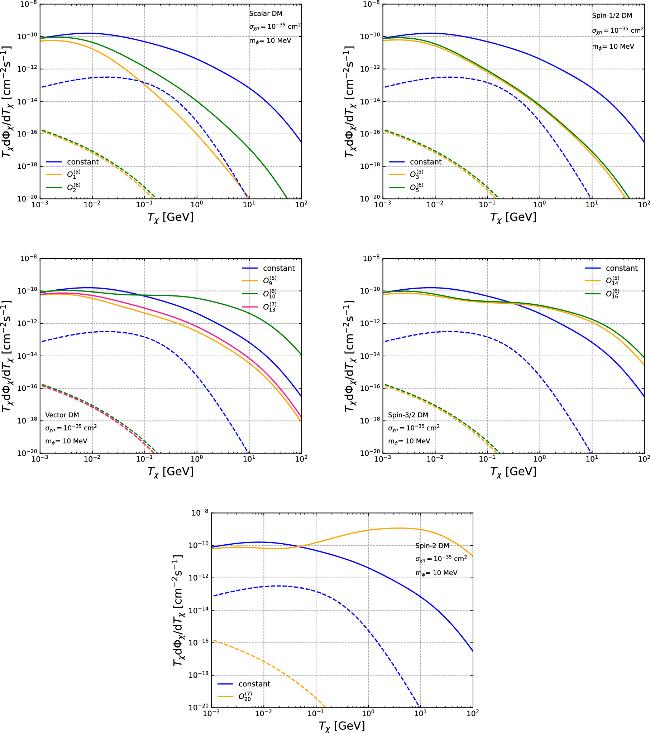
Figure 1. CRDM fluxes for scalar DM (upper left), spin-1/2 DM (upper right), vector DM (middle left), spin-3/2 DM (middle right) and spin-2 DM (lower) for DM masses mχ = 10 MeV and mχ = 1 GeV. Solid lines (dashed lines) represent the CRDM fluxes resulting from the masses of mχ = 10 MeV (mχ = 1 GeV). The DM-nucleon cross section is fixed at σχp = 10−35cm2 and the mediator mass is taken as mφ = 10 MeV. For comparison, we also show the corresponding CRDM flux for the constant cross section (blue lines). |
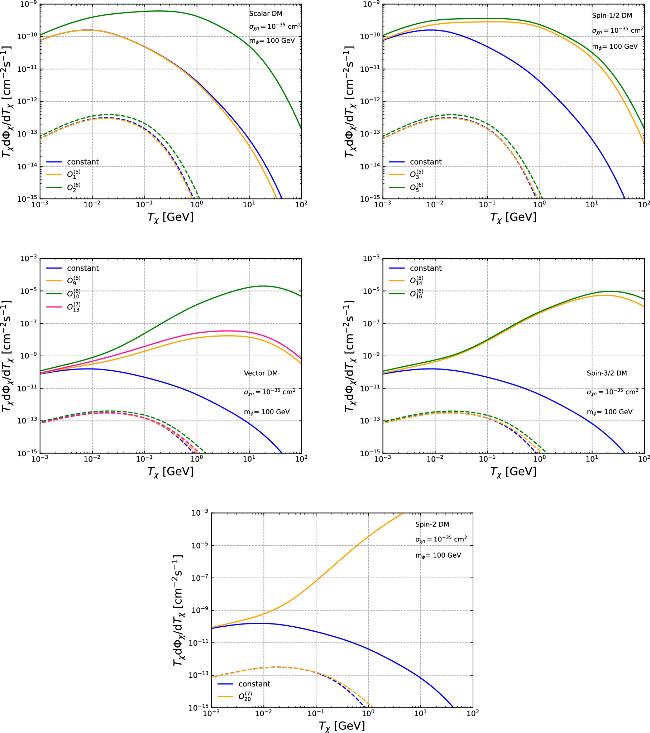
Figure 2. CRDM fluxes for scalar DM (upper left), spin-1/2 DM (upper right), vector DM (middle left), spin-3/2 DM (middle right) and spin-2 DM (lower) for DM masses mχ = 10 MeV and mχ = 1 GeV. Solid lines (dashed lines) represent the CRDM fluxes resulting from the masses of mχ = 10 MeV (mχ = 1 GeV). The DM-nucleon cross section is fixed at σχp = 10−35cm2 and the mediator mass is taken as mφ = 100 GeV. For comparison, we also show the corresponding CRDM flux for the constant cross section (blue lines). |
Before arriving at the underground detectors, CRDM particles lose energy through both elastic and inelastic scatterings with nuclei in the Earth’s crust. For relativistic dark matter, quasielastic and deep inelastic scatterings become important. Including the contribution of the inelastic scattering in the Earth attenuation effect will change the resulting upper bound on the DM- nucleus scattering by about one order of magnitude. [56, 57]. To preliminarily estimate the effect of the dark matter operators on the lower bound of the exclusion region, we consider only DM acceleration and detection processes in this work. The attenuation process of inelastic scattering will be discussed in detail in future work.
4. Constraints from LZ
4.1. Recoil event spectrum
The elastic scattering event rate of relativistic CRDM particles arriving at underground detectors is given by 10 –19 ). We adopt the numerical result of the helm form factor [49]. For elastic scattering,
$\begin{eqnarray}\frac{{\rm{d}}R}{{\rm{d}}{T}_{N}}=\frac{1}{{m}_{N}}{\int }_{{T}_{\chi }^{{\rm{\min }}}}^{\infty }\frac{{\rm{d}}{\sigma }_{\chi N}}{{\rm{d}}{T}_{N}}\frac{{\rm{d}}{{\rm{\Phi }}}_{\chi }}{{\rm{d}}{T}_{\chi }}{\rm{d}}{T}_{\chi },\end{eqnarray}$
where mN is the mass of the target nucleus, dσχN/dTN is the DM-nucleus scattering cross section given by equations ( $\begin{eqnarray}{T}_{\chi }^{{\rm{\min }}}=\frac{-(2{m}_{\chi }-{T}_{N})+\sqrt{{(2{m}_{\chi }-{T}_{N})}^{2}+\frac{2{T}_{N}}{{m}_{N}}{({m}_{N}+{m}_{\chi })}^{2}}}{2}.\end{eqnarray}$
In figures 3 and 4, we show the recoil event rates of the scattering between CRDM particles and target 132Xe nuclei with DM-nucleon cross section σχn = 10−35cm2 for mediator masses mφ = 10 MeV and mφ = 100 GeV, respectively. Each figure shows results for different DM masses mχ = 10 MeV and mχ = 1 GeV. In figures 3 and 4, the recoil event spectrum displays resonance-like features in the 100 keV to 1000 keV region, resulting from the spherical Bessel Function driven oscillations of the Helm nuclear form factor.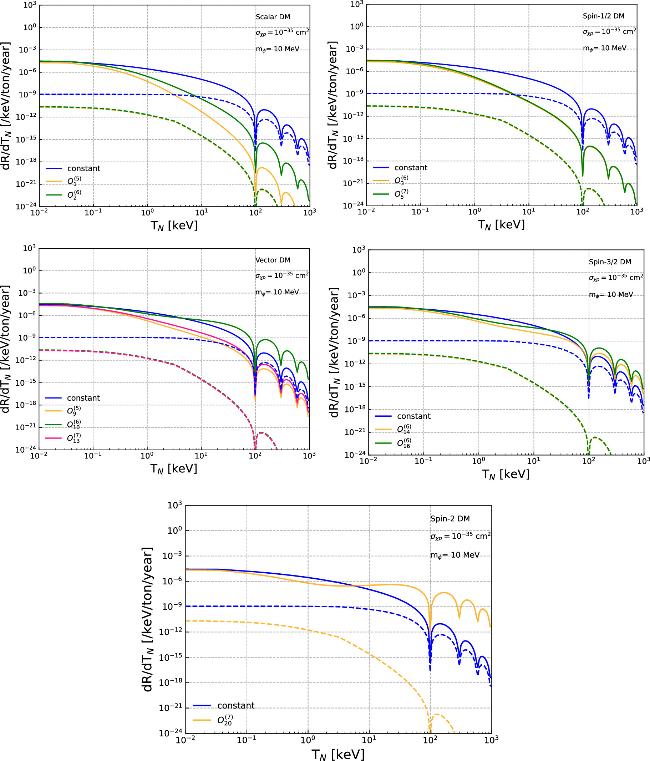
Figure 3. Recoil event rates of the scattering between CRDM particles and target 132Xe nuclei for scalar DM (upper left), spin-1/2 DM (upper right), vector DM (middle left), spin-3/2 DM (middle right) and spin-2 DM (lower) for DM masses mχ = 10 MeV and mχ = 1 GeV. Solid lines (dashed lines) represent the recoil event rates resulting from the masses of mχ = 10 MeV (mχ = 1 GeV). The DM-nucleon cross section is fixed at σχp = 10−35cm2 and the mediator mass is mφ = 10 MeV. For comparison, we also indicate the corresponding recoil rate for the constant interaction (blue lines). |
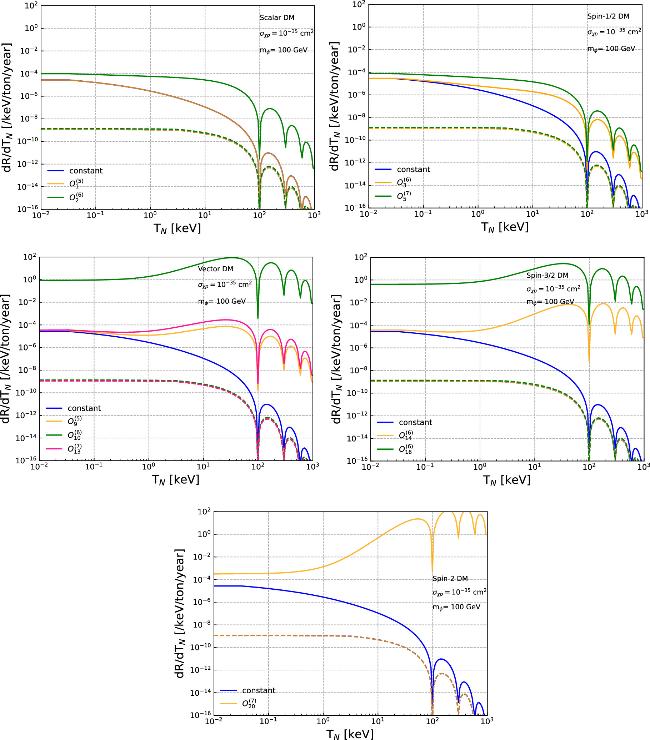
Figure 4. Recoil event rates of the scattering between CRDM particles and target 132Xe nuclei for scalar DM (upper left), spin-1/2 DM (upper right), vector DM (middle left), spin-3/2 DM (middle right) and spin-2 DM (lower) for DM masses mχ = 10 MeV and mχ = 1 GeV. Solid lines (dashed lines) represent the recoil event rates resulting from the masses of mχ = 10 MeV (mχ = 1 GeV). The DM-nucleon cross section is fixed at σχp = 10−35cm2 and the mediator mass is mφ = 100 GeV. For comparison, we also indicate the corresponding recoil rate for the constant interaction (blue lines). |
4.2. LZ detector data analysis
Currently, with the largest fiducial mass (5.5 tonnes) [58, 59] of liquid xenon in the world, the dual-phase time projection chamber detector (TPC) of the LZ experiment has the leading sensitivity to signals induced by DM-nucleus scattering for DM mass above ${ \mathcal O }(10)\,\,\rm{GeV}\,$. The LZ collaboration has set the current most stringent limits on DM-nucleon cross section for DM mass at GeV scale with an accumulated exposure of 4.2 ton-years [58].
In this work, we use the latest S1c-S2c correlated data of LZ experiment published in 2024 with an exposure of 3.3 ton-years to set limits on DM-nucleon cross section via CRDM [58]. Our data analysis methods are as follows.
We calculate the nuclear recoil spectra according to equation (26 ) and multiply them with the efficiency after the application of S2c trigger, single scattering reconstruction and analysis cut given by the LZ collaboration [58]. Then, we sample the DM signal events according to the nuclear recoil spectra with efficiency included. For each sampled recoil event, following [58], we use the publicly available code nestpy [60] to simulate the S1c-S2c signals generated in the xenon TPC detector of the LZ experiment with a setup file of nestpy provided by the LZ collaboration.
We use the binned Poisson profile likelihood ratio method to set constraints on DM-nucleon cross section. The likelihood function is given by
$\begin{eqnarray}{ \mathcal L }({\mu }_{\chi })=\displaystyle \prod _{i=1}^{{N}_{1}}\displaystyle \prod _{j=1}^{{N}_{2}}\frac{{e}^{-({\mu }_{\chi }^{ij}+{\mu }_{\,\rm{BG}\,}^{ij})}}{{n}_{\,\rm{obs}\,}^{ij}!}{({\mu }_{\chi }^{ij}+{\mu }_{\,\rm{BG}\,}^{ij})}^{{n}_{\,\rm{obs}\,}^{ij}},\end{eqnarray}$
where i, j denote the indices of the S1c and ${\rm{S2}\,}_{\,\rm{c}}^{{\prime} }$ bins, ${\rm{S2}\,}_{\,\rm{c}}^{{\prime} }=(({\mathrm{log}}_{10}{\rm{S2}\,}_{\rm{c}}-{\mu }_{\,\rm{ER}})/{\sigma }_{\,\rm{ER}\,})$, μER and σER are the mean value and standard deviation of electron recoil band, respectively. ${\mu }_{\chi }^{ij}$, ${\mu }_{\,\rm{BG}\,}^{ij}$ and ${n}_{\,\rm{obs}\,}^{ij}$ are the event number of DM signal, background and data observed in each signal bin, respectively. ${\mu }_{\chi }={\sum }_{i=1}^{{N}_{1}}{\sum }_{j=1}^{{N}_{2}}{\mu }_{\chi }^{ij}$ is the total event number of DM signal, and N1 and N2 are the number of S1c and ${\rm{S2}\,}_{\,\rm{c}}^{{\prime} }$ bins, respectively. The test statistics (TS) is given by $\begin{eqnarray}\,\rm{TS}\,({\mu }_{\chi })=-2\mathrm{ln}\frac{{ \mathcal L }({\mu }_{\chi })}{{ \mathcal L }({\hat{\mu }}_{\chi })},\end{eqnarray}$
where ${\hat{\mu }}_{\chi }$ is the values of μχ that maximize the likelihood ${ \mathcal L }$. The TS approximately follows a χ2-distribution with one degree-of-freedom [61]. We set the exclusion limit on ${\sigma }_{\chi p}^{\,\rm{SI}\,}$ at 90% C. L. by setting TS(μχ) ≈ 2.71.The numbers of S1c and S2c bins are N1 = 2 and N2 = 18, respectively [58]. The S1c bins are given by 3phd < S1c < 40phd and 40phd < S1c < 80phd while the ${\rm{S2}\,}_{\,\rm{c}}^{{\prime} }$ bins are divided linearly from −6 to 4 [58]. To determine the value of μER and σER that we use to transform S2c to ${\rm{S2}\,}_{\,\rm{c}}^{{\prime} }$, we fit the observed S1c-S2c data with the observed event number in each S1c-${\rm{S2}\,}_{\,\rm{c}}^{{\prime} }$ bin [58]. For simplicity, we consider ${\mu }_{\,\rm{ER}\,}^{i}$ and ${\sigma }_{\,\rm{ER}\,}^{i}$ for each S1c bin i as constant numbers. We assume the observed event number ${n}_{\,\rm{obs}\,}^{ij}$ in each S1c-${\rm{S2}\,}_{\,\rm{c}}^{{\prime} }$ bin observes Gaussian distribution with a deviation of ${\sigma }_{\rm{obs}\,}^{ij}=\sqrt{{n}_{\,\rm{obs}}^{ij}}$. For the S1c-${\rm{S2}\,}_{\,\rm{c}}^{{\prime} }$ bin that contains zero observed event, we take the deviation as one. Then, the χ2 function is given by 30 ) to 31.8 by setting μER = (3.67, 3.94), σER = (0.15, 0.09) and take them as the nominal values for calculation in this work. The background event number distribution is taken from the LZ collaboration, with the mean background event number set to 1203 [58].
$\begin{eqnarray}{\chi }^{2}({{\boldsymbol{\mu }}}_{\,\rm{ER}\,},{{\boldsymbol{\sigma }}}_{\,\rm{ER}\,})=\displaystyle \sum _{i=1}^{{N}_{1}}\displaystyle \sum _{j=1}^{{N}_{2}}{\left(\frac{{n}_{\,\rm{obs}\,}^{ij}-{n}^{ij}({\mu }_{\,\rm{ER}\,}^{i},\,{\sigma }_{\,\rm{ER}\,}^{i})}{{\sigma }_{\,\rm{obs}\,}^{ij}}\right)}^{2},\end{eqnarray}$
where ${n}^{ij}({\mu }_{\,\rm{ER}\,}^{i},\,{\sigma }_{\,\rm{ER}\,}^{i})$ is the event number in S1c bin i and ${\rm{S2}\,}_{\,\rm{c}}^{{\prime} }$ bin j after transforming S2c to ${\rm{S2}\,}_{\,\rm{c}}^{{\prime} }$ with ${\mu }_{\,\rm{ER}\,}^{i}$ and ${\sigma }_{\,\rm{ER}\,}^{i}$. We minimize the χ2 given by equation (4.3. Constraints
In this section, we derive the constraints on different types of DM by analyzing the LZ data. We scan the DM-nucleon scattering cross section space so that the likelihood ratio corresponds to the 90% C.L. limit. In figure 5, we mainly show the final constraints on DM effective operators for mediator masses mφ = 10 MeV, 100 GeV. For the sake of comparison in one single figure, selected constraints from other direct detection experiments [10, 13, 62–65], gas cloud cooling [66] and Milky Way satellite [67] are shown.
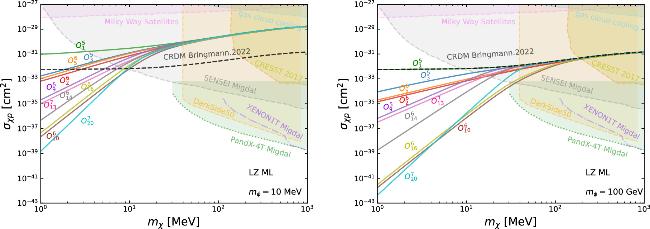


Figure 5. Constraints on SI DM-nucleon cross section at 90% C.L using the LZ data for mediators of mass mφ = 10 MeV (left) and mφ = 100 GeV (right). Solid lines represent the exclusion results given by different types of DM operators. For comparison, the black dashed line shows the exclusion results from the constant cross section of conventional direct detection experiments [62]. A selection of constraints on DM from other experiments such as CRESST surface run[63], gas cloud cooling [66], Milky Way satellite population [67], SENSEI [64], DarkSide-50 [13], PandaX-4T [65] and XENON1T [10] are also shown. |
It can be seen from figure 5 that in the mχ > ∼ 100 MeV region, the lower limits of the cross section are the same for the different DM effective operators. It can be easily understood that the different interactions converge to non-relativistic limits when the DM mass is heavier than 1 GeV. However, we can see that the exclusion regions are different, with only the scalar interaction of scalar DM (${O}_{1}^{(5)}$) closely approximating the constraints of the conventional constant cross section for the DM particle mass below 100MeV, the limits of other operators is generally lower. In other words, a comprehensive consideration of different types of DM can improve the sensitivity of direct detection experiments. Especially, the spin-2 DM particle (${O}_{20}^{(7)}$) is up to ten orders of magnitude lower than the constant cross section.
5. Conclusion
In summary, though the theory of WIMP dark matter scattering is reliable, there are some novel strategies to detect light DM when it is fast-moving. However, conventional direct detection experiments for light DM typically focus on a single type of DM and are constrained by a constant cross section. In this work, we extend the study to include spin-1/2 DM, scalar DM, vector DM, spin-3/2 DM, spin-2 DM. First, we construct a set of effective interaction operators for different types of DM up to seven dimensions. Subsequently, we computed the spin-independent cross section for DM-nucleus scattering based on these operators. Our results show that only the scalar interaction ${O}_{1}^{(5)}$ of scalar DM closely approximates a constant cross section, whereas other types of interactions are dependent on q. In order to study the impact of different types of DM on direct detection, we implemented these effective operators within the context of the CRDM scenario. The numerical results show that in the light DM region, our approach shows complementary sensitivity to conventional direct detection experiments. Notably, our constraints exhibit significantly enhanced sensitivity compared to previous studies, regardless of whether the mediator is light. Especially, the exclusion limits for the spin-2 Tμν operator differ by ten orders of magnitude from those based on a constant cross section assumption when the mediator mass is set to mφ = 100 GeV. Neutrino detectors such as Hyper-K exhibit excellent sensitivity and background discrimination capabilities in the sub-GeV range. Within the framework of DM effective operators, the Hyper-K experiment is expected to set stringent constraints on DM-nucleon scattering cross section in the keV scale mass region.
Appendix The differential cross section for χN scattering
A.1. Spin-1/2 DM
For spin-1/2 DM particles, up to dimension seven [38], the operators is written as
$\begin{eqnarray*}\begin{array}{l}{O}_{4}^{(6)}=\frac{1}{{q}^{2}+{m}_{\phi }^{2}}\bar{\chi }{\gamma }_{5}\chi \bar{N}N,\\ {O}_{6}^{(6)}=\frac{1}{{q}^{2}+{m}_{\phi }^{2}}\bar{\chi }{\gamma }_{\mu }{\gamma }_{5}\chi \bar{N}{\gamma }^{\mu }N,\\ {O}_{7}^{(7)}=\frac{1}{{q}^{2}+{m}_{\phi }^{2}}{\partial }_{\mu }(\bar{\chi }{\sigma }^{\mu \nu }\chi )\bar{N}{\gamma }^{\nu }N,\\ {O}_{8}^{(7)}=\frac{1}{{q}^{2}+{m}_{\phi }^{2}}{\partial }_{\mu }(\bar{\chi }{\sigma }^{\mu \nu }{\gamma }_{5}\chi )\bar{N}{\gamma }^{\nu }N.\end{array}\end{eqnarray*}$
We use equation (9 ) to calculate the spin- independent cross section
$\begin{eqnarray}\begin{array}{rcl}{\left(\frac{{\rm{d}}{\sigma }_{\chi N}}{{\rm{d}}{T}_{N}}\right)}_{{O}_{4}^{(6)}}\, & = & \frac{{g}_{N}^{2}{g}_{\chi }^{2}}{16\pi s{T}_{N}^{{\rm{\max }}}}\frac{1}{{({q}^{2}+{m}_{\phi }^{2})}^{2}}\\ & & \times {q}^{2}({q}^{2}+4{m}_{N}^{2})\times {G}_{N}^{2}({q}^{2}),\end{array}\end{eqnarray}$
$\begin{eqnarray}\begin{array}{rcl}{\left(\frac{{\rm{d}}{\sigma }_{\chi N}}{{\rm{d}}{T}_{N}}\right)}_{{O}_{6}^{(6)}} & = & \frac{{g}_{N}^{2}{g}_{\chi }^{2}}{4\pi s{T}_{N}^{{\rm{\max }}}}\frac{1}{{({q}^{2}+{m}_{\phi }^{2})}^{2}}\\ & & \times \left[\frac{1}{2}{q}^{4}-{q}^{2}(s-2{m}_{\chi }^{2})+4{m}_{N}^{2}{T}_{\chi }(2{m}_{\chi }+{T}_{\chi })\right]\\ & & \times {G}_{N}^{2}({q}^{2}),\end{array}\end{eqnarray}$
$\begin{eqnarray}\begin{array}{rcl}{\left(\frac{{\rm{d}}{\sigma }_{\chi N}}{{\rm{d}}{T}_{N}}\right)}_{{O}_{7}^{(7)}} & = & \frac{{g}_{N}^{2}{g}_{\chi }^{2}}{4\pi s{T}_{N}^{{\rm{\max }}}}\frac{1}{{({q}^{2}+{m}_{\phi }^{2})}^{2}}{q}^{2}\\ & & \times [{q}^{2}(2{m}_{\chi }^{2}+{m}_{N}^{2}-s)+4{m}_{N}^{2}{T}_{\chi }(2{m}_{\chi }+{T}_{\chi })],\end{array}\end{eqnarray}$
$\begin{eqnarray}\begin{array}{rcl}{\left(\frac{{\rm{d}}{\sigma }_{\chi N}}{{\rm{d}}{T}_{N}}\right)}_{{O}_{8}^{(7)}} & = & \frac{{g}_{N}^{2}{g}_{\chi }^{2}}{4\pi s{T}_{N}^{{\rm{\max }}}}\frac{1}{{({q}^{2}+{m}_{\phi }^{2})}^{2}}{q}^{2}\\ & & \times [{q}^{2}({m}_{N}^{2}-s)+4{m}_{N}^{2}{({m}_{\chi }+{T}_{\chi })}^{2}].\end{array}\end{eqnarray}$
A.2. Vector DM
Here, we will mainly list the operators of dimension-five, dimension six and dimension seven [68].
$\begin{eqnarray*}\begin{array}{l}{O}_{11}^{(6)}=\frac{1}{{q}^{2}+{m}_{\phi }^{2}}({\epsilon }^{\mu \nu \rho \sigma }{V}_{\nu }^{\dagger }{\overleftrightarrow{\partial }}_{\rho }{V}_{\sigma })\bar{N}{\gamma }^{\mu }N,\\ {O}_{12}^{(7)}=\frac{1}{{q}^{2}+{m}_{\phi }^{2}}\frac{1}{{m}_{\chi }}{V}_{\mu \nu }^{\dagger }{\tilde{V}}^{\mu \nu }\bar{N}N.\,\end{array}\end{eqnarray*}$
The differential cross section for χN scattering can be written as $\begin{eqnarray}\begin{array}{rcl}{\left(\frac{{\rm{d}}{\sigma }_{\chi N}}{{\rm{d}}{T}_{N}}\right)}_{{O}_{11}^{(6)}} & = & \frac{{\sigma }_{\chi N}^{{\rm{SI,NR}}}}{12{\mu }_{\chi N}^{2}s{T}_{N}^{{\rm{\max }}}}\frac{{m}_{\phi }^{4}}{{({q}^{2}+{m}_{\phi }^{2})}^{2}}\\ & & \times (2+\frac{{q}^{2}}{2{m}_{\chi }^{2}})[2{m}_{\chi }^{2}{q}^{2}-{q}^{2}s+\frac{{q}^{4}}{2}\\ & & +{(s-{m}_{N}^{2}-{m}_{\chi }^{2})}^{2}-4{m}_{N}^{2}{m}_{\chi }^{2}]\times {G}_{N}^{2}({q}^{2}),\end{array}\end{eqnarray}$
$\begin{eqnarray}\begin{array}{rcl}{\left(\frac{{\rm{d}}{\sigma }_{\chi N}}{{\rm{d}}{T}_{N}}\right)}_{{O}_{12}^{(6)}} & = & \frac{{g}_{N}^{2}{g}_{\chi }^{2}}{12\pi s{T}_{N}^{{\rm{\max }}}}\frac{1}{{({q}^{2}+{m}_{\phi }^{2})}^{2}}{q}^{2}\\ & & \times (2+\frac{{q}^{2}}{2{m}_{\chi }^{2}})({q}^{2}+4{m}_{N}^{2})\times {G}_{N}^{2}({q}^{2}).\end{array}\end{eqnarray}$
A.3. Spin-3/2 DM
The most general dimension six operators for the spin–3/2 DM can be written as
$\begin{eqnarray*}\begin{array}{l}{O}_{15}^{(6)}=\frac{1}{{q}^{2}+{m}_{\phi }^{2}}{\bar{{\rm{\Psi }}}}_{\mu }{\gamma }_{5}{{\rm{\Psi }}}^{\mu }\bar{N}N,\\ {O}_{17}^{(6)}=\frac{1}{{q}^{2}+{m}_{\phi }^{2}}{\bar{{\rm{\Psi }}}}_{\nu }{\gamma }_{\mu }{\gamma }_{5}{{\rm{\Psi }}}^{\nu }\bar{N}{\gamma }^{\mu }N,\\ {O}_{18}^{(7)}=\frac{1}{{q}^{2}+{m}_{\phi }^{2}}{\partial }_{\mu }({\bar{{\rm{\Psi }}}}_{\rho }{\sigma }^{\mu \nu }{{\rm{\Psi }}}^{\rho })\bar{N}{\gamma }^{\nu }N,\\ {O}_{19}^{(7)}=\frac{1}{{q}^{2}+{m}_{\phi }^{2}}{\partial }_{\mu }({\bar{{\rm{\Psi }}}}_{\rho }{\sigma }^{\mu \nu }{\gamma }_{5}{{\rm{\Psi }}}^{\rho })\bar{N}{\gamma }^{\nu }N,\end{array}\end{eqnarray*}$
where, the polarization sum of spin-3/2 DM $\begin{eqnarray}\begin{array}{rcl}{{\rm{\Pi }}}^{\mu \nu } & = & \displaystyle \sum _{s=-\frac{3}{2}}^{\frac{3}{2}}{\bar{{\rm{\Psi }}}}^{\mu }{{\rm{\Psi }}}^{\nu }\\ & = & -({{/}\!\!\!{p}}+m)\left[{g}^{\mu \nu }-\frac{2}{3}\frac{{p}^{\mu }{p}^{\nu }}{{m}^{2}}\right.\\ & & \left.-\frac{1}{3}{\gamma }^{\mu }{\gamma }^{\nu }-\frac{1}{3}\frac{({p}^{\nu }{\gamma }^{\mu }-{p}^{\mu }{p}^{\nu })}{m}\right].\end{array}\end{eqnarray}$
The differential cross section for χN scattering can be written as $\begin{eqnarray}\begin{array}{rcl}{\left(\frac{{\rm{d}}{\sigma }_{\chi N}}{{\rm{d}}{T}_{N}}\right)}_{{O}_{15}^{(6)}} & = & \frac{{g}_{N}^{2}{g}_{\chi }^{2}}{8\pi s{T}_{N}^{{\rm{\max }}}}\frac{1}{{({q}^{2}+{m}_{\phi }^{2})}^{2}}\\ & & \times \left(\frac{5}{18}{q}^{2}+\frac{{q}^{4}}{18{m}_{\chi }^{2}}+\frac{{q}^{6}}{36{m}_{\chi }^{4}}\right)\\ & & \times ({q}^{2}+4{m}_{N}^{2})\times {G}_{N}^{2}({q}^{2}),\end{array}\end{eqnarray}$
$\begin{eqnarray}\begin{array}{rcl}{\left(\frac{{\rm{d}}{\sigma }_{\chi N}}{{\rm{d}}{T}_{N}}\right)}_{{O}_{17}^{(6)}} & = & \frac{{g}_{N}^{2}{g}_{\chi }^{2}}{8\pi s{T}_{N}^{{\rm{\max }}}}\frac{1}{{({q}^{2}+{m}_{\phi }^{2})}^{2}}\\ & & \times \left(\frac{5}{9}+\frac{2{q}^{2}}{9{m}_{\chi }2}+\frac{{q}^{4}}{18{m}_{\chi }^{4}}\right)\left[4{m}_{N}^{2}{T}_{\chi }(2{m}_{\chi }+{T}_{\chi })\right.\\ & & -\left.{m}_{\chi }^{2}{q}^{2}-{m}_{N}^{2}{q}^{2}\right]\times {G}_{N}^{2}({q}^{2}),\end{array}\end{eqnarray}$
$\begin{eqnarray}\begin{array}{rcl}{\left(\frac{{\rm{d}}{\sigma }_{\chi N}}{{\rm{d}}{T}_{N}}\right)}_{{O}_{18}^{(7)}} & = & \frac{{g}_{N}^{2}{g}_{\chi }^{2}}{8\pi s{T}_{N}^{{\rm{\max }}}}\frac{1}{{({q}^{2}+{m}_{\phi }^{2})}^{2}}\frac{{q}^{2}}{18{m}_{\chi }^{4}}\\ & & \times \left[28{m}_{N}^{2}{m}_{\chi }^{4}{T}_{\chi }\left(2{m}_{\chi }+{T}_{\chi }\right)+\left(4{m}_{N}^{2}{m}_{\chi }^{2}\right.\right.\\ & & \left(-{m}_{\chi }^{2}+2{m}_{\chi }{T}_{\chi }+{T}_{\chi }^{2}\right)-{m}_{N}{m}_{\chi }^{4}\left(31{m}_{\chi }+14{T}_{\chi }^{2}\right)\\ & & +\left.7{m}_{\chi }^{6}\right){q}^{2}+(2{m}_{N}^{2}{T}_{\chi }(2{m}_{\chi }+{T}_{\chi })\\ & & {m}_{N}{m}_{\chi }^{2}(7{m}_{\chi }+2{T}_{\chi })+3{m}_{\chi }^{4}){q}^{4}\\ & & +\left.\left(-\frac{5}{2}{m}_{N}{m}_{\chi }-{m}_{N}{T}_{\chi }+\frac{1}{2}{m}_{\chi }^{2}\right){q}^{6}\right]\times {G}_{N}^{2}({q}^{2}),\end{array}\end{eqnarray}$
$\begin{eqnarray}\begin{array}{rcl}{\left(\frac{{\rm{d}}{\sigma }_{\chi N}}{{\rm{d}}{T}_{N}}\right)}_{{O}_{19}^{(7)}} & = & \frac{{g}_{N}^{2}{g}_{\chi }^{2}}{8\pi s{T}_{N}^{{\rm{\max }}}}\frac{1}{{({q}^{2}+{m}_{\phi }^{2})}^{2}}\frac{2{q}^{2}}{9{m}_{\chi }^{4}}\\ & & \times (14{m}_{\chi }^{4}+6{m}_{\chi }^{2}{q}^{2}+{q}^{4})(4{m}_{N}^{2}(2{m}_{\chi }-{T}_{\chi })\\ & & \times ({m}_{\chi }+{T}_{\chi })-{m}_{N}{q}^{2}({m}_{\chi }-2{T}_{\chi })+{m}_{\chi }^{2}{Q}^{2})\\ & & \times {G}_{N}^{2}({q}^{2}).\end{array}\end{eqnarray}$