


1. Introduction
As a very promising technique, sending information by quantum communication is a very innovative and secure way [1]. Quantum entanglement, particularly the maximum entangled state, plays an essential role in various quantum communication applications, such as quantum teleportation [2–4], quantum dense coding (QDC) [5, 6], quantum key distribution (QKD) [7–11], quantum secret sharing (QSS) [12–14], and quantum secure direct communication (QSDC) [15–18]. In practice, channel noise is an important limiting factor affecting the distance of entanglement distribution. It will lead to decoherence in a long channel distance [19]. The decoherence will reduce the fidelity and security of quantum communication protocols. A quantum repeater [20–22] is an efficient way to solve the problem in a practical long-distance quantum communication network. Entanglement distillation is one of the important techniques in a quantum repeater protocol [20, 23] to reduce the decoherence caused by the destructive effect of noise. It includes entanglement purification protocol (EPP) [24–32] and entanglement concentration protocol (ECP) [33–35], which can distill the high-quality entangled states from mixed entangled states and high-quality pure entangled states, respectively.
ECP has been extensively studied for its essential application in quantum information processing [36–46]. In 1996, Bennett et al [33] proposed the first ECP for two-qubit systems, resorting to the Schmidt projection. In 2001, Zhao et al [36] and Yamamoto et al [37] independently proposed ECPs with linear optical elements. In their protocol, they use a polarization beam splitter (PBS) as a parity check for two photons to implement ECP. In 2008, Sheng et al [38] proposed an ECP based on the cross-Kerr nonlinearities, which can increase the success probability of ECP by iteration of the protocol. In 2013, Ren et al [39] proposed hyper-ECPs for the polarization-spatial partially hyperentangled states with known and unknown parameters using the parameter-splitting method and the Schmidt projection method, respectively. In 2011, Wang et al [40] presented an interesting ECP for electron-spin entangled states in quantum dots (QDs) coupled with optical microcavities. Since then, numerous ECPs have been put forward based on the solid-state system, such as atomic ensembles [41], nitrogen-vacancy (NV) center [42], and quantum dots [43–46]. In recent years, other related studies have also been proposed, such as entanglement purification, concentration and also QSDC For example, advances on EPP include [47–49] and progress on QSDC include [50]. It is worth mentioning that the idea of entanglement concentration can also be applied to concentrate other types of entanglement, such as the arbitrary W state [51, 52]. In addition, the idea of single-photon-assisted entanglement concentration can also be used to realize such ECPs, as shown in [53].
The solid-state system serves as a crucial constituent of a quantum network node, and the electron spin in QD provides an attractive candidate for solid-state resources with its advantages in quantum control and long coherent time. The strong interaction between the photon and electron spin in QD has been realized by coupling QD with an optical cavity (QD-cavity system), and it has been used in many schemes, such as quantum state preparation, quantum state manipulation and quantum gate [54, 55]. In the experiment, the strong coupling between QD and the optical cavity is still a challenge to be overcome, while the fidelity and efficiency of quantum manipulation will be reduced using a low-coupling QD-cavity system [56, 57]. In 2016, Li et al [58] proposed an error-rejecting quantum entangling gate with QD in low-Q single-sided microcavities, where the imperfect interaction between photon and electron spin in QD does not affect the fidelity of the scheme. This error-rejecting method has been applied in many quantum information protocols, such as entangled state generation [59, 60], universal quantum gates [61–63], entanglement purification [64, 65] and so on. Moreover, there are several other excellent approaches in the field of error-rejecting entanglement concentration [66, 67], which have provided us with ample ideas and inspired us to optimize and improve our schemes.
In this paper, we propose the error-rejecting ECPs for electron spins in QDs coupled with single-sided optical microcavities. As is well known, in QDs coupled with single-sided optical microcavities systems, the imperfect input-output relations during the interaction between photons and the system can reduce the fidelity of entanglement concentration. Our two ECPs employ different methods to transform the factors that lower fidelity into detectable operational errors, thereby significantly reducing the impact of non-ideal interactions on the fidelity of entanglement concentration. Moreover, the entanglement concentration outcome can be read out based on the responses of different detectors. Two kinds of error-rejecting ECPs are proposed for a partially entangled state with unknown and known parameters respectively. The error-rejecting ECP for a partially entangled state with unknown parameters is constructed with parity check operations of electron spins in QDs, and the partially entangled state can be recovered to the maximally entangled state with unit fidelity. The error-rejecting ECP for a partially entangled state with known parameters is constructed in a parameter-splitting way, where the partially entangled state can be recovered to the maximally entangled state with unit fidelity and high success probability. Both error-rejecting ECPs have unit fidelity even under non-ideal experimental conditions, and their success probabilities can be enhanced through resource recycling and iteration. Compared with previous studies, these above advantages make our error-rejecting ECPs more practical and have great application value in improving the fidelity of quantum communication and solving problems such as decoherence in long-distance quantum communication.
The arrangement of this paper is as follows: section 1 is the introduction. In section 2 , we derive the input-output relations between photons and the systems by introducing QDs coupled with single-sided optical microcavities systems. In section 3 , we specifically give the error-rejecting ECPs with unknown and known parameters. In section 4 , we calculate the efficiency of the two ECPs using resource recycling and iterative methods, and provide a discussion and analysis based on experimental parameters.
2. Input-output process with quantum dot system in optical microcavities
In this section, we will briefly introduce the input-output process of QD in single-sided optical microcavity. A singly charged self-assembled In(Ga)As QD embedded in a single-sided optical microcavity [68–73] (QD-cavity) is shown in figure 1(a), where the quantization axis z is selected along the direction of the growth of QD and antiparallel to the propagation direction of the input light. When an excess electron is injected into the QD with state ∣ ↑ ⟩ (or ∣ ↓ ⟩), the singly charged QD will be excited to the negatively charged exciton (X−) state ∣ ↑ ↓ ⇑⟩ (or ∣ ↓ ↑ ⇓⟩) by the left-handed polarized photon ∣L⟩ (or right-handed polarized photon ∣R⟩), based on Pauli's exclusion principle [74] (shown in figure 1 (b)). Here ∣ ↑ ⟩ and ∣ ↓ ⟩ correspond to ${J}_{z}=\frac{1}{2}$ and ${J}_{z}=-\frac{1}{2}$. The negatively charged exciton X− contains two electron spins and one heavy hole, and the heavy hole states ∣⇑⟩ and ∣⇓⟩ correspond to ${J}_{z}=\frac{3}{2}$ and ${J}_{z}=-\frac{3}{2}$, respectively. The optical transitions ∣ ↑ ⟩ → ∣ ↓ ↑ ⇑⟩ and ∣ ↓ ⟩ → ∣ ↑ ↓ ⇑⟩ are dipole forbidden [74].
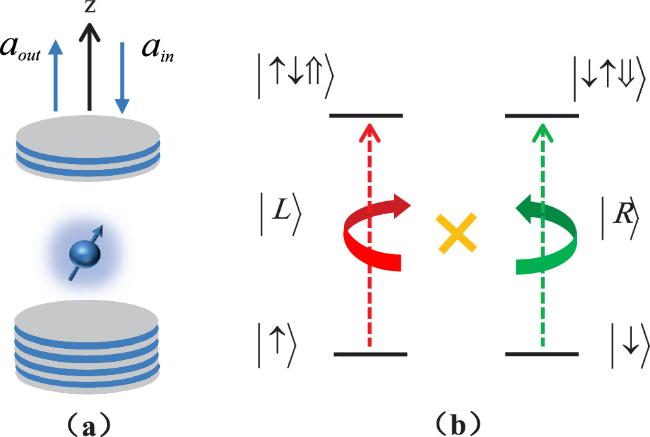
If a circularly polarized photon is launched into the QD-cavity system, it will be reflected by the QD-cavity system with a spin-dependent reflection coefficient r(ω) [69, 70]. And this dynamic process can be described by Heisenberg equations for the cavity field operator $\hat{a}$ and X− dipole operator ${\hat{\sigma }}_{-}$ in the interaction picture [69, 70, 75],
$\begin{eqnarray}\begin{array}{rcl}\frac{{\rm{d}}\hat{a}}{{\rm{d}}t} & = & -\left[{\rm{i}}({\omega }_{c}-\omega )+\frac{\kappa }{2}+\frac{{\kappa }_{s}}{2}\right]\hat{a}-g{\hat{\sigma }}_{-}-\sqrt{\kappa }\hat{{a}_{\mathrm{in}}}+\hat{R},\\ \frac{{\rm{d}}{\hat{\sigma }}_{-}}{{\rm{d}}t} & = & -\left[{\rm{i}}({\omega }_{{X}^{-}}-\omega )+\frac{\gamma }{2}\right]{\hat{\sigma }}_{-}-g{\hat{\sigma }}_{z}\hat{a}+\hat{N}.\end{array}\end{eqnarray}$
Here, ω and ωc are frequencies of the photon and the cavity mode, respectively. ${\omega }_{{X}^{-}}$ is the frequency of the X− dipole transition. g is the coupling strength between X− and the cavity mode. $\frac{\kappa }{2}$ and $\frac{{\kappa }_{s}}{2}$ are the decay rate and the side leakage rate of the cavity field, respectively. $\frac{\gamma }{2}$ represents the decay rate of X− dipole. $\hat{R}$ and $\hat{N}$ are noise operators. ${\hat{a}}_{\mathrm{in}}$ and ${\hat{a}}_{\mathrm{out}}$ are the input and output field operators, and they satisfy the boundary relation ${\hat{a}}_{\mathrm{out}}={\hat{a}}_{\mathrm{in}}+\sqrt{\kappa }\hat{a}$ [75].In the weak excitation approximation, the reflection coefficient of circularly polarized photon interacted with the QD-cavity system is expressed as [69, 70]
$\begin{eqnarray}r(\omega )=1-\frac{\kappa [{\rm{i}}({\omega }_{{X}^{-}}-\omega )+\frac{\gamma }{2}]}{[{\rm{i}}({\omega }_{{X}^{-}}-\omega )+\frac{\gamma }{2}][{\rm{i}}({\omega }_{c}-\omega )+\frac{\kappa }{2}+\frac{{\kappa }_{s}}{2}]+{g}^{2}}.\end{eqnarray}$
If the ∣L⟩ photon is launched into the QD-cavity system, the electron spin ∣ ↑ ⟩ (or ∣ ↓ ⟩) will be coupled (or uncoupled, i.e. g = 0) to the cavity mode, and the reflection coefficient of the ∣L⟩ photon will be r1 (or r0). If ∣R⟩ photon is launched into the QD-cavity system, the electron spin ∣ ↑ ⟩ (or ∣ ↓ ⟩) will be uncoupled (or coupled) to the cavity mode, and the reflection coefficient of ∣L⟩ photon will be r0 (or r1). Therefore, the input-output process of the QD-cavity system can be summarized as [56] $\begin{eqnarray}\begin{array}{l}| L\rangle | \uparrow \rangle \to {r}_{1}| L\rangle | \uparrow \rangle ,\quad | L\rangle | \downarrow \rangle \to {r}_{0}| L\rangle | \downarrow \rangle ,\\ | R\rangle | \uparrow \rangle \to {r}_{0}| R\rangle | \uparrow \rangle ,\quad | R\rangle | \downarrow \rangle \to {r}_{1}| R\rangle | \downarrow \rangle .\end{array}\end{eqnarray}$
3. Error-rejecting entanglement concentration in electronic systems
The maximally entangled state of electron spins in QDs (e.g. $| {\phi }^{+}\rangle =\frac{1}{\sqrt{2}}(| \uparrow \uparrow \rangle +| \downarrow \downarrow \rangle )$ is an important resource in quantum information processing and quantum technology, but it will decay to partially entangled state ∣φ⟩ due to the environmental noise and channel noise. Here,
$\begin{eqnarray}| \phi \rangle =\alpha | \uparrow \uparrow \rangle +\beta | \downarrow \downarrow \rangle .\end{eqnarray}$
α and β are complex coefficients with ∣α∣2 + ∣β∣2 = 1. In this section, we will introduce two error-rejecting entanglement concentration protocols to recover the partially entangled state ∣φ⟩ to the maximally entangled state ∣φ+⟩.3.1. Error-rejecting entanglement concentration for a partially entangled state with unknown parameters
The principle of error-rejecting ECP for the nonlocal partially entangled electron spin state (∣φ⟩) with unknown parameters is depicted in figure 2, where two identical nonlocal partially entangled electron spin systems in state ∣φ⟩ are required. The partially entangled electron spins are in the single-sided QD-cavity systems ${E}_{{A}_{1}}{E}_{{B}_{1}}$ and ${E}_{{A}_{2}}{E}_{{B}_{2}}$, respectively. The single-sided QD-cavity systems ${E}_{{A}_{1}}$ and ${E}_{{A}_{2}}$ belong to remote user Alice, while ${E}_{{B}_{1}}$ and ${E}_{{B}_{2}}$ belong to remote user Bob. The electron spin states of single-sided QD-cavity systems ${E}_{{A}_{1}}{E}_{{B}_{1}}$ and ${E}_{{A}_{2}}{E}_{{B}_{2}}$ are expressed as 8 ) represent the two paths of photon b after it passes through CPBS2.
$\begin{eqnarray}\begin{array}{rcl}| \phi {\rangle }_{{A}_{1}{B}_{1}} & = & \alpha | \uparrow \uparrow {\rangle }_{{A}_{1}{B}_{1}}+\beta | \downarrow \downarrow {\rangle }_{{A}_{1}{B}_{1}},\\ | \phi {\rangle }_{{A}_{2}{B}_{2}} & = & \alpha | \uparrow \uparrow {\rangle }_{{A}_{2}{B}_{2}}+\beta | \downarrow \downarrow {\rangle }_{{A}_{2}{B}_{2}},\end{array}\end{eqnarray}$
where the coefficients α and β are unknown to the remote user Alice and Bob. The subscripts Ij represents the electron spin in single-sided QD-cavity system ${E}_{{I}_{j}}$, where I = A, B and j = 1, 2. Moreover, a photon b in state $| \varphi {\rangle }_{b}=\frac{1}{\sqrt{2}}{(| R\rangle +| L\rangle )}_{b}$ is required, and the initial state of the composite system composed of the photon b and the electron spins A1B1A2B2 is expressed as $\begin{eqnarray}\begin{array}{rcl}| {\rm{\Psi }}\rangle & = & | \phi {\rangle }_{{A}_{1}{B}_{1}}\displaystyle \otimes | \phi {\rangle }_{{A}_{2}{B}_{2}}\displaystyle \otimes | \varphi {\rangle }_{b}\\ & = & \frac{1}{\sqrt{2}}({\alpha }^{2}| \uparrow \uparrow \uparrow \uparrow \rangle +{\beta }^{2}| \downarrow \downarrow \downarrow \downarrow \rangle +\alpha \beta | \uparrow \uparrow \downarrow \downarrow \rangle \\ & & +\alpha \beta | \downarrow \downarrow \uparrow \uparrow \rangle {)}_{{A}_{1}{B}_{1}{A}_{2}{B}_{2}}{(| R\rangle +| L\rangle )}_{b}.\end{array}\end{eqnarray}$
The photon b is sent into the port bin by Bob as shown in figure 2. After the photon b passes through CPBS1, the two components ∣R⟩ and ∣L⟩ will be split into two paths. Here, CPBSk (k = 1, 2) represents a circle polarization beam splitter, which transforms the right-hand polarization photons ∣R⟩ and reflects the photons in left-hand polarization ∣L⟩. The two components ∣R⟩ and ∣L⟩ in the two paths will pass through the optical elements ${H}_{1}\to {E}_{{B}_{1}}\to {H}_{1}\to $ CPBS2 and ${H}_{1}\to {E}_{{B}_{2}}\to {H}_{1}\to $ CPBS2, respectively. Here H1 represents the Hadamard operation on photon, and it is expressed as $\begin{eqnarray}{H}_{1}:\left|R\right\rangle \to \frac{1}{\sqrt{2}}(\left|R\right\rangle +\left|L\right\rangle ),\left|L\right\rangle \to \frac{1}{\sqrt{2}}(\left|R\right\rangle -\left|L\right\rangle ).\end{eqnarray}$
After the photon b passes through CPBS2, the quantum state of the composite system A1B1A2B2b will be transformed to $\begin{eqnarray}\begin{array}{rcl}| {\rm{\Psi }}{\rangle }^{1} & = & \frac{({r}_{0}+{r}_{1})}{2\sqrt{2}}[({\alpha }^{2}| \uparrow \uparrow \uparrow \uparrow \rangle +{\beta }^{2}| \downarrow \downarrow \downarrow \downarrow \rangle \\ & & +\alpha \beta | \uparrow \uparrow \downarrow \downarrow \rangle +\alpha \beta | \downarrow \downarrow \uparrow \uparrow \rangle {)}_{{A}_{1}{B}_{1}{A}_{2}{B}_{2}}| R{\rangle }_{{\rm{1}}}\\ & & +({\alpha }^{2}| \uparrow \uparrow \uparrow \uparrow \rangle +{\beta }^{2}| \downarrow \downarrow \downarrow \downarrow \rangle \\ & & +\alpha \beta | \uparrow \uparrow \downarrow \downarrow \rangle +\alpha \beta | \downarrow \downarrow \uparrow \uparrow \rangle {)}_{{A}_{1}{B}_{1}{A}_{2}{B}_{2}}| L{\rangle }_{1}]\\ & & +\frac{({r}_{0}-{r}_{1})}{2\sqrt{2}}[({\alpha }^{2}| \uparrow \uparrow \uparrow \uparrow \rangle -{\beta }^{2}| \downarrow \downarrow \downarrow \downarrow \rangle \\ & & +\alpha \beta | \uparrow \uparrow \downarrow \downarrow \rangle -\alpha \beta | \downarrow \downarrow \uparrow \uparrow \rangle {)}_{{A}_{1}{B}_{1}{A}_{2}{B}_{2}}| R{\rangle }_{{\rm{2}}}\\ & & +({\alpha }^{2}| \uparrow \uparrow \uparrow \uparrow \rangle -{\beta }^{2}| \downarrow \downarrow \downarrow \downarrow \rangle \\ & & -\alpha \beta | \uparrow \uparrow \downarrow \downarrow \rangle +\alpha \beta | \downarrow \downarrow \uparrow \uparrow \rangle {)}_{{A}_{1}{B}_{1}{A}_{2}{B}_{2}}| L{\rangle }_{{\rm{2}}}],\end{array}\end{eqnarray}$
whose coefficients are not normalized to facilitate the calculation of success probability. The subscripts 1 and 2 in equation (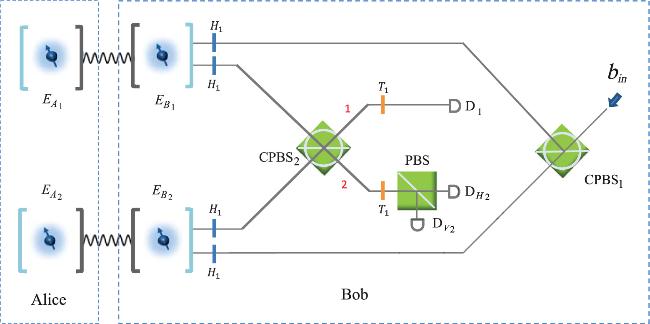
Figure 2. Schematic diagram of error-rejecting ECP for a partially entangled state with unknown parameters. T1 is constructed by a quarter-wave plate (QWP) at 0∘ and a half-wave plate (HWP) at 0∘. H1 is constructed by an HWP at 0∘, a QWP at 0∘, an HWP at 22.5∘ and an HWP at 0∘ [76]. The scheme consists of four QD-cavities, three single-photon detectors (D1, D${}_{{H}_{2}}$, D${}_{{V}_{2}}$), two circular polarizing beam splitters (CPBS) and a polarizing beam splitter (PBS), as well as several QWPs and HWPs. |
Then the photon b passes through T1, whose function is
$\begin{eqnarray}{T}_{1}:| R\rangle \to \frac{1}{\sqrt{2}}(| H\rangle +| V\rangle ),| L\rangle \to \frac{1}{\sqrt{2}}(| H\rangle -| V\rangle ).\end{eqnarray}$
The quantum state of the composite system A1B1A2B2b will be transformed to $\begin{eqnarray}\begin{array}{rcl}| {\rm{\Psi }}{\rangle }^{2} & = & \frac{({r}_{0}-{r}_{1})}{2}[{({\alpha }^{2}\left|\uparrow \uparrow \uparrow \uparrow \right\rangle -{\beta }^{2}\left|\downarrow \downarrow \downarrow \downarrow \right\rangle )}_{{A}_{1}{B}_{1}{A}_{2}{B}_{2}}{\left|H\right\rangle }_{2}\\ & & +\alpha \beta {(\left|\uparrow \uparrow \downarrow \downarrow \right\rangle -\left|\downarrow \downarrow \uparrow \uparrow \right\rangle )}_{{A}_{1}{B}_{1}{A}_{2}{B}_{2}}{\left|V\right\rangle }_{2}]\\ & & +\frac{({r}_{0}+{r}_{1})}{2}{(\alpha \left|\uparrow \uparrow \right\rangle +\beta \left|\downarrow \downarrow \right\rangle )}_{{A}_{1}{B}_{1}}(\alpha \left|\uparrow \uparrow \right\rangle \\ & & +\beta \left|\downarrow \downarrow \right\rangle {)}_{{A}_{2}{B}_{2}}{\left|H\right\rangle }_{1}.\end{array}\end{eqnarray}$
Here ∣H⟩ and ∣V⟩ are horizontal polarization state and vertical polarization state, respectively.If the photon b is emitting from path 2, the quantum state of the composite system A1B1A2B2b will be projected to
$\begin{eqnarray}\begin{array}{rcl}| {\rm{\Psi }}{\rangle }^{3} & = & \frac{({r}_{0}-{r}_{1})}{2}[{({\alpha }^{2}\left|\uparrow \uparrow \uparrow \uparrow \right\rangle -{\beta }^{2}\left|\downarrow \downarrow \downarrow \downarrow \right\rangle )}_{{A}_{1}{B}_{1}{A}_{2}{B}_{2}}{\left|H\right\rangle }_{2}\\ & & +\alpha \beta {(\left|\uparrow \uparrow \downarrow \downarrow \right\rangle -\left|\downarrow \downarrow \uparrow \uparrow \right\rangle )}_{{A}_{1}{B}_{1}{A}_{2}{B}_{2}}{\left|V\right\rangle }_{2}].\end{array}\end{eqnarray}$
After the photon b passes through PBS, it will be detected by D${}_{{V}_{2}}$ or D${}_{{H}_{2}}$.There is a probability of ${P}_{1}=\frac{{| {r}_{0}-{r}_{1}| }^{2}{\alpha }^{2}{\beta }^{2}}{2}$ that detector D${}_{{V}_{2}}$ clicks. At this point, the state of the electron spin system A1B1A2B2 is projected to $| {\rm{\Phi }}{\rangle }^{0}=\frac{1}{\sqrt{2}}(| \uparrow \uparrow \downarrow \downarrow \rangle -| \downarrow \downarrow \uparrow \uparrow \rangle )$. Then Alice and Bob perform Hadamard operations HE (i.e. $| \uparrow \rangle \to \frac{1}{\sqrt{2}}(| \uparrow \rangle +| \downarrow \rangle )$, $| \downarrow \rangle \to \frac{1}{\sqrt{2}}(| \uparrow \rangle -| \downarrow \rangle )$) on two electron spins A2 and B2, and the state of the electron spin system A1B1A2B2 is transformed to
$\begin{eqnarray}\begin{array}{rcl}| {\rm{\Phi }}{\rangle }^{1} & = & \frac{1}{\sqrt{2}}[| {\phi }^{-}{\rangle }_{{A}_{1}{B}_{1}}| {\phi }^{+}{\rangle }_{{A}_{2}{B}_{2}}-| {\phi }^{+}{\rangle }_{{A}_{1}{B}_{1}}| {\psi }^{+}{\rangle }_{{A}_{2}{B}_{2}}]\\ & = & \frac{1}{2\sqrt{2}}[{(| \uparrow \uparrow \rangle -| \downarrow \downarrow \rangle )}_{{A}_{1}{B}_{1}}{(| \uparrow \uparrow \rangle +| \downarrow \downarrow \rangle )}_{{A}_{2}{B}_{2}}\\ & & -{(| \uparrow \uparrow \rangle +| \downarrow \downarrow \rangle )}_{{A}_{1}{B}_{1}}{(| \uparrow \downarrow \rangle +| \downarrow \uparrow \rangle )}_{{A}_{2}{B}_{2}}].\end{array}\end{eqnarray}$
By measuring the two electron spins A2 and B2 with the basis {∣ ↑ ⟩, ∣ ↓ ⟩}, Alice and Bob can obtain the electron spin system A1B1 in a maximally entangled Bell state. If the measurement results of A2 and B2 are different (i.e. $| \uparrow \downarrow {\rangle }_{{A}_{2}{B}_{2}}$ or $| \downarrow \uparrow {\rangle }_{{A}_{2}{B}_{2}}$), the state of the electron spin system A1B1 is projected to $| {\phi }^{+}{\rangle }_{{A}_{1}{B}_{1}}$. If the measurement results of A2 and B2 are the same (i.e. $| \uparrow \uparrow {\rangle }_{{A}_{2}{B}_{2}}$ or $| \downarrow \downarrow {\rangle }_{{A}_{2}{B}_{2}}$), the state of the electron spin system A1B1 is projected to $| {\phi }^{-}{\rangle }_{{A}_{1}{B}_{1}}$, which can be transformed to the state $| {\phi }^{+}{\rangle }_{{A}_{1}{B}_{1}}$ with a phase-flip operation σz = ∣ ↑ ⟩⟨ ↑ ∣ − ∣ ↓ ⟩⟨ ↓ ∣ on A1 (or B1). Consequently, the remote users can get the electron spin system A1B1 in maximally entangled Bell state $| {\phi }^{+}{\rangle }_{{A}_{1}{B}_{1}}$ with a success probability of P1.There is a probability of ${P}_{2}=\frac{{| {r}_{0}-{r}_{1}| }^{2}({\alpha }^{4}+{\beta }^{4})}{4}$ that detector D${}_{{H}_{2}}$ clicks. At this point, the state of the electron spin system A1B1A2B2 is projected to $| {\rm{\Phi }}{\rangle }^{2}\,=\frac{1}{\sqrt{{\alpha }^{4}+{\beta }^{4}}}({\alpha }^{2}| \uparrow \uparrow \uparrow \uparrow \rangle -{\beta }^{2}| \downarrow \downarrow \downarrow \downarrow \rangle )$. Then Alice and Bob perform Hadamard operations HE on two electron spins A2 and B2, and the state of the electron spin system A1B1A2B2 is transformed to
$\begin{eqnarray}\begin{array}{rcl}| {\rm{\Phi }}{\rangle }^{3} & = & \frac{1}{2}({\alpha }^{{\prime} }| \uparrow \uparrow \rangle -{\beta }^{{\prime} }| \downarrow \downarrow \rangle {)}_{{A}_{1}{B}_{1}}(| \uparrow \uparrow \rangle +| \downarrow \downarrow \rangle {)}_{{A}_{2}{B}_{2}}\\ & & +\frac{1}{2}({\alpha }^{{\prime} }| \uparrow \uparrow \rangle +{\beta }^{{\prime} }| \downarrow \downarrow \rangle {)}_{{A}_{1}{B}_{1}}(| \uparrow \downarrow \rangle +| \downarrow \uparrow \rangle {)}_{{A}_{2}{B}_{2}},\end{array}\end{eqnarray}$
where ${\alpha }^{{\prime} }=\frac{{\alpha }^{2}}{\sqrt{{\alpha }^{4}+{\beta }^{4}}}$ and ${\beta }^{{\prime} }=\frac{{\beta }^{2}}{\sqrt{{\alpha }^{4}+{\beta }^{4}}}$. By measuring the two electron spins A2 and B2 with the basis {∣ ↑ ⟩, ∣ ↓ ⟩}, Alice and Bob can obtain the electron spin system A1B1 in a partially entangled Bell state. If the measurement results of A2 and B2 are different, the state of the electron spin system A1B1 is projected to $| {\phi }^{{\prime} }{\rangle }_{{A}_{1}{B}_{1}}={({\alpha }^{{\prime} }| \uparrow \uparrow \rangle +{\beta }^{{\prime} }| \downarrow \downarrow \rangle )}_{{A}_{1}{B}_{1}}$. If the measurement results of A2 and B2 are the same, a phase-flip operation σz is required to perform on A1 (or B1) to obtain the state $| {\phi }^{{\prime} }{\rangle }_{{A}_{1}{B}_{1}}$. In this case, Alice and Bob can perform a second round of ECP on the electron spin systems in $| {\phi }^{{\prime} }\rangle $ to obtain the maximally entangled Bell state ∣φ+⟩.If photon b is emitting from path 1, the quantum state of the composite system A1B1A2B2b will be projected to 14 ), it is easy to see that the state of the electron spin system A1B1A2B2 is projected to $| \phi {\rangle }_{{A}_{1}{B}_{1}}\otimes | \phi {\rangle }_{{A}_{2}{B}_{2}}$, which is the same as the initial partially entangled Bell state. In this case, the electron spin systems A1B1 and A2B2 can be further used in ECP to obtain the maximally entangled Bell state ∣φ+⟩.
$\begin{eqnarray}\begin{array}{rcl}| {\rm{\Psi }}{\rangle }^{4} & = & \frac{({r}_{0}+{r}_{1})}{2}{(\alpha | \uparrow \uparrow \rangle +\beta | \downarrow \downarrow \rangle )}_{{A}_{1}{B}_{1}}\\ & & {(\alpha | \uparrow \uparrow \rangle +\beta | \downarrow \downarrow \rangle )}_{{A}_{2}{B}_{2}}| H{\rangle }_{1},\end{array}\end{eqnarray}$
which will lead the photon b to detector D1 with the probability of ${P}_{3}=\frac{{| {r}_{0}+{r}_{1}| }^{2}}{4}$. From equation (According to the above analysis, the partially entangled state ∣φ⟩ of the electron spin system can be recovered to a maximally entangled state ∣φ+⟩ by this round of ECP with the success probability of P1. However, the partially entangled state of the electron spin system obtained in this round of ECP can be further used to obtain the maximally entangled Bell state ∣φ+⟩, which can increase the success probability of the total ECP process. For example, the success probability of the first round of ECP is ${\eta }_{1}=\mathop{\mathrm{lim}}\limits_{n\to \infty }[{P}_{1}+{P}_{3}{P}_{1}+...+{({P}_{3})}^{n}{P}_{1}]=\frac{2| {r}_{0}-{r}_{1}{| }^{2}{\alpha }^{2}{\beta }^{2}}{4-| {r}_{0}+{r}_{1}{| }^{2}}$, where the iterating of ECP for the case that D1 clicks is included. The success probability of the second round of ECP is ${\eta }_{2}\,={P}_{2}\frac{2| {r}_{0}-{r}_{1}{| }^{2}{\alpha {}^{{\prime} }}^{2}{\beta {}^{{\prime} }}^{2}}{4-| {r}_{0}+{r}_{1}{| }^{2}}$, which corresponds to the case that D${}_{{H}_{2}}$ clicks. By iterating ECP with N rounds, the total success probability of the total ECP process can achieve ${\eta }_{(N)}=\displaystyle {\sum }_{n=1}^{N}{\eta }_{n}\,=\frac{2}{4-| {r}_{0}+{r}_{1}{| }^{2}}\displaystyle {\sum }_{n=1}^{N}\frac{| {r}_{0}-{r}_{1}{| }^{2n}{\alpha }^{{2}^{n}}{\beta }^{{2}^{n}}}{{4}^{n-1}\displaystyle {\prod }_{m=1}^{n}({\alpha }^{{2}^{m}}+{\beta }^{{2}^{m}})}$.
3.2. Error-rejecting entanglement concentration for a partially entangled state with known parameters
The principle of error-rejecting ECP for nonlocal partially entangled electron spin state (∣φ⟩) with known parameters is shown in figure 3, where only one nonlocal partially entangled electron spin system in state ∣φ⟩ is required. The partially entangled electron spins are in the single-sided QD-cavity systems ${E}_{{S}_{1}}{E}_{{S}_{2}}$. The single-sided QD-cavity systems ${E}_{{S}_{1}}$ and ${E}_{{S}_{2}}$ belong to remote users Alice and Bob, respectively. The electron spin state of the single-sided QD-cavity system ${E}_{{S}_{1}}{E}_{{S}_{2}}$ is expressed as
$\begin{eqnarray}| \phi {\rangle }_{{s}_{1}{s}_{2}}=\alpha | \uparrow \uparrow {\rangle }_{{s}_{1}{s}_{2}}+\beta | \downarrow \downarrow {\rangle }_{{s}_{1}{s}_{2}},\end{eqnarray}$
where the coefficients α and β are known to the remote users Alice and Bob. To describe the principle of ECP explicitly and simply, the parameters can be chosen as $\left|\alpha \right|\lt \left|\beta \right|$. A photon a in state $| \varphi {\rangle }_{a}=\frac{1}{\sqrt{2}}{(| R\rangle +| L\rangle )}_{a}$ is required, and the initial state of the composite system composed of the photon a and the partially entangled system S1S2 is $\begin{eqnarray}| {\rm{\Psi }}\rangle =(\alpha | \uparrow \uparrow {\rangle }_{{s}_{1}{s}_{2}}+\beta | \downarrow \downarrow {\rangle }_{{s}_{1}{s}_{2}})\otimes \left[\frac{1}{\sqrt{2}}(| R\rangle +| L\rangle {)}_{a}\right].\end{eqnarray}$
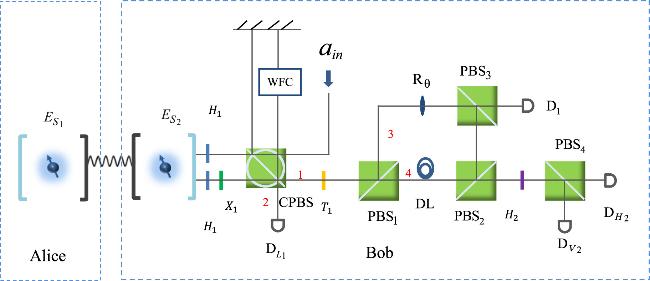
Figure 3. Schematic diagram of error-rejecting ECP for a partially entangled state with known parameters. X1 is constructed by an HWP at 0∘, which can realize bit flip operation on photon in circular polarization $\left(\left|R\right\rangle \leftrightarrow \left|L\right\rangle \right)$. H2 is constructed by an HWP at 22. 5∘, which can realize a Hadamard operation in linear polarization ($\left|H\right\rangle \to \frac{1}{\sqrt{2}}\left(\left|H\right\rangle +\left|V\right\rangle \right),\left|V\right\rangle \to \frac{1}{\sqrt{2}}\left(\left|H\right\rangle -\left|V\right\rangle \right)$). Rθ completes the transformation as follows: $| V\rangle \to \sin \theta | H\rangle +\cos \theta | V\rangle $, which is constructed by a QWP at 90∘, an HWP at $\frac{\theta }{2}$ and a QWP at 0∘. Here $\cos \theta =\frac{\alpha }{\beta }$. WFC represents a waveform corrector, which can map ∣i⟩ to $\frac{{r}_{1}-{r}_{0}}{2}| i\rangle $. DL is a time delay device. The scheme consists of a mirror, a WFC, a DL, two QD-cavities, four single-photon detectors (D1, D${}_{{L}_{1}}$, D${}_{{H}_{2}}$, D${}_{{V}_{2}}$), a CPBS and four PBSs, as well as several QWPs and HWPs. |
The photon a is sent into the port ain by Bob as shown in figure 3. After photon a passes through CPBS1, the two components ∣R⟩ and ∣L⟩ will be split into two paths. The two components ∣R⟩ and ∣L⟩ in the two paths will pass through the optical elements ${H}_{1}\to {E}_{{S}_{2}}\to {H}_{1}\to {X}_{1}\to $ CPBS and mirror → WFC → CPBS, respectively. After the photon a passes through these optical elements, the quantum state of the composite system S1S2a will be transformed to
$\begin{eqnarray}\begin{array}{rcl}| {\rm{\Psi }}{\rangle }^{1} & = & \frac{{r}_{0}-{r}_{1}}{2\sqrt{2}}[{(\alpha \left|\uparrow \uparrow \right\rangle +\beta \left|\downarrow \downarrow \right\rangle )}_{{S}_{1}{S}_{2}}{\left|L\right\rangle }_{1}\\ & & +{(\alpha \left|\uparrow \uparrow \right\rangle -\beta \left|\downarrow \downarrow \right\rangle )}_{{S}_{1}{S}_{2}}{\left|R\right\rangle }_{{\rm{1}}}]\\ & & +\frac{{r}_{0}+{r}_{1}}{2\sqrt{2}}{(\alpha \left|\uparrow \uparrow \right\rangle +\beta \left|\downarrow \downarrow \right\rangle )}_{{S}_{1}{S}_{2}}{\left|L\right\rangle }_{2},\end{array}\end{eqnarray}$
whose coefficients are not normalized to facilitate the calculation of success probability. The subscripts 1 and 2 represent the two paths of photon a in figure 3.If the photon a is emitting from path 1 (i.e. detector D${}_{{L}_{1}}$ does not click), it will pass through the optical elements T1 → PBS1. The two components ∣H⟩ and ∣V⟩ of photon a will be split into two paths 3 and 4 by PBS1. Then two components ∣H⟩ and ∣V⟩ will pass through DL and Rθ, respectively. Rθ is used to rotate the polarization state ∣V⟩ with an angle $\theta =\arccos (\alpha /\beta )$. After two components in two paths pass through PBS2 and PBS3, the quantum state of the composite system S1S2a will be transformed to
$\begin{eqnarray}| {\rm{\Psi }}{\rangle }^{2}=\alpha \left|\uparrow \uparrow \right\rangle {\left|H\right\rangle }_{4}-\alpha \left|\downarrow \downarrow \right\rangle {\left|V\right\rangle }_{4}-\sqrt{{\beta }^{2}-{\alpha }^{2}}\left|\downarrow \downarrow \right\rangle {\left|H\right\rangle }_{3}.\end{eqnarray}$
There is a probability of ${P}_{1}=\frac{{\alpha }^{2}{| {r}_{0}-{r}_{1}| }^{2}}{2}$ that the photon a is emitting from path 4 (i.e. detector D1 does not click), and the quantum state of the composite system S1S2a will be projected to the hybrid maximally entangled state $| {\rm{\Psi }}{\rangle }^{3}\,=\frac{1}{\sqrt{2}}(| \uparrow \uparrow \rangle | H{\rangle }_{4}-| \downarrow \downarrow \rangle | V{\rangle }_{4})$. Then a Hadamard operation H2 is performed on photon a, and the quantum state of the composite system S1S2a will be transformed to
$\begin{eqnarray}| {\rm{\Psi }}{\rangle }^{4}=\frac{1}{\sqrt{2}}(| {\phi }^{-}\rangle \otimes | H{\rangle }_{{D}_{{H}_{2}}}+| {\phi }^{+}\rangle \otimes | V{\rangle }_{{D}_{{V}_{2}}}).\end{eqnarray}$
Photon a will be detected by the photon detector D${}_{{H}_{2}}$ or D${}_{{V}_{2}}$. If detector D${}_{{V}_{2}}$ clicks, the state of the electron spin system S1S2 is projected to ∣φ+⟩. If detector D${}_{{H}_{2}}$ clicks, the state of the electron spin system S1S2 is projected to ∣φ−⟩, which can be transformed into the state ∣φ+⟩ with a phase-flip operation σz on S1.There is a probability of ${P}_{2}=\frac{({\beta }^{2}-{\alpha }^{2}){| {r}_{0}-{r}_{1}| }^{2}}{4}$ that the photon a is emitting from path 3 (i.e. detector D1 clicks), and the quantum state of the composite system S1S2a will be projected to ∣$\Psi$⟩5 = ∣ ↓ ↓ ⟩∣H⟩3. Then photon a is detected by the photon detector D1, and the electron spin system S1S2 is projected to product state ∣ ↓ ↓ ⟩, which means ECP fails.
If the photon a is emitting from path 2, the quantum state of the composite system S1S2a will be projected to $| {\rm{\Psi }}{\rangle }^{6}={(\alpha | \uparrow \uparrow \rangle +\beta | \downarrow \downarrow \rangle )}_{{S}_{1}{S}_{2}}{\left|L\right\rangle }_{2}$ with the probability ${P}_{3}\,=\frac{{| {r}_{0}+{r}_{1}| }^{{\rm{2}}}}{8}$. Then photon a is detected by the photon detector D${}_{{L}_{1}}$, and the electron spin system S1S2 is projected to the state ∣φ⟩ which is the same as the initial partially entangled Bell state. In this case, the electron spin system S1S2a can be further used in ECP to obtain the maximally entangled Bell state ∣φ+⟩.
According to the above analysis, the partially entangled state ∣φ⟩ of the electron spin system can be recovered to a maximally entangled state ∣φ+⟩ by ECP with the success probability of P1. If the iterating of ECP for the case that D${}_{{L}_{1}}$ clicks is included, the success probability could be increased to ${\eta }^{{\prime} }=\mathop{\mathrm{lim}}\limits_{n\to \infty }[{P}_{1}+{P}_{3}{P}_{1}\,+\,...\,+\,{({P}_{3})}^{n}{P}_{1}]=\frac{4{\alpha }^{2}| {r}_{0}-{r}_{1}{| }^{2}}{8-| {r}_{0}+{r}_{1}{| }^{2}}$.
4. Discussion and summary
We have presented the error-rejecting ECPs for nonlocal partially entangled electron spin systems in QDs with unknown and known parameters. The error-rejecting ECP for partially entangled state with unknown parameters is constructed by parity check operations of electron spins using a photon as auxiliary, and the partially entangled state can be recovered to the maximally entangled state when the photon detector D${}_{{V}_{2}}$ clicks (in figure 2). The error-rejecting ECP for partially entangled state with known parameters is constructed in a parameter splitting way assisted by a photon, and the partially entangled state can be recovered to the maximally entangled state when the photon detector D${}_{{V}_{2}}$ (or D${}_{{H}_{2}}$) clicks (in figure 3). Both of these two error-rejecting ECPs can work with unit fidelity under the non-ideal experimental condition of QD-cavity system (i.e., the maximally entangled state obtained in the successful case is not affected by the reflection coefficient of QD-cavity system), while the success probability of the ECPs will be affected by the reflection coefficient of QD-cavity system.
In the two error-rejecting ECPs, the influence of the non-ideal reflection coefficient of the QD-cavity system is converted to the component that can be detected by photon detector (D1 in figure 2 or D${}_{{L}_{1}}$ in figure 3). Therefore, the unit fidelity of error-rejecting ECP can be obtained, while the success probability of the ECP will be affected by this method. However, when the photon detector D1 in figure 2 (or D${}_{{L}_{1}}$ in figure 3) clicks with the probability P3, the electron spin system will be projected to the initial partially entangled state, and they can be used to concentrate maximally entangled state by iterating error-rejecting ECP. That is to say, the error-rejecting ECP can use the resource recycling method to improve the success probability and enhance the resource utilization rate, which could also reduce the influence of the non-ideal reflection coefficient of the QD-cavity system on success probability.
In figures 4(a) and (b), the success probability differences, denoted as △η1 = ηi1 − η1 and $\bigtriangleup {\eta }^{{\prime} }={\eta }_{i}^{{\prime} }-{\eta }^{{\prime} }$, are graphed against the coupling constant ratio g/κ and the coefficient α2. η1 and ${\eta }^{{\prime} }$ are the success probabilities of error-rejecting ECPs with unknown and known parameters, respectively, and they are dependent on the reflection coefficients r0 and r1. Here, the resonance condition with $\omega ={\omega }_{c}={\omega }_{{X}^{-}}$ is considered, and the reflection coefficient can be simplified as
$\begin{eqnarray}r=1-\frac{{\rm{i}}\kappa \frac{\gamma }{2}}{{\rm{i}}\frac{\gamma }{2}(\frac{\kappa }{2}+\frac{{\kappa }_{s}}{2})+{g}^{2}}.\end{eqnarray}$
The side leakage rate of the cavity field is set as κs = 0.1κ [70]. The decay rate of X− dipole is set to γ = 0.1κ [70]. ηi1 = 2α2β2 and ${\eta }_{i}^{{\prime} }=2{\alpha }^{2}$, and they are the success probabilities of ideal ECPs (i.e. ideal reflection coefficients of QD-cavity system with r0 = − r1 = − 1) with unknown and known parameters, respectively. From figures 4(a) and (b), we can find that △η1 and $\bigtriangleup {\eta }^{{\prime} }$ are high in the weak coupling area $\left(\frac{g}{\kappa }\ll 1\right)$, but they decrease rapidly and tend to steady with the increase of coupling strength. It shows r0 and r1 will have a great impact on the success probability of error-rejecting ECP, especially in the area with coupling strength g/κ < 0.4. Of course, △η1 and $\bigtriangleup {\eta }^{{\prime} }$ are also affected by α2, especially in the weak coupling area, and they tend to steady in the strong coupling area. When g/κ > 0.4, △η1 and $\bigtriangleup {\eta }^{{\prime} }$ are small, which means the success probabilities of error-rejecting ECPs are close to the ones of ideal ECPs, especially for the case with small α2.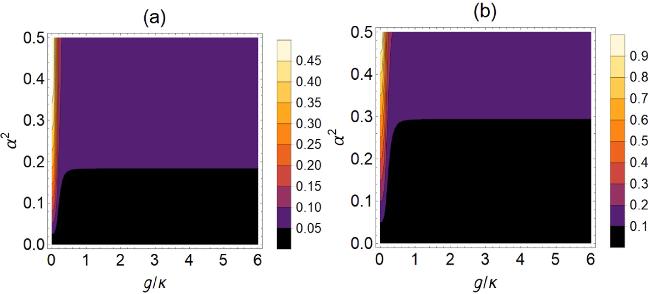
Figure 4. (a) illustrates the relationship between the difference in success probability (△η1 = ηi1 − η1) of the error-rejecting ECP (η1) and the ideal ECP (ηi1) with the coupling strength g/κ and the coefficient α2 under unknown parameters. (b) illustrates the relationship between the difference in success probability ($\bigtriangleup {\eta }^{{\prime} }={\eta }_{i}^{{\prime} }-{\eta }^{{\prime} }$) of the error-rejecting ECP (${\eta }^{{\prime} }$) and the ideal ECP (${\eta }_{i}^{{\prime} }$) with the coupling strength g/κ and the coefficient α2 under known parameters. |
Notably, our calculation of the success probabilities use the recycling approach proposed in [38]. In figure 5, the success probabilities {η1, η(2), η(3), η(7)}, ${\eta }^{{\prime} }$, ηc and ${\eta }_{c}^{{\prime} }$ are plotted as the function of coupling constant g/κ (or coefficient α2). {η1, η(2), η(3), η(7)} are the total success probabilities of error-rejecting ECP with iteration numbers {1, 2, 3, 7}. ηc = (α2 − α4)∣r0 − r1∣2/2 and ${\eta }_{c}^{{\prime} }=({\alpha }^{2}| {r}_{1}+1{| }^{2}\,+\frac{{\alpha }^{4}}{{\beta }^{2}}| {r}_{1}-1{| }^{2}+{\beta }^{2}| {r}_{0}+1{| }^{2}+{\alpha }^{2}| {r}_{0}-1{| }^{2})/4$. And they are the success probability of traditional ECPs with unknown parameters (only the first round) and known parameters respectively, where the error-rejecting method is not employed [41]. From figures 5(a) and (c), it is observable that as the iteration count N increases, the total success probability of the error-rejecting ECP for unknown parameters significantly escalates, swiftly converging towards its maximum potential value. For instance, the overall success probability for the initial round of the ECP is η1 = 0.42, which significantly increases to η(7) = 0.70 after the seventh round, given α2 = 0.49 and g/κ = 2.4 [77]. Users can set the number of iterations based on the accuracy requirements. Moreover, we can also find that η1 is larger than ηc, but ${\eta }^{{\prime} }$ is lower than ${\eta }_{c}^{{\prime} }$ in figures 5(b) and (d). It should be noted that the fidelity of traditional ECP will be affected by the reflection coefficient of the QD-cavity system, which means the fidelity of traditional ECP is lower than the one of error-rejecting ECP. Therefore, it is obvious that error-rejecting ECPs are more practical in the non-ideal experimental condition of the QD-cavity system compared with the previous works.
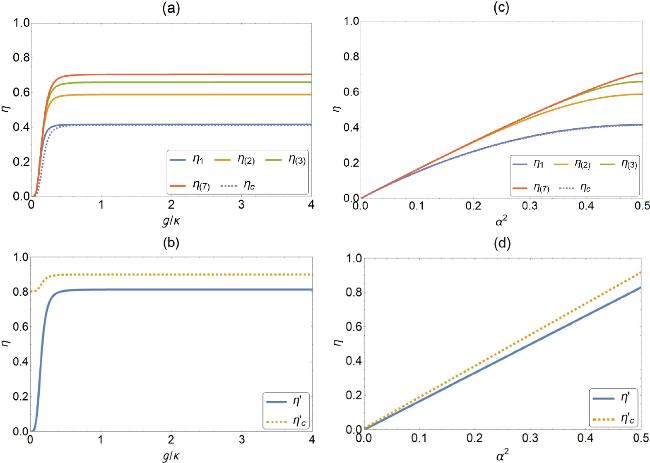


Figure 5. (a) and (b) illustrate the relationship between efficiency and g/κ under unknown and known parameters with α2 = 0.49, respectively. The colored curves represent the efficiency of error-rejecting ECP ({η1, η(2), η(3), η(7)} and ${\eta }^{{\prime} }$), while the dashed lines correspond to the efficiency of classical ECPs (ηc and ${\eta }_{c}^{{\prime} }$). (c) and (d) illustrate the relationship between efficiency and α2 under unknown and known parameters with g/κ = 2.4, respectively. The colored curves represent the efficiency of error-rejecting ECP ({η1, η(2), η(3), η(7)} and ${\eta }^{{\prime} }$), while the dashed lines correspond to the efficiency of classical ECPs (ηc and ${\eta }_{c}^{{\prime} }$). |
In conclusion, we present two error-rejecting ECPs for nonlocal partially entangled electron spins in QDs with unknown and known parameters, using single-sided QD-cavity systems. Both of the error-rejecting ECPs have unit fidelity under non-ideal experimental conditions. Their success probabilities can be further improved by employing the resource recycling method and the iteration method. In addition, these two error-rejecting ECPs have unit fidelity and considerable success probabilities with the current experimental parameters. Compared with previous studies, our scheme is more practical. Therefore, error-rejecting ECPs have promising application value in improving the fidelity of quantum communication.