


1. Introduction
(1)The DsJ states are too light: both ${D}_{s0}^{* }(2317)$ and Ds1(2460) are much lighter than the quark model expectations [19] for the lowest scalar and axial-vector $c\bar{s}$ mesons.
(2)Fine-tuning: within only 2 MeV the relation ${M}_{Ds1(2460)}\,-{M}_{D* s0(2317)}\approx {M}_{{D}^{* \pm }}-{M}_{{D}^{\pm }}$ holds.
(3)Mass hierarchy: one finds ${M}_{{D}_{0}^{* }(2300)}\sim {M}_{{D}_{s0}^{* }(2317)}$ and ${M}_{{D}_{1}(2430)}\sim {M}_{{D}_{s1}(2460)}$, although usually adding a strange quark leads to an increase in mass of about 150–200 MeV.
(4)Discrepancy theory versus experiment: various theoretical studies [12, 14–16, 20], later confirmed by lattice quantum chromodynamics (QCD) [21, 22], find lower masses for ${D}_{0}^{* }$ and D1 than values reported from experiments [23].
2. Flavor structure of light and heavy light diquarks
3. Results
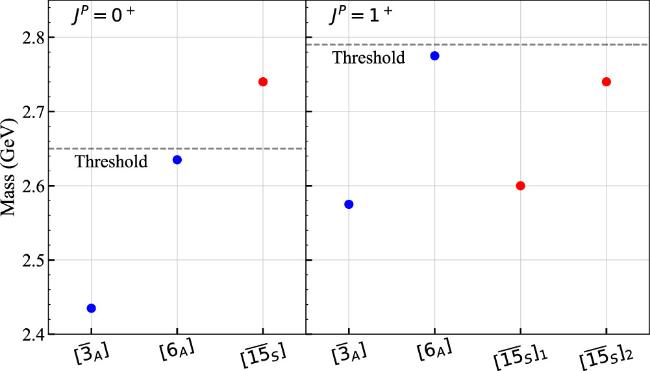


Figure 1. Sketch of the spectrum of scalar and axial-vector tetraquarks in the diquark–anti-diquark model for a pion mass of about 700 MeV. Blue (red) symbols refer to states containing spin-zero (spin-one) light diquarks. In contrast, in the molecular picture, only the analogs of the blue states appear with the higher one being located on the unphysical sheet. |