

1. Introduction
Effective field theories are one of the foundations of building our understanding of the Universe. An important example is the inflation theory [1–4], which was proposed to solve the problems of the original Big Bang model. After the graceful exit problem was solved and later developments [5–8], inflation became a paradigm in cosmology. Many more extensions have emerged since then, giving inflation theory significant advances [9–13]. On the observational front, evidence from the cosmic microwave background to large-scale structures has provided strong support for the paradigm. However, the exact nature of the inflaton remains unsolved. Recently, multi-field inflation models have become increasingly attractive because these models can explain issues such as non-Gaussianities and primordial black holes [14–17], where single-field inflation may struggle. Moreover, multi-field inflation could have fundamental ties to string theory [18–20], where many axion-like and moduli fields naturally exist, so some of them could be natural candidates to drive inflation. Ultimately, cosmological observations will determine the final answer.
Beyond effective field theory, top–down theoretical approaches also offer profound insight into inflation theory. A large number of scalar and pseudo-scalar fields corresponding to different compactification modes of extra dimensions exist in string theory. The masses and couplings of these fields could span many orders in the parameter space. It would be plausible that some of them contributed to inflation in the early universe. Indeed, inflation of multiple axion-like fields has already been widely discussed.
In this paper, we propose a particular, simple scenario in which two axion-like fields with a straightforward, particle-like potential drive inflation. The potential could be natural from the perspective of particle physics. Currently, axion-like particles (ALPs) in inflation, such as N-flation [21], feature periodic potentials that originated from instanton effects and possess a shift symmetry. The shift symmetry typically protects the flatness of the inflaton. Axion monodromy is another interesting possibility [20] where shift symmetry breaking leads to a monodromy effect, which allows the axion field to traverse large distances in field space, essential for driving inflation. Here we suggest two axion fields with monodromy-like potentials, assuming the periodic part is negligible compared to the quadratic term. This is different from the typical scenarios. In addition, the coupling is simply biquadratic, which presented as the primary driver of the end of inflation within the model itself. The total potential form is simple and thus could offer a tractable minimal model. Finally, we demonstrate that this model is consistent with current observational constraints.
2. Theoretical perspectives and numerical results
Currently, string theory-motivated single-field inflation, such as the D-brane model, is consistent with observations. However, multiple-field models are drawing increasing attention. In this paper, we propose a scenario that two ALP fields drive inflation. The Lagrangian can be expressed as:
$\begin{eqnarray}\begin{array}{rcl}{{ \mathcal L }}_{\phi \chi } & = & \frac{1}{2}{\partial }_{\mu }\phi {\partial }^{\mu }\phi -\frac{1}{2}{m}_{\phi }^{2}{\phi }^{2}+\frac{1}{2}{\partial }_{\mu }\chi {\partial }^{\mu }\chi -\frac{1}{2}{m}_{\chi }^{2}{\chi }^{2}\\ & & +\frac{1}{4{\varepsilon }_{\phi }{\varepsilon }_{\chi }{f}_{\phi }{f}_{\chi }}{\phi }^{2}{\chi }^{2},\end{array}\end{eqnarray}$
where mφ and mχ are the masses of the φ field and the χ field; ϵφ and ϵχ are their respective coupling coefficients. fφ and fχ are the decay constants of the φ and χ fields. The last term represents the interaction between the two fields. The field potential is then: $\begin{eqnarray}V(\phi ,\chi )=-\frac{1}{2}{m}_{\phi }^{2}{\phi }^{2}-\frac{1}{2}{m}_{\chi }^{2}{\chi }^{2}+\frac{1}{4{\varepsilon }_{\phi }{\varepsilon }_{\chi }{f}_{\phi }{f}_{\chi }}{\phi }^{2}{\chi }^{2}.\end{eqnarray}$
Figure 1 illustrates the potential energy landscape. As the field values increase, the potential maintains a relatively flat profile, but the coupling rises sharply. This indicates the coupling term being the dominant driver of inflationary dynamics.
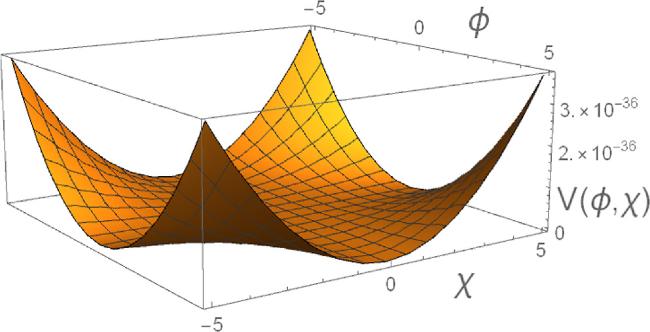
Figure 1. The field potential configuration of the proposed scenario. The yellow surface corresponding to equation ( |
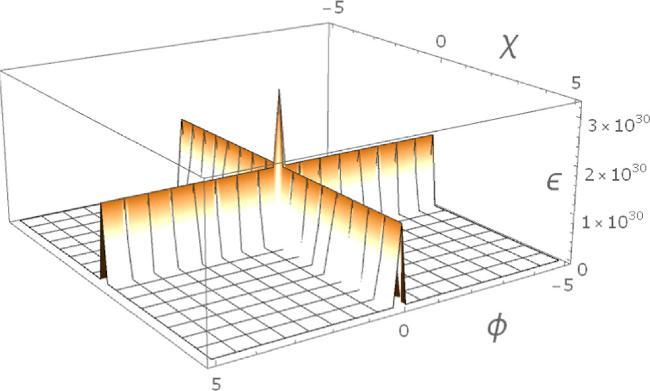
Figure 2. The evolution of the slow roll parameter ε in the dual-axion configuration space. |
Here, the masses are chosen as mφ ∼ 10−8 eV and mχ ∼ 10−7 eV for a scenario demonstration. To ensure symmetry between the fields φ and χ, we implement: ϵφ ∼ ϵχ ∼ 50 GeV−1 and fφ ∼ fχ ∼ 1017 GeV. During inflation, it was assumed that only the two axion-like fields dominated, while the other fields had negligible effects.
In the flat Friedmann–Robertson–Walker (FRW) universe, ${g}_{\mu \nu }=\mathrm{diag}\left\{-1,{a}^{2}(t),{a}^{2}(t),{a}^{2}(t)\right\}$, where a(t) is the scale factor. Let us define Mpl = 1, then the dual axion-like field energy density ρ is
$\begin{eqnarray}\rho =\frac{1}{2}{\dot{\phi }}^{2}+\frac{1}{2}{\dot{\chi }}^{2}+V(\phi ,\chi ),\end{eqnarray}$
and the pressure p is $\begin{eqnarray}p=\frac{1}{2}{\dot{\phi }}^{2}+\frac{1}{2}{\dot{\chi }}^{2}-V(\phi ,\chi ).\end{eqnarray}$
Denote the Hubble parameter $H=\dot{a}(t)/a(t)$. The Friedmann equation, which determines the space-time, is $\begin{eqnarray}3{H}^{2}=\frac{1}{2}{\dot{\phi }}^{2}+\frac{1}{2}{\dot{\chi }}^{2}+V(\phi ,\chi ).\end{eqnarray}$
The equation of motion for the φ field is $\begin{eqnarray}\ddot{\phi }+3H\dot{\phi }+{V}_{\phi }(\phi ,\chi )=0,\end{eqnarray}$
and for the χ field is $\begin{eqnarray}\ddot{\chi }+3H\dot{\chi }+{V}_{\chi }(\phi ,\chi )=0,\end{eqnarray}$
where Vφ(φ, χ) = dV(φ, χ)/dφ, Vχ(φ, χ) = dV(φ, χ)/dχ. For the scalar fields to induce a sustained inflation, the potential energy needs to be much larger than their kinetic energy. In addition, one has (1) the field velocity norm needs to be much smaller than one; (2) the covariant Hessian of the potentials needs to be much smaller than one; and (3) the slow-turn condition needs to be satisfied thus the field trajectory can avoid abrupt changes.Because the field potential dominate over the kinetic energy density: $\dot{\phi }\ll 2V(\phi ,\chi ),\,\dot{\chi }\ll 2V(\phi ,\chi )$, equation(8 ) simplifies to
$\begin{eqnarray}{H}^{2}\simeq \frac{1}{3}V(\phi ,\chi ).\end{eqnarray}$
When the potential is flat enough, the Universe experiences rapid inflation. Equations (9 ) and (10 ) can be written as:
$\begin{eqnarray}3H\dot{\phi }\simeq -{V}_{\phi }(\phi ,\chi ),\end{eqnarray}$
$\begin{eqnarray}3H\dot{\chi }\simeq -{V}_{\chi }(\phi ,\chi ).\end{eqnarray}$
These equations of motion ensure the prolonged drive. One can obtain the slow roll parameters εφχ and ηφχ as: $\begin{eqnarray*}\epsilon =\frac{1}{2}{\left(\frac{{V}^{{\prime} }(\phi ,\chi )}{V(\phi ,\chi )}\right)}^{2},\end{eqnarray*}$
$\begin{eqnarray*}\eta =\frac{{V}^{{\prime\prime} }(\phi ,\chi )}{V(\phi ,\chi )}.\end{eqnarray*}$
The φ and χ potentials of mass and two-field coupling give rise to: $\begin{eqnarray*}{V}_{\phi }^{{\prime} }(\phi ,\chi )=-{m}_{\phi }^{2}\phi +\frac{{\chi }^{2}}{2{\varepsilon }_{\phi }{\varepsilon }_{\chi }{f}_{\phi }{f}_{\chi }}\phi ,\end{eqnarray*}$
$\begin{eqnarray*}{V}_{\chi }^{{\prime} }(\phi ,\chi )=-{m}_{\chi }^{2}\chi +\frac{{\phi }^{2}}{2{\varepsilon }_{\phi }{\varepsilon }_{\chi }{f}_{\phi }{f}_{\chi }}\chi ,\end{eqnarray*}$
$\begin{eqnarray*}{V}_{\phi \phi }^{{\prime\prime} }(\phi ,\chi )=-\,{m}_{\phi }^{2}+\frac{{\chi }^{2}}{2{\varepsilon }_{\phi }{\varepsilon }_{\chi }{f}_{\phi }{f}_{\chi }},\end{eqnarray*}$
$\begin{eqnarray*}{V}_{\phi \chi }^{{\prime\prime} }(\phi ,\chi )=\frac{\phi \chi }{{\varepsilon }_{\phi }{\varepsilon }_{\chi }{f}_{\phi }{f}_{\chi }},\end{eqnarray*}$
$\begin{eqnarray*}{V}_{\chi \chi }^{{\prime\prime} }(\phi ,\chi )=-{m}_{\chi }^{2}+\frac{{\phi }^{2}}{2{\varepsilon }_{\phi }{\varepsilon }_{\chi }{f}_{\phi }{f}_{\chi }},\end{eqnarray*}$
$\begin{eqnarray*}{V}_{\chi \phi }^{{\prime\prime} }(\phi ,\chi )=\frac{\phi \chi }{{\varepsilon }_{\phi }{\varepsilon }_{\chi }{f}_{\phi }{f}_{\chi }}.\end{eqnarray*}$
The respective slow roll parameter of field velocity norm ε is $\begin{eqnarray}\epsilon =\frac{1}{2}\frac{{\left({m}_{\phi }^{2}\phi -\frac{{\chi }^{2}\phi }{2{\varepsilon }_{\phi }{\varepsilon }_{\chi }{f}_{\phi }{f}_{\chi }}\right)}^{2}+{\left({m}_{\chi }^{2}\chi -\frac{{\phi }^{2}\chi }{2{\varepsilon }_{\phi }{\varepsilon }_{\chi }{f}_{\phi }{f}_{\chi }}\right)}^{2}}{{\left(\frac{1}{2}{m}_{\phi }^{2}{\phi }^{2}+\frac{1}{2}{m}_{\chi }^{2}{\chi }^{2}-\frac{1}{4{\varepsilon }_{\phi }{\varepsilon }_{\chi }{f}_{\phi }{f}_{\chi }}{\phi }^{2}{\chi }^{2}\right)}^{2}.}\end{eqnarray}$
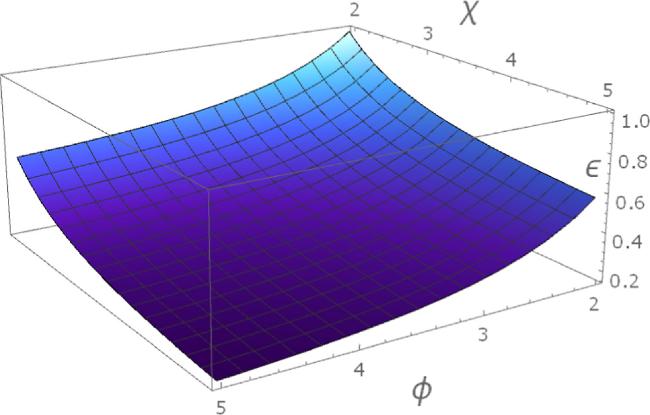
Figure 3. The evolution of the slow roll parameter ε in the first quadrant of φ and χ. The φ and χ will decrease until ε = 1. |
When inflation ends, ε = 1 with the corresponding φe and χe. Figure 4 shows the respective φ and χ, where the outermost line corresponds to ε = 1.
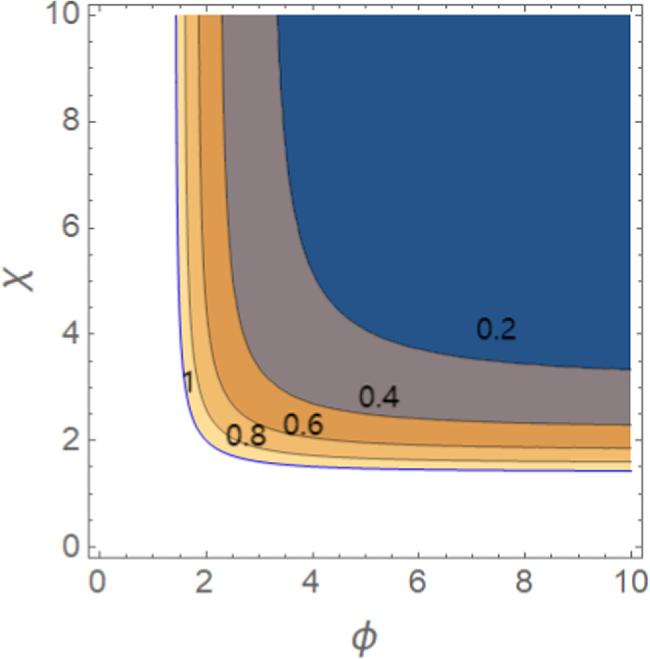
Figure 4. The parameter space of φ and χ associated with the evolution of the slow roll parameter ε. |
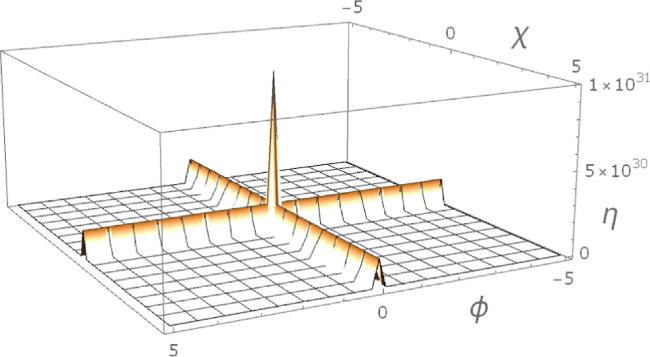
Figure 5. The evolution of the slow roll parameter η with φ and χ configuration space. |
The second slow roll parameter η can be expressed as
$\begin{eqnarray}\eta =\frac{{m}_{\phi }^{2}+{m}_{\chi }^{2}-\frac{{\phi }^{2}+{\chi }^{2}}{2{\varepsilon }_{\phi }{\varepsilon }_{\chi }{f}_{\phi }{f}_{\chi }}-\frac{2\chi \phi }{{\varepsilon }_{\phi }{\varepsilon }_{\chi }{f}_{\phi }{f}_{\chi }}}{\frac{1}{2}{m}_{\phi }^{2}{\phi }^{2}+\frac{1}{2}{m}_{\chi }^{2}{\chi }^{2}-\frac{1}{4{\varepsilon }_{\phi }{\varepsilon }_{\chi }{f}_{\phi }{f}_{\chi }}{\phi }^{2}{\chi }^{2}}.\end{eqnarray}$
Similar to figures 2 and 3, figures 5 and 6 show the evolution behavior of the slow roll parameter η with respect to φ and χ. The contribution of the coupling term to η is significant in the later stage of inflation. Figure 7 shows the critical line (solid blue line) of η = 1, which determines the end of inflation.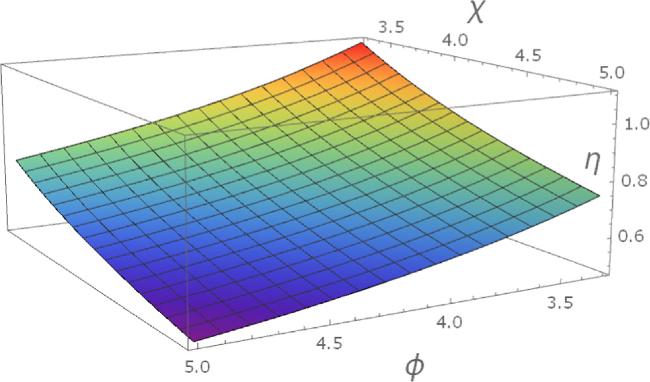
Figure 6. The evolution of the slow roll parameter η, with φ and χ gradually evolving from larger values to smaller values. η = 1 indicates the end of inflation. |
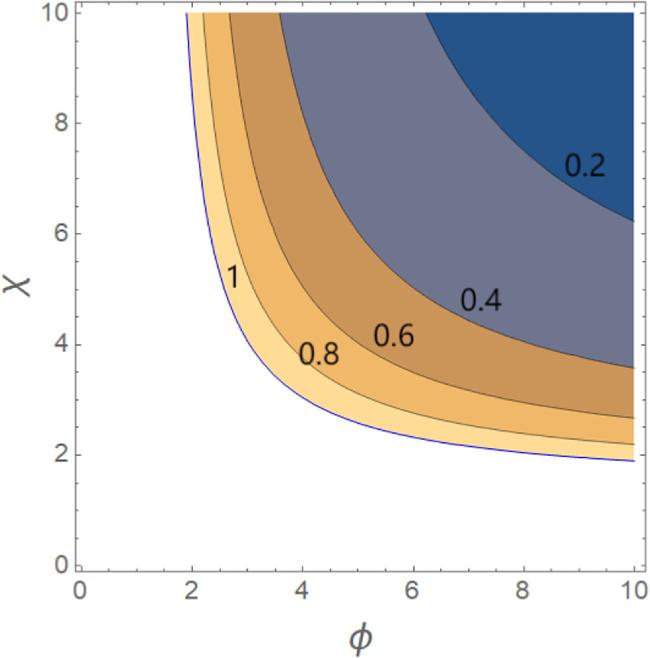


Figure 7. The parameter space of φ and χ, corresponding to the evolution of the slow roll parameter η; also see figure 6. |
As the scale factors determine the expansion of the Universe during inflation, one can introduce the N of e-foldings:
$\begin{eqnarray}\begin{array}{rcl}N({\phi }_{e},{\chi }_{e},{\phi }_{i},{\chi }_{i}) & = & -\frac{{m}_{\phi }^{2}{\varepsilon }_{\phi }{\varepsilon }_{\chi }{f}_{\phi }{f}_{\chi }}{4}({\phi }_{e}^{2}-{\phi }_{i}^{2})({\mathrm{ln}}\,{\chi }_{e}-{\mathrm{ln}}\,{\chi }_{i})\\ & & -\frac{{m}_{\chi }^{2}{\varepsilon }_{\phi }{\varepsilon }_{\chi }{f}_{\phi }{f}_{\chi }}{4}({\chi }_{e}^{2}-{\chi }_{i}^{2})({\mathrm{ln}}\,{\phi }_{e}-{\mathrm{ln}}\,{\phi }_{i})\\ & & +\frac{1}{16}({\phi }_{e}^{2}-{\phi }_{i}^{2})({\chi }_{e}^{2}-{\chi }_{i}^{2}).\end{array}\end{eqnarray}$
To solve the horizon problem, the value of the e-folding number is usually between 50 − 60, which can be satisfied here [22]. When the initial parameters of φi and χi are set to 5Mpl–9Mpl, we will obtain a spectral index of approximately ns ≈ 0.967658 ± 0.012841, which satisfies the current cosmological observations.3. Discussions and conclusions
In the context of string theory, multiple axion and moduli fields naturally arise. Therefore, a multi-field inflation scenario could be preferred from a top-down perspective. Additionally, multi-field inflation models could address some phenomenological issues such as fine-tuning and non-Gaussianities more naturally. In this paper, we propose a two-axion-like field inflation model with straightforward monodromy-dominated potentials. Compared with most multiaxion models, the proposed model is very simple and the steep rise in the coupling term is the primary driver of the end of inflation.
By analyzing the slow-roll parameters and the spectral index, we find that the model is viable and offers a substantial parameter space for exploration. Future studies of its cosmological effects, such as primordial fluctuations and non-Gaussianity, could be worthwhile.