


1. Introduction
Verlinde introduced a groundbreaking model positing that gravity is an entropic force, building on Jacobson's earlier conclusions. This framework suggests that gravity emerges from the informational context related to object positioning. Integrating the thermodynamic perspective of gravity with Hooft's principle, Verlinde's theory fundamentally views gravity not as a traditional force, but as a phenomenon emerging from the microscopic behaviors captured on a holographic screen. Moreover, Verlinde has recently offered insights into the origins of dark matter, sparking significant interest and prompting investigations across different fields. The recent scholarly work has examined the foundations and observational impacts of Verlinde's entropic gravity, leading to the formulation of black hole (BH) solutions within this framework.
The holographic interpretation of extended BH thermodynamics presents certain challenges [1]. In this context, thermodynamics law for BHs does not have a direct connection to the thermodynamic laws of the dual conformal field theory [2, 3]. Fluctuations in fundamental constants, such as the cosmological constant and Newton's constant, highlight the need for new theories [4]. To tackle this issue, Visser modified the law of BH thermodynamics by treating Newton's constant as a variable [5]. Considering the relationship between Newton's constant and the central charge, Cong et al developed an updated law of thermodynamics for BHs [6]. This revised first law includes the necessary adjustments for thermodynamic volume and chemical potential. By applying the duality relation, it illustrates the link between bulk thermodynamics and holographic thermodynamics. The authors [7, 8] have analyzed specific Simpson–Visser (SV) BHs with a Minkowski core. Additionally, researchers have initiated fascinating studies on different BH geometries [9, 10].
The presence of BHs is indirectly confirmed through observations of their shadows [11]. In reality, these observations reflect the bending of photons emitted by light sources located behind the BH [12]. When light rays reach to BH, photons with low momentum are drawn in, while those with high orbital angular momentum manage to escape. As a result, an observer perceives a dark region referred to as the shadow of BH. Naturally, these results vary depending on the relative position and the characteristics of BH [13]. Synge [14] and Luminet [15] found that spherically symmetric static BH create a perfectly circular shadow. Shortly after Synge's initial findings, Bardeen argued that the rotation of spinning BHs cause distortions in these circular shadows [16]. Since the initial observation of BH shadows, lots of researchers have turned their attention to the modeling of these shadows in recent years [17–29]. Earlier studies on BH shadows date back to Bardeen in 1972, who showed that the shadow of a Kerr BH is not circular [30]. Luminet was the first to numerically illustrate the appearance of BHs in luminous rotating accretion disk [31]. Gralla et al investigated the shadow images of Schwarzschild BHs illuminated by a geometrically and optically thin accretion disk using ray-tracing techniques [32]. A thorough review of the methods for calculating shadow images can be found [33]. Additionally, recent studies on the shadow images and optical appearances of different BHs are detailed in [34–41]. These works highlight that this subject has become a major focus in gravity, attracting significant interest within the scientific community.
Gralla et al showed that the rings surrounding the shadow of the M87* can be determined by the points where light rays intersect the disk plane. They identified different types of rings, including the direct, lensing and photon rings [42]. Additionally, Cunha et al examined the shadow of a Schwarzschild BH surrounded by a geometrically thick and optically thin accretion flow [43]. A straightforward model of accretion onto BH, along with an analysis of its shadow characteristics is presented in [44]. Narayan et al [44] suggest that the BH image in a spherical model differs from that in thin disk model. In this case, the inner disk can significantly influence the image particularly when it is positioned outside the orbit. The shadow of BH with accretion flow has been analyzed [45]. The authors investigated how the quintessence state parameter and the type of accretion affect the appearance [45]. The authors also investigated the impact of Gauss–Bonnet parameter and spherical accretion on the shadow characteristics of the BH [46]. Additionally, appearance of BHs in Rastall gravity with various accretions model is studied [47, 48 ]. For more research on how the position and profile of accretion flow influence the shadow see [49–54].
The VEG presents a novel perspective, positing gravity not as a fundamental interaction but as an emergent phenomenon driven by entropic principles. This departure from traditional gravitational frameworks suggests that observable features near BHs, such as shadows and emission intensities, may bear unique signatures of this theory. Within VEG, the interaction between baryonic matter and apparent dark matter influences spacetime geometry, potentially altering the BHs shadow structure and the radiation profile of its surroundings. The Simpson–Visser Minkowski BH (SVMBH) offers an intriguing platform for exploring these effects, as it avoids singularities at the core and incorporates features that might exhibit distinct observational characteristics in VEG. Studying the shadow and intensity distribution around this BH model allows us to investigate whether emergent gravity principles could introduce measurable deviations in observable quantities like shadow size, photon ring brightness, and intensity gradients across the BHs surroundings. These deviations could provide critical clues for differentiating emergent gravity from classical frameworks and help identify empirical markers of apparent dark matters influence. Through this research, we aim to reveal potential observational signatures linked to emergent gravity, offering a pathway to validate or challenge Verlinde's theory through astrophysical observations.
The structure of the paper is as follows: section 2 provides a review of the SVMBH solution within the framework of VEG. In section 3 , we explore the shadows cast by the SVMBH solution in VEG. Section 4 employs a static spherical accretion model to analyze the images and intensities associated with the SVMBH solution in VEG. The paper concludes with section 5 .
2. Simpson–Visser Minkowski core regular black hole solution in Verlinde's emergent gravity
The SV solution is an extension of the Schwarzschild metric that incorporates the effects of both classical and exotic matter distributions, aiming to describe a non-singular. The key feature of this model is the modification of the Schwarzschild solution to include a term that softens the singularity at the origin. According to the findings in Verlinde's research [55], the relationship between apparent dark matter MD(r) and baryonic matter MB(r) can be described by the following equation
$\begin{eqnarray}{\int }_{0}^{r}\frac{G{M}_{D}{({r}^{{\prime} })}^{2}}{{r{}^{{\prime} }}^{2}}\,{\rm{d}}{r}^{{\prime} }=c{H}_{0}{M}_{B}(r)\frac{r}{6},\end{eqnarray}$
where H0 and G represent the current Hubble parameter and Newton's constant, respectively. This equation can also be rewritten as follows $\begin{eqnarray}{\int }_{0}^{r}\frac{{M}_{D}^{2}({r}^{s})}{{r{}^{{\prime} }}^{2}}\,{\rm{d}}{r}^{{\prime} }={a}_{0}{M}_{B}(r)\frac{r}{6},\end{eqnarray}$
a0 = cH0 is utilized. This relationship can also be articulated as $\begin{eqnarray}{M}_{D}^{2}(r)={a}_{0}\frac{{r}^{2}}{6}\frac{{\rm{d}}}{{\rm{d}}r}\left(r-{M}_{B}(r)\right),\end{eqnarray}$
and it is defined that $\begin{eqnarray}{a}_{M}=\frac{{a}_{0}}{6},\end{eqnarray}$
where $\begin{eqnarray}{a}_{0}=5.4\times 1{0}^{-10}\,{s}^{-2}m\rm{}\,\rm{}\,.\end{eqnarray}$
The simplest scenario is to consider a spherically symmetric BH solutions with the line element $\begin{eqnarray}{\rm{d}}{s}^{2}={g}_{tt}{\rm{d}}{t}^{2}+{g}_{rr}{\rm{d}}{r}^{2}+{r}^{2}({\rm{d}}{\theta }^{2}+{\sin }^{2}\theta {\rm{d}}{\phi }^{2}).\end{eqnarray}$
For the BH scenario, we may assume ${g}_{tt}=-{g}_{rr}^{-1}$ and $\begin{eqnarray}{g}_{rr}^{-1}=1-\frac{2m(r)}{r},\end{eqnarray}$
where the mass profile is given by $\begin{eqnarray}m(r)=4\pi {\int }_{0}^{r}\left[{\rho }_{D}({r}^{{\prime} })+{\rho }_{B}({r}^{{\prime} })\right]{r{}^{{\prime} }}^{2}\,{\rm{d}}{r}^{{\prime} }.\end{eqnarray}$
In this analysis, following the approach described in [56], it is possible to develop regular BHs with different mass profiles. This enables an investigation into the influence of apparent dark matter on spacetime geometry. For instance, one might consider the mass profile suggested by Simpson and Visser, which characterizes baryonic matter with an exponentially decreasing distribution $\begin{eqnarray}{M}_{B}(r)=M\exp \left(-\frac{A}{{r}^{n}}\right),\end{eqnarray}$
The analysis can preserve key physical characteristics while being expanded to accommodate any n [57]. When this profile is adapted to include charge, the resulting equation is as follows $\begin{eqnarray}{M}_{B}(r)=\left(M-\frac{{Q}^{2}}{2r}\right)\exp \left(-\frac{A}{{r}^{n}}\right).\end{eqnarray}$
The Einstein field equations, Gμν = 8πTμν, are used to derive the conditions that the metric tensor must satisfy. For the SV model, the energy-momentum tensor Tμν needs to account for both ordinary and exotic matter fields. The exotic matter typically violates certain energy conditions and is characterized by a negative energy density that counters the singularity-inducing effects of the positive mass. The specific form of Tμν for exotic matter can be modeled as $\begin{eqnarray}{T}_{\mu \nu }=(\rho +p){u}_{\mu }{u}_{\nu }+p{g}_{\mu \nu },\end{eqnarray}$
where ρ is the energy density, p is the pressure, and uμ is the four-velocity of the matter. For the SV, ρ and p are functions of r that decay exponentially, as suggested by the factor ${{\rm{e}}}^{-\frac{A}{{r}^{n}}}$ in the metric function. By first solving for the apparent dark matter and then applying $f(r)=-{g}_{tt}={g}_{rr}^{-1}$, the complete solution becomes $\begin{eqnarray}f(r)=1-\left(\frac{2rM-{Q}^{2}}{{r}^{2}}\right){{\rm{e}}}^{-\frac{A}{{r}^{n}}}-2\sqrt{{a}_{M}}{{\rm{e}}}^{-\frac{A}{2{r}^{n}}}\frac{{\rm{\Xi }}(r)}{r},\end{eqnarray}$
where $\begin{eqnarray}{\rm{\Xi }}(r)=\sqrt{r\left(M(r+An{r}^{-(n+1)})-\frac{{Q}^{2}nA}{2{r}^{n}}\right)},\end{eqnarray}$
which introduces modifications to the classical Reissner–Nordström (RN) metric through the parameters A and n, which are absent in the traditional RN metric $\begin{eqnarray*}{f}_{RN}(r)=1-\frac{2M}{r}+\frac{{Q}^{2}}{{r}^{2}}.\end{eqnarray*}$
Our utilized metric incorporates exponential damping factors that modulate the influence of mass and charge with distance, a feature not present in the RN metric. This results in a spacetime geometry that varies significantly with the radial distance r, especially under the influence of the emergent gravity parameters. The non-singular nature of the SV can be demonstrated by analyzing the behavior of the curvature invariants such as R (Ricci scalar) and RμνRμν. The metric described above is regular and the limit r → 0 yields $\begin{eqnarray*}\mathop{\mathrm{lim}}\limits_{r\to 0}{R}_{\mu \nu }{R}^{\mu \nu }\to 0,\quad \end{eqnarray*}$
and $\begin{eqnarray}\quad \mathop{\mathrm{lim}}\limits_{r\to 0}{R}_{\mu \nu \sigma \eta }{R}^{\mu \nu \sigma \eta }\to 0.\end{eqnarray}$
As r → 0, these invariants do not diverge, indicating the absence of a singularity at the center. This is a significant departure from classical solutions, where such invariants typically blow up at r = 0. By setting Q = 0, it turns to SVMBH [58] $\begin{eqnarray}f(r)=1-2M{r}^{-1}{{\rm{e}}}^{-\frac{A}{{r}^{n}}}-B{{\rm{e}}}^{-\frac{A}{2{r}^{n}}}\sqrt{1+\frac{An}{{r}^{n}}},\end{eqnarray}$
where $B=2\sqrt{{a}_{M}M}$. Setting A = 0 gives f(1) = 1 − 2Mr−1 − B, which resembles monopole solution, aligning with the fact that Verlinde's theory allows for monopole-like solution. [59]. The parameters A, B, and n are pivotal in determining the different properties and theoretical consequences of this BH model. The parameter A primarily influences the radial distribution, featuring in the ${{\rm{e}}}^{-\frac{A}{{r}^{n}}}$ that adjusts the mass function. Higher values of A result in a more rapid decrease in baryonic matter density as the radius increases, indicating a denser core. The exponential factor involving A markedly changes metric near BH's core, thereby affecting the gravitational field's behavior near the BH, the required escape velocities, and the curvature of spacetime. A also helps maintain the BH's regularity, preventing the formation of singularities typically found in classical BH. B denotes the strength of the interaction between dark matter and baryonic matter. n controls the rate at which the distribution of baryonic matter decreases with distance from the center of the BH. Variations in n can produce markedly different spacetime geometries, leading to diverse observable characteristics. Our study explores how these parameters influence the shadow images and observable intensities of the BH.3. Shadows of SVMBH in Verlinde's emergent gravity
In this section, we focus to derive BH shadow, specifically within the framework of VEG. We consider the following Lagrangian [60]23 ) and equation (24 ) into equation (22 ), we rewrite it into two distinct equations
$\begin{eqnarray}\begin{array}{l}L=\frac{1}{2}{g}_{\mu \nu }{\dot{x}}^{\mu }{\dot{x}}^{\nu }=\frac{1}{2}\\ \,\,\,\,\times \left(\frac{1}{f(r)}{\dot{r}}^{2}-f(r){\dot{t}}^{2}+{r}^{2}{\sin }^{2}\theta {\dot{\phi }}^{2}+{r}^{2}{\dot{\theta }}^{2}\right),\end{array}\end{eqnarray}$
dot denotes differentiation w.r.t, τ. By applying the Lagrange, we can straightforwardly derive [60] $\begin{eqnarray}E=\left(1-2M{r}^{-1}{{\rm{e}}}^{-\frac{A}{{r}^{n}}}-B{{\rm{e}}}^{-\frac{A}{2{r}^{n}}}\sqrt{1+\frac{An}{{r}^{n}}}\right)\dot{t},\end{eqnarray}$
$\begin{eqnarray}{P}_{\phi }={r}^{2}{\sin }^{2}\theta \dot{\phi }=L.\end{eqnarray}$
Here, E is energy and L represent angular momentum of particle. There are some methodologies, such as the Lagrangian and the Euler–Lagrange approaches, that can be used to derive the equations of motion in curved spacetimes. The Lagrangian method, similar in principle to the Hamiltonian approach, starts directly from the Lagrangian function L and employs the Euler–Lagrange equations to derive the geodesics. This method is particularly straightforward and intuitive as it directly involves the action principle, making it ideal for systems where the conservation properties (such as energy and angular momentum) are more transparent. On the other hand, the Hamiltonian approach, provides a robust framework especially beneficial in dealing with complex spacetimes, as it readily incorporates the canonical momenta and Hamilton's equations. This approach is advantageous in general relativity for handling conserved quantities and can be particularly powerful in numerical relativity where canonical formulations are predominant. Comparatively, while the Lagrangian method often offers a more direct route to the equations of motion and might be considered simpler in some contexts, the Hamiltonian approach excels in its generalizations and its ability to link with quantum gravity theories, where the canonical framework plays a critical role. The subsequent step involves deriving the particle's geodesic, following the Hamilton equation [60] $\begin{eqnarray}H+\frac{\partial S}{\partial \tau }=0,\end{eqnarray}$
$\begin{eqnarray}H=\frac{1}{2}{g}_{\mu \nu }{p}^{\mu }{p}^{\nu }.\end{eqnarray}$
By utilizing $\frac{\partial S}{\partial {x}^{\mu }}={p}^{\mu }$ and the separation technique derived from Carter's work [60], $\begin{eqnarray}S=\frac{{\tilde{m}}^{2}}{2}\tau -Et+{S}_{\theta }(\theta )+L\phi +{S}_{r}(r),\end{eqnarray}$
we derive the following important relation $\begin{eqnarray}\begin{array}{l}\frac{{E}^{2}}{f(r)}-\frac{1}{{r}^{2}}\left(\frac{{L}^{2}}{{\sin }^{2}\theta }+K-{L}^{2}{\cot }^{2}\theta \right)\\ \,-f(r){\left(\frac{\partial {S}_{r}}{\partial r}\right)}^{2}-\frac{1}{{r}^{2}}{\left(\frac{\partial {S}_{\theta }}{\partial \theta }\right)}^{2}+{L}^{2}{\cot }^{2}\theta -K=0.\end{array}\end{eqnarray}$
Here, K represents Carter's constant. It is important to note that we must set the mass $\tilde{m}=0$, because particle is a massless photon. Using $\frac{\partial {S}_{\theta }}{\partial \theta }={p}_{\theta }$, and $\frac{\partial {S}_{r}}{\partial r}={p}_{r}$, one can easily obtain the following $\begin{eqnarray}\frac{\partial {S}_{\theta }}{\partial \theta }={r}^{2}\frac{\partial \theta }{\partial \tau },\end{eqnarray}$
$\begin{eqnarray}\frac{\partial {S}_{r}}{\partial r}=f{(r)}^{-1}\frac{\partial r}{\partial \tau }.\end{eqnarray}$
By substituting equation ( $\begin{eqnarray}{r}^{2}{\left(\frac{\partial {S}_{r}}{\partial r}\right)}^{2}={r}^{2}{E}^{2}f{(r)}^{-2}-({L}^{2}+K)f{(r)}^{-1},\end{eqnarray}$
$\begin{eqnarray}{\left(\frac{\partial {S}_{\theta }}{\partial \theta }\right)}^{2}=-{L}^{2}{\cot }^{2}\theta +K.\end{eqnarray}$
Next, we utilize the definition of the canonically conjugate momentum to express the complete set of equations of motion $\begin{eqnarray}{r}^{2}\frac{\partial \theta }{\partial \tau }=\pm \sqrt{{\rm{\Theta }}},\quad {\rm{\Theta }}=-{L}^{2}{\cot }^{2}\theta +K,\end{eqnarray}$
$\begin{eqnarray}{r}^{2}\dot{r}=\pm \sqrt{R},\quad R={r}^{4}{E}^{2}-({L}^{2}+K){r}^{2}f(r),\end{eqnarray}$
Here, the symbols + and − denote the outgoing and incoming radial motion of photons, respectively. The existence of null orbits defines the shadow boundary of BHs. To locate orbits, we rewrite geodesic equation as follows $\begin{eqnarray}{V}_{\,\rm{eff}\,}(r)+{\left(\frac{\partial r}{\partial \tau }\right)}^{2}=0.\end{eqnarray}$
Here, potential Veff(r) is given by $\begin{eqnarray}{V}_{\,\rm{eff}\,}(r)=f(r)\left({L}^{2}+K\right){r}^{-2}-{E}^{2}.\end{eqnarray}$
Figure 1 illustrates the effective potential Veff(r) as a function of the radial coordinate r for different values of the parameter n. It is observed that with lower values of n, the effective potential exhibits a higher peak, suggesting a stronger gravitational field near the BH. This indicates that the potential barrier, which acts as a gatekeeper for particles trying to escape the BH's gravitational pull, is more formidable at lower n values. As n increases, the height of this barrier decreases, implying a weakening gravitational field. Additionally, the peak of the potential barrier shifts outward, indicating that the radius at which gravitational effects are maximized increases with higher n. Figure 2 depicts how parameter B influences Veff(r). Here, a stronger potential barrier is noted at smaller B values. This enhanced barrier suggests a stronger gravitational influence exerted by the BH, which could significantly affect the BH's shadow and its observable characteristics in terms of gravitational lensing and radiation patterns. Figure 3 examines the impact of the parameter A on the effective potential Veff(r) within the framework of VEG. When A is small, particularly at A = 0, the effective potential is observed to be at its lowest, corresponding to the classical metric without modifications from emergent gravity. As A increases, the effective potential also rises, highlighting a trend opposite to that observed with variations in n and B. This increase in the potential barrier with larger A values underscores the significant role that emergent gravity corrections play in the dynamics of spacetimes. These observations are critical for understanding the nuanced effects of emergent gravity on physics. They particularly impact our predictions and analysis in gravitational wave astronomy and the study of shadows, offering deeper insights into the interplay between parameters and their observable gravitational effects. Next, we set the conditions described in [61]37 ) and (38 ) simplify to the following form 34 ) becomes
$\begin{eqnarray*}{V}_{\,\rm{eff}\,}(r){| }_{r={r}_{p}}=0,\end{eqnarray*}$
$\begin{eqnarray}\frac{{\rm{d}}{V}_{\,\rm{eff}\,}(r)}{{\rm{d}}r}{| }_{r={r}_{p}}=0,\end{eqnarray}$
or $\begin{eqnarray*}R(r){| }_{r={r}_{p}}=0,\end{eqnarray*}$
$\begin{eqnarray}\frac{{\rm{d}}R(r)}{{\rm{d}}r}{| }_{r={r}_{p}}=0,\end{eqnarray}$
to determine the unstable circular orbits, where rp represents the radius of the photon sphere. Using definitions of the impact parameter $\begin{eqnarray*}\zeta =\frac{L}{E},\end{eqnarray*}$
$\begin{eqnarray}\eta =\frac{K}{{E}^{2}},\end{eqnarray}$
we determine, the following important relationship $\begin{eqnarray}\eta +{\zeta }^{2}=\frac{2{r}_{p}^{2}}{f({r}_{p})+\frac{{r}_{p}{f}^{{\prime} }({r}_{p})}{2}}.\end{eqnarray}$
In [62], the authors utilized celestial coordinates to present the shadow. The celestial coordinates X and Y, are indeed instrumental in transforming the theoretical calculations into observable quantities that can be directly compared with astronomical observations. These coordinates transform the complex geometrical properties of photon orbits near a into a more visually intuitive format, effectively mapping the shadow as seen by a distant observer. We use these coordinates which are defined as follows $\begin{eqnarray}X=\mathop{\mathrm{lim}}\limits_{{r}_{o}\to \infty }\left(-{r}_{o}^{2}\sin {\theta }_{o}\frac{{\rm{d}}\phi }{{\rm{d}}r}\right),\end{eqnarray}$
$\begin{eqnarray}Y=\mathop{\mathrm{lim}}\limits_{{r}_{o}\to \infty }\left({r}_{o}^{2}\frac{{\rm{d}}\theta }{{\rm{d}}r}\right).\end{eqnarray}$
Here, ro and θo indicate the distance and the angle between the shadow and the observer respectively. In the case of null geodesics, we can derive $\begin{eqnarray}X=-\frac{\zeta }{\sin {\theta }_{o}},\end{eqnarray}$
$\begin{eqnarray}Y=\pm \sqrt{\eta -{\zeta }^{2}{\cot }^{2}{\theta }_{o}}.\end{eqnarray}$
Considering that the observer lies in equatorial plane and taking ${\theta }_{o}=\frac{\pi }{2}$, equations ( $\begin{eqnarray}X=-\zeta ,\end{eqnarray}$
$\begin{eqnarray}Y=\pm \sqrt{\eta }.\end{eqnarray}$
Thus, equation ( $\begin{eqnarray}{X}^{2}+{Y}^{2}=\eta +{\zeta }^{2}=\frac{2{r}_{p}^{2}}{f({r}_{p})+\frac{{r}_{p}{f}^{{\prime} }({r}_{p})}{2}}={R}_{s}^{2}.\end{eqnarray}$
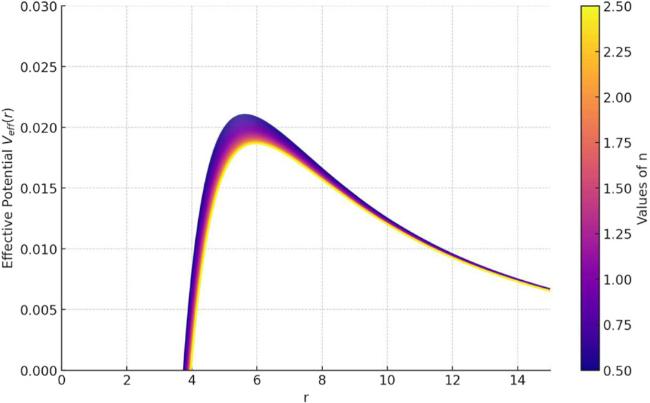
Figure 1. The graph illustrates the effective potential Veff(r) against r for the SVMBH solution in VEG, plotted for various values of n while keeping B = 1.5, A = 0.5, and M = 0.8 constant. |
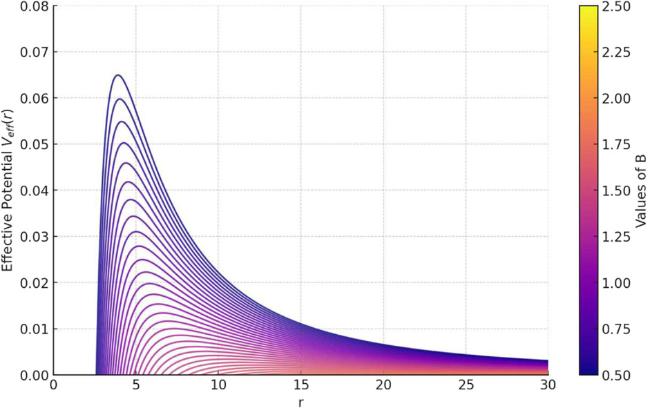
Figure 2. The plot displays the effective potential Veff(r) plotted against r by considering different values of B while keeping n = 0.5, A = 0.5, and M = 0.8 constant. |
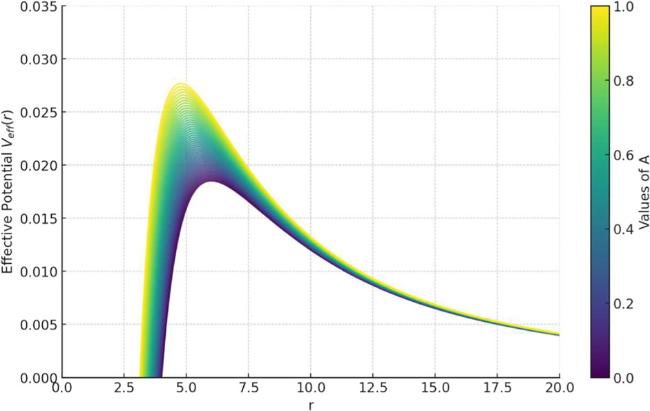
Figure 3. The graph depicts the effective potential Veff(r) against r, plotted across different values of A while maintaining B = 1.5, n = 0.5, and M = 0.8 as constants. |
Figures 4 and 5 illustrate the shadows of SVMBH in VEG. These figures clearly demonstrate that increasing the parameter A leads to an enlargement of the shadow radius, suggesting an enhancement in the spacetime curvature effects surrounding the BH. Conversely, higher values of B result in a reduced shadow radius, indicating a stronger constraining influence on the spacetime deformations caused by the BH. These visual representations effectively show how the shadow sizes can be influenced by theoretical parameters within the VEG model. Specifically, as A increases, the shadow size also increases, illustrating the expansive effect of A on spacetime curvature. In contrast, an increase in B appears to counteract this effect by constraining the spacetime, highlighting a delicate balance between enhancing and constraining forces in the spacetime surrounding BHs. Figure 6 further explores the impacts of varying A, B, and n on the observable shadow sizes of BHs. Each graph in this figure is characterized by a unique combination of parameters, with A set at 0, 0.1, 0.2, 0.3, B at 0, 0.5, 1, 1.5, and n at 1, 2, 3, 4. This detailed exploration allows for an in-depth analysis of their individual and combined effects on shadows. The increase in A consistently leads to larger shadow sizes, which correlates with an expansion in spacetime curvature. Conversely, higher B values typically reduce the shadow size, indicative of a stronger constraining effect on spacetime deformation. The parameter n influences how the effects of A and B manifest, altering the non-linear characteristics of spacetime around the BH. These visualizations effectively highlight the significant variations in shadow sizes driven by different settings of A, B, and n, emphasizing the complex interplay between these theoretical parameters that govern the behavior of spacetime.
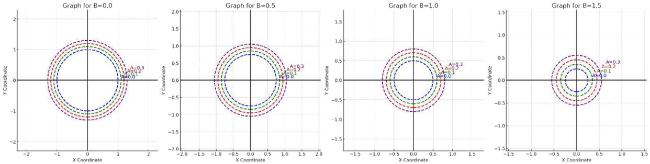
Figure 4. The plot shows the shadows of SVMBH solution in VEG for various A and B values with n = 0.5, M = 0.8. Left to right, the different plots correspond to B = 0, 0.5, 1 and 1.5 respectively. Inner to outward curves correspond to A = 0, 0.1, 0.2 and 0.3 respectively. |
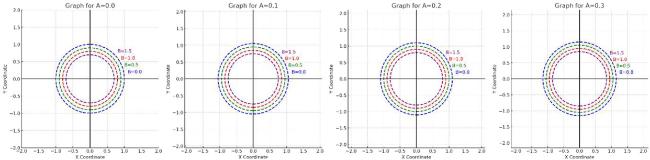
Figure 5. The plot shows the shadows of SVMBH solution in VEG for various A and B values with n = 0.5 and M = 0.8. Left to right, the different plots correspond to A = 0, 0.1, 0.2 and 0.3 respectively. Inner to outward curves correspond to B = 1.5, 1, 0.5 and 0 respectively. |
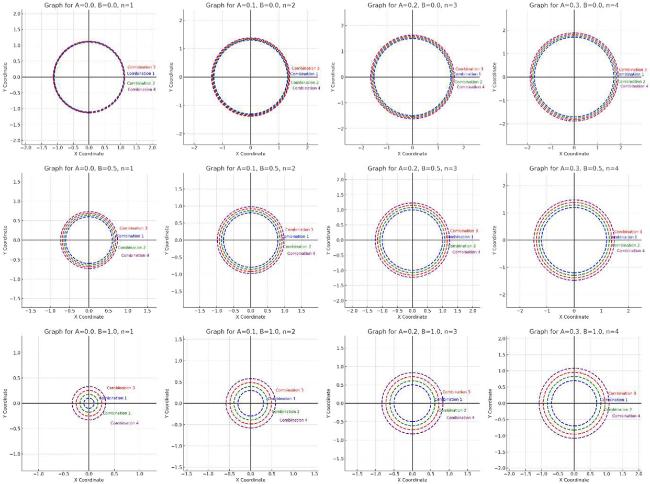
Figure 6. The plot shows the shadows of SVMBH solution in VEG for various A, B and n values with M = 0.8. Top Row: left to right, the different plots correspond to A = 0, 0.1, 0.2 and 0.3 respectively. Middle Row: left to right, the different plots correspond to n = 1, 2, 3 and 4 respectively. Top to Bottom, the columns corresponds to B = 0, 0.5 and 1 respectively. |
Table 1. Estimated uncertainties for the parameters influencing the BH shadow radius Rs. |
| Parameter | Value | Uncertainty | Description |
|---|---|---|---|
| Mass, M | 4.1 × 10⁶ M⊙ | ±0.1 × 10⁶ M⊙ | Black hole mass |
| Distance, D | 8 kpc | ± 0.5 kpc | Distance to the black hole |
| Parameter A | 0.05 | ± 0.01 | Model-specific parameter |
| Parameter B | 0.3 | ± 0.05 | Model-specific parameter |
4. Observable intensities of SVMBH in VEG with static spherical accretion
In this section, we analyze the shadows and observable intensities of a SVMBH solution within the framework of VEG. The observed specific intensities can be calculated by integrating the specific emissivity along the path of light ray [63].44 ) into equation (42 ), we find the intensity as observed by a distant observer, represented by
$\begin{eqnarray}I({\nu }_{\,\rm{ob}\,}^{s})={\int }_{\gamma }{g}^{s3}j({\nu }_{\,\rm{em}\,}^{s}){\rm{d}}{l}_{p},\end{eqnarray}$
where ${g}^{s}\equiv \frac{1}{{\nu }_{\rm{em}\,}^{s}}{\nu }_{\,\rm{ob}}^{s}$ is the redshift factor, with ${{\nu }^{s}}_{\,\rm{ob}\,}$ denotes the observed photon frequency and ${{\nu }^{s}}_{\,\rm{em}\,}$ representing the intrinsic photon frequency [64]. Assuming the emission of monochromatic light with a rest frame frequency νt, the emissivity is defined as follows $\begin{eqnarray}j({{\nu }^{s}}_{\,\rm{em}\,})\propto \delta ({{\nu }^{s}}_{\,\rm{em}\,}-{\nu }_{t}){r}^{-2},\end{eqnarray}$
where we have assumed the emission radial profile to be r−2 [65]. Moreover, the correct length measured in the emitter's rest frame can be calculated using the following equation $\begin{eqnarray}{\rm{d}}{l}_{p}=\sqrt{f{(r)}^{-1}{\rm{d}}{r}^{2}+{r}^{2}{\rm{d}}{\phi }^{2}}=\sqrt{\frac{1+\frac{{r}^{2}}{f(r)}{\left(\frac{{\rm{d}}\phi }{{\rm{d}}r}\right)}^{2}}{f(r)}{\rm{d}}r}.\end{eqnarray}$
Utilizing equation ( $\begin{eqnarray}I({\nu }_{\,\rm{ob}\,}^{s})={\int }_{\gamma }\frac{f(r)}{{r}^{2}}\sqrt{\frac{{r}^{2}-{b}^{2}f(r)+{b}^{2}f(r)}{{r}^{2}-{b}^{2}f(r)}}{\rm{d}}r.\end{eqnarray}$
Figure 7 demonstrates the total observed intensities radiated from the accretion disk around the BH, as the parameter B is varied. It is observed that with an increase in B, the shadow of the BH becomes smaller while the intensities of the surrounding emission increase significantly. For B = 0, the shadow is notably larger, resembling the classical scenario without modifications from emergent gravity. This configuration results in a stronger gravitational influence on nearby light, producing a larger apparent shadow. As B increases, we note that the emission intensities surrounding the become brighter. This implies a reduction in the gravitational influence exerted on light by the BH, enabling more direct and intense radiation to escape and reach the observer. The trend of higher B values leading to a more diffuse intensity distribution suggests weaker redshift effects and a broadening of the observed radiation across a larger area. These observations align with the theoretical expectation that increased B modifies spacetime geometry around the BH, reducing the gravitational lensing effects and thereby shrinking the apparent size of the shadow. figure 8 focuses on the intensities radiated from the accretion disk of BH as influenced by varying levels of the parameter A. At A = 0, the shadow is relatively small, suggesting minimal deviation from a traditional RN-like spacetime configuration. However, as A is increased, the shadow enlarges, indicating a stronger alteration of the spacetime geometry around the BH. This enlargement is accompanied by a decrease in the observed intensities from the accretion disk, which is indicative of stronger gravitational effects dominating the region, leading to more pronounced bending and redshifting of light. This relationship underscores that larger A values enhance the gravitational field's influence on light, resulting in larger shadows and lower luminosities observed from the accretion disk. These findings are significant as they suggest that the BH described by the SV solution in VEG not only exhibit larger shadows but also have reduced luminosity compared to their classical counterparts. Figures 9–11 depict the total observed intensities surrounding s in VEG, plotted against a range of parameter values for A, B, and n = 1, 2, 3. Initially, when both A and B are set to zero, the observed intensities are bright, mirroring a classical configuration where spacetime curvature minimally affects the radiation from the accretion disk. This setup provides a baseline for understanding the modifications introduced by A and B. As A increases, the intensity of the radiation becomes dimmer and more dispersed. This change indicates stronger gravitational lensing effects and an increase in redshift phenomena, consistent with a spacetime that becomes increasingly curved as A rises. The enhancement in curvature simulates more massive effects, leading to more pronounced gravitational influences on the light emitted from the accretion disk. Concurrently, with a constant A, an increase in B further reduces the observed intensity, particularly near the center of the disk. This observation suggests that B significantly enhances the spacetime curvature, thereby intensifying the gravitational bending and redshift of light. The increased B leads to a less luminous accretion disk as viewed by an observer, due to the augmented gravitational effects. The interaction between A and B is notably influenced by the values of n. With n set to 1, 2, and 3, the influence of B becomes increasingly apparent. Higher n values introduce higher powers of the radial coordinate r into the spacetime metric, amplifying the effects of both A and B on the structure of the shadow and the distribution of radiation intensities. This pattern shows that varying n modulates how A and B affect the observable characteristics of s in VEG, with larger n values leading to more significant spacetime deformations. Table 1 provides the estimated uncertainties for the parameters influencing the BH shadow radius Rs.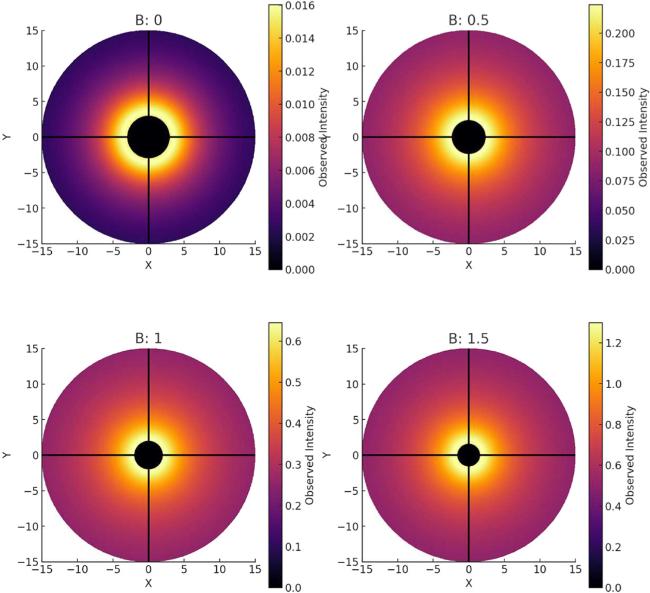
Figure 7. The observed intensities around SVMBH solution radiated from the accretion disk in VEG for different values of B and fixed n = 0.5, A = 0.5, and M = 0.8. |
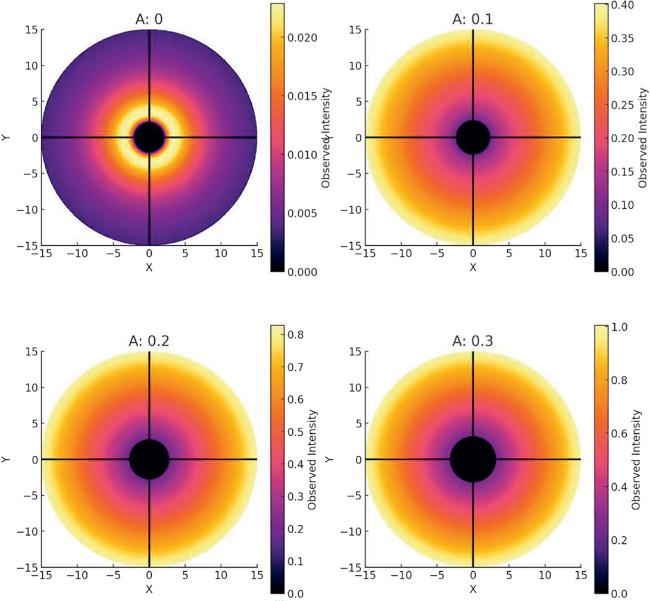
Figure 8. The observed intensities around SVMBH solution radiated from the accretion disk in VEG for different value of A and fixed n = 0.5, B = 0.5, and M = 0.8. |
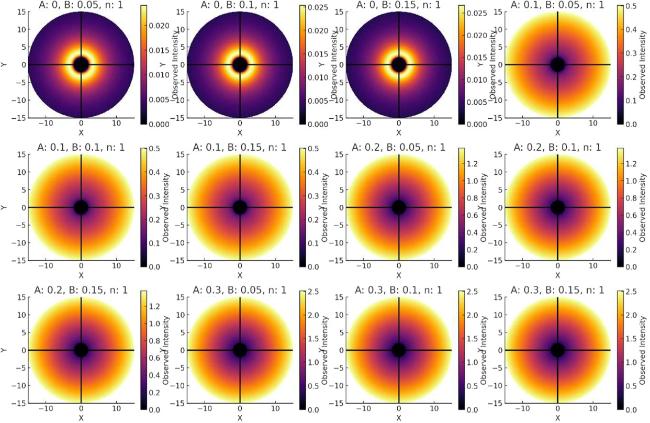
Figure 9. The plot of total observed intensities around SVMBH solution in VEG radiated from the accretion disk for various A, B and fixed n = 1. |
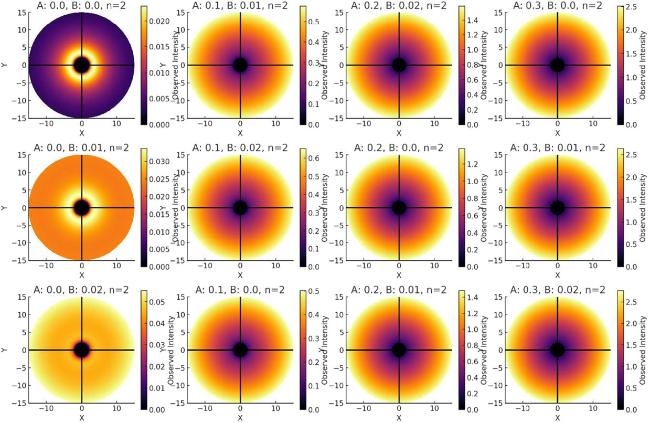
Figure 10. The plot of total observed intensities around SVMBH solution in VEG radiated from the accretion disk for various of A, B and fixed n = 2. |
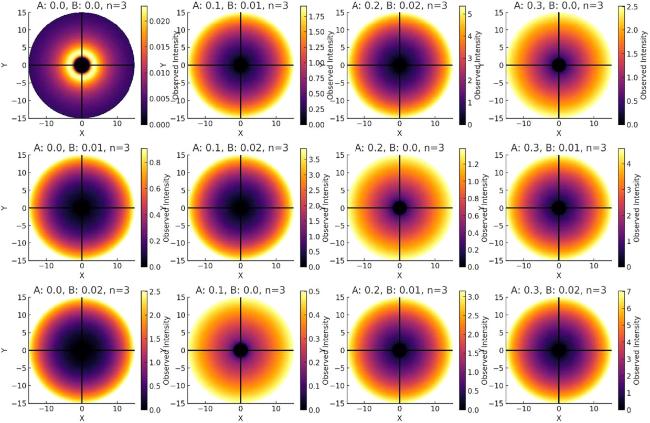


Figure 11. The plot of total observed intensities radiated from the accretion disk around SVMBH solution in VEG for various A, B and fixed n = 3. |
5. Conclusion
In this work, we studied the observable properties of shadows and intensities for the SVMBH within the framework of VEG. This approach views gravity as an emergent phenomenon arising from the entropic characteristics of spacetime provides a compelling alternative to classical gravity theories. Our analysis demonstrates that parameters specific to the VEG model have a substantial impact on the effective potential which in turn influences both the shadow images and intensity profiles of the BH.
The figures presented in this study provide a comprehensive visualization of the effects of the emergent gravity parameters A, B, and n on the observable features of the SVMBH solution. Figures 4–6 clearly demonstrate that the parameter A, which controls the radial decay of baryonic matter, leads to an enlargement of the BH shadow as its value increases. This is attributed to a stronger curvature near the core due to enhanced mass contribution in the central region. Conversely, increasing B, which characterizes the coupling strength between apparent dark matter and baryonic matter, results in a noticeable reduction in the shadow size, indicating a constraining effect on spacetime deformation. The parameter n modulates how these two effects interplay by altering the nonlinearity in the exponential damping. As n increases, the modifications to the shadow morphology become more prominent and asymmetric. In Figures 7–11, the intensity profiles from the accretion disk reveal that higher values of A reduce the brightness near the center due to stronger gravitational redshift and lensing, while increased B tends to flatten the intensity gradients, suggesting a weakening of the gravitational trapping of light. Collectively, these visual results substantiate the claim that SVMBH in the VEG framework exhibits distinctive and tunable observational signatures, markedly different from classical BHs, and highly sensitive to the choice of model parameters.
We compare our findings for the SVMBH with those of the classical RN solution. In the RN case, the spacetime metric is governed solely by mass M and electric charge Q, yielding the metric function ${f}_{\,\rm{RN}\,}(r)=1-\frac{2M}{r}+\frac{{Q}^{2}}{{r}^{2}}$. In contrast, the SVMBH solution modifies this structure via exponential damping terms incorporating the VEG parameters A, B, and n, leading to a non-singular geometry and a modified effective potential. These corrections result in significant changes in observable features. Our analysis shows that, for fixed values of M and Q, the shadow radius in SVMBH is consistently smaller than in RN, due to the damping of the central gravitational field by the emergent gravity terms. Moreover, the intensity profiles reveal that SVMBH leads to dimmer and more spread-out emission patterns compared to the RN case, where the singular core enhances the central brightness. These differences are particularly pronounced for large values of A and B, which govern the decay of baryonic matter and its interaction with apparent dark matter, respectively. This comparative study underscores the capacity of SVMBH within VEG to reproduce classical predictions while introducing novel features that may be probed by future high-resolution observations.
The work thus not only enriches our understanding of emergent gravity's influence on BH metrics but also suggests promising avenues for observational tests, which could help distinguish BHs within alternative gravity frameworks from those predicted by traditional theories.