


1. Introduction
A topological insulator (TI) with a fantastic topological phase and edge states has drawn a lot of interest [1–6], forming a hot topic in condensed-matter physics. TIs have a topological phase and trivial phase, and the phase transitions are characterized by different topological invariants for different TIs. For Chern insulators [7–9], a version of the quantum anomalous Hall effect, the topological invariant is described by the Chern number. The topological edge states emerge in the topological phase with a nonzero Chern number, and the chiral edge states are topologically protected and robust against scattering. The robust topological edge states, including higher-order corner states, have been investigated in many physical systems, such as photonic [10–17], acoustic [18–22], mechanical [23–26], and electric circuit [27–31] systems. These topological states have also been applied to many tasks, including quantum state transfer [32–38], quantum computation, beam splitter and wireless power transfer [39].
Most research is focused on TIs including Chern insulators, time-reversal-invariant TIs and topological crystalline insulators. Recently, another kind of TI, topological Euler insulators, has attracted some attention [40–46]. The Euler insulator is a kind of three-band model, with the Hamiltonian in the momentum space being a real symmetric matrix. The Chern insulators result from the broken time reversal symmetry, corresponding to the quantum Hall effect. However, for the topological Euler insulator, its Hamiltonian has inversion symmetry and time-reversal symmetry. So, the topological Euler insulator has parity-time (PT) symmetry, resulting in the real Hamiltonian and eigenfunctions, different from the complex eigenfunctions of the Chern Hamiltonian. Besides, the topological invariant of a Euler system is described by the Euler number [40, 43] or the Pontryagin skyrmion number [47], while Chern systems are described by the Chern number. Recently, the Euler band topology has been discovered in the nearly flat bands of twisted bilayer graphene at magic angles [48–53]. The quench dynamics of Euler class have been studied in optical lattices [43], and the bulk-edge correspondence for topological Euler insulators has also been investigated on the square lattice [44]. The edge states of the Euler class system have been investigated in the electric circuit [44] and acoustic topological Euler insulator [45].
In this work, we propose a three-band Euler model on the triangular lattice. By calculating the Euler number through the real eigenfunctions of the system, we analyze the topological phase transition of the Euler system. It is found that the Euler system has two kinds of topological phases with different Euler numbers. The edge states exist in the band gap of the Euler insulators in the topological phases, and the topological metals can be realized by adjusting the parameters to close the band gap of the topological insulator.
The paper is organized as follows. In section 2 , we describe the Euler system on the triangle lattice, and discuss the topological properties through the topological invariant—Euler number. In section 3 , we explore the edge states of the topological Euler insulators and metals on the semi-infinite nanoribbon and finite triangle lattice. Conclusions are presented in section 4 .
2. Hamiltonian and topological invariant
The Euler insulators are three-band models, and the Hamiltonian can be written as a real symmetric matrix with three real eigenstates {∣n1⟩, ∣n2⟩, ∣n3⟩}. The eigenstates can be expressed as three normalized three-dimensional vectors
$\begin{eqnarray}{\overrightarrow{n}}_{1}=\frac{\{{x}_{1},{x}_{2},{x}_{3}\}}{\sqrt{{x}_{1}^{2}+{x}_{2}^{2}+{x}_{3}^{2}}},\end{eqnarray}$
$\begin{eqnarray}{\overrightarrow{n}}_{2}=\frac{\{{x}_{2},-{x}_{1},0\}}{\sqrt{{x}_{1}^{2}+{x}_{2}^{2}}},\end{eqnarray}$
and $\begin{eqnarray}\begin{array}{rcl}{\overrightarrow{n}}_{3} & = & {\overrightarrow{n}}_{1}\times {\overrightarrow{n}}_{2}\\ & = & \frac{\{{x}_{1}{x}_{2},{x}_{2}{x}_{3},-({x}_{1}^{2}+{x}_{2}^{2})\}}{\sqrt{{x}_{1}^{2}+{x}_{2}^{2}}\sqrt{{x}_{1}^{2}+{x}_{2}^{2}+{x}_{3}^{2}}}.\end{array}\end{eqnarray}$
Then, the diagonalized Hamiltonian is $\begin{eqnarray}H={E}_{1}| {n}_{1}\rangle \langle {n}_{1}| +{E}_{2}| {n}_{2}\rangle \langle {n}_{2}| +{E}_{3}| {n}_{3}\rangle \langle {n}_{3}| ,\end{eqnarray}$
and we take ${E}_{1}={c}_{1}({x}_{1}^{2}+{x}_{2}^{2}+{x}_{3}^{2})$, ${E}_{2}={c}_{2}({x}_{1}^{2}+{x}_{2}^{2})$ and E3 = 0 for convenience. In the basis {{1, 0, 0}T, {0, 1, 0}T, {0, 0, 1}T}, the Hamiltonian of the system is given by $\begin{eqnarray}H=\left(\begin{array}{ccc}{c}_{1}{x}_{1}^{2}+{c}_{2}{x}_{2}^{2} & ({c}_{1}-{c}_{2}){x}_{1}{x}_{2} & {c}_{1}{x}_{1}{x}_{3}\\ ({c}_{1}-{c}_{2}){x}_{1}{x}_{2} & {c}_{2}{x}_{1}^{2}+{c}_{1}{x}_{2}^{2} & {c}_{1}{x}_{2}{x}_{3}\\ {c}_{1}{x}_{1}{x}_{3} & {c}_{1}{x}_{2}{x}_{3} & {c}_{1}{x}_{3}^{2}\\ \end{array}\right).\end{eqnarray}$
We consider a model on the triangle lattice as shown in figure 1, with each site having three orbitals A, B and C. The orbitals on each site can also be treated as the three sites in a cell of the kagome lattice. By taking 5 ) are written as
$\begin{eqnarray}{x}_{1}=\lambda \left(\sin \frac{1}{2}{k}_{x}\cos \frac{\sqrt{3}}{2}{k}_{y}+\sin {k}_{x}\right),\end{eqnarray}$
$\begin{eqnarray}{x}_{2}=\sqrt{3}\lambda \cos \frac{1}{2}{k}_{x}\sin \frac{\sqrt{3}}{2}{k}_{y},\end{eqnarray}$
$\begin{eqnarray}{x}_{3}=t\left(2\cos \frac{1}{2}{k}_{y}\cos \frac{\sqrt{3}}{2}{k}_{y}+\cos {k}_{x}\right)-\mu ,\end{eqnarray}$
we can obtain a Hamiltonian for the triangle lattice in the momentum space, where x1 and x2 correspond to the spin-orbit interaction term, and x3 corresponds to the chemical potential term in a Chern insulator [54]. Then, the components of the Hamiltonian ( $\begin{eqnarray}\begin{array}{rcl}{H}_{11} & = & \frac{3{\lambda }^{2}}{4}({c}_{1}+{c}_{2})+\frac{{\lambda }^{2}}{4}(3{c}_{2}-{c}_{1})(\cos {k}_{x}-\cos \sqrt{3}{k}_{y})\\ & & +\frac{{c}_{1}{\lambda }^{2}}{2}\left(\cos (\frac{1}{2}{k}_{x}+\frac{\sqrt{3}}{2}{k}_{y})+\cos \left(\frac{1}{2}{k}_{x}-\frac{\sqrt{3}}{2}{k}_{y}\right)\right.\\ & & -\cos (\frac{3}{2}{k}_{x}+\frac{\sqrt{3}}{2}{k}_{y})-\cos \left(\frac{3}{2}{k}_{x}-\frac{\sqrt{3}}{2}{k}_{y}\right)\\ & & \left.-\cos 2{k}_{x}\right)-\frac{{\lambda }^{2}}{8}({c}_{1}+3{c}_{2})(\cos ({k}_{x}+\sqrt{3}{k}_{y})\\ & & +\cos ({k}_{x}-\sqrt{3}{k}_{y})),\end{array}\end{eqnarray}$
$\begin{eqnarray}\begin{array}{rcl}{H}_{22} & = & \frac{3{\lambda }^{2}}{4}({c}_{1}+{c}_{2})+\frac{{\lambda }^{2}}{4}(3{c}_{1}-{c}_{2})(\cos {k}_{x}-\cos \sqrt{3}{k}_{y})\\ & & +\frac{{c}_{2}{\lambda }^{2}}{2}(\cos \left(\frac{1}{2}{k}_{x}+\frac{\sqrt{3}}{2}{k}_{y}\right)+\cos \left(\frac{1}{2}{k}_{x}-\frac{\sqrt{3}}{2}{k}_{y}\right)\\ & & -\cos \left(\frac{3}{2}{k}_{x}+\frac{\sqrt{3}}{2}{k}_{y}\right)-\cos \left(\frac{3}{2}{k}_{x}-\frac{\sqrt{3}}{2}{k}_{y}\right)\\ & & -\cos 2{k}_{x})-\frac{{\lambda }^{2}}{8}(3{c}_{1}+{c}_{2})(\cos ({k}_{x}+\sqrt{3}{k}_{y})\\ & & +\cos ({k}_{x}-\sqrt{3}{k}_{y})),\end{array}\end{eqnarray}$
$\begin{eqnarray}\begin{array}{rcl}{H}_{33} & = & c1(\frac{3{t}^{2}}{2}+{\mu }^{2})+{c}_{1}t(t-\mu )(\cos {k}_{x}\\ & & +\cos \left(\frac{1}{2}{k}_{x}+\frac{\sqrt{3}}{2}{k}_{y}\right)+\cos \left(\frac{1}{2}{k}_{x}-\frac{\sqrt{3}}{2}{k}_{y}\right))\\ & & +{c}_{1}{t}^{2}(\cos \left(\frac{3}{2}{k}_{x}+\frac{\sqrt{3}}{2}{k}_{y}\right)+\cos \left(\frac{3}{2}{k}_{x}-\frac{\sqrt{3}}{2}{k}_{y}\right)\\ & & +\cos \sqrt{3}{k}_{y}+\frac{1}{2}\cos ({k}_{x}+\sqrt{3}{k}_{y})\\ & & +\frac{1}{2}\cos ({k}_{x}-\sqrt{3}{k}_{y})),\end{array}\end{eqnarray}$
$\begin{eqnarray}\begin{array}{rcl}{H}_{12} & = & \frac{\sqrt{3}{\lambda }^{2}}{4}({c}_{2}-{c}_{1})(\cos \left(\frac{1}{2}{k}_{x}+\frac{\sqrt{3}}{2}{k}_{y}\right)\\ & & -\cos \left(\frac{1}{2}{k}_{x}-\frac{\sqrt{3}}{2}{k}_{y}\right)+\cos \left(\frac{3}{2}{k}_{x}+\frac{\sqrt{3}}{2}{k}_{y}\right)\\ & & -\cos \left(\frac{3}{2}{k}_{x}-\frac{\sqrt{3}}{2}{k}_{y}\right))+\frac{\sqrt{3}{\lambda }^{2}}{8}({c}_{2}-{c}_{1})\\ & & \times (\cos ({k}_{x}+\sqrt{3}{k}_{y})-\cos ({k}_{x}-\sqrt{3}{k}_{y})),\end{array}\end{eqnarray}$
$\begin{eqnarray}\begin{array}{rcl}{H}_{13} & = & \frac{{c}_{1}\lambda }{4}(t-2\mu )(2\sin {k}_{x}+\sin \left(\frac{1}{2}{k}_{x}+\frac{\sqrt{3}}{2}{k}_{y}\right)\\ & & +\sin \left(\frac{1}{2}{k}_{x}-\frac{\sqrt{3}}{2}{k}_{y}\right))+\frac{{c}_{1}t\lambda }{4}(2\sin 2{k}_{x}\\ & & +3\sin \left(\frac{3}{2}{k}_{x}+\frac{\sqrt{3}}{2}{k}_{y}\right)+3\sin \left(\frac{3}{2}{k}_{x}-\frac{\sqrt{3}}{2}{k}_{y}\right)\\ & & +\sin ({k}_{x}+\sqrt{3}{k}_{y})+\sin ({k}_{x}-\sqrt{3}{k}_{y})),\end{array}\end{eqnarray}$
$\begin{eqnarray}\begin{array}{rcl}{H}_{23} & = & \frac{\sqrt{3}{c}_{1}\lambda }{4}(t-2\mu )\left(\sin \left(\frac{1}{2}{k}_{x}+\frac{\sqrt{3}}{2}{k}_{y}\right)\right.\\ & & \left.-\sin \left(\frac{1}{2}{k}_{x}-\frac{\sqrt{3}}{2}{k}_{y}\right)\right)+\frac{\sqrt{3}{c}_{1}t\lambda }{4}\\ & & \times \left(\sin (\frac{3}{2}{k}_{x}+\frac{\sqrt{3}}{2}{k}_{y})-\sin \left(\frac{3}{2}{k}_{x}-\frac{\sqrt{3}}{2}{k}_{y}\right)\right.\\ & & +\sin ({k}_{x}+\sqrt{3}{k}_{y})+\sin ({k}_{x}-\sqrt{3}{k}_{y})\\ & & +2\cos (\sqrt{3}{k}_{y})),\end{array}\end{eqnarray}$
H21 = H12, H31 = H13, and H32 = H23.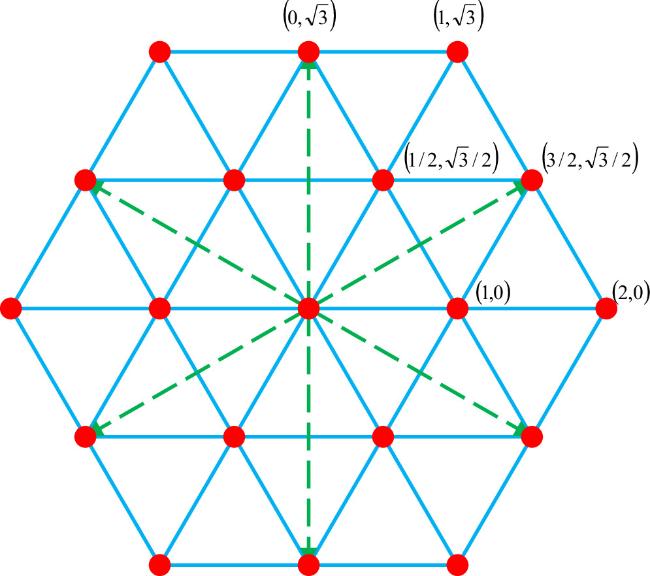
Figure 1. Illustration of a triangle lattice, with each site coupled with the surrounding sites like the center site. |
The band structure of the Hamiltonian is shown in figure 2. It can be found in the contour plot of the band structure in figure 2(a) that the system has C6 symmetry with the high-symmetry points Γ(0, 0), $M(0,2\pi /\sqrt{3})$ and $L(2\pi /3,2\pi /\sqrt{3})$. In figure 2(b), the band of the eigenstates ∣n3⟩ is always a flat band with the eigenvalue Ek = 0, and the value of the eigenvalue of the eigenstates ∣n2⟩ at the Γ point is also Ek = 0, so the gap between the bands of ∣n2⟩ and ∣n3⟩ is always closed. However, the band gap can exist between the bands of ∣n1⟩ and ∣n2⟩, which provide the possibility of the realization of an insulator.
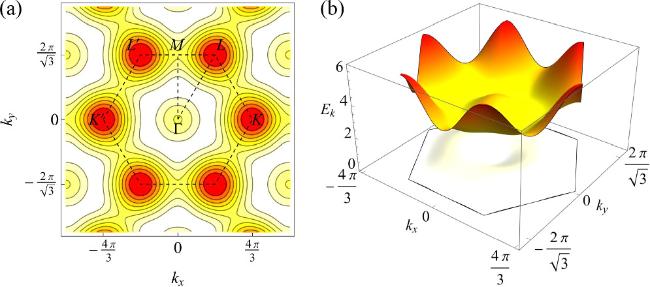
Figure 2. (a) A contour plot of the band structure of the Hamiltonian and (b) the band structure of the Hamiltonian in the Brillouin zone. The parameters are set as c1 = 1, c2 = 0.2, λ = 1, t = 1 and μ = t. |
The topological invariant of the Euler system is calculated via the Euler number, which can also be calculated via the Pontryagin number [43, 47]
$\begin{eqnarray}{{\rm{\Xi }}}_{i}=\frac{1}{2\pi }{\int }_{BZ}{\overrightarrow{n}}_{i}\cdot ({\overrightarrow{n}}_{i}\times {\overrightarrow{n}}_{i}){\rm{d}}{k}_{x}{\rm{d}}{k}_{y}.\end{eqnarray}$
for each vector ${\overrightarrow{n}}_{i}$ in the Brillouin zone, with $\begin{eqnarray}{\xi }_{i}={\overrightarrow{n}}_{i}\cdot ({\overrightarrow{n}}_{i}\times {\overrightarrow{n}}_{i})\end{eqnarray}$
the Pontraygin density. This invariant has the same form as the invariant of a skyrmion. In figure 3, we plot the Pontraygin density ξ1 in the Brillouin zone and the Euler number Ξ1 as a function of μ/t for the vector ${\overrightarrow{n}}_{1}$. In figure 3(d), we obtain the Euler number via calculating the integral of the Pontraygin density over the Brillouin zone. It is found that the Euler number Ξ1 = − 4 for −1.5 < μ/t < − 1, Ξ1 = 2 for −1 < μ/t < 3, and Ξ1 = 0 otherwise. The Euler numbers Ξ1 = 2 and Ξ1 = − 4 indicate that the system has two different types of topological phases, and Ξ1 = 0 corresponds to the trivial phase.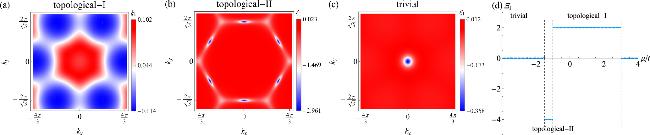
Figure 3. (a)-(c) Pontraygin density ξ1 for the band of the vector ${\overrightarrow{n}}_{1}$ with (a) μ = t, (b) μ = − 1.2t and (c) μ = 4t. (d) Euler numbers Ξ1 as a function of μ/t for the band of the vector ${\overrightarrow{n}}_{1}$. |
In figure 4, we plot the spin textures in the momentum space for the vector ${\overrightarrow{n}}_{1}$ in the Brillouin zone. Due to the same form as the invariant of a skyrmion, the spin texture of ${\overrightarrow{n}}_{1}$ looks like a Néel-type skyrmion when the system is in the two types of topological phases in figures 4(a) and (b), while the spin texture is not a skyrmion when Ξ1 = 0 for the trivial phase in figure 4(c).
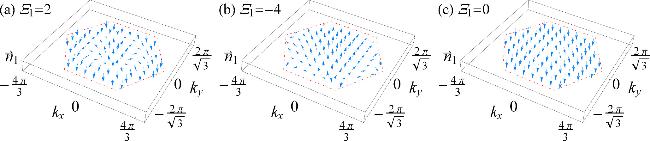
Figure 4. Spin textures in the momentum space for the vector ${\overrightarrow{n}}_{1}$ with (a) μ = t, (b) μ = − 1.2t and (c) μ = 4t. The parameters are set as λ = 1 and t = 1. |
3. Topological edge states
In this section, we explore the topological edges of the Euler system on a semi-infinite ribbon and a finite lattice.
In figure 5, we plot the band structure of a semi-infinite nanoribbon of the Euler system with 40-site width. The band structure shown in figure 5(a) corresponds to the topological phase with Euler number Ξ1 = 2 in figure 3(d), and it can be found that the closed edge states exist in the band gap. However, for the trivial phase in figure 5(b), the edge state is absent. However, the edge states may not always be closed as figure 5(c) shows.
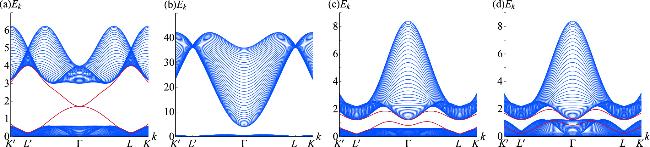
Figure 5. Band structure of the nanoribbon of a triangle lattice with 40-site width for (a) a topological Euler insulators with μ = t and (b) a trivial insulators with μ = 4t. The parameters are set as c1 = 1, c2 = 0.2 and λ = 1. Band structure of the nanoribbon of (c) a topological Euler insulators and (d) a topological Euler metal. The parameters are set as λ = 1, t = 1, μ = 0.1t, c1 = 1, (c) c2 = 0.2 and (d) c2 = 0.4. |
It should be noticed that the topological invariant is independent of the parameters c1 and c2, so the band structure can be changed by c1 and c2 without changing the topological properties of the system. Besides, the band E1 is independent of the parameters c2, while the band E2 depends on c2. The band gap can be changed by adjusting the parameter c2, as is shown in figure 5(d). In this case, the edge states also exist like figure 5(c), but the band gap is closed, resulting in a topological metal.
In figure 6, we investigate the edge states of a finite triangle lattice with the rhombus-shape edge. The energy spectrum of the finite lattice is shown in figure 6(a). The eigenvalues corresponding to the edge states are marked by the red points in the band gap. As each site has three orbitals A, B and C, the probability amplitudes of the orbitals on each site are ${\psi }_{n}^{A}$, ${\psi }_{n}^{B}$ and ${\psi }_{n}^{C}$. Then, the probability density of each site is written as $| {\psi }_{n}| =\sqrt{| {\psi }_{n}^{A}{| }^{2}+| {\psi }_{n}^{B}{| }^{2}+| {\psi }_{n}^{C}{| }^{2}}$. figure 6(b) shows one of the edge states, where the density of the state is mainly localized at the edges of the rhombus.
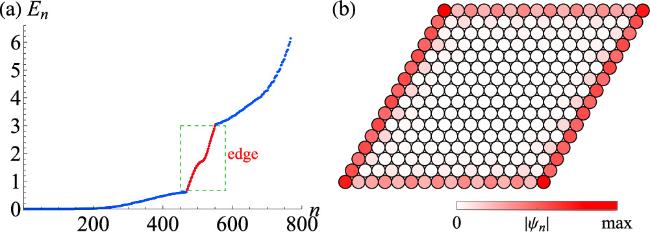


Figure 6. (a) The energy spectrum of a rhombus made of the triangle lattice and (b) an edge state in the band gap. The parameters are set as c1 = 1, c2 = 0.2, λ = 1, t = 1, and μ = t. |
4. Conclusion
In summary, we have studied the topological properties of a Euler system on the triangle lattice. We find the system has two types of topological phase with different topological invariant values Ξ1 = 2 and Ξ1 = − 4. The spin texture of the eigenstate ∣n1⟩ in the momentum space is like a Néel-type skyrmion when the system is in the two types of topological phases. Moreover, the topological invariant only depends on the eigenvector ∣n1⟩ and is independent of the parameter c1 and c2. For this reason, the topological Euler insulator can be turned into the topological Euler metals by adjusting the parameters, without the topological phase transition. Our conclusions of the topological Euler insulators on triangular lattices are similar to that on the square lattices [44]. The spin textures in their Brillouin zones are all skyrmions for the topological phases, and there exist two topological phases on both triangular and tetragonal lattices, but with different values of the Euler number. The energy spectrum and edge states of a finite triangle lattice with the rhombus-shape edge are also displayed in our discussions.