


1. Introduction
1.1. Rota–Baxter algebras: from integrability to perturbative renormalization
• A ${\mathbb{K}}$-linear map N: A → A on a unital ${\mathbb{K}}$-algebra A is called Nijenhuis operator if
• Given Rota–Baxter algebra (A, R) with the idempotent map R, and $\lambda \in {\mathbb{K}}$, the map $N_{\lambda}:=R-\lambda \tilde{R}$ with $\tilde{R}=\mathrm{Id}_{A}-R$ is a Nijenhuis operator on A.
• Nijenhuis and Rota–Baxter operators are the main sources of generating hierarchies of deformed (Lie) algebras [14–16].
1.2. Feynman graph limits
| (1.) Each Feynman diagram in HFG(Φ) has a unique graphon representation in ${{ \mathcal W }}_{\approx }^{[0,1]}$ for the Lebesgue measure space ([0, 1], m). | |
| (2.) Each Feynman graph limit has a unique graphon representation in ${{ \mathcal W }}_{\approx }^{[0,\infty )}$ for the Lebesgue measure space ([0, ∞), m). |
1. For Γ ∈ HFG(Φ) with ∣Γ∣ = n which has no overlapping loops, its rooted tree representation tΓ has n vertices such that each vertex vi ∈ tΓ is decorated by a primitive (1PI) Feynman subdiagram γi of Γ [28, 29]. Let αi > 0 be the weight of the vertex vi such as αi = 1/n for each 1 ≤ i ≤ n in a toy model. Define a partition σ ≔ {I1, …, In} of [0, 1] such that for each 1 ≤ i ≤ n, ${\rm{m}}({I}_{i})=\frac{{\alpha }_{i}}{{\sum }_{i=1}^{n}{\alpha }_{i}}$ and ${I}_{k}\cap {I}_{l}={\rm{\varnothing }}$ for k ≠ l. The boxes ${\{{I}_{i}\times {I}_{j}\}}_{1\,\leqslant \,i,j\,\leqslant \,n}$ determine a pixel picture presentation ${P}_{{\rm{\Gamma }}}^{\sigma }$ given by $(x,y)\in {I}_{k}\times {I}_{l}\mapsto {a}_{kl}\in {{\rm{Ad}}}_{{t}_{{\rm{\Gamma }}}}$ such that ${{\rm{Ad}}}_{{t}_{{\rm{\Gamma }}}}$ is the adjacency matrix of tΓ. The box Ik × Il is colored by black if there exists an edge between vk and vl in tΓ, otherwise it is colored by white. The equivalence class
2. Thanks to (
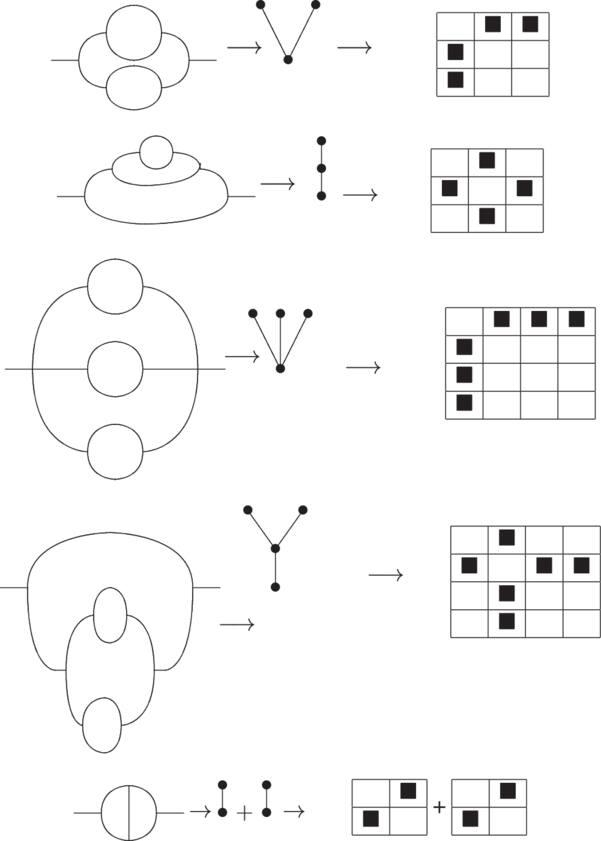
Figure 1. Replacing Feynman diagrams with their rooted tree representations underlying the renormalization Hopf algebra to generate Feynman graphon models via lemma |
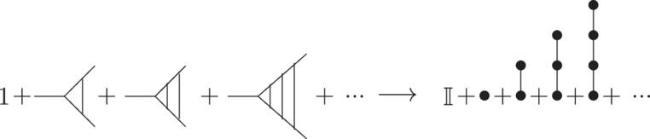
Figure 2. The rooted forest representation of some 1PI Green's function underlying the renormalization Hopf algebra. |
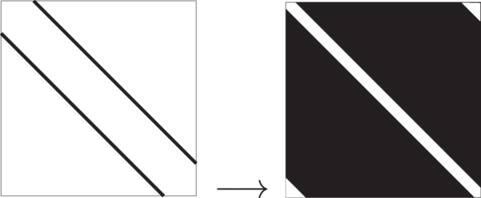


Figure 3. The domain of any Feynman graphon model which contributes to divergent perturbative series such as the one given in figure 2 is stretched to associate non-trivial Feynman graph limit (i.e. large Feynman diagram). Any Feynman graphon model defined on a stretched domain is called a stretched Feynman graphon. Further details are given in [31, 39, 40]. |
Let DSE be a combinatorial Dyson–Schwinger equation such that ${\{{Y}_{m}\}}_{m\geqslant 1}$ be the sequence of partial sums of its solution X with ${Y}_{m}={\sum }_{k=1}^{m}{c}^{k}{X}_{k}$. The solution X, as a large Feynman graph generated by a sequence of stretched Feynman graphons, is presented by a process of random graphs [31, 43, 45].
The stretched Feynman graphon ${W}_{{Y}_{m}}\in {{ \mathcal S }}_{\approx }^{{\rm{\Phi }},{\rm{\Omega }}}$ corresponding to Ym is a direct sum of stretched Feynman graphons ${W}_{{X}_{k}}$, 1 ≤ k ≤ m of weights m(Ck) = ck such that for k ≠ l, ${C}_{k}\cap {C}_{l}={\rm{\varnothing }}$ and ${\cup }_{k=1}^{m}{C}_{k}\subseteq {\rm{\Omega }}$. Thanks to lemma
For each m, let Rm be a random graph built by uniformly choosing m points a1, …, am from ${\cup }_{k=1}^{m}{C}_{k}$ such that $\frac{1}{| | {W}_{{Y}_{m}}| {| }_{1}}{W}_{{Y}_{m}}$ determines the probability value for the existence of an edge between ai and aj in Rm. The sequence ${\{{R}_{m}\}}_{m\geqslant 1}$, which converges to an infinite random graph R∞ defined on ${\cup }_{k=1}^{\infty }{C}_{k}$, provides a process of random graphs for the description of the large Feynman diagram X. ☐
1.3. Achievements
2. Renormalization of Feynman graph limits
There exists a graded commutative non-cocommutative Hopf algebra structure on ${{ \mathcal H }}_{{\rm{gr}}}({\rm{\Phi }})$, topologically completed by (
The renormalization coproduct (
Thanks to Milnor–Moore theorem [21], the graded dual of ${{ \mathcal H }}_{{\rm{gr}}}^{{\rm{cut}}}({\rm{\Phi }})$ is the complex infinite dimensional Lie group ${{\mathbb{G}}}_{{\rm{\Phi }},{\rm{gr}}}({A}_{{\rm{dr}}})={\rm{Hom}}({{ \mathcal H }}_{{\rm{gr}}}^{{\rm{cut}}}({\rm{\Phi }}),{A}_{{\rm{dr}}})$. Suppose Δ* is the infinitesimal punctured disk around z = 0 in the complex plane which restores the regularization parameter. The space of loops ${{\boldsymbol{\Delta }}}^{* }\to {{\mathbb{G}}}_{{\rm{\Phi }},{\rm{gr}}}({A}_{{\rm{dr}}})$, $z\mapsto {\tilde{\phi }}^{z}$ determines regularized unrenormalized Feynman rules characters on the space of stretched Feynman graphons such that
• There exists an injective homomorphism of Hopf algebras Γ ↦ WΓ from ${H}_{{\rm{FG}}}^{{\rm{cut}}}({\rm{\Phi }})$ to ${{ \mathcal H }}_{{\rm{gr}}}^{{\rm{cut}}}({\rm{\Phi }})$.
• Each 1PI Green’s function Gr given by (
• The collection $\{{W}_{{G}_{\leqslant m}^{r}}\in {{ \mathcal S }}_{\approx }^{{\rm{\Phi }},{\rm{\Omega }}}\,:\,r\in {{ \mathcal A }}_{{\rm{\Phi }}},\,m\geqslant 1\}$ recovers a basis for the vector space structure of ${{ \mathcal H }}_{{\rm{gr}}}^{{\rm{cut}}}({\rm{\Phi }})$.
Let ${{ \mathcal W }}_{\approx }^{{\rm{\Omega }},{\rm{FGrp}}}\subset {{ \mathcal W }}_{\approx }^{{\rm{\Omega }}}$ be the complete Hausdorff topological subspace of those stretched graphons corresponding to finite graphs without self-loops and graph limits of their sequences with respect to the cut-distance topology. There exists a topological core Hopf algebra structure generated by ${{ \mathcal W }}_{\approx }^{{\rm{\Omega }},{\rm{FGrp}}}$ which recovers the renormalization of Feynman graph limits of physical theories.
Let ${{ \mathcal H }}_{{\rm{FGrp}},{\rm{gr}}}$ be the free commutative algebra generated by stretched graphons in ${{ \mathcal W }}_{\approx }^{{\rm{\Omega }},{\rm{FGrp}}}$. For each n≥1, ${{ \mathcal H }}_{{\rm{FGrp}},{\rm{gr}}}^{(n)}$ is the ${\mathbb{K}}$-vector space generated by WG with ∣G∣ = n such that ${{ \mathcal H }}_{{\rm{FGrp}},{\rm{gr}}}^{(0)}={\mathbb{K}}\lt {W}_{{\mathbb{I}}}\gt ={\mathbb{K}}$. For ${W}_{{G}_{1}}\in {{ \mathcal H }}_{{\rm{FGrp}},{\rm{gr}}}^{({n}_{1})}$ and ${W}_{{G}_{2}}\in {{ \mathcal H }}_{{\rm{FGrp}},{\rm{gr}}}^{({n}_{2})}$, if G1 and G2 are weakly isomorphic, then n1 =n2. For the cases $G\in {{ \mathcal H }}_{{\rm{FGrp}},{\rm{gr}}}^{(0)}$ or $G\in {{ \mathcal H }}_{{\rm{FGrp}},{\rm{gr}}}^{(1)}$, WG = 0 almost everywhere which means that ${{ \mathcal H }}_{{\rm{FGrp}},{\rm{gr}}}^{(0)}\,={{ \mathcal H }}_{{\rm{FGrp}},{\rm{gr}}}^{(1)}={\mathbb{K}}$. The core coproduct (
Apply (
On the one hand, the renormalization Hopf algebra is a quotient of the core Hopf algebra [50]. On the other hand, given a gauge field theory Φ, the renormalization Hopf algebra HFG(Φ) is embedded in a decorated version of the Connes–Kreimer Hopf algebra of non-planar rooted trees HCK(Φ) [28]. Non-planar rooted trees are simple finite graphs without self-loops. Therefore there exists an injective homomorphism of Hopf algebras t ↦ Wt from HCK(Φ) to ${{ \mathcal H }}_{{\rm{FGrp}},{\rm{gr}}}$. The combination of these facts together with lemma
3. Poisson brackets of quantum integrability

The Rota–Baxter algebra ${{\rm{RB}}}_{{\rm{core}},{\rm{gr}}}$ recovers symplectic geometry models for the spaces of Feynman graph limits (such as solutions of quantum motions) in gauge field theories.
We apply theorems
For $\lambda \in {\mathbb{K}}$, the Nijenhuis map ${{ \mathcal R }}_{\lambda }:= { \mathcal R }-\lambda \hat{{ \mathcal R }}$, with $\hat{{ \mathcal R }}:= {\rm{Id}}-{ \mathcal R }$, determines a new product ∘λ given by
Define Derλ as the set of all linear maps ${C}_{\lambda ,{\rm{gr}},{\rm{core}}}\to {C}_{\lambda ,{\rm{gr}},{\rm{core}}}$ which satisfy the Leibniz rule, called derivations. Set Hamλ ⊂ Derλ as the $Z({C}_{\lambda ,{\rm{gr}},{\rm{core}}})$-module generated by all Hamiltonian derivations ham(φ), $\phi \in {C}_{\lambda ,{\rm{gr}},{\rm{core}}}$. The differential graded algebra on ${C}_{\lambda ,{\rm{gr}},{\rm{core}}}$ is defined by
For $\lambda \in {\mathbb{K}}$, the pair $({C}_{\lambda ,{\rm{gr}},{\rm{core}}},{\omega }_{\lambda })$ is a symplectic geometry model for ${{ \mathcal H }}_{{\rm{FGrp}},{\rm{rg}}}^{{\rm{cut}}}$ which can be lifted onto $((L({{ \mathcal H }}_{{\rm{gr}}}^{{\rm{cut}}}({\rm{\Phi }}),{A}_{{\rm{dr}}}),{* }_{{\rm{ren}},{\rm{gr}}}),{\omega }_{\lambda })$ as a symplectic model for ${{ \mathcal H }}_{{\rm{gr}}}^{{\rm{cut}}}({\rm{\Phi }})$ where solutions of quantum motions are represented by stretched Feynman graphons in ${{ \mathcal H }}_{{\rm{gr}}}^{{\rm{cut}}}({\rm{\Phi }})$. ☐
For the Rota–Baxter algebra RBgr,Φ and $\lambda \in {\mathbb{K}}$, the Rota–Baxter map ${{ \mathcal R }}_{\lambda }$ as the solution of the Yang–Baxter equation
It is a result of [11] and theorem
For the commutative algebra ${{ \mathcal H }}_{{\rm{FGrp}},{\rm{gr}}}$ defined in theorem
The operator ${B}_{{W}_{{\mathbb{I}}}}^{+}$ can be lifted onto the unital noncommutative associative algebra $(L({{ \mathcal H }}_{{\rm{gr}}}^{{\rm{cut}}}({\rm{\Phi }}),\overline{T}({{ \mathcal H }}_{{\rm{FGrp}},{\rm{gr}}})),{* }_{{\rm{ren}},{\rm{gr}}})$ to determine the Nijenhuis map ${{ \mathcal N }}_{{\rm{\Phi }}}(\psi ):= {B}_{{W}_{{\mathbb{I}}}}^{+}\circ \psi $. It defines a new noncommutative associative product ∘u given by
The pair (Cu,gr,Φ, ωu) is a symplectic geometry model for ${{ \mathcal H }}_{{\rm{gr}}}^{{\rm{cut}}}({\rm{\Phi }})$ where solutions of quantum motions are represented by stretched Feynman graphons in ${{ \mathcal H }}_{{\rm{gr}}}^{{\rm{cut}}}({\rm{\Phi }})$. ☐
For the universal Nijenhuis algebra $(\overline{T}({{ \mathcal H }}_{{\rm{FGrp}},{\rm{gr}}}), \circleddash ,{B}_{{W}_{{\mathbb{I}}}}^{+})$, the Nijenhuis operator ${{ \mathcal N }}_{{\rm{\Phi }}}$ as the solution of the Yang–Baxter equation
The Connes–Kreimer Renormalization Group associated to the topological Hopf algebra of renormalization ${{ \mathcal H }}_{{\rm{gr}}}^{{\rm{cut}}}({\rm{\Phi }})$ is an infinite dimensional quantum integrable system which encodes the evolution of Feynman graph limits in a gauge field theory Φ.
Consider an infinitesimal punctured disk Δ⋆ around z = 0 in the complex plane with the boundary C = ∂Δ⋆, a loop $\alpha :C\to {{\mathbb{G}}}_{{\rm{\Phi }},{\rm{gr}}}({A}_{{\rm{dr}}})$ and a one-parameter group ${\{{\theta }_{t}\}}_{t\in {\mathbb{C}}}$ of automorphisms on ${{\mathbb{G}}}_{{\rm{\Phi }},{\rm{gr}}}({A}_{{\rm{dr}}})$ given by
Following [21], let ${\{{F}_{t}\}}_{t\in {\mathbb{C}}}$ be the Renormalization Group given by
We apply theorem
A given combinatorial Dyson–Schwinger equation DSE with the unique solution X = ∑n≥0cnXn and the sequence ${\{{Y}_{m}\}}_{m\geqslant 1}$ of partial sums determine a graded connected commutative Hopf subalgebra HDSE in HFG(Φ) [30] such that the large Feynman graph X is in ${H}_{{\rm{FG}}}^{{\rm{cut}}}({\rm{\Phi }})$ [31, 39, 40]. Therefore, thanks to lemmas
We have
Therefore, for a fixed ${F}_{{t}_{0}}$ from the Renormalization Group, the evolution of X at the stage m≥1 from the perspective of the quantum integrable system ${\{{F}_{t}\}}_{t}$ with the Hamiltonian ${F}_{{t}_{0}}$ is given by the Poisson bracket ${\{{F}_{{t}_{0}},{\tilde{\alpha }}_{{\rm{DSE}}}(z)\}}_{0,{* }_{{\rm{gr}}}}$. ☐
4. Declarations
| • | The author declares that he has no known competing financial interests or personal relationships that could have appeared to influence the work reported in this paper. |
| • | ASF: conceptualization, original motivation, methodology, research, writing/reviewing/editing: original draft and final preparation. |