


1. Introduction
The measurement of a moving atom’s position has emerged as a vibrant area of research, capturing the interest of both experimentalists and theorists due to its diverse potential applications [1–6]. This field has garnered attention because accurately measuring an atom's position is crucial for advancing technologies in quantum control, sensing, and precision measurement, where even small changes can have significant implications in practical applications. These applications span various fields, including nano-lithography, laser cooling and trapping of neutral atoms, and Bose–Einstein condensation [7–11]. Nano-lithography involves precise manipulation of atomic positions for the fabrication of nanoscale devices, while laser cooling and trapping of atoms is essential for studying quantum phenomena in a controlled environment. Bose–Einstein condensation, where atoms form a supercooled quantum state, also relies on precise atomic positioning for manipulating and observing quantum behavior at macroscopic scales. Historically, different research teams have localized atoms within cavities using optical slits [12–15]. This method of atom localization is significant because it enables the confinement and precise control of atomic positions using light, which is essential for creating stable quantum states and implementing quantum information protocols. Phenomena such as electromagnetically induced transparency (EIT), emission enhancement or suppression, four-wave mixing, optical bistability, and giant Kerr nonlinearity [16–24] rely significantly on quantum interference and atomic coherence effects. These phenomena are manifestations of the delicate interplay between atoms and light, where quantum coherence allows for the control and manipulation of light–matter interactions. EIT, for instance, enables slow light, while four-wave mixing is important for generating new frequencies, all of which are influenced by the precise control over atom positioning and the coherent interactions that emerge in quantum systems.
In recent years, various techniques for achieving one-dimensional (1D) atomic localization have been extensively studied, mainly through interactions between atoms and position-dependent fields [25–30]. These studies have led to significant advancements in atomic control and precision measurement in quantum systems. For example, Holland et al demonstrated the possibility of localizing atoms through spontaneous decay, where the decay process itself was harnessed to confine atomic positions [25]. LeKien and his collaborators improved the resolution of atomic localization using Ramsey interferometry, a technique that exploits quantum interference between atomic states to refine the spatial accuracy of the localization process [26]. Moreover, Herkommer et al observed 1D atomic localization via Autler–Townes splitting in the spontaneous emission spectrum, showing how the interaction of an atom with a laser field can result in localized atomic states [27]. Paspalakis and his team utilized a three-level atomic configuration, combining a weak probe field with classical standing wave fields, to localize atoms by manipulating their energy levels in a way that enhances the precision of their position [28, 29]. Further work led to the successful localization of atoms within a ladder-type four-level atomic system, where quantum interference effects were utilized to create localized atomic states [30]. Additionally, Sahrai et al and Kapale et al explored the use of absorption spectra for 1D atomic localization, where the interaction of atoms with light in specific configurations was shown to localize the atomic positions effectively [31, 32]. Other techniques, such as coherent population trapping (CPT) and dark resonance, also proved useful for localizing atoms in 1D, taking advantage of quantum coherence and interference effects to trap atoms in specific locations [33–35]. Recently, advancements have included utilizing two standing-wave superpositions in a Λ-type atomic system, which provides a novel method for measuring atomic localization with high precision [36]. Additionally, there have been investigations into the use of surface plasmon fields to induce atomic localization in tripod-type atomic systems, offering new avenues for manipulating atoms at the surface of materials [37]. These developments demonstrate the growing diversity of methods for achieving 1D atomic localization, with each approach contributing to the overall understanding of quantum control and atomic positioning.
In the realm of two-dimensional (2D) atomic localization, extensive research has been carried out within multi-level atomic systems, leading to promising advancements in quantum control and precision measurement [38–47]. For instance, Wan and his team demonstrated 2D atomic localization in a Y-type four-level atomic system, successfully localizing the atom within a region of λ/2 × λ/2, achieving a localization probability of 25% [38]. Similarly, Li et al proposed a four-level Λ-type atomic system for 2D localization, employing a radio frequency-driven field in combination with phase-sensitive absorption spectra to enhance the localization precision [39]. Ding et al further advanced the field by achieving 100% localization probability in a microwave-driven four-level atomic system, localizing atoms within a λ/2 × λ/2 region, demonstrating the potential for high-precision atomic manipulation in a 2D space [40]. Other notable approaches for 2D atomic localization include schemes based on spontaneous emission [41, 42], where the interaction between atoms and emitted radiation enables precise positioning, and gain absorption spectra [43–45], which rely on analyzing the absorption characteristics of atoms under specific field conditions to achieve localization. Additionally, techniques that focus on level population measurements [46, 47] have been explored, where the population distribution across different energy levels of an atom can provide crucial information for spatial localization. Recent progress in 2D atomic localization has also been documented in studies such as those by Jianchun Wu [48], Neeraj Singh [49], and Hong et al [50], reflecting the continuous evolution of methods and applications in this area. These diverse strategies underline the growing potential for precise control of atomic positions in 2D spaces, with applications ranging from quantum information processing to nanoscale fabrication.
This paper’s primary purpose is to introduce a novel method for enhancing 2D atomic localization within a tripod-type four-level atomic system, utilizing the transmission spectrum. This approach allows the atom to interact with two orthogonal standing-wave fields, along with a weak probe field. Through the spatially varying interactions between the atom and these fields, we are able to pinpoint the position of the atom by analyzing the transmission spectrum of the weak probe. Our theoretical analysis uncovers the emergence of sharply localized peaks, single and double, within a one-wavelength domain, each corresponding to specific atomic locations. Notably, this technique achieves ultra-high-resolution localization, with precision reaching as small as λ/32 × λ/32. This advancement surpasses previous methods that offered less precise localization. The increase in precision results from the delicate interplay between the atom and the precisely engineered standing-wave and probe fields, which allow for exact control over the atom’s position. The implications of this work are significant, particularly for applications like nano-lithography, where precise atomic placement is critical, and in the development of laser cooling technologies, where enhanced localization can lead to more efficient cooling and better manipulation of atomic states.
2. The model and its corresponding Hamiltonian
In this work, we introduce a four-level tripod-type atomic system designed for ultra-high-resolution and precision in 2D atomic localization, utilizing probe transmission within a single wavelength domain, as illustrated in figure 1 [51–54]. The hyperfine levels of 87Rb relevant to our tripod configuration are depicted in figure 1. For our system, we select three lower states, denoted as ∣1⟩, ∣2⟩, and ∣3⟩, along with one excited state, ∣4⟩. The standing wave field with position-dependent Rabi frequency Ω(x) facilitates the transition between levels ∣1⟩ and ∣4⟩ at frequency ω14. Concurrently, the probe field with Rabi frequency Ωp drives the transition from ∣2⟩ to ∣4⟩ at frequency ω24. Additionally, another standing wave field with position-dependent Rabi frequency Ω(y) induces transitions between ∣3⟩ and ∣4⟩ at frequency ω34. The position-dependent Rabi frequencies of the standing wave fields Ω(x) and Ω(y) can be expressed as follows
$\begin{eqnarray}{\rm{\Omega }}(x)={{\rm{\Omega }}}_{1}\sin ({k}_{1}x+{\varphi }_{1}),\end{eqnarray}$
and $\begin{eqnarray}{\rm{\Omega }}(y)={{\rm{\Omega }}}_{2}\sin ({k}_{2}y+{\varphi }_{2}),\end{eqnarray}$
where Ω1 and Ω2 correspond to the magnitudes of Ω(x) and Ω(y), respectively. The parameters kn = kηn (n = 1, 2), and φ1, φ2 represent the wave vectors and phase shifts of these standing beams. Here, the wave number is defined as $k=\frac{2\pi }{\lambda }$, where λ denotes the wavelength of the wave. The parameters ${\eta }_{1}=\cos ({\theta }_{x})$ and ${\eta }_{2}=\cos ({\theta }_{y})$ represent the directional components of the wave vector along the x- and y-axes, respectively, with θx and θy being the angles between the wave vector and the x- and y-axes. When ηn(n = 1, 2) equals 1 or −1, symmetric superposition of the standing beams is observed. In contrast, for −1 < ηn < 1, asymmetric superposition becomes crucial in the development of localization peaks within the ranges −π ≤ kx, ky ≤ π in the 2D plane. We have selected a decay rate for the excited state ∣4⟩ of γ = 2π × 6.07 MHz (the natural linewidth of 87Rb) and scaled all other parameters with respect to γ for our calculations [55]. To analyze the dynamical behavior of this atomic system under the dipole and rotating wave approximations, we express the interaction Hamiltonian HI as follows [56] $\begin{eqnarray}\begin{array}{rcl}{H}_{I} & = & -\frac{\hslash }{2}\left[{{\rm{\Omega }}}_{p}{{\rm{e}}}^{-{\rm{i}}{{\rm{\Delta }}}_{p}t}| 2\rangle \langle 4| +{\rm{\Omega }}(x)\,{{\rm{e}}}^{-{\rm{i}}{{\rm{\Delta }}}_{1}t}| 1\rangle \langle 4| \right.\\ & & \left.+{\rm{\Omega }}(y)\,{{\rm{e}}}^{-{\rm{i}}{{\rm{\Delta }}}_{2}t}| 3\rangle \langle 4| +\,\rm{H.c.}\,\right],\end{array}\end{eqnarray}$
where the H.C. term denotes the Hermitian conjugate. The detuning parameters Δ1 = ω14 − ω1, Δ2 = ω34 − ω2, and Δp = ω24 − ωp characterize the detuning of the standing wave and probe fields, while ω1, ω2, and ωp correspond to the carrier frequencies of the respective fields. To derive the dynamics of the system in the density matrix formalism, we apply the Liouville equation with a phenomenological relaxation term [57] $\begin{eqnarray}\dot{\rho }=-\frac{{\rm{i}}}{\hslash }[{H}_{I},\rho ]-\frac{1}{2}\sum {\gamma }_{j}({\delta }^{\dagger }\delta \rho +\rho \,{\delta }^{\dagger }\delta -2\delta \rho \,{\delta }^{\dagger }),\end{eqnarray}$
where ρ represents the density operator of the system, HI is the interaction Hamiltonian, and γj signifies the spontaneous decay rate from the excited state ∣4⟩ to the ground states ∣j⟩ (where j = 1, 2, 3). The operators δ† and δ are the general raising and lowering operators, respectively.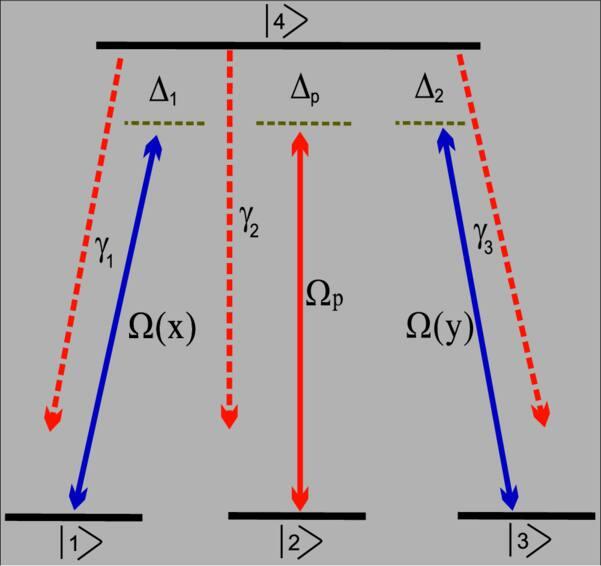
Figure 1. The energy-level diagram of the tripod-type four-level system in a 87Rb atomic structure, including the hyperfine level configuration and the interactions with the laser fields. The level diagram contains one excited state (∣4⟩ and three lower states (∣1⟩, ∣2⟩ and ∣3⟩. Ωp represent the probe field Rabi frequency, whereas standing waves are denoted by Ω(x) and Ω(y). |
The dynamical equations of motion can be derived by substituting equation (1 ) into equation (2 ). To determine the position of the atom, we analyze the transmission spectrum of the probe field, which couples the states ∣2⟩ and ∣4⟩. The density matrix element ρ24 can be derived from the following set of rate equations
$\begin{eqnarray}{\dot{\tilde{\rho }}}_{24}={B}_{1}{\tilde{\rho }}_{24}+\frac{{\rm{i}}}{2}{\rm{\Omega }}(x){\tilde{\rho }}_{21}+\frac{{\rm{i}}}{2}{\rm{\Omega }}(y){\tilde{\rho }}_{23}+\frac{{\rm{i}}}{2}{{\rm{\Omega }}}_{p}({\tilde{\rho }}_{22}-{\tilde{\rho }}_{44}),\end{eqnarray}$
$\begin{eqnarray}{\dot{\tilde{\rho }}}_{21}={B}_{2}{\tilde{\rho }}_{21}+\frac{{\rm{i}}}{2}{{\rm{\Omega }}}^{* }(x){\tilde{\rho }}_{24}-\frac{{\rm{i}}}{2}{{\rm{\Omega }}}_{p}{\tilde{\rho }}_{41},\end{eqnarray}$
$\begin{eqnarray}{\dot{\tilde{\rho }}}_{23}={B}_{3}{\tilde{\rho }}_{23}+\frac{{\rm{i}}}{2}{{\rm{\Omega }}}^{* }(y){\tilde{\rho }}_{24}-\frac{{\rm{i}}}{2}{{\rm{\Omega }}}_{p}{\tilde{\rho }}_{43},\end{eqnarray}$
where $\begin{eqnarray}{B}_{1}={\rm{i}}{{\rm{\Delta }}}_{p}-\frac{1}{2}{\gamma }_{2},\end{eqnarray}$
$\begin{eqnarray}{B}_{2}={\rm{i}}({{\rm{\Delta }}}_{p}-{{\rm{\Delta }}}_{1})-\frac{1}{2}({\gamma }_{1}+{\gamma }_{2}),\end{eqnarray}$
$\begin{eqnarray}{B}_{3}={\rm{i}}({{\rm{\Delta }}}_{p}-{{\rm{\Delta }}}_{2})-\frac{1}{2}({\gamma }_{2}+{\gamma }_{3}).\end{eqnarray}$
We assume that the intensity of the probe field is much weaker than the intensities of the other laser fields, such that all the atoms occupy the ground level ∣2⟩, and ${\tilde{\rho }}_{22}\approx 1$. By applying perturbation theory, we obtain $\begin{eqnarray}{\tilde{\rho }}_{24}=\left[\frac{2{\rm{i}}{B}_{2}{B}_{3}}{4{B}_{1}{B}_{2}{B}_{3}+{B}_{3}{{\rm{\Omega }}}^{2}(x)+{B}_{2}{{\rm{\Omega }}}^{2}(y)}\right].\end{eqnarray}$
The optical susceptibility of the probe field can be obtained from the element ${\widetilde{\rho }}_{24}$ in the following manner [57]11 ) into equation (12 ), we arrive at the susceptibility for the proposed four-level system 13 ), illustrates the 2D position-dependent susceptibility for the proposed atomic system. The probe beam, as it propagates, can undergo absorption, reflection, and transmission within the cavity. Our focus lies in analyzing the transmission spectrum of the probe field, which can be represented as [58]14 ) encapsulates the key findings regarding atomic probability distribution in the system, revealing how the transmission spectrum T(x, y) varies with the standing waves Rabi frequencies Ω(x, y). Such dependencies enable us to infer the position of the atom through the calculation of the probe transmission spectrum. The peaks observed in the figures signify that probe transmission T(x, y) occurs at distinct points, where the position probability reaches its maximum. The atom is effectively localized in a λ/32 × λ/32 smaller region while its presence remains negligible in the rest of the 2D space.
$\begin{eqnarray}\chi (x,y)=\frac{2N| {\mu }_{24}{| }^{2}}{{\epsilon }_{0}\hslash {{\rm{\Omega }}}_{p}}{\widetilde{\rho }}_{24},\end{eqnarray}$
where N represents the atomic density of the medium, μ24 denotes the dipole moment, ε0 stands for the free space permittivity, while ℏ refers to the reduced Planck’s constant. By substituting equation ( $\begin{eqnarray}\chi (x,y)=\frac{-2N| {\mu }_{24}{| }^{2}}{{\epsilon }_{0}\hslash }\left[\frac{2{\rm{i}}{B}_{2}{B}_{3}}{4{B}_{1}{B}_{2}{B}_{3}+{B}_{3}{{\rm{\Omega }}}^{2}(x)+{B}_{2}{{\rm{\Omega }}}^{2}(y)}\right].\end{eqnarray}$
This expression, denoted as equation ( $\begin{eqnarray}T[x,y]={\rm{Exp}}\left({\rm{O}}{\rm{D}}\times \frac{{\gamma }_{1}}{2}\times \,\rm{Im}\,(\chi (x,y))\right),\end{eqnarray}$
where ${\rm{O}}{\rm{D}}=\frac{3NL{\lambda }^{2}}{2\pi }$ denotes the optical depth of the cavity, and L is its length. This equation (3. Results and discussion
This study presents numerical results aimed at enhancing 2D atomic localization within a tripod-type four-level atomic system, using the transmission spectrum as a key tool for analysis. For our calculations, we utilized parameters including N = 2 × 10¹⁷ m−3 for atomic density, ℏ = 1.05 × 10⁻³⁴ J · s for the reduced Planck constant, and ε0 = 1.054 × 10⁻¹² N · m2 · C−2 for the permittivity of free space [59–69]. These values provide the foundational parameters necessary for simulating and analyzing the behavior of atomic localization within the given system.
In figure 2, the results illustrate the distribution of probability, represented as (W(x, y) ∝ T(x, y)), as a function of (kx) and (ky) within a defined single wavelength domain. This methodology facilitates the extraction of localization information about the atom directly from the probe field transmission spectrum, providing a clear visualization of atomic positioning. Notably, our results demonstrate that the asymmetric superposition of standing beams plays a crucial role in influencing the spatial distribution and dynamics of the localized peaks in 2D space. Specifically, we observe two distinct peaks of localization positioned in the first and second quadrants, a direct consequence of the asymmetric superposition of the standing waves (i.e., η1 = 0.9 and η2 = −0.5), as shown in figure 2(a). This figure displays an intensity plot for 2D atomic localization, complemented by a contour plot in figure 2(b) that provides an intuitive understanding of the atomic localization phenomenon. The localized peaks, or transmission maxima, appear at positions where the probability of locating the atom is maximized, highlighting regions of high atomic density. Interestingly, when the directions of the standing waves are reversed (i.e., η1 = −0.9 and η2 = 0.5), the localized peaks shift to the third and fourth quadrants, as illustrated in figure 2(c). The intensity plot for these newly shifted localized peaks is shown in figure 2(c), along with the corresponding contour plot in figure 2(d), which further emphasizes the impact of the standing wave direction on the atom’s localization.
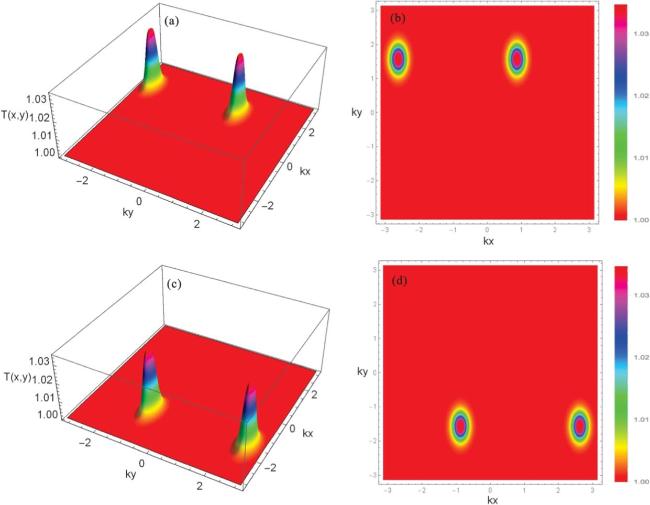
Figure 2. Transmission spectrum versus (kx, ky). The considered parameters are γ1 = γ2 = γ3 = 0.1γ, Δp = 5γ, Δ1 = Δ2 = 0γ, Ω1 = Ω2 = 10γ, and φ1 = φ2 = π/4. For panels (a) and (b), the values of η1 and η2 are set to 0.9 and −0.5, respectively. Meanwhile, in panels (c) and (d), η1 is −0.9 and η2 is 0.5. The left panel displays the intensity plots, while the contour plots corresponding to these intensities are featured in the right panel. |
Upon further investigation, the asymmetric superposition of standing wave fields proves to be pivotal for the evolution of localized peaks within 2D space. For example, when the superposition is defined by η1 = 0.6 and η2 = −0.4, we observe a single localized peak situated in the first quadrant, as shown in figure 3(a). This distinctive peak indicates that probe field transmission is concentrated at a single location, where the conditional positional probability of finding the atom is maximized. The intensity plot for 2D atomic localization is presented in figure 3(a), while figure 3(b) displays the corresponding contour plot, offering a clear visualization of atomic localization at this unique position. A significant shift in the localized peak occurs when the directions of the standing wave fields are reversed (i.e., η1 = −0.6 and η2 = 0.4), as illustrated in figure 3(c) (intensity plot). The contour plot for this shifted peak is provided in figure 3(d), further highlighting the impact of reversing the standing wave directions on the atomic localization.
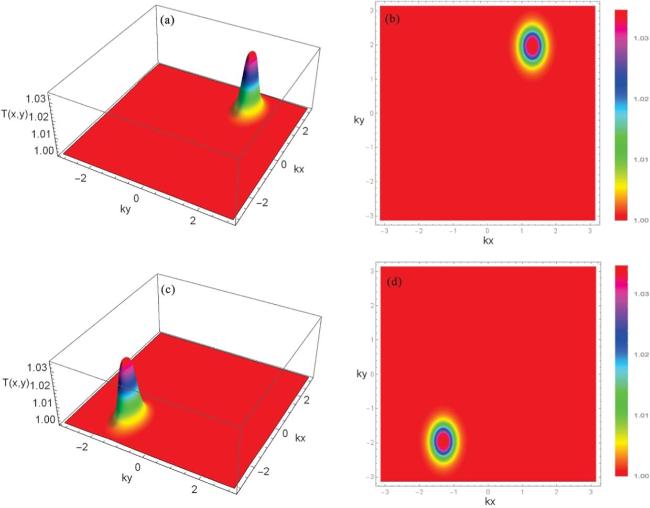
Figure 3. Transmission spectrum versus (kx, ky). The parameters selected for this analysis include (a) and (b) with η1 = 0.6 and η2 = − 0.4, and (c) and (d) show η1 = − 0.6 and η2 = 0.4. The other parameters are the same as those used in figure 2. |
It is important to note that the localization precision in our scheme is highly sensitive to the parameters η1 and η2, which define the projection of the standing wave vectors along the x- and y-directions, respectively. These parameters are directly related to the angles of incidence of the standing wave fields through ${\eta }_{1}=\cos ({\theta }_{x})$ and ${\eta }_{2}=\cos ({\theta }_{y})$. As demonstrated in figures 2 and 3, even small variations in ηn(n = 1, 2) significantly affect the number, position, and symmetry of the localization peaks. For instance, a change from η1 = 0.9 to η1 = 0.6 and η2 = −0.5 to η2 = −0.4 leads to the transition from double-peak to single-peak localization, and reversing the sign of ηn shifts the peaks across quadrants. Such behavior highlights the sensitivity of the localization pattern to laser alignment and mechanical stability. Therefore, to preserve the spatial resolution and robustness of the localization structure in realistic implementations, experimental setups should incorporate angular stabilization techniques, such as beam steering control, vibration isolation, and high-precision optical mounts, to minimize fluctuations in ηn caused by environmental noise or mechanical drift.
Next, we explore the effects of the control fields (Ω(x) and Ω(y)), probe detuning (Δp), and decay rates (γ1,2) on the behavior of 2D atomic localization. With the control fields set to (Ω1 = Ω2 = 9.5γ), as illustrated in figures 4(a) and (b), we observe the broadening of the localized peak, which manifests as spike-like structures in the first quadrant. This broadening suggests a decreased probability of localizing the atom within a specific wavelength range, leading to lower precision and resolution in localization. The influence of probe field detuning on 2D atomic localization is further illustrated in figures 4(c) and (d). When probe detuning reaches Δp = 4.5γ, a crater-like pattern emerges in the first quadrant, indicating that the atom becomes localized along the rings of these structures. Additionally, as the probe field detuning decreases, the width of the localized peak increases, signifying a reduced probability of locating the atom within a specific wavelength range. This behavior highlights a decrease in both the precision and resolution of atomic localization, ultimately suggesting a lower-quality localization at reduced detuning levels. Furthermore, our results highlight a fundamental trade-off between the intensity of the control fields and the achievable precision of atomic localization. As the Rabi frequencies Ω1 and Ω2 decrease, the strength of the coupling between the atomic states and the optical fields diminishes. This reduction weakens the quantum interference effects responsible for creating sharply defined transmission peaks. Consequently, the spatial width of the localized region increases, leading to a broader transmission profile and reduced localization precision. Therefore, optimizing the control field intensities is essential for achieving high-resolution localization, as stronger fields enhance the spatial confinement of the atom, while weaker fields compromise the sharpness and accuracy of localization.
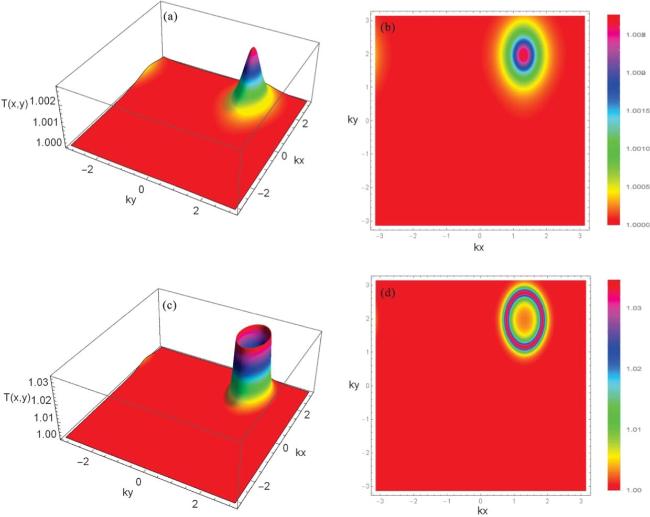
Figure 4. Transmission spectrum versus (kx, ky). For this figure, the parameters include (a) and (b) with Ω1 = Ω2 = 9.5γ and α2 = 0.6. In addition, panels (c) and (d) reflect the scenario when Δp = 4.5γ. All other parameters have been held constant, consistent with those in figure 3(a). |
Moreover, the decay rates (γ1,2,3) play a crucial role in determining the characteristics of 2D atomic localization. By varying the decay rates from γ1,2,3 = 0.1γ to γ1,2,3 = 0.05γ, we observe that spontaneous decay losses become negligible in comparison to the effects of the Rabi frequency and probe detuning. As a result, we find a sharply defined localized peak in the intensity plot (figure 5(a)), located in the first quadrant. The corresponding contour plot for the shifted localized peak is presented in figure 5(b). In this scenario, the probability of finding the atom within a specific wavelength range is significantly enhanced, which translates to high precision and high-resolution atomic localization in 2D space. When the decay rates are further reduced from 0.05γ to 0.01γ, we observe ultra-high-resolution and precision in atomic localization, particularly in the first quadrant, as demonstrated by the probe transmission spectra. The atom becomes fully localized within a region of λ/32 × λ/32, with a notable increase in the localization probability at a precise position. Our theoretical framework for atomic localization provides valuable insights into the potential for achieving and observing atomic localization in such 2D light fields. The effective localization region is quantified by the full width at half maximum (FWHM) of the probe-transmission peak and the spatial probability distribution derived from the probe-transmission spectrum, $T(x,y)\propto \mathrm{Im}[\chi (x,y)]$. The FWHM delineates the spatial domain where the localization probability exceeds half of its maximum value, in the present case this domain is estimated to be smaller than λ/32 × λ/32.
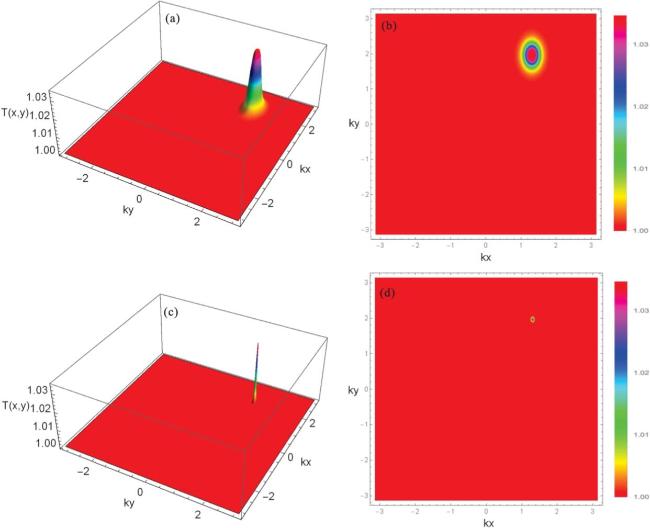


Figure 5. Transmission spectrum versus (kx, ky). The parameters utilized are (a) and (b) where γ1 = γ2 = γ3 = 0.05γ. Additionally, (c) and (d) are based on the conditions where γ1 = γ2 = γ3 = 0.01γ. Consistency is maintained with all other parameters set as in figure 3(a). |
The mechanisms behind 2D atomic localization are governed by the interplay between several key factors, including control fields, probe detuning, decay rates, and the geometry of standing wave fields. The control fields, characterized by Rabi frequencies, determine the coupling strength between the atomic states, thereby influencing the probability of atomic localization. When these control fields are set asymmetrically, as in the case of standing waves with different intensities (η1 and η2), they create a potential landscape that spatially confines the atom in specific regions, forming localized peaks where the probability of finding the atom is maximized. Probe detuning, which refers to the mismatch between the probe field frequency and the atomic transition, further modulates the localization by altering the resonance conditions. As detuning increases, the width of the localized peak expands, indicating a reduction in localization precision and resolution. On the other hand, lower detuning tightens the localization, enhancing the precision. Decay rates also play a crucial role by representing the loss of coherence in the system, mainly due to spontaneous emission. Lower decay rates reduce the effect of these losses, allowing the system to retain coherence over longer periods and enabling sharper localization of the atom. As decay rates decrease, the localization becomes more defined, with higher precision and resolution. Ultimately, the combination of these factors, control field asymmetry, probe detuning, and decay rates results in a complex but tunable localization effect that can be precisely manipulated to achieve high-resolution atomic positioning in 2D space.
4. Conclusions
To summarize, our study of 2D atomic localization in a tripod-type system has led to significant improvements through the analysis of probe transmission spectra from a weak probe field. The results show a remarkable increase in the precision and resolution of atomic localization, achieving ultra-high levels of accuracy. A key factor behind these improvements is the asymmetric superposition of standing waves, which plays a crucial role in shaping the localized peaks we observed in 2D space. Our findings reveal both efficient double peaks and sharply defined single localized peaks within a single wavelength domain, which are a result of the characteristics of weak probe beam transmission. Additionally, we have theoretically shown that atomic localization can achieve unprecedented resolution, confining the localized region to less than λ/32 × λ/32. Recent advances in atomic localization techniques, such as spatial light modulators and adaptive optics, have further improved our ability to manipulate atomic states and enhance localization precision. The combination of these advancements with cutting-edge quantum technologies, including quantum sensors and atom interferometry, opens up new opportunities for applications that require precise measurements of atomic positions and dynamics. The implications of our work extend to many fields, including atom laser cooling, neutral atom trapping, and nano-lithography. This research not only contributes to both fundamental and applied physics but also paves the way for future progress in quantum information science, especially in developing quantum networks and secure communication systems.