


1. Introduction
In the past two decades, a growing number of new hadrons in the heavy quark sector have been observed experimentally. Besides the exotic states, some of them may belong to the conventional heavy baryons, and provide an excellent opportunity for us to investigate and establish the traditional baryon spectroscopy. In the Review of Particle Physics [1], more than fifty hadrons are placed under the charmed and bottom baryons. Understanding the nature of these numerous particles and searching for the more missing heavy resonances have become an intriguing and important topic in hadron physics.
Until now, most candidates of conventional baryons are accommodated into the singly heavy baryons, while the experimental observations for doubly heavy baryons are still scarce. In 2002, the SELEX Collaboration reported the observation of a doubly charmed baryon ${{\rm{\Xi }}}_{cc}^{+}$ [2, 3], but the subsequent experiments and theoretical analyzes did not confirm its existence [4–7]. Surprisingly, the LHCb Collaboration reported a highly significant structure ${{\rm{\Xi }}}_{cc}^{++}(3621)$ in the ${{\rm{\Lambda }}}_{c}^{+}{K}^{-}{\pi }^{+}{\pi }^{+}$ invariant mass spectrum in 2017 [8]. The mass and lifetime are then measured precisely by the LHCb Collaboration [9, 10]. Also, the LHCb Collaboration attempt to hunt for more doubly heavy baryons, such as ${{\rm{\Xi }}}_{cc}^{+}$ [11, 12], ${{\rm{\Omega }}}_{cc}^{+}$ [13], ${{\rm{\Xi }}}_{bc}^{+}$ [14], ${{\rm{\Xi }}}_{bc}^{0}$ [15, 16] and ${{\rm{\Omega }}}_{bc}^{0}$ [16], but no significant signal has been discovered so far. Moreover, the LHCb Collaboration has observed a doubly heavy tetraquark ${T}_{cc}^{+}(3875)$ [17, 18], which may provide valuable clue for doubly heavy baryons [19–21].
Doubly heavy baryons offer an excellent platform for us to investigate the heavy quark symmetry and chiral dynamics simultaneously, where two distinct subsystems with quite different properties exist. One is the heavy-heavy subsystem, and the other is the heavy-light subsystem between a light quark and two heavy quarks. In the heavy quark limit, the two heavy quarks act as a compact color antitriplet source, and interact with the light quark degree of freedom. This is the so called heavy superflavor symmetry that establishes a connection between doubly heavy baryons and heavy mesons. A sketch for heavy superflavor symmetry is shown in figure 1. Also, this symmetry is broken explicitly owing to the finite heavy quark masses. Therefore, it is a important task to establish the spectroscopy of doubly heavy baryons and investigate the emergent heavy superflavor symmetry and its violation.
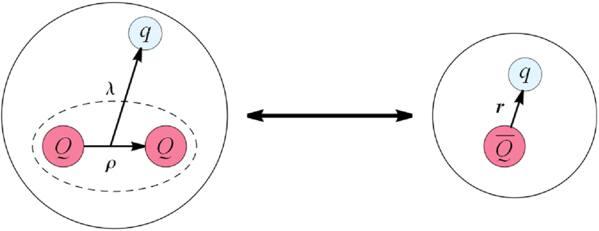
Figure 1. A sketch of heavy superflavor symmetry between doubly heavy baryons and heavy mesons. Here, the Q represents the charm or bottom quark, and the q stands for the light quark up, down or strange, respectively. |
Theoretically, the mass spectra, productions, and weak or radiative decays for doubly heavy baryons have been extensively studied within various approaches [22–60]. On the contrary, the investigations on strong decay behaviors for the low-lying doubly heavy baryons seems relatively few and unsystematic [21, 61–68]. Meanwhile, the strong decay behaviors are essential to understand the internal structures for the low-lying states and investigate the similarity between doubly heavy baryons and heavy mesons. Also, the predicted decay properties of excited states are helpful for future experimental searches. Thus, it is necessary to study the strong decays of doubly heavy baryons carefully and systematically.
In previous works [62–64], we adopted the chiral quark model or quark pair creation model to investigate the strong decays of doubly charmed and bottom baryons, but the simple harmonic oscillator wave functions were employed for calculations. Recently, we perform a systematic study for bottom-charmed baryons by combining the potential model and quark-chiral field interactions, where the masses and strong decays can be obtained within the framework of a unified quark model [34, 68]. To explore the internal structures for the charmed and bottom baryons, it is time to systematically explore their strong decays by using the obtained realistic wave functions.
In this work, we follow the similar route with bottom-charmed systems to investigate the strong decay behaviors of P-wave doubly charmed and bottom baryons Ξcc/bb and Ωcc/bb. We first solve the three-body Schrödinger equation to get the masses and realistic wave functions, and adopt the obtained wave functions together with the quark-chiral field interactions to calculate the Okubo–Zweig–Iizuka-allowed (OZI-allowed) two-body strong decays. Our results indicate that some P-wave doubly heavy charmed and bottom baryons are relatively narrow, which are very likely to be discovered by future experiments. Also, it is found that the heavy superflavor symmetry is preserved well in both charmed and bottom sectors.
This paper is organized as follows. The formalism for pseudoscalar meson emissions is briefly introduced in section 2 . We present the numerical results and discussions of strong decays for doubly charmed and bottom baryons in section 3 . A summary is given in the last section.
2. Method
In the quark model, the interaction between the light quark inside a doubly charmed or bottom baryon and the pseudoscalar meson can be described by the Yukawa interaction. This interaction is considered to be the dominant contribution to one meson emission process, where a doubly charmed or bottom baryon ${Y}_{QQ}^{i}({P}_{i})$ decays into a final baryon ${Y}_{QQ}^{f}({P}_{f})$ plus a pseudoscalar meson Mp(q) as shown in figure 2.
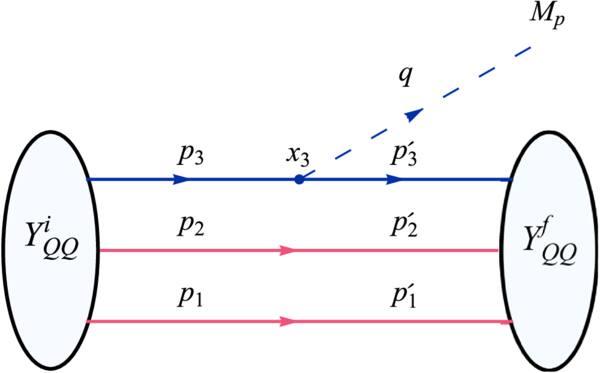
Figure 2. The pseudoscalar meson emission. ${Y}_{QQ}^{i}$ and ${Y}_{QQ}^{f}$ represent the initial and final doubly charmed or bottom baryons, respectively. Mp is a pseudoscalar meson. |
The coupling between the pseudoscalar meson and the light quark can be defined as
$\begin{eqnarray}{{ \mathcal L }}_{{M}_{p}qq}=\frac{{g}_{A}^{q}}{2{f}_{p}}\bar{q}{\gamma }_{\mu }{\gamma }_{5}\overrightarrow{\lambda }q\cdot {\partial }^{\mu }{\overrightarrow{M}}_{p},\end{eqnarray}$
where the q stands for the quark field, ${g}_{A}^{q}$ is the quark-axial-vector coupling, and fp is the decay constant. In present work, fπ = 93 MeV and fK = 111 MeV are adopted that have been extensively used in quark model calculations [62, 68–74]. The ${\overrightarrow{M}}_{p}$ is a matrix of light pseudoscalar mesons and can be defined as $\begin{eqnarray}{\overrightarrow{M}}_{p}=\left(\begin{array}{ccc}\frac{1}{\sqrt{2}}{\pi }^{0}+\frac{1}{\sqrt{6}}\eta & {\pi }^{+} & {K}^{+}\\ {\pi }^{-} & -\frac{1}{\sqrt{2}}{\pi }^{0}+\frac{1}{\sqrt{6}}\eta & {K}^{0}\\ {K}^{-} & {\bar{K}}^{0} & -\sqrt{\frac{2}{3}}\eta \end{array}\right).\end{eqnarray}$
The wave function for the YQQ (YQQ = Ξcc, Ξbb, Ωcc, or Ωbb) baryon with mass ${M}_{{Y}_{QQ}}$ in the rest frame can be expressed in the momentum representation as
$\begin{eqnarray}\begin{array}{rcl}\left|{Y}_{QQ}(J)\right\rangle & = & \sqrt{2{M}_{{Y}_{QQ}}}\displaystyle \sum _{\{s,l\}}\displaystyle \int \frac{{{\rm{d}}}^{3}{{\boldsymbol{p}}}_{\rho }}{{(2\pi )}^{3}}\displaystyle \int \frac{{{\rm{d}}}^{3}{{\boldsymbol{p}}}_{\lambda }}{{(2\pi )}^{3}}\\ & & \times \frac{1}{\sqrt{2{m}_{1}}}\frac{1}{\sqrt{2{m}_{2}}}\frac{1}{\sqrt{2{m}_{3}}}{\psi }_{{l}_{\rho }}({{\boldsymbol{p}}}_{\rho }){\psi }_{{l}_{\lambda }}\left({{\boldsymbol{p}}}_{\lambda }\right)\\ & & \times \left|{q}_{1}\left({p}_{1},{s}_{1}\right)\right\rangle \left|{q}_{2}\left({p}_{2},{s}_{2}\right)\right\rangle \left|{q}_{3}\left({p}_{3},{s}_{3}\right)\right\rangle .\end{array}\end{eqnarray}$
Then, the decay amplitude for ${Y}_{QQ}^{i}({P}_{i})$ → ${Y}_{QQ}^{f}({P}_{f})$ + Mp(q) can be obtained by $\begin{eqnarray}\begin{array}{rcl}-{\rm{i}}{ \mathcal T } & = & -{\rm{i}}\frac{{g}_{A}^{q}{g}_{f}}{2{f}_{p}}\sqrt{2{M}_{i}}\sqrt{2{M}_{f}}\displaystyle \int {{\rm{d}}}^{3}{\boldsymbol{\lambda }}{{\rm{e}}}^{{\rm{i}}{{\boldsymbol{q}}}_{\lambda }\cdot {\boldsymbol{\lambda }}}\\ & & \times \left\langle {Y}_{QQ}^{f}\Space{0ex}{2.5ex}{0ex}| {\rm{i}}\left\{\left(1-\frac{\omega }{2{m}_{3}}+\frac{\omega }{{m}_{1}+{m}_{2}+{m}_{3}}\right){\boldsymbol{\sigma }}\cdot {\boldsymbol{q}}\right.\right.\\ & & \left.\left.+\frac{\omega }{{m}_{3}}{\boldsymbol{\sigma }}\cdot {{\boldsymbol{p}}}_{\lambda }\right\}\Space{0ex}{2.5ex}{0ex}| {Y}_{QQ}^{i}\right\rangle ,\end{array}\end{eqnarray}$
and the qλ is defined as $\begin{eqnarray}{{\boldsymbol{q}}}_{{\boldsymbol{\lambda }}}=\frac{{m}_{1}+{m}_{2}}{{m}_{1}+{m}_{2}+{m}_{3}}{\boldsymbol{q}}.\end{eqnarray}$
The gf denotes the overlap of flavor wave functions, Mi is the mass of initial baryon, Mf is the mass of final baryon, q = (ω, q) is the 4-momentum of outgoing pseudoscalar meson, mi is the constituent quark mass with m1 = m2 = mQ and m3 = mu/d/s.For the doubly heavy baryons, one usually employ the j-j coupling scheme, which is shown in figure 3. The nρ and lρ stand for the radial and orbital quantum numbers between the two heavy quarks, respectively; similarly, the nλ and lλ correspond to the radial and orbital quantum numbers between the light quark and heavy quark subsystem, respectively. The Sρ and Jρ are the total spin and total angular momentum of two heavy quarks, respectively. The j = lλ + s3 represents the light quark spin, and JP is the spin-parity of a doubly heavy baryon. Moreover, the heavy diquark spin Jρ and the light quark spin j are conserved quantities in the heavy quark limit, which can be adopted to label the doubly heavy baryons. Then, the j-j coupling basis can be written as
$\begin{eqnarray}| {J}^{P},j\rangle =\left|{\left[{({l}_{\rho }{S}_{\rho })}_{{J}_{\rho }}{({l}_{\lambda }{s}_{3})}_{j}\right]}_{{J}^{P}}\right\rangle ,\end{eqnarray}$
and the notation ΞQQ(JP, j) or ΩQQ(JP, j) stands for a doubly heavy baryon in present work.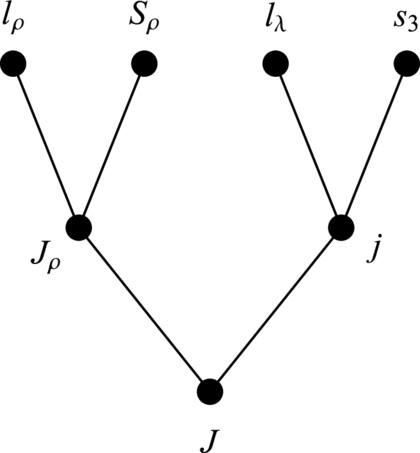


Figure 3. The j-j coupling scheme for doubly heavy baryons. |
The masses and wave functions for initial and final baryons are obtained from the potential model [34]. The useful formulas and parameters of the potential model are presented in the appendix , and the details can be found in the original work [34]. Here, we list the calculated masses for low-lying doubly charmed and bottom baryons in tables 1 and 2, and the predictions of other quark models are also shown for comparisons. Meanwhile, the wave functions of these states also obtained, which can be employed for calculations of strong decays.
Table 1. The mass spectra of Ξcc and Ωcc families in MeV. |
| States | nρ | nλ | lρ | lλ | Sρ | Jρ | j | JP | Mass | [26] | [27] | [28] | [29] | [31] |
|---|---|---|---|---|---|---|---|---|---|---|---|---|---|---|
| ${{\rm{\Xi }}}_{cc}({\frac{1}{2}}^{+},\frac{1}{2})$ | 0 | 0 | 0 | 0 | 1 | 1 | $\frac{1}{2}$ | ${\frac{1}{2}}^{+}$ | 3621 | 3619 | 3674 | 3606 | 3640 | 3620 |
| ${{\rm{\Xi }}}_{cc}^{* }({\frac{3}{2}}^{+},\frac{1}{2})$ | 0 | 0 | 0 | 0 | 1 | 1 | $\frac{1}{2}$ | ${\frac{3}{2}}^{+}$ | 3690 | 3686 | 3753 | 3675 | 3695 | 3727 |
| ${\widetilde{{\rm{\Xi }}}}_{cc}({\frac{1}{2}}^{-},\frac{1}{2})$ | 0 | 0 | 1 | 0 | 0 | 1 | $\frac{1}{2}$ | ${\frac{1}{2}}^{-}$ | 3883 | 3823 | 3910 | 3873 | 3932 | 3838 |
| ${\widetilde{{\rm{\Xi }}}}_{cc}({\frac{3}{2}}^{-},\frac{1}{2})$ | 0 | 0 | 1 | 0 | 0 | 1 | $\frac{1}{2}$ | ${\frac{3}{2}}^{-}$ | 3885 | 3855 | 3921 | 3916 | 3978 | 3959 |
| ${{\rm{\Xi }}}_{cc}({\frac{1}{2}}^{-},\frac{1}{2})$ | 0 | 0 | 0 | 1 | 1 | 1 | $\frac{1}{2}$ | ${\frac{1}{2}}^{-}$ | 4071 | 4048 | 4074 | 3998 | — | 4136 |
| ${{\rm{\Xi }}}_{cc}({\frac{3}{2}}^{-},\frac{1}{2})$ | 0 | 0 | 0 | 1 | 1 | 1 | $\frac{1}{2}$ | ${\frac{3}{2}}^{-}$ | 4085 | 4081 | 4078 | 4014 | — | 4196 |
| ${{\rm{\Xi }}}_{cc}({\frac{1}{2}}^{-},\frac{3}{2})$ | 0 | 0 | 0 | 1 | 1 | 1 | $\frac{3}{2}$ | ${\frac{1}{2}}^{-}$ | 4073 | 4082 | — | 3985 | — | 4053 |
| ${{\rm{\Xi }}}_{cc}({\frac{3}{2}}^{-},\frac{3}{2})$ | 0 | 0 | 0 | 1 | 1 | 1 | $\frac{3}{2}$ | ${\frac{3}{2}}^{-}$ | 4095 | 4114 | — | 4025 | — | 4101 |
| ${{\rm{\Xi }}}_{cc}({\frac{5}{2}}^{-},\frac{3}{2})$ | 0 | 0 | 0 | 1 | 1 | 1 | $\frac{3}{2}$ | ${\frac{5}{2}}^{-}$ | 4099 | 4169 | 4092 | 4050 | — | 4155 |
| | ||||||||||||||
| States | nρ | nλ | lρ | lλ | Sρ | Jρ | j | JP | Mass | [26] | [27] | [28] | [29] | [31] |
| | ||||||||||||||
| ${{\rm{\Omega }}}_{cc}({\frac{1}{2}}^{+},\frac{1}{2})$ | 0 | 0 | 0 | 0 | 1 | 1 | $\frac{1}{2}$ | ${\frac{1}{2}}^{+}$ | 3768 | 3766 | 3815 | 3715 | 3750 | 3778 |
| ${{\rm{\Omega }}}_{cc}^{* }({\frac{3}{2}}^{+},\frac{1}{2})$ | 0 | 0 | 0 | 0 | 1 | 1 | $\frac{1}{2}$ | ${\frac{3}{2}}^{+}$ | 3819 | 3833 | 3876 | 3772 | 3799 | 3872 |
| ${\tilde{{\rm{\Omega }}}}_{cc}({\frac{1}{2}}^{-},\frac{1}{2})$ | 0 | 0 | 1 | 0 | 0 | 1 | $\frac{1}{2}$ | ${\frac{1}{2}}^{-}$ | 4022 | 3970 | 4046 | 3986 | 4049 | 4002 |
| ${\tilde{{\rm{\Omega }}}}_{cc}({\frac{3}{2}}^{-},\frac{1}{2})$ | 0 | 0 | 1 | 0 | 0 | 1 | $\frac{1}{2}$ | ${\frac{3}{2}}^{-}$ | 4022 | 4002 | 4052 | 4020 | 4089 | 4102 |
| ${{\rm{\Omega }}}_{cc}({\frac{1}{2}}^{-},\frac{1}{2})$ | 0 | 0 | 0 | 1 | 1 | 1 | $\frac{1}{2}$ | ${\frac{1}{2}}^{-}$ | 4135 | 4111 | 4135 | 4087 | — | 4271 |
| ${{\rm{\Omega }}}_{cc}({\frac{3}{2}}^{-},\frac{1}{2})$ | 0 | 0 | 0 | 1 | 1 | 1 | $\frac{1}{2}$ | ${\frac{3}{2}}^{-}$ | 4146 | 4144 | 4140 | 4107 | — | 4325 |
| ${{\rm{\Omega }}}_{cc}({\frac{1}{2}}^{-},\frac{3}{2})$ | 0 | 0 | 0 | 1 | 1 | 1 | $\frac{3}{2}$ | ${\frac{1}{2}}^{-}$ | 4137 | 4145 | — | 4081 | — | 4208 |
| ${{\rm{\Omega }}}_{cc}({\frac{3}{2}}^{-},\frac{3}{2})$ | 0 | 0 | 0 | 1 | 1 | 1 | $\frac{3}{2}$ | ${\frac{3}{2}}^{-}$ | 4154 | 4177 | — | 4114 | — | 4252 |
| ${{\rm{\Omega }}}_{cc}({\frac{5}{2}}^{-},\frac{3}{2})$ | 0 | 0 | 0 | 1 | 1 | 1 | $\frac{3}{2}$ | ${\frac{5}{2}}^{-}$ | 4156 | 4232 | 4152 | 4134 | — | 4303 |
Table 2. The mass spectra of Ξbb and Ωbb families in MeV. |
| States | nρ | nλ | lρ | lλ | Sρ | Jρ | j | JP | Mass | [26] | [27] | [28] | [30] | [31] |
|---|---|---|---|---|---|---|---|---|---|---|---|---|---|---|
| ${{\rm{\Xi }}}_{bb}({\frac{1}{2}}^{+},\frac{1}{2})$ | 0 | 0 | 0 | 0 | 1 | 1 | $\frac{1}{2}$ | ${\frac{1}{2}}^{+}$ | 10 250 | 10 295 | 10 340 | 10 138 | 10 192 | 10 202 |
| ${{\rm{\Xi }}}_{bb}^{* }({\frac{3}{2}}^{+},\frac{1}{2})$ | 0 | 0 | 0 | 0 | 1 | 1 | $\frac{1}{2}$ | ${\frac{3}{2}}^{+}$ | 10 275 | 10 317 | 10 367 | 10 169 | 10 211 | 10 237 |
| ${\tilde{{\rm{\Xi }}}}_{bb}({\frac{1}{2}}^{-},\frac{1}{2})$ | 0 | 0 | 1 | 0 | 0 | 1 | $\frac{1}{2}$ | ${\frac{1}{2}}^{-}$ | 10 412 | 10 411 | 10 493 | 10 364 | 10 428 | 10 368 |
| ${\tilde{{\rm{\Xi }}}}_{bb}({\frac{3}{2}}^{-},\frac{1}{2})$ | 0 | 0 | 1 | 0 | 0 | 1 | $\frac{1}{2}$ | ${\frac{3}{2}}^{-}$ | 10 412 | 10 417 | 10 495 | 10 387 | 10 445 | 10 408 |
| ${{\rm{\Xi }}}_{bb}({\frac{1}{2}}^{-},\frac{1}{2})$ | 0 | 0 | 0 | 1 | 1 | 1 | $\frac{1}{2}$ | ${\frac{1}{2}}^{-}$ | 10 639 | 10 700 | 10 710 | 10 525 | — | 10 675 |
| ${{\rm{\Xi }}}_{bb}({\frac{3}{2}}^{-},\frac{1}{2})$ | 0 | 0 | 0 | 1 | 1 | 1 | $\frac{1}{2}$ | ${\frac{3}{2}}^{-}$ | 10 676 | 10 707 | 10 713 | 10 526 | — | 10 694 |
| ${{\rm{\Xi }}}_{bb}({\frac{1}{2}}^{-},\frac{3}{2})$ | 0 | 0 | 0 | 1 | 1 | 1 | $\frac{3}{2}$ | ${\frac{1}{2}}^{-}$ | 10 640 | 10 716 | — | 10 504 | — | 10 632 |
| ${{\rm{\Xi }}}_{bb}({\frac{3}{2}}^{-},\frac{3}{2})$ | 0 | 0 | 0 | 1 | 1 | 1 | $\frac{3}{2}$ | ${\frac{3}{2}}^{-}$ | 10 678 | 10 722 | — | 10 528 | — | 10 647 |
| ${{\rm{\Xi }}}_{bb}({\frac{5}{2}}^{-},\frac{3}{2})$ | 0 | 0 | 0 | 1 | 1 | 1 | $\frac{3}{2}$ | ${\frac{5}{2}}^{-}$ | 10 695 | 10 733 | 10 713 | 10 547 | — | 10 661 |
| | ||||||||||||||
| States | nρ | nλ | lρ | lλ | Sρ | Jρ | j | JP | Mass | [26] | [27] | [28] | [30] | [31] |
| | ||||||||||||||
| ${{\rm{\Omega }}}_{bb}({\frac{1}{2}}^{+},\frac{1}{2})$ | 0 | 0 | 0 | 0 | 1 | 1 | $\frac{1}{2}$ | ${\frac{1}{2}}^{+}$ | 10 383 | 10 438 | 10 454 | 10 230 | 10 285 | 10 359 |
| ${{\rm{\Omega }}}_{bb}^{* }({\frac{3}{2}}^{+},\frac{1}{2})$ | 0 | 0 | 0 | 0 | 1 | 1 | $\frac{1}{2}$ | ${\frac{3}{2}}^{+}$ | 10 403 | 10 460 | 10 486 | 10 258 | 10 303 | 10 389 |
| ${\tilde{{\rm{\Omega }}}}_{bb}({\frac{1}{2}}^{-},\frac{1}{2})$ | 0 | 0 | 1 | 0 | 0 | 1 | $\frac{1}{2}$ | ${\frac{1}{2}}^{-}$ | 10 543 | 10 554 | 10 616 | 10 464 | 10 528 | 10 532 |
| ${\tilde{{\rm{\Omega }}}}_{bb}({\frac{3}{2}}^{-},\frac{1}{2})$ | 0 | 0 | 1 | 0 | 0 | 1 | $\frac{1}{2}$ | ${\frac{3}{2}}^{-}$ | 10 544 | 10 560 | 10 619 | 10 482 | 10 543 | 10 566 |
| ${{\rm{\Omega }}}_{bb}({\frac{1}{2}}^{-},\frac{1}{2})$ | 0 | 0 | 0 | 1 | 1 | 1 | $\frac{1}{2}$ | ${\frac{1}{2}}^{-}$ | 10 732 | 10 762 | 10 763 | 10 605 | — | 10 804 |
| ${{\rm{\Omega }}}_{bb}({\frac{3}{2}}^{-},\frac{1}{2})$ | 0 | 0 | 0 | 1 | 1 | 1 | $\frac{1}{2}$ | ${\frac{3}{2}}^{-}$ | 10 739 | 10 768 | 10 765 | 10 610 | — | 10 821 |
| ${{\rm{\Omega }}}_{bb}({\frac{1}{2}}^{-},\frac{3}{2})$ | 0 | 0 | 0 | 1 | 1 | 1 | $\frac{3}{2}$ | ${\frac{1}{2}}^{-}$ | 10 733 | 10 778 | — | 10 591 | — | 10 771 |
| ${{\rm{\Omega }}}_{bb}({\frac{3}{2}}^{-},\frac{3}{2})$ | 0 | 0 | 0 | 1 | 1 | 1 | $\frac{3}{2}$ | ${\frac{3}{2}}^{-}$ | 10 741 | 10 784 | — | 10 611 | — | 10 785 |
| ${{\rm{\Omega }}}_{bb}({\frac{5}{2}}^{-},\frac{3}{2})$ | 0 | 0 | 0 | 1 | 1 | 1 | $\frac{3}{2}$ | ${\frac{5}{2}}^{-}$ | 10 744 | 10 795 | 10 766 | 10 625 | — | 10 798 |
The helicity amplitude ${{ \mathcal A }}_{h}$ can be derived from the transition operator and the initial and final wave functions. In order to calculate the strong decay widths for pseudoscalar meson emissions, the phase space factor also needs to be taken into account. Then, the strong decays for doubly charmed and bottom baryons can be evaluated straightforwardly
$\begin{eqnarray}{\rm{\Gamma }}=\frac{1}{4\pi }\frac{| {\boldsymbol{q}}| }{2{M}_{i}^{2}}\frac{1}{2J+1}\displaystyle \sum _{h}{\left|{{ \mathcal A }}_{h}\right|}^{2}.\end{eqnarray}$
Finally, it should be mentioned that the theoretical framework based on the quark-chiral field interactions has been widely adopted to study the strong decay behaviors of conventional hadrons and achieved great success [62, 68–73, 75–77] and thus is suitable for investigating the doubly charmed and bottom baryons.3. Results and discussions
3.1. The λ-mode Ξcc(1P) and Ωcc(1P) states
There are five λ-mode Ξcc(1P) states in the constituent quark model, which can be classified into the j = 1/2 doublet and j = 3/2 triplet according to the light quark spin j. The strong decays for λ-mode Ξcc(1P) states are listed in table 3. For the j = 1/2 doublet, the predicted decay widths are broad, which are about 297 and 272 MeV, respectively. Also, it can be found that the strong decays for Ξcc(1/2−, 1/2) and Ξcc(3/2−, 1/2) states are dominated by the Ξccπ and ${{\rm{\Xi }}}_{cc}^{* }\pi $ channels, respectively. However, for the j = 3/2 triplet, the predicted decay widths are relatively narrow and about 46, 67, and 82 MeV for JPC = 1/2−, 3/2−, and 5/2− states respectively. The ${{\rm{\Xi }}}_{cc}^{* }\pi $ channel saturates the strong decay of Ξcc(1/2−, 3/2) state, and the branching ratios for Ξcc(3/2−, 3/2) and Ξcc(5/2−, 3/2) states are calculated to be
$\begin{eqnarray}{\rm{Br}}({{\rm{\Xi }}}_{cc}\pi ,{{\rm{\Xi }}}_{cc}^{* }\pi )=48.47 \% ,51.53 \% ,\end{eqnarray}$
and $\begin{eqnarray}{\rm{Br}}({{\rm{\Xi }}}_{cc}\pi ,{{\rm{\Xi }}}_{cc}^{* }\pi )=45.55 \% ,54.45 \% ,\end{eqnarray}$
respectively.Table 3. The predicted strong decay widths for λ-mode Ξcc(1P) and Ωcc(1P) states in MeV. The × denotes the forbidden channel due to quantum numbers. |
| State | ${{\rm{\Xi }}}_{cc}({\frac{1}{2}}^{-},\frac{1}{2})$ | ${{\rm{\Xi }}}_{cc}({\frac{3}{2}}^{-},\frac{1}{2})$ | ${{\rm{\Xi }}}_{cc}({\frac{1}{2}}^{-},\frac{3}{2})$ | ${{\rm{\Xi }}}_{cc}({\frac{3}{2}}^{-},\frac{3}{2})$ | ${{\rm{\Xi }}}_{cc}({\frac{5}{2}}^{-},\frac{3}{2})$ |
|---|---|---|---|---|---|
| Ξccπ | 296.88 | × | × | 19.62 | 53.52 |
| ${{\rm{\Xi }}}_{cc}^{* }$π | × | 271.59 | 46.38 | 46.92 | 28.53 |
| Total | 296.88 | 271.59 | 46.38 | 66.54 | 82.05 |
| | |||||
| State | ${{\rm{\Omega }}}_{cc}({\frac{1}{2}}^{-},\frac{1}{2})$ | ${{\rm{\Omega }}}_{cc}({\frac{3}{2}}^{-},\frac{1}{2})$ | ${{\rm{\Omega }}}_{cc}({\frac{1}{2}}^{-},\frac{3}{2})$ | ${{\rm{\Omega }}}_{cc}({\frac{3}{2}}^{-},\frac{3}{2})$ | ${{\rm{\Omega }}}_{cc}({\frac{5}{2}}^{-},\frac{3}{2})$ |
| | |||||
| Ξcc$\bar{K}$ | 349.23 | × | × | 0.39 | 1.20 |
| Total | 349.23 | Narrow | Narrow | 0.39 | 1.20 |
The broad j = 1/2 doublet and narrow j = 3/2 triplet result from the enhancement or cancellation in the amplitudes with different Clebsch–Gordan coefficients. In the heavy superflavor symmetry, the cc subsystem corresponds to an antiquark $\bar{c}$, and the λ-mode Ξcc(1P) states are related to P-wave charmed mesons. Indeed, from the Review of Particle Physics [1], the ${D}_{0}^{* }(2300)$ and D1(2430) with j = 1/2 are broad resonances, and the D1(2420) and D2(2460) with j = 3/2 are relatively narrow. It can be seen that the heavy superflavor symmetry is preserved well for decay behaviors of Ξcc(1P) baryons and D(1P) mesons.
According to the SU(3) flavor symmetry of light quarks, the Ωcc(1P) states should show similar properties to the Ξcc(1P) states. However, in present calculations, only the Ωcc(1/2−, 1/2) state has a broad width that decays into the ${{\rm{\Xi }}}_{cc}\bar{K}$ channel, while other four states are predicted to be rather narrow. The main reason for this broken symmetry is that some λ-mode Ωcc(1P) states lie near the ${{\rm{\Xi }}}_{cc}\bar{K}$ threshold and below the ${{\rm{\Xi }}}_{cc}^{* }\bar{K}$ threshold, which leads to the narrow widths for the Ωcc(3/2−, 1/2), Ωcc(1/2−, 3/2), Ωcc(3/2−, 3/2), and Ωcc(5/2−, 3/2) states. Then, the isospin broken pion emissions and radiative transitions become important and may dominate the decay behaviors of λ-mode Ωcc(1P) states except for the Ωcc(1/2−, 1/2) state. The similar situation occurs in the charmed-strange mesons, where the particles ${D}_{s0}^{* }(2137)$ and Ds1(2460) have significantly lower masses and narrow decay widths. For the ${D}_{s0}^{* }(2137)$ and Ds1(2460) resonances, the molecular interpretation and hybrid picture with coupled channel approach were proposed in the literature to explain their mysterious properties [78–84]. Also, the λ-mode Ωcc(1P) states may couple to the meson-baryon molecular states [66, 85–87], which lower their masses of three-quark pictures. In brief, both our calculations and heavy superflavor symmetry indicate that there exist several negative-parity Ωcc(1P) states near the ${{\rm{\Xi }}}_{cc}\bar{K}$ threshold and below the ${{\rm{\Xi }}}_{cc}^{* }\bar{K}$ threshold. We suggest that the future experiments search for these states through isospin broken decay modes ${{\rm{\Omega }}}_{cc}^{(* )}\pi $ and radiative decays ${{\rm{\Omega }}}_{cc}^{(* )}\gamma $, which are also useful for us to better understand the nature of negative-parity charmed-strange mesons.
3.2. The λ-mode Ξbb(1P) and Ωbb(1P) states
The strong decays for λ-mode Ξbb(1P) and Ωbb(1P) states are estimated and shown in table 4. For the j = 1/2 doublet, the calculated decay widths are rather broad with 303 and 312 MeV. For the j = 3/2 triplet, the predicted decay widths are about 41, 67, and 84 MeV for the Ξbb(1/2−, 3/2), Ξbb(3/2−, 3/2) and Ξbb(5/2−, 3/2) states, respectively. Meanwhile, the total decay widths for the five λ-mode Ωbb(1P) states are rather narrow owing to the lower masses and closed ${{\rm{\Xi }}}_{bb}\bar{K}$ channel. These narrow states can be hunted for through the isospin broken pion emissions and radiative transitions in future experiments. Moreover, the narrow Ωbb(1P) states may be observed earlier than the ground state ${{\rm{\Omega }}}_{bb}^{* }(1S)$ in the future as well as the singly bottom Ωb family [1].
Table 4. The predicted strong decay widths for λ-mode Ξbb(1P) and Ωbb(1P) states in MeV. The × denotes the forbidden channel due to quantum numbers, and the ⋯ stands for the the forbidden channel owing to the lack of phase space. |
| State | ${{\rm{\Xi }}}_{bb}({\frac{1}{2}}^{-},\frac{1}{2})$ | ${{\rm{\Xi }}}_{bb}({\frac{3}{2}}^{-},\frac{1}{2})$ | ${{\rm{\Xi }}}_{bb}({\frac{1}{2}}^{-},\frac{3}{2})$ | ${{\rm{\Xi }}}_{bb}({\frac{3}{2}}^{-},\frac{3}{2})$ | ${{\rm{\Xi }}}_{bb}({\frac{5}{2}}^{-},\frac{3}{2})$ |
|---|---|---|---|---|---|
| Ξbbπ | 302.94 | × | × | 15.81 | 48.48 |
| ${{\rm{\Xi }}}_{bb}^{* }$π | × | 311.22 | 40.89 | 51.57 | 35.37 |
| Total | 302.94 | 311.22 | 40.89 | 67.38 | 83.85 |
| | |||||
| State | ${{\rm{\Omega }}}_{bb}({\frac{1}{2}}^{-},\frac{1}{2})$ | ${{\rm{\Omega }}}_{bb}({\frac{3}{2}}^{-},\frac{1}{2})$ | ${{\rm{\Omega }}}_{bb}({\frac{1}{2}}^{-},\frac{3}{2})$ | ${{\rm{\Omega }}}_{bb}({\frac{3}{2}}^{-},\frac{3}{2})$ | ${{\rm{\Omega }}}_{bb}({\frac{5}{2}}^{-},\frac{3}{2})$ |
| | |||||
| Ξbb$\bar{K}$ | ⋯ | ⋯(×) | ⋯(×) | ⋯ | 0.00 |
| Total | Narrow | Narrow | Narrow | Narrow | Narrow |
Our results suggest that the strong decay behaviors for λ-mode Ξbb(1P) and Ωbb(1P) states are quite similar to that of charmed sectors. Therefore, the correspondence between the cc and bb subsystems preserves well for these states. Also, the approximate superflavor symmetry relates the bb subsystem to an antiquark $\bar{b}$ and the doubly bottom baryons to the bottom(-strange) mesons. For the bottom(-strange) mesons, four narrow states B1(5721), ${B}_{2}^{* }(5747)$, Bs1(5830), and ${B}_{s2}^{* }(5840)$ are observed experimentally, which just occupy the four P-wave j = 3/2 states in the quark model [88]. Meanwhile, no experimental evidence for the four j = 1/2 bottom(-strange) mesons exists. More theoretical and experimental information on the bottom(-strange) mesons is also helpful for understanding the doubly bottom baryons.
3.3. Further discussions
We first compare our present results of λ-mode doubly heavy charmed and bottomed baryons with other previous calculations within the quark models in the literature. For the Ξcc/bb(1P) states, the broad j = 1/2 doublet and narrow j = 3/2 triplet are key characteristics in present results, which roughly agree with the 3P0 model calculations for the Ξcc(1P) [61] and Ξbb(1P) [64, 67]. For the Ωcc(1P) states, there is no other work for comparison. The strong decay behaviors for Ωbb(1P) show different properties with those of 3P0 model calculations [64, 67], where the variant phase spaces can affect the decay behaviors significantly for the near threshold states. It should be noted that the calculations in [62, 63] are based on the L − S coupling scheme for the doubly heavy baryons, which cannot be compared with present calculations directly. In other words, although the formulas of amplitudes in different coupling schemes have a close connection, the numerical results for the decay widths do not. Further careful theoretical investigations and experimental inputs are helpful to understand their decay behaviors.
Besides the λ-mode excitations, there are also ρ-mode 1P states denoted as ${\tilde{{\rm{\Xi }}}}_{cc/bb}(1P)/{\tilde{{\rm{\Omega }}}}_{cc/bb}(1P)$ states, and their masses are listed in tables 1 and 2. Owing to the limited phase space, the only possible strong decay modes are light meson emissions for these low-lying states. However, under the spectator assumption for the two heavy quark subsystems, the orthogonality of ρ-mode wave functions between initial and final states leads to the vanishing amplitude in the tree level diagram shown in figure 2. More explicitly, the transition operator only acts on the light quark and λ-mode excitation, and is irrelevant to the heavy subsystem and ρ-mode variables. Then, the helicity amplitude is proportional to overlap of ρ-mode wavefunctions between initial and final baryons
$\begin{eqnarray}\begin{array}{rcl}{{ \mathcal A }}_{h} & \propto & \langle {\psi }_{{n}_{\rho }^{{\prime} }{l}_{\rho }^{{\prime} }{m}_{\rho }^{{\prime} }}^{f}| {\psi }_{{n}_{\rho }{l}_{\rho }{m}_{\rho }}^{i}\rangle \\ & = & \langle {R}_{{n}_{\rho }^{{\prime} }{l}_{\rho }^{{\prime} }}^{f}| {R}_{{n}_{\rho }{l}_{\rho }}^{i}\rangle \langle {Y}_{{l}_{\rho }^{{\prime} }{m}_{\rho }^{{\prime} }}^{f}| {Y}_{{l}_{\rho }{m}_{\rho }}^{i}\rangle .\end{array}\end{eqnarray}$
Here, the ${R}_{{n}_{\rho }{l}_{\rho }}^{i}$ and ${R}_{{n}_{\rho }^{{\prime} }{l}_{\rho }^{{\prime} }}^{f}$ are the radial wave functions of initial and final baryons, respectively; the ${Y}_{{l}_{\rho }{m}_{\rho }}^{i}$ and ${Y}_{{l}_{\rho }^{{\prime} }{m}_{\rho }^{{\prime} }}^{f}$ are the angular wave functions of initial and final baryons, respectively. In present situation, the angular momentum quantum numbers of initial and final baryons are lρ = 1 and ${l}_{\rho }^{{\prime} }=0$, respectively. Then, the overlap of $\langle {Y}_{{l}_{\rho }^{{\prime} }{m}_{\rho }^{{\prime} }}^{f}| {Y}_{{l}_{\rho }{m}_{\rho }}^{i}\rangle $ vanishes owing to the orthogonality of spherical harmonic functions. Therefore, the light meson emissions for these low-lying ρ-mode states are highly suppressed and the electromagnetic and weak decays may become dominating. More discussions can be found in [61, 68].From our calculations on masses and strong decays for doubly charmed and bottom baryons, it can be seen that the heavy superflavor symmetry is preserved well in most cases. Although the masses of charm and bottom quarks are finite, the violation of superflavor symmetry is quite small. This is consistent with the the previous discussions in the quark model [33, 61, 64, 67] and effective field theory [66, 89], but differ from the results of [37] in which the next leading order corrections can be considered as an important source for the violation. Also, previous studies with the same quark-chiral field interactions indicated that the higher order contributions for strong decays of P-wave baryons are small enough and can be safely neglected [70, 71]. In fact, our decay calculations are based on a spectator model, where the two heavy quarks as a whole in the initial baryons go into the final states and the heavy superflavor symmetry for the decay amplitude is preserved automatically.
4. Summary
In this work, we investigate the strong decays for low-lying excited states of doubly charmed and bottom baryons in the constituent quark model. For the λ-mode Ξcc/bb(1P) states, the j = 1/2 doublet are rather broad and the j = 3/2 triplet are expected to be relatively narrow. For the λ-mode Ωcc/bb(1P) states, only the Ωcc(1/2−, 1/2) state is broad, while other states are rather narrow owing to the limited phase space and selection rule. Moreover, the light meson emissions for the low-lying ρ–mode states are highly suppressed due to the orthogonality of wave functions between initial and final states, and then the electromagnetic and weak decay channels for these states may become dominating.
Also, the strong decay behaviors for doubly charmed and bottom baryons preserve the heavy superflavor symmetry well, where the small violation originates from the finite heavy quark masses. Our results indicate that one can establish a close connection between doubly heavy baryons and heavy mesons and safely apply this corresponding relationship to study the two kinds of systems simultaneously. We hope these theoretical results of masses and strong decays for undiscovered doubly charmed and bottom baryons can provide helpful information for future experiments and help us to better understand the heavy quark symmetry.