Methods of quantum information processing often appear in terms of specially selected states. For example, mutually unbiased bases (MUBs) and symmetric informationally complete measurements are widely applied. Finite frames have found use in many areas including quantum information. Due to its specific inner structure, a single equiangular tight frame (ETF) allows one to formulate criteria to detect non-classical correlations. This study aims to approach entanglement detection with the use of mutually unbiased ETFs. Such frames are an interesting generalization of widely recognized MUBs. It still uses rank-one operators, but the number of outcomes can exceed the dimensionality. Several approaches are considered including separability criteria and entanglement witnesses. Separability criteria for multipartite systems are finally obtained.
Alexey E Rastegin. Separability criteria and entanglement witnesses from mutually unbiased equiangular tight frames[J]. Communications in Theoretical Physics, 2026, 78(2): 025104. DOI: 10.1088/1572-9494/ae0abb
1. Introduction
Quantum entanglement is especially important from the conceptual viewpoint as well as for emerging technologies of quantum information processing [1, 2]. The existence of such correlations in quantum systems was independently emphasized in the Schrödinger ‘cat paradox’ paper [3] and the Einstein–Podolsky–Rosen paper [4]. Further development of these questions was notably pushed up by Bohm’s reformulation of the Einstein–Podolsky–Rosen thought experiment (see section 16 of chapter 22 of reference [5]). Quantum entanglement is at the core of parallel processing on a quantum computer [6]. The factorization algorithm of Shor [7] and the search algorithm of Grover [8, 9] were first examples of the quantum speed-up. Although the power of quantum computing is certainly limited [10], this concept seems to actualize in recent future. There are physical platforms recognized as a potential way to construct quantum processors [11–14]. Thus, possible ways to characterize quantum entanglement are required to develop new technologies. For 2 ⨂ 2 and 2 ⨂ 3 systems, the question is resolved by the Peres–Horodecki criterion [15–18]. Entanglement in other systems is more complicated to examine. Methods based on the moments of the partially transposed density matrix were proposed for the certification and benchmarking of medium-size quantum devices [19].
Quantum measurements typically appeared as a final step to complete the protocol of interest. Specially built sets of quantum states are a requisite for many purposes including entanglement detection. Mutually unbiased bases (MUBs) [20] are the well-know example of discrete structures in Hilbert spaces [21]. They were first considered by Schwinger [22] and later applied to quantum state determination [23, 24]. Reference [25] provided a constructive proof of the existence of MUBs. This approach was used to study quantum key distribution [26] and cloning machines [27]. Projective two-designs are another example of vectors with useful properties [28, 29]. Recently, equiangular tight frames (ETFs) have been shown to be useful in quantum information [30–32]. Such frames of finite-dimensional vectors were originally studied without applications [33, 34]. A symmetric informationally complete measurement [35] can be interpreted as an ETF with the maximal number of kets allowed for the given dimensionality. Mutually unbiased ETFs were proposed rather as a way to produce new frames from existing ones [36]. Extending MUBs, such frames deserve further development in various topics including quantum information [37, 38]. Other ways to fit the concept of mutual unbiasedness were accomplished [39–41].
This study aims to examine mutually unbiased ETFs as a tool for entanglement detection. Several ways to obtain needed criteria will be addressed. The so-called correlation measure was originally proposed for MUBs [42]. It was later adopted for a symmetric informationally complete measurement [43], mutually unbiased measurements [44] and a single ETF [30]. It will be realized with measurements assigned to a mutually-unbiased-ETF. Entanglement witnesses can be built with the use of positive maps obtained from MUBs [45] and vectors of an ETF [32]. Both these constructions are particular cases of the maps described in this paper. Criteria to test multipartite entanglements are also of interest. Reference [32] showed the use of a single ETF to check fully separable tripartite states. It will be extended in the following two respects. First, we reformulate the approach with mutually unbiased ETFs. Second, the results for fully separable multipartite states will be presented. This paper is organized as follows. Section 2 reviews the preliminary material. Section 3 presents the main results. Section 4 concludes the paper. Appendix derives auxiliary statements.
2. Preliminaries
In this section, we discuss the required material and fix the notation. First, the basic facts about quantum states and measurements will be given. Also, we recall the concept of separable quantum states. Second, mutually unbiased ETFs will be considered.
2.1. Quantum states and measurements
Let ${ \mathcal L }({{ \mathcal H }}_{d})$ be the space of linear operators on d-dimensional Hilbert space ${{ \mathcal H }}_{d}$. By ${{ \mathcal L }}_{+}({{ \mathcal H }}_{d})$ and ${{ \mathcal L }}_{sa}({{ \mathcal H }}_{d})$, we respectively mean the set of positive semi-definite operators and the real space of Hermitian ones. In the given computational basis, operators of interest are represented by rectangular matrices with complex entries. Matrix norms are widely used to characterize matrices quantitatively [46]. In the following, we will use the Frobenius norm. For the given m × n matrix A = [[aij]], its Frobenius norm is calculated as
The square of this norm is equal to the trace of A†A. The right-hand side of (1) can be extended to the case of entries with three or more indices.
The states of a system with Hilbert space ${{ \mathcal H }}_{d}$ are described by density matrices, i.e. by positive semi-definite operators on ${{ \mathcal H }}_{d}$ with unit trace. In general, quantum measurements are described by positive operator-valued measures (POVMs) [47]. Each POVM is a set of operators ${{\boldsymbol{E}}}_{j}\in {{ \mathcal L }}_{+}({{ \mathcal H }}_{d})$ that obey the completeness relation
where n is the number of measurement outcomes and ${{\mathbb{1}}}_{d}$ is the identity operator on ${{ \mathcal H }}_{d}$. It is principally important that n can exceed d. Informationally complete measurements allow us to estimate the expectation value of an arbitrary operator by just averaging functions of the experimental outcomes [48]. For the pre-measurement state ρ, the probability of jth outcome reads as [47]
$\begin{eqnarray}{p}_{j}({ \mathcal E };{\boldsymbol{\rho }})={\rm{tr}}({{\boldsymbol{E}}}_{j}{\boldsymbol{\rho }}).\end{eqnarray}$
The index of coincidence is defined as
$\begin{eqnarray}I({ \mathcal E };{\boldsymbol{\rho }})=\displaystyle \sum _{j=1}^{n}{p}_{j}{({ \mathcal E };{\boldsymbol{\rho }})}^{2}.\end{eqnarray}$
It will be used to characterize probability distributions quantitatively. Due to estimates on the index (equation (4)), useful inequalities for information entropies can be obtained [49]. In more detail, characterization of probability distribution is discussed in chapter 2 of the book [50].
Let us recall basic notions related to separable states of a bipartite system. By A and B, we denote subsystems of a bipartite system with Hilbert space ${{ \mathcal H }}_{AB}={{ \mathcal H }}_{A}\otimes {{ \mathcal H }}_{B}$. Product states are described by density matrices of the form ρA ⨂ ρB [50]. A bipartite mixed state is called separable, when its density matrix ${\tilde{{\boldsymbol{\rho }}}}_{AB}$ can be represented as a convex combination of product states [51, 52]. That is, there exists a representation of the form
where w(ℓ) ≥ 0 and ∑ℓw(ℓ) = 1. The case of multipartite entanglement is more complicated to analyze. Fully separable tripartite states are represented by density matrices of the form
ETFs were shown to be useful to detect entanglement in bipartite [30] and tripartite systems [32]. Similarly to equation (6), fully separable K-partite states are expressed as
It will be shown that mutually unbiased ETFs give a tool to detect entanglement in multipartite systems.
2.2. Mutually unbiased equiangular tight frames
Finite tight frames are a rapidly growing area with many applications including those in quantum theory (see, e.g. chapter 14 of [53]). A set $\left\{| {\phi }_{j}\rangle \right\}$ of n ≥ d unit vectors of ${{ \mathcal H }}_{d}$ is a tight frame, when [39]
An ETF of n = d2 vectors, if it exists in ${{ \mathcal H }}_{d}$, leads to a symmetric informationally complete measurement (SIC-POVM) ${ \mathcal N }=\left\{{{\boldsymbol{N}}}_{j}\right\}$ with elements
The existence of such sets for all d was conjectured by Zauner [21]. Reference [35] considered SIC-POVMs in more detail.
The notion of a mutually-unbiased-ETF was proposed [36]. Suppose that 1 ≤ M and 1 ≤ d ≤ n. A sequence $\left\{| {\phi }_{\mu j}\rangle \right\}$ of unit vectors with μ = 1, …, M and j = 1, …, n is a mutually-unbiased-ETF if [36]
where c is given by equation (10). That is, this mutually-unbiased-ETF consists of M usual ETFs.
The special case with n = d and c = 0 reduces to a set of M MUBs. Such bases give an example of complementary observables in finite dimensions [54]. The BB84 scheme of quantum cryptography [55] actually deals with two MUBs. The authors of the work [40] proposed mutually unbiased measurements. Such measurements are similar to MUBs, but rank-one elements are not used. On the other hand, rank-one POVMs are often of primary meaning [56]. Several ETFs with the fixed overlap between vectors of different frames can be treated as another capable extension of MUBs. It still uses rank-one POVMs, but the number of outcomes can exceed the dimensionality. The latter is valuable in quantum information, for example, in unambiguous state discrimination [57] and probabilistic quantum cloning [58]. The task to distinguish quantum states by local operations and classical communication is very important in information processing. Its character changes essentially when entangled states are dealt with [59]. This problem was also shown to be closely related with MUBs [59]. It would be interesting to examine distinguishanbility of entangled states with mutually unbiased ETFs.
Now, we exemplify a mutually-unbiased-ETF with c ≠ 0. It deals with a ququart in dimension four. The vectors of mutually unbiased ETFs arise as columns of the matrices ϒ, Δϒ, Δ2ϒ, where [36]
and $\omega =\exp ({\rm{i}}2\pi /15)$. In this example, we have d = 4, n = 5 and M = 3.
Each of M ETFs induces a non-orthogonal resolution ${{ \mathcal F }}^{(\mu )}={\left\{{{\boldsymbol{F}}}_{i}^{(\mu )}\right\}}_{i=1}^{n}$ of the identity with rank-one elements
Putting these probabilities in (4) gives the μth index of coincidence $I({{ \mathcal F }}^{(\mu )};{\boldsymbol{\rho }})$. To a mutually-unbiased-ETF, we also assign a single POVM ${ \mathcal Q }=\{{{\boldsymbol{Q}}}_{\mu i}\}$ with rank-one elements
Here, the total index of coincidence $I({ \mathcal Q };{\boldsymbol{\rho }})$ is obtained from equation (4) by substituting the probabilities (equation (19)). The formula (20) links two different interpretations of measurement data. It was shown in the appendix of the work [37] that
This result follows from the structural properties of a mutually-unbiased-ETF. For generalized ETFs, similar results for the indices of coincidence were obtained in the papers [41, 60].
3. Main results
This section will present new criteria to detect entanglement. The first way uses a generalization of the so-called correlation measure. This measure based on MUBs was originally proposed [42]. Another approach to the problem of entanglement detection was developed in the paper [18]. It deals with positive maps to obtain entanglement witnesses. Also, criteria for multipartite systems will be considered.
3.1. Correlation measures with mutually unbiased ETFs
It is known that entanglement detection can be realized with MUBs [42], MUMs [44] and a single ETF [30, 32]. To use a mutually-unbiased-ETF for entanglement detection, we extend the method considered in the works [42, 43]. Let us take a bipartite system of two d-dimensional subsystems. For each $| \varphi \rangle \in {{ \mathcal H }}_{d}$, we introduce ∣φ*⟩ as the ket with the conjugate components in the canonical basis. To the given mutually-unbiased-ETF, we assign M2 POVMs with elements
For any product state ρA ⨂ ρB, the probability (equation (22)) is a product of two local probabilities. Using equation (21) and the Cauchy–Schwarz inequality, we obtain
Combining the latter with ${\rm{tr}}({{\boldsymbol{\rho }}}_{A}^{2})\leqslant 1$ and ${\rm{tr}}({{\boldsymbol{\rho }}}_{B}^{2})\leqslant 1$ leads to the inequality
Merging this formula with equation (5) completes the proof.
The statement of proposition 1 gives a separability criterion with the use of mutually unbiased ETFs. Substituting n = d and c = 0 gives the case of M MUBs originally considered in the work [42]. Then we have
whenever n ≥ d. The right-hand side of equation (28) corresponds to the case of M MUBs. When d is a prime power, there exist M = d + 1 MUBs and the right-hand side of equation (28) reduces to 2/(d + 1).
3.2. Entanglement witnesses via positive maps
The following result was proved [16, 18]. A bipartite quantum state ${\tilde{{\boldsymbol{\rho }}}}_{AB}$ is separable if and only if $({\rm{id}}\otimes {\rm{\Psi }})({\tilde{{\boldsymbol{\rho }}}}_{AB})\geqslant {\bf{0}}$ for every positive map ${\rm{\Psi }}:\,{ \mathcal L }({{ \mathcal H }}_{B})\to { \mathcal L }({{ \mathcal H }}_{A})$. Here, the identity map acts as id(ρA) = ρA. An operator $\tilde{{\boldsymbol{W}}}\in {{ \mathcal L }}_{sa}({{ \mathcal H }}_{A}\otimes {{ \mathcal H }}_{B})$ is an entanglement witness if it is not positive and
for all $| \varphi \rangle \in {{ \mathcal H }}_{A}$ and $| \varphi ^{\prime} \rangle \in {{ \mathcal H }}_{B}$ [2, 61, 62]. Reference [63] discussed in general entanglement witnesses constructed from symmetric measurements. We aim to construct entanglement witnesses with a mutually-unbiased-ETF.
Let us consider a family of orthogonal n × n matrices R(μ) with real entries, and let each of these matrices leaves the vector ${(1,1,\ldots ,1)}^{{\mathsf{T}}}$ invariant. Then elements of each matrix satisfy the two conditions,
where δjk is the Kronecker symbol. The special class of orthogonal matrices with the required properties is provided by permutations [45]. We define the following linear map,
where ${{\boldsymbol{\rho }}}_{* }={{\mathbb{1}}}_{d}/d$ is the maximally mixed state, and $\bar{{\boldsymbol{X}}}={\boldsymbol{X}}-{\rm{tr}}({\boldsymbol{X}}){{\boldsymbol{\rho }}}_{* }$ for brevity. Also, the positive parameter η is defined as
It is shown in Appendix that the above map is positive and trace-preserving. An entanglement witness ${\tilde{{\boldsymbol{W}}}}_{{\rm{\Psi }}}\in {{ \mathcal L }}_{sa}({{ \mathcal H }}_{d}\otimes {{ \mathcal H }}_{d})$ assigned to a positive but not completely positive map (32) reads as
where ${\left\{| {e}_{i}\rangle \right\}}_{i=1}^{d}$ is an orthonormal basis in ${{ \mathcal H }}_{d}$. This method was applied with a set of MUBs in the work [45] and for a single ETF in the work [32]. Thus, we have generalized these constructions to a set of M ETFs. It allows one to detect entanglement for bipartite systems.
The simplest choice for orthogonal matrices is the identity matrix of the corresponding size. When d + 1 MUBs exist in ${{ \mathcal H }}_{d}$, putting ${R}_{ij}^{(\mu )}={\delta }_{ij}$ for all μ = 1, …, d + 1 finally leads to the map [45]
Up to a factor, this positive map was used in the work [64] to derive an example of the reduction criterion. It should be emphasized that this example can be constructed with the use of an SIC-POVM. Using a single ETF in ${{ \mathcal H }}_{d}$ with n = d2 and the identity matrix as the orthogonal one, we get
where the elements of an SIC-POVM read as equation (11). As is shown in Appendix, for all ${\boldsymbol{X}}\in { \mathcal L }({{ \mathcal H }}_{d})$ one has
Applying (36) to $\bar{{\boldsymbol{X}}}={\boldsymbol{X}}-{\rm{tr}}({\boldsymbol{X}}){{\boldsymbol{\rho }}}_{* }$ and combining the result with equation (37), we obtain
It seems that this link of SIC-POVMs to positive maps was not yet discussed in the literature. If Zauner’s conjecture is true, the map (equation (38)) follows from equation (32) for all d. The right-hand side of equation (36) reduces to equation (35), thought was more complicated initially. It was obtained independently of the assumption that d + 1 MUBs exist in ${{ \mathcal H }}_{d}$.
3.3. Criteria for multipartite systems
The case of bipartite systems is only the first step in studies of multipartite entanglement. In recent literature, separability criteria for tripartite and multipartite systems have found use. We begin with the case of a tripartite system. Let ${\tilde{{\boldsymbol{\rho }}}}_{ABC}$ be a tripartite mixed state of the system with the Hilbert space ${{ \mathcal H }}_{d}\otimes {{ \mathcal H }}_{d}\otimes {{ \mathcal H }}_{d}$. To adopt a mutually-unbiased-ETF, we will use a single POVM with the elements (18). To the given state ${\tilde{{\boldsymbol{\rho }}}}_{ABC}$ and a POVM $\tilde{{ \mathcal E }}$ with the elements ${{\boldsymbol{E}}}_{i}\otimes {{\boldsymbol{E}}}_{j}^{{\prime} }\otimes {{\boldsymbol{E}}}_{k}^{{\prime\prime} }$, we assign the corresponding matrix ${\boldsymbol{\Lambda }}(\tilde{{ \mathcal E }};{\tilde{{\boldsymbol{\rho }}}}_{ABC})$ with entries
Let ${\tilde{{\boldsymbol{\rho }}}}_{ABC}$ be a fully separable tripartite state on ${{ \mathcal H }}_{d}\otimes {{ \mathcal H }}_{d}\otimes {{ \mathcal H }}_{d}$; then
where $\tilde{{ \mathcal Q }}$ contains elements of the form Qλi ⨂ Qμj ⨂ Qνk assigned to a mutually-unbiased-ETF.
It will be sufficient to prove the claim for a product state ρA ⨂ ρB ⨂ ρC. Then the final result follows due to the triangle inequality. Immediate calculations show that
Here, the last step follows by combining equation (20) with equation (21). The obtained inequality (41) proves equation (40) for all states of the form ρA ⨂ ρB ⨂ ρC.
For M = 1, the statement of proposition 2 reproduces the criterion reported in the paper [32]. It is natural to extend equation (40) to the case of multupartite systems. This extension is derived by an immediate reformulation of the above proof. We refrain from presenting the details here. In this way, we have arrived at a conclusion.
Let ${\tilde{{\boldsymbol{\rho }}}}_{{A}_{1}\cdots {A}_{K}}$ be a fully separable K-partite state on ${{ \mathcal H }}_{d}^{\,\otimes K}$; then
Of course, fully separable states are only one of several forms of separable states allowed in a multipartite system. Nevertheless, the statement of proposition 3 shows a utility of ETF-based measurements in studies of multipartite entanglement.
3.4. Examples
Let us consider concrete examples of the use of mutually unbiased ETFs to detect entanglement. Isotropic states are often used to test separability criteria. For q ∈ [0, 1], one considers the density matrix
For M = 1, this inequality was reported in the work [30]. The case of an SIC-POVM with n = d2 implies detectability for q > 1/(d + 1) [30]. For the case of M MUBs, the inequality (45) reads as q > 1/M as reported in the paper [42]. It becomes q > 1/(d + 1) when M = d + 1 MUBs exists in dimension d. Thus, we have obtained the least cases previously mentioned in the literature.
Further, we consider bipartite states on ${{ \mathcal H }}_{4}\otimes {{ \mathcal H }}_{4}$, which are of the form
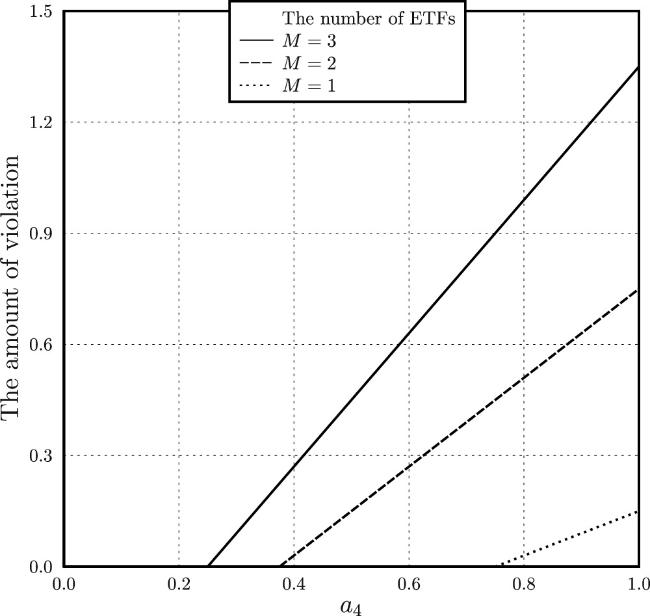
Such bipartite states were used to test new entanglement witnesses for 4 × 4 systems [65]. They concern the key problem to characterize boundaries between the entangled states and separable ones. Let us apply the correlation measure with mutually unbiased ETFs obtained from the matrices ϒ, Δϒ, Δ2ϒ, of which ϒ and Δ are described above by equations (13) and (14). Under the chosen circumstances, the region of detectability depends on the parameter a4. On the other hand, the detection power relies upon the number of involved ETFs. To characterize the situation, we will use the amount of violation defined as
It shows how much the separability criterion (equation (24)) is violated. In figure 1, we depict the amount of violation with bipartite states of a pair of ququarts for M = 1, 2, 3. It is clearly seen that the detection power becomes stronger with growth of M. At the same time, the resulting improvement obtained with a pass from M = 1 to M = 2 is more essential, than with a pass from M = 2 to M = 3. It was already found for entanglement detection with a single ETF [32] that increasing the number of involved states improves the results. Thus, our findings are in a good agreement with the observations reported in the literature.
Figure 1. The amount of violation of the inequality (equation (24)) with bipartite states of the form (equation (46)) for M = 1, 2, 3.
4. Conclusions
This paper considered entanglement detection with the use of states from a mutually-unbiased-ETF. The well-known case of MUBs appeared here as an important particular one. Both the cases of bipartite and multipartite entanglement can be tested with the use of the presented criteria. There are several ways to pose separability criteria on the base of measurements assigned to a mutually-unbiased-ETF. One of them deals with the correlation measure originally developed with a set of MUBs. Mutually unbiased ETFs also lead to a family of positive maps, whence entanglement witnesses follow. In addition, criteria for tripartite and multipartite systems were derived. These criteria are formulated in terms of the Frobenius norm of the corresponding matrices. The presented findings have generalized the results obtained previously for a set of MUBs and for a single ETF. This paper additionally maintains the conclusion that applications of ETF-based measurements in quantum information science deserve more attention than they have obtained at the moment.
Appendix. Auxiliary calculations
This appendix aims to prove auxiliary statements concerning positive maps to build entanglement witnesses.
The map $\Psi$ expressed as equation (32) is positive and preserves the trace.
Let us begin with the fact that ${\boldsymbol{X}}\in {{ \mathcal L }}_{+}({{ \mathcal H }}_{d})$ implies ${\rm{\Psi }}({\boldsymbol{X}})\in {{ \mathcal L }}_{+}({{ \mathcal H }}_{d})$. It will be sufficient to prove here that [45]
for all X = ∣φ⟩⟨φ∣ with unit ket $| \varphi \rangle \in {{ \mathcal H }}_{d}$. This means that the output $\Psi$(X) lies in the largest ρ*-centered ball inscribed in the set of mixed states [50]. Immediate calculations show that
where we used the completeness relation and equation (30). The second term in the right-hand side of equation (A2) can be divided into the two sums, one of which for μ = ν and other for μ ≠ ν. The second sum is calculated as
due to the completeness relation and equation (31). Using $\bar{{\boldsymbol{X}}}={\boldsymbol{X}}-{{\boldsymbol{\rho }}}_{* }$, the right-hand side of equation (A4) can be rewritten as
due to equations (10) and (33). This completes the proof of the inequality (equation (A1)). It is immediate to check that the map of equation (32) preserves the trace.
Let us prove the formula (37). The following statement was shown in reference [35]. If d2 unit vectors $| {\phi }_{j}\rangle \in {{ \mathcal H }}_{d}$ form a SIC-POVM then
where Πsym is the orthogonal projection on the symmetric subspace of ${{ \mathcal H }}_{d}\otimes {{ \mathcal H }}_{d}$. Multiplying both the sides of equation (A6) by ${\boldsymbol{X}}\otimes {{\mathbb{1}}}_{d}$ and taking the partial trace over the first subsystem, we finally obtain equation (37). For every density matrix, it follows from equation (37) that
Thus, the use of measurement statistics allows one to recover the pre-measurement state. For informationally complete measurements, there is one-to-one correspondence between probability distributions and density matrices.
ShorP W1997 Polynomial-time algorithms for prime factorization and discrete logarithms on a quantum computer Soc. Ind. Appl. Math. J. Comput.26 1484-1509
HorodeckiM, HorodeckiP, HorodeckiR2001 Separability of n-particle mixed states: necessary and sufficient conditions in terms of linear maps Phys. Lett. A283 1-7