

1. Introduction
The concept of Lorentz symmetry breaking has garnered substantial interest in contemporary physics, emerging as a crucial area of investigation across multiple theoretical paradigms [1–5]. One notable method for exploring this phenomenon involves the introduction of the antisymmetric tensor field, commonly referred to as the Kalb–Ramond (KR) field [6]. This field, rooted in string theory [7], provides a compelling approach for probing the intricacies of Lorentz symmetry violation.
The physics of black holes (BHs) within the context of KR gravity has been extensively studied [8–12]. When the KR field is coupled with gravity, it can trigger spontaneous Lorentz symmetry breaking [6]. The extent of the Lorentz symmetry violation can be characterized by a parameter that indicates how the KR field interacts with gravitational dynamics [13, 14]. This was demonstrated by deriving an exact solution for a static, spherically symmetric BH configuration. Building on this foundational work, researchers have explored the dynamics of both massive and massless particles near KR BHs [15]. Studies have also focused on the gravitational deflection of light and the shadows produced by rotating BHs [16]. Additionally, significant attention has been directed towards the detection of gravitational waves and their spectral characteristics within the framework of Lorentz symmetry breaking [17–21].
Moreover, the influence of Lorentz symmetry violation on electrically charged BHs has also been explored within the framework of KR gravity [22]. In this context, various phenomena such as the evaporation process, quasinormal modes, and emission rates have been studied [17]. Additionally, numerous aspects of BH physics have been investigated for the case of a zero electric charge, as discussed in [23–27].
In particular, we investigate a spherically symmetric charged BHs with a negative cosmological constant in the presence of a KR field background. We calculate the photon sphere and shadow radii and validate our results using observational data from the Event Horizon Telescope (EHT), with a particular focus on the shadow images of Sagittarius A*. Additionally, we examine greybody factors, emission rates, and partial absorption cross sections. Our analysis extends to exploring the topological charge, temperature-dependent topology, and generalized free energy.
This work is structured as follows: In section 3 , we calculate the shadow radii and derive constraints based on observational data from Sagittarius A*. Section 4 focuses on the heat capacity of the system. In section 5 , we discuss the greybody bounds, highlighting relevant emission power and the absorption cross section. Sections 6 , and 7 explore the topological aspects of the BH and its charge. Finally, in section 8 , we summarize our findings and present concluding remarks. The calculations are performed for the case of ℏ = G = c = kB = 1, and metric signature (− + + +).
2. Metric
The connection between KR gravity and Lorentz symmetry violation lies in the way the KR field introduces modifications to gravitational dynamics. In the context of bumblebee gravity, the KR field can lead to spontaneous Lorentz symmetry violation, which alters the behavior of BHs. The innovative aspect of this model is the introduction of exact solutions for charged BHs, which account for the effects of both the KR field and Lorentz symmetry violation parameters. This framework allows for a deeper understanding of how Lorentz symmetry violation affects the properties of BHs [28, 29].
The relationship between Lorentz violation and the KR potential is fundamentally rooted in the dynamics of the KR field, represented as an antisymmetric tensor Bμν. When this field acquires a non-zero vacuum expectation value, it induces spontaneous Lorentz symmetry breaking. The parameter $\bar{l}$ quantifies the extent of this violation and reflects how the KR field interacts with gravitational dynamics. Considering the rank–antisymmetric tensor Bμν represents the KR field and satisfy Bμν = −Bνμ. The KR field can be decomposed as ${B}_{\mu \nu }={\tilde{E}}_{[\mu }{v}_{\nu ]}+{\epsilon }_{\mu \nu \alpha \beta }{v}^{\alpha }{\tilde{B}}^{\beta }$ that vα indicates a timelike 4-vector and ${\tilde{E}}_{\mu }{v}^{\mu }={\tilde{B}}_{\mu }{v}^{\mu }=0$. The action is given by
$\begin{eqnarray}\begin{array}{rcl}S & = & \displaystyle \int {\,\rm{d}\,}^{4}x\sqrt{-g}{{ \mathcal L }}_{m}\\ & & +\frac{1}{2{\kappa }^{2}}\displaystyle \int {\,\rm{d}\,}^{4}x\sqrt{-g}\left[\Space{0ex}{3ex}{0ex}R+{\xi }_{2}{B}^{\rho \mu }{B}_{\nu }^{\mu }+{\xi }_{3}{B}^{\mu \nu }{B}_{\mu \nu }R\right.\\ & & \left.-2{\rm{\Lambda }}-\frac{1}{6}{H}^{\mu \nu \rho }{H}_{\mu \nu \rho }-V({B}_{\mu \nu }{B}^{\mu \nu })\right],\end{array}\end{eqnarray}$
where Λ is the cosmological constant, ξ2 and ξ3 represent the coupling constants between the Ricci tensor and the KR field, and Hμνρ ≡ ∂[μBνρ] which is the field strength. The matter Lagrangian which describes the electromagnetic field is defined as ${{ \mathcal L }}_{m}=-1/4\,{F}_{\mu \nu }{F}^{\mu \nu }+{{ \mathcal L }}_{\,\rm{int}\,}$, that the field strength of the electromagnetic field is defined as Fμν = ∂μAν − ∂νAμ where the four-vector potential is considered as ${A}_{\mu }=-{\rm{\Phi }}(r){\delta }_{\mu }^{t}$. Also, the interaction between the KR field and the electromagnetic field is expressed as ${{ \mathcal L }}_{\,\rm{int}\,}=-\eta {B}^{\alpha \beta }{B}^{\gamma \rho }{F}_{\alpha \beta }{F}_{\gamma \rho }$, that η denotes the coupling constant. Therefore, the modified Einstein equation has the following form: $\begin{eqnarray}{R}_{\mu \nu }-\frac{1}{2}{g}_{\mu \nu }R+{\rm{\Lambda }}{g}_{\mu \nu }={T}_{\mu \nu }^{m}+{T}_{\mu \nu }^{\,\rm{KR}\,}={{ \mathcal T }}_{\mu \nu }.\end{eqnarray}$
${{ \mathcal T }}_{\mu \nu }$ represents the total stress–energy tensor and ${T}_{\mu \nu }^{m}$ and ${T}_{\mu \nu }^{\,\rm{KR}\,}$ are referred to the stress–energy of the electromagnetic field and the KR field, respectively.As calculated in [22], for a static, spherically symmetric spacetime by considering Lorentz violation parameter as $\bar{l}\equiv {\xi }_{2}{b}^{2}/2$, where BμνBμν = ∓ b2, the metric is described by:
$\begin{eqnarray}{\rm{d}}{s}^{2}=-f(r){\rm{d}}{t}^{2}+\frac{1}{f(r)}{\rm{d}}{r}^{2}+h(r){\rm{d}}{{\rm{\Omega }}}^{2},\end{eqnarray}$
where, in agreement with [22]: $\begin{eqnarray}f(r)=\frac{1}{1-\bar{l}}-\frac{2M}{r}+\frac{{Q}^{2}}{{(1-\bar{l})}^{2}{r}^{2}}-\frac{{\rm{\Lambda }}{r}^{2}}{3(1-\bar{l})}.\end{eqnarray}$
Here, M represents the BH mass, Q denotes the electric charge, and Λ is the cosmological constant, with h(r) = r2.3. Shadow radius
The behavior of light can be determined by applying the Euler–Lagrange equation as follows: 3 ). Indeed, the observed shadow of a BH appears distorted and larger than its actual size and shape [34]. Owing to the geometry, for an observer situated at a distance ro from the BH, the shadow radius is given by [22, 35]3 ) becomes asymptotically flat and approaches the shadow of Reissner–Nordström (RN) BH as $\bar{l}\to 0$.
$\begin{eqnarray}\frac{{\rm{d}}}{{\rm{d}}\tau }\left(\frac{\partial { \mathcal L }}{\partial {\dot{x}}^{\mu }}\right)-\frac{\partial { \mathcal L }}{\partial {x}^{\mu }}=0,\,\,\,\,\,{ \mathcal L }=\frac{1}{2}{g}_{\mu \nu }{\dot{x}}^{\mu }{\dot{x}}^{\nu }.\end{eqnarray}$
At θ = π/2, we are able to define two constants of motion: $L=h(r)\dot{\phi }$ and $E=f(r)\dot{t}$ so that effective potential reads [30, 31] $\begin{eqnarray}{V}_{\mathrm{eff}}=\displaystyle \frac{f(r)}{h(r)}\left(\displaystyle \frac{{L}^{2}}{{E}^{2}}-1\right),\end{eqnarray}$
is acquired. Given that a circular orbit requires Veff(r) = 0 and ${V}_{\mathrm{eff}}^{{\prime} }(r)=0$, the behavior of a photon, particularly the photon radius around a BH, can be determined from these conditions [32, 33] $\begin{eqnarray}{r}_{\mathrm{ph}}{\left.{\partial }_{r}f(r)\right|}_{r={r}_{\mathrm{ph}}}-2f({r}_{\mathrm{ph}})=0,\end{eqnarray}$
in this manner, the photon radius is given by [22] $\begin{eqnarray}{r}_{{\mathrm{ph}}_{\pm }}=\displaystyle \frac{\pm \sqrt{9{(\bar{l}-1)}^{4}{M}^{2}+8(\bar{l}-1){Q}^{2}}-3{(\bar{l}-1)}^{2}M}{2(\bar{l}-1)}.\end{eqnarray}$
Given that in the limit of Q, $\bar{l}$, and Λ approach zero, the photon radius should converge to 3M, which is the photon radius of the Schwarzschild BH, ${r}_{{\mathrm{ph}}_{-}}$ is designated as the photon radius of the BH of form equation ( $\begin{eqnarray}\begin{array}{l}\begin{array}{rcl}{r}_{\mathrm{sh}} & = & {r}_{{\mathrm{ph}}_{-}}\displaystyle \frac{\sqrt{f({r}_{o})}}{\sqrt{f({r}_{{\mathrm{ph}}_{-}})}}\\ & = & \displaystyle \frac{{r}_{{\mathrm{ph}}_{-}}^{2}\sqrt{3{Q}^{2}-(\bar{l}-1){r}_{o}\left(6(\bar{l}-1)M-{\rm{\Lambda }}{r}_{o}^{3}+3{r}_{o}\right)}}{{r}_{o}\sqrt{3{Q}^{2}-(\bar{l}-1){r}_{{\mathrm{ph}}_{-}}\left(6(\bar{l}-1)M-{\rm{\Lambda }}{r}_{{\mathrm{ph}}_{-}}^{3}+3{r}_{{\mathrm{ph}}_{-}}\right)}}.\end{array}\end{array}\end{eqnarray}$
In the absence of the cosmological constant, the BH metric of equation (Considering the observations obtained from EHT for Sgr A*, the permissible range for the shadow radius in the 1σ and 2σ regions is 4.55 < Rsh/M < 5.22 and 4.21 < Rsh/M < 5.56, respectively [11]. Therefore, by calculating the shadow of the BH using equation (9 ) and comparing it with the data obtained from EHT, the ranges for the parameters for which the BH shadow falls within the allowed regions of 1σ and 2σ can be determined. Figures 1 and 2 depict the BH shadow by varying parameters l and Q for Λ = −0.1 and Λ = −0.5, respectively. Some of the upper and lower limits of the parameters for the selected values are reported in table 1.
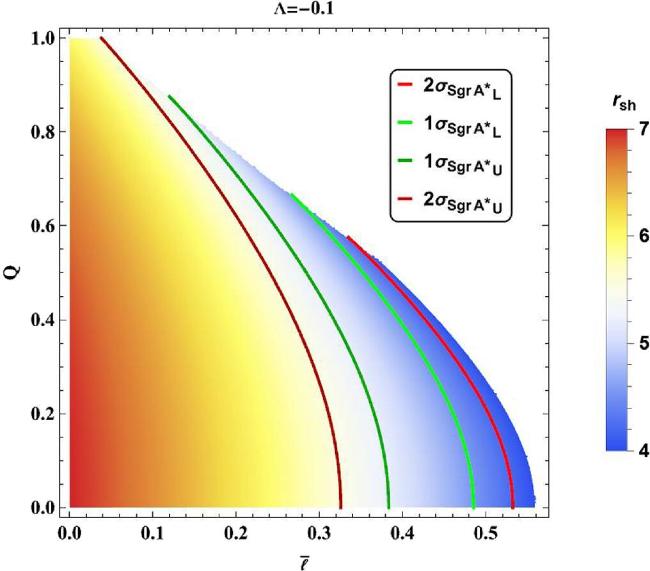
Figure 1. Shadow radius as a function of the parameters $\bar{l}$ and Q considering Λ = −0.1 for an observer located at r0 = 9M is illustrated. The indices L and U refer to the lower bound and upper bound, respectively. |
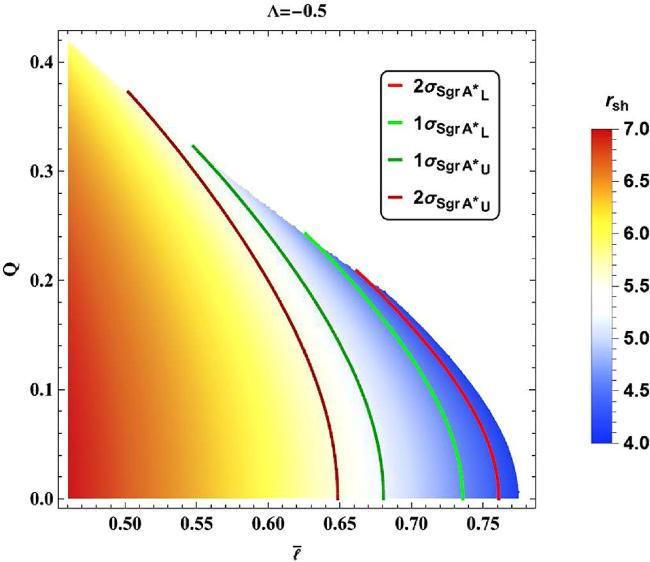
Figure 2. The variation of shadow in terms of the parameters $\bar{l}$ and Q considering Λ = −0.5 for an observer located at r0 = 9M. The indices L and U refer to the lower bound and upper bound, respectively. |
Table 1. The upper and lower bounds of the parameters based on observations of Sgr A* for the case where M = 1. |
| 1σ | 2σ | 1σ | 2σ | ||||||
|---|---|---|---|---|---|---|---|---|---|
| Λ (Q = 0.1) | Lower | Upper | Lower | Upper | ${\rm{\Lambda }}\,(\bar{l}=0.10)$ | Lower | Upper | Lower | Upper |
| $\bar{l}=0.30$ | −0.069 | −0.037 | −0.091 | −0.024 | Q = 0.0 | −0.025 | −0.007 | −0.037 | −0.001 |
| $\bar{l}=0.40$ | −0.111 | −0.065 | −0.142 | −0.047 | Q = 0.3 | −0.028 | −0.009 | −0.040 | −0.002 |
| $\bar{l}=0.50$ | −0.182 | −0.113 | −0.229 | −0.086 | Q = 0.5 | −0.034 | −0.014 | −0.048 | −0.006 |
| | |||||||||
| $\bar{l}\,({\rm{\Lambda }}=-0.10)$ | Lower | Upper | Lower | Upper | $\bar{l}\,(Q=0.1)$ | Lower | Upper | Lower | Upper |
| Q = 0.00 | 0.383 | 0.485 | 0.326 | 0.533 | Λ = −0.10 | 0.379 | 0.479 | 0.322 | 0.525 |
| Q = 0.20 | 0.366 | 0.461 | 0.311 | 0.503 | Λ = −0.30 | 0.589 | 0.653 | 0.551 | 0.682 |
| Q = 0.30 | 0.345 | 0.432 | 0.293 | 0.470 | Λ = −0.50 | 0.665 | 0.713 | 0.635 | 0.734 |
| | |||||||||
| $Q\,(\bar{l}=0.10)$ | Lower | Upper | Lower | Upper | Q (Λ = −0.10) | Lower | Upper | Lower | Upper |
| Λ = −0.01 | — | 0.346 | — | 0.640 | $\bar{l}=0.35$ | 0.279 | 0.505 | — | 0.550 |
| Λ = −0.02 | — | 0.659 | — | 0.800 | $\bar{l}=0.40$ | — | 0.389 | — | 0.457 |
| Λ = −0.03 | 0.386 | 0.788 | — | 0.875 | $\bar{l}=0.45$ | — | 0.242 | — | 0.349 |
Notice that an increase in the Lorentz-violation parameter $\bar{l}$ while keeping other parameters constant, results in a decrease in the value of the shadow radius. Therefore, it can be stated that the shadow radius is diminished in comparison to the RN BH. Furthermore, increasing the size of Q while keeping the other parameters constant reduces the size of the shadow and extends the range for which the shadow lies within the acceptable region for the parameter Λ, while decreasing it for $\bar{l}$. Additionally, increasing the size of Λ with other parameters held constant decreases the radius of the shadow and increases the range of the allowed region for the parameter Q, while reducing the range for the parameter $\bar{l}$.
4. Heat capacity
As it is well know, the Hawking temperature of a corresponding BH is 3 ) BH converges to the Hawking temperature of RN BH [36]. It can also be concluded that increasing the parameter $\bar{l}$, while keeping other parameters constant, leads to an increase in the Hawking temperature of the BH compared to cases with smaller $\bar{l}$. Thus, it can be stated that the presence of the Lorentz-violating parameter results in a higher temperature for the BH compared to the RN BH. In addition, the entropy of the system is [37, 38]
$\begin{eqnarray}{T}_{{\rm{H}}}={\left.\displaystyle \frac{1}{4\pi }{\partial }_{r}f(r)\right|}_{r={r}_{{\rm{h}}}},\end{eqnarray}$
where rh refers to the horizon radius calculated from f(rh) = 0, so that, for our case under consideration, it follows [22] $\begin{eqnarray}{T}_{{\rm{H}}}=\displaystyle \frac{{r}_{{\rm{h}}}^{2}(1-\bar{l})\left(1-{\rm{\Lambda }}{r}_{{\rm{h}}}^{2}\right)-{Q}^{2}}{4\pi {(1-\bar{l})}^{2}{r}_{{\rm{h}}}^{3}}.\end{eqnarray}$
In the limit of $\bar{l}\to 0$ and Λ → 0, the Hawking temperature of the metric equation ( $\begin{eqnarray}S=\pi {r}_{{\rm{h}}}^{2}.\end{eqnarray}$
Figure 3 illustrates the T–S curve. It is evident that as the parameter $\bar{l}$ increases, the maximum value of temperature, along with its corresponding entropy, shifts to higher values.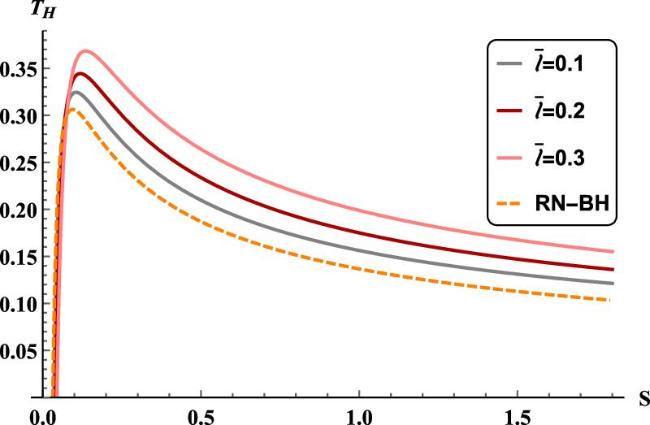
Figure 3. The relationship between temperature and entropy is depicted, with the parameters set to Q = 0.1 and Λ = −0.1. Dashed orange curve represent Hawking temperature of RN black hole. |
For the sake of completeness of our study, we also present the heat capacity [39]
$\begin{eqnarray}\begin{array}{l}\begin{array}{rcl}C & = & {T}_{{\rm{H}}}\displaystyle \frac{\partial S}{\partial {T}_{{\rm{H}}}}\\ & = & \displaystyle \frac{2\pi {r}_{{\rm{h}}}^{2}\left((1-\bar{l}){r}_{{\rm{h}}}^{2}\left(1-{\rm{\Lambda }}{r}_{{\rm{h}}}^{2}\right)-{Q}^{2}\right)}{3{Q}^{2}-(1-\bar{l}){r}_{{\rm{h}}}^{2}\left({\rm{\Lambda }}{r}_{{\rm{h}}}^{2}+1\right)}.\end{array}\end{array}\end{eqnarray}$
In the limit of $\bar{l}\to 0$ and Λ → 0 heat capacity goes to the RN BH heat capacity [36]. Figure 4 illustrates the behavior of heat capacity as a function of horizon radius. The curve indicates that as the parameter $\bar{l}$ increases, the phase transition occurs at a larger horizon radius, leading to a negative heat capacity. It is worth mentioning that such negative values signifies instability, whereas a positive heat capacity indicates a thermodynamically stable BH. Hence, in comparison to the RN BH, the transition from stable to unstable heat capacity, while maintaining constant values of Q and Λ, occurs at a reduced horizon radius in the presence of the parameter $\bar{l}$.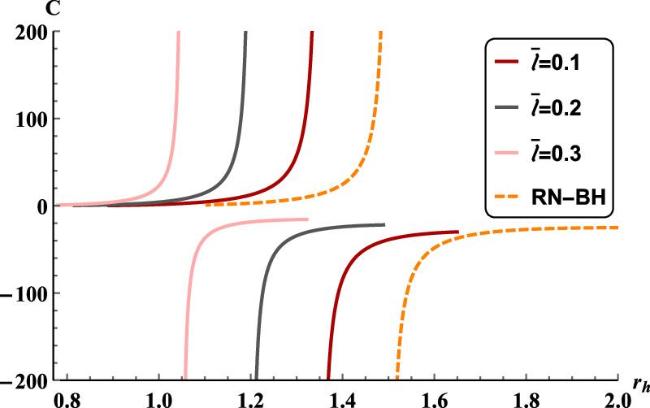
Figure 4. The relation between heat capacity and rh is presented, where rh is calculated by varying the parameter Q. The parameters are set to Λ = −0.1. Dashed orange curves illustrate heat capacity of RN black hole. |
5. Greybody
The greybody factor is a crucial factor for understanding how BHs emit radiation in the context of Hawking radiation and refers to the probability that a particle will be absorbed by a BH. The greybody bound signifies a theoretical limit on the greybody factor, and indicates the maximum deviation of this radiation from the ideal blackbody spectrum. Greybody bound as function of frequency ω of the incoming particles is calculated from [21, 40–43]
$\begin{eqnarray}{T}_{\bar{l}(\omega )}\geqslant {\,\rm{sech}\,}^{2}\left(\displaystyle \frac{1}{2\omega }{\int }_{{r}_{h}}^{\infty }V(r)\displaystyle \frac{{\rm{d}}r}{f(r)}\right),\end{eqnarray}$
where the potential V(r) is an effective potential used in the analysis of gravitational perturbations around BHs and is obtained from [40] $\begin{eqnarray}V(r)=f(r)\left(\frac{(1-{s}^{2}){\partial }_{r}f(r)}{r}+\frac{(\bar{l}+1)\bar{l}}{{r}^{2}}\right).\end{eqnarray}$
Here, $\bar{l}$ represents the multiploe number, while s refers to the multipole number. Specifically, s = 0 is associated with scalar perturbations, and s = 1 corresponds to electromagnetic perturbations. The greybody bounds for several initial values are illustrated in figure 5. It is evident that as the parameter $\bar{l}$ increases, the probability curve shifts upward. Also, it can be concluded that in the presence of the Lorentz-violation parameter and the cosmological constant, the greybody factor decreases. The lth mode emitted power is given by [26] $\begin{eqnarray}{P}_{\bar{l}(\omega )}=\displaystyle \frac{A}{8{\pi }^{2}}{T}_{\bar{l}(\omega )}\displaystyle \frac{{\omega }^{3}}{\exp (\omega /{T}_{{\rm{H}}})-1},\end{eqnarray}$
where A represents the surface area of a BH’s horizon from which radiation can be emitted. Figure 6 illustrates the emission power, clearly showing that as the parameter $\bar{l}$ increases, both the maximum value and its corresponding frequency increases, and emitted power from the RN BH is significantly lower than the emitted power from the BH in the presence of cosmological constant and Lorentz-violating parameter.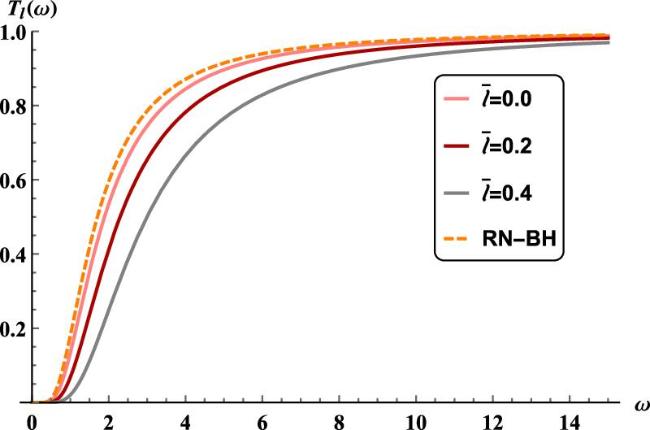
Figure 5. The greybody bounds for different values of $\bar{l}$ are presented, with $(\bar{l}=2)$ and the other parameters set as M = 1, Λ = −0.1, Q = 0.1, and s = 1. Dashed orange curve indicates the greybody bound for RN black hole. |
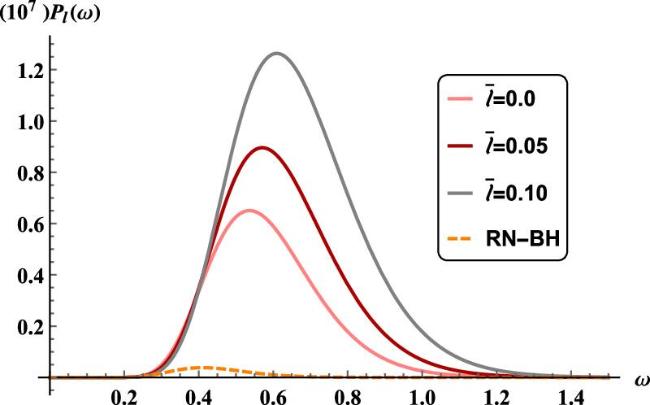
Figure 6. The emitted power for three values of $\bar{l}$ is illustrated, with $\bar{l}=2$ and the other parameters set as M = 1, Λ = −0.1, Q = 0.1, and s = 1. Dashed orange curve displays the emitted power of RN BH. |
Furthermore, partial absorption cross section written below [44, 45]3 ) in the presence of Lorentz-violating parameter and cosmological constant.
$\begin{eqnarray}{\sigma }_{\mathrm{abs}}^{\bar{l}}=\displaystyle \frac{\pi (2\bar{l}+1)}{{\omega }^{2}}| {T}_{\bar{l}(\omega ){| }^{2}}.\end{eqnarray}$
The absorption cross-section is depicted in figure 7. As observed, varying the parameter $\bar{l}$ results in a shift of the curve. An increase in this parameter leads to a lower maximum value for absorption, which occurs at a higher frequency, and it can be concluded that the RN BH has a greater absorption compared to the BH of form equation (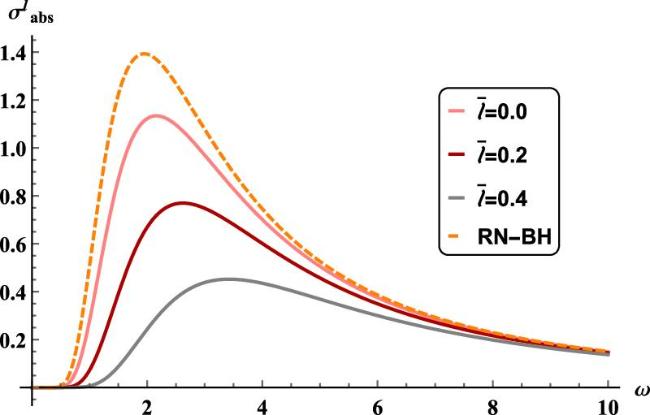
Figure 7. The absorption cross-section curve for different values of $\hat{l}$ is presented, with $\bar{l}=2$ and the other parameters set as M = 1, Λ = −0.1, Q = 0.1, and s = 1. Dashed orange curve demonstrates the absorption cross-section of RN black hole. |
6. Topological charge of photon sphere
Recently, Wei et al. creatively applied the topological current theory to BH thermodynamics [46]. In this direction, the thermodynamic topology of BHs in different backgrounds is investigated [47–85]. We will explore the topological characteristics of the photon sphere. We begin by defining the everywhere regular potential function as [86, 87]
$\begin{eqnarray}H(r,\vartheta )=\frac{1}{\sin \vartheta }\sqrt{\frac{f(r)}{h(r)}},\end{eqnarray}$
Here, we assume h(r) = r2 and $1/\sin \vartheta $ is an auxiliary term which is used to define the vectors of this potential in the polar coordinates. The root of ∂rH = 0 at θ = π/2 corresponds to the radius of the photon sphere. To determine the topological charge associated with it, we define a vector field φ = (φr, φϑ), as described in [86] as $\begin{eqnarray}{\phi }_{r}=\sqrt{f(r)}{\partial }_{r}H(r,\vartheta ),\end{eqnarray}$
$\begin{eqnarray}{\phi }_{\vartheta }=\frac{1}{\sqrt{h(r)}}{\partial }_{\vartheta }H(r,\vartheta ).\end{eqnarray}$
The vector φ can be also rewrite as φ = ∣∣φ∣∣eiΘ, where $| | \phi | | =\sqrt{{\phi }_{a}{\phi }_{a}}$, a = 1, 2, and φ1 = φr, φ2 = φϑ. It is important to note that the zero point of φ coincides precisely with the location of the photon sphere. This implies that φ in φ = ∣∣φ∣∣eiΘ is not well-defined at this point. Therefore, the vector is considered as φ = φr + iφΘ. The normalized vectors are defined as follows:
$\begin{eqnarray}{n}_{r}=\frac{{\phi }_{r}}{| | \phi | | },\ {n}_{\vartheta }=\frac{{\phi }_{\vartheta }}{| | \phi | | }.\end{eqnarray}$
Moreover, the topological current is established as follows $\begin{eqnarray}{J}^{\mu }=\frac{1}{2\pi }{\epsilon }^{\mu \nu \lambda }{\epsilon }_{ab}{\partial }_{\nu }{n}_{a}{\partial }_{\lambda }{n}_{b},\end{eqnarray}$
Since εμνλ = −εμλν, it can be easily verified that the topological current is conserved, satisfying ∂μJμ = 0. The zero component of the topological current is denoted by J0, and integrating this component over a specified region Σ yields the total topological charge [88]. $\begin{eqnarray}{{\mathfrak{Q}}}_{{\mathfrak{t}}}={\int }_{{\rm{\Sigma }}}{j}^{0}{{\rm{d}}}^{2}x=\displaystyle \sum _{i=1}^{N}{\beta }_{i}{\eta }_{i}=\displaystyle \sum _{i=1}^{N}{w}_{i},\end{eqnarray}$
where, N refers to the total number of zero points, and parameters βi and ηi represent the Hopf index and Brouwer degree at the zero point zn, respectively. Considering a closed, smooth, and positively oriented loop Ci that encircles the ith zero point of φ while excluding other zero points, the winding number of the vector is given by [88] $\begin{eqnarray}{w}_{i}=\displaystyle \frac{1}{2\pi }{\oint }_{{C}_{i}}{\rm{d\Omega }},\end{eqnarray}$
due to the geometry $\begin{eqnarray}{\rm{\Omega }}=\arctan \frac{{\phi }_{\vartheta }}{{\phi }_{r}}=\arctan \frac{{n}_{\vartheta }}{{n}_{r}}.\end{eqnarray}$
In this manner, $\begin{eqnarray}{\rm{d\Omega }}=\displaystyle \frac{{n}_{r}{\partial }_{\vartheta }{n}_{\vartheta }-{n}_{\vartheta }{\partial }_{\vartheta }{n}_{r}}{{n}_{r}^{2}+{n}_{\vartheta }^{2}},\end{eqnarray}$
and the topological charge of each zero point can be calculated from $\begin{eqnarray}{\mathfrak{Q}}=\frac{{\rm{\Delta }}{\rm{\Omega }}}{2\pi }.\end{eqnarray}$
The nonzero of ΔΩ occur at the photon spheres, but ${\mathfrak{Q}}$ can take values of 0, ±1. The illustration of the vector space (nr, nϑ) is shown in figure 8. In figure 8(a), there is a photon sphere located at (r, ϑ) = (2.61502, π/2), around which the field lines converge towards the zero point of the vector field, resembling the electric field generated by a negative charge and possessing a topological charge of −1. Based on the classification in [86], this photon sphere is considered standard and unstable.
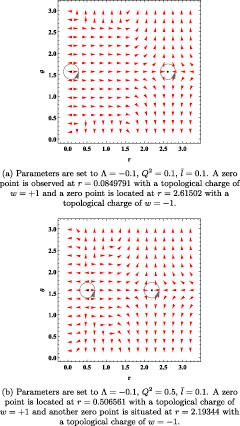
Figure 8. The topological charge of photon spheres. The whole topological charge for both cases are zero. |
An exotic photon sphere exists at (r, ϑ) = (0.0849791, π/2), where the field lines diverge near the zero point, similar to the electric field produced by a positive charge, with a topological charge of +1. This photon sphere is stable and corresponds to the region of the naked singularity [46]. As the charge Q increases, as depicted in figure 8(b), the standard photon sphere and exotic photon sphere approach one another. When Q increases to approximately 0.82, the two photon spheres converge. Further increases in Q lead to the absence of photon spheres in spacetime, resulting in a total topological charge of ${{\mathfrak{Q}}}_{t}=0$.
7. Topology in temperature and generalized free energy
In this section, we will apply temperature and generalized free energy methods to analyze the topological structure of charged spherically symmetric BHs. The critical pressure, given by Λ = −8πP, can be found by setting ${\left.{\partial }_{{r}_{{\rm{h}}}}{T}_{{\rm{H}}}\right|}_{P={P}_{c}}=0$. By substituting Pc into the Hawking temperature in the form given by equation (11 ), we can rewrite TH as ${\tilde{T}}_{{\rm{H}}}$. Consequently, a field can be defined as follows [46]:
$\begin{eqnarray}\begin{array}{rcl}{\rm{\Phi }} & = & \displaystyle \frac{1}{\sin (\vartheta )}{\tilde{T}}_{{\rm{H}}}\\ & = & \csc (\vartheta )\left(\displaystyle \frac{(1-\bar{l}){r}_{{\rm{h}}}^{2}\left(1-{\rm{\Lambda }}{r}_{{\rm{h}}}^{2}\right)-{Q}^{2}}{4\pi {(1-\bar{l})}^{2}{r}_{{\rm{h}}}^{3}}\right).\end{array}\end{eqnarray}$
Since vector fields on a two-dimensional plane are more intuitive than those in one or higher dimensions, ϑ serves as an auxiliary factor that aids in topological analysis. The unit vectors of this field read $\begin{eqnarray}{\varphi }_{r}={\partial }_{{r}_{{\rm{h}}}}{\rm{\Phi }},\end{eqnarray}$
$\begin{eqnarray}{\varphi }_{\vartheta }={\partial }_{\vartheta }{\rm{\Phi }}.\end{eqnarray}$
Specifically, when ϑ = π/2 and ${\partial }_{{r}_{{\rm{h}}}}{\rm{\Phi }}=0$, the vector φ = (φr, φϑ) is always zero. It is straightforward to see that the critical point coincides with the zero point of φ. The normalized vector ${n}^{a}=\frac{{\phi }^{a}}{\parallel \phi \parallel },\,(a=1,2)$ is plotted in figure 9(a), which illustrates only one critical point. Two contours will be constructed: one enclosing the critical point, which has a topological charge of −1, and another that does not enclose any critical points, possessing a topological charge of 0. At this stage, the critical point is conventional and corresponds to the maximum of the spinodal curve in the isobaric diagram, as shown in the figure 9(b). When the charged spherically symmetric BH solution acts as a defect in the thermodynamic parameter space, the generalized Helmholtz free energy is expressed as follows [88–91]: $\begin{eqnarray}\begin{array}{rcl}F & = & M({r}_{{\rm{h}}})-\displaystyle \frac{S}{\tau }\\ & = & \displaystyle \frac{3{Q}^{2}+3{r}_{{\rm{h}}}^{2}-3\bar{l}{r}_{{\rm{h}}}^{2}-{r}_{{\rm{h}}}^{4}{\rm{\Lambda }}+\bar{l}{r}_{{\rm{h}}}^{4}{\rm{\Lambda }}}{6{(\bar{l}-1)}^{2}{r}_{{\rm{h}}}}-\displaystyle \frac{\pi {r}_{{\rm{h}}}^{2}}{\tau },\end{array}\end{eqnarray}$
where Λ = −8πP. This free energy exhibits its on-shell characteristics when τ = 1/TH, and the on–shell condition can also be expressed as ${\partial }_{{r}_{{\rm{h}}}}F=0$. Using the formalism outlined above, the new field and its corresponding unit vectors can be calculated [92, 93] $\begin{eqnarray}{\tilde{\phi }}_{r}={\partial }_{{r}_{{\rm{h}}}}F,\end{eqnarray}$
$\begin{eqnarray}{\tilde{\phi }}_{{\rm{\Theta }}}=-{\rm{\cot }}{\rm{\Theta }}{\rm{\csc }}{\rm{\Theta }},\end{eqnarray}$
where Θ satisfies 0 ≤ Θ ≤ π. At Θ = 0 and Θ = π, the component φΘ diverges, with the direction of the vector pointing outward. By solving the equation ${\phi }_{r}={\partial }_{{r}_{{\rm{h}}}}F$ = 0, we can derive an equation in terms of τ. Figure 10(a) illustrates the zero points of the vector field φ in the τ–rh plane. We observe three branches of BHs: the small and large BH branches are stable, while the middle BH branch is unstable. Figure 10(b) shows the unit vector field n at τ = 10. The zero points are located at (0.454497, π/2), (1.02267, π/2), and (3.31018, π/2), respectively. We find that the topological charge is +1 for both the small and large BH branches, whereas it is −1 for the middle BH branch. Consequently, the total topological charge remains +1. Therefore, the system has a similar topological classification to the charged RN–AdS BH [88].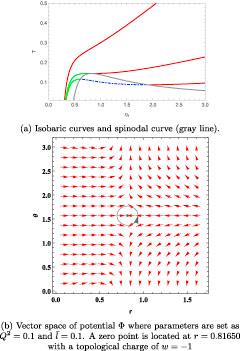
Figure 9. Vector space of temperature potential field for the given set of initial values. a zero point is located at r = 0.8165 and its topological charge is +1. |
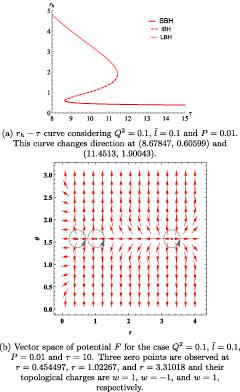


Figure 10. The topological numbers of the black holes solutions. The total topological charge of potential F equals 1. |
8. Conclusion
In this study, we explored the effects of an antisymmetric KR tensor field, which causes spontaneous Lorentz symmetry breaking, on the characteristics of a charged BH in the presence of a negative cosmological constant. Our investigation centered on analyzing various properties, including the shadow radius, greybody bounds, absorption and emission power, heat capacity, topological charge, and the optical features of the BH. This research seeks to address a gap in existing literature and enhance our understanding of the consequences arising from this scenario of Lorentz symmetry breaking.
To begin with, we computed the shadow radius. In the specific scenario where M = 1, we established the lower and upper limits for the parameter $\bar{l}$ across three distinct values of Q. Additionally, we examined characteristics that diverge from conventional solutions for charged BHs, such as the greybody bounds and the associated absorption cross-section. For Q = 0.01 and Λ = −0.1, we found that an increase in the parameter $\bar{l}$ resulted in a decrease in the curves, while the emission power curve exhibited an upward shift as $\bar{l}$ increased.
Importantly, we investigated the topological charge and the related topological phase transitions within this context. Through a detailed analysis of the metric, temperature, and free energy, we were able to determine the system’s topological charge along with the associated phase transitions.
As a next step, we can extend our analysis to other configurations of BH solutions that incorporate the KR field, as discussed in [10]. These concepts, along with additional ideas, are presently being explored and developed further.