Double-pole soliton solutions of the defocusing nonlinear Schrödinger equation with local and nonlocal nonlinearities under nonzero boundary conditions
Chuanxin Xu
1
,
Tao Xu
, 1, *
,
Min Li
2
,
Yuzhi Zhang
1
Expand
1College of Science, China University of Petroleum, Beijing 102249, China
2Department of Mathematics and Physics, North China Electric Power University, Beijing 102206, China
Author to whom any correspondence should be addressed.
Under study in this paper is a nonlinear Schrödinger equation with local and nonlocal nonlinearities, which originates from the parity-symmetric reduction of the Manakov system and has applications in some physical systems with the parity symmetry constraint between two fields/components. Via the Riemann-Hilbert method, the theory of inverse scattering transform with the presence of double poles is extended for this equation under nonzero boundary conditions (NZBCs). Also, the double-pole soliton solutions with NZBCs are derived in the reflectionless case. It is shown that the quasi-periodic beating solitons can be obtained when the double pole lies off the circle $\Gamma$ centered at the origin with radius $\sqrt{2}{q}_{0}$ (where q0 is the modulus of NZBCs) on the spectrum plane. Moreover, using the improved asymptotic analysis method, the asymptotic solitons are found to be located in some logarithmic curves of the xt plane.
Chuanxin Xu, Tao Xu, Min Li, Yuzhi Zhang. Double-pole soliton solutions of the defocusing nonlinear Schrödinger equation with local and nonlocal nonlinearities under nonzero boundary conditions[J]. Communications in Theoretical Physics, 2026, 78(3): 035001. DOI: 10.1088/1572-9494/ae15eb
1. Introduction
As a two-component vector generalization of the scalar nonlinear Schrödinger (NLS) equation, the Manakov system is an important integrable nonlinear wave model [1]:
where x and t are, respectively, the normalized distance and time coordinates, q(x, t) and r(x, t) are the slowly varying envelopes of two copropagating waves, and σ = ±1 correspond to the focusing (+) and defocusing (-) cases, respectively. System (1.1) has significant applications in various physical settings, such as two-component Bose-Einstein condensates [2, 3], birefringent/two-mode optical fibers [4-7], a Kerr-like photorefractive medium [8] and two-wave systems in deep water [9]. Meanwhile, system (1.1) admits many remarkable integrable properties, like infinitely many set of conserved densities [1, 10, 11], closure of the product eigenstates [10], an infinite-dimensional algebra of nonlocal and noncommutative symmetries [12], Bäcklund/Darboux transformation (DT) [13-15], Painlevé properties [13] and Hirota bilinearization [16]. Additionally, system (1.1) possesses the bright-bright, dark-dark, bright-dark vector soliton solutions [16-25] and exotic vector breather and rogue-wave solutions [26-28]. On the other hand, system (1.1) can exhibit both shape-preserving and shape-changing vector-soliton collisions [16-18, 29], where the latter is accompanied by energy exchange between two components. It should be noted that the shape-changing Manakov soliton collisions have been experimentally observed in Kerr-like media and birefringent optical fibers [30, 31], potential applications in all-optical virtual logic, computation and switching [32-35].
In 2018, inspired by Ablowitz and Musslimani's work in 2013 [36], Yang considered the parity-symmetric constraint between two components of the Manakov system (i.e. r(x, t) = q(-x, t)), and proposed the following integrable nonlocal NLS equation:
which incorporates the local and nonlocal nonlinearities, where the combined nonlinear terms depend on x as well as -x and exhibit symmetry in x. Since equation (1.2) arises from the parity-symmetric reduction of the Manakov system (1.1), it can describe the nonlinear wave propagation in such physical systems with certain constraints on the initial conditions. Therefore, the physical significance of equation (1.2) is evident owing to its relation to the Mannakov system.
Due to the Lax pair of the Manakov system (1.1) being in the 3 × 3 matrix form, its inverse scattering transform (IST) has attracted considerable attention for a long time. In 1974, Manakov first established the IST of system (1.1) under zero boundary conditions (ZBCs) [1]. Then, Ablowitz et al extended the IST theory with ZBCs for the multi-component and matrix NLS equations [37]. The IST formulations for both the focusing and defocusing Manakov systems with nonzero boundary conditions (NZBCs) were studied, as seen, for example, in Refs. [38-41]. Furthermore, Abeya et al developed the IST of the defocusing Manakov system by considering the non-parallel boundary conditions [42] and well-defined parity-symmetric boundary conditions [43]. Recently, in the framework of the Riemann-Hilbert problem (RHP), the IST theory of equation (1.2) with ZBCs was studied by starting from the x-part [44] and the t-part [45, 46] of the Lax pair, respectively. Yang obtained the bright one- and two-soliton solutions by examining the discrete scattering symmetries in the Manakov system [44], but the intricate dependencies of eigenvector symmetry relations on eigenvalue configurations (including the number and locations) are a challenge in the construction of N-soliton solutions. By making the spectral analysis of the t-part of the Lax pair, Wu derived the N-soliton solutions of equation (1.2) with ZBCs in the reflectionless case [45, 46]. Additionally, equation (1.2) has been exactly solved by other analytic methods, such as Hirota's bilinear method [47] and DT [48].
Up to now, the existing studies on equation (1.2) have been mainly conducted under ZBCs. In [49], we firstly established the IST of the defocusing equation (1.2) under NZBCs by introducing the adjoint Lax pair and auxiliary eigenfunctions. Also, the N-soliton solutions were presented in the determinant form, and the soliton dynamical behaviors were studied based on the distribution of discrete eigenvalues and the asymptotic behaviors of solutions. It turns out that the defocusing case of equation (1.2) admits the beating and dark soliton solutions, where the former is associated with the discrete eigenvalue pairs lying off $\Gamma$ which is centered at the origin with radius $\sqrt{2}{q}_{0}$ on the spectrum plane and q0 denoting the modulus of NZBCs, while the dark solitons correspond to the discrete eigenvalue pairs lying on the circle $\Gamma$. Moreover, the solutions can exhibit abundant soliton interactions including beating-beating, dark-dark, and beating-dark types. However, [49] assumed that the reciprocals of analytic scattering coefficients admit only simple poles, omitting the possibility of higher-order poles. In the case of higher-order poles, the IST theory had already been developed for many local and nonlocal integrable models in the past several decades (e.g. see Refs. [50-57]). In this paper, we extend the IST theory of defocusing equation (1.2) under NZBCs by considering that the reciprocals of scattering coefficients have double poles. Then, we derive the double-pole soliton solutions and use the improved asymptotic analysis method [58-60] to study the dynamical properties of double-pole soliton interactions.
The outline of this work is as follows: in section 2, we review the results of the direct scattering problem, which were proved in [49]. In section 3, based on the results for the inverse problem with NZBCs, we analyze the distributions, constraints and pole contributions of discrete eigenvalues and extend the trace formulas and reconstruction formulas with the presence of double poles. In section 4, we discuss the soliton dynamical properties of double-pole soliton solutions based on the distribution of discrete eigenvalues and the asymptotic behaviors of solutions. Finally, the conclusions are presented in section 5.
2. Brief review: direct scattering problem with NZBCs
In this section, we present a short review of the direct scattering problem of equation (1.2) with NZBCs, which was studied in [49]. The results include the analyticity, symmetries and asymptotic behaviors of the Jost eigenfunctions, the adjoint Jost eigenfunctions, and the associated scattering data.
2.1. Lax pair and adjoint lax pair
We consider the NZBCs of equation (1.2) as follows:
where q ± ≠ 0 are independent of x and t. To eliminate the t-dependence in boundary conditions, we make the transformation $q(x,t)\to \hat{q}(x,t){{\rm{e}}}^{-2{\rm{i}}(| {q}_{+}{| }^{2}+| {q}_{-}{| }^{2})t}$ and present the following nonzero boundary-value problem:
where ${q}_{0}^{2}=(| {q}_{+}{| }^{2}+| {q}_{-}{| }^{2})/2$ with q0 > 0, and the hat has been dropped for simplicity. Obviously, the solutions of equation (1.2) can be derived from those of equation (2.2a) through the transformation $q(x,t)=\hat{q}(x,t){{\rm{e}}}^{-4{\rm{i}}{q}_{0}^{2}t}$.
Equation (2.2a) is associated with the following Zakharov-Shabat scattering problem:
Considering the branching for λ(k) in the complex k-plane, we introduce the uniformization variable z = k + λ(k). From the relations $k=\frac{1}{2}\left(z+\frac{2{q}_{0}^{2}}{z}\right)$ and $\lambda =\frac{1}{2}\left(z-\frac{2{q}_{0}^{2}}{z}\right)$, the eigenvalues of X ± and T ± can be rewritten as follows:
where J(z) = diag( - λ, k, λ), ∆Q ± (x, t) := Q(x, t) - Q ± and ${{\boldsymbol{Q}}}_{\pm }=\mathop{\mathrm{lim}}\limits_{x\to \pm \infty }{\boldsymbol{Q}}(x,t)$. The functions Φ ± are called the Jost eigenfunctions and can exhibit the asymptotic behaviors
and define its inverse A-1(z) = B(z) = (bij(z)). Here, it can be determined that ${\rm{\det }}({{\boldsymbol{\phi }}}_{\pm }(x,t,z))=\gamma (z){{\rm{e}}}^{{\rm{i}}{\theta }_{2}(x,t,z)}$ and ${\rm{\det }}({\boldsymbol{A}}(z))=1$ for z ∈ Σo.
Let ${C}^{+}=\{z\in {\mathbb{C}}| {\rm{Im}}(z)\gt 0\}$ and C- = $\{z\in {\mathbb{C}}| {\rm{Im}}(z)\lt 0\}$. As proved in [49] (see theorems 2.1 and 2.2 there), μ-,1(x, t, z), μ+,3(x, t, z), a11(z), b33(z) are analytic for z ∈ C+, while μ+,1(x, t, z), μ-,3(x, t, z), a33(z), b11(z) are analytic for z ∈ C-, where the subscripts of μ± ,i denote the ith columns of μ ±. Based on the relation (2.12), the corresponding columns of Φ ± (x, t, z) possess the same analyticity. However, μ ± ,2(x, t, z) (or Φ ± ,2(x, t, z)) and the remaining entries of A(z) and B(z) are nowhere analytic in general.
On the other hand, it is necessary to introduce the adjoint Lax pair [38-40]:
Similarly, for the matrix limits ${\tilde{{\boldsymbol{X}}}}_{\pm }(k)=\mathop{\mathrm{lim}}\limits_{x\to \pm \infty }\tilde{{\boldsymbol{X}}}(x,t,k)$ and ${\tilde{{\boldsymbol{T}}}}_{\pm }(k)=\mathop{\mathrm{lim}}\limits_{x\to \pm \infty }\tilde{{\boldsymbol{T}}}(x,t,k)$, their eigenvalues can be given by {ik, ± iλ} and $\{2{\rm{i}}{k}^{2}-2{\rm{i}}{q}_{0}^{2}$, ± 2ikλ}, respectively. By the uniformization variable z = k + λ(k), the common eigenvector matrices are presented below:
where the determinant of ${\tilde{{\boldsymbol{Y}}}}_{\pm }(z)$ is $\gamma$(z). Meanwhile, the adjoint Jost eigenfunctions ${\tilde{{\boldsymbol{\phi }}}}_{\pm }(x,t,z)$ and the modified adjoint Jost eigenfunctions ${\tilde{{\boldsymbol{\mu }}}}_{\pm }(x,t,z)$ are introduced and they satisfy the asymptotic behaviors:
with $\tilde{{\boldsymbol{A}}}(z)=({\tilde{a}}_{ij}(z))$ and $\tilde{{\boldsymbol{B}}}(z)={\tilde{{\boldsymbol{A}}}}^{-1}(z)=({\tilde{b}}_{ij}(z))$.
Referring to theorem 2.3a in [49], ${\tilde{{\boldsymbol{\mu }}}}_{-,1}(x,t,z),{\tilde{{\boldsymbol{\mu }}}}_{+,3}(x,t,z),{\tilde{a}}_{11}(z),{\tilde{b}}_{33}(z)$ are analytic for z ∈ C-, while ${\tilde{{\boldsymbol{\mu }}}}_{+,1}(x,t,z),{\tilde{{\boldsymbol{\mu }}}}_{-,3}(x,t,z),{\tilde{a}}_{33}(z),{\tilde{b}}_{11}(z)$ are analytic for z ∈ C+. Following Refs. [38-40], one can construct two new analytic solutions of the original Lax pair (2.3a):
where the auxiliary eigenfunctions w(x, t, z) and $\overline{{\boldsymbol{w}}}(x,t,z)$ are analytic in C+ and C-, respectively [49]. Again, to eliminate the exponential oscillation, we define the modified auxiliary eigenfunctions as follows:
For convenience, we use a prime to denote the (partial) derivative of a given function with respect to z, for example, ${{\boldsymbol{\phi }}}_{\pm }^{{\prime} }(x,t,z)=\frac{\partial {{\boldsymbol{\phi }}}_{\pm }(x,t,z)}{\partial z}$ and ${{\boldsymbol{A}}}^{{\prime} }(z)=\frac{{\rm{d}}{\boldsymbol{A}}(z)}{{\rm{d}}z}$. Considering the mappings z $\subset$ z*, z $\subset$ -z and $z\mapsto \hat{z}\,:=\,\frac{2{q}_{0}^{2}}{z}$, [49] obtained the symmetries (see lemmas 2.8-2.13 there) of the eigenfunctions, auxiliary eigenfunctions and scattering matrices. On this basis, we further present the symmetry properties of the z-derivatives of the eigenfunctions, auxiliary eigenfunctions and scattering matrices.
The z-derivatives of Jost functions Φ ± and scattering matrices A(z) and B(z) have the following symmetries:
On the other hand, the asymptotic behaviors of the modified eigenfunctions, modified auxiliary eigenfunctions and scattering matrices were presented in lemma 3.3 and corollaries 3.4 and 3.5 of [49].
3. Inverse scattering problem with NZBCs
In [49], the inverse problem of defocusing equation (1.2) with NZBCs was studied by considering multiple simple poles. In this section, we will extend the results for the inverse problem with the presence of double poles, which include the properties of eigenfunctions, pole contributions, extended trace formulas and reconstruction formulas.
3.1. Distribution of discrete spectrum
For convenience, we use $\Gamma$ to represent the circle centered at the origin with radius $\sqrt{2}{q}_{0}$ in the complex z-plane. Noticing that a11(z) is analytic in C+ and satisfies a11(z) = b11(-z) and ${a}_{11}(z)={b}_{11}^{* }({z}^{* })$, we have ${a}_{11}^{{\prime} }(z)=-{b}_{11}^{{\prime} }(-z)$, ${a}_{11}^{{\prime} }(z)\,={[{b}_{11}^{{\prime} }({z}^{* })]}^{* }$. Then, we can suppose that a11(z) has
In addition, based on the symmetries ${a}_{11}(z)=\,{a}_{33}(\hat{z}),{a}_{33}(z)\,=\,{b}_{33}(-z)$ and ${a}_{33}(z)=\,{b}_{33}^{* }({z}^{* })$, we know that ${a}_{11}^{{\prime} }(z)\,=-\frac{2{q}_{0}^{2}}{{z}^{2}}{a}_{33}^{{\prime} }(\hat{z})$, ${a}_{33}^{{\prime} }(z)=\,-{b}_{33}^{{\prime} }(-z)$ and ${a}_{33}^{{\prime} }(z)=\,{[{b}_{33}^{{\prime} }({z}^{* })]}^{* }$. So, the corresponding simple and double zeros of a33(z), b11(z) and b33(z) can also be found.
3.2. Behaviors of the eigenfunctions at the double poles
In [49], the behaviors of the eigenfunctions at simple poles were showed in lemmas 3.1 and 3.2. Referring to the proof provided in appendix B there, we can derive the behaviors of the eigenfunctions at double poles as follows:
The auxiliary eigenfunctions w at $z={\xi }_{2,i},-{\xi }_{2,i}^{* }$ and $\overline{w}$ at $z={\xi }_{2,i}^{* },-{\xi }_{2,i}$ satisfy
The auxiliary eigenfunctions w at $z\,={z}_{2,i},-{z}_{2,i}^{* },-{\hat{z}}_{2,i},{\hat{z}}_{2,i}^{* }$ and $\overline{w}$ at $z=-{z}_{2,i},{z}_{2,i}^{* },{\hat{z}}_{2,i},-{\hat{z}}_{2,i}^{* }$ satisfy the following relations:
Meanwhile, the derivatives of auxiliary eigenfunctions w at $z={z}_{2,i},-{z}_{2,i}^{* },-{\hat{z}}_{2,i},{\hat{z}}_{2,i}^{* }$ and $\overline{w}$ at $z=-{z}_{2,i},{z}_{2,i}^{* },{\hat{z}}_{2,i},-{\hat{z}}_{2,i}^{* }$ satisfy
In particular, if ξ2,i and z2,i are pure imaginary numbers, there are additional constraints ${c}_{2,i}=-{\bar{c}}_{2,i}$ and ${h}_{2,i}={\bar{h}}_{2,i}$, which lead to the following remark:
If ${\rm{Re}}({\xi }_{2,i})=0$, the constraints (3.6) and (3.8) can be replaced by
and ${\rho }_{1}(z)=\frac{{b}_{13}(z)}{{b}_{11}(z)}$, ${\rho }_{2}(z)=\frac{{a}_{21}(z)}{{a}_{11}(z)}$ are the reflection coefficients. The matrices M ± (x, t, z) have the following asymptotic behaviors:
With the presence of both the simple and double poles, we follow the process described in the appendix B.3 of [49], and obtain the extended trace formulas as follows:
where ${\{{\underline{\xi }}_{1,i}\}}_{i=1}^{{m}_{1}}$ and ${\{{\underline{\xi }}_{2,i}\}}_{i=1}^{{m}_{3}}$, respectively, denote the pure imaginary simple and double eigenvalues lying on $\Gamma$+, while ${\{{\underline{z}}_{1,i}\}}_{i=1}^{{m}_{2}}$ and ${\{{\underline{z}}_{2,i}\}}_{i=1}^{{m}_{4}}$, respectively, represent the pure imaginary simple and double eigenvalues in the upper plane C+ but off $\Gamma$+.
In addition, it was shown in corollary 3.5 of [49] that ${a}_{33}(z),{b}_{33}(z)\to \frac{{q}_{+}{q}_{-}^{* }+{q}_{-}{q}_{+}^{* }}{2{q}_{0}^{2}}+O(z)$ as z → 0. This imposes the constraint |a33(0)| = |b33(0)| = 1, that is, ${({q}_{+}{q}_{-}^{* }+{q}_{+}^{* }{q}_{-})}^{2}={(2{q}_{0}^{2})}^{2}$, which implies that q+ = ± q- is a necessary condition.
3.4. Pole contributions and reconstruction formula
The residue conditions for the meromorphic matrices at simple poles were presented in lemmas 4.2 and 4.3 of [49]. For the contributions of $\frac{{{\boldsymbol{\mu }}}_{-,1}(z)}{{a}_{11}(z)}$, $\frac{{\boldsymbol{m}}(z)}{{b}_{33}(z)}$, $\frac{\overline{{\boldsymbol{m}}}(z)}{{b}_{11}(z)}$ and $\frac{{{\boldsymbol{\mu }}}_{-,3}(z)}{{a}_{33}(z)}$ at the double poles, we calculate the residues and the coefficients of ${(z-{z}_{0})}^{-2}$ in the Laurent expansions, where the latter is denoted by P-2 as below.
The contributions of meromorphic matrices M ± (x, t, z) at double poles on the circle $\Gamma$ are as follows:
Then, removing the asymptotic behaviors of M ± (x, t, z) and the contributions of simple and double poles in the RHP (3.17), we can obtain the regularized RHP. By virtue of Plemelj's formula, the solution of equation (2.2a) with NZBCs (2.2b) can be represented as
In this section, considering the reflectionless situation ρ1 = ρ2 = 0 for z ∈ Σo, we derive the double-pole soliton solutions with NZBCs and discuss the solution dynamical behaviors for three cases with one double pole.
Because of ρ1 = ρ2 = 0, the trace formulas (3.19a) reduce to the following expressions:
Considering that ${a}_{33}(z),{b}_{33}(z)\to \frac{{q}_{+}{q}_{-}^{* }+{q}_{+}^{* }{q}_{-}}{2{q}_{0}^{2}}$ as z → 0, the following constraint must hold:
where the index summation m1 + m2 must be odd if q+ = q- or be even if q+ = - q-.
By virtue of equation (4.1), the simplest case with one double pole is that there exists one pure imaginary eigenvalue ${\underline{\xi }}_{2,1}={\rm{i}}\sqrt{2}{q}_{0}$ on the circle $\Gamma$. However, the relation $\frac{{a}_{33}^{{\prime\prime} }({\xi }_{2,1}^{* })}{{b}_{11}^{{\prime\prime} }({\xi }_{2,1}^{* })}=1$ can simplify the first two relations in constraints (3.13) as
which contradict with |c2,1|2 > 0. Thus, the corresponding solution does not exist. On the other hand, if there exists some ξ2,i or ${\underline{\xi }}_{2,i}$ lying on the circle $\Gamma$, or if $| {z}_{2,i}| ,| {\underline{z}}_{2,i}| \lt \sqrt{2}{q}_{0}$ or c1,i = -1, the solutions always exhibit singularities [49].
In the following, we consider the nonsingular solutions for three cases with a double pole: homoclinic solutions (with q+ = q-) where n1 = n2 = n3 = 0, n4 = 1 and heteroclinic solutions (with q+ = -q-) for the cases n2 = n3 = 0, n1 = n4 = 1, and n1 = n3 = 0, n2 = n4 = 1.
(i) n1 = n2 = n3 = 0 and n4 = 1. In this case, there is just one pair of pure imaginary eigenvalues $\{{z}_{2,1},{\hat{z}}_{2,1}\}$ with ${z}_{2,1}={\rm{i}}\sqrt{2}\kappa {q}_{0}$ (κ > 1) off the circle $\Gamma$, and the corresponding norming constants d2,1 and l2,1 satisfy
with ${\kappa }^{{\prime} }=\frac{{\kappa }^{2}-1}{{\kappa }^{2}+1}$ and ${\kappa }^{{\prime\prime} }=\frac{2\kappa }{{\kappa }^{2}+1}$.
Next, we use the improved asymptotic analysis method (which was recently developed in Refs. [58-60]) to derive the asymptotic solitons as t → ± ∞. By assuming $t{{\rm{e}}}^{\mp \frac{\sqrt{2}{q}_{0}}{\kappa }x}=O(1)$ and $t{{\rm{e}}}^{\pm \frac{\sqrt{2}{q}_{0}}{\kappa }x}=O(1)$, respectively, we obtain two pairs of logarithmically curved asymptotic solitons as follows:
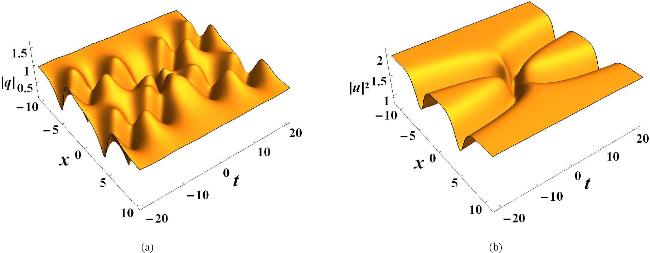
Both the asymptotic expressions ${q}_{{\rm{I}}}^{\pm }$ and ${q}_{{\rm{II}}}^{\pm }$ are the combined dark-bright solitons with the logarithmic center trajectories ${\eta }_{{\rm{I}}}^{\pm }=0$ and ${\eta }_{{\rm{II}}}^{\pm }=0$, respectively. Similar to the conventional soliton solutions with simple poles [49], each asymptotic soliton here exhibits the beating behavior during its evolution over time. However, the difference lies in that such beating behavior is not strictly periodic since the velocities of two solitons change with t at the rate O(t-1). Therefore, equations (4.6a) and (4.6b) can be referred to as the quasi-periodic beating solitons. In addition, given that q(x, t) and q(-x, t) are two components of system (1.1), their superposed intensity |u(x, t)|2 := |q(x, t)|2 + |q(-x, t)|2 shows an elastic interaction between two conserved solitons, i.e. two logarithmically curved dark solitons (see figure 1(b)).
Figure 1. (a) An interaction between two quasi-periodic beating solitons with ${z}_{2,1}=\sqrt{6}{\rm{i}}$, q+ = 1, ${d}_{2,1}=\frac{3}{4}$ and ${l}_{2,1}=-\frac{{\rm{i}}}{8}$. (b) An interaction between two logarithmically curved dark solitons for the superposed intensity |q(x, t)|2 + |q( - x, t)|2.
(ii) n2 = n3 = 0 and n1 = n4 = 1. In this case, one pair of simple poles$\{{\xi }_{1,1},{\xi }_{1,1}^{* }\}$ lies on the circle $\Gamma$, and the other pair of double poles $\{{z}_{2,1},{\hat{z}}_{2,1}\}$ is symmetric about the circle $\Gamma$. Then, we take ${\xi }_{1,1}={\rm{i}}\sqrt{2}{q}_{0}$ and ${z}_{2,1}={\rm{i}}\sqrt{2}\kappa {q}_{0}$ with κ > 1. Based on the constraints (3.14), (3.15) and the constraint of c1,1 described in lemma 3.1 of [49], the norming constants should satisfy the following conditions:
Then, assuming that $t{{\rm{e}}}^{\mp \frac{\sqrt{2}{q}_{0}}{\kappa }x}=O(1)$, $t{{\rm{e}}}^{\pm \frac{\sqrt{2}{q}_{0}}{\kappa }x}=O(1)$ and x = O(1), respectively, we can use the improved asymptotic analysis method to obtain three non-singular asymptotic solitons as t → ±∞:
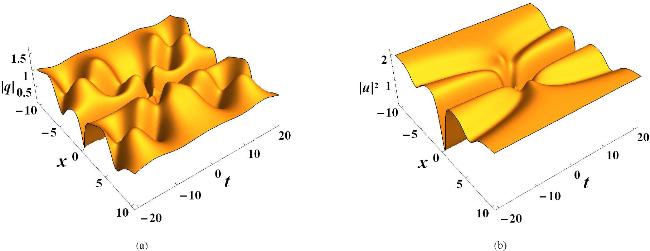
It can be seen that ${q}_{{\rm{I}}}^{\pm }$ and ${q}_{{\rm{II}}}^{\pm }$ are two logarithmically curved beating solitons, which are both quasi-periodic in t and exhibit the phase shift varying logarithmically with t; whereas ${q}_{{\rm{III}}}^{\pm }$ is a static dark soliton which experiences no phase shift. As shown in figures 2(a) and (b), this solution describes an interaction among two propagating quasi-periodic beating solitons and one static dark soliton, which correspond to three dark solitons in the superposed intensity |u|2.
Figure 2. (a) An interaction among two quasi-periodic beating solitons and one static dark soliton with ${\xi }_{2,1}=\sqrt{2}{\rm{i}}$, ${z}_{2,1}=2\sqrt{2}{\rm{i}}$, q+ = 1, c1,1 = 1, ${d}_{2,1}=\frac{\sqrt{30}}{25}$ and ${l}_{2,1}=-\frac{21}{250}{\rm{i}}$. (b) An interaction among two propagating logarithmically curved dark solitons and one static dark soliton for the superposed intensity |q(x, t)|2 + |q( - x, t)|2.
(iii) n1 = n3 = 0 and n2 = n4 = 1. In this case, there are one pair of simple poles $\{{z}_{1,1},{\hat{z}}_{1,1}^{* }\}$ and one pair of double poles $\{{z}_{2,1},{\hat{z}}_{2,1}^{* }\}$, which are symmetrically distributed with respect to the circle $\Gamma$. Then, we define that ${z}_{1,1}={\rm{i}}{\kappa }_{1}\sqrt{2}{q}_{0}$, ${z}_{2,1}={\rm{i}}{\kappa }_{2}\sqrt{2}{q}_{0}$ with κ1, κ2 > 1. By virtue of the constraints (3.14) and (3.15), the norming constants should obey that
where ${\kappa }_{1}^{{\prime} }=\frac{{\kappa }_{1}^{2}-1}{{\kappa }_{1}^{2}+1}$ and ${\kappa }_{2}^{{\prime} }=\frac{{\kappa }_{2}^{2}-1}{{\kappa }_{2}^{2}+1}$. Based on the following relations:
we assume that $t{{\rm{e}}}^{\mp \frac{\sqrt{2}{q}_{0}x}{{\kappa }_{2}}}=O(1)$, $t{{\rm{e}}}^{\pm \frac{\sqrt{2}{q}_{0}x}{{\kappa }_{2}}}=O(1)$ and x = O(1) as t → ± ∞, and then obtain three non-singular asymptotic solitons:
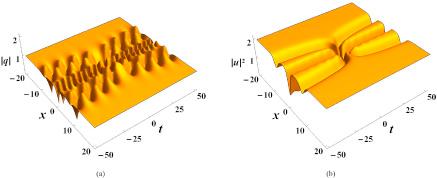
Obviously, both ${q}_{{\rm{I}}}^{\pm }$ and ${q}_{{\rm{II}}}^{\pm }$ are quasi-periodic beating solitons with logarithmically curved center trajectories ${\eta }_{{\rm{I}}}^{\pm }=0$ and ${\eta }_{{\rm{II}}}^{\pm }=0$, respectively, and they have the same t-period $\frac{\pi {\kappa }_{2}^{2}}{{q}_{0}^{2}}$, while ${q}_{{\rm{III}}}^{\pm }$ is the static beating soliton with the t-period $\frac{\pi {\kappa }_{1}^{2}}{{q}_{0}^{2}}$. Again, the phase shifts of ${q}_{{\rm{I}}}^{\pm }$ and ${q}_{{\rm{II}}}^{\pm }$ exhibit the logarithmic dependence of t, but there is no phase shift for ${q}_{{\rm{III}}}^{\pm }$. Thus, this solution displays an interaction among two propagating logarithmically curved quasi-periodic beating solitons and one static beating soliton, as shown in figure 3(a). Meanwhile, the corresponding superposed intensity |u|2 shows an interaction among three dark solitons (see figure 3(b)).
Figure 3. (a) An interaction between two quasi-periodic beating solitons and one static beating soliton with ${z}_{1,1}=\frac{5\sqrt{2}}{4}{\rm{i}}$, ${z}_{2,1}=2\sqrt{2}{\rm{i}}$, q+ = 1, ${d}_{1,1}=\frac{45\sqrt{2}}{574}$, ${d}_{2,1}=\frac{3}{5}\sqrt{\frac{3}{70}}$ and ${l}_{2,1}=-\frac{127}{350}\sqrt{\frac{3}{35}}{\rm{i}}$. (b) An interaction among two propagating logarithmically curved dark solitons and one static dark soliton for the superposed intensity |q(x, t)|2 + |q( - x, t)|2.
5. Conclusion
Equation (1.2) is a physically significant nonlocal NLS equation since it can be derived from the parity-symmetric reduction of the Manakov system. In this work, we have considered that the reciprocals of scattering coefficients have both the simple and double poles, and extended the IST theory for the defocusing equation (1.2) under NZBCs. By analyzing the behavior of the Jost eigenfunction and the auxiliary Jost eigenfunction at double poles, we have regularized the RHP and obtained the extended trace formulas and reconstruction formulas. Meanwhile, based on the symmetries of eigenfunctions and their derivatives, we have derived the complex constraint relations between norming constants.
In the reflectionless case, we have presented the double-pole soliton solutions with NZBCs. Also, we have analyzed the solution dynamical properties for three cases with one double pole by studying the discrete eigenvalue distribution and asymptotic analysis of the solutions. The obtained asymptotic solitons indicate that a double pole off the circle $\Gamma$ can lead to two quasi-periodic beating solitons with logarithmically curved central trajectories. Moreover, their superposed intensity can form a pair of logarithmically curved dark solitons. Considering the coexistence of simple and double poles, one can also observe the interactions between the logarithmically curved beating solitons and either the conventional dark soliton or beating soliton. It should be noted that the number of pure imaginary simple poles must be odd for θ+ - θ- = π (q+ = - q-) and even for θ+ - θ- = 0 (q+ = q-), but there is no such restriction on the double poles. Continually, we can establish the IST theory of equation (1.2) under NZBCs with the presence of multiple poles, and obtain higher-order multi-pole soliton solutions. Similarly, a multiple pole off the circle $\Gamma$ can generate multiple quasi-periodic beating solitons, most of which have logarithmical center trajectories [61, 62]. Meanwhile, the solutions can exhibit a rich variety of soliton interactions; for example, one may observe the interaction among two logarithmically curved beating solitons and a static one when a triple pole lies on the imaginary axis but off the circle $\Gamma$.
This work was supported by the Beijing Natural Science Foundations (Grant Nos. 1232022 and 1252016), the National Natural Science Foundations of China (Grant Nos. 12475003 and 11705284), and the Hebei Province Natural Science Foundation (Grant No. A2025502019).
KamchatnovA M, SokolovV V2015 Nonlinear waves in two-component Bose-Einstein condensates: Manakov system and Kowalevski equations Phys. Rev. A91 043621
WaiP K A, MenyukC R1996 Polarization mode dispersion, decorrelation, and diffusion in optical fibers with randomly varying birefringence J. Lightwave Technol.14 148 157
OnoratoM, OsborneA R, SerioM2006 Modulational instability in crossing sea states: a possible mechanism for the formation of freak waves Phys. Rev. Lett.96 014503
C. WrightO, Gregory ForestM2000 On the Bäcklund-gauge transformation and homoclinic orbits of a coupled nonlinear Schrödinger system Physica D141 104 116
XuT, TianB2010 Bright N-soliton solutions in terms of the triple Wronskian for the coupled nonlinear Schrödinger equations in optical fibers J. Phys. A: Math. Theor.43 245205
XuT, TianB2010 An extension of the Wronskian technique for the multicomponent Wronskian solution to the vector nonlinear Schrödinger equation J. Math. Phys.51 033504
XuT, TianB, XueY S, QiF H2010 Direct analysis of the bright-soliton collisions in the focusing vector nonlinear Schrödinger equation Europhys. Lett.92 50002
ChenS C, LiuC, YaoX, ZhaoL C, AkhmedievN2021 Extreme spectral asymmetry of Akhmediev breathers and Fermi-Pasta-Ulam recurrence in a Manakov system Phys. Rev. E104 024215
VijayajayanthiM, KannaT, LakshmananM2023 Simulation of universal optical logic gates under energy sharing collisions of Manakov solitons and fulfillment of practical optical logic criteria Phys. Rev. E108 054213
JakubowskiM H, SteiglitzK, SquierR1998 State transformations of colliding optical solitons and possible application to computation in bulk media Phys. Rev. E58 6752 6758
SiZ Z, WangY Y, DaiC Q2024 Switching, explosion, and chaos of multi-wavelength soliton states in ultrafast fiber lasers Sci. China Phys. Mech. Astron.67 274211
SiZ Z, JuZ T, RenL F, WangX P, MalomedB A, DaiC Q2025 Polarization-induced buildup and switching mechanisms for soliton molecules composed of noise-like-pulse transition states Laser Photonics Rev.19 2401019
AbeyaA, BiondiniG, PrinariB2022 Inverse scattering transform for the defocusing Manakov system with non-parallel boundary conditions at infinity East Asian J. Appl. Math.12 715 760
AbeyaA, BiondiniG, PrinariB2022 Manakov system with parity symmetry on nonzero background and associated boundary value problems J. Phys. A-Math. Theor.25 254001
WuJ P2025 A novel Riemann-Hilbert formulation-based reduction method to an integrable reverse-space nonlocal Manakov equation and its applications Chaos Soliton. Fract.192 115997
XuC X, XuT, LiM2025 Inverse scattering transform for the defocusing nonlinear Schrödinger equation with local and nonlocal nonlinearities under non-zero boundary conditions Lett. Math. Phys.115 105
ZakharovV E, ShabatA B1972 Exact theory of two-dimensional self-focusing and one-dimensional selfmodulation of waves in nonlinear media Sov. Phys. JETP34 62 69
[52]
WadatiM, OhkumaK1982 Multiple-pole solutions of the modified Korteweg-de Vries equation J. Phys. Soc. Jpn.51 2029 2035
BiondiniG, KovačičG2014 Inverse scattering transform for the focusing nonlinear Schrödinger equation with non-zero boundary conditions and double-poles J. Math. Phys.55 031506
YangJ J, TianS F, LiZ Q2022 Riemann-Hilbert problem for the focusing nonlinear Schrödinger equation with multiple high-order poles under nonzero boundary conditions Physica D432 133162
LiM, ZhangX F, XuT, LiL L2020 Asymptotic analysis and soliton interactions of the multi-pole solutions in the Hirota equation J. Phys. Soc. Jpn.85 124001
XuT, LiL L, LiM, LiC X, ZhangX F2021 Rational solutions of the defocusing non-local nonlinear Schrödinger equation: asymptotic analysis and soliton interactions Proc. R. Soc. A477 20210512
LiM, ZhangX F, XuT, LiL L2020 Asymptotic analysis and soliton interactions of the multi-pole solutions in the Hirota equation J. Phys. Soc. Jpn.89 054004