

1. Introduction
Coherent laser fields provide an efficient tool for controlling the dynamical behavior of quantum systems [1, 2]. Due to its simplicity, the laser-driven two-level system has become a prototypical model for demonstrating quantum control principles [3]. When the laser fields are treated classically, time-dependent two-level models (TLMs) are commonly employed. As exact analytical solutions are fundamentally important for understanding quantum control physics, the search for exactly solvable time-dependent (ESTD) TLMs has attracted extensive research interest over several decades.
The first nontrivial ESTD TLM was proposed by Landau and Zener [4, 5], where the level bias changes linearly in time. Subsequently, numerous ESTD TLMs have been discovered, including Rosen-Zener [6], Nikitin [7], Demkov [8], Demkov-Kunike [9], Bambini-Berman [10], Bambini-Lindberg [11], Hioe [12], Robinson [13], Hioe-Carroll [14], Carroll-Hioe [15, 16], Allen-Eberly [17], Ishkhanyan [18, 19], and Vitanov [20, 21] models. This list is non-exhaustive. Despite their apparent simplicity, such models find extensive applications in atomic/molecular physics, quantum optics, and quantum information.
There are two primary approaches for constructing ESTD TLMs. The first utilizes specific laser amplitude and frequency modulations such that, through appropriate variable transformation, the Schrödinger equation reduces to well-studied second-order differential equation. While hypergeometric and confluent hypergeometric equations have predominated in earlier studies, recent extensions employ the Heun equation and its confluent forms [22-31]. The second approach employs reverse-engineering algorithms to generate unlimited exact solutions [32-36]. Except in limited cases, these solutions typically require complex laser-field modulations that remain experimentally challenging [37, 38]. Moreover, for more complex field excitations, various numerical algorithms have been developed and applied, including Yee's finite-difference time-domain discretization method [39, 40] and the predictor-corrector method [41-43].
The Lorentzian pulse is commonly utilized in current experiments [37]. While the exact analytical solution for standard Lorentzian TLMs remains under investigation, a double Lorentzian TLM has recently been proposed [26, 31]. In this system, a two-level quantum system is subjected to a laser pulse featuring both Lorentzian-modulated frequency and Lorentzian-modulated amplitude. Analytical solutions for the double Lorentzian TLM can be expressed using confluent Heun functions (CHFs). But these solutions are incomplete. Furthermore, from the termination conditions for CHFs, explicit solutions have only been obtained for certain specific parameter conditions. Finding exact solutions for generic system parameters, outside these restrictive termination conditions, remains elusive.
Here we introduce a novel class of time-dependent TLMs featuring Lorentzian frequency and sub-Lorentzian amplitude modulations. For simplicity, we term this model the mixed Lorentzian TLM. We demonstrate that the corresponding Schrödinger equation is exactly reducible to the confluent Heun equation (CHE) through an appropriate variable transformation. An analytical method is developed to express the complete analytical solutions in terms of CHFs. Furthermore, infinite sets of explicit closed-form solutions emerge under parameter constraints derived from CHF termination conditions. Using these exact solutions, we systematically investigate the parametric dependence of final transition probabilities on system properties and initial conditions. In particular, we derive an exact analytical expression for transition probabilities when parameters deviate from termination conditions, under which the population admits a simple functional form. This formalism directly applies to broader cases, including the double-Lorentzian TLM and a single Lorentzian TLM with Lorentzian frequency modulation but constant amplitude.
2. Model and analytical solutions
We consider a two-level quantum system driven by a nonresonant laser field, described by the time-dependent Hamiltonian (ħ = 1) 4 ) and (5 ) possess conjugate solution pairs: if Φ(t) solves equation (4 ), then Φ*(t) solves equation (5 ). This symmetry simplifies subsequent analysis. Once a1(t) is determined, a2(t) follows from equation (2 ).
$\begin{eqnarray}H=\frac{f(t)}{2}{\sigma }_{z}+\frac{\nu (t)}{2}{\sigma }_{x},\end{eqnarray}$
where σx,z are the usual Pauli matrices, f(t) represents the detuning from resonance, and ν(t) describes the coupling between levels, corresponding to the temporal laser profile. The probability amplitudes a1(t) and a2(t) obey the coupled equations $\begin{eqnarray}{\rm{i}}\displaystyle \frac{{\rm{d}}{a}_{1}}{{\rm{d}}t}=\displaystyle \frac{\nu (t)}{2}{a}_{2}+\displaystyle \frac{f(t)}{2}{a}_{1},\end{eqnarray}$
$\begin{eqnarray}{\rm{i}}\displaystyle \frac{{\rm{d}}{a}_{2}}{{\rm{d}}t}=\displaystyle \frac{\nu (t)}{2}{a}_{1}-\displaystyle \frac{f(t)}{2}{a}_{2}.\end{eqnarray}$
Elimination of a2(t) and a1(t) yields second-order differential equations $\begin{eqnarray}\displaystyle \frac{{{\rm{d}}}^{2}{a}_{1}}{{\rm{d}}{t}^{2}}-\displaystyle \frac{\dot{\nu }}{\nu }\displaystyle \frac{{\rm{d}}{a}_{1}}{{\rm{d}}t}+\left(\displaystyle \frac{{f}^{2}}{4}+\displaystyle \frac{{\nu }^{2}}{4}+{\rm{i}}\displaystyle \frac{\dot{f}}{2}-{\rm{i}}\displaystyle \frac{f}{2}\displaystyle \frac{\dot{\nu }}{\nu }\right){a}_{1}=0,\end{eqnarray}$
$\begin{eqnarray}\displaystyle \frac{{{\rm{d}}}^{2}{a}_{2}}{{\rm{d}}{t}^{2}}-\displaystyle \frac{\dot{\nu }}{\nu }\displaystyle \frac{{\rm{d}}{a}_{2}}{{\rm{d}}t}+\left(\displaystyle \frac{{f}^{2}}{4}+\displaystyle \frac{{\nu }^{2}}{4}-{\rm{i}}\displaystyle \frac{\dot{f}}{2}+{\rm{i}}\displaystyle \frac{f}{2}\displaystyle \frac{\dot{\nu }}{\nu }\right){a}_{2}=0,\end{eqnarray}$
where dots denote time derivatives, $\dot{f}={\rm{d}}f/{\rm{d}}t$ and $\dot{\nu }={\rm{d}}\nu /{\rm{d}}t$. Equations (Prior works [26, 31] investigated the double Lorentzian temporal laser model with
$\begin{eqnarray}f(t)={f}_{0}+\frac{{f}_{1}}{1+{g}^{2}{t}^{2}},\nu (t)=\frac{{\nu }_{1}}{1+{g}^{2}{t}^{2}},\end{eqnarray}$
where f0 is constant detuning, f1/(1 + g2t2) denotes the Lorentzian frequency modulation, and ν1/(1 + g2t2) describes the Lorentzian amplitude modulation. Here the parameter g is related to the width scale Γ, g = π/Γ. This double Lorentzian TLM generalizes the standard Lorentzian TLM (where f1 = 0) to include both amplitude and frequency modulations.Here we propose a mixed Lorentzian TLM with Lorentzian frequency and sub-Lorentzian amplitude modulations
$\begin{eqnarray}f(t)={f}_{0}+\frac{{f}_{1}}{1+{g}^{2}{t}^{2}},\nu (t)=\frac{{\nu }_{1}}{\sqrt{1+{g}^{2}{t}^{2}}}.\end{eqnarray}$
Typical profiles of this frequency and amplitude modulations are shown in figure 1 with g = 1, f0/g = 0.5, f1/g = 0.2, and ν1/g = 0.6. Furthermore, in the case of gt « 1, we can approximate the detuning f(t) by Taylor series expansion $\begin{eqnarray}f(t)\approx {f}_{0}+{f}_{1}-{f}_{1}{(gt)}^{2},\end{eqnarray}$
revealing that the laser pulse frequency varies quadratically with time [44].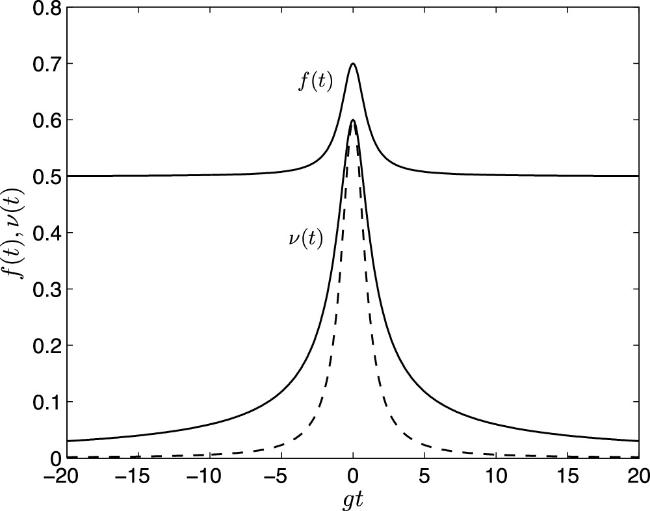
Figure 1. Modulation profiles for the frequency and amplitude described in equations ( |
To solve the system equation (4 ) under modulation equation (7 ), we apply the transformations A ) 9 ) into equation (4 ) yields the CHE for Φ(z) [45-47]
$\begin{eqnarray}\begin{array}{l}\,z=\displaystyle \frac{1}{2}(1-{\rm{i}}gt),\\ {a}_{1}(z)={{\rm{e}}}^{-{\rm{i}}{\lambda }_{1}gt/2}{(1-{\rm{i}}gt)}^{{\lambda }_{2}}{(1+{\rm{i}}gt)}^{{\lambda }_{3}}\phi (z),\end{array}\end{eqnarray}$
with parameters given by (see Appendix $\begin{eqnarray}{\lambda }_{1}=\pm \frac{{f}_{0}}{g},{\lambda }_{2}=\frac{{f}_{1}}{4g},{\lambda }_{3}=\frac{{f}_{1}+2g}{4g}.\end{eqnarray}$
Note that it is important to choose suitable parameters λ1,2,3 to obtain a complete set of analytical solutions for a1(t). Substituting equation ( $\begin{eqnarray}\frac{{{\rm{d}}}^{2}\phi }{{\rm{d}}{z}^{2}}+\left(\alpha +\frac{\beta +1}{z}+\frac{\gamma +1}{z-1}\right)\frac{{\rm{d}}\phi }{{\rm{d}}z}+\frac{pz+q}{z(z-1)}\phi =0,\end{eqnarray}$
where p = δ + α(β + $\gamma$ + 2)/2 and q = η + β/2 + ($\gamma$ - α) × (β + 1)/2. All relevant parameters are given by, α = 2λ1, β = -1/2 + 2λ2, $\gamma$ = -1/2 + 2λ3, δ = -f0/g, $\eta \,=(4{f}_{0}({f}_{1}+g)+{f}_{1}^{2}+3{g}^{2}+2{\nu }_{1}^{2})/8{g}^{2}$. The local Frobenius solution at z = 0 is [45-47] $\begin{eqnarray}\phi (z)={\rm{HC}}(\alpha ,\beta ,\gamma ,\delta ,\eta ,z)=\displaystyle \sum _{n=0}^{\infty }{h}_{n}{z}^{n},\end{eqnarray}$
where HC(α, β, $\gamma$, δ, η, z) denotes CHF. Coefficients hn satisfy the three-term recurrence relation, Kn+1hn+1 + Lnhn + Mn-1hn-1 = 0 (n≥1) with Kn = -n(n + β), Ln = n(n + 1) + (β + $\gamma$ - α - 1)n+η - β/2 + ($\gamma$ - α)(β + 1)/2, and Mn = α(n + 1) + δ + α(β + $\gamma$)/2, and the initial conditions h0 = 1 and h-1 = 0. Therefore, with two different values of λ1, we have a complete set of two linearly independent solutions for a1(t) expressed via the CHFs.However, from a mathematical perspective, the convergence radius |z| < 1 of the CHF restricts its validity to $| t| \lt \sqrt{3}/g$ [45-47]. Compared to the classical hypergeometric functions, the asymptotic properties of CHFs are less comprehensively studied. To obtain global solutions, we apply termination conditions for the CHF [45-47]13 ) gives 14 ) imposes parameter relations. For N1 = 0, 1, 2, we have
$\begin{eqnarray}\delta =-\left(N+\frac{\gamma +\beta +2}{2}\right)\alpha ,\end{eqnarray}$
$\begin{eqnarray}{h}_{N+1}=0,\end{eqnarray}$
which reduce HC to an N-degree polynomial. Choosing λ1 = f0/g, condition ( $\begin{eqnarray}{f}_{1}=-(2{N}_{1}+3)g.\end{eqnarray}$
Condition ( $\begin{eqnarray}{\left(\frac{{\nu }_{1}}{2g}\right)}^{2}-\frac{2{f}_{0}}{g}+1=0,\end{eqnarray}$
$\begin{eqnarray}{\left(\frac{{\nu }_{1}}{2g}\right)}^{4}+\left(5-3\frac{2{f}_{0}}{g}\right){\left(\frac{{\nu }_{1}}{2g}\right)}^{2}-8\frac{2{f}_{0}}{g}+2{\left(\frac{2{f}_{0}}{g}\right)}^{2}+4=0,\end{eqnarray}$
$\begin{eqnarray}\begin{array}{l}{\left(\frac{{\nu }_{1}}{2g}\right)}^{6}+\left(14-\frac{2{f}_{0}}{g}\right){\left(\frac{{\nu }_{1}}{2g}\right)}^{4}\\ +\left(49-58\frac{2{f}_{0}}{g}+11{\left(\frac{2{f}_{0}}{g}\right)}^{2}\right){\left(\frac{{\nu }_{1}}{2g}\right)}^{2}\\ +\left(36-108\frac{2{f}_{0}}{g}+54{\left(\frac{2{f}_{0}}{g}\right)}^{2}-\frac{3}{2}{\left(\frac{2{f}_{0}}{g}\right)}^{3}\right)=0.\end{array}\end{eqnarray}$
Constraints involve ν1/2g and 2f0/g, forming (2N + 2)- and (N + 1)-degree polynomials, respectively. Figure 2 plots cases N = 0, 1.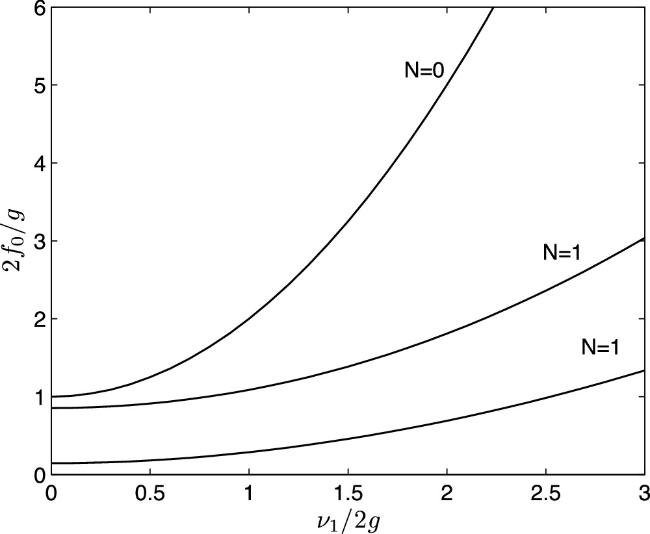
Figure 2. Parameter constraints between 2f0/g and ν1/2g for exact solutions with N1 = 0, 1. |
Under these constraints λ1 = f0/g, the solution is 13 ) gives f1 = -(2N2 + 1)g. For N2 = N1 + 1, identical constraints arise, yielding a second solution
$\begin{eqnarray}\begin{array}{rcl}{a}_{1,1}(t) & = & \displaystyle \frac{{{\rm{e}}}^{-{\rm{i}}\tfrac{{f}_{0}}{2}t}}{{(1-{\rm{i}}gt)}^{(2{N}_{1}+3)/4}{(1+{\rm{i}}gt)}^{(2{N}_{1}+1)/4}}\\ & & \times \displaystyle \sum _{n=0}^{{N}_{1}}\displaystyle \frac{{h}_{n}}{{2}^{n}}{(1-{\rm{i}}gt)}^{n}.\end{array}\end{eqnarray}$
Choosing λ1 = -f0/g, condition ( $\begin{eqnarray}\begin{array}{rcl}{a}_{1,2}(t) & = & \displaystyle \frac{{{\rm{e}}}^{{\rm{i}}\tfrac{{f}_{0}}{2}t}}{{(1-{\rm{i}}gt)}^{(2{N}_{1}+3)/4}{(1+{\rm{i}}gt)}^{(2{N}_{1}+1)/4}}\\ & & \times \displaystyle \sum _{n=0}^{{N}_{1}+1}\displaystyle \frac{{h}_{n}}{{2}^{n}}{(1-{\rm{i}}gt)}^{n}.\end{array}\end{eqnarray}$
The general solution combines these $\begin{eqnarray}{a}_{1}(t)={c}_{1}{a}_{1,1}(t)+{c}_{2}{a}_{1,2}(t).\end{eqnarray}$
If we assume that the initial states are a1(t0) = 1 and a2(t0) = 0, we then obtain $\begin{eqnarray}{c}_{1}=-\frac{{\dot{a}}_{1,2}({t}_{0})+f({t}_{0}){a}_{1,2}({t}_{0})/2}{\dot{{a}_{1,2}}({t}_{0}){a}_{1,2}({t}_{0})-{a}_{1,2}({t}_{0}){a}_{1,1}({t}_{0})},\end{eqnarray}$
$\begin{eqnarray}{c}_{2}=\frac{{\dot{a}}_{1,1}({t}_{0})+f({t}_{0}){a}_{1,2}({t}_{0})/2}{{\dot{a}}_{1,1}({t}_{0}){a}_{1,2}({t}_{0})-{a}_{1,2}({t}_{0}){a}_{1,1}({t}_{0})}.\end{eqnarray}$
The asymptotic behavior (t → ∞) yields |a1,1| → 0 and $| {a}_{1,2}| \to | {h}_{{N}_{1}+1}/{2}^{{N}_{1}+1}| $, giving the final probability $\begin{eqnarray}{P}_{1}^{f}={\left|\frac{{c}_{2}{h}_{{N}_{1}+1}}{{2}^{{N}_{1}+1}}\right|}^{2}.\end{eqnarray}$
These results provide an analytical study on the parameter dependence of the probabilities |a1,2|2 and ${P}_{1,2}^{f}$.To illustrate this, we discuss the simple case of N1 = 0 as an example. In this case, we have f1 = -3g and ${f}_{0}=({\nu }_{1}^{2}+4{g}^{2})/8g$. The solutions are given by
$\begin{eqnarray}{a}_{1,1}(t)=\displaystyle \frac{{{\rm{e}}}^{-{\rm{i}}\tfrac{{\nu }_{1}^{2}+4{g}^{2}}{16g}t}}{{(1-{\rm{i}}gt)}^{3/4}{(1+{\rm{i}}gt)}^{1/4}},\end{eqnarray}$
$\begin{eqnarray}\begin{array}{rcl}{a}_{1,2}(t) & = & \displaystyle \frac{{{\rm{e}}}^{{\rm{i}}\tfrac{{\nu }_{1}^{2}+4{g}^{2}}{16g}t}}{{(1-{\rm{i}}gt)}^{3/4}{(1+{\rm{i}}gt)}^{1/4}}\\ & & \times \left(1-\displaystyle \frac{4{g}^{2}+{\nu }_{1}^{2}}{8{g}^{2}}(1-{\rm{i}}gt)\right),\end{array}\end{eqnarray}$
with Wronskian $\begin{eqnarray}\begin{array}{rcl}W & = & {a}_{1,1}(t)\displaystyle \frac{{\rm{d}}}{{\rm{d}}t}{a}_{1,2}(t)-{a}_{1,2}(t)\displaystyle \frac{{\rm{d}}}{{\rm{d}}t}{a}_{1,1}(t)\\ & & =\displaystyle \frac{{\rm{i}}}{64{g}^{3}}\displaystyle \frac{({\nu }_{1}^{2}+4{g}^{2})}{\sqrt{1+{g}^{2}{t}^{2}}}.\end{array}\end{eqnarray}$
This nonzero Wronskian means that a1,1(t) and a1,2(t) are linearly independent. Complete exact analytical solutions to a1(t) are thus obtained. The initial conditions of a1(t0) = 1 and a2(t0) = 0 yield the final transition probability $\begin{eqnarray}{P}_{1}^{f}=1-\frac{16{\nu }_{1}^{2}{g}^{2}}{(1+{g}^{2}{t}_{0}^{2}){(4{g}^{2}+{\nu }_{1}^{2})}^{2}}.\end{eqnarray}$
When t0 → -∞, ${P}_{1}^{f}=1$ for arbitrary ν1 and g, indicating complete population revival (CPR). This arises because f(t) changes sign twice (at ${t}_{b}=\pm \sqrt{-({f}_{0}+{f}_{1})/({f}_{0}g)}$ for f0 > 0, f0 + f1 < 0 or f0 > 0, f0 + f1 > 0), leading to two avoided crossings in the adiabatic energies $\begin{eqnarray}{E}_{\pm }^{\mathrm{ad}}(t)=\pm \displaystyle \frac{1}{2}\sqrt{{f}^{2}(t)+{\nu }^{2}(t)}.\end{eqnarray}$
Adiabatic following through dual crossings enables CPR. Figures 3(a) and (c) shows bare energies E± = ±f(t)/2 and adiabatic energies ${E}_{\pm }^{\mathrm{ad}}(t)$, and figure 3(b) displays an imperfect CPR for t0 = -100, with ${f}_{0}/g=({\nu }_{1}^{2}+4{g}^{2})/(8{g}^{2})$, f1/g = -3, ν1/g = 4/5, and g = 1. Figures 3(c) and (d) show complete population inversion (CPI) for t0 = 0, and ν1/g = 2.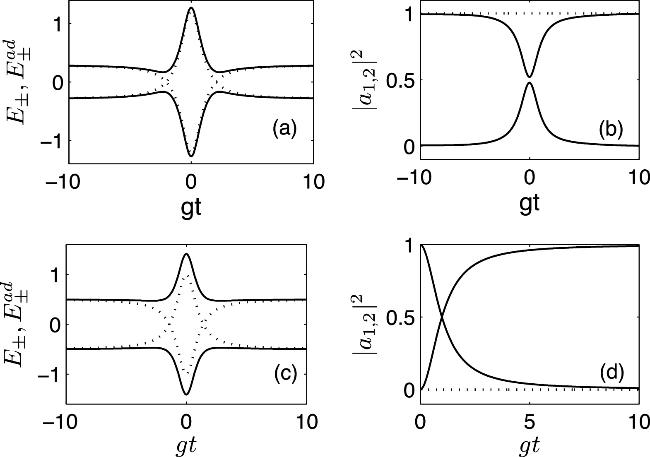
Figure 3. (a) and (c) Bare (E±, dotted) and adiabatic (${E}_{\pm }^{\mathrm{ad}}$, solid) energies. (b) and (d) Time evolution of the probability P1(t) = |a1(t)|2. In the dual-crossing case (a), (b), an imperfect CPR appears for gt0 = -100. In the single-crossing case (c), (d), CPI appears for t0 = 0. Parameters: ${f}_{0}/g=({\nu }_{1}^{2}+4{g}^{2})/8{g}^{2}$, f1/g = -3, g = 1, ν1/g = 4/5 (a), (b) and ν1/g = 2 (c), (d). In (b) and (d), the dotted lines are for the final population. |
Additionally, a key question is whether exact results can be obtained when parameters deviate from termination conditions. Under general parameter conditions, the analytical solutions for a1,2 are expressed in terms of the CHFs, as given in equation (12 ). Here, we provide an example where an explicit exact solution for the probability |a1|2 is derived under such deviations. Here we present an example where an exact solution to the probability |a1|2 can be obtained in an explicit form when the relevant parameters deviate from termination conditions. For f0/g = 1, f1/g = -2, ν1/g = 1, the probability |a1|2 is
$\begin{eqnarray}{P}_{1}(t)=\frac{1}{2}\left(1-\frac{gt}{\sqrt{1+{g}^{2}{t}^{2}}}\right).\end{eqnarray}$
As t → ∞, ${P}_{1}^{f}\to 0$, indicating CPI. Furthermore, dual avoided crossings arise for this set of parameters. Figure 4 demonstrates CPI for f0/g = 1, f1/g = -2, and ν1/g = 1, despite the occurrence of two avoided crossings. This implies that two avoided crossings do not universally guarantee CPR.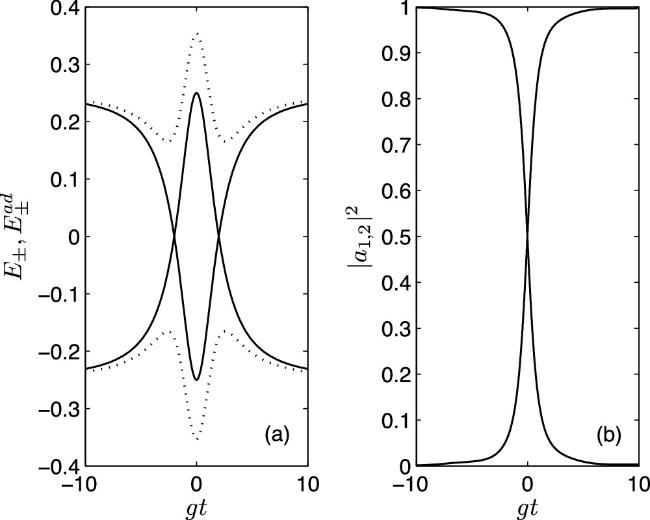


Figure 4. (a) Bare (dotted) and adiabatic (solid) energies. (b) Probability P1(t) = |a(t)|2 for gt0 = -100. Parameters: f0/g = 1, f1/g = -2, ν1/g = 1, and g = 1. |
3. Conclusion
This study investigates a mixed Lorentzian TLM describing the dynamics of a two-level quantum system driven by a nonresonant laser pulse exhibiting Lorentzian frequency modulation and sub-Lorentzian amplitude modulation. A complete set of analytical solution for the system dynamics, explicitly expressed in terms of CHFs, is derived. This result identifies a novel class of ESTD TLMs in principle. Given the rapid advancement in laser technology, this mixed Lorentzian model could hold significant potential for experimental realization.
Although the asymptotic properties of CHFs are less comprehensively characterized than those of classical hypergeometric functions, they reduce to finite series under specific termination conditions. This reduction imposes an infinite set of parameter constraints, enabling exact analytical solutions. Under these constrained parameters, the instantaneous adiabatic energy levels exhibit two avoided crossings during the temporal evolution of the pulse. This characteristic double avoided crossing significantly influences the final transition probabilities between the two quantum levels; their detailed parametric dependence was analyzed using a concrete example. Furthermore, when parameters deviate from the termination constraints, an exact analytical expression for the transition probabilities in a simple form is presented.
Our method is directly applicable to the double Lorentzian TLM (see Appendix B ). Moreover, it also solves the case of a TLM with only Lorentzian-modulated frequency (see Appendix C ). We note that the standard Lorentzian TLM, characterized by constant detuning and Lorentzian amplitude modulation, can be mapped via a suitable transformation to a TLM with Lorentzian-modulated frequency and constant amplitude. Consequently, such a single Lorentzian frequency-modulated TLM includes the standard Lorentzian TLM as a special case.
The predictions presented in this work are promising candidates for experimental verification in established platforms such as quantum dots [48, 49], superconducting qubits [50], Nitrogen-Vacuum (NV) centers [51], and ultracold atoms [52]. Verification in these systems would significantly enhance the understanding of quantum control in two-level systems.