

1. Introduction
Proton radioactivity is a primary decay mode observed in odd-Z nuclei which are proton-rich and located beyond the proton drip line [1-3]. It was first discovered in 1970 by Jackson et al [4] in an isomeric state of 53Co. Shortly afterward, proton emission from the ground state of 151Lu [5] and 147Tm [6] were observed by Hofmann et al and Klepper et al, respectively, which provided further confirmation of proton radioactivity. Experimental advances in equipment and radioactive beam technology led to the discovery of an increasing number of proton emitters, where emitted protons originate from either the ground state or low-lying isomeric states [7-12], within the range of 50 ≤ Z ≤ 83. The properties and structures of odd-Z proton emitters beyond the proton drip line, such as shell structure [13, 14], the coupling between bound and unbound states [15, 16] and others [17-23], can be effectively investigated through this dominant decay mode——an indispensable tool. In addition, the proton radioactivity half-life is significantly sensitive to the energy released by the proton radioactivity Qp and the orbital angular momentum l taken away by the emitted proton. Therefore, measurements of the released energy and half-life of proton radioactivity also help in acquiring the orbital angular momentum carried by the emitted proton and characterizing its wave function within the nucleus [24-27].
Up to now, proton radioactivity half-lives have been studied extensively using numerous models and/or empirical formulae, embracing the generalized liquid drop model [28, 29], the single folding model [30], the density-dependent M3Y effective interaction [31, 32], the phenomenological unified fission model [33, 34], the Gamow-like model [35], the distorted-wave Born approximation [8], the two-potential approach [21], the Woods-Saxon nuclear potential model [36-38], the one-parameter model (OPM) [39], the Coulomb and proximity potential model [40], deformed/triaxial relativistic Hartree-Bogoliubov theory in continuum [41, 42], the new Geiger-Nuttall law (NGNL) of Chen et al [43], the four-parameter phenomenological formula of Sreeja et al [44] and Zhang et al [45], the universal decay law (UDLP) proposed by Qi et al [14], and so on [24, 46-50]. These works have improved and enriched our knowledge of proton radioactivity half-lives.
In 2020, based on the Wentzel-Kramers-Brillouin (WKB) method and the Bohr-Sommerfeld quantization condition [51], Bayrak [52] modified the nuclear interaction potential between the emitted α particle and the daughter nucleus as the harmonic oscillator potential, and proposed a new simple model to calculate the favored α decay half-lives of 263 nuclei including 136 even-even, 48 even-odd, 49 odd-even and 30 odd-odd nuclei, with a total root-mean-square (rms) deviation of σ = 0.4818. Recently, based on this model, the cluster radioactivity half-lives of 28 trans-lead nuclei were studied by considering the modified preformation probability in our previous work [53]. Since proton radioactivity, cluster radioactivity and α decay share the same mechanism as the tunneling effect, whether this model can be effectively extended to study proton radioactivity or not aroused our interest. To this end, we extend this model to systematically investigate the favored proton radioactivity half-lives of nine nuclei within the 67 ≤ Z ≤ 83 region. In this model, the depth of the nuclear potential V0 is the only adjustable parameter; this is tuned by fitting the experimental favored proton radioactivity half-lives. Meanwhile, the spectroscopic factor Sp is calculated using the relativistic mean field (RMF) theory combined with the Bardeen-Cooper-Schrieffer (BCS) method. We further derived a simple analytic expression from the WKB approximation to evaluate the half-lives of favored proton radioactivity. The calculated results show good agreement with the experimental half-lives, with a standard deviation of σ = 0.430. As an application, this model is used to predict the half-lives of possible proton radioactive candidates. In addition, the empirical formula UDLP [14] and the OPM model [39] are also used for comparison. The corresponding predictions are consistent with each other. The predictions might provide useful information for guiding the search for candidates for proton radioactivity in experiments.
The structure of this article is as follows. Section 2 gives a brief introduction of the theoretical framework for the harmonic oscillator potential model (HOPM) . In section 3 , detailed calculations and a discussion are presented. Finally, section 4 provides a concise summary.
2. Theoretical framework
The proton radioactivity half-life T1/2 can be generally determined by 2 ) S is the action integral. It can be expressed as
$\begin{eqnarray}{T}_{1/2}=\frac{\hslash \,{\mathrm{ln}}\,2}{{\rm{\Gamma }}},\end{eqnarray}$
where ħ is the reduced Planck constant and $\Gamma$ is the proton radioactivity width. Within the framework of HOMP [54], $\Gamma$ can be expressed as $\begin{eqnarray}{\rm{\Gamma }}=F{{\rm{e}}}^{-2S}\frac{{\hslash }^{2}}{4\,\mu }{S}_{{\rm{p}}}.\end{eqnarray}$
Here the reduced mass μ = mpmd/(mp + md), with mp and md being the mass of the emitted proton and daughter nucleus, respectively. Sp denotes the spectroscopic factor. The normalized factor F, related to the assault frequency of the emitted proton interacting with the potential barrier, satisfies the condition [55] $\begin{eqnarray}F\,{\int }_{0}^{{r}_{1}}{\rm{d}}r\frac{1}{2\,k(r)}=1.\end{eqnarray}$
In equation ( $\begin{eqnarray}S={\int }_{{r}_{1}}^{{r}_{2}}k(r)\,{\rm{d}}r,\end{eqnarray}$
where $k(r)=\sqrt{\frac{2\mu }{{\hslash }^{2}}({V}_{\mathrm{eff}}(r)-{Q}_{{\rm{p}}})}$ is the wave number in the effective potential barrier region. The distance r represents the separation between the centers of the emitted proton and the daughter nucleus. Veff(r) denotes the effective interaction potential between the emitted proton and the daughter nucleus, which includes the nuclear potential VN(r), the Coulomb potential VC(r) and the centrifugal potential Vl(r). More detailed information is given in the following. Qp represents the released energy of proton radioactivity. The classical turning points, denoted as r1 and r2, satisfy the conditions Veff(r1) = Veff(r2) = Qp, whereas Qp is commonly calculated by [39] $\begin{eqnarray}{Q}_{p}={\rm{\Delta }}M-({\rm{\Delta }}{M}_{{\rm{d}}}+{\rm{\Delta }}{M}_{{\rm{p}}})+k({Z}^{\beta }-{Z}_{{\rm{d}}}^{\beta }),\end{eqnarray}$
where ∆M, ∆Md and ∆Mp represent the mass excess of the parent nucleus, daughter nucleus and emitted proton, respectively, and their values are obtained from the atomic mass excess table NUBASE2020 [56]. Zd and Z are the proton numbers of daughter and parent nucleus, respectively. The term $k({Z}^{\beta }-{Z}_{{\rm{d}}}^{\beta })$ denotes the screening effect of atomic electrons. For Z < 60, k = 13.6 eV and β = 2.408, while for Z ≥ 60, k = 8.7 eV and β = 2.517 [57]. Since the half-life of a proton emitter is highly sensitive to Qp, the experimental Qp was used in the calculations [41, 42].In this work, the nuclear potential between the emitted proton and daughter nucleus VN(r) is chosen as the modified harmonic oscillator potential [52]. It is given by
$\begin{eqnarray}{V}_{{\rm{N}}}(r)=-{V}_{0}+{V}_{1}{r}^{2},\end{eqnarray}$
where the parameter V0 represents the depth of the nuclear potential while V1 denotes the diffusivity of the nuclear potential. The Coulomb potential VC, which represents the nucleus-nucleus interaction between the emitted proton and daughter nucleus, is a uniformly charged sphere with radius R; it is taken as [58, 59] $\begin{eqnarray}{V}_{{\rm{C}}}(r)=\left\{\begin{array}{ll}\frac{{Z}_{{\rm{p}}}{Z}_{{\rm{d}}}{e}^{2}}{2R}(3-\frac{{r}^{2}}{{R}^{2}}), & r\leqslant {r}_{1},\\ \frac{{Z}_{{\rm{p}}}{Z}_{{\rm{d}}}{e}^{2}}{r}, & r\gt {r}_{1}.\end{array}\right.\end{eqnarray}$
Here e2 = 1.4399652 MeV fm denotes the square of the elementary charge associated with an electron and $R={r}_{0}{A}_{{\rm{d}}}^{1/3}+{R}_{{\rm{p}}}$ represents the sharp radius with Ad and Rp being the mass numbers of the daughter nucleus and the proton radius, respectively. In this study, we choose r0 = 1.14 fm and Rp = 0.8409 fm [60]. The centrifugal potential Vl(r) is generally expressed as ${V}_{{\rm{l}}}(r)=\frac{{\hslash }^{2}l(l+1)}{2\mu {r}^{2}}$, where l is the orbital angular momentum removed by the emitted proton. In general, for favored proton transitions (l = 0), Vl(r) = 0. Hence, the effective interaction potential Veff(r) between the emitted proton and daughter nucleus can be written as follows [52, 61]: $\begin{eqnarray}{V}_{{\rm{e}}{\rm{f}}{\rm{f}}}(r)=\left\{\begin{array}{ll}{C}_{0}-{V}_{0}+({V}_{1}-{C}_{1}){r}^{2}, & r\leqslant {r}_{1},\\ \frac{{C}_{2}}{r}, & r\gt {r}_{1},\end{array}\right.\end{eqnarray}$
where ${C}_{0}=\frac{3{Z}_{p}{Z}_{d}{e}^{2}}{2R}$, ${C}_{1}=\frac{{Z}_{p}{Z}_{d}{e}^{2}}{2{R}^{3}}$ and C2 = ZpZde2. To provide a more intuitive illustration of the effective potential, we use the nucleus 185Bi as a representative example and plot Veff(r) versus r in figure 1. Using the conditions Veff(r1) = Veff(r2) = Qp, we obtain the classical turning points ${r}_{1}=\sqrt{\frac{{Q}_{{\rm{p}}}+{V}_{0}-{C}_{0}}{{V}_{1}-{C}_{1}}}$ and ${r}_{2}=\frac{{C}_{2}}{{Q}_{{\rm{p}}}}$.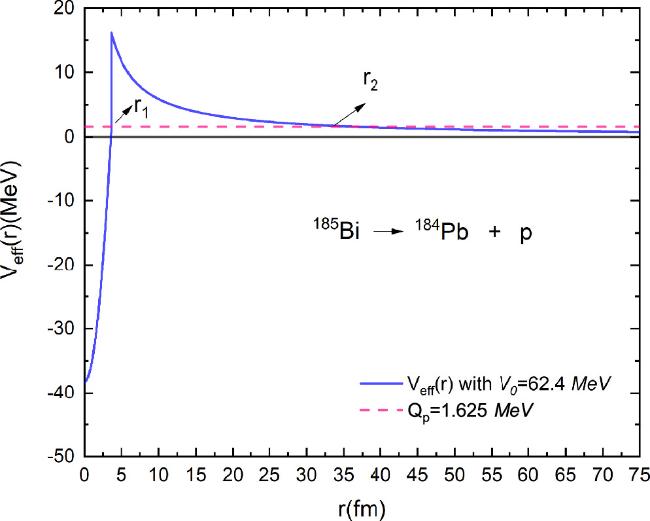
Figure 1. Schematic plot of effective potential as a function of the distance between the centers of the emitted proton and of the daughter nucleus r for the 185Bi nucleus system. |
As a fundamental tool in the WKB approximation, the Bohr-Sommerfeld quantization condition, which is based on the principles of classical and quantum mechanics, can effectively constrain the system's degrees of freedom. In this study, we apply the Bohr-Sommerfeld quantization condition to reduce the parameters of system in the interaction potential between the emitted proton and daughter nucleus. It is expressed as [62]
$\begin{eqnarray}{\int }_{0}^{{r}_{1}}\sqrt{\frac{2\mu }{{\hslash }^{2}}({V}_{\mathrm{eff}}(r)-{Q}_{{\rm{p}}})}{\rm{d}}r=(G-l+1)\frac{\pi }{2},\end{eqnarray}$
where G = 2nr + l is the principal quantum number with nr and l being the radial and angular momentum quantum number, respectively. In the present work, we choose G = 4 or 5, which corresponds to the 4ħω or 5ħω oscillator shells, depending on the specific proton emitter under consideration. Then, the relationship between V0 and V1 can be expressed as $\begin{eqnarray}{V}_{1}={C}_{1}+\frac{\mu }{2{\hslash }^{2}}{\left(\frac{{Q}_{{\rm{p}}}+{V}_{0}-{C}_{0}}{1+G}\right)}^{2},\end{eqnarray}$
with the integral conditions C0 < (Qp + V0) and C1 < V1.Using equation (10 ), the normalization factor F and action integral S can be further written as
$\begin{eqnarray}F=\frac{4}{\pi }\,\frac{\mu }{{\hslash }^{2}}\left(\frac{{Q}_{{\rm{p}}}+{V}_{0}-{C}_{0}}{1+G}\right).\end{eqnarray}$
$\begin{eqnarray}S=\frac{\sqrt{2\mu }}{\hslash }\frac{{C}_{2}}{\sqrt{{Q}_{{\rm{p}}}}}\left[{\rm{\arccos }}\left(\sqrt{\frac{{Q}_{{\rm{p}}}{r}_{1}}{{C}_{2}}}\right)-\sqrt{\frac{{Q}_{{\rm{p}}}{r}_{1}}{{C}_{2}}-{\left(\frac{{Q}_{{\rm{p}}}{r}_{1}}{{C}_{2}}\right)}^{2}}\right].\end{eqnarray}$
The spectroscopic factor of the emitted proton-daughter system Sp is obtained from RMF theory and the BCS method [8, 10, 41, 42]. Based on the Dirac-Lagrangian density, RMF theory is particularly suitable for investigating the single-particle structure of these proton-rich nuclei since it naturally incorporates the spin degree of freedom [31, 32]. In this work, Sp can be estimated by
$\begin{eqnarray}{S}_{{\rm{p}}}={u}_{j}^{2},\end{eqnarray}$
where ${u}_{j}^{2}$ represents the probability that the orbit of the emitted proton is empty in the daughter nucleus [11].Combining equations (1 )-(13 ), the favored proton radioactivity half-life can be expressed as
$\begin{eqnarray}\begin{array}{rcl}{T}_{1/2} & = & \frac{\pi \,\hslash \,{\mathrm{ln}}\,2}{{S}_{{\rm{p}}}}\frac{(1+G)}{({Q}_{{\rm{p}}}+{V}_{0}-{C}_{0})}\\ & & \times {\rm{\exp }}\left(\frac{2\sqrt{2\mu }}{\hslash }\frac{{C}_{2}}{\sqrt{{Q}_{{\rm{p}}}}}\left[{\rm{\arccos }}\left(\sqrt{\frac{{Q}_{{\rm{p}}}{r}_{1}}{{C}_{2}}}\right)\right.\right.\\ & & -\left.\left.\sqrt{\frac{{Q}_{{\rm{p}}}{r}_{1}}{{C}_{2}}-{\left(\frac{{Q}_{{\rm{p}}}{r}_{1}}{{C}_{2}}\right)}^{2}}\right]\right).\end{array}\end{eqnarray}$
3. Results and discussion
Before discussing the calculated results, the corresponding details about the spectroscopic factor Sp and the depth of the nuclear potential V0 require further explanation. On the one hand, the spectroscopic factor Sp is obtained from RMF theory and the BCS method [21] in this work. The force parameter is chosen as DD-ME2, which has demonstrated widespread success and applicability in depicting diverse structural characteristics across a broad spectrum of nuclei [63-67]. In order to further prove the reliability of the obtained Sp, a similar work [21] is also used for comparison. Our calculated results and those of [21] are shown in columns 4 and 5 of table 1, denoted as ${S}_{{\rm{p}}}^{\mathrm{cal}}$ and ${S}_{{\rm{p}}}^{\mathrm{ref}}$, respectively. From this table, one can clearly see that the corresponding results are basically consistent. Meanwhile, ${S}_{{\rm{p}}}^{\mathrm{cal}}$ satisfies the trend of the spectroscopic factors evaluated by various methods [11, 28, 31, 32, 68, 69]. Beyond individual cases, systematic trends in spectroscopic factors Sp reveal distinct categories aligned with deformation and pairing effects. Classified via RMF+BCS-calculated β2 values, spherical nuclei (167Ir,171Au; |β2| < 0.1) exhibit high Sp = 0.83 ± 0.03, transitional nuclei (157Ta,177Tl; 0.1 ≤ β2 < 0.2) show moderate Sp = 0.81 ± 0.02, while deformed nuclei (141Hom,185Bi; β2 ≥ 0.3) display significant suppression (Sp = 0.48 ± 0.25). This stratification resonates with the multilinear formation probability systematics (k-classification) in proton radioactivity [70], where our Sp values correspond to k = 2 (transitional) and k = 1 (deformed) regimes. Crucially, the predictions of HOPM retain accuracy across all categories; for example, the highly hindered 185Bi (Sp = 0.041) aligns with k = 1 in Amaro et al's model ($| RF(R){| }_{k=1}^{2}\sim 1{0}^{-3}$), while the spherical 171Au (Sp = 0.831) approaches the k = 3 particle decay unit limit. On the other hand, V0 is an adjustable parameter that reflects the strength of the interaction between nucleons in the framework of HOPM. In this work, the ideal value of V0 is obtained by using a genetic algorithm with the optimal solution of the standard deviation σ as the objective function; we used V0 = 62.4 MeV based on experimental data from nine favored proton emitters with orbital angular momentum l = 0, and sensitivity analysis confirms that minor variations in V0 induce significant deviations in half-life predictions due to the exponential dependence on the tunneling integral. Details on σ can be found in equation (15 ).
Table 1. Comparison between the experimental and calculated half-lives of favored proton radioactivity with 50 ≤ Z ≤ 83. The symbol '#' represents estimated values based on trends in neighboring nuclides with the same Z and N parities. The symbol m indicates the isomeric state, '()' denotes uncertain spin and/or parity. The experimental data for favored proton radioactivity half-lives and Qp value information are obtained from [21, 27, 39]. |
| ${\mathrm{log}}_{10}{T}_{1/2}(s)$ | |||||||||
|---|---|---|---|---|---|---|---|---|---|
| Nuclei | Qp (MeV) | ${j}_{{\rm{p}}}^{x}\longrightarrow {j}_{{\rm{d}}}^{x}$ | ${S}_{{\rm{p}}}^{\mathrm{ref}}$ | ${S}_{{\rm{p}}}^{\mathrm{cal}}$ | Expt | HOPM | UDLP | NGNL | OPM |
| ${}_{67}^{141}{{\rm{Ho}}}^{{\rm{m}}}$ | 1.264 | (1/2+) → 0+ | 0.715 | 0.914 | -5.137 | -6.244 | -5.333 | -5.526 | -5.979 |
| ${}_{69}^{146}{\rm{Tm}}$ | 0.904 | (1+) → 1/2+# | 0.748 | 0.889 | -0.81 | -0.975 | -0.605 | -0.963 | -0.711 |
| ${}_{73}^{157}{\rm{Ta}}$ | 0.956 | (1/2+) → 0+ | 0.906 | 0.795 | -0.529 | -0.335 | -0.194 | -0.510 | -0.154 |
| ${}_{75}^{161}{\rm{Re}}$ | 1.216 | (1/2+) → 0+ | 0.908 | 0.786 | -3.357 | -3.247 | -2.893 | -3.017 | -3.113 |
| ${}_{77}^{167}{\rm{Ir}}$ | 1.087 | (1/2+) → 0+ | 0.894 | 0.828 | -1.128 | -0.972 | -0.867 | -1.078 | -0.822 |
| ${}_{79}^{171}{\rm{Au}}$ | 1.464 | (1/2+) → 0+ | 0.872 | 0.831 | -4.652 | -4.681 | -4.294 | -4.224 | -4.579 |
| ${}_{81}^{176}{\rm{Tl}}$ | 1.278 | (3-, 4-, 5-) → (7/2-) | 0.926 | 0.999 | -2.208 | -2.254 | -2.059 | -2.113 | -2.067 |
| ${}_{81}^{177}{\rm{Tl}}$ | 1.172 | (1/2+) → 0+ | 0.498 | 0.832 | -1.178 | -0.850 | -0.863 | -1.003 | -0.740 |
| ${}_{83}^{185}{\rm{Bi}}$ | 1.625 | (1/2+) → 0+ | 0.032 | 0.041 | -4.192 | -3.606 | -4.761 | -4.513 | -5.064 |
In the following, with the help of equation (14 ), we systematically calculate the half-lives of nine proton emitters. The detailed results are shown in table 1. In this table, the first two columns represent the proton emitter and the corresponding released energy Qp, respectively. The third column denotes the spin and parity transition. The experimental favored proton radioactivity half-lives and calculated results are shown in the sixth and seventh column, denoted ${{\rm{log}}}_{10}{T}_{1/2}^{{\rm{Exp}}}$ and ${{\rm{log}}}_{10}{T}_{1/2}^{{\rm{HOPM}}}$, respectively. For comparison, UDLP [14], NGNL [43] and OPM [39] are used to calculate proton radioactivity half-lives. The calculated results in logarithmic form are also listed in the last three columns, denoted as ${{\rm{log}}}_{10}{T}_{1/2}^{{\rm{UDLP}}}$, ${{\rm{log}}}_{10}{T}_{1/2}^{{\rm{NGNL}}}$ and ${{\rm{log}}}_{10}{T}_{1/2}^{{\rm{OPM}}}$, respectively. For displaying a clear comparison, we plot the differences in logarithmic form between the experimental half-lives and calculated ones by using HOPM, UDLP, NGNL and OPM, which are respectively shown as the blue squares, green circles, purple diamonds and red inverted triangles in figure 2. From this figure, it can be clearly seen that the deviations between the experimental data and our calculated ones almost all lie within the range of ±0.5, which means that HOPM can reproduce the experimental data well. However, one can find that there are still two nuclei, 141Hom and 185Bi, with large deviations in this figure, and the largest one 141Hom is greater than one order of magnitude. For 141Hom, the calculated results using all models or formulae are less than the experimental data. The relevant studies have proved that the nucleus 141Hom [13, 71] is deformed. By contrast, for 185Bi, the deviation between experimental data and calculated results using all models or formulae is greater. For 185Bi, the significant deviation observed across all models (figure 2) can be attributed to two combined effects revealed by recent precision measurements [21, 72-74]: one arises from the mixed oblate-prolate shape (β2 ~ 0.15) of 185Bi and shape coexistence in the 184Pb daughter, which lowers the effective Coulomb barrier, enhancing decay probability beyond spherical-model predictions. The other stems from the HOPM-predicted half-life T1/2 ∝ 1/Sp, which exhibits exceptional sensitivity. When Sp increases from 0.041 (RMF+BCS) to 0.6 (experimental [72]), ${T}_{1/2}^{{\rm{HOPM}}}$ increases from 0.193 μs to 13.2 μs, reducing the logarithmic deviation from +2.36 dex to +0.67 dex relative to the new experimental value (${T}_{1/2}^{{\rm{Expt}}}=2.8\,{\rm{\mu }}$s). This confirms 185Bi to be a critical benchmark for testing model robustness in deformed proton emitters, where conventional spherical approximations prove inadequate.
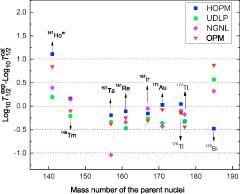
Figure 2. The decimal logarithm deviations represent the differences, in logarithmic form, between the experimental half-lives of favored nuclei undergoing proton radioactivity and the corresponding calculated values obtained from various theoretical models and formulae. |
The standard deviation σ quantifies the difference between the experimental proton radioactivity half-lives and the calculated ones, defined as 15 ), we calculate the standard deviation σ using UDLP, NGNL, OPM and our model. The detailed results are shown in table 2. From this table, the σ value between the experimental data and the results obtained using HOMP is 0.430, larger than the results from the four-parameter empirical formula UDLP and smaller than the results from the empirical formula NGNL and the OPM model, which are 0.461 and 0.470, respectively. This indicates that our model can reproduce the experimental data well for favored proton radioactivity half-lives.
$\begin{eqnarray}\sigma =\sqrt{\frac{1}{n}{\sum }_{i=1}^{n}{\left({{\rm{log}}}_{10}{T}_{i,1/2}^{{\rm{\exp }}}-{{\rm{log}}}_{10}{T}_{i,1/2}^{{\rm{cal}}}\right)}^{2}}.\end{eqnarray}$
Here, n represents the total number of nuclei and ${{\rm{log}}}_{10}{T}_{i,1/2}^{{\rm{\exp }}}$ and ${{\rm{log}}}_{10}{T}_{i,1/2}^{{\rm{cal}}}$ denote the experimental and calculated logarithmic half-lives for the ith nucleus. With the help of equation (Table 2. The standard deviation σ between the experimental data for favored proton radioactivity half-lives and the corresponding calculated ones obtained from various theoretical models and formulae. |
| UDLP | NGNL | OPM | HOPM |
|---|---|---|---|
| σ = 0.342 | σ = 0.461 | σ = 0.470 | σ = 0.430 |
In view of the close agreement between the experimental half-lives and the calculated ones when using HOPM, we extend this model to predict the proton radioactivity half-lives of possible proton-emission candidates. Their proton radioactivities are energetically permitted or observed but not yet quantified in NUBASE2020 [56] for a range of proton numbers from 67 to 85. We also apply OPM and UDLP for comparison. The corresponding predictions are listed in table 3. In this table, the first two columns share the same information as table 1. Based on the RMF+BCS method, the predicted spectroscopic factors ${S}_{{\rm{p}}}^{\mathrm{pre}}$ are listed in the third column. The last three columns display the predicted half-lives of proton radioactivity using HOPM, OPM and UDLP, denoted as ${{\rm{log}}}_{10}{T}_{1/2}^{{\rm{HOPM}}}$, ${{\rm{log}}}_{10}{T}_{1/2}^{{\rm{OPM}}}$ and ${{\rm{log}}}_{10}{T}_{1/2}^{{\rm{UDLP}}}$. For a more intuitive comparison, the predictions from these three models are presented in figure 3. From this figure, it can be seen that the predictions agree with each other to within ±0.5 log units.
Table 3. The favored proton radioactivity half-lives that are observed or their proton radioactivity is energetically allowed but not yet quantified in the latest atomic mass excess NUBASE2020 [56] and the related [21, 27, 39], predicted using HOPM, OPM and UDLP. |
| ${\mathrm{log}}_{10}{T}_{1/2}({\rm{s}})$ | |||||
|---|---|---|---|---|---|
| Nucleus | Qp (MeV) | ${S}_{{\rm{p}}}^{\mathrm{pre}}$ | HOPM | OPM | UDLP |
| ${}^{159}{\rm{Re}}$ | 1.606 | 0.745 | -6.892 | -6.796 | -6.226 |
| ${}^{163}{\rm{Re}}$ | 0.723 | 0.823 | 5.183 | 5.375 | 4.755 |
| 163Ir | 1.917 | 0.738 | -8.498 | -8.434 | -7.759 |
| 165Ir | 1.547 | 0.786 | -5.924 | -5.822 | -5.387 |
| 169Ir | 0.628 | 0.866 | 8.786 | 8.971 | 7.969 |
| 168Au | 2.007 | 0.047 | -7.376 | -8.534 | -7.887 |
| 169Au | 1.947 | 0.788 | -8.248 | -8.186 | -7.572 |
| 173Au | 1.002 | 0.841 | 1.001 | 1.134 | 0.867 |
| 178Tl | 0.898 | 0.848 | 3.604 | 3.745 | 3.180 |
| 179Tl | 0.773 | 0.866 | 6.389 | 6.548 | 5.700 |
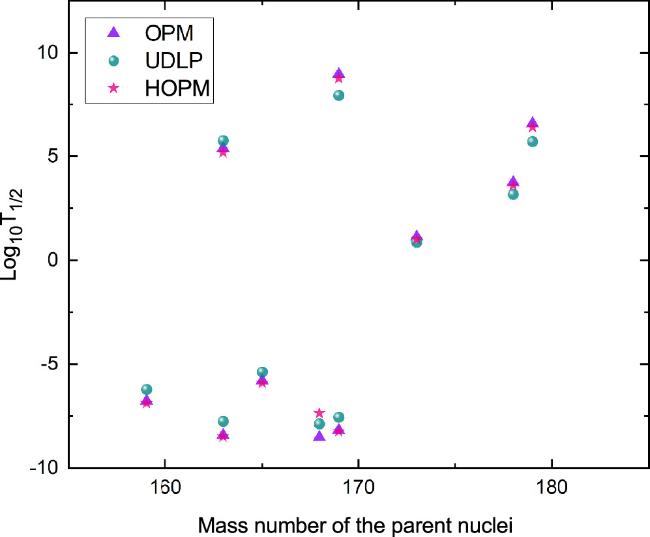
Figure 3. The predicted proton radioactivity half-lives compared using HOPM, OPM and UDLP models, represented by a pink five-pointed star, purple triangle and green spheres, respectively. |
Besides the model predictions, empirical laws serve to verify the reliability of predictions. In 2006, Delion et al [24] proposed a linear correlation between the reduced half-life and the Coulomb parameter χ. This formula can be written as
$\begin{eqnarray}{{\rm{log}}}_{10}{T}^{k}={a}_{k}(\chi -20)+{b}_{k},\end{eqnarray}$
where ak and bk (k = 1, 2) are the fitting parameters. For Z < 68, a1 = 1.31 and b1 = -2.44, while for Z > 68, a2 = 1.25 and b2 = -4.71.Recently, our group also proposed a two-parameter empirical formula to investigate proton radioactivity [43], which is given by
$\begin{eqnarray}{\mathrm{log}}_{10}{T}_{1/2}=a({Z}_{{\rm{d}}}^{0}8+l){Q}_{{\rm{p}}}^{-1/2}+b,\end{eqnarray}$
where the parameters a = 0.843 and b = -27.194.These empirical formulae completely describe the certain relationship between the half-life and the related physical quantities such as decay energy, centrifugal potential energy and Coulomb parameter. In the following, equations (16 ) and (17 ) are employed to further strengthen the reliability of our predicted results. On the one hand, we plot the relationship between the predicted proton radioactivity half-lives and the Coulomb parameter χ in figure 4. In this figure, the blue squares and solid line denote our predicted results and the linear relationship based on equation (16 ). On the other hand, the significant correlation between the half-life of proton radioactivity and ${Z}_{{\rm{d}}}^{0.8}{Q}_{{\rm{p}}}^{-1/2}$, the quantity ${{\rm{log}}}_{10}{T}_{1/2}$ as a function of ${Z}_{{\rm{d}}}^{0.8}{Q}_{{\rm{p}}}^{-1/2}$ is plotted in figure 5. The purple triangles and red spheres represent predicted half-lives and experimental data, which are consistent with the linear relationship based on equation (17 ). The above results suggest that the phenomenological model HOPM can reliably evaluate favored proton radioactivity half-lives. The predictions may provide useful information for identifying potential proton radioactive nuclides for further experiments.
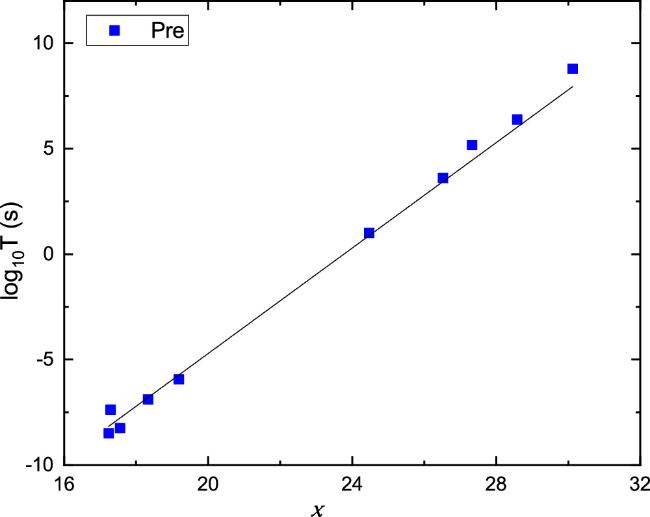
Figure 4. Values of ${{\rm{log}}}_{10}{T}_{{\rm{red}}}$ as a function of χ. The blue squares are extracted from table 3. The solid line is plotted by equation ( |
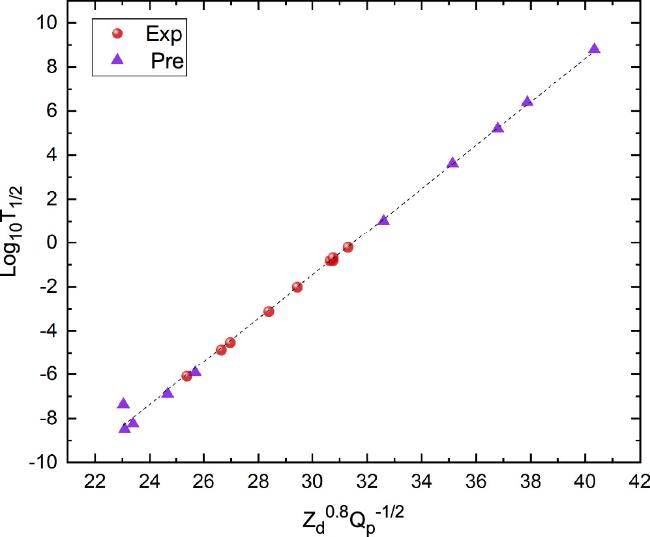


Figure 5. Graphical representation of the experimental and predicted half-lives in logarithmic form versus ${Z}_{{\rm{d}}}^{0.8}{Q}_{{\rm{p}}}^{-1/2}$. The experimental data for the half-lives are depicted as red spheres, while the predicted ones obtained by using HOPM are shown as purple triangles. |
4. Summary
In summary, based on the WKB approximation and Bohr-Sommerfeld quantization condition, a phenomenological modified harmonic oscillator model is applied to systematically study the favored proton radioactivity half-lives. In this model, the important spectroscopic factor Sp is obtained by the RMF method combined with the BCS method. Meanwhile, the nuclear potential, incorporating just one adjustable parameter, was determined to be V0 = 62.4 MeV by least-squares optimization against the experimental data. Using the obtained Sp and parameter V0, we systematically calculate the favored proton radioactivity half-lives, which exhibit good agreement with the experimental data. Additionally, we extend this phenomenological model to predict the half-lives of proton radioactivity for possible candidates. These candidates have been observed or their proton radioactivity is energetically allowed but not yet quantified in the latest atomic mass excess NUBASE2020. Furthermore, the reliability of our predictions is further supported by the validation through the new Geiger-Nuttall law and a standard formula that connects the reduced half-life to the Coulomb parameter χ. This indicates that our predictions could be a theoretical guide for future experimental studies.