

1. Introduction
Irreversibility is an old and recurrent topic in both classical and quantum dynamics [1–15]. As a general phenomenon, it has many faces. In statistical physics, the second law of thermodynamics elevates irreversibility to a fundamental aspect of physical evolution. In quantum theory, irreversibility gains new features, while the Schrödinger equation gives rise to reversible and deterministic evolution, quantum measurement introduces intrinsic irreversibility and probability.
Irreversibility of quantum channels, as a fundamental property indicating the inability to perfectly recover input states from their outputs, has been extensively studied in quantum information theory [16–23]. This phenomenon often arises from the system-environment interaction, which results in the loss of information to the environment and causes dissipation and decoherence. While reversible channels (e.g., unitary channels) are achievable under idealized conditions, most quantum channels exhibit some degree of irreversibility and require tools such as quantum error correction or approximate recovery protocols to mitigate their effects [24–29].
A pair of quantum channels is usually classified as compatible or incompatible, depending on whether it is possible or impossible to implement them simultaneously [30–35]. Quantum incompatibility, as a radical feature distinguishing quantum mechanics from its classical counterpart, is a crucial resource in many quantum information processing tasks [36–50]. Due to the complexity and subtlety of incompatibility, there are different notions of channel incompatibility based on distinct operational or theoretical perspectives [51], which form a hierarchy and every level of this hierarchy has its own unique feature [51–54].
Both irreversibility and incompatibility are key characteristics in quantum theory, and are the roots of many quantum phenomena. A natural and basic question arises concerning the relation between these two fundamental characteristics of quantum theory. In conventional studies, irreversibility of quantum channels is typically characterized as an intrinsic attribute of a single channel isolated from the relationship between different channels. In contrast, incompatibility naturally arises in the context of at least two channels. Motivated by this distinction and in order to connect them, we introduce a generalized framework that extends the traditional definition of reversible channels to relatively reversible channels. This relative notion of reversibility enables a unified perspective for investigating the relation between irreversibility and incompatibility of quantum channels. We will provide a quantitative study of channel irreversibility in terms of channel incompatibility, which in turn is quantified via Jordan negativity [55–58]. We reveal basic properties of this quantifier of irreversibility and make some comparisons with existing quantifiers of irreversibility by working out some qubit examples.
The work is arranged as follows. In section 2 , we review some basic properties of reversible channels and complementary channels, which will be useful in our investigation of channel irreversibility and incompatibility. We introduce the notion of relative reversibility, which generalizes the conventional notion of reversibility and has interesting meaning in quantum error correction. In section 3 , we establish an intrinsic connection between irreversibility and incompatibility of quantum channels. We quantify irreversibility via incompatibility and discuss its intuitive properties. We illustrate the quantifier via several explicit examples. In section 4 , we make a comparative study between our quantifier of irreversibility and some other quantifiers in the literature. Finally, we conclude with some discussions and perspectives in section 5 .
2. Reversible channels and complementary channels
Let H and K be finite-dimensional Hilbert spaces and denoted by L(H) and L(K) the spaces of all linear operators on H and K, respectively. Let
$\begin{eqnarray*}{ \mathcal E }\,:L(H)\to L(K),\end{eqnarray*}$
be a quantum channel (a completely positive trace-preserving mapping) with a Kraus representation [59, 60] $\begin{eqnarray}{ \mathcal E }(X)=\displaystyle \sum _{i}{E}_{i}X{E}_{i}^{\dagger },\qquad \forall \,X\in L(H),\end{eqnarray}$
where Ei are the Kraus operators of ${ \mathcal E }$ satisfying ${\sum }_{i}{E}_{i}^{\dagger }{E}_{i}={{\bf{1}}}_{H}$ (the identity operator on H). Recall that a quantum channel is often defined on S(H) (the convex set of all density operators on H). But it can be readily extended to L(H) via linearity, and thus may be regarded as defined on L(H).A quantum channel ${ \mathcal E }\,:L(H)\to L(K)$ is called an isometric channel if there exists an isometry V: H → K (i.e., V†V = 1) such that
$\begin{eqnarray}{ \mathcal E }(X)=VX{V}^{\dagger },\qquad \forall \,X\in L(H).\end{eqnarray}$
In the special case ${\rm{\dim }}H={\rm{\dim }}K,$ V is actually a unitary operator, and ${ \mathcal E }$ reduces to a unitary channel. The identity mapping $\begin{eqnarray*}{ \mathcal I }\,:L(H)\to L(H),\end{eqnarray*}$
is a simple example of a unitary channel.A quantum channel ${ \mathcal E }$ is called trace-norm preserving if
$\begin{eqnarray*}| | { \mathcal E }(X)| {| }_{1}=| | X| {| }_{1},\end{eqnarray*}$
where $| | X| {| }_{1}={\rm{tr}}\sqrt{{X}^{\dagger }X}$ denotes the trace-norm of X. Every isometric channel is trace-norm preserving, but the converse does not always hold, as can be clearly seen from the discussion on equivalence between reversible channels and trace-norm preserving channels.A quantum channel ${ \mathcal E }\,:\,L(H)\to L(K)$ is called reversible if there exists a quantum channel (called the recovery channel)
$\begin{eqnarray*}{ \mathcal R }\,:L(K)\to L(H),\end{eqnarray*}$
such that ${ \mathcal R }\,\circ \,{ \mathcal E }={ \mathcal I }$ (the identity channel), i.e., $\begin{eqnarray*}X={ \mathcal R }\,\circ \,{ \mathcal E }(X),\qquad \forall \,X\in L(H).\end{eqnarray*}$
Otherwise, it is called irreversible.In terms of the Stinespring dilation theorem [63], any quantum channel ${ \mathcal E }\,:\,L(H)\to L(K)$ can be represented as
$\begin{eqnarray*}{ \mathcal E }(X)={\mathrm{tr}}_{{K}_{1}}(VX{V}^{\dagger }),\,\,\,\,\,\,X\in L(H),\end{eqnarray*}$
with V: H → K ⨂ K1 being an isometric operator. Its complementary channel $\begin{eqnarray*}\hat{{ \mathcal E }}\,:L(H)\to L({K}_{1}),\end{eqnarray*}$
is defined as $\begin{eqnarray*}\hat{{ \mathcal E }}(X)={\mathrm{tr}}_{K}(VX{V}^{\dagger }),\qquad X\in L(H).\end{eqnarray*}$
Let Ei: H → K be determined by $\begin{eqnarray}\langle y| {E}_{i}| x\rangle =\langle y| \otimes \langle i| V| x\rangle ,\qquad \forall \,| x\rangle \in H,\,| y\rangle \in K,\end{eqnarray}$
and {∣i⟩} be an orthonormal basis for K1, then Ei are the Kraus operators of ${ \mathcal E }$ in the sense that $\begin{eqnarray*}{ \mathcal E }(X)=\displaystyle \sum _{i}{E}_{i}X{E}_{i}^{\dagger },\qquad X\in L(H),\end{eqnarray*}$
and ${\sum }_{i}{E}_{i}^{\dagger }{E}_{i}={\bf{1}}.$ In this context, the Kraus operators ${\hat{E}}_{\alpha }$ of $\hat{{ \mathcal E }}$ are determined by ${({\hat{E}}_{\alpha })}_{ij}={({E}_{i})}_{\alpha j}$ in the form of matrix elements [64], and $\begin{eqnarray}\hat{{ \mathcal E }}(X)=\displaystyle \sum _{ij}{\rm{tr}}({E}_{i}X{E}_{j}^{\dagger })| i\rangle \langle j| =\displaystyle \sum _{\alpha }{\hat{E}}_{\alpha }X{\hat{E}}_{\alpha }^{\dagger }.\end{eqnarray}$
In other words, the Kraus operators ${\hat{E}}_{\alpha }$ of the complementary channel can be obtained from the Kraus operators of the original channel by simply exchanging the indexes.The Stinespring dilation theorem implies that for a given quantum channel, its complementary channel always exists but is not unique. Among these, the complementary channel with the minimal environment space K1, whose dimension equals the Choi rank of ${ \mathcal E }$, is called the minimal complementary channel. Suppose ${\hat{{ \mathcal E }}}_{2}\,:\,L(H)\to L({K}_{2})$ is another complementary channel of ${ \mathcal E }$, then there exists an isometric operator V : K1 → K2 such that ${\hat{{ \mathcal E }}}_{2}={ \mathcal V }\,\circ \,\hat{{ \mathcal E }}$, where ${ \mathcal V }(X)=VX{V}^{\dagger },X\in L({K}_{1}),$ is an isometric channel [61].
The complementary channels have the following composition property: for any unitary channels ${ \mathcal U }(X)=UX{U}^{\dagger }$ on K and ${ \mathcal W }(Y)=WY{W}^{\dagger }$ on H, it holds that
$\begin{eqnarray*}\widehat{{ \mathcal U }\,\circ \,{ \mathcal E }}=\hat{{ \mathcal E }},\qquad \widehat{{ \mathcal E }\,\circ \,{ \mathcal W }}=\hat{{ \mathcal E }}\,\circ \,{ \mathcal W }.\end{eqnarray*}$
To establish the above statement, noting that the Stinespring representation of ${ \mathcal U }\,\circ \,{ \mathcal E }$ and ${ \mathcal E }\,\circ \,{ \mathcal W }$ are given by 3 ), we have 4 ).
$\begin{eqnarray*}\begin{array}{rcl}{ \mathcal U }\,\circ \,{ \mathcal E }(X) & = & {{\rm{tr}}}_{{K}_{1}}((U\displaystyle \otimes {\bf{1}})VX{V}^{\dagger }{(U\displaystyle \otimes {\bf{1}})}^{\dagger }),\\ { \mathcal E }\,\circ \,{ \mathcal W }(X) & = & {{\rm{tr}}}_{{K}_{1}}(VWX{W}^{\dagger }{V}^{\dagger }),\end{array}\end{eqnarray*}$
respectively. From equation ( $\begin{eqnarray*}\begin{array}{rcl}\langle y| U{E}_{i}| x\rangle & = & \langle y| \displaystyle \otimes \langle i| (U\displaystyle \otimes {\bf{1}})V| x\rangle ,\\ \langle y| {E}_{i}W| x\rangle & = & \langle y| \displaystyle \otimes \langle i| VW| x\rangle ,\end{array}\end{eqnarray*}$
for all vector∣x⟩ ∈ H, ∣y⟩ ∈ K. Therefore we obtain $\begin{eqnarray*}\begin{array}{rcl}\widehat{{ \mathcal U }\,\circ \,{ \mathcal E }}(X) & = & \displaystyle \sum _{ij}{\rm{tr}}(U{E}_{i}X{E}_{j}^{\dagger }{U}^{\dagger })| i\rangle \langle j| =\hat{{ \mathcal E }}(X),\\ \widehat{{ \mathcal E }\,\circ \,{ \mathcal W }}(X) & = & \displaystyle \sum _{ij}{\rm{tr}}({E}_{i}WX{W}^{\dagger }{E}_{j}^{\dagger })| i\rangle \langle j| =\hat{{ \mathcal E }}\,\circ \,{ \mathcal W }(X),\end{array}\end{eqnarray*}$
from equation (The equivalence between reversible channels and trace-norm preserving channels is established in [22]. We summarize the related results as follows. For a quantum channel ${ \mathcal E }\,:\,L(H)\to L(K)$, the following statements are equivalent:
(1) ${ \mathcal E }$ is reversible.
(2) ${ \mathcal E }$ is trace-norm preserving.
(3) The complementary channel $\hat{{ \mathcal E }}\,:\,L(H)\to L({K}_{1})$ of ${ \mathcal E }$ is a replacement channel in the sense that
$\begin{eqnarray*}\hat{{ \mathcal E }}(X)={\rm{tr}}(X)\rho ,\qquad \forall \,X\in L(H),\end{eqnarray*}$
with ρ a fixed quantum state on an auxiliary system K1.(4) There exist positive numbers λi and isometries Vi: H → K, i = 1, 2, ⋯ , m, such that
$\begin{eqnarray}{ \mathcal E }(X)=\displaystyle \sum _{i=1}^{m}{\lambda }_{i}{V}_{i}X{V}_{i}^{\dagger },\end{eqnarray}$
where ${\sum }_{i=1}^{m}{\lambda }_{i}=1$ and ${V}_{j}^{\dagger }{V}_{i}=0$ for all i ≠ j (orthogonal condition).Reversibility of quantum channels is a crucial and fundamental issue in analyzing quantum systems. We generalize this notion considerably by extending it to channel's reversible relative to a fixed quantum channel.
Given a fixed quantum channel ${\rm{\Phi }}\,:L(H)\to L({H}^{{\prime} })$, a quantum channel ${ \mathcal E }\,:L(H)\to L(K)$ is called $\Phi$-reversible (alternatively, reversible relative to $\Phi$) if there exists a quantum channel ${{ \mathcal R }}_{{\rm{\Phi }}}\,:L(K)\to L({H}^{{\prime} })$ such that
$\begin{eqnarray*}{\rm{\Phi }}(X)=({{ \mathcal R }}_{{\rm{\Phi }}}\,\circ \,{ \mathcal E })(X),\qquad \forall \,X\in L(H).\end{eqnarray*}$
The above definition is schematically depicted in Figure 1.
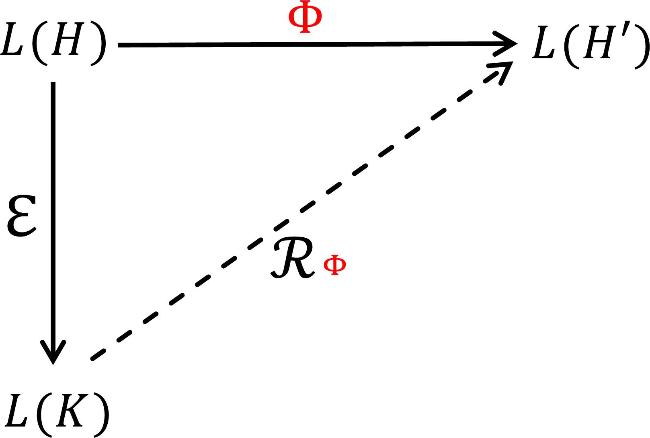
Figure 1. $\Phi$-reversibility of ${ \mathcal E }$ means that ${\rm{\Phi }}={{ \mathcal R }}_{{\rm{\Phi }}}\,\circ \,{ \mathcal E }$ for some channel ${{ \mathcal R }}_{{\rm{\Phi }}}$. |
The conventional (absolute) notion of channel reversibility for ${ \mathcal E }$ corresponds to the (relative) case when ${ \mathcal E }$ is reversible relative to the identity channel ${ \mathcal I }$ (i.e., taking ${\rm{\Phi }}={ \mathcal I }$). A quantum channel ${ \mathcal E }$ is $\Phi$-reversible means that $\Phi$ is a concatenation of ${{ \mathcal R }}_{{\rm{\Phi }}}$ and ${ \mathcal E }$ in the sense of [34].
3. Irreversibility versus incompatibility of quantum channels
Two quantum channels ${{ \mathcal E }}_{a}$ and ${{ \mathcal E }}_{b}$ are compatible if they can be implemented simultaneously, with the future option to select one channel’s output while discarding the other’s. In the following we review two notions of compatibility of quantum channels.
Let ${{ \mathcal E }}_{a}\,:\,L(H)\to L({K}_{a})$ and ${{ \mathcal E }}_{b}\,:\,L(H)\to L({K}_{b})$ be two quantum channels. If there exists a quantum channel
$\begin{eqnarray*}{ \mathcal E }\,:L(H)\to L({K}_{a}\otimes {K}_{b}),\end{eqnarray*}$
such that $\begin{eqnarray*}{{\rm{tr}}}_{a}{ \mathcal E }(X)={{ \mathcal E }}_{b}(X),\quad {{\rm{tr}}}_{b}{ \mathcal E }(X)={{ \mathcal E }}_{a}(X),\quad \forall \,X\in L(H),\end{eqnarray*}$
then they are called joint-compatible. Otherwise, they are joint-incompatible. Here ${{\rm{tr}}}_{a}$ means taking partial trace over Ka. Clearly, two quantum channels are joint-compatible if they can be realized as marginal channels of a global channel.Recall that the Choi state (up to a constant factor) of a quantum channel ${ \mathcal E }\,:L(H)\to L(K)$ is defined as
$\begin{eqnarray*}{C}_{{ \mathcal E }}=\displaystyle \sum _{ij}{e}_{ij}\otimes { \mathcal E }({e}_{ij}),\end{eqnarray*}$
where eij = ∣i⟩⟨j∣ with {∣i⟩} an orthonormal basis of H. By the celebrated channel-state duality [65], a channel is uniquely determined by its Choi state.Let ${{ \mathcal E }}_{a}\,:\,L(H)\to L({K}_{a})$ and ${{ \mathcal E }}_{b}\,:\,L(H)\to L({K}_{b})$ be two quantum channels. If their Jordan product
$\begin{eqnarray*}{{ \mathcal E }}_{a}\odot {{ \mathcal E }}_{b}\,:L(H)\to L({K}_{a}\otimes {K}_{b}),\end{eqnarray*}$
is a quantum channel, then they are called Jordan-compatible [56]. Here the Jordan product ${{ \mathcal E }}_{a}\odot {{ \mathcal E }}_{b}$ of ${{ \mathcal E }}_{a}$ and ${{ \mathcal E }}_{b}$ is defined via the corresponding Choi operator (not necessarily a state) [55] $\begin{eqnarray*}{C}_{{{ \mathcal E }}_{a}\odot {{ \mathcal E }}_{b}}=\displaystyle \sum _{ijkl}\{{e}_{ij},{e}_{kl}\}\otimes {{ \mathcal E }}_{a}({e}_{ij})\otimes {{ \mathcal E }}_{b}({e}_{kl}),\end{eqnarray*}$
where $\begin{eqnarray*}\{{e}_{ij},{e}_{kl}\}=\frac{1}{2}({e}_{ij}{e}_{kl}+{e}_{kl}{e}_{ij}),\end{eqnarray*}$
is the Jordan product of the operators eij and ekl. It is straightforward to see that the operator ${C}_{{{ \mathcal E }}_{a}\odot {{ \mathcal E }}_{b}}$ is Hermitian and satisfies the following marginal property $\begin{eqnarray*}{{\rm{tr}}}_{b}{C}_{{{ \mathcal E }}_{a}\odot {{ \mathcal E }}_{b}}={C}_{{{ \mathcal E }}_{a}},\qquad {{\rm{tr}}}_{a}{C}_{{{ \mathcal E }}_{a}\odot {{ \mathcal E }}_{b}}={C}_{{{ \mathcal E }}_{b}}.\end{eqnarray*}$
The linear map ${{ \mathcal E }}_{a}\odot {{ \mathcal E }}_{b}\,:\,L(H)\to L({K}_{a}\otimes {K}_{b})$ is a quantum channel if and only if $\begin{eqnarray*}{C}_{{{ \mathcal E }}_{a}\odot {{ \mathcal E }}_{b}}\geqslant 0.\end{eqnarray*}$
The following quantifier of Jordan incompatibility between two quantum channels ${{ \mathcal E }}_{a}$ and ${{ \mathcal E }}_{b},$
$\begin{eqnarray}I({{ \mathcal E }}_{a},{{ \mathcal E }}_{b})=| | {C}_{{{ \mathcal E }}_{a}\odot {{ \mathcal E }}_{b}}| {| }_{1}-d,\end{eqnarray}$
is studied in [57]. Here d is the dimension of the input space H. This is the Jordan negativity of ${C}_{{{ \mathcal E }}_{a}\odot {{ \mathcal E }}_{b}}.$The Jordan-compatibility of two quantum channels ${{ \mathcal E }}_{a}$ and ${{ \mathcal E }}_{b}$ is a sufficient condition for their joint-compatibility. Moreover, in certain special cases, such as unitary channels, joint-compatibility and Jordan-compatibility are equivalent [55]. Consequently, given any quantum channel ${ \mathcal E }$, the quantifier
$\begin{eqnarray*}I({ \mathcal I },{ \mathcal E })=| | {C}_{{ \mathcal I }\odot { \mathcal E }}| {| }_{1}-d,\end{eqnarray*}$
may be utilized to capture certain degree of joint-incompatibility between the identity channel ${ \mathcal I }$ and the channel ${ \mathcal E }$, which has also been employed to characterize temporal correlating power of ${ \mathcal E }$ [58].The notion of channel compatibility is fundamentally connected to the notion of relative reversibility. Let ${{ \mathcal E }}_{a}\,:\,L(H)\to L({K}_{a})$ and ${{ \mathcal E }}_{b}\,:\,L(H)\to L({K}_{b})$ be two quantum channels. The following statements are equivalent [34]:
(1) ${{ \mathcal E }}_{a}$ and ${{ \mathcal E }}_{b}$ are joint-compatible.
(2) ${\hat{{ \mathcal E }}}_{a}$ is ${{ \mathcal E }}_{b}$-reversible.
(3) ${\hat{{ \mathcal E }}}_{b}$ is ${{ \mathcal E }}_{a}$-reversible.
Here the channels ${\hat{{ \mathcal E }}}_{a}$ and ${\hat{{ \mathcal E }}}_{b}$ are the complementary channels of ${{ \mathcal E }}_{a}$ and ${{ \mathcal E }}_{b}$, respectively. In particular, the reversibility of a channel ${ \mathcal E }$ is equivalent to the compatibility between the identity channel ${ \mathcal I }$ and its complementary channel $\hat{{ \mathcal E }}$. It turns out that $I({ \mathcal I },\hat{{ \mathcal E }})$ is indeed a bona fide quantifier for irreversibility.
For a quantum channel ${ \mathcal E }\,:\,L(H)\to L(K)$ with dimH = d, we define a quantifier of irreversibility of ${ \mathcal E }$ with the help of its complementary channel $\hat{{ \mathcal E }}$ as
$\begin{eqnarray}S({ \mathcal E })=I({ \mathcal I },\hat{{ \mathcal E }})=| | {C}_{{ \mathcal I }\odot \hat{{ \mathcal E }}}| {| }_{1}-d.\end{eqnarray}$
This definition is well-defined because the complementary channel is uniquely defined up to isometrical equivalence, and the quantifier satisfies
$\begin{eqnarray*}I({ \mathcal I },\hat{{ \mathcal E }})=I({ \mathcal I },{ \mathcal V }\,\circ \,\hat{{ \mathcal E }}),\end{eqnarray*}$
for any isometric channel ${ \mathcal V }$ (cf [58]).The quantifier of irreversibility $S({ \mathcal E })$ has the following properties.
(1) $0\,\leqslant \,S({ \mathcal E }).$ The lower bound $S({ \mathcal E })=0$ is attained if and only if ${ \mathcal E }$ is reversible, which in turn is equivalent to that it is either an isometric channel or a convex mixture of isometric channels that satisfy the orthogonality condition in equation (5 ).
(2) $S({ \mathcal E })$ is invariant under composition with unitary channels in the sense that
$\begin{eqnarray*}S({ \mathcal U }\,\circ \,{ \mathcal E })=S({ \mathcal E }\,\circ \,{ \mathcal W })=S({ \mathcal E }),\end{eqnarray*}$
for any unitary channels ${ \mathcal U }(Y)=UY{U}^{\dagger }$ on K and ${ \mathcal W }(Y)=WY{W}^{\dagger }$ on H.(3) Among all quantum channels ${ \mathcal E }\,:\,L(H)\to L(K)$ with ${\rm{\dim }}H=d,$ $S({ \mathcal E })$ achieves the maximum value d(d − 1) when ${ \mathcal E }$ is any replacement channel.
The above results can be easily verified by Proposition 1 in [58] and the properties of complementary channels.
Next we further illustrate the quantifier of irreversibility by studying some concrete classes of qubit channels.
Consider the amplitude damping channel ${{ \mathcal E }}_{p}(X)={\sum }_{i=1}^{2}{E}_{i}X{E}_{i}^{\dagger }$ on a qubit system with
$\begin{eqnarray*}{E}_{1}=\left(\begin{array}{cc}1 & 0\\ 0 & \sqrt{1-p}\end{array}\right),\quad {E}_{2}=\left(\begin{array}{cc}0 & \sqrt{p}\\ 0 & 0\end{array}\right),\qquad 0\leqslant p\leqslant 1,\end{eqnarray*}$
which models energy dissipation, such as the decay of an excited state to the ground state. According to equation ( $\begin{eqnarray*}\hat{{E}_{1}}=\left(\begin{array}{cc}1 & 0\\ 0 & \sqrt{p}\end{array}\right),\quad \hat{{E}_{2}}=\left(\begin{array}{cc}0 & \sqrt{1-p}\\ 0 & 0\end{array}\right),\qquad 0\leqslant p\leqslant 1.\end{eqnarray*}$
Through direct calculation, we obtain the eigenvalues (including degeneracy) of the corresponding ${C}_{{ \mathcal I }\odot {\hat{{ \mathcal E }}}_{p}}$ as 0(4), λ+, λ−, μ+, μ− (the superscripts mean multiplicity) and $\begin{eqnarray*}\begin{array}{rcl}{\lambda }_{\pm } & = & \frac{1}{2}(p\pm \sqrt{2p+2{p}^{2}}),\\ {\mu }_{\pm } & = & \frac{1}{2}(2-p\pm \sqrt{4-2p+2{p}^{2}}),\end{array}\end{eqnarray*}$
with λ+, μ+ ≥ 0, λ−, μ− ≤ 0 for p ∈ [0, 1]. Therefore, we have $\begin{eqnarray*}S({{ \mathcal E }}_{p})=\sqrt{2}(\sqrt{2-p+{p}^{2}}+\sqrt{p+{p}^{2}})-2\in [0,2],\end{eqnarray*}$
which is an increasing function of p. We see that $S({{ \mathcal E }}_{p})=0$ if and only if p = 0 (corresponding to ${{ \mathcal E }}_{0}={ \mathcal I })$, and $S({{ \mathcal E }}_{p})=2$ if and only if p = 1. In this case, ${{ \mathcal E }}_{1}$ is the replacement channel determined by sending any state to the fixed state ∣0⟩⟨0∣. The phase damping channel ${{ \mathcal E }}_{p}(X)\,={\sum }_{i=1}^{2}{E}_{i}X{E}_{i}^{\dagger }$ on a qubit system with
$\begin{eqnarray*}{E}_{1}=\left(\begin{array}{cc}1 & 0\\ 0 & \sqrt{1-p}\end{array}\right),\quad {E}_{2}=\left(\begin{array}{cc}0 & 0\\ 0 & \sqrt{p}\end{array}\right),\qquad 0\leqslant p\leqslant 1,\end{eqnarray*}$
describes the loss of quantum coherence without energy dissipation. In the computational basis, the phase damping channel retains a states's diagonals, but the off-diagonal elements acquire a factor of $\sqrt{1-p}$, where p determines the damping strength. According to equation ( $\begin{eqnarray*}\hat{{E}_{1}}=\left(\begin{array}{cc}1 & 0\\ 0 & 0\end{array}\right),\quad \hat{{E}_{2}}=\left(\begin{array}{cc}0 & \sqrt{1-p}\\ 0 & \sqrt{p}\end{array}\right),\qquad 0\leqslant p\leqslant 1.\end{eqnarray*}$
Through direct calculation, we obtain the eigenvalues (including degeneracy) of the corresponding ${C}_{{ \mathcal I }\odot {\hat{{ \mathcal E }}}_{p}}$ as 0(4), λ1, λ2, λ3, λ4 (the superscripts mean multiplicity) with $\begin{eqnarray*}\begin{array}{rcl}{\lambda }_{1} & = & \frac{1}{2}(1-\sqrt{2-2\sqrt{1-p}}-\sqrt{1-p})\leqslant 0,\\ {\lambda }_{2} & = & \frac{1}{2}(1+\sqrt{2-2\sqrt{1-p}}-\sqrt{1-p})\geqslant 0,\\ {\lambda }_{3} & = & \frac{1}{2}(1-\sqrt{2+2\sqrt{1-p}}+\sqrt{1-p})\leqslant 0,\\ {\lambda }_{4} & = & \frac{1}{2}(1+\sqrt{2+2\sqrt{1-p}}+\sqrt{1-p})\geqslant 0.\end{array}\end{eqnarray*}$
For this channel, the irreversibility defined via ( $\begin{eqnarray}S({{ \mathcal E }}_{p})=\sqrt{2}\left(\right.\sqrt{1-\sqrt{1-p}}+\sqrt{1+\sqrt{1-p}}\left)\right.-2,\end{eqnarray}$
and $S({{ \mathcal E }}_{p})=0$ if and only if p = 0 (corresponding to ${{ \mathcal E }}_{0}={ \mathcal I }$), and $S({{ \mathcal E }}_{p})=2(\sqrt{2}-1)$ (the maximum value) if and only if p = 1. In this case, ${{ \mathcal E }}_{1}$ is the channel determined by the von Neumann measurement along the computational base {∣0⟩, ∣1⟩}, which is consistent with our physical intuition.The phase flip channel on a qubit system is defined as ${{\rm{\Phi }}}_{q}(X)={\sum }_{i=1}^{2}{F}_{i}X{F}_{i}^{\dagger }$ with Kraus operators 8 ) yields the irreversibility of the phase flip channel
$\begin{eqnarray*}{F}_{1}=\sqrt{q}{\bf{1}},\quad {F}_{2}=\sqrt{1-q}{\sigma }_{z},\qquad 0\leqslant q\leqslant 1.\end{eqnarray*}$
It is worth noting that there exists a unitary matrix $\begin{eqnarray*}U=({u}_{ij})=\left(\begin{array}{cc}\sqrt{q} & \sqrt{1-q}\\ \sqrt{1-q} & -\sqrt{q}\end{array}\right),\quad q=\frac{1}{2}(1+\sqrt{1-p}),\end{eqnarray*}$
such that Fi = ∑j uijEj, which connects the Kraus operators of the phase flip channel and that of the phase damping channel. According to Theorem 8.2 in [66], which addresses the unitary freedom of the Kraus operators of quantum channels, the phase flip channel $\Phi$q is essentially the phase damping channel after reparametrization, indeed, ${{ \mathcal E }}_{p}={{\rm{\Phi }}}_{q}$ with $q=(1+\sqrt{1-p})/2.$ Consequently, performing a parameter transformation on equation ( $\begin{eqnarray*}S({{\rm{\Phi }}}_{q})=2(\sqrt{q}+\sqrt{1-q}-1)\in [0,2(\sqrt{2}-1)].\end{eqnarray*}$
The depolarizing channel
$\begin{eqnarray*}{{ \mathcal E }}_{p}(X)=(1-p)X+\frac{p{\rm{tr}}X}{2}{\bf{1}},\qquad 0\leqslant p\leqslant 1,\end{eqnarray*}$
on the qubit system can be written in the Kraus representation as $\begin{eqnarray*}{{ \mathcal E }}_{p}(X)=(1-p)X+\frac{p}{2}\displaystyle \sum _{i,j=1}^{2}| i\rangle \langle j| X| j\rangle \langle i| ,\end{eqnarray*}$
with the Kraus operators $\begin{eqnarray*}{E}_{0}=\sqrt{1-p}{\bf{1}},\quad {E}_{ij}=\sqrt{\frac{p}{2}}| i\rangle \langle j| ,\qquad i,j=1,2.\end{eqnarray*}$
According to equation ( $\begin{eqnarray*}\hat{{E}_{1}}=\left(\begin{array}{cc}\sqrt{1-p} & 0\\ \sqrt{\frac{p}{2}} & 0\\ 0 & \sqrt{\frac{p}{2}}\\ 0 & 0\\ 0 & 0\end{array}\right),\quad \hat{{E}_{2}}=\left(\begin{array}{cc}0 & \sqrt{1-p}\\ 0 & 0\\ 0 & 0\\ \sqrt{\frac{p}{2}} & 0\\ 0 & \sqrt{\frac{p}{2}}\end{array}\right)\end{eqnarray*}$
The eigenvalues of the corresponding ${C}_{{ \mathcal I }\odot {\hat{{ \mathcal E }}}_{p}}$ are ${0}^{(12)},{\lambda }_{+},{\lambda }_{-},{\mu }_{+}^{(3)},{\mu }_{-}^{(3)}$ (the superscripts mean multiplicities) with $\begin{eqnarray*}{\lambda }_{\pm }=\frac{1}{4}(4\pm 2\sqrt{4-3p}-3p),\quad {\mu }_{\pm }=\frac{1}{4}(p\pm 2\sqrt{p}),\end{eqnarray*}$
and λ+, μ+≥0, μ−, λ−≤0. Therefore, we have $\begin{eqnarray*}S({{ \mathcal E }}_{p})=\sqrt{4-3p}+3\sqrt{p}-2\in [0,2].\end{eqnarray*}$
$S({{ \mathcal E }}_{p})$ attains its maximum value 2 if and only if p = 1, in which case ${{ \mathcal E }}_{1}(X)={\bf{1}}/2,$ i.e., ${{ \mathcal E }}_{1}$ is a replacement channel. It attains its minimum value 0 if and only if p = 0 for which ${{ \mathcal E }}_{0}={ \mathcal I }$.We recall that a completely decoherent channel (Schur channel) on a qubit system is defined as [67, 68]
$\begin{eqnarray*}{{ \mathcal E }}_{M}(X)=M\ast X,\end{eqnarray*}$
where $\begin{eqnarray*}M=\left(\begin{array}{cc}1 & \alpha \\ \alpha & 1\end{array}\right),\qquad -1\leqslant \alpha \leqslant 1,\end{eqnarray*}$
is a non-negative matrix with all diagonal elements being 1, and ∗ denotes the Hadamard (entry-wise) product of matrices. A Kraus representation of this channel can be expressed as ${{ \mathcal E }}_{M}(X)={\sum }_{i=1}^{3}{E}_{i}X{E}_{i}^{\dagger }$ with [21] $\begin{eqnarray*}\begin{array}{rcl}{E}_{1} & = & \left(\begin{array}{cc}\sqrt{1-| \alpha | } & 0\\ 0 & 0\end{array}\right),\quad {E}_{2}=\left(\begin{array}{cc}0 & 0\\ 0 & \sqrt{1-| \alpha | }\end{array}\right),\\ {E}_{3} & = & \sqrt{| \alpha | }\left(\begin{array}{cc}1 & 0\\ 0 & {\rm{s}}{\rm{g}}{\rm{n}}\alpha \end{array}\right),\qquad -1\leqslant \alpha \leqslant 1.\end{array}\end{eqnarray*}$
According to equation ( $\begin{eqnarray*}\hat{{E}_{1}}=\left(\begin{array}{cc}\sqrt{1-| \alpha | } & 0\\ 0 & 0\\ \sqrt{| \alpha | } & 0\end{array}\right),\quad \hat{{E}_{2}}=\left(\begin{array}{cc}0 & 0\\ 0 & \sqrt{1-| \alpha | }\\ 0 & {\rm{s}}{\rm{g}}{\rm{n}}\alpha \sqrt{| \alpha | }\end{array}\right),\end{eqnarray*}$
where −1 ≤ α ≤ 1. The eigenvalues of the corresponding ${C}_{{ \mathcal I }\odot {\hat{{ \mathcal E }}}_{M}}$ are 0(8), λ1, λ2, λ3, λ4 (the supscripts mean multiplicity) with $\begin{eqnarray*}\begin{array}{rcl}{\lambda }_{1} & = & \frac{1}{2}(1-\sqrt{2-2\alpha }-\alpha )\leqslant 0,\\ {\lambda }_{2} & = & \frac{1}{2}(1+\sqrt{2-2\alpha }-\alpha )\geqslant 0,\\ {\lambda }_{3} & = & \frac{1}{2}(1-\sqrt{2+2\alpha }+\alpha )\leqslant 0,\\ {\lambda }_{4} & = & \frac{1}{2}(1+\sqrt{2+2\alpha }+\alpha )\geqslant 0.\end{array}\end{eqnarray*}$
For this channel, the irreversibility defined via equation ( $\begin{eqnarray*}S({{ \mathcal E }}_{M})=\sqrt{2-2\alpha }+\sqrt{2+2\alpha }-2\in [0,2(\sqrt{2}-1)].\end{eqnarray*}$
Moreover, we have $S({{ \mathcal E }}_{M})=0$ if and only if α = ±1. In these cases, $S({{ \mathcal E }}_{M})$ is either the identity channel ${ \mathcal I }$ (α = 1) or the unitary channel σz( · )σz (α = −1). Furthermore, $S({{ \mathcal E }}_{M})=2(\sqrt{2}-1)$ if and only if α = 0, in which case ${{ \mathcal E }}_{M}$ is the completely dephasing channel.4. Comparisons
In this section, we recall two celebrated quantifiers of irreversibility and make a comparative study with our quantifier of irreversibility.
(1) In [20], the authors employed the squared Hilbert–Schmidt norm of the Gram matrix of a quantum channel to quantify reversibility. The quantifier of reversibility of the channel ${ \mathcal E }\,:L(H)\to L(H)$ with the Kraus representation ${ \mathcal E }(X)={\sum }_{i}{E}_{i}X{E}_{i}^{\dagger }$ can be expressed as
$\begin{eqnarray*}R({ \mathcal E })=\frac{1}{{d}^{2}}\displaystyle \sum _{ij}| {\rm{tr}}({E}_{j}^{\dagger }{E}_{i}){| }^{2},\end{eqnarray*}$
which satisfies $\frac{1}{{d}^{2}}\,\leqslant \,R({ \mathcal E })\,\leqslant \,1$. From this, a quantifier of irreversibility of the channel ${ \mathcal E }$ is defined as $\begin{eqnarray*}{S}_{1}({ \mathcal E })=1-\frac{1}{{d}^{2}}\displaystyle \sum _{ij}| {\rm{tr}}({E}_{j}^{\dagger }{E}_{i}){| }^{2}.\end{eqnarray*}$
(2) A quantifier of irreversibility of the channel ${ \mathcal E }\,:L(H)\to L(H)$ was introduced as
$\begin{eqnarray*}{S}_{2}({ \mathcal E })=\frac{1}{2}\mathrm{ln}d-\frac{1}{2d}{\rm{tr}}{C}_{{ \mathcal E }}{\rm{ln}}{C}_{{ \mathcal E }},\end{eqnarray*}$
in [21], where ${C}_{{ \mathcal E }}$ is the Choi state of the channel ${ \mathcal E }$. This quantifier is defined via entropy of the Choi states of the corresponding channel.Next we evaluate explicitly the above quantifiers of irreversibility for four typical qubit channels in order to gain a more intuitive understanding of the comparison between various quantifiers of irreversibility.
First, for the amplitude damping channel ${{ \mathcal E }}_{p}$ defined as example 1, we have
$\begin{eqnarray*}{S}_{1}({{ \mathcal E }}_{p})=\frac{1}{2}p(2-p),\end{eqnarray*}$
from [20], and $\begin{eqnarray*}{S}_{2}({{ \mathcal E }}_{p})=-\frac{p}{4}{\rm{ln}}\frac{p}{2}-\frac{2-p}{4}{\rm{ln}}\frac{2-p}{2},\end{eqnarray*}$
from [21].For the phase damping channel ${{ \mathcal E }}_{p}$ defined as example 2, we obtain that
$\begin{eqnarray*}{S}_{1}({{ \mathcal E }}_{p})=\frac{p}{2},\end{eqnarray*}$
and $\begin{eqnarray*}{S}_{2}({{ \mathcal E }}_{p})=-\frac{1}{2}\left({p}^{{\prime} }{\rm{ln}}{p}^{{\prime} }+(1-{p}^{{\prime} }){\rm{ln}}(1-{p}^{{\prime} })\right),\end{eqnarray*}$
with ${p}^{{\prime} }=(1+\sqrt{1-p})/2$ from [20] and [21], respectively.For the depolarizing channel ${{ \mathcal E }}_{p}$ defined as example 3, we have
$\begin{eqnarray*}{S}_{1}({{ \mathcal E }}_{p})=\frac{3}{4}p(2-p),\end{eqnarray*}$
and $\begin{eqnarray*}{S}_{2}({{ \mathcal E }}_{p})=\frac{3p-4}{8}{\rm{ln}}(4-3p)-\frac{3}{8}p{\rm{ln}}p+{\rm{ln}}2,\end{eqnarray*}$
from [20] and [21], respectively.For the completely decoherent channel ${{ \mathcal E }}_{M}$ defined as example 4, we obtain that
$\begin{eqnarray*}{S}_{1}({{ \mathcal E }}_{M})=\displaystyle \frac{1}{2}(1-{\alpha }^{2})\end{eqnarray*}$
and $\begin{eqnarray*}{S}_{2}({{ \mathcal E }}_{M})=-\displaystyle \frac{1+\alpha }{4}\mathrm{ln}\displaystyle \frac{1+\alpha }{2}-\displaystyle \frac{1-\alpha }{4}\mathrm{ln}\displaystyle \frac{1-\alpha }{2}\end{eqnarray*}$
from [20] and [21], respectively.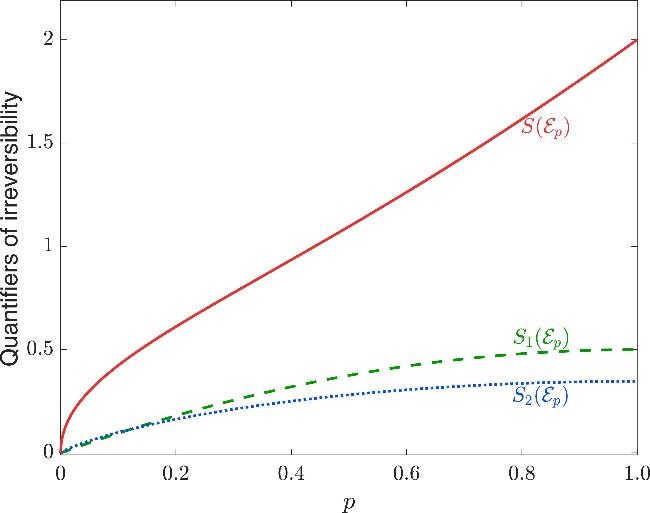
Figure 2. Various quantifiers of irreversibility for the amplitude damping channel ${{ \mathcal E }}_{p}$ defined in example 1. |
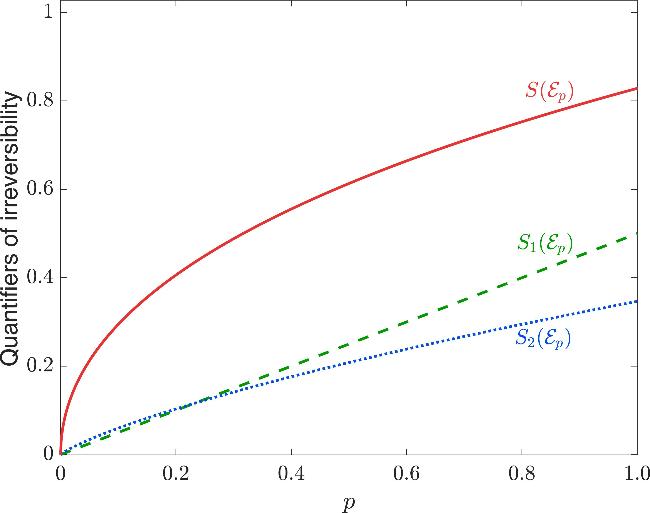
Figure 3. Various quantifiers of irreversibility for the phase damping channel ${{ \mathcal E }}_{p}$ defined in example 2. |
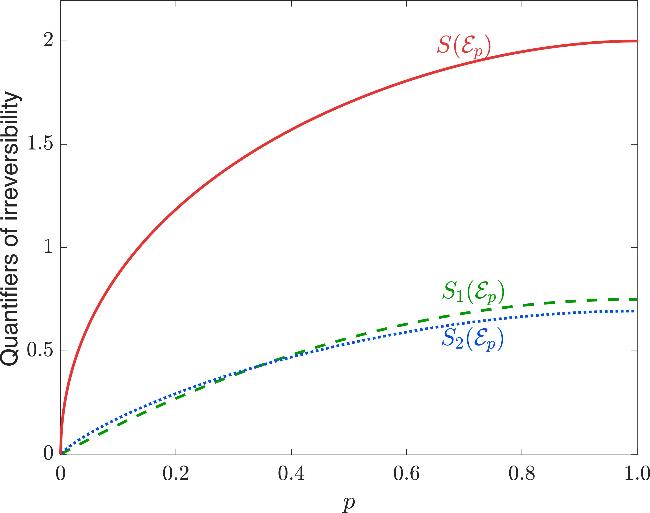
Figure 4. Various quantifiers of irreversibility for the depolarizing channel ${{ \mathcal E }}_{p}$ defined in example 3. |
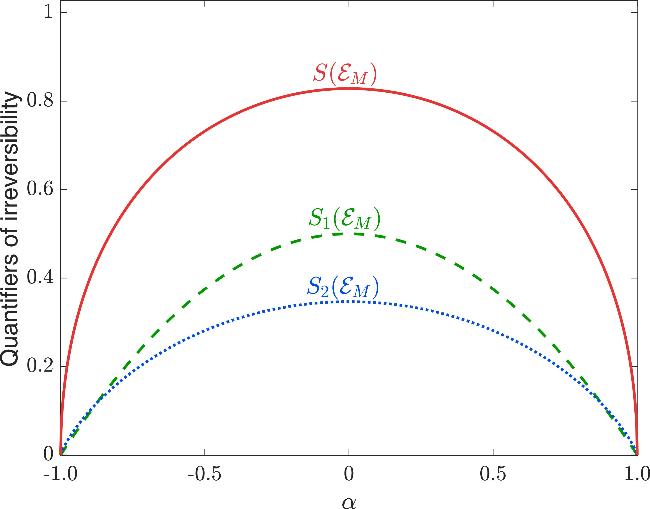


Figure 5. Various quantifiers of irreversibility for the completely decoherent channel ${{ \mathcal E }}_{M}$ defined in example 4. |
5. Discussions
Although quantum dynamics of closed systems are reversible and information is conserved, most practical physical processes, including the ubiquitous quantum measurements, are irreversible. In the traditional approach to the notion of reversibility, one usually takes an absolute position in the sense of reversible on the entire domain of the relevant operation. With the rapid development of quantum information theory, in particular quantum error correction and quantum measurements, it is desirable to consider relative notions of irreversibility. In this work, we have introduced such a notion, and we have further related irreversibility with quantum incompatibility, both of which are an important features of quantum theory. More precisely, in order to quantify the irreversibility of a quantum channel, we have invoked its complementary channel and have employed the incompatibility between this complementary channel and the identity channel. We have revealed basic properties of this novel quantifier of irreversibility, and have worked out explicitly several examples to illustrate the concept.
The interplay between irreversibility and incompatibility sheds insights into the structures and relations between quantum channels. It is desirable to further investigate the operational meaning, theoretical implications, and practical applications of the concept of relative reversibility in the contexts of quantum error correction and quantum measurements. In particular, since quantum error correction is essentially reversing the detrimental effects of noise quantum channels, it is intrinsically related to reversibility of quantum channels. Our results concerning channel irreversibility may be used to assess the limitation and extent of error correction. This interesting issue is worth further investigation.