Welcome to visit Communications in Theoretical Physics,
Particle Physics and Quantum Field Theory

New molecular bonds existing in the strong interaction

  • Hua-Xing Chen ,
Expand
  • School of Physics, Southeast University, Nanjing 210094, China

Author to whom any correspondence should be addressed.

Received date: 2025-08-26

  Revised date: 2025-11-17

  Accepted date: 2025-11-28

  Online published: 2026-01-13

Supported by

Jiangsu Provincial Double-Innovation Program(JSSCRC2021488)

National Natural Science Foundation of China https://doi.org/10.13039/501100001809(12075019)

Fundamental Research Funds for the Central Universities https://doi.org/10.13039/501100012226

Copyright

© 2026 Institute of Theoretical Physics CAS, Chinese Physical Society and IOP Publishing. All rights, including for text and data mining, AI training, and similar technologies, are reserved.
This article is available under the terms of the IOP-Standard License.

Abstract

Similar to the covalent bond in chemical molecules induced by shared electrons, we proposed in Chen (2022 Commun. Theor. Phys. 74 125201) a hadronic covalent bond induced by shared light quarks to explain Tcc(3875) and the deuteron. In this paper we improve and extend this mechanism to explain Zc(3900), which is bound by the shared light quark–antiquark pair along with sea quark–antiquark pairs from the vacuum. Our analysis is based on the following forward and backward reasoning: a hadronic molecule exists, iff the attraction between its components is strong enough, iff the wave functions of its components significantly overlap with each other, iff the Pauli principle is well satisfied among all the shared quarks and antiquarks. Additionally, X(3872) is so unique that we need to further consider the annihilation of the shared light quark–antiquark pair, just in line with the reasoning that the creation and annihilation of sea quark–antiquark pairs should be given equal consideration. Both the ‘creation’ and ‘annihilation’ molecular bonds exist only in the strong interaction, not in the electromagnetic interaction, and they provide a quasi-static low-energy platform for studying quantum chromodynamic confinement.

Cite this article

Hua-Xing Chen . New molecular bonds existing in the strong interaction[J]. Communications in Theoretical Physics, 2026 , 78(4) : 045201 . DOI: 10.1088/1572-9494/ae2bea

1. Introduction

The past decade has been a golden era in hadron physics [1], and our understanding of the non-perturbative behavior of the strong interaction in the low-energy regime has been significantly improved [216]. This presents an ideal opportunity to compare it with the electromagnetic interaction through investigation of the hydrogen atom/molecule and the charmed meson/molecule.
A hydrogen atom consists of an electron bound to a proton, with a binding energy of 13.6 eV. In the ground state, the interaction between the electron and proton spins results in a slight increase in energy when the spins are parallel and a decrease when they are antiparallel. The energy difference between these two hyperfine states is approximately 5.87 × 10−6 eV. The situation becomes more complex in the hydrogen molecule, which consists of two hydrogen atoms bound together by a chemical covalent bond, with a binding energy of 4.73 eV. There are two spin configurations of the hydrogen molecule, i.e. ortho-hydrogen has parallel proton spins and a higher energy while para-hydrogen has antiparallel proton spins and a lower energy. The energy difference between these two spin isomers is approximately 0.0151 eV.
A comparable picture has been found in the strong interaction, namely, the charmed meson and its hadronic molecule. A charmed meson consists of a light up/down antiquark bound to a charm quark within the conventional quark model. There are two ground states: D with JP = 0 and D with JP = 1, with a mass difference of about 140 MeV. For brevity, we denote them collectively as D(∗), and refer to $\bar{D}$ and ${\bar{D}}^{\ast }$ collectively as ${\bar{D}}^{(\ast )}$. Two ${\bar{D}}^{(\ast )}$ mesons may form a ${\bar{D}}^{(\ast )}{\bar{D}}^{(\ast )}$ hadronic molecule, but so far only Tcc(3875) has been observed in the LHCb experiment [17, 18], which can be interpreted as the $\bar{D}{\bar{D}}^{\ast }$ hadronic molecule of (I)JP = (0)1+, with a binding energy of the order of 1 MeV. More ${\bar{D}}^{(\ast )}{\bar{D}}^{(\ast )}$ hadronic molecules, such as the ${\bar{D}}^{\ast }{\bar{D}}^{\ast }$ hadronic molecule of (I)JP = (0)1+, have been predicted in the literature and are yet to be discovered, which would contribute to completing this picture [216].
In addition to the many similarities between the hydrogen atom/molecule and the charmed meson/molecule, there are two distinct differences:

In the hydrogen atom and the hydrogen molecule, the contribution from the proton spin is small and negligible. In contrast, in the ${\bar{D}}^{(\ast )}$ meson and its hadronic molecule, the contribution from the spin of the charm antiquark is no longer negligible.

The binding energy of the hydrogen molecule, resulting from the residual electromagnetic interaction between two hydrogen atoms, is of the same order as that of the hydrogen atom, which arises from the direct electromagnetic interaction between the electron and proton. In contrast, the binding energy of Tcc(3875), resulting from the residual strong interaction between $\bar{D}$ and ${\bar{D}}^{\ast }$ mesons, is significantly smaller than the ‘binding’ energy of the ${\bar{D}}^{(\ast )}$ meson, which arises from the direct strong interaction between the light up/down quark and the charm antiquark.
Another related observation is that a muonic Z atom is believed to behave as if it were a Z − 1 atom, although this will not be discussed in the present study.
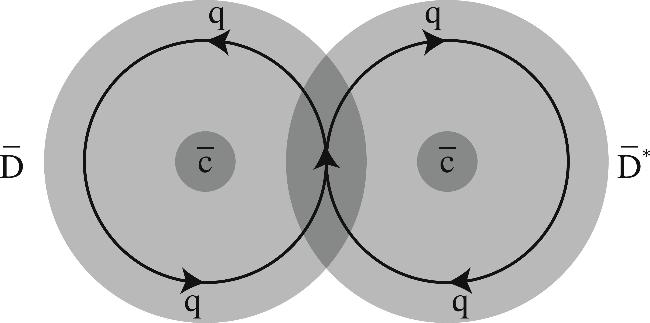
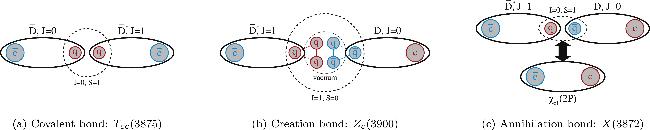
Similar to a chemical covalent bond, we proposed in [19] a hadronic covalent bond to explain Pc/Pcs/Tcc [17, 18, 2024] and the deuteron as possible hadronic covalent molecules. In the hydrogen molecule, the two electrons shared between two protons are antisymmetric so that they obey the Pauli principle. Similarly, we proposed in Tcc(3875) that the two light up/down quarks shared between two charm antiquarks are also antisymmetric so that they obey the Pauli principle, as illustrated in Figure 1(a). Since the binding energy of Tcc(3875) is significantly smaller than the ‘binding’ energy of the ${\bar{D}}^{(\ast )}$ meson, the two shared light up/down quarks need not be fully antisymmetric, as long as there is enough antisymmetric component to provide sufficient attraction.
Figure 1. Possible binding mechanisms induced by: (a) shared light quarks, (b) a shared light quark–antiquark pair along with sea quark–antiquark pairs from the vacuum and (c) the annihilation of the shared light quark–antiquark pair.
However, the hadronic covalent bond cannot explain the hadronic molecule composed of one D(∗) meson and one ${\bar{D}}^{(\ast )}$ meson. Specifically, Zc(3900) [25, 26] and X(3872) [27] can be interpreted as such hadronic molecules [216]. An interesting question related to the electromagnetic interaction is whether a chemical molecule composed of one hydrogen atom and one anti-hydrogen atom exists. While the answer is not yet known to us, it is likely that additional binding mechanisms exist in the strong interaction.
In this paper we extend the hadronic covalent bond to explain Zc(3900) as the $D{\bar{D}}^{* }/{D}^{* }\bar{D}$ hadronic molecule with IGJPC = 1+1+−. As illustrated in Figure 1(b), we consider not only the light quark–antiquark pair from the D and ${\bar{D}}^{\ast }$ mesons but also two sea quark–antiquark pairs from the vacuum. Consequently, annihilation of the light quark–antiquark pair should also be considered. As illustrated in Figure 1(c), this effect has been studied in [2831] to explain X(3872) as a mixture of a $c\bar{c}$ state and a $D{\bar{D}}^{* }/{D}^{* }\bar{D}$ component with IGJPC = 0+1++, and this analysis is closely related to the 3P0 model studies on the hadronic decay of charmonium [3234]. We refer to the two binding mechanisms above as the ‘creation’ and ‘annihilation’ bonds, which exist only in the strong interaction not in the electromagnetic interaction. These two bonds provide a quasi-static low-energy platform for studying quantum chromodynamic (QCD) confinement, so we refer to them collectively as the ‘confined’ bond, with the relevant molecule termed the hadronic ‘confined’ molecule.
This paper is organized as follows. In section 2 we improve the hadronic covalent bond proposed in [19] and apply it to study Tcc(3875) and the deuteron. In section 3 we propose the hadronic creation bond to explain Zc(3900) through the shared light quark–antiquark pair along with sea quark–antiquark pairs from the vacuum. In section 4 we use the hadronic annihilation bond to explain X(3872) by further considering the annihilation of the light quark–antiquark pair, after which we conclude the paper.

2. Covalent bond

We proposed in [19] a hadronic covalent bond induced by shared light quarks, as illustrated in Figure 2. In a chemical covalent bond the shared electrons are totally antisymmetric so that they obey the Pauli principle. Similarly, we found in the hadronic covalent bond that ‘the light-quark-exchange interaction is attractive when the shared light quarks are totally antisymmetric so that [they] obey the Pauli principle’. In this section we improve this mechanism and apply it to study several examples in the following subsections.
Figure 2. Possible binding mechanism for Tcc(3875) as the $\bar{D}{\bar{D}}^{\ast }$ hadronic molecule with (I)JP = (0)1+, due to the hadronic covalent bond induced by shared light quarks.

2.1. Tcc(3875)

In this subsection we study the hadronic molecules composed of two ${\bar{D}}^{(\ast )}$ mesons. In order to form these molecules, the light quark from one ${\bar{D}}^{(\ast )}$ meson and the light quark from the other ${\bar{D}}^{(\ast )}$ meson should be totally antisymmetric according to the Pauli principle. This ensures that the wave functions of the two ${\bar{D}}^{(\ast )}$ mesons significantly overlap with each other, resulting in a strong attraction that may lead to the formation of a hadronic covalent molecule. The two light quarks shared between the two ${\bar{D}}^{(\ast )}$ mesons have the same color, and so a symmetric color structure. Besides, we assume their orbital structure to be S-wave and so also symmetric. Consequently, we only need to investigate their spin and flavor structures (q = up/down):

${\bar{D}}^{0}[{u}_{1}{\bar{c}}_{2}]$–${\bar{D}}^{0}[{u}_{3}{\bar{c}}_{4}]$. Let us exchange u1 from the first ${\bar{D}}^{0}$ meson with u3 from the second ${\bar{D}}^{0}$ meson. u1 and ${\bar{c}}_{2}$ inside the first ${\bar{D}}^{0}$ meson spin in opposite directions, u3 and ${\bar{c}}_{2}$ also need to spin in opposite directions in order to form another ${\bar{D}}^{0}$ meson, so u1 and u3 spin in the same direction with a symmetric spin structure. The flavor structure of u1 and u3 is also symmetric, so they are totally symmetric (S = symmetric and A = antisymmetric):

Color Flavor Spin Orbital Total
u1 ↔ u3 S S S S S
Accordingly, the ${\bar{D}}^{0}{\bar{D}}^{0}$ covalent molecule does not exist.

$\bar{D}[{q}_{1}{\bar{c}}_{2}]$–$\bar{D}[{q}_{3}{\bar{c}}_{4}]$. After including isospin symmetry, exchange can occur between the up and down quarks. Let us exchange q1 from the first $\bar{D}$ meson with q3 from the second $\bar{D}$ meson. As discussed above, they have a symmetric spin structure, so they can be totally antisymmetric as long as their flavor structure is antisymmetric:

Color Flavor Spin Orbital Total
q1 ↔ q3 S A S S A
However, this configuration still vanishes, i.e.
$\begin{eqnarray}| \bar{D}\bar{D};I=0\rangle ={\bar{D}}^{0}{D}^{-}-{D}^{-}{\bar{D}}^{0}=0,\end{eqnarray}$
so there is no $\bar{D}\bar{D}$ covalent molecule, neither with I = 0 nor with I = 1.

$\bar{D}[{q}_{1}{\bar{c}}_{2}]$–${\bar{D}}^{\ast }[{q}_{3}{\bar{c}}_{4}]$. Let us exchange q1 from the $\bar{D}$ meson with q3 from the ${\bar{D}}^{\ast }$ meson. In this case q1 and q3 do not need to spin in the same direction since the $\bar{D}{\bar{D}}^{\ast }$ molecule can transform into the ${\bar{D}}^{\ast }\bar{D}$ molecule with the exchange of these two light quarks. Accordingly, there are two possible configurations that satisfy the Pauli principle, either

Strong Color Flavor Spin Orbital Total
q1 ↔ q3 S A S S A

or

Weak Color Flavor Spin Orbital Total
q1 ↔ q3 S S A S A

As discussed in [19], the former configuration with (I)JP = (0)1+ is more stable than the latter one with (I)JP = (1)0+. Accordingly, we refer to the former as the ‘strong’ bond and the latter as the ‘weak’ bond. Additionally, there exists a ‘repulsive’ bond due to the exchange of the two charm antiquarks:

Repulsive Color Flavor Spin Orbital Total
${\bar{c}}_{2}\leftrightarrow {\bar{c}}_{4}$ S S S S S

Therefore, we need to consider both the ‘strong/weak’ bond and the ‘repulsive’ bond in order to verify the existence of the I = 0/1 $\bar{D}{\bar{D}}^{\ast }$ covalent molecule. Specifically, as illustrated in Figure 1(a), Tcc(3875) can be interpreted as the $\bar{D}{\bar{D}}^{\ast }$ hadronic covalent molecule with (I)JP = (0)1+, which contains one strong bond and one repulsive bond.

• ${\bar{D}}^{* }[{q}_{1}{\bar{c}}_{2}]$–${\bar{D}}^{* }[{q}_{3}{\bar{c}}_{4}]$. Similarly, we study the ${\bar{D}}^{* }{\bar{D}}^{* }$ covalent molecule. Our results suggest the possible existence of the (I)JP = (0)1+${\bar{D}}^{* }{\bar{D}}^{* }$ covalent molecule, which contains one strong bond and one repulsive bond. However, the (I)JP = (0)0+ and (I)JP = (0)2+${\bar{D}}^{* }{\bar{D}}^{* }$ covalent molecules do not exist. Besides, our results suggest the possible existence of the (I)JP = (1)0+ and (I)JP = (1)2+${\bar{D}}^{* }{\bar{D}}^{* }$ covalent molecules, each of which contains one weak bond and one repulsive bond, while the (I)JP = (1)1+${\bar{D}}^{* }{\bar{D}}^{* }$ covalent molecule does not exist.

Summarizing the above discussions, our results suggest the possible existence of the (I)JP = (0)1+$\bar{D}{\bar{D}}^{* }$ and (I)JP = (0)1+${\bar{D}}^{* }{\bar{D}}^{* }$ covalent molecules, both of which contain a strong covalent bond; our results also suggest the possible existence of the (I)JP = (1)1+$\bar{D}{\bar{D}}^{* }$ and (I)JP = (1)0/2+${\bar{D}}^{* }{\bar{D}}^{* }$ covalent molecules, which contain the weak covalent bond.

2.2. Deuteron

In this subsection we study nuclei as hadronic covalent molecules composed of nucleons. We take the p(roton)/n(eutron)/Λ as combinations of an (I)JP = (0)0+ up–down quark pair along with an isolated up/down/strange quark, and explore several examples as follows (q = up/down and s = strange):
• $N[{q}_{1}{({u}_{2}{d}_{3})}_{(0){0}^{+}}]$–$N[{q}_{4}{({u}_{5}{d}_{6})}_{(0){0}^{+}}]$. Let us exchange q1 and q4 in order to share
Strong Color Flavor Spin Orbital Total
q1 ↔ q4 S A S S A
or
Weak Color Flavor Spin Orbital Total
q1 ↔ q4 S S A S A
Similar to the $\bar{D}{\bar{D}}^{* }$ covalent molecule, the former strong bond is more stable than the latter weak bond; moreover, there exists a repulsive bond due to the two (I)JP = (0)0+ up–down quark pairs:
Repulsive Color Flavor Spin Orbital Total
u2 ↔ u5 S S S S S
d3 ↔ d6 S S S S S
Therefore, we need to consider both the strong/weak bond and the repulsive bond in order to verify the existence of the I = 0/1 NN covalent molecule. Specifically, the deuteron can be interpreted as the proton–neutron hadronic covalent molecule with (I)JP = (0)1+, which contains one strong bond and one repulsive bond.
4He[p(u1)p(u2)n(d3)n(d4)]. It is interesting to study how many light quarks can be shared at most in the lowest orbit. We find that the 4He nucleus can accommodate four light up/down quarks with the configuration of (I)JP = (0)0+, satisfying that any two of these four quarks are totally antisymmetric so that they obey the Pauli principle:
Color Flavor Spin Orbital Total
u1 ↔ u2 S S A S A
u1 ↔ d3 S A S S A
u1 ↔ d4 S A S S A
u2 ↔ d3 S A S S A
u2 ↔ d4 S A S S A
d3 ↔ d4 S S A S A
This makes the 4He nucleus quite stable.
•${}_{{\rm{\Lambda }}}^{3}$H[p(u1)n(d2)Λ(s3)]. Let us exchange u1 from the proton, d2 from the neutron and s3 from the Λ. It is possible for any two of them to be totally antisymmetric, either
Color Flavor Spin Orbital Total
u1 ↔ d2 S A S S A
d2 ↔ s3 S A S S A
s3 ↔ u1 S S A S A
or
Color Flavor Spin Orbital Total
u1 ↔ d2 S A S S A
d2 ↔ s3 S S A S A
s3 ↔ u1 S A S S A
We use the strong/weak qq bond to refer to the strong/weak bond composed of two light up/down quarks, and the strong/weak qs bond to refer to the strong/weak bond composed of one light up/down quark and one light strange quark. It seems that the ${}_{{\rm{\Lambda }}}^{3}$H nucleus contains one strong qq bond, one strong qs bond, one weak qs bond and three repulsive bonds. However, the weak qs bond may be even weaker than the repulsive bond, so it is possible that there is only one strong qq bond, one strong qs bond and two repulsive bonds in this system.

2.3. A toy model

Many possible hadronic covalent molecules can exist, in addition to Tcc(3875) and the deuteron investigated in the previous subsections. A toy model was developed in [19] to estimate their binding energies (B), and in this subsection we update it as
$\begin{eqnarray}B={N}_{{\rm{S}}}S+{N}_{{\rm{W}}}W+{N}_{{\rm{\Lambda }}}{\rm{\Lambda }}-{N}_{{\rm{R}}}R-N\epsilon ,\end{eqnarray}$
where S is the energy of the strong qq bond with NS its number, W is the energy of the weak qq bond with NW its number, Λ is the energy of the strong qs bond with NΛ its number, R is the energy of the repulsive bond with NR its number and ε is the residual energy of each component hadron with N the number of components. The weak qs bond is not taken into account. Note that the term NWW was neglected in [19], while the term to describe the spin effects is neglected here since we do not consider spin effects in the present study. Assuming Pc/Pcs/Tcc as possible hadronic covalent molecules, we estimate these parameters to be
$\begin{eqnarray}\begin{array}{rcl}S & \sim & 23\,\mathrm{MeV}\\ W & \sim & 17\,\mathrm{MeV}\\ {\rm{\Lambda }} & \sim & 18\,\mathrm{MeV}\\ R & \sim & 14\,\mathrm{MeV}\\ \epsilon & \sim & 4\,\mathrm{MeV}.\end{array}\end{eqnarray}$
We use the above toy model to estimate the binding energies of some possible hadronic covalent molecules, and the obtained results are summarized in table 1.
Table 1. Binding energies of some possible hadronic covalent molecules, estimated within our toy model through the simplified formula B = NSS + NWW + NΛΛ − NRR − , with S ∼ 23 MeV, W ∼ 17 MeV, Λ ∼ 18 MeV, R ∼ 14 MeV and ε ∼ 4 MeV. The spin effects are not taken into account in this formula. For brevity, we denote D and D* collectively as D(*), and Σc and ${{\rm{\Sigma }}}_{{\rm{c}}}^{* }$ collectively as ${{\rm{\Sigma }}}_{{\rm{c}}}^{(* )}$, and so on.
Covalent molecules Binding energies (MeV) Covalent molecules Binding energies (MeV)
2H, ${D}^{* }{D}^{(* )}/{\bar{B}}^{* }{\bar{B}}^{(* )}$ 1 ${D}^{* }{\bar{B}}^{(* )}/{D}^{(* )}{\bar{B}}^{* }$ 15
3H/3He, ${D}^{* }{D}^{* }{D}^{(* )}/{\bar{B}}^{* }{\bar{B}}^{* }{\bar{B}}^{(* )}$ 9 ${D}^{* }{D}^{* }{\bar{B}}^{(* )}/{D}^{(* )}{\bar{B}}^{* }{\bar{B}}^{* }/\cdots \,$ 37
4He, ${D}^{* }{D}^{* }{D}^{* }{D}^{(* )}/{\bar{B}}^{* }{\bar{B}}^{* }{\bar{B}}^{* }{\bar{B}}^{(* )}$ 26 ${D}^{* }{D}^{* }{D}^{* }{\bar{B}}^{(* )}/{D}^{(* )}{\bar{B}}^{* }{\bar{B}}^{* }{\bar{B}}^{* }/\cdots \,$ 68
${D}^{* }{D}^{* }{\bar{B}}^{* }{\bar{B}}^{(* )}/{D}^{(* )}{D}^{* }{\bar{B}}^{* }{\bar{B}}^{* }/\cdots \,$ 82

${{\rm{\Sigma }}}_{{\rm{c}}}^{(* )}{{\rm{\Sigma }}}_{{\rm{c}}}^{(* )}/{{\rm{\Sigma }}}_{{\rm{b}}}^{(* )}{{\rm{\Sigma }}}_{{\rm{b}}}^{(* )}$ 24 ${{\rm{\Sigma }}}_{{\rm{c}}}^{(* )}{{\rm{\Sigma }}}_{{\rm{b}}}^{(* )}$ 38
${\bar{D}}^{(* )}{{\rm{\Sigma }}}_{{\rm{c}}}^{(* )}/{\bar{D}}^{(* )}{{\rm{\Sigma }}}_{{\rm{b}}}^{(* )}/{B}^{(* )}{{\rm{\Sigma }}}_{{\rm{c}}}^{(* )}/{B}^{(* )}{{\rm{\Sigma }}}_{{\rm{b}}}^{(* )}$ 15
${\bar{D}}^{* }{\bar{D}}^{(* )}{{\rm{\Sigma }}}_{{\rm{c}}}^{(* )}/{\bar{D}}^{* }{\bar{D}}^{(* )}{{\rm{\Sigma }}}_{{\rm{b}}}^{(* )}/\cdots \,$ 37

${D}^{* }{\bar{B}}_{{\rm{s}}}^{(* )}/{D}^{(* )}{\bar{B}}_{{\rm{s}}}^{* }$ 10
${}_{{\rm{\Lambda }}}^{3}$H, ${D}^{* }{D}^{* }{D}_{{\rm{s}}}^{(* )}/{D}^{(* )}{D}^{* }{D}_{{\rm{s}}}^{* }$ 1 ${D}^{* }{D}^{* }{\bar{B}}_{{\rm{s}}}^{(* )}/{D}^{(* )}{D}^{* }{\bar{B}}_{{\rm{s}}}^{* }/\cdots \,$ 15
${}_{{\rm{\Lambda }}}^{4}$H/${}_{{\rm{\Lambda }}}^{4}$He, ${D}^{* }{D}^{* }{D}^{* }{D}_{{\rm{s}}}^{(* )}/{D}^{(* )}{D}^{* }{D}^{* }{D}_{{\rm{s}}}^{* }$ 13 ${D}^{* }{D}^{* }{D}^{* }{\bar{B}}_{{\rm{s}}}^{(* )}/{D}^{(* )}{D}^{* }{D}^{* }{\bar{B}}_{{\rm{s}}}^{* }/\cdots \,$ 41
${}_{{\rm{\Lambda }}}^{5}$He, ${D}^{* }{D}^{* }{D}^{* }{D}^{* }{D}_{{\rm{s}}}^{(* )}/\cdots \,$ 30 ${D}^{* }{D}^{* }{D}^{* }{D}^{* }{\bar{B}}_{{\rm{s}}}^{(* )}/\cdots \,$ 58
${}_{{\rm{\Lambda }}{\rm{\Lambda }}}^{\,\,6}$He, ${D}^{* }{D}^{* }{D}^{* }{D}^{* }{D}_{{\rm{s}}}^{(* )}{D}_{{\rm{s}}}^{(* )}/\cdots \,$ 34 ${D}^{* }{D}^{* }{D}^{* }{D}^{* }{\bar{B}}_{{\rm{s}}}^{(* )}{\bar{B}}_{{\rm{s}}}^{(* )}/\cdots \,$ 90

${{\rm{\Sigma }}}_{{\rm{c}}}^{(* )}{{\rm{\Xi }}}_{{\rm{c}}}^{(^{\prime} * )}/{{\rm{\Sigma }}}_{{\rm{b}}}^{(* )}{{\rm{\Xi }}}_{{\rm{b}}}^{(^{\prime} * )}$ 19 ${{\rm{\Sigma }}}_{{\rm{c}}}^{(* )}{{\rm{\Xi }}}_{{\rm{b}}}^{(^{\prime} * )}/{{\rm{\Sigma }}}_{{\rm{b}}}^{(* )}{{\rm{\Xi }}}_{{\rm{c}}}^{(^{\prime} * )}$ 33
${{\rm{\Xi }}}_{{\rm{c}}}^{(^{\prime} * )}{{\rm{\Xi }}}_{{\rm{c}}}^{(^{\prime} * )}/{{\rm{\Xi }}}_{{\rm{b}}}^{(^{\prime} * )}{{\rm{\Xi }}}_{{\rm{b}}}^{(^{\prime} * )}$ 14 ${{\rm{\Xi }}}_{{\rm{c}}}^{(^{\prime} * )}{{\rm{\Xi }}}_{{\rm{b}}}^{(^{\prime} * )}$ 28
${{\rm{\Sigma }}}_{{\rm{c}}}^{(* )}{{\rm{\Xi }}}_{{\rm{c}}}^{(^{\prime} * )}{{\rm{\Xi }}}_{{\rm{c}}}^{(^{\prime} * )}/{{\rm{\Sigma }}}_{{\rm{b}}}^{(* )}{{\rm{\Xi }}}_{{\rm{b}}}^{(^{\prime} * )}{{\rm{\Xi }}}_{{\rm{b}}}^{(^{\prime} * )}$ 45 ${{\rm{\Sigma }}}_{{\rm{c}}}^{(* )}{{\rm{\Xi }}}_{{\rm{c}}}^{(^{\prime} * )}{{\rm{\Xi }}}_{{\rm{b}}}^{(^{\prime} * )}/{{\rm{\Sigma }}}_{{\rm{b}}}^{(* )}{{\rm{\Xi }}}_{{\rm{c}}}^{(^{\prime} * )}{{\rm{\Xi }}}_{{\rm{c}}}^{(^{\prime} * )}$ 73

${\bar{D}}^{(* )}{{\rm{\Xi }}}_{{\rm{c}}}^{(^{\prime} * )}/{\bar{D}}^{(* )}{{\rm{\Xi }}}_{{\rm{b}}}^{(^{\prime} * )}/{B}^{(* )}{{\rm{\Xi }}}_{{\rm{c}}}^{(^{\prime} * )}/{B}^{(* )}{{\rm{\Xi }}}_{{\rm{b}}}^{(^{\prime} * )}$ 15
${\bar{D}}^{* }{\bar{D}}^{(* )}{{\rm{\Xi }}}_{{\rm{c}}}^{(^{\prime} * )}/{\bar{D}}^{* }{\bar{D}}^{(* )}{{\rm{\Xi }}}_{{\rm{b}}}^{(^{\prime} * )}/\cdots \,$ 32
${\bar{D}}^{* }{\bar{D}}^{(* )}{{\rm{\Xi }}}_{{\rm{c}}}^{(^{\prime} * )}{{\rm{\Xi }}}_{{\rm{c}}}^{(^{\prime} * )}/{\bar{D}}^{* }{\bar{D}}^{(* )}{{\rm{\Xi }}}_{{\rm{b}}}^{(^{\prime} * )}{{\rm{\Xi }}}_{{\rm{b}}}^{(^{\prime} * )}/\cdots \,$ 55

3. Creation bond

The hadronic covalent bond studied in the previous section cannot explain the hadronic molecule composed of one D(∗) meson and one ${\bar{D}}^{(\ast )}$ meson, which will be explored in this section. To address this, we extend the covalent bond by incorporating not only the light quark–antiquark pair from the D(∗) and ${\bar{D}}^{(\ast )}$ mesons but also two sea quark–antiquark pairs from the vacuum, as illustrated in Figure 1(b).
We use ${\bar{q}}_{1}{q}_{2}$ to denote the light quark–antiquark pair from the D(∗) and ${\bar{D}}^{(\ast )}$ mesons, where ${\bar{q}}_{1}$ is from the D(∗) meson and q2 is from the ${\bar{D}}^{(\ast )}$ meson. We use ${\bar{q}}_{3}{q}_{4}$ and ${\bar{q}}_{5}{q}_{6}$ to denote the two sea quark–antiquark pairs from the vacuum. According to the Lagrangian ${ \mathcal L }=\bar{q}{\rm{i}}{\gamma }^{\mu }{D}_{\mu }q$ with Dμ = ∂μ + igsAμ, we assume their quantum numbers to both be
$\begin{eqnarray}{[}^{3}{S}_{1}]\,:\,I=0,\,S=1,\,L=0,\,J=1,\end{eqnarray}$
and their total quantum numbers to be
$\begin{eqnarray}{[}^{3}{S}_{1}]\otimes {[}^{3}{S}_{1}]\,:\,I=0,\,S=0,\,L=0,\,J=0.\end{eqnarray}$
In addition, two 3P0 quark–antiquark pairs are also possible, but they would result in a higher energy configuration. Moreover, we require that the three antiquarks ${\bar{q}}_{1,3,5}$, which orbit around the charm quark in the D(∗) meson, have the same color and so a symmetric color structure; the three quarks q2,4,6, which orbit around the charm antiquark in the ${\bar{D}}^{(\ast )}$ meson also have the same color and so a symmetric color structure; the two antiquarks ${\bar{q}}_{3}$ and ${\bar{q}}_{5}$ form a strong bond, while the two quarks q4 and q6 form another strong bond. There are numerous sea quark–antiquark pairs and sea gluons in the QCD vacuum, making it possible for these assumptions to be satisfied.
Based on the above assumptions, we find that the ${\bar{q}}_{1}{q}_{2}$ pair with the quantum numbers
$\begin{eqnarray}I=1,\,S=0,\,L=0,\,J=0,\end{eqnarray}$
is capable of forming the following configuration:
[I1S0L0J0] Color Flavor Spin Orbital Total
${\bar{q}}_{1}\leftrightarrow {q}_{2}$ 1C S A S [1S0]

${\bar{q}}_{1}\leftrightarrow {\bar{q}}_{3}$ S S A S A (weak)
${\bar{q}}_{1}\leftrightarrow {\bar{q}}_{5}$ S A S S A (strong)
${\bar{q}}_{3}\leftrightarrow {\bar{q}}_{5}$ S A S S A (strong)
q2 ↔ q4 S A S S A (strong)
q2 ↔ q6 S S A S A (weak)
q4 ↔ q6 S A S S A (strong)

${\bar{q}}_{3}\leftrightarrow {q}_{4}$ 8C A S S [3S1]
${\bar{q}}_{3}\leftrightarrow {q}_{6}$ 1C/8C S A S [π(?)]
${\bar{q}}_{5}\leftrightarrow {q}_{4}$ 1C/8C S A S [π(?)]
${\bar{q}}_{5}\leftrightarrow {q}_{6}$ 8C A S S [3S1]

${\bar{q}}_{1}\leftrightarrow {q}_{4}$ A/S S S
${\bar{q}}_{1}\leftrightarrow {q}_{6}$ S S S
${\bar{q}}_{3}\leftrightarrow {q}_{2}$ S S S
${\bar{q}}_{5}\leftrightarrow {q}_{2}$ A/S S S
We refer to this configuration as the hadronic creation bond due to the activity of sea quark–antiquark pairs from the vacuum, thus being closely related to QCD confinement. It contains four strong bonds (${\bar{q}}_{1}{\bar{q}}_{5}$, ${\bar{q}}_{3}{\bar{q}}_{5}$, q2q4 and q4q6) and two weak bonds (${\bar{q}}_{1}{\bar{q}}_{3}$ and q2q6), which attract the D(∗) and ${\bar{D}}^{(\ast )}$ mesons to potentially form a hadronic confined molecule that behaves as a resonance lying above the ${D}^{(\ast )}{\bar{D}}^{(\ast )}$ threshold. Additionally, the two color-octet sea quark–antiquark pairs from the vacuum, ${\bar{q}}_{3}{q}_{4}$ and ${\bar{q}}_{5}{q}_{6}$, both with I = 0 and J = 1, couple strongly to sea gluons, so there is a tremendous number of them; moreover, they can be recombined into the two color-singlet quark–antiquark pairs, ${\bar{q}}_{3}{q}_{6}$ and ${\bar{q}}_{5}{q}_{4}$ both with I = 1 and J = 0, which couple strongly to the pseudoscalar mesons π and so are capable of providing long-range attraction.
Besides, the ${\bar{q}}_{1}{q}_{2}$ pair with the quantum numbers
$\begin{eqnarray}I=0,\,S=1,\,L=0,\,J=1,\end{eqnarray}$
can form another similar configuration:
[I0S1L0J1] Color Flavor Spin Orbital Total
${\bar{q}}_{1}\leftrightarrow {q}_{2}$ 1C A S S [3S1]

${\bar{q}}_{1}\leftrightarrow {\bar{q}}_{3}$ S S A S A (weak)
${\bar{q}}_{1}\leftrightarrow {\bar{q}}_{5}$ S A S S A (strong)
${\bar{q}}_{3}\leftrightarrow {\bar{q}}_{5}$ S A S S A (strong)
q2 ↔ q4 S S A S A (weak)
q2 ↔ q6 S A S S A (strong)
q4 ↔ q6 S A S S A (strong)

${\bar{q}}_{3}\leftrightarrow {q}_{4}$ 8C A S S [3S1]
${\bar{q}}_{3}\leftrightarrow {q}_{6}$ 1C/8C S A S [π(?)]
${\bar{q}}_{5}\leftrightarrow {q}_{4}$ 1C/8C S A S [π(?)]
${\bar{q}}_{5}\leftrightarrow {q}_{6}$ 8C A S S [3S1]

${\bar{q}}_{1}\leftrightarrow {q}_{4}$ A A/S S
${\bar{q}}_{1}\leftrightarrow {q}_{6}$ S S S
${\bar{q}}_{3}\leftrightarrow {q}_{2}$ A A/S S
${\bar{q}}_{5}\leftrightarrow {q}_{2}$ S S S
However, the ${\bar{q}}_{1}{q}_{2}$ pair with the quantum numbers
$\begin{eqnarray}I=0,\,S=0,\,L=0,\,J=0,\end{eqnarray}$
cannot form this type of configuration, nor can the ${\bar{q}}_{1}{q}_{2}$ pair with the quantum numbers
$\begin{eqnarray}I=1,\,S=1,\,L=0,\,J=1.\end{eqnarray}$
Besides the configurations mentioned above, there are other possible configurations that could form hadronic creation bonds, and thus hadronic confined molecules. We list these in Appendix A but shall not investigate them in the present study.
We apply the above binding mechanism to study several examples, as follows:

$D[{\bar{q}}_{1}{c}_{7}]$–$\bar{D}[{q}_{2}{\bar{c}}_{8}]$. The D meson cannot employ the weak ${\bar{q}}_{1}{\bar{q}}_{3}/{\bar{q}}_{1}{\bar{q}}_{5}$ bond, and the $\bar{D}$ meson cannot employ the weak q2q4/q2q6 bond either. Accordingly, there is no $D\bar{D}$ confined molecule, neither with I = 0 nor with I = 1.

$D[{\bar{q}}_{1}{c}_{7}]$–${\bar{D}}^{* }[{q}_{2}{\bar{c}}_{8}]\oplus {D}^{* }[{\bar{q}}_{1}{c}_{7}]$–$\bar{D}[{q}_{2}{\bar{c}}_{8}]$. The D meson itself cannot employ the weak ${\bar{q}}_{1}{\bar{q}}_{3}/{\bar{q}}_{1}{\bar{q}}_{5}$ bond, but the D and D* mesons together can employ the weak ${\bar{q}}_{1}{\bar{q}}_{3}/{\bar{q}}_{1}{\bar{q}}_{5}$ bond, making it possible for the combination of $D{\bar{D}}^{* }$ and ${D}^{* }\bar{D}$ to form a hadronic confined molecule. According to heavy quark spin symmetry [3541], we perform the spin decomposition:

$\begin{eqnarray}\begin{array}{l}| \left(D{\bar{D}}^{* }-{D}^{* }\bar{D}\right)/\sqrt{2};{J}^{PC}={1}^{++}\rangle \\ \quad =-| {s}_{{\bar{c}}_{8}{c}_{7}}=1,{s}_{{\bar{q}}_{1}{q}_{2}}=1;J=1\rangle ,\end{array}\end{eqnarray}$
$\begin{eqnarray}\begin{array}{l}| \left(D{\bar{D}}^{* }+{D}^{* }\bar{D}\right)/\sqrt{2};{J}^{PC}={1}^{+-}\rangle \\ \quad =+| {s}_{{\bar{c}}_{8}{c}_{7}}=1,{s}_{{\bar{q}}_{1}{q}_{2}}=0;J=1\rangle /\sqrt{2}\\ \quad -| {s}_{{\bar{c}}_{8}{c}_{7}}=0,{s}_{{\bar{q}}_{1}{q}_{2}}=1;J=1\rangle /\sqrt{2}.\end{array}\end{eqnarray}$
There are three possibilities:

1. The state given in equation (10) contains the ${\bar{q}}_{1}{q}_{2}$ pair with ${s}_{{\bar{q}}_{1}{q}_{2}}=1$, so its isoscalar component can form a creation bond, making it possible to interpret X(3872) as the $D{\bar{D}}^{* }/{D}^{* }\bar{D}$ confined molecule with IGJPC = 0+1++.

2. The state given in equation (11) contains the ${\bar{q}}_{1}{q}_{2}$ pair with ${s}_{{\bar{q}}_{1}{q}_{2}}=0$, so its isovector component can form a creation bond, making it possible to interpret Zc(3900) as the $D{\bar{D}}^{* }/{D}^{* }\bar{D}$ confined molecule with IGJPC = 1+1+−.

3. The state given in equation (11) also contains the ${\bar{q}}_{1}{q}_{2}$ pair with ${s}_{{\bar{q}}_{1}{q}_{2}}=1$, suggesting the possible existence of the $D{\bar{D}}^{* }/{D}^{* }\bar{D}$ confined molecule with IGJPC = 01+−. However, its corresponding ${\bar{c}}_{8}{c}_{7}$ pair has ${s}_{{\bar{c}}_{8}{c}_{7}}=0$, which could render this system potentially unstable.

${D}^{* }[{\bar{q}}_{1}{c}_{7}]$–${\bar{D}}^{* }[{q}_{2}{\bar{c}}_{8}]$. According to heavy quark spin symmetry, we perform the spin decomposition

$\begin{eqnarray}\begin{array}{l}| {D}^{* }{\bar{D}}^{* };{J}^{{\rm{P}}{\rm{C}}}={0}^{++}\rangle \\ \quad =-| {s}_{{\bar{c}}_{8}{c}_{7}}=0,{s}_{{\bar{q}}_{1}{q}_{2}}=0;J=0\rangle \times \sqrt{3}/2\\ \qquad +| {s}_{{\bar{c}}_{8}{c}_{7}}=1,{s}_{{\bar{q}}_{1}{q}_{2}}=1;J=0\rangle /2,\end{array}\end{eqnarray}$
$\begin{eqnarray}\begin{array}{l}\\ | {D}^{* }{\bar{D}}^{* };{J}^{{\rm{P}}{\rm{C}}}={1}^{+-}\rangle \\ \quad =-| {s}_{{\bar{c}}_{8}{c}_{7}}=1,{s}_{{\bar{q}}_{1}{q}_{2}}=0;J=1\rangle /\sqrt{2}\\ \qquad -| {s}_{{\bar{c}}_{8}{c}_{7}}=0,{s}_{{\bar{q}}_{1}{q}_{2}}=1;J=1\rangle /\sqrt{2},\end{array}\end{eqnarray}$
$\begin{eqnarray}\begin{array}{l}\\ | {D}^{* }{\bar{D}}^{* };{J}^{{\rm{P}}{\rm{C}}}={2}^{++}\rangle \\ \quad =-| {s}_{{\bar{c}}_{8}{c}_{7}}=1,{s}_{{\bar{q}}_{1}{q}_{2}}=1;J=2\rangle .\end{array}\end{eqnarray}$
After requiring ${s}_{{\bar{c}}_{8}{c}_{7}}=1$, there are three possibilities remaining:

1. The state given in equation (12) contains the ${\bar{q}}_{1}{q}_{2}$ pair with ${s}_{{\bar{q}}_{1}{q}_{2}}=1$, so its isoscalar component can form a creation bond, suggesting the possible existence of the ${D}^{* }{\bar{D}}^{* }$ confined molecule with IGJPC = 0+0++.

2. The state given in equation (13) contains the ${\bar{q}}_{1}{q}_{2}$ pair with ${s}_{{\bar{q}}_{1}{q}_{2}}=0$, so its isovector component can form a creation bond, suggesting the possible existence of the ${D}^{* }{\bar{D}}^{* }$ confined molecule with IGJPC = 1+1+−.

3. The state given in equation (14) contains the ${\bar{q}}_{1}{q}_{2}$ pair with ${s}_{{\bar{q}}_{1}{q}_{2}}=1$, so its isoscalar component can form a creation bond, suggesting the possible existence of the ${D}^{* }{\bar{D}}^{* }$ confined molecule with IGJPC = 0+2++.

Summarizing the above discussions, our results suggest the possible existence of the IGJPC = 0+1++/1+1+−$D{\bar{D}}^{* }/{D}^{* }\bar{D}$ confined molecules and the IGJPC = 0+0++/1+1+−/0+2++${D}^{* }{\bar{D}}^{* }$ confined molecules, all of which contain the hadronic creation bond.

4. Summary and discussions

In this paper we systematically study the ${\bar{D}}^{(* )}{\bar{D}}^{(* )}$ and ${D}^{(* )}{\bar{D}}^{(* )}$ hadronic molecules. For the ${\bar{D}}^{(* )}{\bar{D}}^{(* )}$ hadronic molecules, we proposed in [19] a hadronic covalent bond induced by shared light quarks and used this binding mechanism to interpret Tcc(3875) as the $\bar{D}{\bar{D}}^{* }$ covalent molecule with (I)JP = (0)1+. In this paper we improve upon this binding mechanism and estimate the binding energies of some possible hadronic covalent molecules. The obtained results are summarized in table 1, based on the hypothesis proposed in [19] that ‘the light-quark-exchange interaction is attractive when the shared light quarks are totally antisymmetric so that [they] obey the Pauli principle’.
The covalent bond cannot explain the ${D}^{(* )}{\bar{D}}^{(* )}$ hadronic molecules. In this paper we attempt to explain them by incorporating not only the light quark–antiquark pair from the D(*) and ${\bar{D}}^{(* )}$ mesons but also two sea quark–antiquark pairs from the vacuum 2() 3(). These three quarks and three antiquarks together can form four strong covalent bonds and two weak covalent bonds, potentially attracting the D(*) and ${\bar{D}}^{(* )}$ mesons to form a hadronic confined molecule. Our results suggest the possible existence of the IGJPC = 0+1++/1+1+−$D{\bar{D}}^{* }/{D}^{* }\bar{D}$ and IGJPC = 0+0++/1+1+−/0+2++${D}^{* }{\bar{D}}^{* }$ confined molecules.
Given that the creation of sea quark–antiquark pairs from the vacuum has been considered, their annihilation back into the vacuum should receive equal consideration:

The annihilation bond does not affect the isovector ${D}^{(* )}{\bar{D}}^{(* )}$ molecule, but it could potentially destabilize the isoscalar ${D}^{(* )}{\bar{D}}^{(* )}$ molecule unless a relevant charmonium state is nearby (consequently, there would be mixing between the molecular state and the charmonium state, and the mass of this charmonium state would increase). Accordingly, the IGJPC = 0+0++/0+2++${D}^{* }{\bar{D}}^{* }$ confined molecule might not exist.

The annihilation bond could reduce the mass of the molecule due to its mixing with the relevant charmonium state. Accordingly, the mass of X(3872), interpreted as the $D{\bar{D}}^{* }/{D}^{* }\bar{D}$ confined molecule of IGJPC = 0+1++ mixed with the χc1(2P) state, becomes smaller than the mass of Zc(3900), interpreted as the $D{\bar{D}}^{* }/{D}^{* }\bar{D}$ confined molecule of IGJPC = 1+1+−.

The hadronic creation and annihilation bonds provide a quasi-static, low-energy platform for studying QCD confinement. In addition to the ${D}^{(* )}{\bar{D}}^{(* )}$ confined molecule, a brief application of these two bonds to the hidden-charm baryonium states is presented in appendix B. We will apply this framework to study additional properties of hadrons in the future, such as the electromagnetic structure of the deuteron.
To end this paper, we list several unique features of our framework, which is based on the hadronic covalent, creation and annihilation bonds:

The hadronic covalent molecule formed by shared light quarks often behaves as a bound state. By contrast, the hadronic confined molecule formed by the shared light quark–antiquark pair often behaves as a resonance lying above the relevant threshold due to the activity of sea quark–antiquark pairs from the vacuum, which might be connected to the behavior of hadrons lying above the thresholds of current quarks.

$DD/\bar{B}\bar{B}$ covalent molecules do not exist, neither for I = 0 nor for I = 1; $D\bar{D}/B\bar{B}$ confined molecules possibly do not exist, neither for I = 0 nor for I = 1; however, $\bar{D}{{\rm{\Sigma }}}_{c}/\bar{D}{{\rm{\Sigma }}}_{b}/B{{\rm{\Sigma }}}_{c}/B{{\rm{\Sigma }}}_{b}$ covalent molecules with (I)JP = (1/2)1/2+ do exist. Note that if $D\bar{D}/B\bar{B}$ confined molecules exist we would need to consider the configurations provided in appendix A and significantly modify our framework.

The binding energies of (I)JP = (0)1+$D{\bar{B}}^{* }/{D}^{* }\bar{B}$ covalent molecules are much larger than those of (I)JP = (0)1+$D{D}^{* }/\bar{B}{\bar{B}}^{* }$ covalent molecules, while the (I)JP = (1/2)1/2+$\bar{D}{{\rm{\Sigma }}}_{{\rm{c}}}/\bar{D}{{\rm{\Sigma }}}_{{\rm{b}}}/B{{\rm{\Sigma }}}_{{\rm{c}}}/B{{\rm{\Sigma }}}_{{\rm{b}}}$ covalent molecules have similar binding energies.

Appendix A Other configurations for the creation bond

Besides the configurations provided in section 3 there are other possible configurations that could form hadronic confined molecules. We list them as follows:
The ${\bar{q}}_{1}{q}_{2}$ pair with the quantum numbers
$\begin{eqnarray}I=1,\,S=0,\,L=0,\,J=0,\end{eqnarray}$
can form only one configuration, which has been provided in section 3.
Besides the configuration provided in section 3, the ${\bar{q}}_{1}{q}_{2}$ pair with the quantum numbers
$\begin{eqnarray}I=0,\,S=1,\,L=0,\,J=1,\end{eqnarray}$
can form another configuration:
[I0S1L0J1] Color Flavor Spin Orbital Total
${\bar{q}}_{1}\leftrightarrow {q}_{2}$ 1C A S S [3S1]

${\bar{q}}_{1}\leftrightarrow {\bar{q}}_{3}$ S A S S A (strong)
${\bar{q}}_{1}\leftrightarrow {\bar{q}}_{5}$ S A S S A (strong)
${\bar{q}}_{3}\leftrightarrow {\bar{q}}_{5}$ S S A S A (weak)
q2 ↔ q4 S A S S A (strong)
q2 ↔ q6 S A S S A (strong)
q4 ↔ q6 S S A S A (weak)

${\bar{q}}_{3}\leftrightarrow {q}_{4}$ A A/S S
${\bar{q}}_{3}\leftrightarrow {q}_{6}$ A A/S S
${\bar{q}}_{5}\leftrightarrow {q}_{4}$ A A/S S
${\bar{q}}_{5}\leftrightarrow {q}_{6}$ A A/S S

${\bar{q}}_{1}\leftrightarrow {q}_{4}$ S A/S S
${\bar{q}}_{1}\leftrightarrow {q}_{6}$ S A/S S
${\bar{q}}_{3}\leftrightarrow {q}_{2}$ S A/S S
${\bar{q}}_{5}\leftrightarrow {q}_{2}$ S A/S S
The ${\bar{q}}_{1}{q}_{2}$ pair with the quantum numbers
$\begin{eqnarray}I=0,\,S=0,\,L=0,\,J=0,\end{eqnarray}$
is capable of forming two configurations, either
[I0S0L0J0] Color Flavor Spin Orbital Total
${\bar{q}}_{1}\leftrightarrow {q}_{2}$ 1C A A S [1S0]

${\bar{q}}_{1}\leftrightarrow {\bar{q}}_{3}$ S S A S A (weak)
${\bar{q}}_{1}\leftrightarrow {\bar{q}}_{5}$ S A S S A (strong)
${\bar{q}}_{3}\leftrightarrow {\bar{q}}_{5}$ S A S S A (strong)
q2 ↔ q4 S S A S A (weak)
q2 ↔ q6 S A S S A (strong)
q4 ↔ q6 S A S S A (strong)

${\bar{q}}_{3}\leftrightarrow {q}_{4}$ A A S
${\bar{q}}_{3}\leftrightarrow {q}_{6}$ S S S
${\bar{q}}_{5}\leftrightarrow {q}_{4}$ S S S
${\bar{q}}_{5}\leftrightarrow {q}_{6}$ A A S

${\bar{q}}_{1}\leftrightarrow {q}_{4}$ A S S
${\bar{q}}_{1}\leftrightarrow {q}_{6}$ S S S
${\bar{q}}_{3}\leftrightarrow {q}_{2}$ A S S
${\bar{q}}_{5}\leftrightarrow {q}_{2}$ S S S
or
[I0S0L0J0] Color Flavor Spin Orbital Total
${\bar{q}}_{1}\leftrightarrow {q}_{2}$ 1C A A S [1S0]

${\bar{q}}_{1}\leftrightarrow {\bar{q}}_{3}$ S A S S A (strong)
${\bar{q}}_{1}\leftrightarrow {\bar{q}}_{5}$ S A S S A (strong)
${\bar{q}}_{3}\leftrightarrow {\bar{q}}_{5}$ S S A S A (weak)
q2 ↔ q4 S A S S A (strong)
q2 ↔ q6 S A S S A (strong)
q4 ↔ q6 S S A S A (weak)

${\bar{q}}_{3}\leftrightarrow {q}_{4}$ A A/S S
${\bar{q}}_{3}\leftrightarrow {q}_{6}$ A A/S S
${\bar{q}}_{5}\leftrightarrow {q}_{4}$ A A/S S
${\bar{q}}_{5}\leftrightarrow {q}_{6}$ A A/S S

${\bar{q}}_{1}\leftrightarrow {q}_{4}$ S A/S S
${\bar{q}}_{1}\leftrightarrow {q}_{6}$ S A/S S
${\bar{q}}_{3}\leftrightarrow {q}_{2}$ S A/S S
${\bar{q}}_{5}\leftrightarrow {q}_{2}$ S A/S S
The ${\bar{q}}_{1}{q}_{2}$ pair with the quantum numbers
$\begin{eqnarray}I=1,\,S=1,\,L=0,\,J=1,\end{eqnarray}$
is capable of forming the following configuration:
[I1S1L0J1] Color Flavor Spin Orbital Total
${\bar{q}}_{1}\leftrightarrow {q}_{2}$ 1C S S S [3S1]

${\bar{q}}_{1}\leftrightarrow {\bar{q}}_{3}$ S S A S A (weak)
${\bar{q}}_{1}\leftrightarrow {\bar{q}}_{5}$ S A S S A (strong)
${\bar{q}}_{3}\leftrightarrow {\bar{q}}_{5}$ S A S S A (strong)
q2 ↔ q4 S S A S A (weak)
q2 ↔ q6 S A S S A (strong)
q4 ↔ q6 S A S S A (strong)

${\bar{q}}_{3}\leftrightarrow {q}_{4}$ S S S
${\bar{q}}_{3}\leftrightarrow {q}_{6}$ A/S A S
${\bar{q}}_{5}\leftrightarrow {q}_{4}$ A/S A S
${\bar{q}}_{5}\leftrightarrow {q}_{6}$ S S S

${\bar{q}}_{1}\leftrightarrow {q}_{4}$ S A/S S
${\bar{q}}_{1}\leftrightarrow {q}_{6}$ A/S S S
${\bar{q}}_{3}\leftrightarrow {q}_{2}$ S A/S S
${\bar{q}}_{5}\leftrightarrow {q}_{2}$ A/S S S
The above configurations might form some hadronic confined molecules. Furthermore, we can incorporate the light strange quark to construct more configurations, which could potentially form additional hadronic confined molecules to explain the Zcs states. All these possibilities will be explored in our future studies.

Appendix B A brief investigation into the hidden-charm baryonium state

In this appendix we briefly investigate the hidden-charm baryonium state, i.e. the hadronic molecule composed of one charmed antibaryon and one charmed baryon, which have the quark contents ${\bar{q}}_{1}{\bar{q}}_{7}{\bar{c}}_{9}$ and q2q8c10, respectively. We use ${\bar{q}}_{3}{q}_{4}$ and ${\bar{q}}_{5}{q}_{6}$ to denote the two sea quark–antiquark pairs from the vacuum. We require that the three antiquarks ${\bar{q}}_{1,3,5}$ have the same color, and the three quarks q2,4,6 also have the same color. Utilizing the hadronic creation and annihilation bonds, we examine several examples, as follows:
${\bar{{\rm{\Lambda }}}}_{{\rm{c}}}[{\bar{q}}_{1}{\bar{q}}_{7}{\bar{c}}_{9}]$–Λc[q2q8c10]. Let us exchange the light quark q2 from the Λc baryon with the sea quark q4 from the vacuum. q2 and q8 inside the Λc baryon spin in opposite directions, q4 and q8 also need to spin in opposite directions in order to form another Λc baryon, so q2 and q4 spin in the same direction with a symmetric spin structure. Similarly, q2 and q4 have parallel isospin with a symmetric flavor structure. As a result, the two light quarks q2 and q4 are totally symmetric:  
Color Flavor Spin Orbital Total
q2 ↔ q4 S S S S S
Accordingly, there is no ${{\rm{\Lambda }}}_{c}{\bar{{\rm{\Lambda }}}}_{c}$ confined molecule.
${\bar{{\rm{\Lambda }}}}_{{\rm{c}}}[{\bar{q}}_{1}{\bar{q}}_{7}{\bar{c}}_{9}]$–${{\rm{\Sigma }}}_{{\rm{c}}}[{q}_{2}{q}_{8}{c}_{10}]\oplus {\bar{{\rm{\Sigma }}}}_{{\rm{c}}}[{\bar{q}}_{1}{\bar{q}}_{7}{\bar{c}}_{9}]$–Λc[q2q8c10]. As discussed above, the Λc baryon itself cannot employ a strong bond, but the Λc and Σc baryons together can, making it possible for the combination of ${\bar{{\rm{\Lambda }}}}_{{\rm{c}}}{{\rm{\Sigma }}}_{{\rm{c}}}$ and ${\bar{{\rm{\Sigma }}}}_{{\rm{c}}}{{\rm{\Lambda }}}_{{\rm{c}}}$ to form a hadronic confined molecule. This state has I = 1, so we can assume that the ${\bar{q}}_{1}{q}_{2}$ pair also has I = 1. Since there is no constraint on the spin of this quark–antiquark pair, the following configuration can potentially be formed:
[I1S0L0J0] Color Flavor Spin Orbital Total
${\bar{q}}_{1}\leftrightarrow {q}_{2}$ 1C S A S [1S0]

${\bar{q}}_{1}\leftrightarrow {\bar{q}}_{3}$ S S A S A (weak)
${\bar{q}}_{1}\leftrightarrow {\bar{q}}_{5}$ S A S S A (strong)
${\bar{q}}_{3}\leftrightarrow {\bar{q}}_{5}$ S A S S A (strong)
q2 ↔ q4 S A S S A (strong)
q2 ↔ q6 S S A S A (weak)
q4 ↔ q6 S A S S A (strong)

${\bar{q}}_{3}\leftrightarrow {q}_{4}$ 8C A S S [3S1]
${\bar{q}}_{3}\leftrightarrow {q}_{6}$ 1C/8C S A S [π(?)]
${\bar{q}}_{5}\leftrightarrow {q}_{4}$ 1C/8C S A S [π(?)]
${\bar{q}}_{5}\leftrightarrow {q}_{6}$ 8C A S S [3S1]

${\bar{q}}_{1}\leftrightarrow {q}_{4}$ A/S S S
${\bar{q}}_{1}\leftrightarrow {q}_{6}$ S S S
${\bar{q}}_{3}\leftrightarrow {q}_{2}$ S S S
${\bar{q}}_{5}\leftrightarrow {q}_{2}$ A/S S S
This configuration is identical to the one formed by the quark–antiquark pair given in equation (6). Its corresponding hadronic creation bond attracts the combination of ${\bar{{\rm{\Lambda }}}}_{{\rm{c}}}{{\rm{\Sigma }}}_{{\rm{c}}}$ and ${\bar{{\rm{\Sigma }}}}_{{\rm{c}}}{{\rm{\Lambda }}}_{{\rm{c}}}$ to potentially form a hadronic confined molecule. However, the hadronic annihilation bond may annihilate the ${\bar{q}}_{7}{q}_{8}$ pair depending on its isospin, while leaving the isovector ${\bar{q}}_{1}{q}_{2}$ pair unaffected.
${\bar{{\rm{\Sigma }}}}_{{\rm{c}}}[{\bar{q}}_{1}{\bar{q}}_{7}{\bar{c}}_{9}]$–Σc[q2q8c10]. This molecule can have I = 0, 1 or 2. Specifically, both the ${\bar{q}}_{1}{q}_{2}$ and ${\bar{q}}_{7}{q}_{8}$ pairs inside the isotensor state have I = 1. The ${\bar{q}}_{1}{q}_{2}$ pair can form a configuration identical to the one described above, and the hadronic annihilation bond does not affect either pair, suggesting that the isotensor ${\bar{{\rm{\Sigma }}}}_{{\rm{c}}}{{\rm{\Sigma }}}_{{\rm{c}}}$ confined molecule is likely to exist.
${\bar{{\rm{\Xi }}}}_{{\rm{c}}}^{{\prime} }[{\bar{q}}_{1}{\bar{s}}_{7}{\bar{c}}_{9}]$–${{\rm{\Xi }}}_{{\rm{c}}}^{{\prime} }[{q}_{2}{s}_{8}{c}_{10}]$. This molecule can have I = 0 or I = 1. Specifically, the ${\bar{q}}_{1}{q}_{2}$ pair inside the isoscalar state has I = 0. Since there is no constraint on its spin, the following configuration can potentially be formed:
[I0S1L0J1] Color Flavor Spin Orbital Total
${\bar{q}}_{1}\leftrightarrow {q}_{2}$ 1C A S S [3S1]

${\bar{q}}_{1}\leftrightarrow {\bar{q}}_{3}$ S S A S A (weak)
${\bar{q}}_{1}\leftrightarrow {\bar{q}}_{5}$ S A S S A (strong)
${\bar{q}}_{3}\leftrightarrow {\bar{q}}_{5}$ S A S S A (strong)
q2 ↔ q4 S S A S A (weak)
q2 ↔ q6 S A S S A (strong)
q4 ↔ q6 S A S S A (strong)

${\bar{q}}_{3}\leftrightarrow {q}_{4}$ 8C A S S [3S1]
${\bar{q}}_{3}\leftrightarrow {q}_{6}$ 1C/8C S A S [π(?)]
${\bar{q}}_{5}\leftrightarrow {q}_{4}$ 1C/8C S A S [π(?)]
${\bar{q}}_{5}\leftrightarrow {q}_{6}$ 8C A S S [3S1]

${\bar{q}}_{1}\leftrightarrow {q}_{4}$ A A/S S
${\bar{q}}_{1}\leftrightarrow {q}_{6}$ S S S
${\bar{q}}_{3}\leftrightarrow {q}_{2}$ A A/S S
${\bar{q}}_{5}\leftrightarrow {q}_{2}$ S S S
This configuration is identical to the one formed by the quark–antiquark pair given in equation (7). Its corresponding hadronic creation bond attracts the ${\bar{{\rm{\Xi }}}}_{{\rm{c}}}^{{\prime} }$ and ${{\rm{\Xi }}}_{{\rm{c}}}^{{\prime} }$ baryons to potentially form a hadronic confined molecule. However, the hadronic annihilation bond can annihilate the ${\bar{q}}_{1}{q}_{2}$ pair, potentially destabilizing this molecule.
Summarizing the above discussions, our results suggest the possible existence of the ${\bar{{\rm{\Lambda }}}}_{{\rm{c}}}{{\rm{\Sigma }}}_{{\rm{c}}}/{\bar{{\rm{\Sigma }}}}_{{\rm{c}}}{{\rm{\Lambda }}}_{{\rm{c}}}$, ${\bar{{\rm{\Sigma }}}}_{{\rm{c}}}{{\rm{\Sigma }}}_{{\rm{c}}}$, and ${\bar{{\rm{\Xi }}}}_{{\rm{c}}}^{{\prime} }{{\rm{\Xi }}}_{{\rm{c}}}^{{\prime} }$ confined molecules, along with many others. These states may behave as resonances lying above the relevant thresholds due to the activity of sea quark–antiquark pairs from the vacuum, possibly linked to the behavior of hadrons lying above the thresholds of current quarks. These hadronic molecules are formed by the hadronic creation bond proposed in the present study, while the annihilation bond also proposed in the present study may destabilize them. A detailed analysis will be presented in our future work.

This project is supported by the National Natural Science Foundation of China under Grant No. 12075019, the Jiangsu Provincial Double-Innovation Program under Grant No. JSSCRC2021488, and the Fundamental Research Funds for the Central Universities.

1
Navas S et al 2024 Review of particle physics Phys. Rev. D 110 030001

DOI

2
Chen H-X, Chen W, Liu X, Zhu S-L 2016 The hidden-charm pentaquark and tetraquark states Phys. Rep. 639 1-121

DOI

3
Liu Y-R, Chen H-X, Chen W, Liu X, Zhu S-L 2019 Pentaquark and tetraquark states Prog. Part. Nucl. Phys. 107 237-320

DOI

4
Chen H-X, Chen W, Liu X, Liu Y-R, Zhu S-L 2023 An updated review of the new hadron states Rep. Prog. Phys. 86 026201

DOI

5
Hosaka A, Iijima T, Miyabayashi K, Sakai Y, Yasui S 2016 Exotic hadrons with heavy flavors: X, Y, Z, and related states, PTEP 2016 062C01

DOI

6
Richard J-M 2016 Exotic hadrons: review and perspectives Few Body Syst. 57 1185-1212

DOI

7
Lebed R F, Mitchell R E, Swanson E S 2017 Heavy-quark QCD exotica Prog. Part. Nucl. Phys. 93 143-194

DOI

8
Esposito A, Pilloni A, Polosa A D 2017 Multiquark resonances Phys. Rep. 668 1-97

DOI

9
Ali A, Lange J S, Stone S 2017 Exotics: heavy pentaquarks and tetraquarks Prog. Part. Nucl. Phys. 97 123-198

DOI

10
Guo F-K, Hanhart C, Meißner U-G, Wang Q, Zhao Q, Zou B-S 2018 Hadronic molecules Rev. Mod. Phys. 90 015004

DOI

11
Olsen S L, Skwarnicki T, Zieminska D 2018 Nonstandard heavy mesons and baryons: experimental evidence Rev. Mod. Phys. 90 015003

DOI

12
Karliner M, Rosner J L, Skwarnicki T 2018 Multiquark states Ann. Rev. Nucl. Part. Sci. 68 17-44

DOI

13
Guo F-K, Liu X-H, Sakai S 2020 Threshold cusps and triangle singularities in hadronic reactions Prog. Part. Nucl. Phys. 112 103757

DOI

14
Brambilla N, Eidelman S, Hanhart C, Nefediev A, Shen C-P, Thomas C E, Vairo A, Yuan C-Z 2020 The XYZ states: experimental and theoretical status and perspectives Phys. Rep. 873 1-154

DOI

15
Meng L, Wang B, Wang G-J, Zhu S-L 2023 Chiral perturbation theory for heavy hadrons and chiral effective field theory for heavy hadronic molecules Phys. Rep. 1019 1-149

DOI

16
Liu M-Z, Pan Y-W, Liu Z-W, Wu T-W, Lu J-X, Geng L-S 2025 Three ways to decipher the nature of exotic hadrons: multiplets, three-body hadronic molecules, and correlation functions Phys. Rep. 1108 1-108

DOI

17
Aaij R et al 2022 Study of the doubly charmed tetraquark ${T}_{cc}^{+}$ Nat. Commun. 13 3351

DOI

18
Aaij R et al 2022 Observation of an exotic narrow doubly charmed tetraquark Nat. Phys. 18 751-754

DOI

19
Chen H-X 2022 Covalent hadronic molecules induced by shared light quarks Commun. Theor. Phys. 74 125201

DOI

20
Aaij R et al 2015 Observation of J/ψp resonances consistent with pentaquark states in ${{\rm{\Lambda }}}_{b}^{0}\to J/\psi {K}^{-}p$ decays Phys. Rev. Lett. 115 072001

DOI

21
Aaij R et al 2019 Observation of a narrow pentaquark state, Pc(4312)+, and of the two-peak structure of the Pc(4450)+ Phys. Rev. Lett. 122 222001

DOI

22
Aaij R et al 2022 Evidence for a new structure in the J/ψp and $J/\psi \bar{p}$ systems in ${B}_{s}^{0}\to J/\psi p\bar{p}$ decays Phys. Rev. Lett. 128 062001

DOI

23
Aaij R et al 2021 Evidence of a J/ψΛ structure and observation of excited Ξ states in the ${{\rm{\Xi }}}_{b}^{-}\to J/\psi {\rm{\Lambda }}{K}^{-}$ decay Sci. Bull. 66 1391

DOI

24
Aaij R et al 2023 Observation of a J/ψΛ resonance consistent with a strange pentaquark candidate in B → J/ψΛp decays Phys. Rev. Lett. 131 031901

DOI

25
Ablikim M et al 2013 Observation of a charged charmoniumlike structure in e+e → π+πJ/ψ at $\sqrt{s}$ =4.26 GeV Phys. Rev. Lett. 110 252001

DOI

26
Liu Z Q et al 2013 Study of e+e → π+πJ/ψ and observation of a charged charmoniumlike state at Belle Phys. Rev. Lett. 110 252002 [Erratum: Phys.Rev. Lett. 111, 019901 (2013)]

DOI

27
Choi S K et al 2003 Observation of a narrow charmoniumlike state in exclusive B± → K±π+πJ/ψ decays Phys. Rev. Lett. 91 262001

DOI

28
Meng C, Gao Y-J, Chao K-T 2013 Bχc1(1P,2P)K decays in QCD factorization and X(3872) Phys. Rev. D 87 074035

DOI

29
Meng C, Sanz-Cillero J J, Shi M, Yao D-L, Zheng H-Q 2015 Refined analysis on the X(3872) resonance Phys. Rev. D 92 034020

DOI

30
Matheus R D, Navarra F S, Nielsen M, Zanetti C M 2009 QCD sum rules for the X(3872) as a mixed molecule–charmoniun state Phys. Rev. D 80 056002

DOI

31
Brambilla N, Mohapatra A, Scirpa T, Vairo A 2025 The nature of ${\chi }_{c1}\left(3872\right)$ and ${T}_{cc}^{+}\left(3875\right)$ Phys. Rev. Lett. 135 13

DOI

32
Micu L 1969 Decay rates of meson resonances in a quark model Nucl. Phys. B 10 521-526

DOI

33
Le Yaouanc A, Oliver L, Pene O, Raynal J C 1973 Naive quark pair creation model of strong interaction vertices Phys. Rev. D 8 2223-2234

DOI

34
Barnes T, Godfrey S, Swanson E S 2005 Higher charmonia Phys. Rev. D 72 054026

DOI

35
Isgur N, Wise M B 1989 Weak decays of heavy mesons in the static quark approximation Phys. Lett. B 232 113-117

DOI

36
Neubert M 1994 Heavy-quark symmetry Phys. Rept. 245 259-396

DOI

37
Manohar A V, Wise M B 2007 Heavy Quark Physics Cambridge University Press

38
Guo F-K, Hanhart C, Meissner U-G 2009 Implications of heavy quark spin symmetry on heavy meson hadronic molecules Phys. Rev. Lett. 102 242004

DOI

39
Bondar A E, Garmash A, Milstein A I, Mizuk R, Voloshin M B 2011 Heavy quark spin structure in Zb resonances Phys. Rev. D 84 054010

DOI

40
Hidalgo-Duque C, Nieves J, Ozpineci A, Zamiralov V 2013 X(3872) and its partners in the heavy quark limit of QCD Phys. Lett. B 727 432-437

DOI

41
Ozpineci A, Xiao C W, Oset E 2013 Hidden beauty molecules within the local hidden gauge approach and heavy quark spin symmetry Phys. Rev. D 88 034018

DOI

Outlines

/