

1. Introduction
One of the important challenges in nuclear and high energy physics is to understand the strongly interacting Quantum Chromodynamics (QCD) matter [1–3]. The Relativistic Heavy Ion Collider (RHIC) at Brookhaven National Laboratory and Large Hadron Collider (LHC) at European Organization for Nuclear Research (CERN) are designed to produce and analyze strongly interacting QCD matter under extreme circumstances when nuclei collide at high temperature and density. According to lattice QCD, under extreme conditions, the strongly interacting matter undergoes a phase transition of a system from partonic degrees of freedom to hadronic degrees of freedom [4–6]. However, such a partonic system cannot be observed experimentally, but a system that evolves from partonic to hadronic degrees of freedom can be studied.
Important observable quantities such as particle ratios, charged particle multiplicity, and pT distribution are used to study the phase transition of identified particles produced in proton–proton (pp), proton–nucleus (p–A), and nucleus–nucleus (A–A) collisions. The baryon chemical potential (μB) and chemical freeze-out temperature (Tch) are frequently employed to represent the phase diagram of QCD matter. Lattice QCD calculations [7, 8] describe the phase transition of matter as a crossover at μB = 0. As baryon chemical potential μB increases, lattice QCD [9] and several QCD-based models [10–13] suggest that a first-order phase transition occurs. The point where the first-order phase transition ends in T − μB plane is known as the QCD critical point [14, 15]. To locate the critical point and investigate the phase boundary from hadronic matter to QGP in high-energy collisions, RHIC conducted the Beam Energy Scan (BES-I) program [16–19] in heavy-ion collisions during 2010–2011.
To understand the dynamics of the strongly interacting QCD medium, the study of pT spectra in heavy-ion collisions is very crucial. Such analyses provide insights into the thermodynamic properties of the medium formed during collisions, including its degree of thermalization and collective behavior. Monte Carlo (MC) models, such as EPOS4, EPOSLHC, and Pythia 8.3, play a critical role in simulating particle production by incorporating key physical processes, such as hadronic rescattering, baryon-antibaryon annihilation, and collective flow. Comparing experimental data with predictions from these models not only validates theoretical frameworks but also helps refine phenomenological descriptions of heavy-ion collisions. This work aims to bridge gaps in understanding particle production mechanisms, particularly at intermediate and high pT, and evaluate the predictive power of these models at the energy scale of $\sqrt{{s}_{NN}}=11.5$ GeV. In addition, this work also provides the information about the excitation function and thermalization of the system with fluctuating event centrality.
In this work, the double differential yield as a function of pT spectra at $\sqrt{{s}_{NN}}=11.5$ GeV in gold–gold (Au–Au) collisions are analyzed. This analysis is measured by the STAR detector at the RHIC. This assessment evaluates the performance of MC Models (EPOS4, EPOSLHC, and Pythia 8.3) by comparing their results with the data measured by the STAR Collaboration at the RHIC [20].
The next part of the paper is described as follows. A short description of methods and models is provided in section 2 . The results are analyzed in section 3 , while in section 4 , the summary and conclusion are presented.
2. Methods and models
In this research, we have employed a method to examine the pT distributions of specific hadrons using multiple MC event generators. The predictions from these models are compared against experimental data provided by the STAR collaboration [20]. For the simulations, we utilized Pythia 8.308 [21], EPOSLHC [22, 23] and EPOS4 [24]. A description of these MC generators is as follows:
Pythia 8.308 (Pythia 8.3) [21] is a general-purpose event generator designed for high-energy interactions and capable of simulating both soft and hard physics processes. This framework is extensively used for studying heavy-ion collisions and is based on the LUND string model [25, 26] to study flow effect, string fragmentation and scattering. It incorporates advanced mechanisms for matching and merging parton showers with matrix elements, thereby playing a critical role in describing inelastic hadron interactions through a variety of models. Pythia 8.3 includes features for analyzing multiple partonic interactions (MPI) [27], as well as initial state radiation (ISR) [28] and final state radiation (FSR) [29]. The Pythia 8.3/ANGANTYR framework enhances heavy-ion interaction studies by including hadronic rescattering and modeling the space-time evolution of hadronization. Recent developments have introduced structures like color reconnection (CR) between protons and hard scattering processes. The model uses an energy damping parameter to regulate multi-partonic interaction cross-sections and employs perturbative 2–2 parton–parton differential cross-sections for hard interactions. Pythia integrates underlying event (UE) dynamics, combining ISR, FSR, and beam-beam remnants (BBR), and transitions to the hadronization phase by forming colorless hadrons from color partons.
The tuning parameters used in the Pythia 8.3 simulations are:
| 1.SoftQCD: all (default = on) | |
| 2.HardQCD: all (default = off) | |
| 3.pTmin = off | |
| 4.AngantyRescattering: mode = on | |
| 5.Hadronic interactions enabled | |
| 6.Heavy ion mode = on |
The aim of this model to validate the experimental data accurately. It used by many experimental groups to study the soft and hard processes. It has been extended for heavy-ion collisions in the form of PYTHIA/Angantyr, a simulation framework designed to enhance particle spectra characterization and refine the hadronization process.
EPOSLHC is an minimum bias event generator that incorporates both hard and soft QCD processes through parton ladders produced in binary collisions. It is widely used to simulate cosmic ray-induced air showers and hadron-nucleus interactions. EPOSLHC based on Gribov-Regge technique in which multiple pomeron exchanged in those pp collisions that have Regge amplitudes [22, 30] in parallel. This low-bias hadronic interaction model aims to provide a comprehensive description of soft particle production at various collision energies and masses. In EPOS, a single scattering occurs to exchange the parton ladder, incorporating ISR. The entire thing is recognized as a pair of color flux tubes that fragment into hadrons. Several partons ladders participate in high multiplicity events with multiple scattering which means that numerous flux tubes are effectively testing on top of one another, such as scattering at RHIC. In case of heavy ions, we only assume thermalization that calculate the energy density associated with flux tubes. Afterwards, based on the initial condition can perform hydrodynamic evolution [31]. Key features include the inclusion of parton saturation, the cronin effect, collective phenomena [32], core-corona dynamics, hydrodynamic evolution, radial flow, hadronic rescattering, and baryon production mechanisms [22, 33]. Hydrodynamic evolution in EPOSLHC describes the collective expansion of QGP [34] i.e. radial flow. It provides a more comprehensive description of particle production in high-energy collisions. Improvements in radial flow calculations in EPOSLHC address discrepancies in high multiplicity events. Issues in earlier versions, such as overestimated strangeness production and baryon-anti-baryon pairing, have been corrected in EPOSLHC.
EPOS4 is an advanced MC framework designed to simulate high-energy heavy-ion collisions [24]. It incorporates new developments such as hydrodynamic evolution to describe the collective expansion of QGP [35]. Which are the crucial aspects of high energy collisions. The initial collision phase is characterized using the Glauber model, which considers nucleon fluctuations and spatial distributions. A pre-equilibrium phase follows, combining parton cascades with perturbative QCD calculations. Upon reaching equilibrium, EPOS4 transitions to a relativistic viscous hydrodynamic evolution phase, which concludes when the energy density drops below a threshold, leading to a hadron cascade phase. Hydrodynamic evolution applies the principles of fluid dynamics to describe the behavior of a system in high energy collision. Specifically, it focuses on the collective behavior of particles rather than individual particle interactions. Hydrodynamic evolution describes the system’s behavior in terms of macroscopic properties, such as density, pressure and flow velocity. Particle production can be originates from multiple scattering diagrams. This means that prehadrons, have the quantum number of hadrons are not necessarily final but are produced from the pomerons (via kinky strings) or remnants. These are the main sources of prehadrons. The pQCD component (parton ladder) is the essential element of pomeron at LHC energies. However, when energy decreases, the likelihood of these pomerons being replaced by entirely soft ones increases. At 200 GeV, "normal" and soft protons have a weight ratio of about 1:1; at even lower energies, soft protons predominate. Additionally, pomerons lose energy and produce less particles. The core-corona procedure [36] described the above mention prehadrons that separate core from corona particles at a specific (early) proper time τ0. The core prehadrons will be processed via hydrodynamics and will constitute "bulk matter". Corona prehadrons transform into hadrons and spread with less energy.
Key parameters used in EPOS4 simulations include:
| 1.core = off Disables the core-corona effect. | |
| 2.eos = on Incorporates a realistic equation of state (EOS), consistent with lattice QCD results, supporting a cross-over transition from hadronic matter to QGP. | |
| 3.Hacas = full Activates hadronic rescattering. | |
| 4.Hydro = off Disables hydrodynamic evolution. |
The pT spectra of particles in high-energy collisions remain a key observable in particle physics. For decades, the Boltzmann-Gibbs exponential function has been widely used to describe these spectra:
$\begin{eqnarray*}f(E)\,\sim \,{{\rm{e}}}^{-E/T},\end{eqnarray*}$
where E is the energy and T represents the temperature. However, this model is inadequate for characterizing high-pT regions (pT > 3 GeV/c) where non-thermal and non-equilibrium perturbative QCD processes dominate. To address this, a power-law distribution is often preferred.To unify the description across regimes, the statistical framework has been extended using non-extensive Tsallis statistics, resulting in the Tsallis distribution function [37–40]:
$\begin{eqnarray}\frac{{{\rm{d}}}^{2}N}{2\pi {N}_{{\rm{e}}{\rm{v}}}{p}_{{\rm{T}}}{\rm{d}}{p}_{{\rm{T}}}{\rm{d}}y}=C{m}_{{\rm{T}}}{\left[1+(q-1)\frac{{m}_{{\rm{T}}}}{T}\right]}^{\frac{-q}{(q-1)}},\end{eqnarray}$
where T is the effective temperature, q is the non-extensivity parameter, and $C=\frac{gV}{{(2\pi )}^{3}}$ is the normalization constant, with g representing the degeneracy factor, V the kinetic freeze-out volume and Nev is the number of events. The transverse mass is given by ${m}_{{\rm{T}}}=\sqrt{{{p}_{{\rm{T}}}}^{2}+{{m}_{0}}^{2}}$, where m0 is the rest mass. As q approaches 1, the system’s thermalization level increases, reducing the function to the Boltzmann–Gibbs exponential form. The equation has been extensively used in previous studies [41–45].3. Results and discussion
This study presents predictions from phenomenological models regarding the pT distributions of identified hadrons produced in gold–gold collision events at $\sqrt{s}=11.5\,\,\rm{GeV}\,$. The measurements were conducted using the STAR detector as part of the Beam Energy Scan Program at RHIC [20]. The pT spectra for π±, K±, and (anti-)protons are analyzed at mid-rapidity (∣y∣ < 0.1) across nine centrality classes. Simulations are performed using three event generators: EPOS4, EPOSLHC, and Pythia 8.3, and the predictions are compared with experimental data from the STAR collaboration [20].
A characteristic trend in the inverse slope parameter for the identified hadrons is observed, following the sequence: π < K < p. This indicates that protons exhibit a slower decline in yield with increasing pT compared to kaons and pions. The behavior is attributed to the dead cone effect [46], whereby heavier particles, such as protons, experience less energy loss than lighter particles like kaons and pions.
This work focuses on low-energy interactions at $\sqrt{s}=11.5\,\,\rm{GeV}\,$, where the pT spectra predominantly lie below 2 GeV/c. Particles with pT > 2 GeV/c are exceedingly rare at this energy scale [47]. Additionally, low-energy interactions exhibit a widening discrepancy between the production rates of particles and their antiparticles. Consequently, this study separately considers π+, π−, K+, K−, and (anti-)protons to provide a more detailed analysis of their individual pT distributions.
It is noteworthy that the Tsallis distribution has some limitations at high transverse momenta, but it gives a good description of particle production in the low- and intermediate-pT regions. Soft QCD processes’ power-law behavior and non-equilibrium dynamics are best described by the Tsallis distribution, which is based on a generalization of Boltzmann–Gibbs statistics. The function might not, however, adequately represent all aspects of particle generation in the high-pT zone when hard scattering processes take center stage, particularly for heavier baryons like protons and anti-protons. This is because phenomena like jet fragmentation and perturbative QCD effects, which become more significant at higher momenta, are not explicitly included in the distribution. Despite these limitations, there are a number of significant reasons why we chose the Tsallis distribution as our principal fitting function. First of all, it offers a uniform framework for comparing outcomes from various collision systems and particle types. Second, its parameters provide non-extensive and thermal properties of the particle manufacturing system that are physically significant. Third, it makes direct comparisons with a large number of other research in the field that have used the same methodology possible. The Tsallis distribution is a useful tool that captures the key characteristics of particle generation over the majority of the measured range, even if we acknowledge that no single model can accurately describe the whole pT spectrum.
Figure 1 illustrates the pT spectra for π− across nine centrality classes. For the most central (0–5)% collisions, a comparison of the MC models with the STAR experimental data shows that EPOS4 overestimates with the data for pT < 1 GeV/c and then provides a good match to the data, while EPOSLHC and Pythia 8.3 significantly overestimate the spectra for the entire pT spectra. In the (5–10)% and (10–20)% centrality classes, EPOS4 overestimates the data for pT < 1 GeV/c but begins to underestimates after this range. EPOS4 continues to show good agreement, whereas Pythia 8.3 and EPOSLHC overpredicts the spectra for entire pT range.
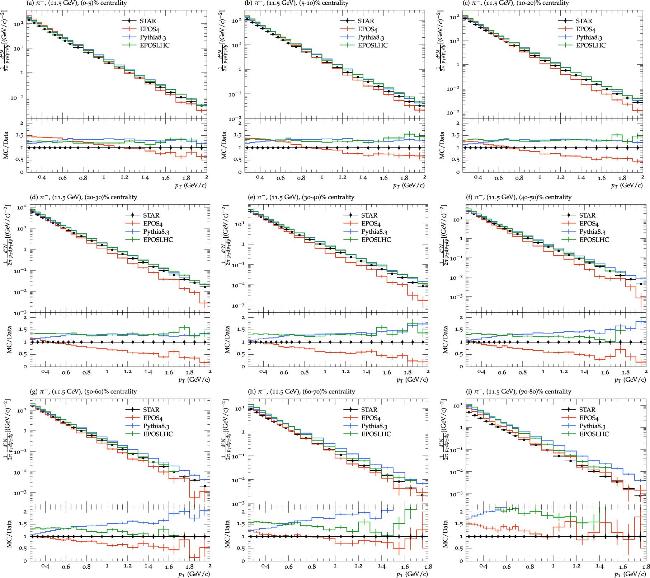
Figure 1. The pT spectra for π− across nine centrality classes during gold–gold collisions at $\sqrt{s}=11.5$ GeV are illustrated. Predictions from three MC models—EPOS4, EPOSLHC, and Pythia 8.3—are compared against the experimental data from the STAR collaboration [20]. Each plot is accompanied by the corresponding data-to-MC ratio, providing a detailed comparison of the model predictions with the experimental results. |
For the (20–30)% centrality class, EPOS4 accurately reproduces the spectra for pT < 0.8 GeV/c and after this underestimates the data for the remaining pT range with 50% deviation. In contrast, EPOSLHC and Pythia 8.3 overestimates the data for all pT with 50% 20% deviation. Similarly, for the (30–40)% and (40–50)% centrality classes, EPOS4 provides excellent agreement with the data for pT < 0.8 GeV/c values. However, EPOSLHC and Pythia 8.3 overestimate the spectra by approximately 40% and 30%, respectively. EPOS4 fails to describe the spectra for the pT > 1 GeV/c range.
In the (50–60)% centrality class, EPOS4 shows good agreement with experimental data for pT < 0.6 GeV/c. However, beyond this range, it fails to reproduce the data. In contrast, EPOSLHC and Pythia 8.3 overestimate the spectra. While these two models reproduce the data well for pT < 0.8 GeV/c, they increasingly overestimate it as pT rises, with significant overestimation observed for pT > 1.2 GeV/c. EPOSLHC is used for radial flow calculation that affects the high multiplicity region (low pT), leading to a highly improved description of this observable in the region. To address the limitations observed in EPOS LHC for high pT particles, a new saturation scale has been introduced in EPOS4, which can vary for each pomeron. This model introduced an efficient code for solving the hydrodynamic equation, including the conservation of baryon number and strangeness, as well as a hadronic cascade procedure following hadronization. Pythia 8.3 also fails to describe the high pT particles due to a lack of collective flow effect and hadronic rescattering. For the (60–70)% centrality class, EPOS4 accurately reproduces the data. EPOSLHC also provides a better description compared to Pythia 8.3, primarily due to its inclusion of collective flow effects. The pT spectra are sensitive to collective flow and hadronic rescattering, both of which EPOS4 models effectively. This results in a softer spectrum due to fluid-like hadronization [48]. EPOSLHC also benefits from its treatment of collective flow effects, whereas Pythia 8.3 struggles to accurately describe the spectra above 0.6 GeV/c. The challenges faced by Pythia 8.3 in achieving high precision can be attributed to its omission of critical aspects related to these effects. For the (70–80)% centrality class, EPOS4 once again reproduces the data accurately over the entire pT range. While EPOSLHC and Pythia 8.3 fails to satisfactorily reproduce the experimental data, highlighting limitations in their descriptions of highly peripheral collisions.
Figure 2 illustrates the pT spectra for π+ across nine centrality classes. For the (0–5)% centrality class, a comparison of MC model predictions with STAR data reveals that both EPOSLHC and Pythia 8.3 reproduced the data well while EPOS4 overestimates the data for pT < 0.8 GeV/c and afterwards slightly underestimates it. Despite this, EPOS4 also provides a reasonable match to the data for this centrality.
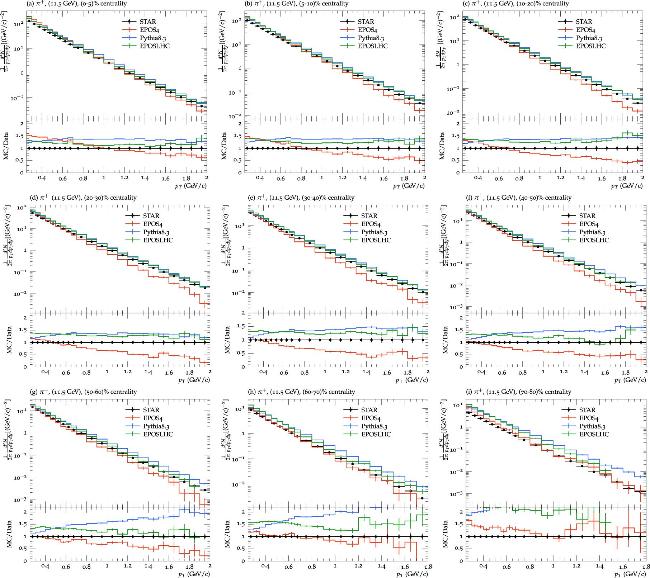
Figure 2. The pT spectra for π+ across nine centrality classes during gold–gold collisions at $\sqrt{s}=11.5$ GeV are illustrated. Predictions from three MC models—EPOS4, EPOSLHC, and Pythia 8.3—are compared against the experimental data from the STAR collaboration [20]. Each plot is supplemented with a data-to-MC ratio, enabling a more precise evaluation of the agreement between the model predictions and experimental results. |
In the (5–10)% and (10–20)% centrality classes, Pythia 8.3 and EPOSLHC agrees well with the data for all pT range. While EPOS4 overestimates the data for pT < 0.8 GeV/c and afterwards underestimates it with larger discrepancy. For the (20–30)% class, EPOS4 reproduces the data well for pT < 0.8 GeV/c. However, EPOSLHC and Pythia 8.3 overestimates the spectra for pT < 1.6 GeV/c but aligns closely with the data at pT > 1.6 GeV/c. In the (30–40)% and (40–50)% centrality classes, EPOSLHC provides a better match to the data, whereas Pythia 8.3 fails to describe the spectra across the entire pT range. EPOS4 demonstrates well reproduced the data for pT < 0.8 GeV/c range. At pT > 0.8 GeV/c, EPOS4 underestimates the data with larger discrepancy. For the (50–60)% centrality class, EPOSLHC maintains good agreement with the data throughout the pT region. EPOS4 also good agreement with the data for pT < 1.2 and afterwards underestimates the data the spectra by 80% deviation. In the contrast, Pythia 8.3 fails to describe the spectra for the entire pT spectra. In the (60–70)% class, EPOS4 is the only model to accurately reproduce the data across all pT. EPOSLHC provides a relatively better description compared to Pythia 8.3, largely due to its inclusion of collective flow effects.
The pT spectra are highly sensitive to collective flow and hadronic rescattering, both of which EPOS4 and EPOSLHC models effectively described the data. Pythia 8.3, however, struggles to describe the pT spectra above 0.6 GeV/c due to its lack of these effects. Finally, for the (70–80)% centrality class, EPOS4 model affectively described the data compared to EPOSLHC and Pythia 8.3. These two models overestimate it with larger discrepancies, due to the lack of energy density for hydrodynamic collectively and hadronic rescattering.
Figure 3 illustrates the pT spectra for K− across nine centrality classes. In the (0–5)% centrality class, comparisons between MC model predictions and STAR experimental data show that EPOSLHC and Pythia 8.3 agree well with the data across the entire pT range while EPOS4 overestimates it with 70% deviation at pT < 1 GeV/c. Afterwards, EPOS4 reproduced the data well. In the (5–10)% and (10–20)% centrality classes, all three models reproduced the data well.
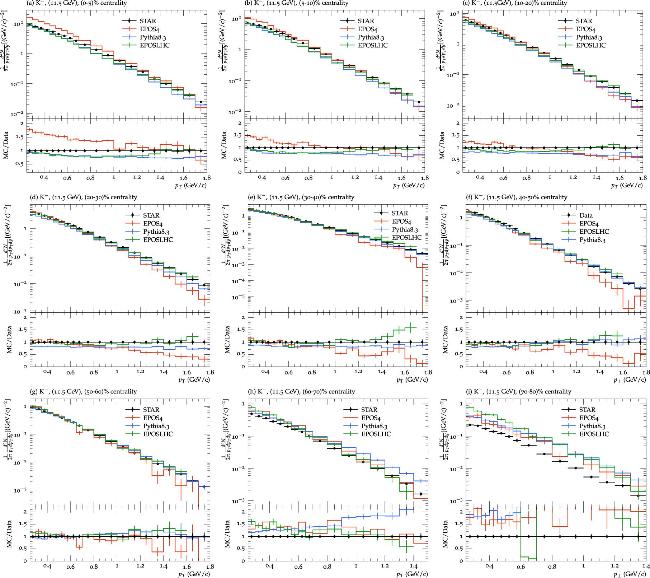
Figure 3. The pT spectra for K− across nine centrality classes from gold–gold collisions at $\sqrt{s}=11.5$ GeV are shown. Predictions from the MC models EPOS4, EPOSLHC, and Pythia 8.3 are compared with experimental data from the STAR collaboration [20]. Each plot includes a data-to-MC ratio, enabling a comprehensive comparison of model predictions with observations. |
In the (20–30)% centrality class, EPOSLHC provides an excellent match to the data for the entire pT range while Pythia 8.3 and EPOS4 also good predicted the data for pT < 1.2 GeV/c and afterward, Pythia 8.3 and EPOS4 underestimated it with 20% 60% discrepancies. The rescattering effect in EPOS4 diminishes from central to peripheral collisions as the interaction volume decreases, reducing the likelihood of rescattering events. This decline correlates with reduced centrality, as smaller interaction volumes lower the probability of particle rescattering. In the (30–40)% centrality class, Pythia 8.3 provides and excellent match to the data. EPOS4 and EPOSLHC both reproduce the spectra effectively, while EPOS4 underpredict the data at higher pT while EPOSLHC overpredict it. For the (40–50)% centrality class, EPOSLHC and Pythia 8.3 provide an excellent match to the data while EPOS4 also good predicted but in the region of pT < 1.2 GeV/c and afterwards underpredicted with 50% deviation. In the (50–60)% centrality class, all the three models maintain good agreement with the data for the entire pT range. In the (60–70)% centrality class, all the given models overpredicted the data at pT < 0.8 GeV/c. When pT was increasing, EPOS4 and EPOSLHC provides a good match to the data. In contrast, Pythia 8.3 overestimate the data, with larger discrepancy observed. However, for the most peripheral 70%–80% centrality class, none of the given model predict the data well, underscoring significant challenges in modeling these collisions. In the most peripheral (70–80) % centrality class, all models fail to reproduce the experimental data accurately. This discrepancy can be attributed primarily to the absence or significant suppression of collective effects such as radial flow and hadronic rescattering, which are typically more pronounced in central collisions. Moreover, the lower multiplicity in peripheral events enhances the role of statistical fluctuations and non-equilibrium dynamics, making it difficult for models, especially those relying on hydrodynamic assumptions or tuned for high-multiplicity scenarios, to reliably describe such events. These factors collectively limit the predictive power of current models in the peripheral regime.
Figure 4 displays the transverse momentum (pT) spectra for K+ across nine centrality classes. In the (0–5)% centrality class, a comparison of MC models with STAR experimental data reveals that EPOS4 overestimates the data for pT < 0.8 GeV/c while afterwards underestimates the data. In contrast, EPOSLHC and Pythia 8.3 underestimate the spectra with deviations of approximately 30% and 40%, respectively. For the (5–10)% centrality class, EPOSLHC provides a good match to the data approximately across all pT values. Pythia 8.3 underpredicted the data for the entire pT range with 50% deviation. EPOS4 overestimates the data for pT < 0.6 GeV/c while afterwards as pT was increasing, EPOS4 underpredicts it beyond this range, with a deviation of 70%.
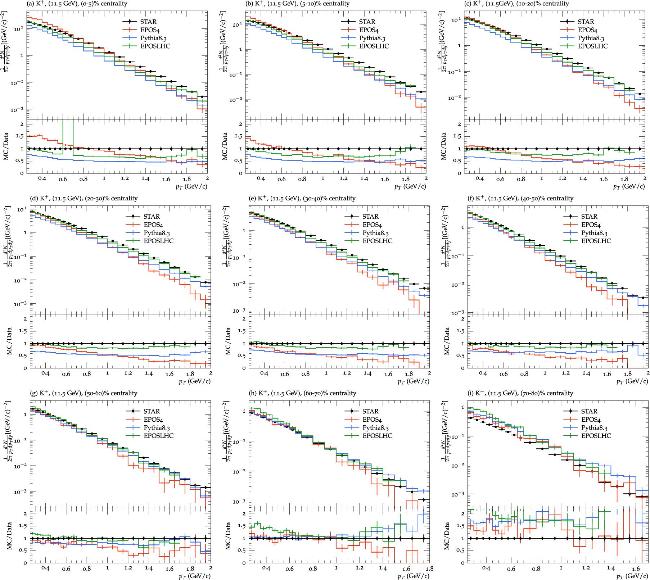
Figure 4. The pT spectra for K+ at nine centrality classes in gold–gold collisions at $\sqrt{s}=11.5$ GeV are depicted. The predictions from the MC models—EPOS4, EPOSLHC, and Pythia 8.3—are evaluated against the experimental results from the STAR collaboration [20]. Each plot is supplemented by a data-to-MC ratio, facilitating a detailed examination of the agreement between the models and the measured data. |
In the (10–20)%, (20–30)% and (30–40)% centrality classes, EPOSLHC exhibit strong agreement with the data, while Pythia 8.3 underpredicts the spectra across the entire pT range. EPOS4 also good agreement with the data for pT < 0.8 GeV/c while beyond this range underestimates the data with almost 70% deviation. For the (40–50)% and (50–60)% classes, EPOSLHC shows excellent agreement across all pT values. Pythia 8.3 also reproduce the data well for pT < 1.8 GeV/c while EPOS4 well reproduced the data at pT < 1 GeV/c while beyond this range, underestimates it with larger discrepancy.
In the (60–70)% centrality class, EPOS4 and Pythia 8.3 exhibit strong agreement with the data. EPOSLHC good agreement with the data at 0.6 < pT < 1.4 while overestimates the data for pT < 0.6 GeV/c and pT > 1.4 GeV/c. However, in the most peripheral (70–80)% centrality class, none of the models accurately predict the spectra while mostly overestimates the data with larger discrepancies due to the reason described above.
Figure 5 presents the pT spectra for $\bar{p}$ across nine centrality classes. In the (0–5)% centrality class, a comparison of MC models with STAR experimental data shows that the EPOS4 underestimates the data for the entire pT range However, both EPOSLHC and Pythia 8.3 overestimates the data and fail to reproduce the spectra for pT < 1.4 GeV/c while as provides a better match to the experimental data for higher pT range.
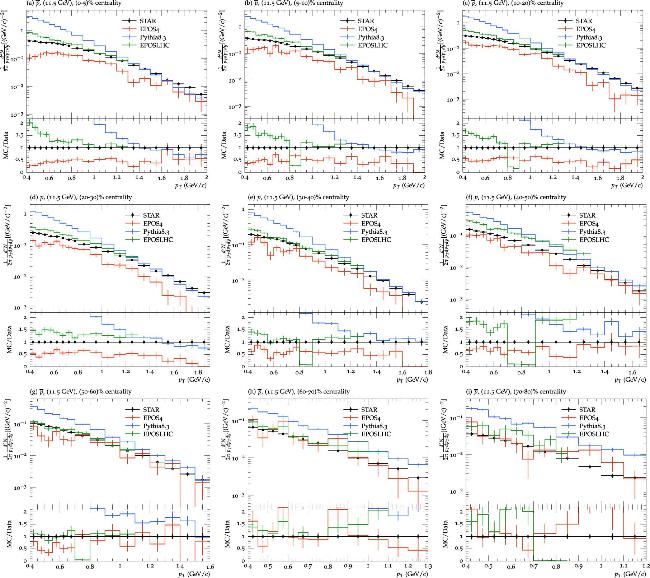
Figure 5. The pT spectra for $\bar{p}$ across nine centrality classes in gold–gold collisions at $\sqrt{s}=11.5$ GeV are shown. The predictions from the MC models—EPOS4, EPOSLHC, and Pythia 8.3—are compared with the experimental data from the STAR collaboration [20]. Each plot is accompanied by a data-to-MC ratio, providing a detailed comparison of the model predictions to the experimental results. |
In the (5–10)% and (10–20)% centrality classes, EPOS4 fails to reproduce the data while EPOSLHC and Pythia 8.3 also fails to reproduced the data at pT < 0.8 GeV/c and pT < 1 GeV/c respectively. As pT are increasing, these two models approaches to the data. The improved agreement of EPOS4 at higher pT is attributed to the EOS parameter, which facilitates the transition from the hadronic phase to the QGP phase. Conversely, both Pythia 8.3 and EPOSLHC overestimate the data with large discrepancies, failing to reproduce the spectra. In the (20–30)% class, EPOSLHC good agreement with the data, whereas Pythia 8.3 significantly overestimates the spectra at lower pT values but aligns more closely at pT > 1.2 GeV/c. Pythia 8.3 fails to reproduced the data at low pT region. EPOS4 underestimates the data for the entire pT range with 50% deviation.
In the (30–40)% centrality class, EPOSLHC matches the data well for entire pT range while EPOS4 approaches to the data as compared to the previous centrality classes. Pythia 8.3 overestimates the spectra with larger discrepancy but close to the data at pT > 1.2 GeV/c. For the (40–50)% centrality class, EPOS4 matches the data well for entire pT range while EPOSLHC and Pythia 8.3 fails to reproduce the spectra.
In the (50–60)% centrality class, EPOS4 and EPOSLHC good reproduced the data for entire pT range while Pythia 8.3 fails to reproduced the data for entire pT range. In the (60–70)% class, EPOS4 relatively better described the data as compared to the EPOSLHC and Pythia 8.3. EPOS4 underestimates the data at pT > 1 GeV/c with 50% deviation. Pythia 8.3 and EPOSLHC fail to describe the spectra.
Finally, in the most peripheral (70–80)% centrality class, all three models fail to reproduce the experimental data, highlighting significant limitations in their ability to model collisions at such high centralities.
Figure 6 presents the pT spectra for protons across nine centrality classes. In the (0–5)% and (5–10)% centrality intervals, comparisons between MC models and data from the STAR collaboration shows that EPOS4 and EPOSLHC well reproduced the data for pT < 0.8 GeV/c while in this range Pythia 8.3 overestimates it. Beyond this range, EPOS4, EPOSLHC and Pythia 8.3 underestimates the data with 50%, 10% and 50% deviation. In the (10–20)% centrality range, EPOSLHC aligns closely with experimental results for all pT range while EPOS4 underestimates the data for entire pT range, whereas Pythia 8.3 overestimates the data at pT < 0.7 GeV/c. Beyond pT > 0.8 GeV/c, both Pythia 8.3 and EPOSLHC underpredict the measurements with 50% 10% deviation, with EPOS4 showing a discrepancy of 60%. The suppression observed at high pT in heavy-ion collisions is attributed to collective effects in EPOSLHC and hadron rescattering in EPOS4. In EPOSLHC, the high-pT suppression arises from collective flow, where the dense medium formed in the collision impacts particle dynamics. At higher pT, particles escape the medium’s influence, leading to diminished collective behavior. Conversely, in EPOS4, suppression at pT > 0.8 GeV/c is linked to reduced hadron rescattering and baryon-antibaryon annihilation [48]. Pythia 8.3 also underpredicts central collision data for pT > 0.8 GeV/c due to insufficient modeling of hard scattering processes.
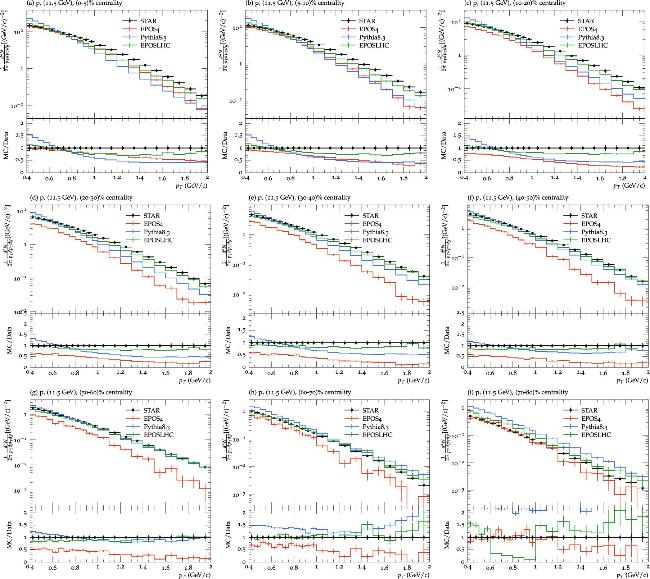
Figure 6. The pT spectra for protons (p) across nine centrality classes in gold–gold collisions at $\sqrt{s}=11.5$ GeV are presented. Predictions from the MC models—EPOS4, EPOSLHC, and Pythia 8.3—are compared with experimental data from the STAR collaboration [20]. Each plot is followed by a data-to-MC ratio, allowing for a comprehensive comparison between the model predictions and the experimental measurements. |
For the (20–30)% centrality range, EPOSLHC align with experimental data for the entire pT range, while Pythia 8.3 overestimates at pT < 0.6 GeV/c. EPOS4 underestimates the data for the entire pT range. At pT > 0.8 GeV/c, Pythia 8.3 underestimate the data with 50% deviation. Within the (30–40)% range, EPOSLHC once again show good agreement for entire pT range while Pythia 8.3 overestimates by 30% for pT < 0.6 GeV/c afterwards underestimates it with 50% deviation. EPOS4 underestimates the data for the entire pT range. In the (40–50)% and (50–60)% classes, EPOSLHC and Pythia 8.3 reproduces the data well across the entire pT spectrum, and EPOS4 underestimate data across all pT values with 70% deviation.
In the (60–70)% range, EPOSLHC closely matches the data for pT < 1.8 GeV/c while EPOS4 showing agreement for pT < 0.8 GeV/c as compared to the previous classes, but underpredicting by 60% at pT > 0.8 GeV/c. Pythia 8.3 fails to reproduce experimental results, overestimating the data with larger discrepancy. For baryons and antibaryons, EPOS4 demonstrates a pronounced impact of hadron rescattering from central to peripheral collisions. This effect, driven by baryon-antibaryon annihilation, causes a rise in the proton curve and a decline in the antiproton curve. For the (70–80)% centrality class, EPOS4 satisfactory reproduced the data as compared to Pythia 8.3 and EPOSLHC. The failure of EPOSLHC is due to the lack of energy density for hydrodynamic and hadronic rescattering while Pythia 8.3 also fails to describe the data due to lack of collective flow effect and hadronic rescattering. Figure 7 illustrates the fitting of the experimental data using equation (1 ), and the corresponding parameter values extracted are presented in Table 1. Now comparing the effective temperature (T) as a function of collision centrality percentage show that T increases with increasing collision centrality. This trend arises due to the higher energy deposition in central collisions compared to peripheral ones. The table also highlights that changes in T are most pronounced for protons (p) relative to the other analyzed particles. This is attributed to the greater mass of protons, which leads to stronger interactions with the surrounding medium. These interactions facilitate more substantial energy exchange, resulting in more noticeable variations in T for protons. Additionally, the table demonstrates higher T values for heavier particles and lower T values for lighter particles, confirming that heavier particles decouple from the system earlier when the medium is highly thermalized, followed by lighter particles, indicating to the multiple kinetic freezeout scenario [49, 50].
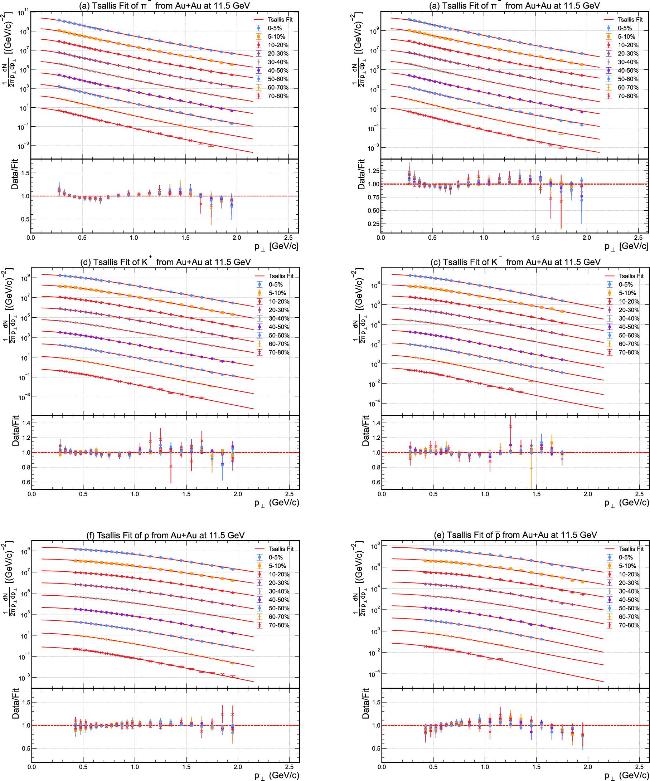


Figure 7. The fit of the Tsallis function to the pT spectra is illustrated for (a) π+, (b) π−, (c) K+, (d) K−, (e) proton, and (f) anti-proton across nine centrality classes in gold–gold collisions at $\sqrt{s}=11.5$ GeV. |
Table 1 also includes the non-extensive parameter (q), which measures the thermal equilibrium state of the system. Behavior of (q) with collision centrality reveal that q decreases with increasing centrality, indicating that the system approaches thermal equilibrium more closely in central collisions than in peripheral ones. Furthermore, the table shows that heavier particles exhibit smaller q values compared to lighter particles, reflecting quicker equilibration for heavier particles. This behavior is due to the stronger coupling of heavier particles with the medium and their more frequent interactions, enabling more efficient energy exchange and earlier thermalization. These findings align with the results reported in [51–54]. Specifically, in [53], the entropy-based parameter (n), defined as the inverse of q (q = 1 + 1/n), was found to be larger for heavier particles than for lighter ones, further corroborating the observation that q is smaller for heavier particles. In addition, the parameter (N), which is the multiplicity parameter. One can see that the parameter N decreases from head-on to peripheral collisions due to decreasing the deposition of energy in the system in peripheral collisions that leads to decrease in multiplicity. On the other hand, N is larger for the lighter particles which indicates that lighter particles are generated in large amount compared to massive particles.
Table 1. The values of free parameters, the normalization constant, χ2 and ndof obtained through the fitting procedure of the experimental data with Tsallis function given in equation ( |
| Particle Type | Centrality | N | q | T | χ2 | dof |
|---|---|---|---|---|---|---|
| (00–05)% | 4357.8005 ± 571.4319 | 1.0523 ± 0.0059 | 0.1223 ± 0.0047 | 25.7296 | 20 | |
| (05–10)% | 3737.0471 ± 436.2158 | 1.056 ± 0.0051 | 0.1191 ± 0.0041 | 20.1315 | 20 | |
| (10–20)% | 3163.9527 ± 349.2886 | 1.0603 ± 0.0047 | 0.1152 ± 0.0037 | 16.8557 | 20 | |
| (20–30)% | 2343.8153 ± 249.534 | 1.0632 ± 0.0044 | 0.1122 ± 0.0035 | 15.1205 | 20 | |
| π− | (30-40)% | 1865.4928 ± 211.8716 | 1.0628 ± 0.0044 | 0.1081 ± 0.0035 | 17.6271 | 20 |
| (40–50)% | 1345.5467 ± 175.1223 | 1.0649 ± 0.0048 | 0.1042 ± 0.0038 | 22.4511 | 20 | |
| (50–60)% | 889.5916 ± 129.6847 | 1.0626 ± 0.0052 | 0.1021 ± 0.0041 | 28.1853 | 20 | |
| (60–70)% | 579.2516 ± 97.6054 | 1.0625 ± 0.0064 | 0.0989 ± 0.0047 | 26.8256 | 18 | |
| (70–80)% | 355.0651 ± 56.1875 | 1.0632 ± 0.0059 | 0.095 ± 0.0042 | 21.7992 | 18 | |
| | ||||||
| (00–05)% | 3985.4372 ± 445.576 | 1.0529 ± 0.0052 | 0.1241 ± 0.0041 | 19.3804 | 20 | |
| (05–10)% | 3497.734 ± 332.77 | 1.0569 ± 0.0043 | 0.12 ± 0.0034 | 13.6595 | 20 | |
| (10–20)% | 2886.3358 ± 289.1116 | 1.0588 ± 0.0043 | 0.1171 ± 0.0035 | 14.7312 | 20 | |
| (20–30)% | 2038.2808 ± 207.6257 | 1.0622 ± 0.0044 | 0.1151 ± 0.0035 | 14.2148 | 20 | |
| π+ | (30-40)% | 1536.8153 ± 148.2497 | 1.0618 ± 0.004 | 0.1121 ± 0.0031 | 12.6558 | 20 |
| (40–50)% | 1023.0385 ± 106.9339 | 1.0614 ± 0.0042 | 0.1105 ± 0.0033 | 14.692 | 20 | |
| (50–60)% | 774.8206 ± 81.2313 | 1.0629 ± 0.0039 | 0.1042 ± 0.0031 | 14.1875 | 20 | |
| (60–70)% | 466.7735 ± 47.2927 | 1.0592 ± 0.0041 | 0.1031 ± 0.003 | 9.7309 | 18 | |
| (70–80)% | 256.9512 ± 28.3163 | 1.0554 ± 0.0045 | 0.1022 ± 0.0032 | 11.3367 | 18 | |
| | ||||||
| (00–05)% | 202.871 ± 16.9942 | 1.0282 ± 0.0068 | 0.1674 ± 0.0051 | 16.4055 | 18 | |
| (05–10)% | 176.6393 ± 16.1698 | 1.0332 ± 0.0075 | 0.1641 ± 0.0055 | 19.0502 | 18 | |
| (10–20)% | 142.3888 ± 10.8671 | 1.0361 ± 0.0058 | 0.159 ± 0.0043 | 12.2308 | 18 | |
| (20–30)% | 101.1271 ± 8.4051 | 1.0383 ± 0.0062 | 0.155 ± 0.0046 | 14.0072 | 18 | |
| (30–40)% | 70.6209 ± 8.5981 | 1.042 ± 0.0089 | 0.15 ± 0.0065 | 29.3156 | 18 | |
| K− | (40–50)% | 51.0597 ± 4.2378 | 1.0381 ± 0.0057 | 0.145 ± 0.0041 | 12.8265 | 18 |
| (50–60)% | 29.6244 ± 2.602 | 1.0431 ± 0.0061 | 0.14 ± 0.0043 | 12.1854 | 18 | |
| (60–70)% | 17.109 ± 2.6903 | 1.0398 ± 0.012 | 0.135 ± 0.0075 | 20.8595 | 15 | |
| (70–80)% | 8.8421 ± 1.8227 | 1.0411 ± 0.0174 | 0.1301 ± 0.0098 | 18.5523 | 13 | |
| | ||||||
| (00–05)% | 351.0547 ± 24.064 | 1.0279 ± 0.0053 | 0.1761 ± 0.0044 | 15.9971 | 20 | |
| (05–10)% | 307.8929 ± 24.556 | 1.0264 ± 0.0059 | 0.1728 ± 0.0049 | 22.2926 | 20 | |
| (10–20)% | 230.9988 ± 16.4659 | 1.0265 ± 0.005 | 0.1708 ± 0.0043 | 16.9267 | 20 | |
| (20–30)% | 156.1787 ± 10.9097 | 1.0266 ± 0.0048 | 0.1688 ± 0.0041 | 15.9163 | 20 | |
| K+ | (30–40)% | 105.7554 ± 5.7281 | 1.0367 ± 0.0039 | 0.1632 ± 0.0031 | 8.5291 | 20 |
| (40–50)% | 71.4319 ± 3.0768 | 1.0293 ± 0.0029 | 0.1601 ± 0.0023 | 5.2874 | 20 | |
| (50–60)% | 38.2754 ± 2.094 | 1.0277 ± 0.0037 | 0.1582 ± 0.0029 | 8.1202 | 20 | |
| (60–70)% | 20.7044 ± 0.7685 | 1.023 ± 0.0027 | 0.1553 ± 0.002 | 2.5601 | 18 | |
| (70–80)% | 10.4783 ± 0.971 | 1.0157 ± 0.0073 | 0.1531 ± 0.005 | 11.5313 | 17 | |
| | ||||||
| (00–05)% | 8.1387 ± 2.4939 | 1.0197 ± 0.0342 | 0.241 ± 0.0301 | 76.8598 | 18 | |
| (05–10)% | 8.917 ± 3.4294 | 1.0436 ± 0.0379 | 0.2146 ± 0.0326 | 91.8643 | 18 | |
| (10–20)% | 8.7699 ± 3.8287 | 1.0479 ± 0.0387 | 0.2012 ± 0.0337 | 116.2951 | 18 | |
| (20–30)% | 7.0766 ± 2.7006 | 1.0513 ± 0.0345 | 0.1956 ± 0.0285 | 65.9176 | 17 | |
| $\overline{p}$ | (30-40)% | 6.1162 ± 2.3955 | 1.053 ± 0.0346 | 0.1856 ± 0.0273 | 52.5573 | 16 |
| (40–50)% | 4.1217 ± 1.2576 | 1.0284 ± 0.0274 | 0.19 ± 0.0214 | 26.3118 | 14 | |
| (50–60)% | 3.0653 ± 0.6956 | 1.0325 ± 0.0204 | 0.1812 ± 0.0151 | 9.6197 | 13 | |
| (60–70)% | 2.3611 ± 0.7593 | 1.0476 ± 0.0318 | 0.1645 ± 0.0199 | 5.3469 | 10 | |
| (70–80)% | 1.3177 ± 0.5636 | 1.0253 ± 0.0442 | 0.1645 ± 0.0263 | 5.5928 | 9 | |
| | ||||||
| (00–05)% | 228.4887 ± 39.4237 | 1.004 ± 0.0187 | 0.2545 ± 0.0172 | 32.1218 | 20 | |
| (05–10)% | 204.6313 ± 37.3875 | 1.0237 ± 0.0193 | 0.24 ± 0.0172 | 29.8519 | 20 | |
| (10–20)% | 172.7307 ± 33.2898 | 1.0281 ± 0.019 | 0.2302 ± 0.017 | 31.68 | 20 | |
| (20–30)% | 133.6101 ± 23.6586 | 1.0306 ± 0.0162 | 0.2203 ± 0.0146 | 25.1984 | 20 | |
| p | (30–40)% | 97.7446 ± 14.8287 | 1.0316 ± 0.013 | 0.2123 ± 0.0117 | 17.7303 | 20 |
| (40–50)% | 83.1455 ± 16.7427 | 1.0342 ± 0.0145 | 0.1923 ± 0.0133 | 30.3546 | 20 | |
| (50–60)% | 56.1583 ± 8.9702 | 1.0386 ± 0.0106 | 0.1812 ± 0.0096 | 17.1264 | 20 | |
| (60–70)% | 34.2067 ± 6.6358 | 1.0288 ± 0.0114 | 0.1735 ± 0.0106 | 27.5094 | 20 | |
| (70–80)% | 19.94 ± 3.0175 | 1.039 ± 0.0087 | 0.1612 ± 0.0076 | 12.1937 | 20 | |
Prior to moving on to the next segment, we would like to emphasize the pT spectra are significantly modified by collective flow, which includes radial and anisotropic components, particularly in head-on collisions where the system shows intense interactions. The effect depends on centrality: radial flow hardens the spectrum in central (high-multiplicity) collisions, pushing particles toward higher pT, whereas flow effects are less pronounced in peripheral (low-multiplicity) collisions, keeping spectra closer to the original production mechanisms like fragmentation. Our analysis’s Tsallis distribution (equation (1 )) is essentially a phenomenological tool that captures the power-law behavior at high pT and other non-equilibrium aspects of particle creation. Although hydrodynamic flow is not specifically included, some of the flow-related changes can be empirically and averagely absorbed by the effective temperature and non-extensivity parameter.
The interpretation is further complicated by hadronic re-scattering, especially at low pT, where momentum is redistributed among particles by final-state interactions. Once more, this impact depends on centrality, with more frequent re-scattering occurring in central collisions. This can increase some particle species (like pions) and suppress others (like strangeness-enhanced hadrons). Conversely, the spectra of peripheral collisions are more representative of the initial production processes because they are less impacted by re-scattering. These re-scattering effects are not specifically taken into account by the Tsallis model since it is a statistical description rather than a dynamical one. At low pT, however, discrepancies between the model and evidence, especially in core collisions, might show where these processes become important.
4. Summary and conclusions
This study applies a phenomenological approach to analyze the pT distributions of specific hadrons produced during gold–gold collisions at $\sqrt{s}=11.5$ GeV, as measured by the STAR detector under the Beam Energy Scan Program at RHIC [20]. pT spectra of π±, K±, and (anti)protons are reported at mid-rapidity (∣y∣ < 0.1) across nine centrality classes, utilizing simulations from three event generators: EPOS4, EPOSLHC and Pythia 8.3.
For π+ and π− mesons, EPOS4 aligns well with the experimental data across most peripheral centrality classes. EPOSLHC also replicate the data accurately in the all centrality classes expect last two classes. Pythia 8.3 overestimates the data for all centrality classes. Regarding K+ and K− mesons, both EPOS4 and EPOSLHC show good agreement with the data, while Pythia 8.3 underestimates the yields with less discrepancy. Pythia 8.3 also good predicted the data for 4th, 5th, 6th and 7th centrality classes. Pythia 8.3 consistently fails to represent the data accurately for most peripheral centrality class. Overall none of the given models accurately predict the data for most peripheral centrality class, due to the lack of energy density required for hydrodynamic collectively and hadronic rescattering.
In EPOS4 and EPOSLHC, the production of strange quarks (kaons) is naturally embedded in the framework without modifications to the string hadronization process, aligning seamlessly with their particle production and hadronization mechanisms. For anti-protons, all the given models fails to represent the data for the given pT spectra while EPOSLHC effectively describes the data from (20–30)% and (30–40)% centrality classes. EPOS4 good reproduced the data well from (40–50)% to (60–70)% centrality classes. Pythia 8.3 is entirely unable to explain the data, and EPOSLHC also fails to describe the data at pT < 1 GeV/c. For protons, EPOSLHC has good agreement with the data for the entire pT range while EPOS4 also accurately match the data at pT < 0.8 GeV/c for first three centrality classes, but underpredict it at higher pT values. Pythia 8.3 also gives good results as compared to the previous hadrons.
At higher pT, suppression is evident in EPOSLHC due to the lack of hard scattering effects and the diminished influence of collective flow on high-pT particles. Comparing pion, kaon, and proton production reveals that pions dominate the low-pT region, resulting in a gentler slope compared to kaons and protons. For K+ and K−, no significant differences are observed, and all models reasonably replicate the data. However, for baryons and anti-baryons, EPOSLHC exhibits stronger effects due to collective effects.
Among the three models, EPOSLHC provides the most accurate performance of the data, benefiting from its incorporation of correlated flow and rescattering processes. EPOS4 also perform well, likely due to its enhanced treatment of correlated flow, saturation effects, hadronic rescattering, and EOS parameters. In contrast, Pythia 8.3 exhibits notable deviations due to the absence of these effects. None of the models successfully predict the data for the ninth centrality class for any particle species, including π±, K±, protons, and anti-protons.
Additionally, none of the models accurately describe the most peripheral (70–80)% collisions. This limitation is likely due to the lack of significant collective phenomena, such as radial flow and hadronic rescattering, as well as enhanced event-by-event fluctuations and non-thermal particle production mechanisms in low-multiplicity environments. These findings highlight the need for further theoretical development to better understand particle production in peripheral heavy-ion collisions.
Additionally, freeze-out parameters such as the effective temperature, non-extensive parameter, and the multiplicity parameter (N) have been extracted from experimental data using the non-extensive Tsallis model. The effective temperature rises with increasing centrality due to higher excitation levels in central collisions. Conversely, the non-extensive parameter decreases with higher centrality, suggesting that the system approaches thermal equilibrium in more central collisions. The parameter N also decrease from head-on to peripheral collisions, indicating the production of more particles in central collisions, and it is larger for the lighter particles, rendering the production of lighter particles to be in large quantity.