

1. Introduction
In experiments involving the ultrafast intense laser pulse ionization of atoms and molecules, the measured yields of doubly charged ions have been observed to exceed predictions based on sequential ionization by several orders of magnitude. The intensity-dependent yield curve for these ions exhibits a distinct ‘knee-like’ structure [1]. This phenomenon, known as non-sequential double ionization (NSDI), is characterized by complex electron-electron correlation effects and has become a major research focus in strong-field physics [2–4]. Extensive experimental and theoretical studies have shown that atomic NSDI is well described by the recollision model [5–11]. Within this framework, the intense laser field significantly distorts the atomic potential well, effectively lowering the ionization barrier. Consequently, one electron can escape from the core binding through tunnel ionization or over-the-barrier ionization. Once freed, this electron is driven by the laser field to initially move away from the parent ion. Subsequently, during its trajectory, it gains energy from the laser field before returning to collide with the core again. The energetic recollision plays a pivotal role in determining the subsequent pathways of NSDI. In cases where the energy is sufficiently high, the returning electron can ionize the second electron through impact ionization, a process termed recollision-induced ionization (RII) [12, 13]. When the energy is insufficient for direct ionization but can excite the second electron while leaving the returning electron unbound, the mechanism is classified as recollision-induced excitation with subsequent ionization (RESI) [14, 15].
Investigating molecular NSDI is intrinsically more complex than atomic NSDI due to additional degrees of freedom, including the influence of electronic orbitals and molecular orientation on correlated electron dynamics [16]. NSDI has been experimentally observed in molecules [16–18], and the three-step recollision model provides a robust theoretical framework for interpreting these phenomena. Early studies predominantly focused on NSDI induced by one-dimensional (1D) electric fields, such as linearly polarized monochromatic pulses or parallel two-color pulses, where the field geometry facilitates electron return and recollision. Recent investigations, however, have shifted focus to molecular NSDI driven by two-dimensional (2D) electric fields. By adjusting the laser parameters, the trajectory of the electric-field vector within the polarization plane can be precisely controlled, thereby modifying the laser-driven electron dynamics [19, 20]. Typical 2D laser field configurations include counter-rotating two-color circularly polarized (TCCP) fields, and counter-rotating two-color elliptically polarized (TCEP) fields [21–26]. Among these configurations, counter-rotating TCCP fields exhibit spatial symmetry that allows recolliding electrons to return through multiple pathways, a phenomenon that generally suppresses recollision efficiency [27]. In contrast, counter-rotating TCEP fields not only break the spatial symmetry [28], but also offer a flexible way to control electron recollision via their ellipticity, providing greater tunability compared to TCCP fields. Prior works have mainly focused on atomic NSDI, while our work extends the investigation to oxygen molecules, which exhibit richer dynamic features. More importantly, unlike previous studies that primarily controlled the amplitude ratio, relative phase, or laser intensity, we introduce a new control parameter—the angle between the major axes of the two elliptically polarized components. This unique degree of freedom enables us to uncover novel characteristics of molecular NSDI in TCEP fields. Recently, TCEP fields have been successfully employed to trigger various strong-field processes, including high-order harmonic generation (HHG) [29, 30], above-threshold ionization (ATI) [31], molecular dissociation [32], and NSDI [25, 33].
Studies have shown that in counter-rotating TCEP fields, electron momentum distributions exhibit significant asymmetry, with the preferential recollision direction determined by the relative orientation of the two elliptically polarized components. In this work, for the 800 nm elliptically polarized field, its major axis was fixed along the x-direction, while the major axis of the 400 nm elliptically polarized field was rotated. By defining θ as the angle between the two polarization fields, we employed the CEM to investigate how different angles influence the NSDI dynamics of oxygen molecules in TCEP fields. Observations revealed that increasing the angle between the major axes of the two elliptically polarized fields distorts the combined field. This distortion significantly modulates the DI yield and induces a transition in the dominant pathways of the NSDI process.
2. Theoretical method
This study employs a three-dimensional (3D) CEM to investigate NSDI in aligned molecules. First proposed by Eberly et al [34], this model has subsequently been widely applied to interpret and predict strong-field double ionization phenomena [35–42]. The model has successfully explained numerous experimentally observed phenomena and made accurate predictions for double ionization under novel conditions. In the 3D classical ensemble framework, the motion of the two electrons is governed by Newton’s classical equations of motion (atomic units are used throughout unless otherwise specified)
$\begin{eqnarray}\frac{{{\rm{d}}}^{2}{{\boldsymbol{r}}}_{{i}}}{{\rm{d}}{t}^{2}}=-{\rm{\nabla }}\left[{V}_{\,\rm{ne}\,}\left({{\boldsymbol{r}}}_{{i}}\right)+{V}_{\,\rm{ee}\,}\left({{\boldsymbol{r}}}_{{\rm{1}}},{{\boldsymbol{r}}}_{{\rm{2}}}\right)\right]-{\boldsymbol{E}}\left(t\right).\end{eqnarray}$
Here, the subscript i = 1, 2 denotes the two electrons, and ri represents the position vector of the i-th electron. The subject of investigation is a model oxygen molecule oriented along the x-axis. The two nuclei are positioned at (−R/2, 0, 0) and (R/2, 0, 0), with the internuclear separation R assigned a value of 2.04 a.u.. In the case of the oxygen molecule, Coulomb interactions between electrons and nuclei, as well as between electrons themselves, are modeled using a two-center 3D soft-core potential
$\begin{eqnarray}\begin{array}{rcl}{V}_{\,\rm{ne}\,}({{\boldsymbol{r}}}_{{i}}) & = & -\frac{1}{\sqrt{{({x}_{{i}}-R/2)}^{2}+{y}_{{i}}^{2}+{z}_{{i}}^{2}+{a}^{2}}}\\ & & -\frac{1}{\sqrt{{({x}_{{i}}+R/2)}^{2}+{y}_{{i}}^{2}+{z}_{{i}}^{2}+{a}^{2}}},\end{array}\end{eqnarray}$
$\begin{eqnarray}{V}_{\,\rm{ee}\,}({{\boldsymbol{r}}}_{{\rm{1}}},{{\boldsymbol{r}}}_{{\rm{2}}})=\frac{1}{\sqrt{{({{\boldsymbol{r}}}_{{\rm{1}}}-{{\boldsymbol{r}}}_{{\rm{2}}})}^{2}+{b}^{2}}}.\end{eqnarray}$
Softening parameters a = 1.07 and b = 0.1 are introduced to prevent unphysical auto-ionization and numerical singularities.
To establish the initial configuration for equation (1 ), a statistical ensemble is generated starting from positions permitted by classical mechanics corresponding to a total energy of −1.68 a.u.. This energy precisely matches the sum of the first and second ionization potentials of molecular oxygen O2. The accessible kinetic energy is probabilistically distributed between the two electrons, with their momentum vectors assigned through stochastic orientation sampling. Following initialization, the two-electron dynamics evolve under external-laser-free conditions for an extended time interval (400 a.u.), ensuring that spatial coordinates and momentum vectors attain full equilibration. Upon completion of this pre-laser preparation, the externally applied laser field is activated. The laser’s electric field components are defined as
$\begin{eqnarray}{{\boldsymbol{E}}}_{800}(t)=\frac{{E}_{0}f(t)}{\sqrt{{\varepsilon }^{2}+1}}\left[\cos (\omega t)\hat{{\boldsymbol{x}}}-\varepsilon \sin (\omega t)\hat{{\boldsymbol{y}}}\right],\end{eqnarray}$
$\begin{eqnarray}\begin{array}{rcl}{{\boldsymbol{E}}}_{400}(t) & = & \frac{f(t){E}_{0}}{\sqrt{1+{\varepsilon }^{2}}}\left[\left(\cos (2\omega t)\cos (\theta )-\varepsilon \sin (2\omega t)\sin (\theta )\right)\hat{{\boldsymbol{x}}}\right.\\ & & \left.+\left(\cos (2\omega t)\sin (\theta )+\varepsilon \sin (2\omega t)\cos (\theta )\right)\hat{{\boldsymbol{y}}}\right].\end{array}\end{eqnarray}$
In this framework, E(t) = E800(t) + E400(t) represents the electric field of the combined laser pulse, while E800(t) and E400(t) denote the field components at 800 nm (ω = 0.057 a.u.) and 400 nm wavelengths, respectively. The unit vectors along the x-axis and y-axis are $\hat{{\boldsymbol{x}}}$ and $\hat{{\boldsymbol{y}}}$. The two-color field ellipticity, characterized by parameter ϵ, is fixed at 0.3. The field amplitudes of both components are configured with a 1: 1 ratio. The relative orientation between the polarization ellipses of the two fields is defined by angle θ. The 800 nm pulse period is designated as T, which also represents the period of the two-color combined field since their temporal evolution periods match. The laser pulse temporal envelope f(t) is defined as
$\begin{eqnarray}f(t)=\left\{\begin{array}{ll}\frac{t}{2T}\quad & 0\leqslant t\leqslant 2T\\ 1\quad & 2T\lt t\leqslant 8T\\ \frac{10T-t}{2T}\quad & 8T\lt t\leqslant 10T\\ 0\quad & t\gt 10T.\end{array}\right.\end{eqnarray}$
All trajectories evolve under the combined influence of the Coulomb fields and the previously introduced laser field. Upon termination of the laser pulse, the energy states of both electrons are evaluated. An event is classified as double ionization when both electrons attain positive energy states. The energy associated with each electron includes its kinetic energy, the potential energy from electron-ion interactions, and half of the electron-electron repulsion energy.
3. Results and discussion
Figure 1(a) illustrates the DI probability of oxygen molecules in a TCEP field as a function of laser intensity for angles θ = 0∘, 30∘, 60∘, and 90∘. Within the intensity range from 5 × 10¹⁴ W/cm2 to 1 × 10¹⁵ W/cm2, all DI probability curves exhibit a distinct knee-like structure. This characteristic indicates that ionized electrons can recollide with the molecular core, ejecting an inner-shell electron and triggering NSDI.
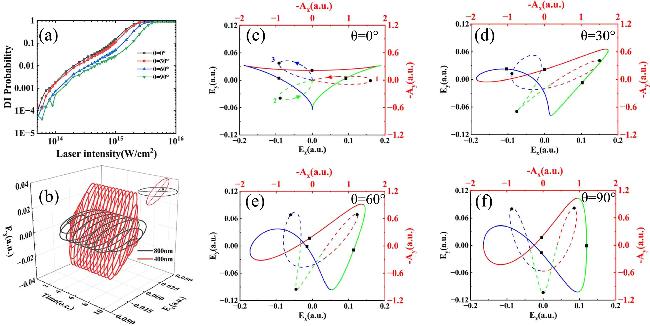
Figure 1. (a) DI probability of oxygen molecules as a function of laser intensity under different angles θ. (b) Combined form of the two electric fields in 3D space at θ = 30∘. (c)–(f) Typical trajectories of the laser electric field waveform (colored dashed lines) and negative vector potential (colored solid lines) under different angles. |
Figure 1(b) schematically shows the polarization configuration of the two elliptically polarized beams (800 nm and 400 nm) composing the TCEP field, where θ denotes the angle between their major elliptical axes. Here, the total laser intensity is fixed at 1 × 10¹⁵ W/cm2 to investigate the NSDI process of oxygen molecules at different θ angles. Figures 1(c)–(f) present the synthesized temporal waveforms of the total electric field E(t) (colored dashed lines) and the corresponding negative vector potential −A(t) (colored solid lines) for different θ values. Both the amplitude and morphology of the three electric field lobes undergo significant variations with changing θ. The arrows in these panels indicate the temporal evolution direction of the electric field vector, progressing sequentially from lobe 1 (red) to lobe 2 (green) and then to lobe 3 (blue). Solid circles and squares respectively mark the positions of the electric field maxima and their corresponding negative vector potential −A(t) values. As θ increases, the characteristic three-lobe structure of the laser field waveform becomes progressively distorted. These modifications in the electric field profile typically induce changes in electron dynamics during the NSDI process.
It has been observed that the DI yield gradually decreases as the angle θ between the two laser fields increases, as shown in Figure 1(a). To investigate the origin of this phenomenon, we calculated the 1D potential energy curves of the combined potential wells formed by the laser field at various θ values. Figure 2(a) presents the 3D combined potential for ${O}_{2}^{+}$ at θ = 0∘, which incorporates both the Coulomb potential and the laser electric field at the peak laser field strength. This 3D potential representation clearly illustrates a double-well structure, which arises from the presence of two atomic nuclei separated by an internuclear distance R within the molecular potential, thereby distinguishing it from atomic potential wells.
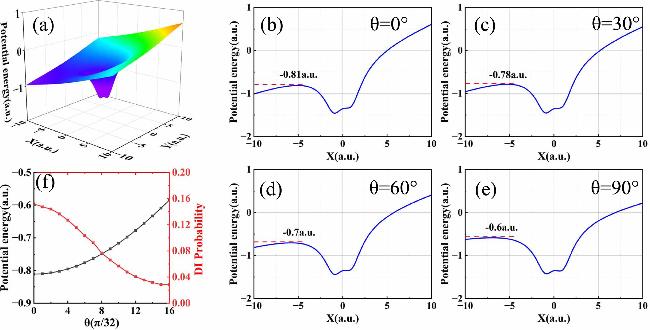
Figure 2. (a) The combined Coulomb and laser electric potential in 3D space for O2 at the instant when the laser electric field reaches its maximum strength (θ = 0∘). (b)–(e) 1D potential well curves derived from the 3D combined potential for angles θ = 0∘, 30∘, 60∘, and 90∘. (f) DI yield (red curve) and the height of the suppressed barrier (black curve) plotted as functions of θ. |
Figures 2(b)–(e) present the corresponding 1D potential energy curves derived from the combined potentials at θ = 0∘, 30∘, 60∘, and 90∘, respectively. Here, we define the barrier height as the maximum point of the lowered barrier on the left side of the potential curve. The analysis reveals that at θ = 0∘, the laser field significantly reduces the height of one potential barrier. This reduction facilitates tunneling ionization of electrons from the ground state. However, as θ increases, the laser field’s barrier-suppressing effect weakens, causing the suppressed barrier height to increase. Consequently, the ionization probability for ground-state electrons decreases. Figure 2(f) presents the DI yield (red curve) and the height of the suppressed potential barrier (black curve) as functions of θ. The results show that as θ increases, the suppressed barrier height (black curve) rises continuously, which inhibits electron ionization. Consequently, the DI yield (red curve) decreases proportionally with increasing θ. This barrier-suppression mechanism directly explains the observed θ-dependent decrease in DI yield shown in Figure 1(a).
The NSDI process, through its recollision mechanism, enables energy transfer from the returning electron to the bound-state electron, thereby inducing pronounced correlation effects between them. Consequently, the dynamics of interelectron correlation emerge as the central focus of NSDI research. Figures 3(a)–(d) and (e)–(h) present the electron momentum spectra with x-direction and y-direction. The horizontal axis represents the x-direction and y-direction momentum of the returning electron, while the vertical axis corresponds to the x-direction and y-direction momentum of the bound-state electron. As evident from figures 3(e)–(h), the y-direction electron momenta predominantly cluster near the origin, showing small magnitudes and minimal variations. In contrast, the x-direction momenta exhibit significantly larger values and pronounced distribution changes, indicating that the correlation dynamics between the two electrons are primarily governed by their x-direction momentum components. Further analysis of the x-direction correlated momentum distributions reveals that the momentum distribution predominantly concentrates in the first, second, and fourth quadrants when θ = 0∘. Compared to the first and third quadrants, the second and fourth quadrants exhibit marginally higher particle counts, indicating a dominant anti-correlation behavior. As θ increases to 30∘, the particle populations in the second and fourth quadrants decrease, though anti-correlation remains the primary feature. When θ further rises to 60∘, significant enhancements occur in the first and third quadrant distributions. This trend becomes most pronounced at θ = 90∘. These results collectively demonstrate that the positive correlation characteristics of the electron pair progressively strengthen with increasing θ angles. This phenomenon can be attributed to the two distinct ionization channels in NSDI.
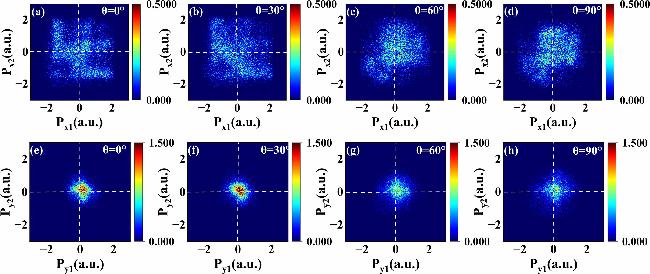
Figure 3. Correlation electron momentum distributions along the x-axis (a)–(d) and y-axis (e)–(h) at θ = 0∘, 30∘, 60∘, and 90∘. |
Taking the θ = 0∘ case as an example (Figure 4(a)), in the RII pathway, a singly ionized electron undergoes ionization at 1.0 optical cycles (o.c.) while absorbing energy from the laser field. Subsequently, at 1.9 o.c., this electron returns and collides with a bound electron. At this collision point, a sharp increase occurs in the repulsive potential between the two electrons, which serves as the criterion to determine whether the returning electron interacts with the bound electron. Following the collision, both the returning and bound electrons ionize within a very short time interval. During this brief period, the laser field’s strength and direction remain nearly constant. Consequently, as shown in Figure 4(c), the electron pair generated through this recollision process exhibits a higher probability of directional emission alignment, thereby inducing positive correlation in the two-electron momentum distribution.
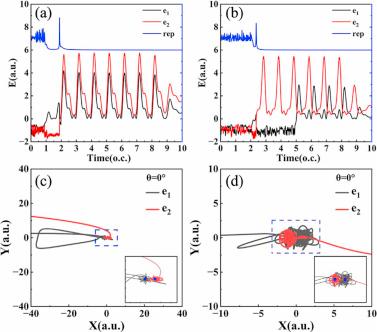
Figure 4. Energy evolution (a) and electron trajectory curves on the laser polarization plane (c) of the two electrons in the RII event at θ = 0∘. The black solid line corresponds to the first electron, the red solid line to the second electron, and the blue solid line represents the repulsive potential between them. The lower-right inset illustrates the positions of the two parent nuclei. Panels (b) and (d) show analogous results for the RESI event. |
In contrast, the RESI pathway exhibits distinct characteristics. As illustrated in Figure 4(b), the singly ionized electron undergoes ionization at 2.2 o.c. while absorbing energy from the laser field. Subsequently, at 2.4 o.c., this electron returns and collides with a bound electron. Following the collision, the bound-state electron ionizes, whereas the returning electron remains trapped in an excited bound state. The bound electron experiences prolonged energy absorption in this excited state before eventual ionization. This creates a substantial time delay between the ionization instants of the two electrons post-recollision. Consequently, the laser field strength and direction differ significantly during their respective ionization processes. As shown in Figure 4(d), the electron pair from the recollision is more likely to be emitted in opposite directions, leading to a anti-correlation in the momentum distribution of the two electrons. Therefore, the increased proportion of positively correlated momentum in the correlated electron momentum spectrum reflects an increase in the RII channel contribution.
Through the detailed analysis of electron correlations and ionization channel characteristics, we hypothesize that angular variations in θ induce shifts in dominant ionization pathways. Figures 5(a)–(d) present the statistical distribution of the travel time tRC − tSI of returning electrons across different θ values. This travel time represents the temporal difference between single ionization and recollision. Specifically, tRC corresponds to the moment when the returning electron reaches its minimum distance from the bound electron, while tSI is defined as the instant when the returning electron’s energy first exceeds zero.
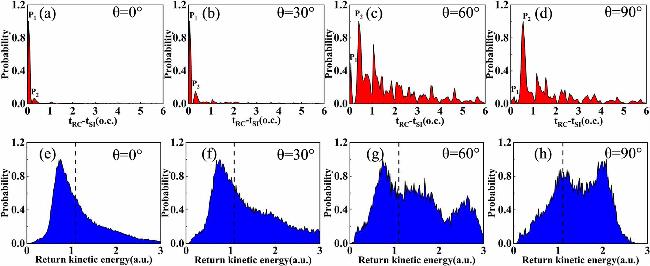
Figure 5. Statistical distribution of the travel time (a)–(d) and kinetic energy (e)–(h) of the returning electron at different angles θ, where the dashed line indicates the region exceeding the second ionization energy of the O2 molecule (1.2 a.u.). |
As shown in Figure 5(a), when θ = 0∘, the travel time of returning electrons within the laser field exhibits ultra-short durations, with most events concentrated near the P1 peak. Only a small fraction of electrons show travel times distributed in the longer P2 peak region. The short travel time indicates limited energy absorption from the field, resulting in low kinetic energy during recollision. Consequently, most returning electrons are low-energy particles, with only a minor fraction possessing energies exceeding the second ionization threshold of oxygen molecules (approximately 1.2 a.u.), as demonstrated in Figure 5(e). This scenario favors the RESI channel dominance, where the majority of returning electrons collide with bound electrons to induce excitation rather than direct ionization. When θ = 30∘, as illustrated in Figure 5(b), the P1 peak remains dominant, but the proportion of events in the P2 peak region increases significantly. As θ increases to 60∘, the P1 peak weakens significantly, with most returning electrons now concentrated around the P2 peak (Figure 5(c)). This shift in travel time distribution leads to a higher proportion of electrons possessing kinetic energies exceeding 1.2 a.u.. Consequently, more returning electrons gain sufficient energy to directly ionize bound electrons, thereby increasing the RII event proportion. At θ = 90∘, as shown in figures 5(d) and (h), the P1 peak becomes negligible while the P2 peak dominates prominently. The proportion of long-duration travel times increases further, resulting in a pronounced peak in the kinetic energy distribution above 1.2 a.u.. Therefore, angular variations in θ modulate the field exposure duration of return electrons, thereby influencing their kinetic energy. This mechanism alters the relative weights of RII and RESI pathways, demonstrating a clear angular dependence in ionization channel selection.
We have analyzed the correlation between double ionization time tDI and recollision time tRC for varying angles θ. The double ionization time is defined as the moment when both electrons’ energies become positive after recollision. In figures 6(a)–(d), the white diagonal line represents tDI = tRC, with the diagonal vicinity delineated by a red dashed line. When the tDI and tRC difference increases, the density distribution deviates from the white diagonal, indicating longer delay times characteristic of the RESI channel. Conversely, smaller time differences concentrate the distribution near the diagonal (within the red box), reflecting shorter delays attributable to the RII channel. Our findings indicate that at θ = 0∘, the density distribution predominantly deviates from the diagonal, implying longer delay times dominated by the RESI channel, as shown in Figure 6(a). As θ increases, the distribution gradually shifts toward the diagonal while intensifying within the red-boxed region (figures 6(b)–(d)). This evolution demonstrates a rising RII channel contribution. By analyzing the temporal energy evolution of both electrons and examining the tDI and tRC correlation, we observe that increasing θ significantly alters the ionization pathway in NSDI, favoring enhanced RII channel participation.
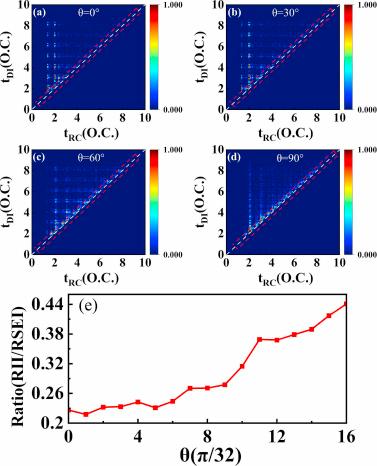
Figure 6. (a)–(d) DI time (tDI) versus the recollision time (tRC) for different θ in the counter-rotating TCEP laser field. (e) Variation curve of the ratio of RII to RESI with the increase of angle θ. |
Figure 6(e) illustrates the angular dependence of the RII/RESI ratio across θ values. The data reveals a consistent upward trend in the RII/RESI ratio with increasing θ, though the ratio remains below unity. This indicates that while the RESI mechanism maintains dominance, the RII contribution progressively enhances. This observation underscores the significant angular modulation of ionization pathways in NSDI, extending beyond the four discrete angles examined. Across the full 0∘ to 90∘ range, the RII proportion exhibits a monotonic increase with θ.
We further investigate how double ionization (DI) probabilities vary with laser intensity for different molecular alignment angles at ellipticities of ϵ = 0.5 and ϵ = 0.8. As illustrated in figures 7(a) and (b), for ϵ = 0.5, the differences in DI yields among different angles are smaller than those observed at ϵ = 0.3. When the ellipticity rises to ϵ = 0.8, the DI yields at different angles are almost the same, indicating a significant reduction in the influence of the angle on DI. Furthermore, as illustrated in Figure 7(c), when ϵ = 0.5, the ratio RII/RESI rises from 0.22 to 0.31 as the angle increases. However, when ϵ = 0.8, the increment is relatively slight, ranging from 0.26 to 0.29. These findings imply that, with the augmentation of ellipticity, the effect of the angle on the RII channel gradually weakens. This can be attributed to the fact that as the ellipticity increases, the laser field gradually approaches a circularly polarized state. In this situation, variations in the relative angle between the two fields exert little influence on the combined field structure. When ϵ reaches 1, indicating that both fields are circularly polarized, the combined field becomes completely independent of the relative angle. Consequently, at higher ellipticities, the efficacy of controlling the total field, and thus the NSDI dynamics through the relative angle, is significantly diminished.
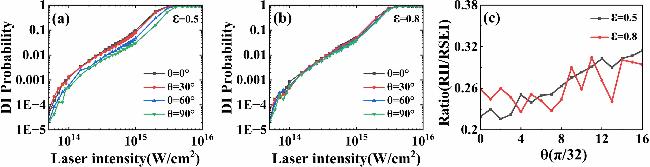


Figure 7. Double ionization (DI) probabilities of oxygen molecules as functions of the laser intensity for different angles θ at ellipticities of ϵ = 0.5 (a) and ϵ = 0.8 (b) . (c) The variation of the ratio of RII to RESI with an increasing angle θ for ϵ = 0.5 and ϵ = 0.8. |
4. Conclusion
In conclusion, a three-dimensional classical ensemble model was employed to investigate the NSDI dynamics of oxygen molecules driven by counter-rotating TCEP laser fields. By adjusting the angle between the two elliptically polarized fields, we modulated the potential barrier suppression of the diatomic molecule, thereby influencing the total DI yield. As the angle increased, the contribution from the electron pair’s correlated momentum distribution in the first and third quadrants progressively enhanced. This significant variation is primarily attributed to the substantial influence of ionization channels on electron pair correlations. Further analysis of the relationship between returning electrons’ travel time and their kinetic energy revealed that a longer travel time leads to higher electron kinetic energies upon return, thus increasing the probability of RII events. Furthermore, we examined the impact of altering the ellipticity of the laser fields. The findings reveal that as the ellipticity rises, the regulatory influence of the angle on both the DI yield and the relative contributions of various ionization channels gradually fades. This phenomenon is linked to the laser field gradually approaching a circularly polarized state, where the relative angle between the two fields exerts only a negligible influence on the combined field structure. These findings advance our understanding of NSDI dynamics under TCEP laser fields, offer valuable insights for experimental design, and suggest potential strategies for precise control and optimization of the NSDI process.