

1. Introduction
Terahertz (THz) radiation, spanning frequencies between 0.1 and 10 THz, has emerged as a pivotal tool across diverse fields, including high-resolution imaging, ultrafast spectroscopy, biomedical diagnostics, and wireless communications [1–5]. The challenge of generating intense, tunable, and compact THz sources has navigated considerable research into laser–plasma interaction schemes, in which plasma serves as a robust nonlinear medium immune to damage from high-intensity fields. Among advanced techniques, the beating of structured laser beams within underdense plasma environments has shown remarkable promise. Structured beams such as Hermite–Gaussian and Hermite–Cosh–Gaussian (HChG) [6–9] profiles offer unique spatial intensity distributions, enabling enhanced field localization, mode control, and improved nonlinear coupling with plasma electrons. Notably, HChG beams with their hybrid transverse structure allow tighter confinement and stronger ponderomotive forces, resulting in improved efficiency of THz generation. To further augment the interaction, frequency chirping plays an important role. Although linear and quadratic chirps have been studied extensively, the introduction of a cubic frequency chirp provides a higher-order modulation of the laser phase, thereby extending the interaction duration and enhancing electron displacement. The resulting nonlinear current density, modulated at the beat frequency of chirped components, gives rise to a robust source of THz radiation. Through theoretical modeling and numerical simulations, Gurjar et al [10] investigated high-field coherent THz radiation generation from chirped laser pulse interaction with plasmas. Sohrabi et al [11] studied the effect of the chirp parameter on second harmonic efficiency in relativistic super-Gaussian laser–plasma interaction and found that the maximum value of the second harmonic efficiency depends on the laser propagation distance and chirp parameter. Zare [12] reported that a positive chirp parameter could reduce defocusing and strengthen self-focusing in collisional quantum plasma. Salamin and Jisrawi [13] reported that the absolute maximum energy is almost twice for a linear chirp than for a quadratic chirp. Mou et al [14] investigated how positive and negative chirps affect the polarization of THz generation. Hamazaki et al [15] carried out an experimental study to examine how frequency chirp in laser pump pulses affects broadband THz generation through optical rectification (OR) in gallium phosphate. Using time-domain spectroscopy, they revealed that fine-tuning the chirp profile significantly influences both the temporal and spectral properties of the emitted THz pulses. Their results highlight the critical importance of precise chirp control for maximizing THz output and bandwidth in OR-based systems. Tan et al [16] showed a water-based coherent detection scheme that can accurately capture broadband THz pulses. This is a strong alternative to traditional electro-optic sampling methods. In addition to this progress, Zheng et al [17] came up with a new way to use abruptly autofocusing laser beams to make directional and intense THz emission. This opened up new possibilities for shaping beams and focusing energy in THz sources. Rajput et al [18] investigated THz radiation generation via the beating of two linearly chirped HChG laser pulses in an underdense plasma. A numerical analysis revealed that THz field amplitude and profile are highly sensitive to laser parameters, such as chirp, decentering, and Hermite mode index, with optimized conditions yielding amplitudes up to ∼0.8. Rajput and Rajput [19] explored the enhancement of THz radiation via laser–plasma interaction using a quadratically chirped HChG laser beam, and their findings underscore a significant increase in THz amplitude at a lower value of the chirp parameter.
This study presents a comprehensive theoretical model of THz generation by a cubic frequency chirped HChG laser beam interacting with underdense plasma. A cubic chirped laser pulse creates a strongly asymmetric electric field envelope. This asymmetry causes electrons, once ionized, to experience uneven acceleration. They are pushed more in one direction rather than oscillating symmetrically. This means that there is more current remaining after the pulse ends. This current is the main source of THz radiation. Thus, when the laser pulse is shaped with a cubic chirp, it enhances this directional push, leading to a stronger net current and thus more intense THz emission. The degree of enhancement depends on the chirp parameter b. Optimal values of b increase the field asymmetry without excessively stretching the pulse, maintaining a balance between efficient ionization and effective current generation. In contrast, a pulse without chirp or with only a simple linear chirp produces a more symmetric electric field. This results in more balanced electron motion, smaller net current, and consequently weaker THz radiation. Analytical expressions for the nonlinear current and the resulting THz fields are derived using fluid and electromagnetic theory. The influence of chirp coefficient, mode index, decentered parameter, and plasma profile is analyzed to optimize output intensity and efficiency. This study contributes a novel framework for tunable THz generation with improved control and scalability.
The structure of this paper is outlined as follows. Section 2 presents a comprehensive theoretical framework, detailing the derivation of governing equations that describe the ponderomotive force and the associated nonlinear current density generated by a cubically chirped laser pulse interacting with an underdense plasma. Section 3 outlines the analytical model for THz radiation generation, elucidating the underlying physical mechanisms and mathematical formulation responsible for the emission of THz fields. Section 4 discusses the results in depth, emphasizing the behavior of normalized THz amplitude with respect to transverse spatial variation and exploring the influence of key laser and plasma parameters on THz efficiency. Section 5 concludes the study by summarizing the principal findings, highlighting their implications for optimizing THz output through tailored chirped laser–plasma interactions.
2. Theoretical framework
The electric field of two HChG laser beams of frequencies ω1 and ω2 is represented [7] as
$\begin{eqnarray}{\vec{E}}_{1}=\hat{y}{E}_{01}{H}_{m}\left(\sqrt{2}\displaystyle \frac{y}{{r}_{{\rm{o}}}}\right)\cosh \left(\displaystyle \frac{yd}{{r}_{{\rm{o}}}}\right)\exp {\left(\displaystyle \frac{y}{{r}_{{\rm{o}}}}\right)}^{2}{\rm{}}{{\rm{e}}}^{\left.-{\rm{i}}\left({\omega }_{1}t-{k}_{1}{\rm{z}}\right)\right)},\end{eqnarray}$
$\begin{eqnarray}{\vec{E}}_{2}=\hat{y}{E}_{02}{H}_{m}\left(\sqrt{2}\displaystyle \frac{y}{{r}_{{\rm{o}}}}\right)\cosh \left(\displaystyle \frac{yd}{{r}_{{\rm{o}}}}\right)\exp {\left(\displaystyle \frac{y}{{r}_{{\rm{o}}}}\right)}^{2}{\rm{}}{{\rm{e}}}^{\left.-{\rm{i}}\left({\omega }_{2}t-{k}_{2}{\rm{z}}\right)\right)},\end{eqnarray}$
where ${E}_{01}$ and ${E}_{02}$ are the electric field amplitudes of two laser beams at central position y = z = 0, Hm is the Hermite polynomial, m is the mode index of the Hermite polynomial, ${k}_{j}={(\omega }_{j}/c)\sqrt{1-\left(\tfrac{{\omega }_{{\rm{p}}}^{2}}{{\omega }_{j}^{2}}\right)}$ is the propagation constant of the incident laser beam, ro is the initial beam width, ωj is the angular frequency of the laser beam, d is the decentered parameter, and ωp is the plasma frequency.Cubic chirp is applied on the incident laser beams, which is represented as
$\begin{eqnarray}{{\omega }_{1}=\omega }_{0}\left(1+b{{\omega }_{0}}^{3}{\left(t-z/c\right)}^{3}\right)\,\mathrm{and}\,{\omega }_{2}={\omega }_{0}\left(1+b{{\omega }_{0}}^{3}{\left(t-\displaystyle \frac{z}{c}\right)}^{3}-\omega /{\omega }_{0}\right),\end{eqnarray}$
where ω0 is the frequency of the incident laser in the absence of a cubic chirp, b is the chirp parameter, ω is the beat frequency, and c is the velocity of light in vacuum.The interaction of the laser with the plasma induces a velocity ${\vec{V}}_{j}$ in the electrons, which can be derived by solving their equation of motion under the influence of the laser’s electric field. This analysis assumes that the laser frequencies ω1 and ω2 are greater than the plasma frequency.
$\begin{eqnarray}{\vec{V}}_{j}=\displaystyle \frac{e{\vec{E}}_{j}}{{m}_{{\rm{e}}}{\rm{i}}{\propto }_{j}},\end{eqnarray}$
where j = 1 and 2, $e$ is the electronic charge, and ${m}_{{\rm{e}}}$ is the mass of the electron: $\begin{eqnarray*}{\propto }_{1}=\left(1+b{{\omega }_{0}}^{3}{\left(t-z/c\right)}^{3}\right),\,{\propto }_{2}=\left(1+b{{\omega }_{0}}^{3}{\left(t-z/c\right)}^{3}\right)-\omega /{\omega }_{0}.\end{eqnarray*}$
In the current analysis, the total electron velocity is written as the sum of a rapidly oscillating quiver velocity and a slowly varying nonlinear (drift) velocity driven by the ponderomotive force. This perturbative separation is standard in nonlinear laser–plasma theory and is justified by the clear timescale difference; the quiver motion oscillates at the optical frequencies ω1 and ω2 and therefore averages to zero at the beat frequency, whereas the nonlinear drift evolves on the envelope timescale and provides the only contribution to the THz current. Thus, equations (5 )–(6 ) represent the first-order quiver velocity, and the subsequent velocity derived from the ponderomotive force corresponds to the second-order nonlinear component responsible for THz emission.
$\begin{eqnarray}{\vec{V}}_{1}=\displaystyle \frac{e{\vec{E}}_{j}}{{m}_{{\rm{e}}}{\rm{i}}{\omega }_{0}\left(1+b{{\omega }_{0}}^{3}{\left(t-z/c\right)}^{3}\right)}.\end{eqnarray}$
$\begin{eqnarray}{\vec{V}}_{2}=\displaystyle \frac{e{\vec{E}}_{j}}{{m}_{{\rm{e}}}{\rm{i}}{\omega }_{0}\left(1+b{{\omega }_{0}}^{3}{\left(t-z/c\right)}^{3}\right)-\omega /{\omega }_{0}}.\end{eqnarray}$
The nonlinear ponderomotive force (${\vec{F}}_{{\rm{p}}}^{\mathrm{nl}}$) arises from the ponderomotive potential $\varphi =-{m}_{{\rm{e}}}\tfrac{{\vec{V}}_{1}\bullet {\vec{V}}_{2}^{* }}{2e}$
Accordingly, the nonlinear ponderomotive force is given by
$\begin{eqnarray}{\vec{F}}_{{\rm{p}}}^{\mathrm{nl}}=-e\vec{{\rm{\nabla }}}\varphi =\displaystyle \frac{{m}_{{\rm{e}}}}{2}\vec{{\rm{\nabla }}}\left({\vec{V}}_{1}\bullet \,{\vec{V}}_{2}^{* }\right).\end{eqnarray}$
By substituting the expressions for ${\vec{V}}_{1}$ and complex conjugate of ${\vec{{V}}}_{2}$ into equation (7 ), we obtain the resulting form of the nonlinear ponderomotive force acting on plasma electrons. This derived expression captures the spatial variation of the laser-induced velocity fields and highlights the role of chirped laser parameters in shaping the force profile.
$\begin{eqnarray}{\vec{F}}_{{\rm{p}}}^{\mathrm{nl}}=\displaystyle \frac{{e}^{2}{E}_{01}{E}_{02}\exp \left(\tfrac{-2{y}^{2}}{{r}_{0}^{2}}\right)\exp \left(-{\rm{i}}\left(\omega t-{kz}\right)\right)\,\left(\hat{y}{\beta }_{1}+\hat{z}{\rm{i}}k{\beta }_{2}\right)}{2{m}_{{\rm{e}}}{\omega }_{0}^{2}\left(1+b{{\omega }_{0}}^{3}{\left(t-\tfrac{z}{c}\right)}^{3}\right)\left(\left(1+b{{\omega }_{0}}^{3}{\left(t-z/c\right)}^{3}\right)-\omega /{\omega }_{0}\right)}.\end{eqnarray}$
Here, $\begin{eqnarray}\begin{array}{l}{\,\beta }_{1}=\left(\frac{4\sqrt{2}m}{{r}_{0}}{H}_{m}\left(\frac{\sqrt{2}y}{{r}_{0}}\right){H}_{m-1}\left(\frac{\sqrt{2}y}{{r}_{0}}\right){\cosh }^{2}\left(\frac{yd}{{r}_{0}}\right)-\right.\frac{2d}{{r}_{0}}{H}_{m}^{2}\left(\frac{\sqrt{2}y}{{r}_{0}}\right)\\ \,\times \,\cosh \left(\frac{yd}{{r}_{0}}\right)\sinh \left(\frac{yd}{{r}_{0}}\right)-\,\frac{4y}{{r}_{0}^{2}}{H}_{m}^{2}\left(\frac{\sqrt{2}y}{{r}_{0}}\right){\cosh }^{2}\left(\frac{yd}{{r}_{0}}\right)\Space{0ex}{3.0ex}{0ex}),\end{array}\end{eqnarray}$
and $\begin{eqnarray*}{\beta }_{2}=\left({H}_{m}^{2}\left(\displaystyle \frac{\sqrt{2}y}{{r}_{0}}\right){\cosh }^{2}\left(\displaystyle \frac{yd}{{r}_{0}}\right)\right).\end{eqnarray*}$
Here, k = k1 − k2 is the propagation constant of the generated THz wave, ω0 is the incident laser frequency in the absence of chirp, and ω = ω1 − ω2 is the beat frequency.The nonlinear velocity generated due to this ponderomotive force can be expressed as
$\begin{eqnarray}{\vec{V}}^{\mathrm{nl}}=\displaystyle \frac{{\vec{F}}_{{\rm{P}}}^{\mathrm{nl}}{\left(1+b{{\omega }_{0}}^{3}{\left(t-\tfrac{z}{c}\right)}^{3}\right)}^{2}{\left(\left(1+b{{\omega }_{0}}^{3}{\left(t-z/c\right)}^{3}\right)-\omega /{\omega }_{0}\right)}^{2}}{{m}_{{\rm{e}}}\left(\left({\rm{i}}\omega \left(1+b{{\omega }_{0}}^{3}{\left(t-\tfrac{z}{c}\right)}^{3}\right)\left(\left(1+b{{\omega }_{0}}^{3}{\left(t-z/c\right)}^{3}\right)-\omega /{\omega }_{0}\right)\right)+3b{\omega }_{0}^{3}{\left(t-\tfrac{z}{c}\right)}^{2}\left(\left(1+b{{\omega }_{0}}^{3}{\left(t-\tfrac{z}{c}\right)}^{3}\right)+\left(\left(1+b{{\omega }_{0}}^{3}{\left(t-z/c\right)}^{3}\right)-\omega /{\omega }_{0}\right)\right)\right)}.\end{eqnarray}$
Substituting equation (8 ) in equation (9 ) and after simplifying, the nonlinear velocity becomes
$\begin{eqnarray*}{\vec{V}}_{\omega }^{\mathrm{nl}}=\displaystyle \frac{{e}^{2}{\,E}_{01}{E}_{02}\exp \left(\tfrac{-2{y}^{2}}{{r}_{0}^{2}}\right)\exp \left(-{\rm{i}}\left(\omega t-{kz}\right)\right)\left(1+b{{\omega }_{0}}^{3}{\left(t-\tfrac{z}{c}\right)}^{3}\right)\left(\left(1+b{{\omega }_{0}}^{3}{\left(t-\tfrac{z}{c}\right)}^{3}\right)-\omega /{\omega }_{0}\right)\,\left(\hat{y}{\beta }_{1}+\hat{z}{\rm{i}}k{\beta }_{2}\right)}{2{{\boldsymbol{m}}}_{{\bf{e}}}^{{\bf{2}}}{\omega }_{0}^{2}\,\left(\left({\rm{i}}\omega \left(1+b{{\omega }_{0}}^{3}{\left(t-\tfrac{z}{c}\right)}^{3}\right)\left(\left(1+b{{\omega }_{0}}^{3}{\left(t-\tfrac{z}{c}\right)}^{3}\right)-\omega /{\omega }_{0}\right)\right)+3b{\omega }_{0}^{3}{\left(t-\tfrac{z}{c}\right)}^{2}\left(\left(1+b{{\omega }_{0}}^{3}{\left(t-\tfrac{z}{c}\right)}^{3}\right)+\left(\left(1+b{{\omega }_{0}}^{3}{\left(t-\tfrac{z}{c}\right)}^{3}\right)-\omega /{\omega }_{0}\right)\right)\right)}.\end{eqnarray*}$
or $\begin{eqnarray}{\vec{V}}_{\omega }^{\mathrm{nl}}=\displaystyle \frac{{e}^{2}{\,E}_{01}{E}_{02}\exp \left(\tfrac{-2{y}^{2}}{{r}_{0}^{2}}\right)\exp \left(-{\rm{i}}\left(\omega t-{kz}\right)\right)\,{\propto }_{1}{\propto }_{2}}{2{{\boldsymbol{m}}}_{{\bf{e}}}^{{\bf{2}}}{\omega }_{0}^{2}\,\left(\left({\rm{i}}\omega {\propto }_{1}{\propto }_{2}\right)+3b{\omega }_{0}^{3}{\left(t-\tfrac{z}{c}\right)}^{2}\left({\propto }_{1}+{\propto }_{1}\,\right)\right)}\left(\hat{y}{\beta }_{1}+\hat{z}{\rm{i}}k{\beta }_{2}\right),\end{eqnarray}$
where $\begin{eqnarray*}{\propto }_{1}=\left(1+b{{\omega }_{0}}^{3}{\left(t-z/c\right)}^{3}\right),\,{\propto }_{2}=\left(1+b{{\omega }_{0}}^{3}{\left(t-z/c\right)}^{3}\right)-\omega /{\omega }_{0}.\end{eqnarray*}$
The nonlinear velocity induced by the laser–plasma interaction gives rise to a nonlinear current density at the beat frequency ω, which is expressed as10 ) in equation (11 ), the nonlinear current density becomes
$\begin{eqnarray}{\vec{J}}_{\omega }^{\mathrm{nl}}=-\displaystyle \frac{e}{2}{n}_{{\rm{o}}}{\vec{V}}_{\omega }^{\mathrm{nl}}.\end{eqnarray}$
Substituting the value of ${\vec{V}}_{\omega }^{{\rm{nl}}}$ from equation ( $\begin{eqnarray}{\vec{J}}_{\omega }^{\mathrm{nl}}=-\displaystyle \frac{e}{2}{n}_{{\rm{o}}}{\vec{V}}_{\omega }^{\mathrm{nl}}=-\displaystyle \frac{{n}_{{\rm{o}}\,}{e}^{2}{\,E}_{01}{E}_{02}\exp \left(\tfrac{-2{y}^{2}}{{r}_{0}^{2}}\right)\exp \left(-{\rm{i}}\left(\omega t-{kz}\right)\right)\,{\propto }_{1}{\propto }_{2}\,\left(\hat{y}{\beta }_{1}+\hat{z}{\rm{i}}k{\beta }_{2}\right)\,}{4{{\boldsymbol{m}}}_{{\bf{e}}}^{{\bf{2}}}{\omega }_{0}^{2}\,\left(\left({\rm{i}}\omega {\propto }_{1}{\propto }_{2}\right)+3b{\omega }_{0}^{3}{\left(t-\tfrac{z}{c}\right)}^{2}\left({\propto }_{1}+{\propto }_{1}\,\right)\right)}.\end{eqnarray}$
When a cubically chirped laser pulse interacts with plasma, its temporal phase evolves nonlinearly, which effectively prolongs the laser–plasma interaction time. This extended coupling strengthens the ponderomotive force, enabling more efficient electron acceleration. As a result, the induced nonlinear current density becomes stronger and exhibits greater asymmetry. This transient current acts as a source of THz radiation, leading to enhanced emission characterized by higher intensity and broader spectral bandwidth compared to conventional linear or quadratic chirping.3. Analytical treatment of THz generation
The emission of THz radiation in plasma arises from the nonlinear current density generated through the interaction of the chirped laser fields with electrons. The evolution of the THz electric field follows directly from Maxwell’s equations in a source-free, homogeneous plasma. Starting from the standard curl equations and combining them using the well-known vector identity, we get $\vec{{\rm{\nabla }}}\times \left(\vec{{\rm{\nabla }}}\times {\vec{E}}_{{\rm{ThR}}}\right)\,={\rm{\nabla }}\left({\rm{\nabla }}\bullet {\vec{E}}_{{\rm{ThR}}}\right)-{{\rm{\nabla }}}^{2}{\vec{E}}_{{\rm{ThR}}}$, and assuming no free charge in the medium ($\vec{{\rm{\nabla }}}\cdot {\vec{E}}_{{\rm{ThR}}}=0$), the wave equation becomes13 ) shows that the time-varying nonlinear current acts as the source term responsible for THz emission. To obtain an analytical expression for the emitted THz field, we assume a plane-wave form: ${\vec{E}}_{\mathrm{ThR}}=\,{T}_{\mathrm{RA}}{{\rm{e}}}^{-{\rm{i}}\left(\omega t-kz\right)}$, where ${\vec{T}}_{{\rm{RA}}}$ is the amplitude of the THz wave, ω is the THz frequency, and k is the wave number. Substituting this form in equation (13 ), together with the nonlinear current density derived in equation (12 ), yields the following expression for the normalized THz amplitude:
$\begin{eqnarray}{{\rm{\nabla }}}^{2}{\vec{E}}_{{\rm{ThR}}}-\frac{1}{{c}^{2}}\frac{{\partial }^{2}{\vec{E}}_{{\rm{ThR}}}}{\partial {{\rm{t}}}^{2}}=\frac{4\pi \,}{{c}^{2}}\,\frac{\partial {\vec{J}}_{\omega }^{{\rm{nl}}}}{\partial {\rm{t}}},\end{eqnarray}$
where ${\vec{E}}_{{\rm{ThR}}}$ is the electric field vector of the THz wave, and ${\vec{J}}_{\omega }^{{\rm{nl}}}$ represents a nonlinear current density arising at the beat frequency of the two interacting laser beams. Equation ( $\begin{eqnarray}{T}_{\mathrm{RA}}=\frac{{a}_{1}{a}_{2}{\left(\frac{{\omega }_{{\rm{p}}}}{{\omega }_{0}}\right)}^{2}\exp \left(\frac{{-2y}^{2}}{{r}_{{\rm{o}}}^{2}}\right)\left(\frac{{\omega }_{0}}{\omega }\right){\beta }_{1}\left[\begin{array}{c}\left(-{\rm{i}}{\alpha }_{1}{\alpha }_{2}+3b\left(\frac{{\omega }_{0}}{\omega }\right){\,{\left({\omega }_{0}t-\frac{{\omega }_{0}z}{c}\right)}^{2}\,{(\alpha }_{1}+\alpha }_{2})\right)G-\\ {\left(\frac{{\omega }_{0}}{\omega }\right)}^{2}\left({\alpha }_{1}{\alpha }_{2}\left(3{\rm{i}}b\left(\frac{{\omega }_{0}}{\omega }\right)\,\left({\alpha }_{1}+{\alpha }_{2}\right){\left({\omega }_{0}t-\frac{{\omega }_{0}z}{c}\right)}^{2}\right)+\,\left(6b\left({\propto }_{1}+\,{\propto }_{2}\right)\left({\omega }_{0}t-\frac{{\omega }_{0}z}{c}\right)\right)+18{b}^{2}{\left({\omega }_{0}t-\frac{{\omega }_{0}z}{c}\right)}^{4}\right)\end{array}\right]}{4{G}^{2}\left(\frac{{k}^{2}{c}^{2}}{{\omega }_{0}^{2}}-\frac{{\omega }^{2}}{{\omega }_{0}^{2}}\right)},\end{eqnarray}$
where ${a}_{1}\,=e{E}_{01}/m{\omega }_{1}c,\,{a}_{2}\,=e{E}_{02}/m{\omega }_{2}c$, ${E}_{01}$ and ${E}_{02}$ are the amplitudes of the incident laser beam, TRA is the normalized THz amplitude, and a1 and a2 are the normalized amplitudes of incident lasers k = k1 − k2.Equation (14 ) plays a central role in interpreting the THz emission process because it explicitly connects the generated THz amplitude to the key physical parameters governing the laser–plasma interaction. The expression shows how the THz field depends on the laser intensities, beam width, chirp coefficient, spatial mode structure, and beat frequency, thereby providing a quantitative means to predict and optimize THz output. The above equation reveals the manner in which cubic chirping modifies both the amplitude and phase of the emitted THz radiation through the complex coefficient G. This analytical formulation offers clear physical insight into the underlying mechanisms and serves as a practical tool for guiding the design of efficient, tunable THz sources.
$\begin{eqnarray*}\begin{array}{l}G={\rm{i}}\left(1+b{{\omega }_{0}}^{3}{\left(t-\displaystyle \frac{z}{c}\right)}^{3}\right)\left(\left(1+b{{\omega }_{0}}^{3}{\left(t-\displaystyle \frac{z}{c}\right)}^{3}\right)-\omega /{\omega }_{0}\right)\\ \,+\,\displaystyle 2b{\omega }_{{\rm{o}}}\omega {\left({\omega }_{0}\,t-\tfrac{{\omega }_{0}\,z}{c}\right)}^{2}\left(\left(1+b{{\omega }_{0}}^{3}{\left(t-\tfrac{z}{c}\right)}^{3}\right)+\left(\left(1+b{{\omega }_{0}}^{3}{\left(t-\tfrac{z}{c}\right)}^{3}\right)-\omega /{\omega }_{0}\right)\right).\end{array}\end{eqnarray*}$
Here, G is in general complex that encodes both amplitude and phase modifications to the THz response caused by cubic chirping.4. Results and discussion
This study presents a comprehensive numerical and graphical investigation into THz radiation generation in a collisionless plasma using a tailored set of physical parameters. The interaction involves two HChG laser pulses with normalized amplitudes ${a}_{1}\,=e{A}_{01}/{m}_{{\rm{e}}}{\omega }_{0}c)\,=0.5$ (corresponding to laser intensity ${I}_{1}\cong 3.05\times {10}^{15}$ W cm−2) and ${a}_{2}\,=e{A}_{02}/{m}_{{\rm{e}}}{\omega }_{0}c)\,=0.8$ (corresponding to laser intensity ${I}_{2}\cong 7.81\times {10}^{15}$ W cm−2). The wave frequency for CO2 laser is ${\,\omega }_{0}=1.78\times 10$14 rad s−1 ($\lambda =\,10$ μm). The frequency of plasma ${\omega }_{{\rm{p}}}=7.76\,\times 10$13 rad s−1 corresponding to electron density ${n}_{{\rm{o}}}=5\,\times {10}^{18}$ cm−3. The analysis is conducted at time t = 200 fs and position z = 30 μm. For chirp parameter b = 0.000099, the corresponding frequencies are ${\omega }_{1\,}$= $2.77\times {10}^{14}{\,{\rm{and}}\,\omega }_{2}\,=2.10\times {10}^{14}$. These values are used consistently in all numerical plots.
The analysis focuses on the spatial variation of the normalized THz amplitude ${(T}_{\mathrm{RA}}=e{E}_{\mathrm{oT}}/{m}_{{\rm{e}}}\omega c)$ as a function of the normalized transverse distance (${y}_{1}=y/{w}_{{\rm{o}}}$). By varying Hermite mode indices, chirp parameters, decentering values, and laser intensities, this study evaluates their combined influence on THz field strength and spatial distribution. The results offer valuable insights into optimizing THz generation through precise control of laser–plasma interaction parameters.
Figure 1 shows the variation of the normalized THz amplitude (TRA) as a function of the normalized transverse coordinate ${y}_{1}$ for HChG modes m = 1, 2, and 3 using optimized parameters d = $0.5$ and $b\,=\,0.000099$. The input laser intensities were kept the same for all mode indices so that each mode was driven with identical total power. The field amplitudes were normalized with respect to the peak field of the fundamental mode (m = 1), ensuring that differences in THz amplitude arise only from the transverse mode structure and not from changes in driving power. The results show a substantial increase in THz amplitude from approximately 0.5 to 4.5 as the mode index increases. Higher-order modes produce stronger transverse intensity gradients, which enhance the ponderomotive force and lead to greater asymmetry in electron motion, resulting in stronger nonlinear currents that generate THz radiation. The enhancement is further supported by the off-axis energy localization typical of higher Hermite modes. Our findings are consistent with those of Rajput and Rajput [19], but comparable THz enhancement is achieved here using a chirp parameter nearly two orders of magnitude smaller, demonstrating the superior efficiency of cubic chirping over linear and quadratic chirps.
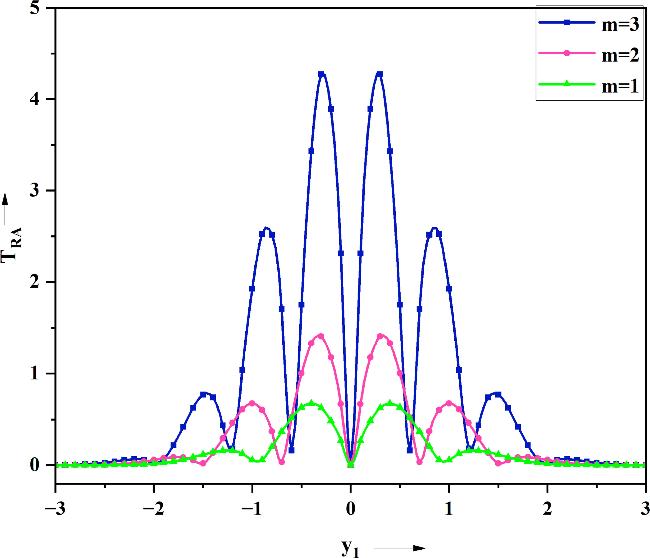
Figure 1. Normalized THz amplitude TRA plotted against normalized transverse coordinate ${y}_{1}$ shown for mode indices ${\boldsymbol{m}}$ = 1, 2, and 3 at a fixed decentered parameter d = 0.5. |
Figure 2 presents the variation in normalized THz amplitude TRA as a function of the chirp parameter $b$, evaluated for mode indices m = 1, 2, and 3 at a fixed decentered parameter d = 0.5. The results clearly demonstrate that increasing the chirp parameter leads to a corresponding rise in THz amplitude. Notably, higher-order spatial modes m = 2 and 3 exhibit a substantially greater enhancement in THz output compared to the fundamental mode m = 1. This behavior underscores the critical role of both temporal (chirp) and spatial (mode structure) shaping of the pump beam in optimizing THz generation. The observed synergy between chirped optical pulses and higher-order spatial modes facilitates stronger nonlinear interactions, thereby boosting the efficiency of THz emission. These findings have significant implications for the design of high-performance THz sources, particularly in applications such as time-resolved spectroscopy, high-resolution imaging, and broadband wireless communication. Furthermore, the trend observed in our study aligns well with the results reported by Mehta et al [20] and Rajput and Rajput [19], reinforcing the influence of the chirp parameter on THz amplitude. Our analysis reveals that a comparable enhancement in THz output can be achieved using only one-hundredth of the chirp parameter value used in their study. This suggests that cubic chirping, as used in our model, offers superior efficiency over linear and quadratic chirping, enabling enhanced THz generation with reduced chirp magnitude. Such optimization not only improves system performance but also reduces the complexity and energy requirements of the pump configuration, making it a promising approach for scalable THz technologies.
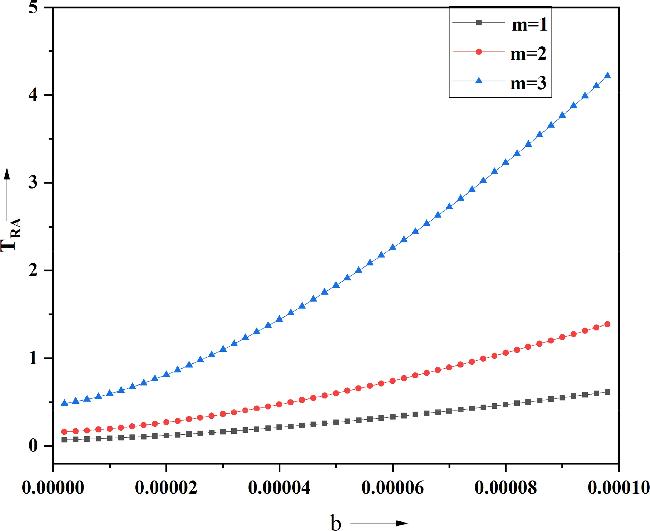
Figure 2. Normalized THz amplitude TRA plotted against the chirp parameter b shown for mode indices m = 1, 2, and 3 at a fixed decentered parameter d = $0.5$. |
Figure 3 illustrates the normalized THz amplitude TRA as a function of transverse distance ${y}_{1}$ for varying cubic chirp parameters $b=0.000011,\,0.000055,\,\mathrm{and}\,0.000099$ with fixed mode index m = 3 and decentered parameter d = 0.5. The results reveal that increasing the cubic chirp significantly enhances both the amplitude and sharpness of THz radiation peaks. This improvement stems from extended interaction time between the laser pulse and plasma electrons, facilitated by the temporal stretching introduced by the cubic chirp. The prolonged interaction promotes stronger nonlinear currents, evident in the elevated peak amplitudes and more pronounced side lobes in the transverse THz profile. These findings underscore the pivotal role of the chirp parameter in tailoring the spectral and spatial features of THz emission, positioning cubic chirp as a powerful tool for optimizing THz output. Our results diverge from those reported by Rajput and Rajput [19], who investigated enhanced THz emission from unmagnetized plasma using a quadratically chirped HChG laser pulse. Despite using substantially lower chirp values, this study demonstrates superior THz enhancement, highlighting the greater efficiency of cubic chirping in driving nonlinear plasma dynamics.
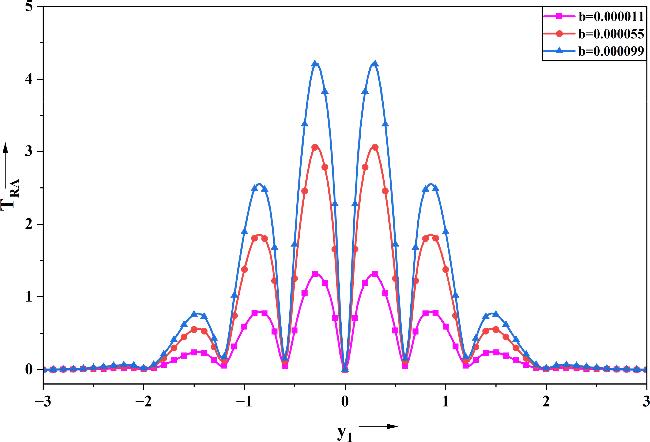
Figure 3. Normalized THz amplitude TRA plotted against normalized transverse distance ${y}_{1}$ for different values of chirp parameter ${\boldsymbol{b}}$ = 0.000011, 0.000055, and 0.000099 at decentered parameter d = 0.5 and at a fixed mode index m = 3. |
Figure 4 depicts the normalized THz amplitude TRA as a function of the normalized THz frequency $\omega /{\omega }_{{\rm{p}}}$ for mode indices m = 1, 2, and 3 $.$ and b = 0.00099. The plot reveals a distinct inverse relationship; as the normalized frequency increases, the THz amplitude rapidly diminishes, approaching negligible values at higher frequencies. Additionally, higher-order modes yield significantly stronger THz emission across the spectrum, with m = 3 producing the highest amplitude, followed by m = 2 and m = 1. This enhancement is attributed to the increased energy content and sharper transverse field gradients in higher-order Hermite modes, which intensify electron acceleration and boost nonlinear current generation, key mechanisms behind THz radiation. The results underscore the critical role of spatial mode structure in shaping both the strength and spectral distribution of THz output in plasma-based sources. In this study, we used cubic frequency chirping, which extends the interaction time between the laser pulse and plasma electrons more effectively than linear chirping. This leads to stronger nonlinear coupling and enhanced THz generation. Although Midha et al [21] reported similar trends using linear chirp in magnetized plasma, our findings demonstrate comparable or superior THz enhancement using significantly lower chirp parameter values. This highlights the efficiency of cubic chirp in driving robust THz emission with reduced temporal distortion, offering a promising route for tunable and high-yield THz sources.
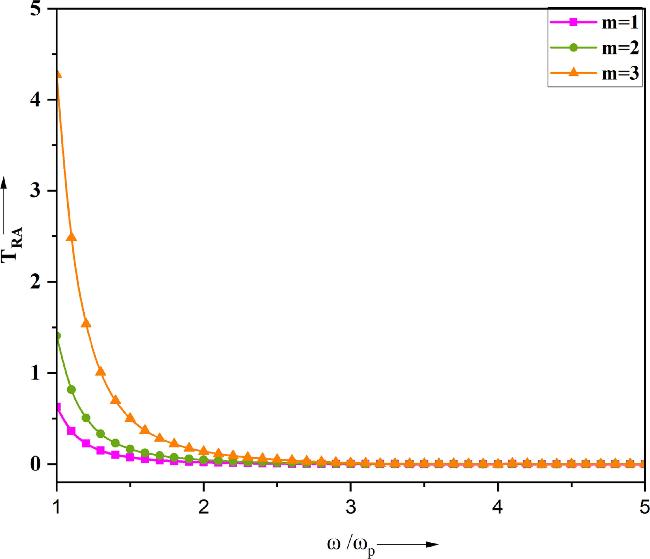
Figure 4. Normalized THz amplitude TRA plotted against the normalized THz frequency $\omega /{\omega }_{{\rm{p}}}$ for different mode indices m = 1, 2, and 3. Other parameters are the same as in Figure 2. |
Figure 5 illustrates the variation of the normalized THz amplitude TRA as a function of the normalized transverse distance y1 for mode index m = 3, highlighting the impact of varying input amplitudes ${a}_{1}$ and ${a}_{2}$ on the spatial THz distribution under cubic chirping. The red curve, corresponding to higher input amplitudes a1 = 0.5 and a2 = 0.8, shows a more intense central peak and pronounced side lobes compared to the green curve (a1 = 0.4 and a2 = 0.6). This indicates that an increase in laser intensity enhances THz emission. The underlying physics involves the amplification of the electric field strength at higher input amplitudes, which strengthens the nonlinear optical response of the plasma. When combined with cubic chirping, the temporal stretching of the pulse prolongs the interaction between the laser field and plasma electrons, further boosting nonlinear current generation. This synergy between spatial intensity and temporal shaping leads to more efficient THz radiation, demonstrating that both amplitude control and cubic chirp are key parameters for optimizing THz output in laser–plasma systems.
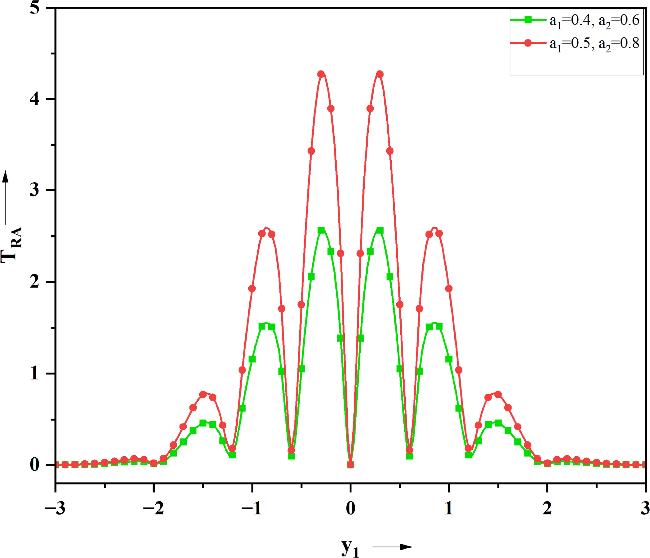


Figure 5. Normalized THz amplitude TRA plotted against the normalized transverse distance ${y}_{1}$ for different values of normalized amplitudes ${a}_{1}\,\mathrm{and}{\,a}_{2}$ at mode index m = 3. The other parameters are the same as in Figure 1. |
5. Conclusion
This investigation establishes cubic frequency chirping as a highly efficient mechanism for enhancing THz radiation in laser–plasma interactions. Through systematic analysis across spatial modes, chirp parameters, and input amplitudes, we found that higher-order Hermite modes (m = 2 and 3) significantly amplify THz output owing to stronger transverse intensity gradients, which enhance ponderomotive forces and asymmetric electron acceleration. In addition, cubic chirping, even at values one-hundredth of those used in previous studies, yields comparable or superior THz enhancement, demonstrating its superior efficiency over linear and quadratic chirping in driving nonlinear plasma dynamics. Increasing the chirp parameter b intensifies both the amplitude and spatial sharpness of THz peaks, owing to prolonged interaction time between the laser pulse and plasma electrons. In addition, input amplitude modulation also boosts THz radiation. More energy means more intense electric fields and better current generation. The synergy between temporal shaping (chirp) and spatial structuring (mode index and amplitude) is pivotal for optimizing THz generation, offering a tunable and energy-efficient pathway for high-performance THz sources. These findings not only align with but also extend the results of Rajput and Rajput [19] and Mehta et al [20], positioning cubic chirping as a promising strategy for scalable THz technologies in applications ranging from time-resolved spectroscopy to broadband wireless communication.