

1. Introduction
Quantum many-body systems exhibit a rich mosaic of emergent phenomena, ranging from quantum phase transitions (QPTs) and topological order to exotic entangled states, that distinguish them from their classical counterparts [1–3]. Among these phenomena, entanglement stands out as both a defining feature of quantum complexity and a cornerstone resource for next-generation quantum technologies [4]. Quantum entanglement, being the most critical resource in quantum information science, has long been a central focus of research in the field.
To gain a deep understanding and quantify the properties of entanglement, researchers established the conceptual framework of entanglement measures early on. Entanglement entropy is computed to characterize the degree of quantum entanglement between the two subsystems [5, 6], which is defined as follows: when the entire quantum system is partitioned into two subsystems A and B, the von Neumann entropy of the reduced density matrix ρA of subsystem A, namely ${S}_{A}=-{\rm{Tr}}({\rho }_{A}{\rm{ln}}{\rho }_{A})$. Another measurement is called concurrence [7], which measures pairwise entanglement between two spins [8, 9]. Unlike the two entanglement measurements above, which describe quantum correlations between two subsystems or two spins, multipartite entanglement involves non-separable correlations across three or more components, enabling functionalities such as distributed quantum sensing [10], fault-tolerant quantum computing [11], and quantum secret sharing [12]. In recent decades, understanding how multipartite entanglement evolves with system size, interaction range, and external parameters has become a central goal of condensed matter physics and quantum information science, as it not only reveals fundamental limits of quantum correlation distribution, but also guides the design of quantum devices leveraging these correlations. Driven by recent advances in quantum information theory, the quantum Fisher information (QFI) has emerged as a unifying framework intrinsically connecting quantum metrology, multipartite entanglement, and critical phenomena [13].
The transverse-field Ising model is perhaps the simplest quantum lattice model that still captures the essence of a genuine zero-temperature phase transition. This competition between classical interaction energies and quantum fluctuations turns the model into an ideal theoretical playground. These elegant connections, coupled with its experimental validations across diverse physical systems, establish it as a highly versatile model for investigating phase transitions and beyond. It is reported that the measurement induces a phase transition in a one-dimensional Ising chain with a transverse magnetic field in the no-click limit. A phase transition between the absence and the presence of multipartite entanglement can exist in the system [14]. However, many real-world quantum systems, including ultracold atomic arrays [15], trapped ions [16], and magnetic insulators [17], exhibit long-range interactions that decay algebraically with distance r−α, (where r is the inter-spin distance and α > 0 is the decay exponent). The long-range transverse-field Ising model thus bridges short-range quantum magnetism and long-range quantum correlation physics. It would be interesting to investigate the effects of long-range interactions on multipartite entanglement and its relationship with critical phenomena.
The article is organized as follows. In section 2 , we introduce the long-range transverse-field Ising model and its properties. Section 3 provides a detailed introduction to the QFI and explains how it is used to determine the multipartite entanglement structure of the system. In section 4 , we present a comprehensive analysis of our results, including the scaling of multipartite entanglement with system size, and the behavior of entanglement density across different interaction ranges. Moreover, the relations between QFI and QPTs are also discussed in section 4 . We conclude in section 5 with implications for understanding multipartite entanglement in quantum critical systems.
2. Model
The core model investigated in this work is the long-range transverse-field Ising model [18–28], with the Hamiltonian given by: 3 ).
$\begin{eqnarray}\hat{H}=-4J\displaystyle \sum _{i\lt j}^{L}\frac{{\hat{S}}_{i}^{z}{\hat{S}}_{j}^{z}}{{r}_{ij}^{\alpha }}-2h\displaystyle \sum _{i}{\hat{S}}_{i}^{x},\end{eqnarray}$
where ${\hat{S}}_{i}^{\alpha }={\sigma }_{i}^{\alpha }/2$ are spin-1/2 operators. The parameter J governs the sign of the spin–spin coupling: J > 0 corresponds to a ferromagnetic coupling, and J < 0 to an antiferromagnetic coupling. The algebraically decaying interaction 1/rα with r = ∣i − j∣ is tuned by the positive parameter α > 0 [29, 30]. The parameter h characterizes the strength of the transverse field that disrupts the ${\hat{S}}^{z}$-oriented order. In this work, we consider open boundary conditions. When α → +∞, the model reduces to the classical short-range transverse-field Ising model, while when α → 0, it becomes equivalent to a mean-field model with all-to-all equal coupling. This model exhibits rich physical behavior by tuning three parameters and reduces to a series of important models in certain limits. For the ferromagnetic case (J = 1), the system resides in the ferromagnetic phase when the transverse field h is weak. The ground state favors aligned spins along the same direction in z-axis, which can be schematically represented as $\begin{eqnarray}| \psi {\rangle }_{J=1,h=0}=\cdots | \uparrow {\rangle }_{i-1}| \uparrow {\rangle }_{i}\uparrow {\rangle }_{i+1}| \uparrow {\rangle }_{i+2}\cdots \,\end{eqnarray}$
As h increases, the influence of the transverse field becomes dominant, driving a QPT. For sufficiently large h, the system enters the paramagnetic phase, where the ground state consists of spins polarized along the field direction (x-axis), which $\begin{eqnarray}| \psi {\rangle }_{h=+\infty }=\cdots | \to {\rangle }_{i-1}| \to {\rangle }_{i}\to {\rangle }_{i+1}| \to {\rangle }_{i+2}\cdots \,\end{eqnarray}$
A similar process occurs for the antiferromagnetic case (J = −1). At small h, the system is in the antiferromagnetic phase with a ground state favoring staggered spin alignment, which $\begin{eqnarray}| \psi {\rangle }_{J=-1,h=0}=\cdots | \uparrow {\rangle }_{i-1}| \downarrow {\rangle }_{i}| \uparrow {\rangle }_{i+1}| \downarrow {\rangle }_{i+2}\cdots \,\end{eqnarray}$
With the increasing field strength h, the system ultimately undergoes a transition to the same paramagnetic phase as described above in equation (3. Quantum Fisher information and method
The QFI stands as a fundamental concept in quantum estimation theory, quantifying the sensitivity of a quantum state to variations in a parameter and establishing the ultimate precision limit for parameter estimation through the quantum Cramér–Rao bound [31–34]. Moreover, QFI exhibits a profound connection with entanglement depth in many-body quantum systems: a large QFI indicates a state is highly entangled.
For a general mixed-state density matrix ρ = ∑λl∣l⟩⟨l∣ and a given operator $\hat{O}$, which is chosen to perform final measurement, the QFI is defined as:
$\begin{eqnarray}F(\rho ,\hat{O})=2\displaystyle \sum _{l,{l}^{{\prime} }}\frac{{({\lambda }_{l}-{\lambda }_{{l}^{{\prime} }})}^{2}}{{\lambda }_{l}+{\lambda }_{{l}^{{\prime} }}}{(| \langle l| \hat{O}| {l}^{{\prime} }\rangle | )}^{2},\end{eqnarray}$
where the sum runs over indices. When ρ = ∣ψ⟩⟨ψ∣ represents the system is a pure state, the expression simplifies considerably. The QFI reduces to the well-known form, which is given by $\begin{eqnarray}F(| \psi \rangle ,\hat{O})=4(\langle \psi | {\hat{O}}^{2}| \psi \rangle -{\langle \psi | \hat{O}| \psi \rangle }^{2}).\end{eqnarray}$
In the paper, we focus on the ground state ∣ψ0(h)⟩ (zero-temperature regime), which is pure state. We employ the average QFI as a detector for multipartite entanglement effectively circumvents the aforementioned issues by averaging the QFI over three orthogonal directions. For an L-particle system, the average QFI is defined as $\begin{eqnarray}F=[F(| \psi \rangle ,\hat{{J}_{x}})+F(| \psi \rangle ,\hat{{J}_{y}})+F(| \psi \rangle ,\hat{{J}_{z}})]/3,\end{eqnarray}$
where $\hat{{J}_{x}}={\sum }_{i=1}^{L}{S}_{i}^{x}$, $\hat{{J}_{y}}={\sum }_{i=1}^{L}{S}_{i}^{y}$, $\hat{{J}_{z}}={\sum }_{i=1}^{L}{S}_{i}^{z}$. The average QFI eliminates the dependency on any single specific direction, providing a robust, direction-independent metric that reflects the intrinsic entanglement properties of the system. As long as genuine multipartite entanglement exists in the system, it will manifest enhanced fluctuations in certain directions, which are captured by the average QFI.For a pure state of L particles, it is k-producible if it can be written as $| {\psi }_{k\,\rm{-prod}\,}\rangle ={\otimes }_{l=1}^{M}| {\psi }_{l}\rangle $, where at least one state ∣ψl⟩ has Nl ≥ k particles. It should be noted that ${\sum }_{l=1}^{M}{N}_{l}=L$. Therefore, a state is k-particle entangled if it is k-producible but not (k − 1)-producible. For a pure state L-particle system with k + 1 entangled state, the average QFI defined in equation (7 ) satisfies [35]:
$\begin{eqnarray}F\gt \frac{1}{3}\left[s({k}^{2}+2k-{\delta }_{k,1})+{r}^{2}+2r-{\delta }_{r,1}\right],\end{eqnarray}$
where s = ⌊L/k⌋, r = L − sk, and δ is the Kronecker delta. On the other hand, separable states obey the upper bound: $\begin{eqnarray}F\leqslant \frac{2L}{3}.\end{eqnarray}$
Thus, if the QFI density F/L > 2/3, the ground state must be entangled [36]. Conversely, if the QFI density is below the threshold of 2/3, the system is in a separable state.As we know, the density matrix renormalization group (DMRG) is a powerful algorithm for accurately simulating the ground state of one-dimensional quantum many-body systems [37–39]. The DMRG numerical simulations have been performed by using the ITensor library [40, 41], and we set the maximal bond χ = 500 to ensure the discard weight lower than 10−10. The convergence criterion was set to an energy tolerance of 10−8 between successive sweeps and a minimum of 200 sweeps was performed to ensure complete convergence of the ground state. The long-range interactions in our DMRG simulations are handled using the matrix product operator (MPO) representation. The Hamiltonian is constructed as an exact MPO that faithfully encodes the full power-law decay 1/rα without any distance cutoff [39, 42], rather than approximating it through a truncated sum of exponentially decaying terms.
4. Results
To explore the behavior of multipartite entanglement and its dependence on the nature of interactions, we systematically computed the average QFI across the transverse field for both ferromagnetic and antiferromagnetic couplings.
4.1. Ferromagnetic chain (J = 1)
Figure 1(a) shows the average QFI as a function of the transverse field h. When h is small, so is the QFI, the system is weakly entangled or non-entangled. With the increasing h, the QFI suddenly changes and reaches a peak value quickly. This peak signifies the higher degree of multipartite entanglement in the system under the corresponding parameters. The QFI decreases as increasing h further.
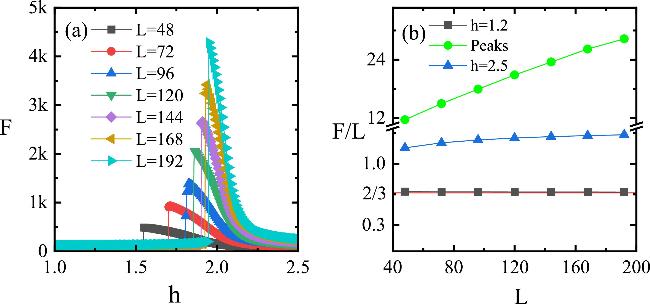
Figure 1. (a) Quantum Fisher information versus transverse field h for different system sizes at α = 2.2. (b)The QFI density F/L versus system size L for different transverse field h at α = 2.2. Red line: value = 2/3. To clearly illustrate the local trend, the vertical axis range (1.4–11.0) has been truncated. |
For a multi-particle quantum system with size L, the QFI of the system follows a scaling relation F ∝ Lβ(1 ≤ β ≤ 2) [14, 36, 43]. For QFI density fQ = F/L, it will be fQ ∝ Lβ−1. If β = 2, it indicates the presence of high multipartite entanglement (L-partite entangled) [43]. We further study the behavior of the relation between QFI density F/L and the system size L for in the cases of h = 1.2, 2.5 in figure 1(b). The QFI density for the peaks is also considered. For h = 1.2, 2.5, we can observe that F/L lies almost right along the top of the red dashed line, particularly for h = 1.2. These mean they both have low multipartite entanglement, maybe pairwise entanglement between two nearest spins. A power fit yields approximately β = 1.635 for peaks. This result unambiguously confirms that our system generates a highly multipartite entangled state near h = 2.0 [44].
According to equation (8 ), figure 2(a) shows the growth of the multipartite entanglement number k for the peaks when system size L increases with different decay exponent α. Two clear trends can be observed: first, for any given α, k increases monotonically with L. This indicates that, in larger systems, the entangled states still exist. Second, for the same system size L, a larger α (i.e. shorter-range interactions) leads to a larger maximum entanglement number k, which means strong long-range interactions will reduce the multipartite entanglement. Figure 2(b) shows the entanglement number density k/L versus system size L. We observe that for all decay exponents α, as the system size L increases, the entanglement number density k/L exhibits an extremely gentle decreasing trend and would tend toward a constant value, which implies that multipartite entanglement persists in the thermodynamic limit.
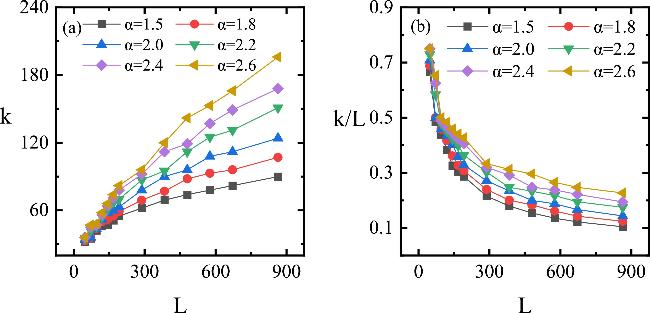
Figure 2. (a) Multipartite entanglement number k for the peaks is plotted as a function of system size L for different decay exponents α in the ferromagnetic chain. (b) The entanglement number density k/L for the peaks decreases with increasing L, and saturates to a plateau for short-range interactions (large α). |
It would be interesting to find the peaks' location of multipartite entanglement. The location is close to abrupt discontinuity point. It has been demonstrated that the QFI of the ground state can exhibit super-extensive divergence or abrupt changes in the vicinity of a quantum critical point [32, 45, 46]. The pseudo-critical point hc(L) of a finite-size system converges to the true critical point hc(∞) in the thermodynamic limit. Its convergence behavior is governed by the parameter γ, and it follows the scaling law:
$\begin{eqnarray}| {h}_{c}(L)-{h}_{c}(\infty )| \sim {L}^{-\gamma },\end{eqnarray}$
where γ is a constant given by the correlation-length critical exponent ν, γ ≡ 1/ν [47, 48]. As shown in figure 3(a), by fitting $\mathrm{ln}| {h}_{c}(L)-{h}_{c}| $ versus $\mathrm{ln}L$, we successfully obtained a straight line with a negative slope. The numerical value of this slope corresponds to −γ. From the fitting, we extracted the critical exponent γ = 0.7831 and hc(∞) = 2.1567, and the critical point hc is consistent with the results obtained by fidelity susceptibility [29].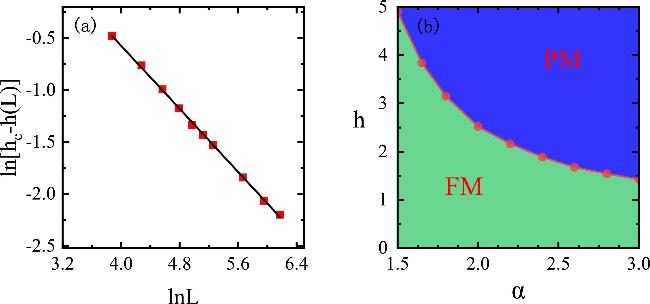
Figure 3. (a) The corresponding scaling of the abrupt discontinuity point of QFI in ferromagnetic chain with α = 2.2. (b) Quantum phase diagram of the long-range interacting system. The horizontal axis represents the decay exponent α, and the vertical axis represents the transverse field strength h. The solid curve hc(α) denotes the phase boundary determined through finite-size scaling, below which lies the ferromagnetic phase (FM) and above which lies the paramagnetic phase (PM). |
Figure 3(b) presents the global phase diagram in terms of the transverse field h and the parameter α. The curve hc(α) marks the QPT boundary from the ferromagnetic phase (FM, below the curve) to the paramagnetic phase (PM, above the curve). A key feature is that the phase boundary line is monotonically decreasing, meaning the critical field strength hc decreases as α increases, and hc approaches 1 when α = +∞ [8], a result is derived from pairwise entanglement in the nearest-neighboring spins. In the FM phase, multipartite entanglement remains extremely low: for instance, there is either no entanglement at all (such as h = 0) or only two-partite entanglement. By contrast, in the PM phase, multipartite entanglement becomes remarkably strong when the system is close to the critical points. As the system moves farther away from the critical points, multipartite entanglement gradually decreases until it vanishes entirely.
4.2. Antiferromagnetic chain (J = −1)
For the antiferromagnetic chain, the appropriate order parameter is not the uniform operator ${\hat{J}}_{z}={\sum }_{i=1}^{N}{S}_{i}^{z}$ (which is suitable for the ferromagnetic case), but the staggered operator ${\hat{J}}_{z}^{{\rm{st}}}={\sum }_{i=1}^{N}{(-1)}^{i}{S}_{i}^{z}$. As justified by the model's properties in section 2 , this choice is essential to properly characterize the antiferromagnetic order and, consequently, to capture the corresponding divergence of the QFI at the quantum critical point [49]. Similar to the case of the ferromagnetic chain, figure 4(a) present F versus h with different system size L in the antiferromagnetic chain. A similar phenomenon has occurred again, the only difference is that peaks locate nearby h ≈ 0.35. We also observe QFI density F/L ∝ Lβ−1, which is shown in figure 4(b). We considered the peak values of F and the other cases h = 0.26, 0.48. It is seen that QFI density F/L is slightly greater than 2/3 and β ≈ 1 in the cases of h = 0.26, 0.48, which means they both have low multipartite entanglement. We also obtain β = 1.56 for peaks, and it means the system has high multipartite entanglement. Figures 5(a) and (b) show the curves of the multipartite entanglement number k and its density value k/L as functions of L respectively. Overall, the antiferromagnetic chain exhibits trends similar to those of the ferromagnetic chain. However, it should be noted that when α is large (e.g. α ≥ 1.0), the frustration effect is weak. In contrast, when α is small (e.g. α = 0.4), the frustration effect becomes significant. For the same system size L, a larger α leads to a larger maximum entanglement number k, which means the frustration will reduce multipartite entanglement. Figure 5(b) shows the k/L versus system size L. It is shown that the ratio k/L will exhibit an extremely gentle decreasing trend and would tend toward a constant value when L increases, regardless of the value of α.
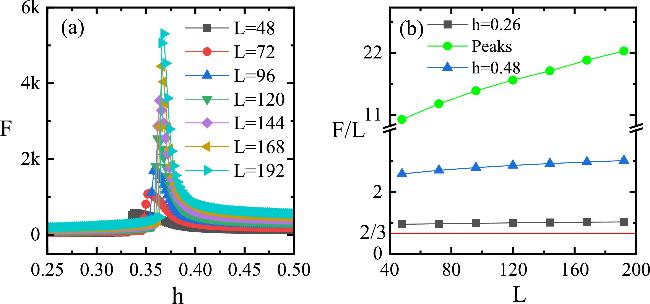
Figure 4. (a) Quantum Fisher information is plotted as a function of the transverse field h with α = 0.6 for different system sizes. (b) The QFI density F/L versus system size L for different transverse field h at α = 0.6. Red line: value = 2/3. To make the local trend clearly visible, we have truncated the vertical axis to the range of 4.0–9.0. |
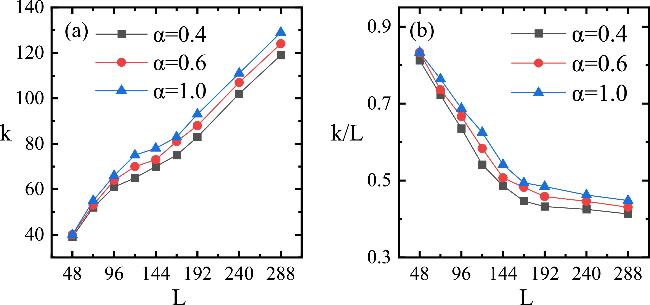
Figure 5. (a) Multipartite entanglement number k for the peaks as a function of system size L and decay exponent α for the antiferromagnetic chain. (b) The entanglement number density k/L for the peaks as a function of system size L and decay exponent α for the antiferromagnetic chain. |
According to the finite size effect in equation (10 ), we also find the critical point for the case α = 0.6 in antiferromagnetic chain, which is shown in figure 6(a). It is found that γ = 1.070, and the hc(∞) = 0.3735 is obtained, which is also consistent with the results of previous studies [30]. Figure 6(b) displays the phase diagram of the antiferromagnetic chain. A comparison with the phase diagram of the ferromagnetic chain [figure 3(b)], clearly reveals that the finite-size scaling behavior of the quantum critical point hc in the antiferromagnetic chain is completely opposite to that of the ferromagnetic chain: in the antiferromagnetic chain, hc increases with increasing α. This behavior can be attributed to the effect of frustration. In the antiferromagnetic chain, when α is small, the system exhibits long-range interactions and strong frustration, resulting in lower ground-state stability. Thus, only a relatively small transverse magnetic field h is required to drive the phase transition. When α is large, the system tends to exhibit short-range interactions with weaker frustration and a more stable ground state, requiring a larger h to induce the phase transition. This physical picture is consistent with the phase diagram from our finite-size scaling. Correspondingly, multipartite entanglement exhibits an extremely low magnitude in the AFM phase. Specifically, when the magnetic field is zero (h = 0), the system is in a separable state, and it only supports two-partite entanglement in the majority of instances. In sharp contrast, the PM phase presents a distinct scenario: multipartite entanglement grows notably intense as the system approaches its critical points. As the system deviates further from the critical points, multipartite entanglement undergoes a gradual reduction and eventually disappearing completely.
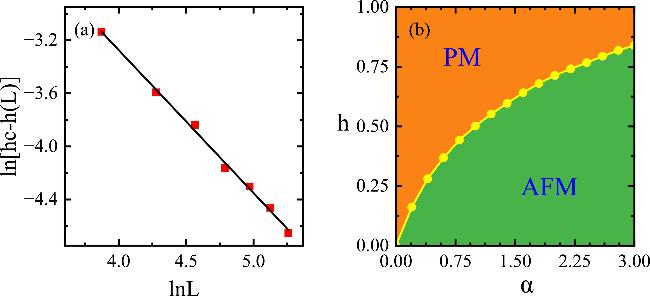
Figure 6. (a) The corresponding scaling of the abrupt discontinuity point of QFI in antiferromagnetic chain with α = 0.6. (b) The phase diagram of the long-range interacting system. The horizontal axis represents the decay exponent α, and the vertical axis represents the transverse field strength h. The solid curve hc(α) denotes the phase boundary determined through finite-size scaling, below which lies the antiferromagnetic phase (AFM) and above which lies the paramagnetic phase (PM). |
Actually, for the generator corresponding to $\hat{{J}_{z}}$, it is also possible to use the uniform operator. As shown in figure 7(a), when the uniform operator is used, the result of QFI versus h becomes relatively flat, making it difficult to identify the discontinuity point accurately. Therefore, it is necessary to compute the derivative of the curve to precisely locate the extremum, and the corresponding derivative is shown in figure 7(b). For the case α = 0.6, we can also determine the critical point hc = 0.375, which is identified by the peak location of the QFI's first derivative. The key difference is that the signature of the QPT is relatively faint.
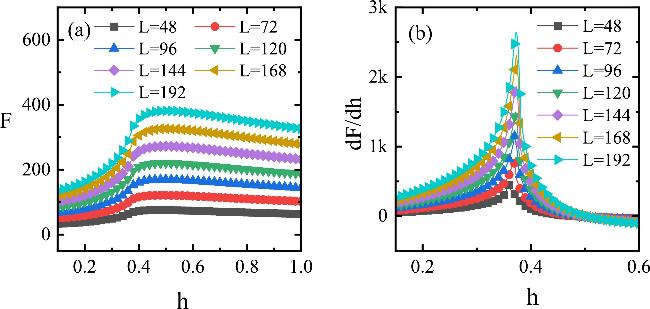


Figure 7. (a) The QFI and (b) its first derivative dF/dh, are plotted as functions of the transverse field h for different system sizes L. The QFI is measured using the generator defined in equation ( |
5. Conclusions and outlook
In the work, we performed DMRG to simulate the long-range transverse-field Ising model, and employed the average QFI as a criterion to quantify multipartite entanglement. Our results show that the multipartite entanglement increases with increasing system size, while the density of multipartite entanglement decreases as the system size increases. The scaling behaviors show that the entanglement density would saturate to a constant value in the thermodynamic limit, likely governed by model parameters such as the decay exponent α and magnetic field. Interestingly, regardless of whether the system exhibits ferromagnetism or anti-ferromagnetism, the multipartite entanglement density always decreases as α increases.
Multipartite entanglement refers to the nonlocal quantum correlations, which cannot be decomposed into a simple superposition of bipartite entanglements. Our results show it diverges at critical points for both the long-range ferromagnetic and antiferromagnetic transverse-field Ising models. The behaviors of QFI in the long-range Ising models further confirm that QFI can serve as a universal marker for criticality—a property that traditional order parameters lack.
In the light of these promising results, it would be interesting to investigate whether it is feasible to use it for systems with more complicated degrees of freedom, such as the two-dimensional Ising model. Moreover, the models under consideration could be envisioned in quantum simulation in ultracold atoms [18–21], and the QFI can be measured experimentally [34, 50]. These advances open new prospects for experimentally investigating the issues addressed in the present work.