


1. Introduction
2. Preliminaries
2.1. Stabilizer formalism
2.2. The framework of magic resource theory
2.3. The quantum (α, β) entropy and the quantum $\left(\alpha ,\beta \right)$-relative entropy
Let ${\left\{{\rho }_{j}\right\}}_{j}\in { \mathcal D }({ \mathcal H })$, and ${\left\{{p}_{j}\right\}}_{j}$ be a probability distribution. Then we have
(i) (Concavity) For α ∈ (0, 1), β ∈ ( − ∞, 0) ∪ (0, 1], it holds that
(ii) For α ∈ (0, 1) ∪ (1, +∞), β ∈ (−∞, 0) ∪ (0, +∞), it holds that
(iii) (Unitary invariance) For α ∈ (0, 1) ∪ (1, +∞), β ∈ (−∞, 0) ∪ (0, +∞) and any unitary operator $U\in { \mathcal U }({ \mathcal H })$, it holds that
(iv) (Lipschitz continuity) For α ∈ (1, +∞), β ∈ [1, +∞), it holds that
Let ${\left\{{\rho }_{j}\right\}}_{j},{\left\{{\sigma }_{j}\right\}}_{j}\in { \mathcal D }({ \mathcal H })$, and ${\left\{{p}_{j}\right\}}_{j}$ be a probability distribution. Then we have
(i) For α ∈ (0, 1) ∪ (1, +∞), β ∈ (−∞, 0) ∪ (0, +∞), it holds that
(ii) For α ∈ (0, 1) ∪ (1, +∞), β ∈ (−∞, 0) ∪ (0, +∞), it holds that
(iii) (Monotonicity) For any quantum operation ${ \mathcal E }$ and α ∈ (0, 1), β ∈ (−∞, 0) ∪ (0, 1], it holds that
(iv) (Unitary invariance) For α ∈ (0, 1) ∪ (1, +∞), β ∈ (−∞, 0) ∪ (0, +∞) and any unitary operator $U\in { \mathcal U }({ \mathcal H })$, it holds that
(v) (Joint convexity) For α ∈ (0, 1), β ∈ (−∞, 0) ∪ (0, 1], it holds that
3. Quantum (α, β) Jensen–Shannon divergence
For α ∈ (0, 1) ∪(1, +∞), β ∈ (−∞, 0) ∪ (0, +∞), we define two kinds of quantum (α, β) Jensen–Shannon divergence as
Equations (
For any α ∈ (0, 1) ∪ (1, 2), β ∈ (−∞, 0) ∪(0, +∞), it holds that
Let ${\rho }_{1},{\rho }_{2},{\sigma }_{1},{\sigma }_{2}\in { \mathcal D }({ \mathcal H })$, ${\left\{| {\psi }_{j}\rangle \right\}}_{j}$, ${\left\{| {\phi }_{j}\rangle \right\}}_{j}$ are pure states on ${ \mathcal H }$, and ${\left\{{p}_{j}\right\}}_{j}$ is a probability distribution. Then we have
(i) It holds that
(ii) For α ∈ (0, 1) ∪ (1, +∞), β ∈ (−∞, 0)∪(0, +∞), it holds that
(iii) (Unitary invariance) For α ∈ (0, 1) ∪ (1, +∞), β ∈ (−∞, 0)∪(0, +∞) and any unitary operator $U\in { \mathcal U }({ \mathcal H })$, it holds that
(iv) (Symmetry) For α ∈ (0, 1) ∪ (1, +∞), β ∈ ( − ∞, 0)∪(0, +∞), it holds that
(v) (Lipschitz continuity) For α ∈ (1, + ∞), β ∈ [1, + ∞), Jα,β(ρ, σ) is Lipschitz continuous in the first or second entry, i.e.
Let ${\left\{{\rho }_{j}\right\}}_{j},{\left\{{\sigma }_{j}\right\}}_{j}\in { \mathcal D }({ \mathcal H })$, and ${\left\{{p}_{j}\right\}}_{j}$ be a probability distribution. Then we have
(i) For α ∈ (0, 1) ∪ (1, + ∞), β ∈ ( − ∞, 0) ∪ (0, + ∞), it holds that
(ii) For α ∈ (0, 1) ∪ (1, + ∞), β ∈ ( − ∞, 0)∪(0, + ∞), it holds that
(iii) (Monotonicity) For any quantum operation ${ \mathcal E }$ and α ∈ (0, 1), β ∈ ( − ∞, 0) ∪ (0, 1], it holds that
(iv) (Unitary invariance) For α ∈ (0, 1) ∪ (1, + ∞), β ∈ ( − ∞, 0)∪(0, + ∞) and any unitary operator $U\in { \mathcal U }({ \mathcal H })$, it holds that
(v) (Joint convexity) For α ∈ (0, 1), β ∈ ( − ∞, 0) ∪(0, 1], it holds that
(vi) (Symmetry) For α ∈ (0, 1) ∪ (1, ∞), β ∈ ( − ∞, 0)∪(0, + ∞), it holds that
By applying proposition
4. Quantum (α, β) Jensen–Shannon divergence of magic
4.1. Two new stabilizer monotones
For α ∈ (0, 1) ∪(1, + ∞),β ∈ ( − ∞, 0)∪(0, + ∞), define
For α ∈ (0, 1) ∪ (1, + ∞), β ∈ ( − ∞, 0)∪(0, + ∞), we define two kinds of quantum (α, β) Jensen–Shannon divergence of magic as
Both of the quantities in equations (
Let ${\left\{{\rho }_{j}\right\}}_{j}\in { \mathcal D }({ \mathcal H })$, and ${\left\{{p}_{j}\right\}}_{j}$ be a probability distribution. Then we have
(i) (Faithfulness) For α ∈ (0, 1) ∪ (1, + ∞), β ∈ ( − ∞, 0)∪(0, + ∞), it holds that
(ii) (Invariance under Clifford operations) For any Clifford operator $V\in {{ \mathcal C }}_{d}$ and α ∈ (0, 1) ∪ (1, + ∞),β ∈ ( − ∞, 0)∪(0, + ∞), it holds that
(iii) (Convexity) For α ∈ (0, 1) ∪ (1, + ∞), β ∈ ( − ∞, 0)∪(0, + ∞), it holds that
(iv) (Monotonicity) For α ∈ (1, 2), β ∈ ( − ∞, 0) ∪ (0, 1] and any stabilizer operation ${ \mathcal E }$ which obeys ${ \mathcal E }(| \psi \rangle \langle \psi | )=| \phi \rangle \langle \phi | $, it holds that
(v) For α ∈ (1, 2), β ∈ ( − ∞, 0) ∪ (0, 1], it holds that
(vi) (Lipschitz continuity) For α ∈ (1, + ∞), β ∈ [1, + ∞), Mα,β(ρ) is Lipschitz continuous for pure states, i.e.
Let ${\left\{{\rho }_{j}\right\}}_{j}\in { \mathcal D }({ \mathcal H })$, and ${\left\{{p}_{j}\right\}}_{j}$ be a probability distribution. Then we have
(i) (Faithfulness) For α ∈ (0, 1) ∪ (1, + ∞),β ∈ ( − ∞, 0)∪(0, + ∞), it holds that
(ii) (Invariance under Clifford operations) For any Clifford operator $V\in {{ \mathcal C }}_{d}$ and α ∈ (0, 1)∪(1, + ∞),β ∈ ( − ∞, 0)∪(0, + ∞), it holds that
(iii) (Convexity) For α ∈ (0, 1) ∪ (1, + ∞),β ∈ ( − ∞, 0)∪(0, + ∞) and ρ = ∑jpjρj, convexity holds, i.e.
(iv) (Monotonicity) For α ∈ (0, 1), β ∈ ( − ∞, 0) ∪ (0, 1] and any stabilizer operation ${ \mathcal E }$ which satisfying ${ \mathcal E }(| \psi \rangle \langle \psi | )=| \phi \rangle \langle \phi | $, it holds that
(v) For α ∈ (0, 1), β ∈ ( − ∞, 0) ∪ (0, 1], it holds that
The function
(i) g(x, α, β) is strictly monotonically increasing for α ∈ (0, 1), β ∈ ( − ∞, 0) ∪ (0, + ∞) and strictly monotonically decreasing for α ∈ (1, + ∞), β ∈ ( − ∞, 0) ∪ (0, + ∞) with respect to x ∈ (0, + ∞);
(ii) g(x, α, β) is strictly convex with respect to x ∈ (0, + ∞) for α ∈ (1, + ∞), β ∈ ( − ∞, 0) ∪ (0, 1).
The function
For α ∈ (0, 1) ∪ (1, + ∞), β ∈ ( − ∞, 0) ∪ (0, + ∞), we have
4.2. Relationship with other magic quantifiers
For λ ∈ [0, 1],
For λ ∈ [0, 1],
For α ∈ (0, 1) ∪ (1, + ∞), λ ∈ [1/2, 1], β ∈ (1, + ∞), it holds that
5. Magic generating power of quantum gates via quantum (α, β) Jensen–Shannon divergence
For any $U,{U}_{1},{U}_{2}\in { \mathcal U }({ \mathcal H })$, we have
(i) For α ∈ (0, 1) ∪ (1, + ∞), β ∈ ( − ∞, 0) ∪ (0, + ∞), it holds that
(ii) For α ∈ (0, 1) ∪ (1, + ∞), β ∈ ( − ∞, 0) ∪ (0, + ∞) and any ${V}_{1},{V}_{2}\in {{ \mathcal C }}_{d}$, it holds that
(iii) For α ∈ (1, 2), β ∈ ( − ∞, 0) ∪ (0, 1], it holds that
For α ∈ (0, 1) ∪ (1, + ∞), β ∈ ( − ∞, 0) ∪ (0, + ∞) and any $U\in { \mathcal U }({ \mathcal H })$, we have
The function
(i) w(x, α) is strictly monotonically decreasing for α ∈ (1, 2) with respect to $x\in (0,\frac{\pi }{4})$.
(ii) w(x, α) is strictly concave for α ∈ (1, 2) with respect to $x\in (0,\frac{\pi }{16}]$.
In qubit systems, for α ∈ (1, 2), β ∈ ( − ∞, 0) ∪ (0, 1), there exists some ${U}_{0}\in { \mathcal U }({ \mathcal H })$ and input state ∣ψ0⟩ such that
6. Examples
Note that in qubit systems, ${ \mathcal P }{{ \mathcal S }}_{2}\,=\left\{| 0\rangle ,| 1\rangle ,| +\rangle ,| -\rangle ,| +{\rm{i}}\rangle ,| -{\rm{i}}\rangle \right\}$, and any pure state ∣ψ⟩ can be represented as $| \psi \rangle =| {\psi }_{\theta ,\phi }\rangle ={\rm{\cos }}\frac{\theta }{2}| 0\rangle +{\,\rm{e}\,}^{{\rm{i}}\phi }{\rm{\sin }}\frac{\theta }{2}| 1\rangle $ with (θ, φ) ∈ [0, π] × (0, 2π]. Then we have
At the same time, we can show that Mα,β(ρ) are bounded in qubit systems with α ∈ (0, 1) ∪ (1, + ∞), β ∈ ( − ∞, 0) ∪ (0, + ∞).
We first introduce a vital class of magic states which are called T-type states in qubit systems, i.e.
Direct calculations show that in qubit systems, we have
Using lemma
Suppose that the optimal decomposition of ${M}_{\alpha ,\beta }\left(\rho \right)$ is $\left\{\left({p}_{j},| {\psi }_{j}\rangle \right)\right\}$. Then we have
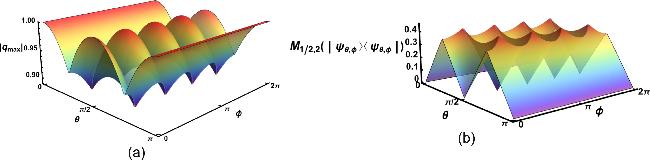
Figure 1. The surfaces of $| {q}_{{\rm{\max }}}| $ and ${M}_{1/2,2}\left(| {\psi }_{\theta ,\phi }\rangle \langle {\psi }_{\theta ,\phi }| \right)$ with the variation of θ ∈ [0, π] and φ ∈ [0, 2π), respectively. |
Consider qutrit systems and note that
The qutrit T state is defined as $| T\rangle \,=\frac{1}{\sqrt{3}}\left({\,\rm{e}\,}^{\frac{2\pi }{9}{\rm{i}}}| 0\rangle +| 1\rangle +{\,\rm{e}\,}^{\frac{-2\pi }{9}{\rm{i}}}| 2\rangle \right).$ Then by direct calculations, we have
By proposition
We depict ${M}_{\alpha ,\beta }\left(| T\rangle \langle T| \right)$ and ${m}_{\alpha ,\beta }\left(| T\rangle \langle T| \right)$ in equations (
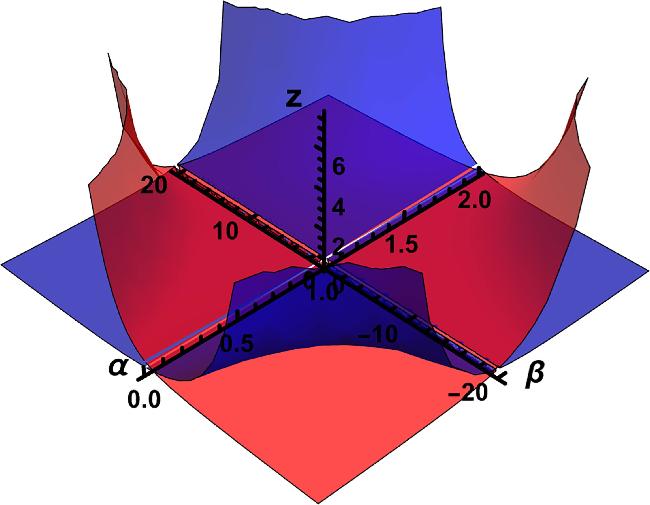
Figure 2. The red surface represents ${M}_{\alpha ,\beta }\left(| T\rangle \langle T| \right)$ and the blue surface represents ${m}_{\alpha ,\beta }\left(| T\rangle \langle T| \right)$ with α ∈ (0, 1) ∪ (1, 2) and β ∈ (−20, 0) ∪ (0, 20). |
According to the proof of proposition
We depict Mα,β(T1/4∣ψ0⟩) − Mα,β(∣ψ0⟩) and ${{ \mathcal M }}_{\alpha ,\beta }({T}^{1/4})$ with α ∈ (1, 2) and β ∈ (− 5, 0) ∪ (0, 1) in figure 3. It shows that Mα,β(T1/4∣ψ0⟩) − Mα,β(∣ψ0⟩) is always larger than ${{ \mathcal M }}_{\alpha ,\beta }({T}^{1/4})$ in this parameter range.
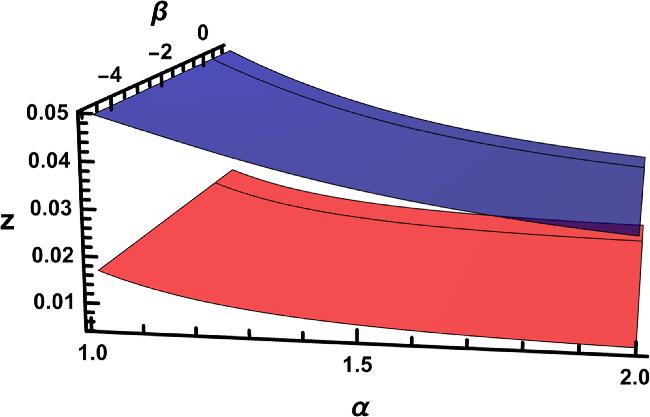


Figure 3. The blue surface represents Mα,β(T1/4∣ψ0⟩) − Mα,β(∣ψ0⟩) and the red surface represents ${{ \mathcal M }}_{\alpha ,\beta }({T}^{1/4})$ with α ∈ (1, 2) and β ∈ (−5, 0) ∪ (0, 1). |