

1. Introduction
In recent years, macroscopic oscillator Schrödinger cat states have attracted significant attention due to their crucial role as resource states for quantum information processing, quantum computing, and fundamental tests [1–8]. These oscillators can mediate interactions between optical and microwave frequency electromagnetic waves through coupling mechanisms [9, 10]. While optical cat states have been extensively studied in current implementation schemes, macroscopic oscillator cat states remain an active area of development in both theoretical and experimental domains.
A notable advantage of cavity optomechanical systems lies in their compatibility with cold atomic systems, enabling the formation of hybrid optomechanical systems [11–18]. Recent advances in quantum Rabi models [19] have achieved the ultrastrong coupling regime (characterized by coupling strength to cavity field frequency ratios between 0.1 and 1). Grimsmo et al developed an implementation scheme based on resonant Raman transitions between stable ground states of 87Rb atoms, facilitated by strong atom-cavity coupling achievable with microtoroidal whispering-gallery-mode resonators [20, 21]. This approach yields a system governed by an effective generalized Rabi model and introduces a nonlinear atom-photon coupling term in the Hamiltonian, which physically corresponds to a dynamical Stark shift of the cavity mode frequency. Recently, Floquet-type driving has offered a promising route toward actively protected and dynamically controllable optomechanical entanglement [22, 23], such as periodic modulation of amplitude of optical drives [24], or mechanical spring-constant [25].
Recently, significant progress has been made in generating quantum cat states within atom-cavity optomechanical systems [12, 14, 26] through various approaches. On one hand, within the framework of linear interactions, the preparation of mechanical cat states has been achieved using the standard Jaynes–Cummings model under single-photon strong coupling conditions [27]. Reference [28] proposed a scheme to generate a macroscopic mechanical cat state by coupling a mechanical oscillator to an atom-cavity system described by the Rabi-Stark model, and showed that the Stark term significantly enhances the quantum coherence of the generated state. On the other hand, schemes utilizing collective coupling between multi-atom ensembles (e.g., BECs) and optical cavities have been explored, though their focus often lies on bistability, phase transitions, or quantum simulation rather than the targeted preparation of mechanical cat states [29]. Furthermore, other works employ cat states themselves as a resource for fault-tolerant simulation of model dynamics, such as in the quantum Rabi model [30].
Beyond Hamiltonian-engineering schemes that directly tailor light–matter interaction, significant efforts have been dedicated to alternative paradigms for preparing non-classical mechanical states, which provide a crucial context for this work. One major direction is coherent feedback control, where optical interference loops are used to manipulate quantum dynamics without projective measurement, potentially enhancing state preparation fidelity [31]. Another powerful and diverse strategy is non-Gaussian reservoir engineering. This encompasses (i) dissipative stabilization, where a target state (e.g., a cat or pair-coherent state) is prepared as a steady state through engineered system-bath interactions [32]; (ii) remote state preparation, which leverages pre-established optomechanical entanglement and conditional measurements on light to herald motional cat states in a mechanical oscillator [33, 34]; and (iii) protocols that combine measurement and filtering (e.g., photon subtraction) for fast generation of highly non-Gaussian states [35]. Furthermore, generalized nonlinear optomechanical interactions themselves can be optimized to enhance cat-state generation [36].
In contrast, the present work pursues a conceptually distinct pathway for generating mechanical cat states, centered on intrinsic nonlinearity and deterministic projection within a minimal tripartite quantum system. Unlike schemes relying on continuous feedback loops or engineered dissipation, our protocol does not depend on tailored external control or specific decay channels. It also differs from remote preparation protocols that require prior generation of complex entangled resources. Instead, we harness the built-in and tunable nonlinearity of the Rabi-Stark model as the core resource.
In section 2 , we describe our model setup. The generation of quantum cat states via the quantum Rabi model is demonstrated in section 3 , and the generation of quantum cat states via the quantum Rabi-Stark model is numerically analyzed in section 4 . The dissipation is discussed in section 5 , and a conclusion is presented in section 6 .
2. Theoretical model and setup
Our system is a tripartite quantum system comprising an atom, an optical cavity, and a mechanical oscillator (figure 1). The model system is supposed to be implemented with a Fabry–Perot cavity, where one end mirror serves as a cantilever-type mechanical oscillator. This mechanical element couples optomechanically to the cavity field via radiation pressure. Simultaneously, the cavity field interacts with a two-level atomic system in the ultrastrong coupling regime [37], described by the Rabi-Stark model.
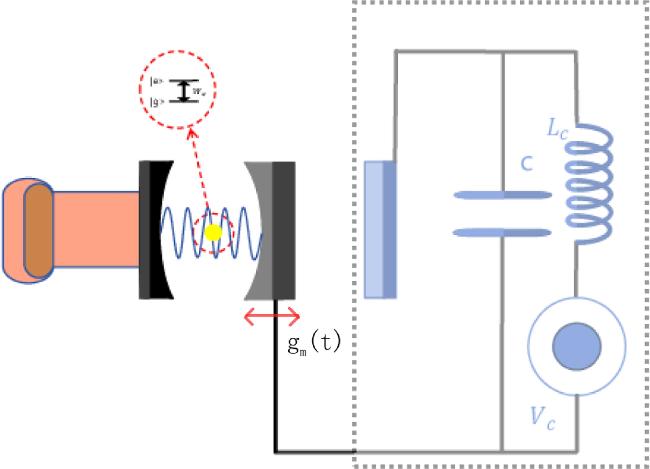
Figure 1. Schematic of a model of the tripartite hybrid system with modulated optomechanical coupling. The system comprises a single-mode Fabry–Perot cavity (frequency ωc) containing a two-level atom (transition frequency ωa). One end mirror is suspended as a mechanical oscillator (frequency ωm). We work in the resonant condition ωc = ωa = ωm. The atom and the cavity field are in the ultrastrong coupling regime, with a normalized coupling strength gc/ωc ≥ 0.1. The optomechanical coupling rate gm(t) = gmcos(νt) is actively modulated at a frequency ν, where ν = ωm − Δ, and Δ denotes the modulation detuning. The LC circuit enclosed within the dashed box is depicted as a representative example of a potential tuning interface but is not part of the theoretical model considered in this work. |
Regarding the experimental implementation of the proposed model, a feasible platform can be constructed as follows. The ultrastrong atom-cavity coupling, essential for the Rabi-Stark model, can be realized using a microtoroidal whispering-gallery-mode resonator [20, 21]. This system facilitates resonant Raman transitions between the two hyperfine ground states of a rubidium atom, thereby creating an effective two-level system. The atom-cavity subsystem is realized using an atom positioned near the surface of a microtoroidal optical resonator coupled to whispering-gallery mode evanescent fields [17, 18, 38–40], with the cavity exhibiting ultrahigh quality factors. The mechanical mirror's oscillation frequency (ranging from kHz to GHz [41]) is tuned to match the atomic transition frequency ωm = ωa. The optomechanical interaction can be realized through the coupling mechanism between the microdisk and a nanobeam [42–44]. The tuning of this mechanical oscillator could be achieved through methods such as the LC circuit design proposed in [45–48]. Actually, [49, 50] employ modulated optomechanical coupling to amplify a weakly-coupled system into the single-photon strong-coupling regime, enabling the generation of noise-resilient non-classical states such as Schrödinger cat states or robust steady-state entanglement between two coupled oscillators.
The system dynamics is primarily governed by two coupling mechanisms. First, the radiation pressure from intracavity light drives the motion of the cantilever, establishing a direct optomechanical interaction; second, the cavity field itself is strongly coupled to the internal states of the atom. These two intertwined couplings collectively define the total Hamiltonian for the atom-cavity-mechanics hybrid system as follows (note that an LC circuit for capacitive coupling is not included here, as our aim is to study the essential dynamics of the isolated atom-cavity-mechanics system. Throughout this paper, we set ℏ = 1.)
$\begin{eqnarray}\begin{array}{rc}H & =\,{H}_{{\rm{rabi}}}+{H}_{{\rm{stark}}}+{H}_{{\rm{M}}}+{H}_{{\rm{Cav}}-{\rm{M}}},\end{array}\end{eqnarray}$
where $\begin{eqnarray}\begin{array}{rc}{H}_{{\rm{rabi}}} & =\,\hslash {\omega }_{{\rm{a}}}{\sigma }_{z}+\hslash {\omega }_{{\rm{c}}}{a}^{\dagger }a+\hslash {g}_{{\rm{c}}}({\sigma }_{+}+{\sigma }_{-})({a}^{\dagger }+a),\end{array}\end{eqnarray}$
$\begin{eqnarray}\begin{array}{rc}{H}_{{\rm{stark}}} & =\,\hslash \frac{U}{2}{a}^{\dagger }a{\sigma }_{z},\end{array}\end{eqnarray}$
$\begin{eqnarray}\begin{array}{rc}{H}_{{\rm{M}}} & =\,\hslash {\omega }_{{\rm{m}}}{b}^{\dagger }b,\end{array}\end{eqnarray}$
$\begin{eqnarray}\begin{array}{rc}{H}_{{\rm{Cav}}-{\rm{M}}} & =\,\hslash {g}_{{\rm{m}}}\,\rm{cos}\,(\nu t){a}^{\dagger }a({b}^{\dagger }+b).\end{array}\end{eqnarray}$
Hrabi is the quantum Rabi model Hamiltonian describing the interaction between atom and light [19], where the first term and second term in equation (2 ) are the Hamiltonian of the atom and the cavity respectively, and the third term is for the coupling between the atom and the cavity. ωa and ωc are the atom and electromagnetic field mode frequencies, respectively. gc is the atom-cavity interaction strength, and we assume η = gc/ωc ≥ 0.1. σz, σ± are two-state operators and a (a†) is the annihilation (creation) operator for the optical cavity mode.
Hstark is the atom-cavity Stark interaction term with a†aσz is the nonlinear coupling term added to the quantum Rabi model. Here, U is the nonlinear tunable Stark coupling strength. Hstark describes the nonlinear coupling between the atom and the cavity field in the ultrastrong coupling regime, and can be viewed as a dynamic shift of the cavity field frequency, introduced by [20, 21].
HM is the Hamiltonian of the mechanical oscillator, with ωm and b (b†) being the frequency and annihilation (creation) operators of the mechanical oscillator, respectively. HCav−M is the coupling term between the cavity and the mechanical oscillator. gmcos(νt) is the modulated optomechanical coupling strength, with frequency ν = ωm − Δ. Δ is the detuning caused by modulation.
The time-evolved density operator ρ(t) can be expressed as follows
$\begin{eqnarray}\rho (t)=\displaystyle \sum _{n,m,n^{\prime} ,m^{\prime} =0}^{\propto }\displaystyle \sum _{i,i^{\prime} =e,g}{\rho }_{n,n^{\prime} ,m,m^{\prime} ,i,i^{\prime} }\left|n,m,i\right\rangle \left\langle n^{\prime} ,m^{\prime} ,i^{\prime} \right|,\end{eqnarray}$
where $\{\left|n,m,i\right\rangle =\left|n\right\rangle \otimes \left|m\right\rangle \otimes \left|i\right\rangle \}$. $\left|n\right\rangle $ and $\left|m\right\rangle $ are the Fock states of the cavity and the mechanical oscillator in the Fock space, respectively. The indices i and $i^{\prime} $ label the states of the two-level atomic subsystem, with i and $i^{\prime} \in g,e$, and $\left|e\right\rangle $ and $\left|g\right\rangle $ are the excited and ground states of the two-level atom respectively.Actually, if the initial state of the optical cavity is assumed to be a Fock state $\left|n\right\rangle $, and the atom is in its excited state $\left|e\right\rangle $, then during the system's evolution, the states of the light field and the atom primarily reside within the subspace with excitation number of n + 1. Therefore, we can analyze the effective Hamiltonian of the system within the energy-level subspace of the total excitation number of n + 1 for the cavity-atom system. Since we can describe the states of the optical cavity and atom using the dressed states for the Jaynes–Cummings (JC) model, according to equation (2 ), by treating terms σ+a† and σ−a as perturbation terms, we can use perturbation theory to obtain the revised dressed states. For simplicity, here we assume U = 0. Considering second perturbation revision and at first order in η, the dressed states $\left|m,\pm \right\rangle $ can be coupled to the dressed states of $\left|m,\pm \right\rangle ,\left|m+2,\pm \right\rangle $ and $\left|m-2,\pm \right\rangle $, where $| m,\pm \rangle =(| m,g\rangle \pm | m-1,e\rangle )/\sqrt{2}$. Thus, we obtain the revised eigen energies and eigen states as
$\begin{eqnarray}\begin{array}{r}{\omega }_{n\pm }=(n-\frac{1}{2})\omega \pm {g}_{{\rm{c}}}\sqrt{n}-\frac{{g}_{{\rm{c}}}^{2}}{2\omega },\end{array}\end{eqnarray}$
$\begin{eqnarray}\begin{array}{rcl}\left|n,\pm \right\rangle & = & \frac{1}{\sqrt{2}}[(1\pm \frac{n\eta }{8})\left|n-1,e\right\rangle +(1\mp \frac{n\eta }{8})\left|n,g\right\rangle ]\\ & \pm & \frac{\eta }{2}(\sqrt{n-1}\left|n-2,g\right\rangle -\sqrt{n+1}\left|n+1,e\right\rangle )].\end{array}\end{eqnarray}$
Then we can get the effective Hamiltonian in the atom-cavity subspace of $\left|n,\pm \right\rangle $, that is
$\begin{eqnarray}\begin{array}{rcl}{H}_{{\rm{eff}}} & = & {\omega }_{n+}\left|n,+\right\rangle \left\langle n,+\right|+{\omega }_{n-}\left|n,-\right\rangle \left\langle n,-\right|+{\omega }_{{\rm{m}}}{b}^{\dagger }b\\ & & +\,{g}_{0}\cos (\nu t)\left(b+{b}^{\dagger }\right)\left({\alpha }_{n+}\left|n,+\right\rangle \left\langle n,+\right|\right)\\ & & +\,{g}_{0}\cos (\nu t)\left(b+{b}^{\dagger }\right)\left({\alpha }_{n-}\left|n,-\right\rangle \left\langle n,-\right|\right).\end{array}\end{eqnarray}$
Here, we omitted terms proportional to the operators $\left|n\pm \right\rangle \left\langle n\mp \right|$ in a rotating-wave approximation [51], and
$\begin{eqnarray}\begin{array}{r}{\alpha }_{n\pm }=\left\langle n,\pm \right|{a}^{\dagger }a\left|n,\pm \right\rangle =n-\frac{1}{2}\mp \frac{n\eta }{8}.\end{array}\end{eqnarray}$
In the interaction picture, the effective Hamiltonian can be given as
$\begin{eqnarray}\begin{array}{rcl}{H}_{{\rm{eff}}}^{{\rm{I}}} & = & \frac{{g}_{0}}{2}(b{{\rm{e}}}^{-{\rm{i}}{\rm{\Delta }}t}+{b}^{\dagger }{{\rm{e}}}^{{\rm{i}}{\rm{\Delta }}t})\\ & & \times \,\left({\alpha }_{n+}\left|n,+\right\rangle \left\langle n,+\right|+{\alpha }_{n-}\left|n,-\right\rangle \left\langle n,-\right|\right).\end{array}\end{eqnarray}$
At time t = 0, we assume that the initial state of the whole system to be $\left|n,\pm \right\rangle \otimes {\left|0\right\rangle }_{{\rm{m}}}$, where ${\left|0\right\rangle }_{{\rm{m}}}$ is the vacuum state of the mechanical oscillator. By applying the propagator associated with ${H}_{{\rm{eff}}}^{{\rm{I}}}$ on the initial state, the evolution state of the whole system at time t in the Schrödinger picture can be derived as
$\begin{eqnarray}\begin{array}{r}\left|{{\rm{\Psi }}}_{n\pm }(t)\right\rangle ={{\rm{e}}}^{{\rm{i}}{v}_{n\pm }}\left|n,\pm \right\rangle \displaystyle \otimes \left|{\beta }_{n\pm }\right\rangle ,\end{array}\end{eqnarray}$
where $\begin{eqnarray}{v}_{n\pm }=-({\omega }_{n\pm }-\frac{{g}_{{\rm{m}}}^{2}{\alpha }_{n\pm }^{2}}{4{\rm{\Delta }}})t-\frac{{g}_{{\rm{m}}}^{2}{\alpha }_{n\pm }^{2}}{4{{\rm{\Delta }}}^{2}}\sin ({\rm{\Delta }}t),\end{eqnarray}$
$\begin{eqnarray}{\beta }_{n\pm }=-{\rm{i}}\frac{{g}_{{\rm{m}}}{\alpha }_{n\pm }}{{\rm{\Delta }}}\sin (\frac{{\rm{\Delta }}t}{2}){{\rm{e}}}^{-{\rm{i}}({\omega }_{{\rm{m}}}-\frac{{\rm{\Delta }}}{2})t}.\end{eqnarray}$
If we assume that for time t = 0, the initial state of the atom-cavity to be $\left|n,e\right\rangle $ and the mechanical oscillator to be in the state of ${\left|0\right\rangle }_{{\rm{m}}}$, i.e., the initial state of the whole system is
$\begin{eqnarray}\begin{array}{l}\left|{\rm{\Psi }}(t=0)\right\rangle \,=\,\left|n,e\right\rangle \displaystyle \otimes {\left|0\right\rangle }_{{\rm{m}}}\\ \,\displaystyle =\,\frac{1}{\sqrt{2}}(\left|n,+\right\rangle -\left|n,-\right\rangle )\,\otimes \,{\left|0\right\rangle }_{{\rm{m}}}.\end{array}\end{eqnarray}$
According to equation (12 ), the evolution state of the whole system at time t in the Schrödinger picture can be obtained as
$\begin{eqnarray}\left|{\rm{\Psi }}(t)\right\rangle =\frac{1}{\sqrt{2}}({{\rm{e}}}^{{\rm{i}}{v}_{n+}}\left|n,+\right\rangle \otimes \left|{\beta }_{n+}\right\rangle -{{\rm{e}}}^{{\rm{i}}{v}_{n-}}\left|n,-\right\rangle \otimes \left|{\beta }_{n-}\right\rangle ).\end{eqnarray}$
The optical field provides a versatile platform for photon state manipulation, enabling creation, control, and readout of quantum states. In our scheme, if we implement a projective measurement to determine the photon occupation number n within the cavity and the atom state, then this measurement operation collapses the system's density matrix, projecting it onto the subspace corresponding to the detected photon number n and atom state $\left|i\right\rangle $ (i = e, g), with the reduced density matrix of the mechanical oscillator being 16 ), the reduced mechanical state should be the superposition state of state $\left|{\beta }_{n+}\right\rangle $ and $\left|{\beta }_{n-}\right\rangle $.
$\begin{eqnarray}\begin{array}{r}{\rho }_{{\rm{ni}}}^{{\rm{me}}}(t)=(\left|n,i\right\rangle \left\langle n,i\right|\rho (t)\left|n,i\right\rangle \left\langle n,i\right|)/{p}_{ni}(t),\end{array}\end{eqnarray}$
where $\rho (t)=\left|{\rm{\Psi }}(t)\right\rangle \left\langle {\rm{\Psi }}(t)\right|$, $\left|n,i\right\rangle =\left|n\right\rangle \otimes \left|i\right\rangle $, and ${p}_{ni}(t)\,={\rm{Tr}}(\left|n,i\right\rangle \left\langle n,i\right|\rho (t))$ is the corresponding measurement probability. According to equation (3. Parameter-controlled cat-state generation
For a macroscopically distinguishable cat state in a mechanical oscillator, two conditions must be satisfied: the constituent coherent state components should possess sufficiently large amplitudes (∣βn±∣ > 1) and exhibit high orthogonality, i.e., their overlap integral satisfies ∣⟨βn−∣βn+⟩∣2 ≪ 1. The orthogonality is given by $| \langle {\beta }_{n+}| {\beta }_{n-}\rangle {| }^{2}=\exp (-| {\beta }_{n+}-{\beta }_{n-}{| }^{2})$. A value closer to 0 indicates a greater separation between the two components in phase space and more pronounced cat-state characteristics. In this work, we systematically investigate the influence of key parameters—the initial photon number n, the modulation frequency Δ, the optomechanical coupling strength gm, and the atom-field coupling coefficient η—on cat-state preparation by analyzing the evolution of the modulus of the amplitude difference ∣βn+ − βn−∣ and the orthogonality ∣⟨βn+∣βn−⟩∣2.
Figure 2 shows the time evolution of ∣βn+ − βn−∣ and ∣⟨βn+∣βn−⟩∣2 for different parameter sets. It can be observed that in some cases, ∣βn+ − βn−∣ exceeds 1 while ∣⟨βn+∣βn−⟩∣2 approaches zero. Figure 2(a) shows the evolution of ∣βn+ − βn−∣ with time Δt for different initial photon numbers n. All curves oscillate with a period of Δt = 2π, and the oscillation amplitude increases significantly with n, indicating that a larger n directly leads to the generation of a cat state with a larger spatial scale. The corresponding evolution of orthogonality is shown in figure 2(b), where the value oscillates periodically between 0 and 1, visually reflecting the dynamical process of cat-state "birth" and "sudden death." As n increases, the orthogonality curve remains near 0 for a notably longer duration, implying enhanced stability of the cat state.
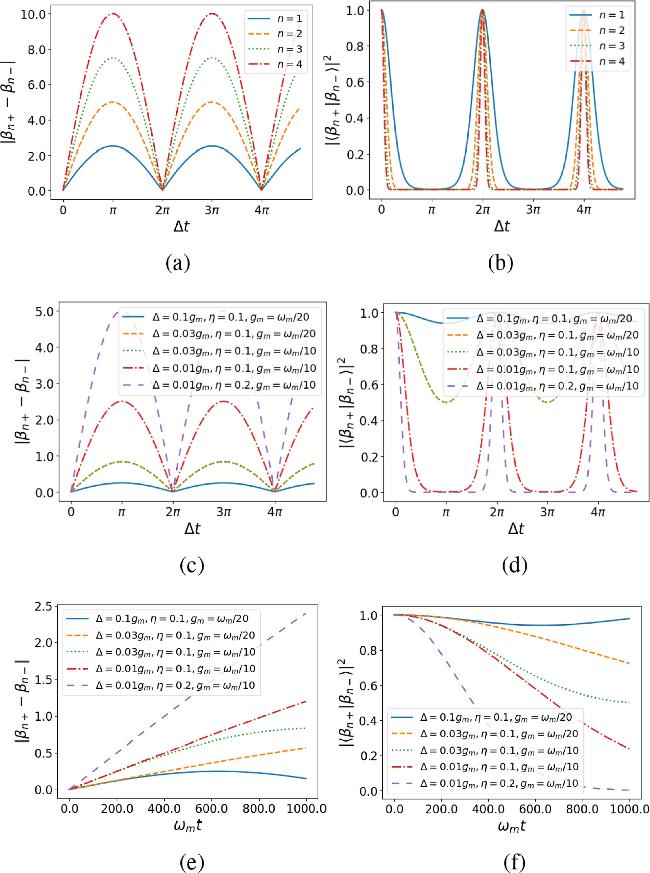
Figure 2. Dynamics of mechanical cat-state formation. The quality of the cat state is assessed by the separation ∣βn+ − βn−∣ and the orthogonality ∣⟨βn+∣βn−⟩∣2 of its two coherent components. (a) ∣βn+ − βn−∣ versus scaled time Δt for different initial photon numbers n. We have taken Δ = 0.01gm, η = 0.1, gm = ωm/20 for both (a) and (b). Larger n yields greater separation. (b) Corresponding orthogonality ∣⟨βn+∣βn−⟩∣2. Larger n leads to longer periods of near-zero orthogonality (better cat state). (c, d) Parameter dependence for fixed n = 1. Smaller modulation frequency Δ and larger atom-field coupling η enhance both the separation (c) and orthogonality (d), while gm has a minor effect. (e, f) Short-time evolution (ωmt < 1000) for n = 1. A distinguishable cat state (orthogonality 0) forms on this time scale only when η ≳ 0.2 (f), correlating with a significant separation (e). |
To explore the effects of other parameters, we fix n = 1. Figures 2(c) and (d) present the evolution of ∣βn+ − βn−∣ and ∣⟨βn+∣βn−⟩∣2 with Δt under different parameter combinations, respectively. The results show that the modulation frequency Δ plays the most critical role: a smaller Δ (e.g., decreasing from 0.1gm to 0.01gm) leads to a larger amplitude difference and better orthogonality (i.e., a lower minimum value of ∣⟨βn+∣βn−⟩∣2). The influence of the optomechanical coupling strength gm is relatively weak (comparing curves for gm = ωm/20 and ωm/10), while increasing the atom-field coupling coefficient η (e.g., from 0.1 to 0.2) effectively enhances the distinguishability and orthogonality of the two components.
Since the above evolution corresponds to a long physical time scale in terms of Δt (Δt = π corresponds to ωmt ≈ 3000), we further plot the short-time-scale dynamics to clearly demonstrate the formation process of the cat state. Figures 2(e) and (f) show the evolution of ∣βn+ − βn−∣ and ∣⟨βn+∣βn−⟩∣2, respectively, within ωmt < 1000 for n = 1. Figure 2(e) shows that ∣βn+ − βn−∣ can reach 1 in a shorter time (ωmt ∼ 100) only when η≥0.2. From figure 2(f), it is also evident that on the time scale of ωmt ∼ 100, the orthogonality approaches 0 only when the atom-field coupling coefficient satisfies η ≥ 0.2 (purple dashed curve in the figure), indicating the formation of a high-quality cat state. This reveals that under a small initial photon number (such as n = 1), preparing a distinguishable cat state within a relatively ‘short' time requires stronger atom-field coupling.
In summary, under the U = 0 mechanism, the initial photon number n in the cavity field is the primary factor determining the scale and stability of the cat state. Therefore, increasing the initial photon number is an effective strategy for rapidly preparing macroscopically distinguishable cat states in mechanical oscillators. For smaller n (such as n = 0, 1), preparing a macroscopic cat state requires a longer evolution time and imposes higher demands on the atom-field coupling strength η.
4. Accelerated generation via the Rabi-Stark mechanism
When U ≠ 0, however, the dynamics differ significantly. In the following, we demonstrate through numerical analysis that the quantum Rabi-Stark model can substantially enhance both ∣βn+ − βn−∣ and the quantum coherence of the cat states even for smaller n and η, thereby enabling the rapid generation of macroscopic quantum cat states in the mechanical oscillator.
For our numerical simulations using QuTiP, ρ(t) can be numerically determined by solving the quantum master equation. The master equation of the system in the Markov approximation can be written as 18 ) under the initial condition, the time evolution of the density matrix can be obtained.
$\begin{eqnarray}\begin{array}{rcl}\dot{\rho } & = & -{\rm{i}}[H,\rho ]+{{\rm{\Gamma }}}_{{\rm{a}}}D({\sigma }_{-})\rho +\kappa D(a)\rho \\ & & +{{\rm{\Gamma }}}_{{\rm{m}}}(1+{n}_{{\rm{th}}})D(b)\rho +{{\rm{\Gamma }}}_{{\rm{m}}}{n}_{{\rm{th}}}D({b}^{\dagger })\rho ,\end{array}\end{eqnarray}$
where κ, Γa and Γm are the cavity, atom, and mechanical damping rates, respectively, and nth is the thermal phonon occupation number. ${\sigma }_{-}=\left|g\right\rangle \left\langle e\right|$ is the atomic annihilation operator. D[o]ρ = oρo† − (o†oρ + ρo†o)/2 (o is a normal annihilation operator) is the standard Lindblad dissipative super-operator for damping the cavity, atom and mechanical modes. By numerically solving the master equation in equation (The generation of quantum cat states in the mechanical oscillator is verified through the measured Wigner function Wme, defined as
$\begin{eqnarray}{W}_{{\rm{me}}}(\alpha ,t)=\frac{2}{\pi }{\rm{Tr}}\left[{{\rm{D}}}^{\dagger }(\alpha ){\rho }_{{\rm{ni}}}^{{\rm{me}}}({\rm{t}}){\rm{D}}(\alpha ){(-1)}^{{{\rm{b}}}^{\dagger }{\rm{b}}}\right],\end{eqnarray}$
where $D(\alpha )={\rm{\exp }}\left(\alpha {{\rm{b}}}^{\dagger }-{\alpha }^{* }{\rm{b}}\right)$ is the displacement operator, and α is the complex displacement amplitude. The non-classicality of the measured Wigner function can be quantitatively described by Wigner negativity ([52]), defined as $\begin{eqnarray}\left\langle \delta \right\rangle \equiv \int \left|{W}_{{\rm{me}}}(\alpha ,t)\right|{{\rm{d}}}^{2}\alpha -1.\end{eqnarray}$
As demonstrated in [52], $\left\langle \delta \right\rangle $ exhibits oscillatory behavior with a frequency that increases with momentum. When the growth of non-classicality saturates at a distinct wave-packets separation distance, where the interference patterns become fully distinct from both peaks, the parameter δ approaches its limiting value of ${\left\langle \delta \right\rangle }_{{\rm{\max }}}\approx 0.636$.
To demonstrate the advantage of the quantum Rabi-Stark model (U ≠ 0) for the rapid generation of cat states, we focus our numerical analysis on short-time-scale dynamics. In contrast to the case of U = 0, where a distinguishable cat state forms only after a long evolution time (e.g., ωmt ∼ 1000 for n = 1, as shown in figures 2(e, f)), our results for U ≠ 0 reveal that a macroscopic superposition with significant size emerges within a much shorter time (typically ${\omega }_{{\rm{m}}}t\sim { \mathcal O }(10)$). This dramatic reduction in the preparation time highlights the practical efficiency of the proposed protocol, as it enables the generation of non-classical states well within the typical coherence window of modern optomechanical systems.
The preparation of quantum cat states is first analyzed in the absence of dissipation (i.e., all decoherence rates are set to zero). The system is initialized with the cavity field in either a vacuum state $\left|n=0\right\rangle $ or a single-photon Fock state $\left|n=1\right\rangle $, and the frequencies are scaled as ωa = ωc = ωm = 1. The dependence of the resulting negativity oscillations on the nonlinear coupling U and the optomechanical coupling gm is systematically examined, as shown in figures 3 and 4, respectively. In these simulations, the measured photon-atom state is projected onto $\left|1,g\right\rangle $ for the n = 0 case, or onto $\left|2,g\right\rangle $ for the n = 1 case. Figures 3(a) and (b) demonstrates that when U = 0, $\left\langle \delta \right\rangle $ exhibits periodic oscillations for both n = 0 and n = 1, failing to reach a stable maximum value in a short time. This indicates the absence of optimal cat state generation. In contrast, figures 3(c)–(f) reveals that the measured negativity exhibits periodic oscillations and ultimately tend towards a maximum value in shorter time, which is precisely the characteristic of cat like behavior. Also, the oscillation frequency of $\left\langle \delta \right\rangle $ scales with n (higher n values correspond to higher oscillation frequencies). Comparing figures 3(c) with (e), or (d) with (f), reveals that larger values of U result in higher oscillation frequencies and an earlier attainment of the maximum in the ⟨δ⟩ curves.
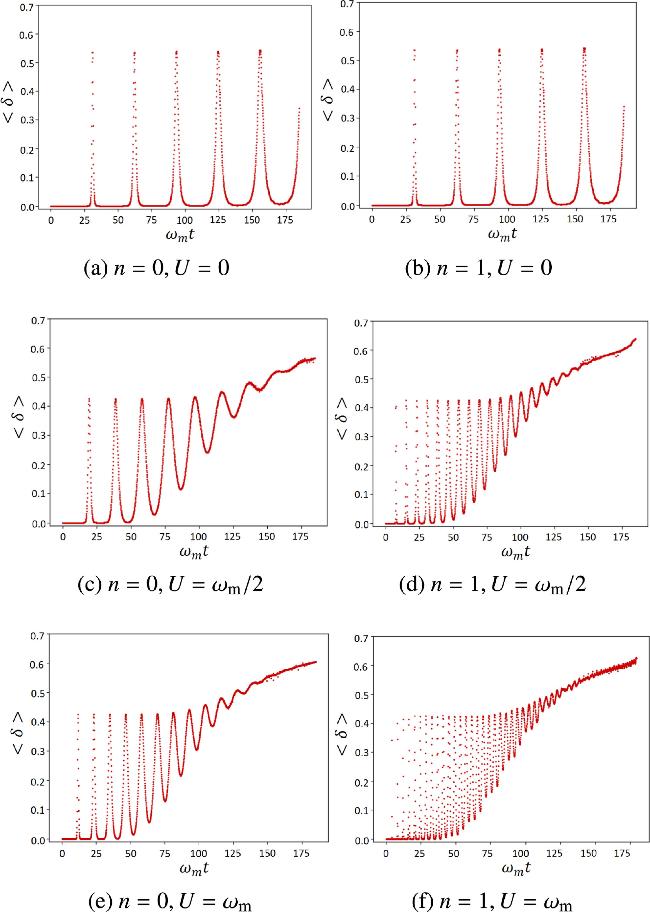
Figure 3. Plots of the negativity of the measured Wigner function of the mechanical oscillator, for different initial cavity Fock states $\left|n\right\rangle $ and atom-cavity nonlinear coupling strengths U. The left column correspond to the cases where the initial Fock state of the cavity field is $\left|0\right\rangle $ and the measurement result is $\left|1,g\right\rangle $. The column on the right correspond to the cases where the initial Fock state of the cavity field is $\left|1\right\rangle $ and the measurement result is $\left|2,g\right\rangle $. Here, we have taken gm = ωm/20, η = 0.1, Δ = 0.01gm. |
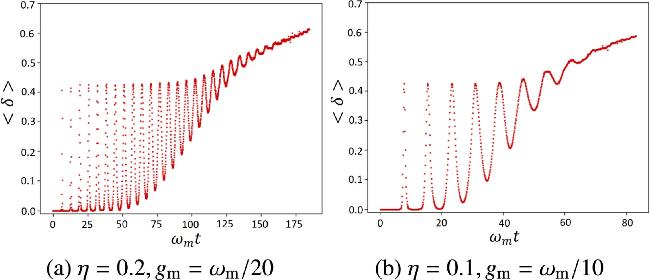
Figure 4. Negativity of the Wigner function for the mechanical oscillator under varying atom-cavity coupling strength η and optomechanical coupling strength gm. Parameters: U = ωm/2, initial cavity state $\left|n=1\right\rangle $, and measurement outcome $\left|2,g\right\rangle $. The left panel is for η = 0.2 (atom-cavity Rabi coupling) with gm = ωm/20. The right panel is for η = 0.1 (atom-cavity Rabi coupling) with gm = ωm/10. And detuning Δ = 0.01gm. |
Figure 4 presents results under two parameter sets: η = 0.2, gm = ωm/20 (left curve), and η = 0.1, gm = ωm/10 (right curve), with U fixed at U = ωm/2 in both cases. The data show that the time required to reach the maximum value is inversely proportional to gm—stronger coupling accelerates state generation—and positively correlated with η—higher η increases the oscillation frequency.
More notably, under strong atom-field coupling conditions, the nonlinear coupling term U exerts a stronger control over the cat-state formation time than the linear term η. Furthermore, increasing the optomechanical coupling strength significantly reduces the time needed to generate the cat state. These observations quantitatively demonstrate the distinct roles of coupling strength and nonlinearity in controlling quantum cat-state dynamics, offering clear guidance for engineering non-classical states through parameter optimization.
Now we take a selection of verification moments to give a quantitative verification of the generation of quantum cat states. As indicated in [52], when the wave-packet separation reaches a certain degree and the interference fringes are fully distinct from the two main peaks, the negativity approaches its limiting value. Therefore, we selected the moments immediately after the negativity first reaches its stable maximum in figures 3(c) and (d), and figure 4(b) to plot the corresponding Wigner functions of the mechanical oscillator.
Figure 5 presents the corresponding 3D and contour plots of the Wigner functions at these time points, along with the probability distributions for the quadratures X and Y. The quadrature operators are defined as $X=(b+{b}^{\dagger })\sqrt{2}$ for amplitude quadrature and $Y=(b-{b}^{\dagger })/(\sqrt{2}{\rm{i}})$ for phase quadrature. Notably, the appearance of two distinct peaks in the X quadrature, and the interference fringes between two wave packets arise from their superposition, exhibiting alternating bright (constructive interference) and dark (destructive interference) patterns due to phase differences, strongly suggests the formation of a cat state. To rigorously prove from numerical results that these states are cat states, we compared them with ideal even/odd cat states and calculated the fidelities $F={\rm{Tr}}({\rho }_{{\rm{ni}}}^{{\rm{me}}}\left|\phi \right\rangle \left\langle \phi \right|)$, where $\left|\phi \right\rangle $ denotes an ideal cat state. The results demonstrate that high-quality cat states are successfully generated after the negativity stabilizes. The relevant fidelities and ideal cat state expressions are as follows.
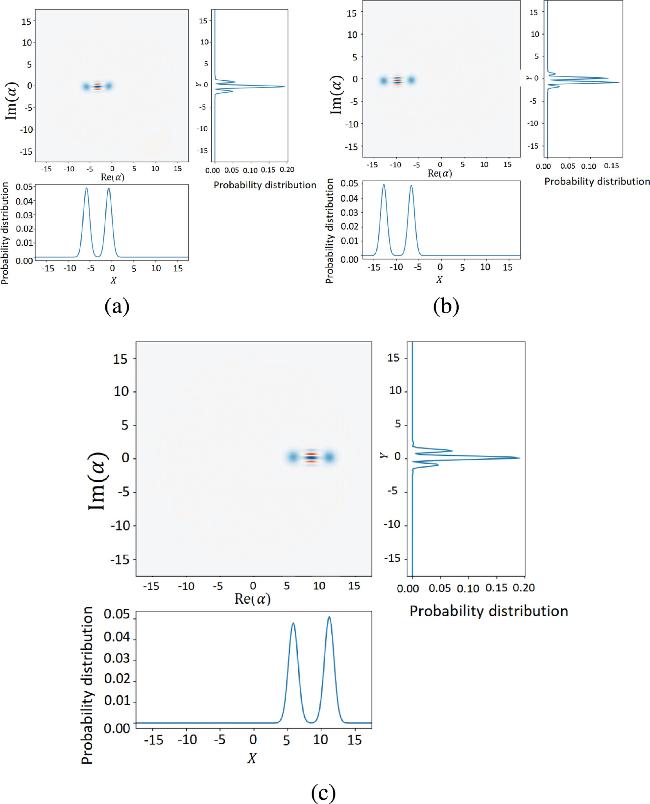
Figure 5. Wigner functions and quantitative verification of the generated mechanical cat states. (a)- (c) show the Wigner functions (3D surface and contour plots) and the corresponding quadrature probability distributions ($X=(b+{b}^{\dagger })\sqrt{2}$, $Y=(b-{b}^{\dagger })/(\sqrt{2}{\rm{i}})$) for the mechanical oscillator, with the initial state of cavity being $\left|n=0\right\rangle $ for (a) and $\left|n=1\right\rangle $ for (b)-(c), The measured times correspond to the the first instance the negativity reaches its stable maximum in figures 3(c), (d) and 4(b), respectively. All states exhibit the definitive hallmarks of a Schrödinger cat state: two well-separated peaks in phase space and characteristic interference fringes between them. Parameters: η = 0.1, U/ωm = 0.5, Δ = 0.01gm, and (a) gm = ωm/20, measured in $\left|1,g\right\rangle $ at time ωmt ≈ 58.5π; (b) gm = ωm/20, measured in $\left|2,g\right\rangle $ at time ωmt ≈ 58.5π; (c)gm = ωm/10, measured in $\left|2,g\right\rangle $ at time ωmt ≈ 25.5π. |
Figure 5(a) has a fidelity of 99.4% with the ideal even cat state $\left|{\phi }_{{\rm{a}}}\right\rangle =\left|{\beta }_{{\rm{1a}}}\right\rangle +\left|{\beta }_{{\rm{2a}}}\right\rangle $, where β1a = −4.12e0.066i, β2a = −0.48e−0.066i. The corresponding Wigner negativity is 0.551. Figure 5(b) has a fidelity of 96.8% with an ideal odd cat state $\left|{\phi }_{{\rm{b}}}\right\rangle =\left|{\beta }_{{\rm{1b}}}\right\rangle -\left|{\beta }_{{\rm{2b}}}\right\rangle $, where β1b = −4.73e−0.019i, β2b = −9.07e0.019i, and a negativity of 0.633. Figure 5(c) has a fidelity of 98.7% with an ideal even cat state $\left|{\phi }_{c}\right\rangle =\left|{\beta }_{{\rm{1c}}}\right\rangle +\left|{\beta }_{{\rm{2c}}}\right\rangle $ where β1c = 4.12e−0.009i, β2c = 7.91e0.009i, and a negativity of 0.577. These high fidelities quantitatively prove that the generated states are essentially identical to the target superposition.
A negligible overlap (i.e., $\left|{\beta }_{{\rm{1i}}}-{\beta }_{{\rm{2i}}}\right|\gg 1$ (i = a, b, c) signifies macroscopic distinguishability. The values of $\left|{\beta }_{{\rm{1a}}}-{\beta }_{{\rm{2a}}}\right|\approx 3.64$, $\left|{\beta }_{{\rm{1b}}}-{\beta }_{{\rm{2b}}}\right|\approx 4.34$ and $\left|{\beta }_{{\rm{1c}}}-{\beta }_{{\rm{2c}}}\right|\approx 3.79$ are all much greater than 1. The non-classicality is independently verified by the significant Wigner negativity of the state. The obtained values (δ ∼ 0.55 − 0.63) are close to the theoretical maximum for cat states, providing direct evidence of a strongly non-Gaussian quantum superposition. Therefore, the cat-state condition is rigorously established by the simultaneous fulfillment of a large phase-space separation ($\left|{\beta }_{{\rm{1i}}}-{\beta }_{{\rm{2i}}}\right|\gg 1$) and a high-fidelity, negative Wigner function that matches an ideal cat state. Furthermore, for the same of gm = ωm/10, the cat state in figure 5(c) forms at an earlier time ($t\approx 25.5\pi {\omega }_{{\rm{m}}}^{-1}$) than that in figure 5(b) ($t\approx 58.5\pi {\omega }_{{\rm{m}}}^{-1}$).
The nonlinear Stark coupling coefficient U decisively accelerates the generation of the mechanical cat state. Physically, an increased U enhances the effective optomechanical coupling asymmetry between the system's dressed states, which in turn amplifies the coherent displacement amplitudes of the mechanical oscillator [28]. This amplification directly leads to a faster growth of the phase-space separation X between the two coherent components. According to Kenfack and Życzkowski [52], the Wigner negativity saturates at a maximum value δmax ≈ 0.636 once the separation enters the well-distinguished regime X > 4. Thus, a larger U does not alter the saturated value of negativity, but rather shortens the time required to reach the saturation regime by accelerating the dynamical separation process. This explains the observed rapid evolution of the Wigner negativity: the enhanced nonlinear coupling drives the oscillator more swiftly into a macroscopic quantum superposition, enabling the negativity to attain its maximum in a significantly reduced preparation time.
5. Robustness against dissipation
To evaluate the robustness and experimental observability of the generated cat states, we investigate the impact of realistic dissipation on the Wigner negativity—a direct witness of non-classicality. In the ideal lossless case, the negativity undergoes persistent oscillations, eventually stabilizing around a maximum value of approximately 0.636, which corresponds to a well-defined macroscopic cat state. Here, we assumed the cavity is coupled to a zero-temperature optical bath with loss rate κ, while the mechanical resonator is in contact with an environment at temperature T corresponding to mean occupation ${n}_{{\rm{th}}}=1/({{\rm{e}}}^{\hslash {\omega }_{{\rm{m}}}/{k}_{{\rm{B}}}T}-1)$, with loss rate Γm.
Figure 6 displays the time evolution of $\left\langle \delta \right\rangle $ under four distinct dissipation regimes. In the regime of weak mechanical damping (Γm = 10−6ωm) with moderate cavity loss and thermal noise (figure 6(a)), the negativity saturates at a steady-state value of $\left\langle \delta \right\rangle \approx 0.5$. Although reduced from the ideal maximal value of 0.636, this persistent, significant negativity unambiguously confirms the stabilization of a non-classical cat state. The direct phase-space signature of this state is verified by the Wigner function at a representative time such as ωmt = 46.5π (see figure 7), which shows two distinct lobes and a negative interference pattern. Its structure is characterized by the target cat state $\left|\phi \right\rangle ={ \mathcal N }(2\left|{\beta }_{1}\right\rangle -\left|{\beta }_{2}\right\rangle )$, where β1 = − 3.8e−0.01i and β2 = − 7.2e0.01i, yielding a phase-space separation of ∣β1 − β2∣ ≈ 3.4, which fulfills the criterion for a macroscopically distinguishable superposition. The calculated fidelity between the dissipatively stabilized state and the target cat state $\left|\phi \right\rangle $ exceeds 99%. When the mechanical damping is increased to Γm = 10−4ωm (figure 6(b)), the steady-state negativity drops further to $\left\langle \delta \right\rangle \approx 0.35$, indicating a greater loss of coherence, yet the state retains its essential cat-state character. In contrast, stronger dissipation leads to the complete decay of non-classicality: increasing the cavity decay rate to κ = 0.05ωm (Figure 6(c)) or raising the thermal occupation to nth = 100 (figure 6(d)) results in the negativity decaying to zero, demonstrating that excessive optical loss or thermal noise can fully suppress the cat state. These results delineate the practical requirements for observing the mechanical cat state: while the protocol exhibits inherent robustness against weak dissipation, successful experimental realization necessitates a high-finesse cavity (low κ), a high-quality mechanical oscillator (low Γm), and cryogenic operation (low nth) to preserve quantum coherence.
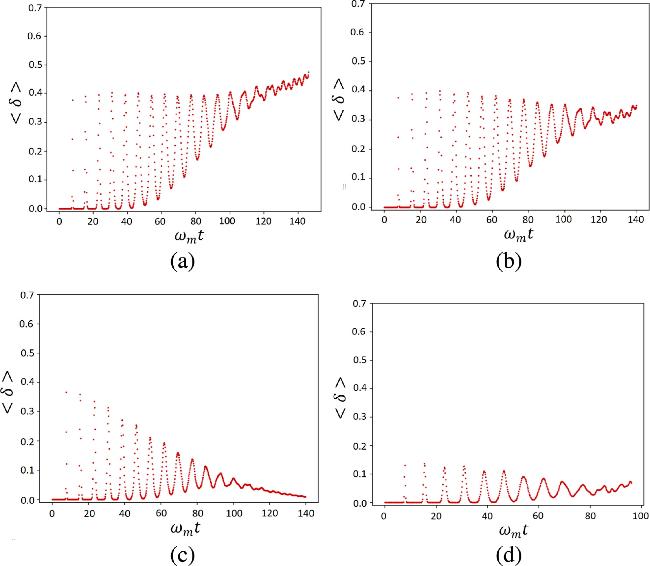
Figure 6. Robustness of the cat state against different dissipation channels. Time evolution of the Wigner negativity $\left\langle \delta \right\rangle $ under realistic dissipation for system parameters Δ = 0.01gm, η = 0.1, gm = ωm/20, n = 1. (a) With weak mechanical damping (Γm = 10−6ωm, κ = 0.01ωm, nth = 10), the negativity saturates at a steady-state value of $\left\langle \delta \right\rangle \approx 0.5$, confirming the persistence of a cat state. (b) For stronger mechanical damping (Γm = 10−4ωm, other parameters as in (a)), the negativity reaches a lower steady-state value of $\left\langle \delta \right\rangle \approx 0.35$, indicating increased decoherence but survival of the non-classical superposition. (c) Enhanced cavity loss (κ = 0.05ωm, with Γm and nth as in (b)) leads to the decay of negativity to zero. (d) Elevated thermal noise (nth = 100, with κ and Γm as in (b)) also destroys the cat state, driving the negativity to zero. |
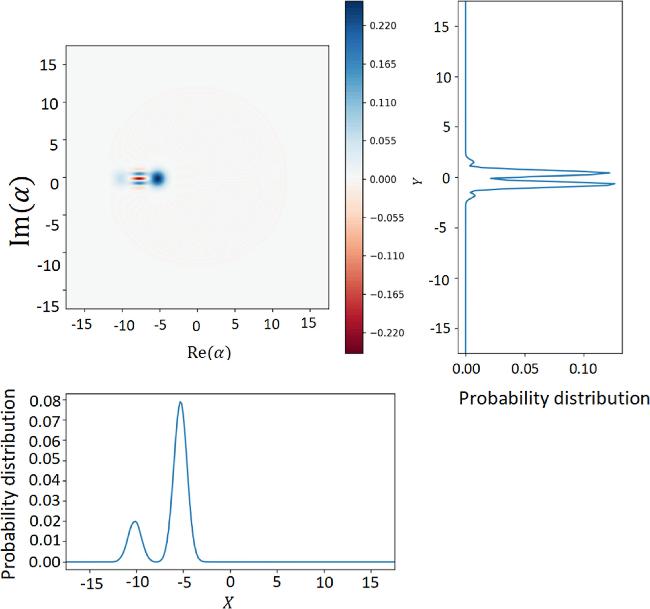


Figure 7. Phase-space characterization of the cat state under weak dissipation. The Wigner function W(α) is plotted at time ωmt = 46.5π for the same dissipative parameters as in figure 6(a) (κ = 0.01ωm, Γm = 10−6ωm, nth = 10). The presence of two separated lobes and a central interference pattern with negative values (blue region) unequivocally identifies the mechanical state as a quantum superposition (cat state). The fidelity of this state with the target cat state exceeds 99% (see text for details), demonstrating that high-purity cat states can be stabilized under realistic experimental conditions. |
6. Results and conclusions
We have theoretically demonstrated the generation of quantum cat states in a hybrid atom-optomechanical system, proposing three essential protocols: (1) atom-cavity ultrastrong coupling, (2) initializing the cavity field in a quantum Fock state, and (3) implementing periodic modulation of the optomechanical coupling. The system dynamics are governed by radiation-pressure-induced photon-phonon coupling, where the mechanical mirror's motion alters the cavity field distribution, thereby modifying the atom-field interaction as described by a generalized Rabi model. This interplay creates three-mode entanglement among the atom, optical field, and mechanical mirror. The macroscopic mechanical cat state is then directly generated via a projective measurement on the atom-cavity subsystem, establishing a deterministic link from preparation to the final quantum superposition. The non-classical nature of the mechanical cat states is rigorously verified through Wigner function analysis and its negativity measure.
The results consistently demonstrate that the distinguishability between the two coherent states forming the cat state is significantly influenced by multiple parameters. A higher initial photon number n leads to both larger amplitude values of the constituent coherent states and greater amplitude differences between them. The parameter Δ exhibits an inverse relationship with distinguishability, where smaller Δ values result in more pronounced separation between the coherent states. Additionally, the atom-field coupling parameters η and the initial photon number n play a crucial role, with their enhancement directly improving the observability of the amplitude difference between the coherent states. Especially, the nonlinear atom-field coupling term U and the optomechanical coupling coefficient gm can control the generation time of cat states—larger U or gm values lead to shorter preparation times. Crucially, the analysis incorporating optical and mechanical dissipation (κ, Γm) and finite temperature (nth) confirms the scheme's robustness in a realistic setting. While decoherence reduces the peak negativity of the cat state, its generation remains effective within a short time window, demonstrating that the state can be prepared well before significant coherence loss occurs (figures 3(d) and 6(a)). This establishes the feasibility of the proposed parameter control under practical experimental conditions.
The intrinsic nonlinearity induced by atom-cavity ultrastrong coupling, coupled with modulated optomechanical interaction and Fock-state initialization (as opposed to conventional vacuum-state initialization), enables the programmable engineering of the system dynamics. This approach not only facilitates faster state generation and enhances coherence visibility, but also provides a direct, parameter-driven method for quantum state engineering. By integrating a single atom as a deterministic nonlinear source within a cavity-optomechanical setup, our scheme avoids the complexity and collective decoherence of many-body systems. Consequently, it offers a complementary paradigm in terms of nonlinear origin, system scale, and operational simplicity, presenting a fresh perspective and a new framework for engineering programmable macroscopic quantum superpositions in hybrid quantum systems.
Previous studies in [28] have demonstrated the preparation of macroscopic cat states in mechanical oscillators using similar models. However, this study was limited to analyzing scenarios where the initial optical field state was a vacuum state. Additionally, the measurement time for generating cat states was set at Δt = π with Δ = 0.0015ωm, resulting in a measurement time of $t=2093{\omega }_{{\rm{m}}}^{-1}$. In contrast, the measurement time in the present study is significantly shorter, approximately $t=170{\omega }_{{\rm{m}}}^{-1}$, and the framework allows for cases where n ≠ 0, enabling even shorter measurement times.
In summary, this work establishes a parameter-controlled coherence engineering scheme for generating macroscopic mechanical cat states. This paradigm is conceptually distinct from established measurement-based coherence control approaches, such as those utilizing semiclassical predictions [53], harnessing measurement-induced nonlinearities in multimode systems [54], or relying on photon detection for state heralding [55, 56]. While these methods treat measurement as an active, in-loop resource essential for conditional preparation or real-time feedback, our protocol operates on a fundamentally different principle. The coherence and macroscopic properties of the target mechanical state are pre-determined through the precise setting of the Rabi-Stark Hamiltonian parameters and the modulated optomechanical coupling. The final projective measurement acts solely as a deterministic trigger to herald the cat state after its pre-programmed unitary evolution, not as a continuous control input. Consequently, our scheme shifts the engineering focus from overcoming challenges inherent to real-time measurement and feedback [57, 58] to the precise design and optimization of the system Hamiltonian. It thereby offers a complementary route for quantum state engineering that prioritizes direct programmability, deterministic output upon success, and simplified experimental overhead.