

1. Introduction
The thermodynamics of black holes in asymptotically anti-de Sitter (AdS) spacetime holds a unique position within the study of quantum gravity, as it interlaces principles from gravitation, thermodynamics, and quantum mechanics. A notable example is the AdS/conformal field theories (CFT) correspondence, a powerful framework that enables the study of gravitational systems via dual quantum field theories. Within this framework, the Hawking–Page phase transition—a first-order transition between radiation and black hole states in Schwarzschild-AdS black holes immersed in a thermal bath [1]—finds a dual interpretation. This transition corresponds to the confinement/deconfinement phase transition in a quark-gluon plasma within the boundary quantum field theory [2]. Such insights from AdS/CFT have significantly expanded our understanding of quantum gravity and provide an avenue to address the black hole information paradox. Furthermore, the negative cosmological constant characterizing the AdS spacetime gives rise to complex phase structures, a field now known as black hole chemistry [3–6]. These ideas later extended to study the thermodynamic topology of black holes in AdS spacetimes [7–12]. Through this framework, the holographic duality extends from black holes to CFT [13, 14], to phenomena in quantum chromodynamics [15], and even to condensed matter systems, particularly those with strong coupling [16, 17]. The extended phase space thermodynamic has been analogously extended to study topology of AdS black holes for their CFT counterparts [18–21]. The kinetics and dynamics of Hawking–Page and other similar phase transition behaviors are also explored in the generalized free energy landscape taking into account the contribution from the off-shell Gibbs free energy [22–26].
When a black hole is treated as a thermal system, drawing analogies with conventional thermodynamics in any diffeomorphism-invariant gravity theory is straightforward. However, the microscopic description of the black hole event horizon, and the related phase transition behavior is formidable. Despite extensive progress in black hole thermodynamics, the statistical foundation of these phase transitions remains elusive. Although the thermal properties of black holes in classical geometry are well understood, developing a full statistical framework is ongoing. The Euclidean path integral method, with a partition function approach, presents a promising avenue [27–38]. Yet, integrating quantum gravity effects within this framework remains a complex task. In the path integral formulation of gravity, the saddle point approximation identifies action extrema, corresponding to the global minimum of the on-shell Euclidean action. While on-shell geometries provide insights into classical black hole thermodynamics, off-shell geometries must be considered to fully capture the subtleties of black hole phase transitions. Recent work has explored the ensemble-averaged description of black hole thermodynamics by including non-classical contributions to the path integral [39–41]. Inclusion of non-saddle contributions to the partition function results modified expression for the free energy and one does not observe a sharp phase transition point. In this construction, the black hole phase transition is interpreted as the small GN limit of ensemble averaged theory.
In this paper, we investigate the thermodynamics of Einstein–Gauss–Bonnet (EGB)-AdS black holes beyond the classical limit by applying the ensemble-averaged theory. EGB theory is the natural extension of general relativity with higher-curvature contributions [42]. Also, it presents a rich thermodynamic structure [43, 44]. Notably, the thermodynamic behavior of five-dimensional EGB black holes resembles that of Reissner–Nordström-AdS (RN-AdS) black holes, while six-dimensional EGB black holes share similarities with Schwarzschild-AdS black holes. However, these correspondences have been explored only within the classical limit. Here, we extend this analysis to examine whether these thermodynamic parallels persist beyond the classical framework.
The paper is organized as follows. In section 2 , we examine the classical thermodynamics of black holes in a generic D-dimensional EGB-AdS spacetime. Section 3 extends this analysis using the ensemble-averaged theory, evaluating the gravitational partition function by including non-saddle geometries, in contrast to the usual approach that relies on the saddle-point approximation. We present numerical results for the ensemble-averaged free energy of five- and six-dimensional EGB-AdS black holes for various values of GN. In section 4 , we expand the free energy in powers of GN and identify the quantum corrections at subleading and sub-subleading orders. Finally, in section 5 , we discuss our findings and conclude.
2. Thermodynamics of EGB-AdS black holes in D dimensions
We start with a brief overview of the charged AdS black holes in Gauss–Bonnet gravity theory. In this theory, we have the EGB action in the presence of a negative cosmological constant and Maxwell's electrodynamic field.
$\begin{eqnarray}\begin{array}{rcl}S & = & \frac{1}{16\pi {G}_{{\rm{N}}}}\displaystyle \int {{\rm{d}}}^{D}x\sqrt{-g}\left[R+\frac{(D-1)(D-2)}{{L}^{2}}\right.\\ & & +\left.\alpha ({R}_{\mu \nu \alpha \beta }{R}^{\mu \nu \alpha \beta }-4{R}_{\mu \nu }{R}^{\mu \nu }+{R}^{2})+{ \mathcal L }(F)\Space{0ex}{3ex}{0ex}\right],\end{array}\end{eqnarray}$
where L is the AdS radius, α (≥0) is the Gauss–Bonnet coupling constant, ${ \mathcal L }(F)=-{F}^{\mu \nu }{F}_{\mu \nu }$ is the Maxwell Lagrangian, with Fμν = 2∇[μAν]. The spacetime metric for D-dimensional, asymptotically AdS, EGB gravity in the presence of an electromagnetic gauge field is given by, $\begin{eqnarray}{{\rm{d}}{s}}^{2}=-f(r){{\rm{d}}{t}}^{2}+\frac{1}{f(r)}{{\rm{d}}{r}}^{2}+{r}^{2}{\rm{d}}{{\rm{\Omega }}}_{D-2}^{2},\end{eqnarray}$
where ${\rm{d}}{{\rm{\Omega }}}_{D-2}^{2}$ is the metric of a (D − 2) dimensional sphere of unit radius. The metric function f(r) for the black hole solution is given by [43], $\begin{eqnarray}\begin{array}{r}f(r)=1+\frac{{r}^{2}}{2\tilde{\alpha }}\left[1-\sqrt{1+4\tilde{\alpha }\left(\frac{m}{{r}^{D-1}}-\frac{{q}^{2}}{{r}^{2D-4}}-\frac{1}{{L}^{2}}\right)}\right]\end{array},\end{eqnarray}$
where $\tilde{\alpha }=(D-3)(D-4)\alpha $. The parameters m, q are related to the mass (M) and charge (Q) of the hole by the following relations: $\begin{eqnarray*}\begin{array}{r}M=\frac{(D-2){{\rm{\Omega }}}_{D-2}}{16\pi {G}_{{\rm{N}}}}\,m,\ Q=\sqrt{2(D-2)(D-3)}\ q.\end{array}\end{eqnarray*}$
One can express the basic thermodynamic quantities associated with the black hole in terms of its event horizon (rH) which is defined by f(rH) = 0. Accordingly, the mass, temperature, and the entropy of the black hole are given, respectively, as,
$\begin{eqnarray}M=\frac{(D-2){{\rm{\Omega }}}_{D-2}}{16\pi {G}_{{\rm{N}}}}\left[\frac{{r}_{{\rm{H}}}^{D-1}}{{L}^{2}}+{r}_{{\rm{H}}}^{D-3}+\tilde{\alpha }{{r}_{{\rm{H}}}}^{D-5}+\frac{{q}^{2}}{{{r}_{{\rm{H}}}}^{D-3}}\right],\end{eqnarray}$
$\begin{eqnarray}\begin{array}{rcl}{T}_{{\rm{H}}} & = & \frac{1}{4\pi {r}_{{\rm{H}}}({{r}_{{\rm{H}}}}^{2}+2\tilde{\alpha })}\left[(D-3){{r}_{{\rm{H}}}}^{2}+\frac{D-1}{{L}^{2}}{{r}_{{\rm{H}}}}^{4}\right.\\ & & \left.+(D-5)\tilde{\alpha }-\frac{(D-3)}{{{r}_{{\rm{H}}}}^{2(D-4)}}{q}^{2}\right],\end{array}\end{eqnarray}$
$\begin{eqnarray}S=\frac{1}{4{G}_{{\rm{N}}}}{{\rm{\Omega }}}_{D-2}{{r}_{{\rm{H}}}}^{D-2}\left(1+\frac{2\tilde{\alpha }(D-2)}{(D-4)}\frac{1}{{{r}_{{\rm{H}}}}^{2}}\right).\end{eqnarray}$
In the canonical ensemble description of black hole thermodynamics, the black hole is considered in contact with a thermal bath at a fixed temperature T (corresponding to the boundary). To examine the phase-switching dynamics of the black hole due to thermal fluctuations, one can use the free energy landscape approach. In this framework, the state of the black hole is defined by taking the horizon radius as the system's order parameter. Each state is referred to as a fluctuating black hole, and phase transition occurs between two stable black hole states through a series of unstable fluctuating black hole states. The Hawking–Gibbons path integral method for quantum gravity offers an elegant way to derive the thermodynamic free energy of fluctuating black holes also called generalized free energy. In this approach, the partition function in the canonical ensemble theory of gravity is obtained by integrating the Euclidean action (IE[g]) over all geometries, i.e.
$\begin{eqnarray}{Z}_{\mathrm{grav}}(\beta )=\int [{ \mathcal D }g]\,{{\rm{e}}}^{-{I}_{{\rm{E}}[g]}},\end{eqnarray}$
where β = 1/T is the period of Euclidean time. The Euclidean action for EGB gravity theory can be obtained as [23], $\begin{eqnarray}\begin{array}{rcl}{I}_{{\rm{E}}} & = & \frac{(D-2){{\rm{\Omega }}}_{D-2}\beta }{16\pi {G}_{{\rm{N}}}}\left[{r}_{{\rm{h}}}^{D-3}+\frac{{r}_{{\rm{h}}}^{D-1}}{{L}^{2}}+\tilde{\alpha }{r}_{{\rm{h}}}^{D-5}+\frac{{q}^{2}}{{r}_{{\rm{h}}}^{D-3}}\right]\\ & & -\frac{1}{4{G}_{{\rm{N}}}}{{\rm{\Omega }}}_{D-2}{r}_{{\rm{h}}}^{D-2}\left(1+\frac{2\tilde{\alpha }(D-2)}{(D-4)}\frac{1}{{r}_{{\rm{h}}}^{2}}\right).\end{array}\end{eqnarray}$
We use rh to denote the horizon radius for generalized configurations in the bulk, and when rh = rH, the classical results can be recovered. In the standard free energy landscape description, one exploits the saddle-point approximation to obtain the gravitational partition function. This approximation is reasonable since the maximum contribution to the partition function comes from the classical geometry which describes the black hole. Once we have the partition function, it is straightforward to obtain the free energy from the relation $F=-T\mathrm{ln}{Z}_{\,\rm{grav}\,}$. For the case of EGB theory, the free energy for the fluctuating black holes is given by, 9 ) represents a collection of black hole states, each associated with a different horizon temperature. Thermodynamically stable black hole states correspond to the local extrema of the generalized free energy function. In other words, when the ensemble temperature is equal to the Hawking temperature the black hole state is in equilibrium with the thermal bath. The generalized free energy is used to construct the free energy landscape and various thermodynamic properties of EGB black holes can be obtained [23] (and the references therein). It is important to note that all these black hole states are derived solely from the classical geometry. To understand the non-classical contributions to black hole thermodynamics we use the ensemble-averaged theory as proposed in [40]. In the following section, we discuss the ensemble-average theory for five and six-dimensional EGB-AdS gravity theory.
$\begin{eqnarray}\begin{array}{rcl}F & = & \frac{(D-2){{\rm{\Omega }}}_{D-2}}{16\pi }\left[{r}_{{\rm{h}}}^{D-3}+\frac{{r}_{{\rm{h}}}^{D-1}}{{L}^{2}}+\tilde{\alpha }{r}_{{\rm{h}}}^{D-5}+\frac{{q}^{2}}{{r}_{{\rm{h}}}^{D-3}}\right.\\ & & -\left.\frac{4\pi T}{(D-2)}{r}_{{\rm{h}}}^{D-2}\left(1+\frac{2\tilde{\alpha }(D-2)}{(D-4)}\frac{1}{{r}_{{\rm{h}}}^{2}}\right)\right].\end{array}\end{eqnarray}$
The generalized free energy F, obtained in equation (3. Black hole thermodynamics and ensemble average theory
As discussed in the previous section, the gravitational path integral formulation of black hole thermodynamics is, so far, limited to contributions from classical saddle points. In other words, the free energy expression was derived directly from the classical Euclidean action without performing the full integration. Ideally, the gravitational partition function should involve integrating over all possible Euclidean geometries, weighted by the Euclidean action IE[g], as outlined in equation (7 ). Consequently, any physical quantity associated with the Lorentzian metric must be averaged across all ensembles. In this spirit, one can define the ensemble average of a physical quantity A[g] by,
$\begin{eqnarray}\left\langle A\right\rangle =\frac{\int A[g]\,{{\rm{e}}}^{-{I}_{{\rm{E}}[g]}}\,[{ \mathcal D }g]}{\int {{\rm{e}}}^{-{I}_{{\rm{E}}}[g]}\,[{ \mathcal D }g]}.\end{eqnarray}$
Here, the integration is over various geometries described by $[{ \mathcal D }g]$. In this context, ${{\rm{e}}}^{-{I}_{{\rm{E}}}[g]}$ can be interpreted as the probability of obtaining the value of A from the geometry gμν, with the partition function in the denominator serving as a normalization factor. Since we are interested in examining the nature of phase transitions in the theory of gravity, we focus on the ensemble average of the free energy. The key question that arises is: what variables should be considered when performing the integration? A natural choice will be to describe the geometry in terms of the canonical coordinate rh and its conjugate momentum ${\dot{r}}_{{\rm{h}}}$, as proposed by the black hole free energy landscape [23, 45, 46]. This construction is the same as in the standard statistical mechanical description. However, in the case of gravity theory, integrating over ${\dot{r}}_{{\rm{h}}}$ contributes a constant on both the numerator and the denominator, and therefore gets canceled. To this extent, the ensemble average of the free energy for the D-dimensional EGB-AdS gravity theory is given as, 8 ) and (9 ), respectively.
$\begin{eqnarray}\left\langle F\right\rangle =\frac{\int F({r}_{{\rm{h}}})\,{{\rm{e}}}^{-{I}_{{\rm{E}}}({r}_{{\rm{h}}})}\,{\rm{d}}{r}_{{\rm{h}}}}{\int {{\rm{e}}}^{-{I}_{{\rm{E}}}({r}_{{\rm{h}}})}\,{\rm{d}}{r}_{{\rm{h}}}},\end{eqnarray}$
where IE and F are given in equations (The above discussion can be understood from the statistical interpretation of the density of states and the Euclidean path integral. Imagine we have all allowed bulk black hole geometries described by the same Lorentz metric, with fixed boundary ensemble temperature. This is a physical setting for bulk geometries. When the black hole horizon temperature is different than the ensemble temperature, there would be conical singularities associated with the Euclidean counterparts, which are allowed in the bulk. The horizon radius rh is the natural label that labels different states in the phase space. And the weight of each state in the phase space can be calculated from the Euclidean action as 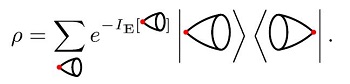 Then, the partition function can be expressed as
$\begin{eqnarray}Z={\rm{tr}}\,\rho .\end{eqnarray}$
So, with the given density of states, any physical quantity should be an ensemble-averaged one $\left\langle A\right\rangle ={\rm{tr}}(\rho A)/Z$. Especially, the averaged free energy should be $\begin{eqnarray}\left\langle F\right\rangle =\frac{1}{Z}{\rm{tr}}[\rho F({r}_{{\rm{h}}})].\end{eqnarray}$
The normalized density of states can be plotted as far as the Euclidean action can be calculated, where we have peaks at the classical saddles, indicating that the main contributions in the path integral come from the classical saddles. We will expand around the adjacent area of the classical saddles to the second order (Gaussian distribution) to see the quantum corrections later. The corrections are proven to be universal due to the Gaussianity [39]. In the semi-classical limit GN → 0, the density of states can be approximated by Dirac delta functions with peaks at the classical saddles. The black hole phase transition corresponds to a switch between different saddles.As the thermodynamic behavior of a five-dimensional EGB black hole differs from a six-dimensional one, we examine the ensemble-averaged theory separately.
3.1. Case-I: five dimensions
The Euclidean action for five-dimensional EGB gravity theory is given by [23],
$\begin{eqnarray}{I}_{{\rm{E}}}=\frac{3\pi \beta {r}_{{\rm{h}}}^{2}}{8{G}_{{\rm{N}}}}\left[1+\frac{{r}_{{\rm{h}}}^{2}}{{L}^{2}}+\frac{\tilde{\alpha }}{{r}_{{\rm{h}}}^{2}}+\frac{{q}^{2}}{{r}_{{\rm{h}}}^{4}}-\frac{4\pi }{3}T{r}_{{\rm{h}}}\left(1+\frac{6\tilde{\alpha }}{{r}_{{\rm{h}}}^{2}}\right)\right].\end{eqnarray}$
The corresponding free energy is obtained by differentiating the Euclidean action with respect to β. Now, the ensemble average of free energy can be obtained numerically using equation (11 ). When q = 0, the classical and ensemble-averaged free energies are plotted against the ensemble temperature in figure 1(a) for two distinct values of GN. As observed in numerous studies, the free energy derived through the saddle-point approximation exhibits a distinct phase transition between small and large black holes, clearly indicated by the blue-dashed curve. This behavior resembles the RN-AdS spacetime and is supported by interpreting the Gauss–Bonnet coupling constant as a gauge field parameter. However, similar to the RN-AdS case, the ensemble average of free energy has no distinct turning point. Furthermore, as GN approaches zero, the ensemble-averaged and the classical free energy curves merge. Thus we conclude that the black hole phase transition can be viewed as a small GN approximation of ensemble-averaged physics. In the presence of an electromagnetic gauge field, the deviation between the ensemble-averaged free energy and its saddle-point counterpart becomes more pronounced, as shown in figure 1(b). These findings highlight the quantum mechanical nature of the ensemble system under study. For larger values of GN, the likelihood of the system occupying states beyond the classical solution increases, a behavior marked by the absence of a sharp phase transition point between the small and large black hole phases.
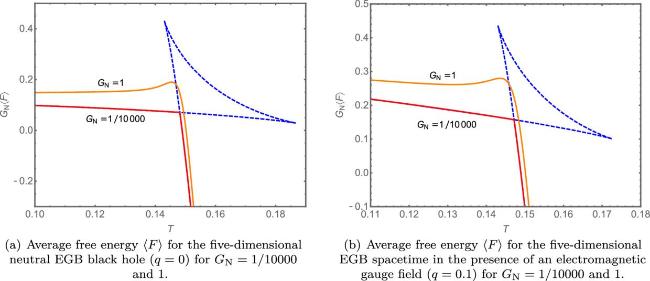
Figure 1. As GN increases the sharp characteristics of phase transition are absent in both cases. The dashed blue curve represents the free energy obtained using the saddle point approximation. We set L = 3 and α = 0.1 here. |
3.2. Case-II: six dimensions
In EGB gravity theory, the thermodynamic behavior of black holes in six dimensions differs from that in five dimensions. This distinction primarily arises from the nature of the Hawking temperature given in equation (4 ). When D = 5, one of the terms in equation (4 ) vanishes, impacting the free energy expression as seen in equation (9 ). This specific term, however, contributes to the thermodynamic structure in all other dimensions. Consequently, for neutral black holes in six-dimensional EGB theory, a small-intermediate-large phase transition does not occur; rather, the phase transition resembles that of Schwarzschild-AdS spacetime, i.e. a transition between thermal AdS space and a black hole phase. In contrast, when an electric charge is present, the behavior of six-dimensional black holes closely aligns with that of five-dimensional ones.
The ensemble-averaged expression for the free energy includes contributions from non-classical geometries. In figure 2, the behavior of free energy obtained from both the saddle-point approximation and the ensemble-averaged theory is plotted against the ensemble temperature for various values of GN. The free energy from the saddle-point approximation shows a sharp phase transition, as indicated by the dashed blue lines. A key observation is the absence of a sharp turning point in the ensemble-averaged theory, similar to what is observed in the five-dimensional case. This characteristic is due to the non-classical contributions to the free energy, which become more pronounced as GN increases. For q = 0, the ensemble-averaged free energy behaves similarly to the Schwarzschild-AdS black hole described in [40]. When an electromagnetic gauge field is present, the ensemble-averaged free energy qualitatively resembles the behavior seen in the five-dimensional EGB theory. The conclusion that the black hole phase transition can be understood as a small GN approximation of the ensemble-averaged theory applies to six-dimensional EGB gravity as well.
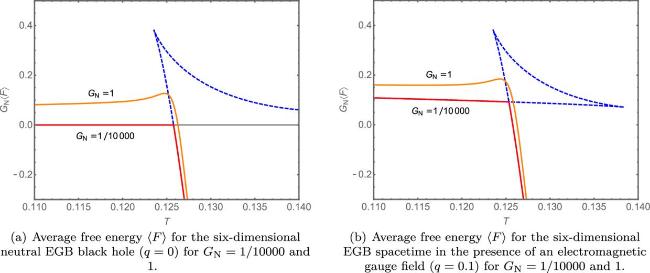
Figure 2. As GN increases the sharp characteristics of phase transition is absent in both cases. The dashed blue curve represents the free energy obtained using the saddle point approximation. We set L = 4.5 and α = 0.1 here. |
4. Non-classical corrections to the black hole thermodynamics
We interpret the ensemble-averaged free energy as the free energy of the classical solution, with additional contributions from other Euclidean geometries. According to the saddle-point approximation, and as explicitly shown in the previous section, the classical solution provides the dominant contribution, corresponding to small values of GN. Consequently, non-classical contributions become more significant at larger values of GN. To further investigate the effect of GN, we expand the free energy around the classical solution, i.e. around rh = rH, where rH denotes the horizon radius of the saddle. This is justified when GN is sufficiently small, as only the geometries near the saddle point contribute significantly to the free energy. To this extent, consider the parameter Δ = rh − rH. Expanding the Euclidean action for EGB gravity, equation (8 ) around Δ = 0 gives, 18 ) yields,
$\begin{eqnarray}{I}_{{\rm{E}}}({\rm{\Delta }})\,\approx \,{I}_{{\rm{E}}}({r}_{{\rm{H}}})+\frac{1}{2}{\left.\frac{{{\rm{d}}}^{2}{I}_{{\rm{E}}}}{{{\rm{d}}{r}_{{\rm{h}}}}^{2}}\right|}_{{r}_{{\rm{h}}}={r}_{{\rm{H}}}}{{\rm{\Delta }}}^{2}.\end{eqnarray}$
The term linear in Δ vanishes as it corresponds to the extremum free energy. The expression for the generalized free energy is then given by, $\begin{eqnarray}F({\rm{\Delta }})=\frac{{I}_{{\rm{E}}}({\rm{\Delta }})}{\beta }.\end{eqnarray}$
Now, ${{\rm{e}}}^{-{I}_{{\rm{E}}}({\rm{\Delta }})}$ essentially becomes Gaussian distribution and one can use Gaussian integral to obtain the approximate value for the averaged-free energy, i.e. $\begin{eqnarray}\left\langle F\right\rangle \,\approx \,\frac{{\int }_{-5\sigma }^{5\sigma }F{\rm{\Delta }})\,{{\rm{e}}}^{-{I}_{{\rm{E}}}({\rm{\Delta }})}{\rm{d}}{\rm{\Delta }}}{{\int }_{-5\sigma }^{5\sigma }\,{{\rm{e}}}^{-{I}_{{\rm{E}}}({\rm{\Delta }})}{\rm{d}}{\rm{\Delta }}}.\end{eqnarray}$
Here σ is the standard deviation of the Gaussian distribution, $\begin{eqnarray}\sigma =\frac{1}{\sqrt{\frac{{{\rm{d}}}^{2}{I}_{{\rm{E}}}}{{\rm{d}}{r}_{{\rm{h}}}^{2}}}}.\end{eqnarray}$
The integration in equation ( $\begin{eqnarray}\left\langle F\right\rangle \,\approx \frac{{I}_{{\rm{E}}}({r}_{{\rm{H}}})}{\beta }+\frac{{T}_{{\rm{H}}}}{2}-\frac{5{{\rm{e}}}^{-25/2}}{\sqrt{2\pi }\,\rm{erf}\,\left(\frac{5}{\sqrt{2}}\right)}{T}_{{\rm{H}}}.\end{eqnarray}$
The last term depends on the choice of integration limit and is neglected since it is very small compared to TH/2. The result above suggests that the ensemble-averaged free energy near the saddle geometry is given by the classical black hole free energy plus a correction term from non-classical geometries, i.e. TH/2. Note that this derivation applies to all black holes with asymptotic AdS behavior. This universal characteristic of free energy was reported in [39], and our results reinforce this claim by extending it to the case of higher-curvature gravity theories. A more realistic description of black hole thermodynamics for small values of GN is obtained by defining a quantum-corrected free energy as follows: $\begin{eqnarray}{F}_{\rm{corrected}\,}={F}_{\,\rm{classical}}+\frac{{T}_{{\rm{H}}}}{2}.\end{eqnarray}$
For the case of arbitrary dimensional EGB gravity theory, the expression for quantum corrected black hole free energy takes the form, $\begin{eqnarray}\begin{array}{rcl}{F}_{\,\rm{corrected}\,} & = & \frac{1}{8\pi {r}_{{\rm{H}}}({r}_{{\rm{H}}}^{2}+2\tilde{\alpha })}\left[\Space{0ex}{3.25ex}{0ex}(D-3){r}_{{\rm{H}}}^{2}\right.\\ & & \left.+\frac{D-1}{{L}^{2}}{r}_{{\rm{H}}}^{4}+(D-5)\tilde{\alpha }-\frac{(D-3)}{{r}_{{\rm{H}}}^{2(D-4)}}{q}^{2}\right]\\ & & +\frac{(D-2){{\rm{\Omega }}}_{D-2}{r}_{{\rm{H}}}^{D-3}}{16\pi {G}_{{\rm{N}}}}\left[\left(1+\frac{{r}_{{\rm{H}}}^{2}}{{L}^{2}}+\frac{\tilde{\alpha }}{{r}_{{\rm{H}}}^{2}}+\frac{{q}^{2}}{{r}_{{\rm{H}}}^{2(D-3)}}\right)\right.\\ & & -\frac{1}{({r}_{{\rm{H}}}^{2}+2\tilde{\alpha })}\left(1+\frac{2\tilde{\alpha }(D-2)}{(D-4)}\frac{1}{{r}_{{\rm{H}}}^{2}}\right)\left(\Space{0ex}{3ex}{0ex}(D-3){r}_{{\rm{H}}}^{2}\right.\\ & & \left.\left.+\frac{D-1}{{L}^{2}}{r}_{{\rm{H}}}^{4}+(D-5)\tilde{\alpha }-(D-3){q}^{2}{r}_{{\rm{H}}}^{-2(D-4)}\right)\right].\end{array}\end{eqnarray}$
The quantum-corrected free energy Fcorrected for both five and six-dimensional neutral cases is plotted alongside with the corresponding classical expressions Fclassical in figure 3. In the five-dimensional EGB case, Fcorrected closely follows the behavior of the Fclassical. However, in the six-dimensional case, an intriguing difference appears in the F–T diagram: Fcorrected exhibits a local minimum, a feature absent in Fclassical [43]. This newly appearing minimum naturally suggests the presence of a locally stable phase.
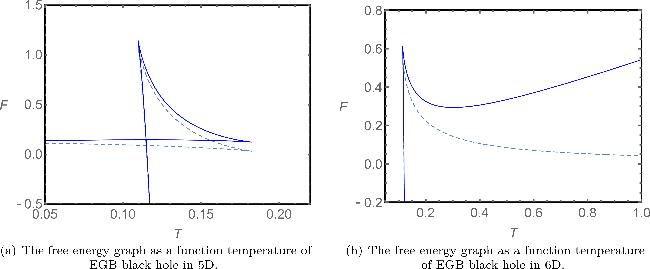
Figure 3. The quantum corrected black hole free energy Fcorrected (solid blue line) is plotted along with the classical expression of free energy Fclassical (dashed line). |
Note that when GN → 0, only the classical geometry, which depends on 1/GN, contributes to the free energy. As it increases we have the significant contributions from higher order terms of ⟨F⟩ expanded in terms of GN. Thus, one can express the ensemble-averaged free energy as a series in GN, i.e.
$\begin{eqnarray}\langle F\rangle =\frac{{F}_{{\rm{0}}}}{{G}_{{\rm{N}}}}+{F}_{{\rm{1}}}\,{{G}_{{\rm{N}}}}^{0}+{F}_{{\rm{2}}}{{G}_{{\rm{N}}}}^{2}+\ldots ,\end{eqnarray}$
where F0 is the contribution from classical geometries, F1 and F2 are the sub-leading and sub-sub-leading order contributions, respectively. The sub-leading term is independent of GN.In this spirit, one can verify the analytical results using numerical techniques. To this extent, we explicitly construct a data set for ⟨F⟩ corresponding to various values of GN and T. This allows us to obtain the graphical representation of ⟨F⟩ for a given value of GN, as shown in figures 1 and 2. Further, we demonstrate the series expansion for ⟨F⟩ by plotting the coefficients F0, F1, and F2 in equation (23 ) using the method of curve fitting.
The averaged free energy obtained from numerical calculations for the five-dimensional EGB black hole is summarized in figure 4. For GN = 1/1000, the coefficients F0, F1, and F2 are plotted against ensemble temperature. The numerical results match the analytical expressions for leading and sub-leading order contributions. Our results are qualitatively similar to the case of RN-AdS and Kerr-AdS black holes [39, 40].
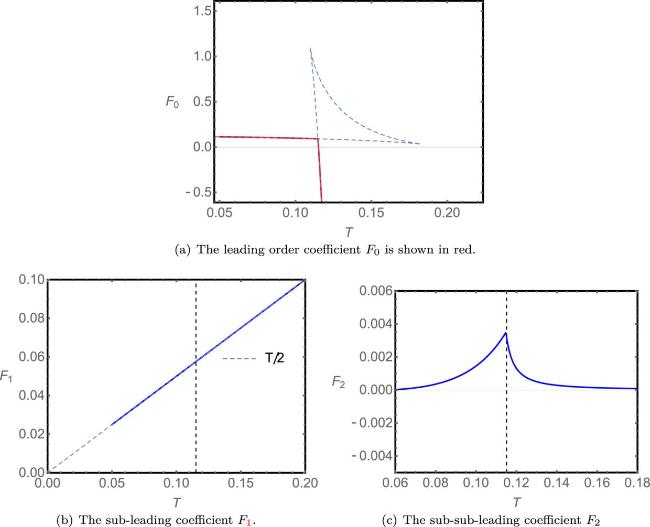


Figure 4. (a) The leading order term matches the classical free energy for 5D EGB black hole. The dashed line represents GNFclassical. (b) The sub-leading term is shown in the solid blue curve and it matches with the analytical value (dashed line). The vertical line represents the classical transition temperature. (c) The sub-sub-leading order contribution to the averaged free energy is asymmetric to the classical transition temperature. |
5. Discussion
This work introduces an ensemble-averaged free energy for black holes in EGB gravity theory. In the standard free energy landscape description of black hole thermodynamics, the Gibbs free energy is derived from the gravitational partition function using the saddle-point approximation. However, a more physically relevant expression for the free energy, called the ensemble-averaged free energy, can be obtained by including non-saddle geometries in the integration, as outlined in [39]. Using this approach, we analyze the thermodynamic properties of EGB black holes through the ensemble-averaged free energy. The ensemble-averaged free energy does not display a sharp transition point, suggesting that the black hole phase transition can be viewed as the small GN approximation within the ensemble-averaged theory.
The ensemble-averaged free energy can be expanded in powers of GN, with the leading order term corresponding to the classical black hole free energy. For both five and six-dimensional EGB black holes, the sub-leading term is TH/2. Our results support the conjecture that this sub-leading contribution remains TH/2 regardless of the specific gravity theory [39, 40]. Additionally, we derive an expression for the quantum-corrected free energy for EGB black holes. In the case of a six-dimensional EGB black hole, the quantum-corrected free energy exhibits a distinct local minimum, a feature not present in the classical free energy. This feature is also observed in the Schwarzschild-AdS black hole. Additionally, the ensemble-averaged free energy structure is identical for both of these black holes. Thus, we conclude that the striking similarities in thermodynamic behavior between the Schwarzschild-AdS and six-dimensional EGB-AdS black holes and between the RN-AdS and five-dimensional EGB-AdS black holes extend beyond the classical limit.
It is worth noting that the ensemble-averaged theory is grounded in the established principle of the Euclidean path integral representation of the density matrix. By including geometries with conical singularity on their Euclidean counterparts, we extend the phase space of the EGB gravity theory to include more states, whose weight of state can be calculated through the Euclidean path integral. We are actually ensemble averaging over all the allowed states on the free energy landscape. The black hole thermodynamics can be recovered in the semi-classical limit mainly because the on-shell configurations have the largest weight in the phase space. In the GN → 0 limit, the distribution of the weight is the Dirac delta function. That is the usual occasion and people only need to care about the saddle point contributions. For finite but relatively small GN, the distribution can be approximated by the Gaussian distribution. That is the reason why we can recover the black hole result and get a universal subleading-order contribution.