

1. Introduction
In strongly correlated electron systems, the narrowing of electron energy bands amplifies the influence of the system's potential energy [1]. This effect is especially pronounced in flat band regions, where vanishingly small dispersion gives rise to extensive electronic degeneracy. Such extreme degeneracy provides an important environment for the emergence of remarkable quantum phenomena such as strange metal [2, 3], super-Klein tunneling [4–7] and unconventional superconductivity [8–10]. A prime example is magic-angle twisted bilayer graphene [11]. Interlayer coupling at specific ‘magic' twist angles in MATBG generates ultra-flat bands near the Fermi level, leading to the experimental observation of correlated insulating states, superconductivity, and ferromagnetism within a single tunable platform. Beyond MATBG, topologically protected flat bands in multilayer graphene heterostructures are also of great significance. Their divergent density of states (DOS) at the Fermi level significantly enhances electronic instabilities, as demonstrated by robust surface superconductivity, facilitated by the amplified pairing susceptibility near the flat band energy and flat band ferromagnetism, which has emerged as a significant research frontier where the Stoner criterion for itinerant ferromagnetism is readily satisfied due to the high DOS and strong interactions within the flat band [12]. These remarkable phenomena underscore the pivotal role of flat bands and high degeneracy points in correlated electron physics.
The pursuit of ferromagnetism, a quintessential correlated electron phenomenon, finds fertile ground in such flat band systems. The seminal works of Tasaki [13] and Mielke [14, 15] provide a rigorous theoretical bedrock for flat-band ferromagnetism. Tasaki proved that in a multi-band Hubbard model with sufficiently large Coulomb repulsion U, ferromagnetism emerges in flat bands when the band is nearly half-filled. Mielke further showed that a ferromagnetic ground state arises when the number of electrons is less than or equal to the number of degenerate single-particle ground states, a conclusion that holds for partially flat bands even away from half-filling. This latter scenario is particularly relevant for understanding itinerant ferromagnets, where magnetism coexists with charge conduction, a key motivation for the present study. Beyond the specific multi-band realizations like magic-angle graphene, geometrically frustrated lattices offer an alternative pathway to high degeneracy. The triangular lattice stands out as a paradigmatic example due to its inherent geometric frustration, which promotes single-particle energy-level degeneracy, particularly near van Hove singularities (VHS). At VHS points, the DOS diverges, mimicking a flat band over a finite energy range. Under these conditions, for significant on-site repulsion U and appropriate electron filling, the competition between kinetic and interaction energy is tilted: the high DOS suppresses the kinetic energy gain associated with delocalization, while the Pauli exclusion principle favors spin polarization to avoid the energy cost of double occupation. This mechanism can lead to strong ferromagnetic fluctuations or ordering, crucially dependent on the assumption that U does not drastically reshape the underlying DOS.
Numerous studies have explored metallic ferromagnetism across various correlated electron systems [1, 16–21]. For instance, a recent work [1] calculated critical electron concentrations for saturated ferromagnetism within the Hubbard model, mapping its instability in the DOS diagram for several narrow-band lattices, including square, simple cubic, bcc, and fcc structures. In another study, researchers investigated the extended Hubbard model on a square lattice, incorporating different hopping types between empty, singly, and doubly occupied sites; they demonstrated that each hopping type distinctly influences Nagaoka ferromagnetic states [22]. Furthermore, first-principles calculations on a two-dimensional metal-organic framework with a kagome lattice [18] confirmed both ferromagnetism and non-trivial topology arising from its nearly flat bands.
In addition to the lattices mentioned above, the triangular lattice, with its inherent geometric frustration, offers a means to achieve high degeneracy, making it a highly representative example in research related to flat-band ferromagnetism. The Hubbard model and the t–J model are commonly used to investigate the electronic properties of triangular lattices [23–27]. For instance, results from quantum Monte Carlo (QMC) calculations on the triangular-lattice Hubbard model show that relatively strong antiferromagnetism exists in the region near half-filling at low temperatures [28]; researchers have simulated the electronic characteristics influenced by both geometric frustration and electron correlation in the Hubbard model of the triangular lattice by applying the quantum cluster method based on dynamical mean field theory [29]; the high temperature expansion study uses the Renormalization Group method to study the magnetic stability of the t–J model of the triangular lattice [30]; the high temperature expansion study of the t–J model has found that the sign of the nearest-neighbor (NN) hopping integral plays an important role in the magnetic properties of the system [31]. Additionally, determinant QMC (DQMC) simulations on flat-band systems of the triangular lattice have revealed short-ranged ferromagnetic correlations in the filling region near VHS points [16, 32]. while Kong et al [17], who explicitly took the next-nearest-neighbor (NNN) hopping ${t}^{{\prime} }$ into account, have proven that ${t}^{{\prime} }$ plays an essential role in governing magnetic correlations and superconducting pairing.
Motivated by the theoretical framework of Tasaki and Mielke and leveraging the unique potential of the triangular lattice to host VHS-enhanced DOS, this work investigates the magnetic correlation phenomena within the single-band Hubbard model on triangle lattice. We focus on the interplay between two key tuning parameters: electron filling $\left\langle n\right\rangle $ and NNN hopping ${t}^{{\prime} }$. The parameter ${t}^{{\prime} }$ is crucial as it directly controls the position of the VHS relative to the Fermi level and the degree of band flattening around it. Our primary goal is to systematically characterize how these parameters influence the competition between ferromagnetic (FM) and antiferromagnetic (AFM) fluctuations and to identify regimes where VHS-enhanced DOS promotes robust FM correlations. To capture the essential physics—including quantum fluctuations and correlation effects beyond mean-field approximations—we employ the numerically exact DQMC method [33]. This enables us to compute the wave vector-dependent spin susceptibility χ(q), a direct probe of magnetic correlations, across a wide range of fillings and ${t}^{{\prime} }$ values.
2. Model
In single-band Hubbard model, the Hamiltonianon on triangular lattice reads
$\begin{eqnarray}\begin{array}{rcl}\widehat{H} & = & -t\displaystyle \sum _{\langle i,j\rangle \sigma }({\hat{c}}_{i\sigma }^{\dagger }{\hat{c}}_{j\sigma }+{\rm{H.c.}})-t^{\prime} \displaystyle \sum _{\left[i,j\right]\sigma }({\hat{c}}_{i\sigma }^{\dagger }{\hat{c}}_{j\sigma }+{\rm{H.c.}})\\ & & +U\displaystyle \sum _{i}{\hat{n}}_{i\uparrow }{\hat{n}}_{i\downarrow }-\mu \displaystyle \sum _{i\sigma }{\hat{n}}_{i\sigma },\end{array}\end{eqnarray}$
where $\left\langle i,j\right\rangle $ denotes summation over NN lattice sites i and j, t is the NN hopping matrix element, ${t}^{{\prime} }$ is the NNN hopping matrix element, U is the on-site repulsive interaction strength, and μ is the chemical potential. The operators ${\hat{c}}_{i\sigma }$ and ${\hat{c}}_{i\sigma }^{\dagger }$ annihilates and creates, respectively, an electron with spin σ (↑ or ↓) at site i, and ${\hat{n}}_{i\sigma }={\hat{c}}_{i\sigma }^{\dagger }{\hat{c}}_{i\sigma }$ is the number operator. Throughout this paper, we set $\left|t\right|=1$ as the energy unit.Our numerical simulations employed the triangular lattice model defined on a hexagonal cluster, as depicted in figure 1(a). This cluster configuration contains 2 × L sites along the diagonal direction, yielding a total of 3 × L2. This lattice setting reserves most geometric symmetries of the triangular lattice. Figure 1(b) shows the first Brillouin zone with the high-symmetry points Γ, K and M indicated. The behavior of DOS and filling $\left\langle n\right\rangle $ as a function of enenry was shown in figure 1 with (c) ${t}^{{\prime} }=0.15$ and (d) ${t}^{{\prime} }=0.3$. The energy dependence of the DOS and electron filling ⟨n⟩ is presented in figure 1(c) for ${t}^{{\prime} }=0.15$ and figure 1(d) for ${t}^{{\prime} }=0.3$. Each ${t}^{{\prime} }$ value produces a VHS at a distinct filling level. By tuning ${t}^{{\prime} }$ and ⟨n⟩, we can control the VHS position, enabling partial band flattening and enhanced ferromagnetic spin fluctuations near the singularity.
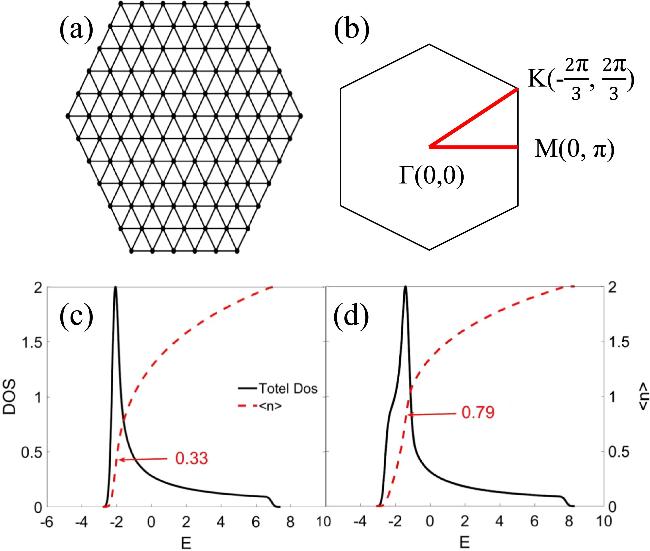
Figure 1. (a) Sketch of triangular lattice for L = 6 the total number of sites is 3 × L2 and there are 2 × L sites along the diagonal. (b) The first Brillouin zone (BZ) of the triangular lattice. The high-symmetry path is marked by red line, and representative points are Γ(0, 0), M(0, π), and $K(-\frac{2\pi }{3},\frac{2\pi }{3})$. (c) DOS (solid dark lines ) and filling $\left\langle n\right\rangle $ (dash red lines ) as functions of energy for ${t}^{{\prime} }=0.15$; (d) same for ${t}^{{\prime} }=0.3$. |
To characterize magnetic correlations, we define the zero-frequency (ω = 0) spin susceptibility in the z-direction as [16, 32]
$\begin{eqnarray}\begin{array}{r}\chi ({\boldsymbol{q}})={\displaystyle \int }_{0}^{\beta }{\rm{d}}\tau \displaystyle \sum _{i,j}{{\rm{e}}}^{{\rm{i}}{\boldsymbol{q}}\cdot ({\boldsymbol{i}}-{\boldsymbol{j}})}\langle {m}_{i}(\tau )\cdot {m}_{j}(0)\rangle ,\end{array}\end{eqnarray}$
where mi(τ) = eHτmi(0)e−Hτ, with the local moment operator ${m}_{i}\equiv {c}_{i\uparrow }^{\dagger }{c}_{i\uparrow }-{c}_{i\downarrow }^{\dagger }{c}_{i\downarrow }$. Here, χ(Γ) quantifies the ferromagnetic correlation, while χ(k) quantifies the AFM correlations.3. Results and discussion
Figure 2(a) shows the filling dependence of spin susceptibility with parameters U = 3, ${t}^{{\prime} }=0.15$, β = 4, where the VHS occurs at $\left\langle n\right\rangle =0.33$. The behavior of spin susceptibility differs qualitatively between two regions. Between $\left\langle n\right\rangle =0.3$ and 0.5, $\chi \left({\boldsymbol{q}}={\rm{\Gamma }}\right)$ decreases with filling, and the maximum spin susceptibility remains at q = Γ. Between $\left\langle n\right\rangle =0.6$ and 1.0. $\chi \left({\boldsymbol{q}}={\rm{\Gamma }}\right)$ decreases with filling, and the maximum spin susceptibility shifts from Γ to the K point. In both regions, $\chi \left({\boldsymbol{q}}=K\right)$ gradually increases with filling. In the first region, $\chi \left({\boldsymbol{q}}=K\right)$ is smaller than $\chi \left({\boldsymbol{q}}={\rm{\Gamma }}\right)$, while in the second region, $\chi \left({\boldsymbol{q}}=K\right)$ exceeds $\chi \left({\boldsymbol{q}}={\rm{\Gamma }}\right)$ as filling increases. Figure 2(b), shows that $\chi \left({\boldsymbol{q}}=K\right)$ with ${t}^{{\prime} }=0.3$ follows the same trend as in panel (a), except that the transition point occurs at $\left\langle n\right\rangle =0.7$, near the van hole singularity ($\left\langle n\right\rangle =0.79$).
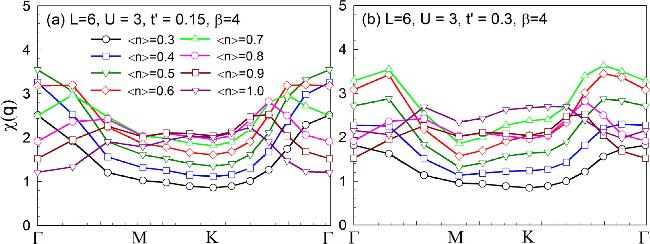
Figure 2. χ(q) versus q with different fillings at L = 6, U = 3, β = 4 and (a) ${t}^{{\prime} }=0.15$; (b) ${t}^{{\prime} }=0.3$. |
The behavior of spin susceptibility reflects the competition between ferromagnetic and AFM fluctuations. Near half-filling, AFM fluctuations dominate, as indicated by the peak of χ(q) at K point. As ${t}^{{\prime} }$ increases and the system approaches the VHS point, the DOS is insufficient for ferromagnetic fluctuations to dominate. The competition causes the peak of χ(q) to shift from the K point toward the Γ point.
To clearly observe the effects of ${t}^{{\prime} }$ and temprature on $\chi \left({\boldsymbol{q}}\right)$, we present temerature dependence of spin susceptibility at $\left\langle n\right\rangle =0.3$ and $\left\langle n\right\rangle =0.6$ for different ${t}^{{\prime} }$. Figure 3 shows $\chi \left({\boldsymbol{q}}={\rm{\Gamma }}\right)$ versus temperature for U = 3 with ${t}^{{\prime} }$ ranging from 0 to 0.3. As temperature decreases, $\chi \left({\rm{\Gamma }}\right)$ gradually increases and exhibits a diverging trend at sufficiently low temperatures. Moreover, in figure 3(a) ($\left\langle n\right\rangle =0.3$), $\chi \left({\rm{\Gamma }}\right)$ is increased as ${t}^{{\prime} }$ approaches 0.15, while in figure 3(b)($\left\langle n\right\rangle =0.6$), it increases as ${t}^{{\prime} }$ approaches 0.2. Notably, $\left\langle n\right\rangle =0.3$ corresponds to the VHS point at ${t}^{{\prime} }=0.15$, and $\left\langle n\right\rangle =0.3$ corresponds to the VHS point near ${t}^{{\prime} }=0.2$. This indicates that the higher DOS at these VHS points enhances ferromagnetic correlations greatly.
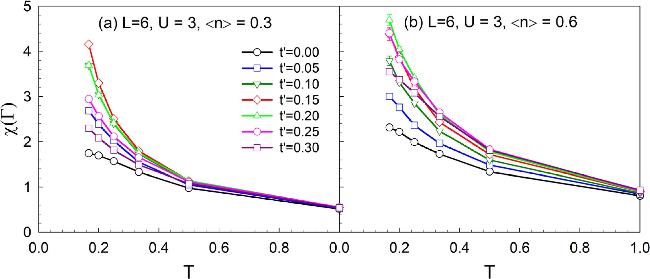
Figure 3. χ(Γ) as a function of temperature with different ${t}^{{\prime} }$ at L = 6, U = 3, and filling (a) $\left\langle n\right\rangle =0.3$; (b) $\left\langle n\right\rangle =0.6$. |
Figure 4 shows results for the NN spin correlation in the z direction with different ${t}^{{\prime} }$ at U = 3 and β = 4. Corroborating the trends observed in the susceptibility measurements (figures 2 and 3), the spin correlation is positive in the region around $\left\langle n\right\rangle =0.4$, signifying dominant ferromagnetic correlations. Consistent with the shift in the peak of χ(q) from Γ to K observed in figure 2(a) as filling increases beyond the VHS point ($\left\langle n\right\rangle =0.33$ for ${t}^{{\prime} }=0.15$), the spin correlation in figure 4 drops to a negative value as $\left\langle n\right\rangle $ increases and continues to decrease. This sign change signifies a crossover from ferromagnetic to AFM correlations. Thus, the evolution of the local spin correlation (figure 4), the wavevector dependence of χ(q) (figure 2), and the enhancement of χ(Γ) near VHS fillings (figure 3) collectively demonstrate that antiferromagnetism suppresses ferromagnetism in the range approaching half-filling, while enhanced DOS near the VHS (controlled by ${t}^{{\prime} }$ and $\left\langle n\right\rangle $) promotes ferromagnetic fluctuations.
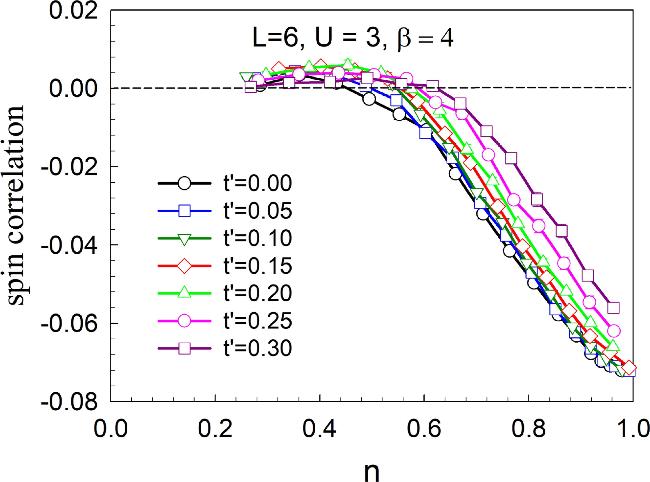
Figure 4. The nearest spin correlation as a function of filling with different ${t}^{{\prime} }$ at L = 6, U = 3 and β = 4. |
Figure 5 shows $\chi \left({\boldsymbol{q}}={\rm{\Gamma }}\right)$ versus temperature for different on-site interactions U at ${t}^{{\prime} }=0.15$ and various fillings. At fixed temperatures, $\chi \left({\boldsymbol{q}}={\rm{\Gamma }}\right)$ systematically increases with U, confirming that on-site interactions strengthen ferromagnetic fluctuations. Consistent with expectations for correlated electron systems, this effect becomes particularly pronounced at low temperatures. Building upon the ferromagnetic correlations identified near VHS points.
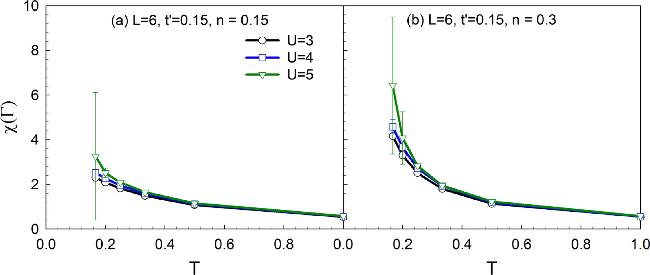
Figure 5. χ(Γ) as a function of temperature with different U at L = 6, ${t}^{{\prime} }=0.15$, and filling (a) ${t}^{{\prime} }=0.15$; (b) ${t}^{{\prime} }=0.3$. |
Figure 6, shows χ(q) plotted as a function of filling $\left\langle n\right\rangle $ and on five lattice sizes: N = 48, 75, 108, 147 and 192 sites. Crucially, the data for different lattice sizes exhibit a clear collapse onto the same curve, demonstrating conclusively that ferromagnetic correlations in our system are indeed short-ranged.
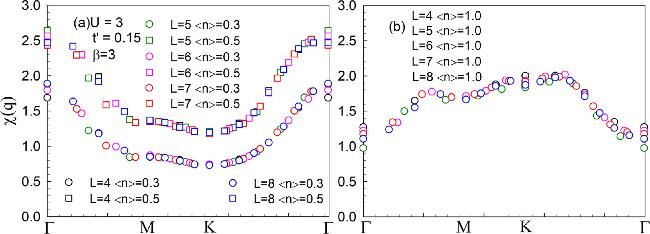


Figure 6. χ(q) versus q for different lattice sizes (a) $\left\langle n\right\rangle =0.3$, 0.5; (b) $\left\langle n\right\rangle =1.0$. |
4. Summary
We studied the behavior of spin susceptibility χ(q) of the triangular lattice on single-band Hubbard model using DQMC method. From the results of numerical simulations, we found that both the NNN hopping ${t}^{{\prime} }$ and filling have a significant effect on the spin susceptibility. By adjusting ${t}^{{\prime} }$and filling, the system can be driven into regions of high DOS (near VHS point), and shows ferromagnetic correlation. We also found the strengthening effect of larger Coulomb interaction and lower temprature on ferromagnetic correlation. At half-filled, a larger ${t}^{{\prime} }$ promotes AFM fluctuations.