


1. Introduction
Axion-like particles (ALPs) naturally emerge in extensions of the Standard Model (SM) of particle physics as CP-odd pseudo Nambu-Goldstone bosons resulting from the spontaneous breaking of global symmetries, which are singlets under the SM gauge groups. ALPs can serve as compelling candidates for dark matter [1–3] or inflaton [4] and solve the gauge hierarchy problem [5]. In addition, ALPs can also explain the observed matter–antimatter asymmetry [6, 7]. In general, ALPs can couple to all SM particles with model-dependent couplings, which lead to a multitude of possible signatures at various experiments. Thus, ALPs can be searched through astrophysical and cosmological observations as well as laboratory experiments (see e.g. [8–14]).
ALP is a natural generalization of the idea of the QCD axion, but is not constrained by a linear mass-coupling relation, which means its mass ma and coupling strengths suppressed by the global symmetry breaking scale fa are independent free parameters. Thus, ALP may interact with various particles and has masses in a wide range, which are subject to various cosmological, astrophysical, and laboratory experimental constraints. For the ALPs with masses in the range from few MeV to few GeV, flavor physics observables provide the best constraints (see e.g. [15, 16]). In this paper, we will focus on this mass range for so-called leptophilic ALPs, which, by definition, couple only directly to charged leptons. Such leptophilic ALPs are well motivated, since the absence of direct couplings to hadrons eliminates many stringent constraints from hadronic observables, leaving leptonic channels as comparatively clean probes for leptophilic ALPs searches.
Leptophilic ALPs, denoted as ℓALPs, can generate rich phenomenology at collider experiments, depending on the precise form of their interactions with other particles (see e.g. [17] and references therein). In this paper, we consider ℓALP (denoted as a), produced via the purely leptonic decays of charged pseudoscalar meson P and the gauge boson W, P → ℓνℓa and W → ℓνℓa, where a is assumed to escape the detector as missing energy or to decay into a pair of charged leptons. Based on these assumptions, we investigate the constraints on ℓALP from the precision measurements of these decay processes, P → ℓνℓ, $P\to {\ell }{\nu }_{{\ell }}\nu \bar{\nu }$, P → ℓνℓe+e− and W → ℓνℓ. In our analysis, we restrict ourselves to flavor-diagonal (FD) couplings and assume flavor-violating couplings to be vanishing for the ℓALP with mass in the range 10 MeV ≤ ma ≤ 100 MeV.
The rest of this paper is organised as follows. In section 2 , we review the effective interactions of ℓALP with charged leptons and photons, and discuss its decay modes and lifetime in the considered mass range. The constraints on ℓALP from the leptonic decay processes P → ℓνℓ, ${\ell }{\nu }_{{\ell }}\nu \bar{\nu }$ and ℓνℓe+e− are calculated in sections 3 and 4 , respectively. The corresponding constraints on ℓALPs from the decay W → ℓνℓ are also discussed in section 3 . Our conclusions are presented in section 5 .
2. The couplings and decays of leptophilic ALP
The interactions of ℓALP with charged leptons can be described by the effective Lagrangian involving operators with dimension up to five [12, 18, 19]1 ) can be rewritten as4
$\begin{eqnarray}\begin{array}{rcl}{{ \mathcal L }}_{a{\ell }} & = & \frac{1}{2}{\partial }_{\mu }a{\partial }^{\mu }a-\frac{1}{2}{m}_{a}^{2}{a}^{2}\\ & & +\frac{{\partial }_{\mu }a}{2{f}_{a}}\displaystyle \sum _{{\ell }=e,\mu ,\tau }{g}_{{\ell }}(\bar{{\ell }}{\gamma }^{\mu }{\gamma }_{5}{\ell }),\end{array}\end{eqnarray}$
where gℓ is dimensionless coupling coefficient treated as free parameter throughout this paper and fa is the global symmetry breaking scale being independent of the mass parameter ma. In the following discussions, we focus on the FD coupling $a{\ell }\bar{{\ell }}$ and change the so-called ‘derivative' basis to the ‘chirality-flipping' basis, equation ( $\begin{eqnarray}\begin{array}{rcl}{{ \mathcal L }}_{a{\ell }\rm{}\,\rm{}\,} & = & \frac{1}{2}{\partial }_{\mu }a{\partial }^{\mu }a-\frac{1}{2}{m}_{a}^{2}{a}^{2}\\ & & -{\rm{i}}a\displaystyle \sum _{{\ell }=e,\mu ,\tau }\frac{{g}_{{\ell }}{m}_{{\ell }}}{{f}_{a}}\bar{{\ell }}{\gamma }_{5}{\ell }.\end{array}\end{eqnarray}$
This can also give rise to contributions to the effective couplings of ℓALP with photons and weak gauge bosons induced by the coupling $a{\ell }\bar{{\ell }}$ at loop (see e.g. [12, 17, 20–22] for details).For the ℓALP with masses in the range 10 MeV ≤ ma≤ 100 MeV, it can only decay into electrons and photons. The corresponding decay rates read
$\begin{eqnarray}\begin{array}{r}{\rm{\Gamma }}(a\to {e}^{+}{e}^{-})=\frac{{m}_{a}{m}_{e}^{2}{g}_{{\ell }}^{2}}{8\pi {f}_{a}^{2}}\sqrt{1-\frac{4{m}_{e}^{2}}{{m}_{a}^{2}}},\end{array}\end{eqnarray}$
$\begin{eqnarray}\begin{array}{r}{\rm{\Gamma }}(a\to \gamma \gamma )=\frac{{m}_{a}^{3}}{64\pi }| {g}_{a\gamma \gamma }^{{\rm{eff}}}{| }^{2}.\end{array}\end{eqnarray}$
Here ${g}_{a\gamma \gamma }^{{\rm{eff}}}$ denotes the effective coupling strength of ℓALP with photons and its specific form has recently been studied in detail [17]. Then the total decay width can be written as $\begin{eqnarray}{{\rm{\Gamma }}}_{a}={\rm{\Gamma }}(a\to {e}^{+}{e}^{-})+{\rm{\Gamma }}(a\to \gamma \gamma ).\end{eqnarray}$
The decay length La in the laboratory frame depends on the couplings, energy, and mass of ℓALP, which is given by
$\begin{eqnarray}{L}_{a}=c{\beta }_{a}{\gamma }_{a}{\tau }_{a}=\frac{c| {{\boldsymbol{p}}}_{a}| }{{m}_{a}{{\rm{\Gamma }}}_{a}},\end{eqnarray}$
where τa = 1/Γa is the ℓALP lifetime, βa and γa are its velocity and Lorentz boost factors, respectively. βaγa = ∣pa∣/ma with ∣pa∣ being its three-momentum. For the mass in the range 10 MeV ≤ ma ≤ 100 MeV, the decay a → e+e− is the dominant channel, while the decay a → γγ induced at one loop is strongly suppressed and has a negligible contribution to the ℓALP lifetime. Consequently, the effective ℓALP-photon coupling is not considered in our analysis. Thus, the proper decay length (or proper lifetime) can be approximately written as $\begin{eqnarray}c{\tau }_{a}\approx 1.9\,\,\rm{cm}\,{\left(\frac{{f}_{a}}{\,\rm{MeV}\,}\right)}^{2}\left(\frac{10\,\,\rm{MeV}\,}{{m}_{a}}\right){\left(\frac{1\times 1{0}^{-5}}{{g}_{{\ell }}}\right)}^{2}.\end{eqnarray}$
In the following section, we will assume that the decay length La is sufficiently long and ℓALP escapes the detector as missing energy, and derive the constraints on ℓALPs from the decay processes P → ℓνℓ, $P\to {\ell }{\nu }_{{\ell }}\nu \bar{\nu }$ and W → ℓνℓ.
3. ℓALP and the decays P → ℓνℓ, $P \rightarrow {\ell }{\nu }_{{\ell }}\nu \bar{\nu }$, and W → ℓνℓ
ALPs can be produced via the leptonic charged-meson decay P → ℓνℓa, which has been extensively studied in literature (see e.g. [23, 24]). From the above discussions, we can see that ℓALPs can be produced on-shell via the decay P → ℓνℓa with a emitted from the charged lepton ℓ if kinematically accessible. When the mass mP of the charged pseudoscalar meson P is much larger than the mass mℓ of the charged lepton ℓ+, the expression of the partial width Γ(P+ → ℓ+νℓa) can be approximately given by [23, 24]8 ) does not contain the f0 term that appears in equation (4) of the [23] and equation (2.14) of the [24]. ΓSM(P+ → ℓ+νℓ) is the leading-order decay width of the decay P+ → ℓ+ν in the SM, which can be written as
$\begin{eqnarray}\begin{array}{l}{\rm{\Gamma }}({P}^{+}\to {{\ell }}^{+}{\nu }_{{\ell }}a)\simeq \frac{{{\rm{\Gamma }}}^{{\rm{SM}}}({P}^{+}\to {{\ell }}^{+}\nu ){m}_{P}^{2}{g}_{{\ell }}^{2}}{96{\pi }^{2}{f}_{a}^{2}}{\left(1-\frac{{m}_{{\ell }}^{2}}{{m}_{P}^{2}}\right)}^{-2}\\ \quad \times \left(1+9x-9{x}^{2}-{x}^{3}+6x(1+x)\mathrm{log}x\right)\\ \quad =\,{{\rm{\Gamma }}}^{{\rm{SM}}}({P}^{+}\to {{\ell }}^{+}\nu ){B}_{{\ell }}.\end{array}\end{eqnarray}$
Here $x={m}_{a}^{2}/{m}_{P}^{2}$. In this paper, we focus on electroweak-preserving scenarios, in which the four-point interaction Wℓνa is absent. Consequently, equation ( $\begin{eqnarray}\begin{array}{rcl}{{\rm{\Gamma }}}^{{\rm{SM}}}({P}^{+}\to {{\ell }}^{+}{\nu }_{{\ell }}) & = & \frac{{G}_{{\rm{F}}}^{2}}{8\pi }| {V}_{ij}{| }^{2}{{\rm{F}}}_{P}^{2}{m}_{{\ell }}^{2}{m}_{P}\\ & & \times {\left(1-\frac{{m}_{{\ell }}^{2}}{{m}_{P}^{2}}\right)}^{2}.\end{array}\end{eqnarray}$
Here GF is the Fermi constant, Vij is the CKM matrix element that parametrizes the relative strength of the charged-current weak interaction between quark flavors i and j. The transition rates are proportional to ∣Vij∣2, where the specific choices of i and j are determined by the charged meson under consideration. FP denotes the decay constant of the meson P. The values of these input parameters used in our calculation are taken from [25].If we assume that the ℓALP lifetime is sufficiently long to escape the detector, then its signature is missing energy/momentum, just as neutrinos. Based on this hypothesis, we can use equations (8 ) and (9 ) to drive the constraints on ℓALP from the decays P → ℓνℓ and $P\to {\ell }{\nu }_{{\ell }}\nu \bar{\nu }$.
Since both theoretical and experimental uncertainties cancel out to a large extent in the lepton flavor universality (LFU) parameter ${R}_{{\ell }/{{\ell }}^{{\prime} }}^{P}=Br(P\to {\ell }{\nu }_{{\ell }})/Br(P\to {{\ell }}^{{\prime} }{\nu }_{{{\ell }}^{{\prime} }})$, the LFU parameter ${R}_{{\ell }/{{\ell }}^{{\prime} }}^{P}$ is a powerful tool to test the ${\ell }\to {{\ell }}^{{\prime} }$ flavor universality and is very sensitive to the new physics effects. For the charged pseudoscalar mesons $({\pi }^{\pm },{K}^{\pm },{D}_{(s)}^{\pm }$ and B±), the experimental measured values and the corresponding SM predictions are collected in table 1.
Table 1. The experimental measured values and the corresponding SM predictions for the LFU parameter ${R}_{{\ell }/{{\ell }}^{{\prime} }}^{P}$. |
| ${R}_{{\ell }/{{\ell }}^{{\prime} }}^{P}$ | Exp. | SM |
|---|---|---|
| ${R}_{e/\mu }^{\pi }$ | 1.2327(23) × 10−4 [25] | 1.23524(15) × 10−4 [26] |
| ${R}_{e/\mu }^{K}$ | 2.488(9) × 10−5 [25] | 2.477 × 10⁻⁵ [27] |
| ${R}_{\mu /e}^{D}$ | >42.5 [25] | 4.24 × 10⁴ [28] |
| ${R}_{\tau /\mu }^{D}$ | 3.18(73) [29] | 2.67(1) [29] |
| ${R}_{\mu /e}^{{D}_{s}}$ | >65.4 [25, 30] | 4.25 × 10⁴ [28] |
| ${R}_{\tau /\mu }^{{D}_{s}}$ | 10.01(29) [29] | 9.75(1) [29] |
| ${R}_{\mu /e}^{B}$ | >0.66 [25, 31] | 4.27 × 10⁴ [28] |
| ${R}_{\tau /\mu }^{B}$ | 1.7(8) × 102 [25, 31] | 2.23 × 10² [28] |
Including the contributions of ℓALP, the LFU parameter ${R}_{{\ell }/{{\ell }}^{{\prime} }}^{P}$ can be written as 8 ).
$\begin{eqnarray}\begin{array}{rcl}{R}_{{\ell }/{{\ell }}^{{\prime} }}^{P,a} & = & \frac{B{r}^{{\rm{SM}}}(P\to {\ell }{\nu }_{{\ell }})(1+{B}_{{\ell }})}{B{r}^{{\rm{SM}}}(P\to {{\ell }}^{{\prime} }{\nu }_{{{\ell }}^{{\prime} }})(1+{B}_{{{\ell }}^{{\prime} }})}\\ & = & {R}_{{\ell }/{{\ell }}^{{\prime} }}^{P,{\rm{SM}}}\frac{1+{B}_{{\ell }}}{1+{B}_{{{\ell }}^{{\prime} }}},\end{array}\end{eqnarray}$
where the expression forms of Bℓ and ${B}_{{{\ell }}^{{\prime} }}$ have been defined in equation (Comparing the theoretical predictions including the ℓALP contributions with the corresponding experimental and the SM results, we can obtain the constraints from ${R}_{{\ell }/{{\ell }}^{{\prime} }}^{P}$ on the free parameter gℓ/fa with the ℓALP mass ma in the considered range. From table 1 we can see that it is very difficult to generate severe constraints on ℓALP from the LFU parameters ${R}_{{\ell }/{{\ell }}^{{\prime} }}^{D}$, ${R}_{\mu /e}^{{D}_{s}}$ and ${R}_{{\ell }/{{\ell }}^{{\prime} }}^{B}$. So we show the numerical results for ${R}_{e/\mu }^{K}$ in figure 1, where gℓ/fa is shown as a function of the mass ma. As shown in figure 1, the upper constraints on gℓ/fa from ${R}_{e/\mu }^{K}$ are in the range from 9.51 GeV−1 to 12.89 GeV−1 for ℓALPs with masses between 10 MeV and 100 MeV. In obtaining these results, the experimental measurement is allowed to vary within a 2σ deviation. It should be noted that the ${R}_{e/\mu }^{\pi }$ and ${R}_{\tau /\mu }^{{D}_{s}}$ could, in principle, provide the constraints on ℓALP. However, since the muon and tau masses are not much smaller than the π and Ds meson masses, respectively, equation (8 ) is no longer a good approximation and needs to be modified. Meanwhile, our estimates indicate that ${R}_{e/\mu }^{\pi }$ and ${R}_{\tau /\mu }^{{D}_{s}}$ can not give stringent constraints on ℓALP when using equation (8 ). Consequently, the constraints from ${R}_{e/\mu }^{\pi }$ and ${R}_{\tau /\mu }^{{D}_{s}}$ are not shown in figure 1. In the following analysis, we do not consider the decays π+ → μ+νa and ${D}_{s}^{+}\to {\tau }^{+}\nu a$.
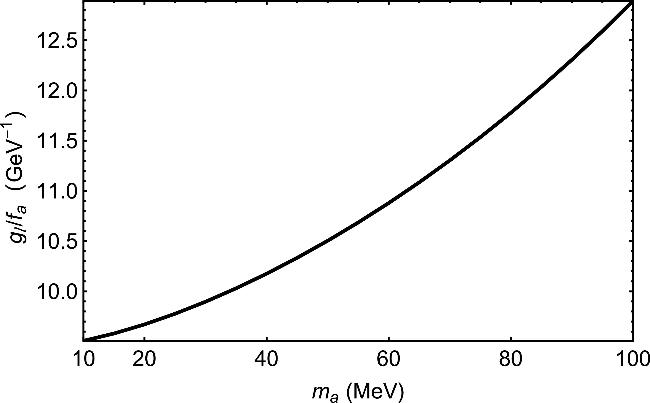
Figure 1. The upper constraints on ℓALP from the LFU parameter ${R}_{e/\mu }^{K}$ at the 95% confidence level (C.L.). |
In the SM, the four-leptonic decays of charged pseudoscalar mesons, ${P}^{+}\to {{\ell }}^{+}{\nu }_{{\ell }}\nu \bar{\nu }$, exhibit very low decay rates, which have been studied theoretically and experimentally for a long time. So far, substantial progresses have been made in related research. We summarize the currently existing experimental measurements and the corresponding SM predictions of the branching ratio $Br({P}^{+}\to {{\ell }}^{+}{\nu }_{{\ell }}\nu \bar{\nu }$) in table 2. If the ℓALP a from the decay channel P → ℓνℓa is assumed as an invisible or undetectable particle, its experimental signature would be analogous to that of a di-neutrino. Consequently, the precise measurements of the decay ${P}^{+}\to {{\ell }}^{+}{\nu }_{{\ell }}\nu \bar{\nu }$ can be used to constrain ℓALP.
Table 2. The experimental upper limits at the 90% C.L. and the corresponding SM predictions for the branching ratio $Br({P}^{+}\to {{\ell }}^{+}{\nu }_{{\ell }}\nu \bar{\nu })$. |
| $Br({P}^{+}\to {{\ell }}^{+}{\nu }_{{\ell }}\nu \bar{\nu })$ | Exp. | SM |
|---|---|---|
| $Br({\pi }^{+}\to {e}^{+}{\nu }_{e}\nu \bar{\nu })$ | <1.6 × 10⁻⁷ [25] | 1.7 × 10⁻¹⁸ [32] |
| $Br({K}^{+}\to {e}^{+}{\nu }_{e}\nu \bar{\nu })$ | <6 × 10⁻⁵ [25] | 2.58 × 10⁻¹⁶ [33] |
| $Br({K}^{+}\to {\mu }^{+}{\nu }_{\mu }\nu \bar{\nu })$ | <1.0 × 10⁻⁶ [25] | 1.62 × 10⁻¹⁶ [33] |
It can be seen from table 2 that the SM predictions are far smaller than the upper limits of the experimental measurements. Thus, we assume that the contributions of ℓALP do not exceed the upper limits of the experimental measurements. Since the decay width of the process P → ℓνℓa is proportional to the square of the charged lepton mass mℓ, as shown in equations (8 ) and (9 ), the contributions of the process K+ → e+νea to the decay ${K}^{+}\to {e}^{+}{\nu }_{e}\nu \bar{\nu }$ are very small. So we only consider the constraints on ℓALP from the processes ${\pi }^{+}\to {e}^{+}{\nu }_{e}\nu \bar{\nu }$ and ${K}^{+}\to {\mu }^{+}{\nu }_{\mu }\nu \bar{\nu }$ for its mass in the range 10 MeV ≤ ma ≤ 100 MeV, which are shown in figure 2. One can see that the decay ${K}^{+}\to {\mu }^{+}{\nu }_{\mu }\nu \bar{\nu }$ can give the stricter constraints, which demand the values of gℓ/fa from 7.60 × 10⁻² GeV−1 to 1.03 × 10⁻¹ GeV−1 at the 90% C.L.
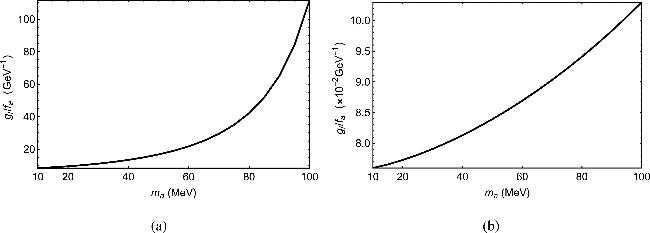
Figure 2. The upper constraints on the parameter gℓ/fa from the decays ${\pi }^{+}\to {e}^{+}{\nu }_{e}\nu \bar{\nu }$ (a) and ${K}^{+}\to {\mu }^{+}{\nu }_{\mu }\nu \bar{\nu }$ (b) as function of the ℓALP mass ma at the 90% C.L. |
ℓALP can also be produced from the decay W → ℓνℓa with a emitted from the charged lepton ℓ. Its decay rate can be approximately written as [34]
$\begin{eqnarray}{\rm{\Gamma }}(W\to {\ell }{\nu }_{{\ell }}a)=\frac{{G}_{{\rm{F}}}{m}_{W}^{3}{m}_{{\ell }}^{2}}{96\sqrt{2}{\pi }^{3}}\frac{{g}_{{\ell }}^{2}}{{f}_{a}^{2}}\left[\mathrm{log}\left(\frac{{m}_{W}}{{m}_{a}}\right)-\frac{17}{12}\right].\end{eqnarray}$
In above equation, we have taken the masses of the final state lepton ℓ and neutrino ν to be zero. The ℓALP signature is also assumed as missing energy/momentum, then the decay W → ℓνℓa can contribute to the signature of the decay W → ℓνℓ. Since the contributions are proportional to the square of the charged lepton mass, ${m}_{{\ell }}^{2}$, we only compare the numerical results for the decays W → μν and W → τν with the recently experimental measurements [25] and the corresponding SM predictions [35] to set limits on the free parameter gℓ/fa for ma in the considered range of this paper, which are shown in figure 3. For ma = 100 MeV, the decays W → μν and τν demand the values of gℓ/fa to be smaller than 3.8 GeV−1 and 0.54 GeV−1 at the 68% C.L., respectively.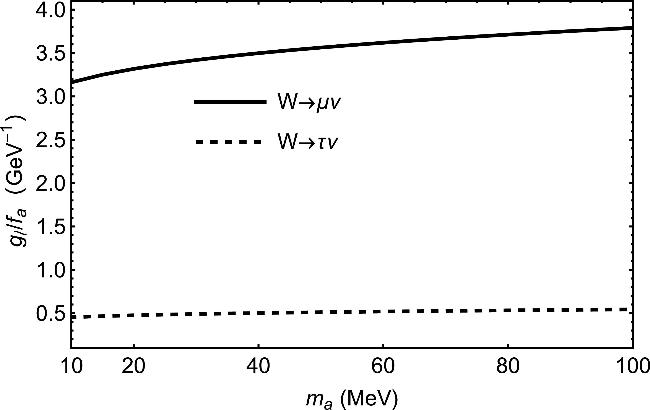
Figure 3. The upper constraints on the parameter gℓ/fa from the decays W → ℓνℓ as function of the ℓALP mass ma at the 68% C.L. |
We investigate the impact of the long-lived ALP assumption on the parameter space of ℓALP as shown in figures 1–3. Under the assumption of a long-lived ALP, certain regions of the parameter space are excluded. For instance, if we assume the ALP satisfies the long-lived condition mentioned above, the parameter space obtained from ${R}_{e/\mu }^{K}$ and ${\pi }^{+}\to {e}^{+}{\nu }_{e}\nu \bar{\nu }$ no longer satisfy the long-lived condition due to the relatively loose constraints obtained from them. As a result, the fraction of invisible ALP decays is reduced, which in turn diminishes the sensitivity of the channel. However, some regions of the parameter space remain unaffected. For example, the decay process ${K}^{+}\to {\mu }^{+}{\nu }_{\mu }\nu \bar{\nu }$ provides stringent constraints, and our calculations show that a portion of parameter space allowed by this process fully satisfies the long-lived ALP condition.
4. ℓALP and the leptonic four-body decay P+ → ℓ+νℓe+e−
The four-leptonic decays $P\to {\ell }{\nu }_{{\ell }}{{\ell }}^{{\prime} }\bar{{{\ell }}^{{\prime} }}$ with P being charged pseudoscalar mesons ${\pi }^{\pm },{K}^{\pm },{D}_{(s)}^{\pm }$ or B± are highly suppressed in the SM, which have been studied theoretically and experimentally for a long time. Many meaningful results have been given in literature (see e.g. [25]). For the ℓALP with mass in the range 10 MeV ≤ ma ≤ 100 MeV, if it prompt decays in the detector, then it mainly decays into electrons. Based on this hypothesis, we can also use equations (8 ) and (9 ) to drive the constraints on ℓALP from the decay P → ℓνℓe+e−.
So far, no measurement or limit exists for the decay π+ → μ+νμe+e−, the experimental measured value of the branching ratio Br(π+ → e+νee+e−) is (3.2 ± 0.5) × 10−9 [25]. In our numerical estimation, we take Br(a → e+e−) ≈ 1 as the loop-induced decay channel a → γγ is strongly suppressed in the mass range of our interest [24, 36, 37]. The SM prediction values of the branching ratio Br(π+ → e+νee+e−) is 3.0 × 10⁻⁹ [38]. Our numerical results are shown in figure 4, where the upper limits on the coupling parameter gℓ/fa are in the interval of 0.55–7.38 GeV−1 for 10 MeV ≤ ma ≤ 100 MeV. The results are obtained by allowing the experimental measured value to vary within a 1σ deviation.
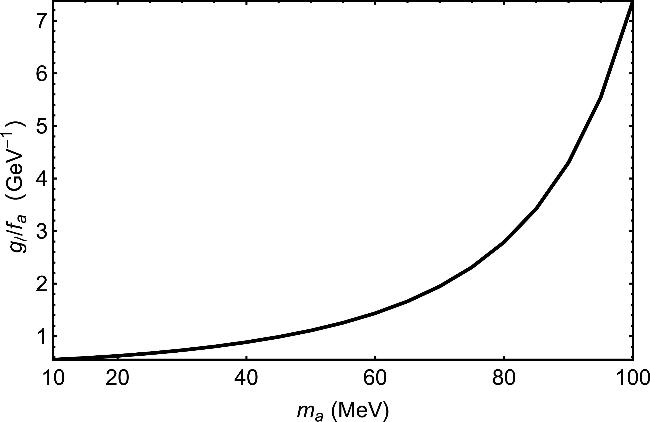
Figure 4. The upper limits on the coupling parameter gℓ/fa from the decay π+ → e+νee+e− as a function of the ℓALP mass ma at the 68% C.L. |
The experimental measured values of the branching ratios Br(K+ → e+νee+e−) and Br(K+ → μ+νμe+e−) are (2.48 ± 0.20) × 10−8 and (7.06 ± 0.31) × 10−8, respectively, for an invariant electron–positron mass mee > 140 MeV [25]. Thus, these experimental results can not be used to constrain the ℓALP with mass in the range from 10 MeV to 100 MeV. The SM prediction values of the branching ratios Br(K+ → μ+νμe+e−) and Br(K+ → e+νee+e−) with mee ≥ 15 MeV are 4.2 × 10⁻⁶ and 1.22 × 10⁻⁷, respectively [38]. If we demand that the contributions of ℓALP be smaller than 10% of the SM values, then one can obtain the significant constraints on ℓALP with mass in the range from 15 MeV to 100 MeV, as shown in figure 5. From this figure, one can see that the decays K+ → μ+νμe+e− and K+ → e+νee+e− provide upper limits on the coupling parameter gℓ/fa in the ranges 4.96 × 10⁻²–6.67 × 10⁻² GeV−1 and 1.75–2.35 GeV−1 for 15 MeV ≤ ma ≤ 100 MeV. It should be emphasized that the numerical results obtained from these decay channels are derived under the specific assumptions adopted in our analysis. Therefore, they are not directly comparable to the bounds obtained from experiments.
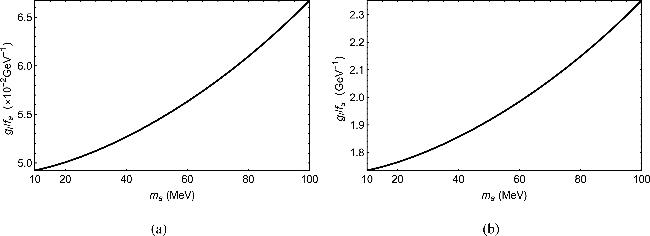


Figure 5. The upper limits on the coupling parameter gℓ/fa from the decays K+ → μ+νμe+e− (a) and K+ → e+νee+e− (b) as function of the ℓALP mass ma. |
5. Conclusions
The leptonic decays of charged pseudoscalar mesons are highly suppressed and their decay rates are very small in the SM, and thus are sensitive to new physics effects. In recent years, various high-and low-energy experiments have paid great attention to this kind of decays and significant advancements have been and will be made in this field. Thus, it is needed to systematically study the contributions of various new physics scenarios to the leptonic decays of charged pseudoscalar mesons.
In this paper, we systematically consider the constraints of the purely leptonic decays of charged pseudoscalar mesons P on ℓALPs with masses in the range 10–100 MeV, and compare our numerical results with the latest experimental data. We find that the decays ${P}^{+}\to {{\ell }}^{+}{\nu }_{{\ell }}\nu \bar{\nu }$ and P+ → ℓ+νℓe+e− (P being π±, K±) can give meaningful constraints on ℓALP, while the LFU parameter ${R}_{e/\mu }^{K}$ provides relatively weak constraints. The most strongest constraints arise from the measurements of the decay ${K}^{+}\to {\mu }^{+}{\nu }_{\mu }\nu \bar{\nu }$, which set upper bounds of 7.60 × 10⁻²–1.03 × 10⁻¹ GeV−1 for ALPs with masses between 10 MeV and 100 MeV at the 90% C.L. Moreover, under the specific assumptions adopted in our analysis, the upper bounds on the coupling gℓ/fa from the decay K+ → μ+νμe+e− and K+ → e+νee+e− for ALP with masses in the range of 15–100 MeV are in the ranges 4.96 × 10⁻²–6.67 × 10⁻² GeV−1 and 1.75–2.35 GeV−1, respectively. The precision measurements of the W decays W+ → μ+νμ and τ+ντ can also generate significant constraints on the FD coupling $a{\ell }\bar{{\ell }}$. We hope that this work will be helpful to explore ℓALP via meson decays in future experiments.