

1. Introdution
Robust evidences from astrophysical observations point to the existence of cold dark matter (DM), which can not be addressed by the minimal Standard Model (SM) of particle physics. For a DM mass above 1 keV, it behaves as a cold DM [1]. It is well-known that cold DM needs to interact with the SM particles in addition to the gravitational interaction so as to explain the observed relic abundance, but how it couples to the SM is still unknown. There are various DM candidates with mass ranging from 10−22 eV to 1055 GeV. Due to the progress of direct and indirect DM detection technology, many DM models have already been excluded, however the neutrino portal [2–12] is relatively safe, as neutrinos themselves are also difficult to probe. One of the most famous neutrino portal model is sterile neutrino DM which can be warm or cold DM and whose production mechanism is via neutrino oscillations [2, 3]. There is also famous scotogenic model [13] which include the DM and neutrino masses into one framework by introducing extra Yukawa interactions. A third typical neutrino portal model takes ${Z}^{{\prime} }$ or dark photon as the mediator [14, 15]. New interactions in the neutrino portal may induce irreducible background, named as ‘neutrino floor' [16–19], in direct detection experiments. They may also generate some exotic signals in various neutrino oscillation experiments. It is of great significance to study these signals because they may be an important indirect evidence for the existence of CDM.
In this paper, we will study possible signal of DM in neutrino oscillations. As we all know, DM accounts for 26.8% of the Universe, and the entire Milky Way Galaxy is in a huge dark halo. When neutrinos propagate in the dark halo, the interaction between neutrinos and DM will lead to the matter effect of neutrino oscillations. Note that the density of DM is about 0.4 GeV cm−3 [20] near the solar system, so the matter effect caused by DM may be too small to be observed in long baseline neutrino oscillation experiments that are located on the Earth. However, in some regions of the Universe, such as the center of the Galactic center or dwarf spheroidal galaxies, the density of DM can be very high. When high-energy neutrinos pass through these regions, strong matter effect can be induced by the DM. In fact, the matter effect induced by DM has drawn the theorists' attention, and some important issues have already been addressed [21–23]. We will discuss the phenomenology of DM and neutrino oscillations within the framework of $U{(1)}_{{L}_{\mu }-{L}_{\tau }}$ [24, 25], which is one of the most economical extensions to the SM. It does not require the introduction of additional elementary particles to eliminate various anomalies. Compared with Le − Lμ [26], B − L [27], and $U{(1)}_{R}^{}$ [28], this model is less restricted and can be used to explain exotic phenomena in high-energy physics experiments, such as the universality violation in the decay of B meson [25] and the low-energy recoil signal of XENON1T [29]. We first perform a systematic study on constraints on the model arising from the observed relic abundance of DM, upper limits on the direct detection cross section as well as the anomalous magnetic moment of the muon. Then we discuss impacts of this new neutral current interaction to neutrino oscillations. In the three-flavor neutrino oscillation scheme, we study the (dark) matter effect of neutrino masses, lepton mixing angles, Dirac CP phase, and neutrino oscillation probabilities in the dark halo using full numerical calculations. Our results are applicable to study high energy neutrino oscillations in a dense DM environment.
The remaining of the paper is organized as follows: In section 2 we introduce the model in detail and discuss various constraints. In section 3 , we study the phenomenology of DM in the Lμ − Lτ model. Section 4 is devoted to the study of neutrino oscillations in dark halo. The last part is concluding remarks.
2. The $U{(1)}_{{L}_{\mu }-{L}_{\tau }}$ model
It is well known that [24] the differences of lepton numbers can be gauged U(1) symmetries with anomalies automatically cancelled. Such gauge theories, named as $U{(1)}_{{L}_{\alpha }-{L}_{\beta }}$ with α, β = e, μ, τ, have been widely studied as potential candidates of new physics beyond the SM. In this paper, we introduce a vector-like fermion χ in the $U{(1)}_{{L}_{\mu }-{L}_{\tau }}^{}$ model to address the DM problem, and study neutrino oscillations in the DM halo. The particles and relevant charge assignments are shown in the table 1. The Lagrangian for new particles can be written as
$\begin{eqnarray}\begin{array}{l}{ \mathcal L }\sim \overline{\chi }{\rm{i}}/D\chi +{({D}_{\mu }{\rm{\Phi }})}^{\dagger }({D}^{\mu }{\rm{\Phi }})-{m}_{\chi }\overline{\chi }\chi +{\mu }^{2}{{\rm{\Phi }}}^{\dagger }{\rm{\Phi }}\\ \quad -\lambda {({{\rm{\Phi }}}^{\dagger }{\rm{\Phi }})}^{2},\end{array}\end{eqnarray}$
where ${D}_{\mu }={\partial }_{\mu }^{\,}-{\rm{i}}{g}_{X}^{\,}Z{{\prime} }_{\mu }$ being the covariant derivative with ${g}_{X}^{\,}$ the new gauge coupling and ${Z}^{{\prime} }$ the new gauge boson, ${\rm{\Phi }}\equiv (\phi +{\rm{i}}\eta )/\sqrt{2}$ being a complex scalar singlet. When Φ develops a non-zero vacuum expectation value ${v}_{{\rm{\Phi }}}^{\,}$, the $U{(1)}_{{L}_{\mu }-{L}_{\tau }}$ gauge symmetry is broken spontaneously and ${Z}^{{\prime} }$ gets nonzero mass ${M}_{{Z}^{{\prime} }}={g}_{X}^{\,}{v}_{{\rm{\Phi }}}$. The physical scalar singlet is φ with the mass squared ${M}_{\phi }^{2}=2\lambda {v}_{{\rm{\Phi }}}^{2}$. Here we have assumed that the mixing between Φ and the SM Higgs is negligible for simplicity. In the following we will address several constraints that are relevant to this model.Table 1. Particles and relevant $U{(1)}_{{L}_{\mu }-{L}_{\tau }}$ charges. |
| Particles | ℓe | ℓμ | ℓτ | eR | μR | τR | ${\chi }_{L,R}^{\,}$ | Φ |
|---|---|---|---|---|---|---|---|---|
| Charges | 0 | 1 | −1 | 0 | 1 | −1 | 1 | 1 |
2.1. Neutrino masses
The discovery of neutrino oscillations have proved that the SM is incomplete and one needs to explain the origin of tiny but non-zero neutrino masses. A most economic approach towards understanding the origin of neutrino masses is using the dimension-five Weinberg operator [30],
$\begin{eqnarray}\frac{1}{4}{\kappa }_{fg}{\overline{{{\ell }}_{Lc}^{C}}}^{f}{\varepsilon }_{cd}{H}_{d}{{\ell }}_{Lb}^{g}{\varepsilon }_{ba}{H}_{a}+{\rm{h.c.}},\end{eqnarray}$
where f and g are flavor indices, a, b, c and d are isospin indices, H is the SM Higgs doublet, ℓL is left-handed lepton doublet. This operator comes from integrating out heavy seesaw particles. In the $U{(1)}_{{L}_{\mu }-{L}_{\tau }}$ model, ${{\ell }}_{L}^{e}$, ${{\ell }}_{L}^{\mu }$ and ${{\ell }}_{L}^{\tau }$ carry different $U{(1)}_{{L}_{\mu }-{L}_{\tau }}^{\,}$ charges. As a result, the active neutrino mass matrix takes the following form $\begin{eqnarray}{M}_{\nu }\sim \left(\begin{array}{ccc}\star & 0 & 0\\ 0 & 0 & \star \\ 0 & \star & 0\end{array}\right),\end{eqnarray}$
which results in θ12 = θ13 = 0 and θ23 = 45° with θij the mixing angle of the Pontecorvo–Maki–Nakagawa–Sakata (PMNS) matrix in the standard parameterization. This scenario has been ruled out by the neutrino oscillation data. One possible way out is including the following dimension-six effective operators $\begin{eqnarray}\begin{array}{l}\frac{1}{4}{\kappa }_{e\mu }^{{\prime} }{{\rm{\Phi }}}^{\dagger }{\overline{{{\ell }}_{Lc}^{C}}}^{e}{\varepsilon }_{cd}{H}_{d}{{\ell }}_{Lb}^{\mu }{\varepsilon }_{ba}{H}_{a}\\ \quad +\frac{1}{4}{\kappa }_{e\tau }^{{\prime} }{\rm{\Phi }}{\overline{{{\ell }}_{Lc}^{C}}}^{e}{\varepsilon }_{cd}{H}_{d}{{\ell }}_{Lb}^{\tau }{\varepsilon }_{ba}{H}_{a}+{\rm{h.c.}}.\end{array}\end{eqnarray}$
Then, only the (2, 2) and (3, 3) elements in the neutrino mass matrix are zero. It has been shown in the Ref. [31] that this kind of texture zero only favors the inverted hierarchy scenario. Actually (2, 2) and (3, 3) elements can be nonzero by introducing dimension-seven effective operators. Taking into account these arbitrariness, we will not concentrate on the flavor structure of neutrino mass matrix in the $U{(1)}_{{L}_{\mu }-{L}_{\tau }}$ and take the experimental observables as input in the following study. It should be mentioned that these high dimensional operators may come from integrating out heavy right-handed Majorana neutrinos.2.2. Muon g-2
The anomalous magnetic moment of the muon, (g − 2)μ is one of the most precisely measured quantities in high energy physics. Combining the earlier Brookhaven result with the recent measurement by the Fermilab Muon g − 2 experiment [32, 33], the current world-average experimental value is
$\begin{eqnarray}{a}_{\mu }^{{\rm{\exp }}}=116592061(41)\times 1{0}^{-11},\end{eqnarray}$
which deviates from the SM prediction [34, 35] by about 4.2σ. However, it should be noted that recent lattice QCD calculations suggest a larger SM contribution, which reduces the tension between theoretical calculations and experimental measurements [36]. Due to the gauge interaction of muon with ${Z}^{{\prime} }$, aμ receives contribution from the ${Z}^{{\prime} }$ mediated loop, which can be expressed as $\begin{eqnarray}{\rm{\Delta }}{a}_{\mu }=\frac{{g}_{X}^{2}}{4{\pi }^{2}}{\int }_{0}^{1}{\rm{d}}t\frac{{t}^{2}(1-t)}{{t}^{2}+(1-t){M}_{{Z}^{{\prime} }}^{2}/{m}_{\mu }^{2}}.\end{eqnarray}$
As can be seen, both gX and ${M}_{{Z}^{{\prime} }}$ are relevant to the Δaμ, which is always positive in this model. We show in the figure 1 contours of Δaμ in the ${M}_{{Z}^{{\prime} }}-{g}_{X}$ plane. The magenta band is favored by the current data. For more discussions about the (g − 2)μ in $U{(1)}_{{L}_{\mu }-{L}_{\tau }}$, we refer the reader to Refs [37–39] and references cited therein.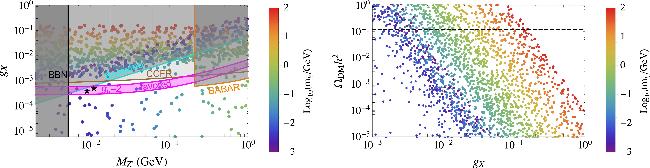
Figure 1. The left panel shows the allowed points in ${g}_{X}-{M}_{{Z}^{{\prime} }}$ plane that may give rise to the observed relic density ΩDMh2 = 0.12. The right panel illustrates the correlation between gX and ΩDMh2 as a function of mχ for ${M}_{Z^{\prime} }=1{0}^{-2}$ GeV. |
2.3. Stability of the ${Z}^{{\prime} }$, φ and χ
There are three new particles in the Lμ − Lτ model: ${Z}^{{\prime} }$, φ and χ. We will discuss their stabilities one by one. ${Z}^{{\prime} }$ couples to χ, left-handed active neutrinos and charged leptons μ, τ. The total decay rate of ${Z}^{{\prime} }$ to leptons can be written as 7 ) is the total decay rate to neutrinos in which we have neglected the tiny neutrino masses. For ${Z}^{{\prime} }$ mass smaller than 2mν where mν is the neutrino mass, the dominant decay channel is to three photons through the muon loop, and the decay rate is calculated as [40]
$\begin{eqnarray}\begin{array}{rcl}{{\rm{\Gamma }}}_{{Z}^{{\prime} }\to \bar{f}f}^{\,} & = & \displaystyle \sum _{\alpha =\mu ,\tau ,\chi }{\rm{\Theta }}({M}_{{Z}^{{\prime} }}-2{m}_{\alpha })\frac{{\alpha }_{X}{M}_{{Z}^{{\prime} }}}{3}\sqrt{1-4{\beta }_{\alpha }}\\ & & \times \left(1+2{\beta }_{\alpha }\right)+\frac{{M}_{{Z}^{{\prime} }}{\alpha }_{X}}{3},\end{array}\end{eqnarray}$
where ${\alpha }_{X}={g}_{X}^{2}/4\pi $ and ${\beta }_{\alpha }={m}_{\alpha }^{2}/{M}_{{Z}^{{\prime} }}^{2}$, Θ(x) is the step function. The second term on the right-handed side of the equation ( $\begin{eqnarray}{{\rm{\Gamma }}}_{{Z}^{{\prime} }\to 3\gamma }\approx \frac{17{\alpha }^{3}{\alpha }_{X}}{11664000{\pi }^{3}}\frac{{M}_{{Z}^{{\prime} }}^{9}}{{m}_{\mu }^{8}},\end{eqnarray}$
where α is the fine-structure constant. In this paper, we assume that ${M}_{{Z}^{{\prime} }}$ is sizable and thus ${Z}^{{\prime} }$ cannot be a DM candidate.The physical scalar φ arises from the spontaneous breaking of the $U{(1)}_{{L}_{\mu }-{L}_{\tau }}$. It only couples to ${Z}^{{\prime} }$ in the toy model. For ${M}_{\phi }\gt {M}_{{Z}^{{\prime} }}$, φ can decay into ${Z}^{{\prime} }$ pair, with the decay rate
$\begin{eqnarray}{{\rm{\Gamma }}}_{\phi \to {Z}^{{\prime} }{Z}^{{\prime} }}={\alpha }_{X}^{\,}\frac{{M}_{{Z}^{{\prime} }}^{2}}{{M}_{\phi }}\sqrt{1-4\frac{{M}_{{Z}^{{\prime} }}^{2}}{{M}_{\phi }^{2}}}\left(\frac{{M}_{\phi }^{4}}{4{M}_{{Z}^{{\prime} }}^{4}}-\frac{{M}_{\phi }^{2}}{{M}_{{Z}^{{\prime} }}^{2}}+3\right).\end{eqnarray}$
For ${M}_{{Z}^{{\prime} }}\lt {M}_{\phi }\lt 2{M}_{{Z}^{{\prime} }}$, the decay channel turns to be $\phi \to {Z}^{{\prime} }{Z}^{{\prime} * }\to {Z}^{{\prime} }\bar{f}f$. With neutrino pairs in the final state, the decay rate can be written as $\begin{eqnarray}{\rm{\Gamma }}(\phi \to {Z}^{{\prime} }\bar{\nu }\nu )=\frac{{\alpha }^{2}{M}_{\phi }}{24\pi }F(x),\end{eqnarray}$
where $x={M}_{{Z}^{{\prime} }}/{M}_{\phi }$ and [41] $\begin{eqnarray}\begin{array}{rcl}F(x) & = & \frac{3(1-8{x}^{2}+20{x}^{4})}{{(4{x}^{2}-1)}^{1/2}}\arccos \left(\frac{2{x}^{2}-1}{2{x}^{3}}\right)\\ & & -(1-{x}^{2})\left(\frac{47}{2}{x}^{2}-\frac{13}{2}+\frac{1}{{x}^{2}}\right)\\ & & -3(1-6{x}^{2}+4{x}^{4})\mathrm{ln}(x).\end{array}\end{eqnarray}$
For ${M}_{\phi }\lt {M}_{{Z}^{{\prime} }}$, the possible decay channels of φ are to four leptons or six photons mediated by virtual ${Z}^{{\prime} }$. In this case, the decay rate can only be calculated numerically. In short, φ cannot be stable unless it is ultra-light.As can be seen in equation (1 ), χ is vector-like fermion with respect to the $U{(1)}_{{L}_{\mu }-{L}_{\tau }}$, so there is no interaction between χ and Φ. However there can be a Yukawa interaction ${Y}_{\chi }^{\,}\overline{{{\ell }}_{L}^{\mu }}\tilde{H}{\chi }_{R}$, which may lead to an unstable χ. We need to introduce a Z2 symmetry, under which only χ is odd and all other particles are even, to forbid this Yukawa interaction. Alternatively, the stability of the DM particle χ can also be ensured by an appropriate assignment of its $U{(1)}_{{L}_{\mu }-{L}_{\tau }}$ charge. For example, interactions between the SM lepton doublets and χ will be forbidden whenever $U{(1)}_{{L}_{\mu }-{L}_{\tau }}$ charges of ${\chi }_{L,R}^{\,}$ are assigned to be any value other than 1. In this sense, the introduction of a discrete Z2 symmetry is a simple and minimal choice, but not the only possible mechanism to stabilize χ. As a result, χ is a stable DM candidate and only couples to the lepton sector via the gauge portal.
3. Dark matter phenomenology
3.1. The relic density
The DM χ can be thermalized with the thermal bath via the gauge interaction in the early Universe and its evolution is described by the Boltzmann equation,
$\begin{eqnarray}\frac{{\rm{d}}{n}_{\chi }}{{\rm{d}}t}+3H{n}_{\chi }=-\langle \sigma v\rangle \left({({n}_{\chi })}^{2}-{({n}_{\chi }^{{\rm{eq}}})}^{2}\right),\end{eqnarray}$
where nχ is the number density of χ, H is the Hubble constant and ⟨σv⟩ is the thermal average of the reduced annihilation cross section. The reduced annihilation cross section are $\begin{eqnarray}\begin{array}{l}\sigma v(\bar{\chi }\chi \to {\bar{{\ell }}}_{\alpha }{{\ell }}_{\alpha })=8\pi {\alpha }_{X}^{2}\sqrt{1-\frac{{m}_{\alpha }^{2}}{{m}_{\chi }^{2}}}\\ \quad \times \frac{2{m}_{\chi }^{2}+{m}_{\alpha }^{2}}{{(4{m}_{\chi }^{2}-{M}_{{Z}^{{\prime} }}^{2})}^{2}+{M}_{{Z}^{{\prime} }}^{2}{{\rm{\Gamma }}}_{{Z}^{{\prime} }}^{2}},\end{array}\end{eqnarray}$
$\begin{eqnarray}\sigma v(\bar{\chi }\chi \to {Z}^{{\prime} }{Z}^{{\prime} })=\frac{4\pi {\alpha }_{X}^{2}{(1-{M}_{{Z}^{{\prime} }}^{2}/{m}_{\chi }^{2})}^{3/2}}{{m}_{\chi }^{2}{(2-{M}_{{Z}^{{\prime} }}^{2}/{m}_{\chi }^{2})}^{2}},\end{eqnarray}$
where mα denotes lepton mass. For the annihilation into neutrinos, one needs to include an extra factor of 1/2 in the cross section. Note that for ${M}_{\phi }+{M}_{{Z}^{{\prime} }}\lt 2{m}_{\chi }$, an extra channel $\bar{\chi }\chi \to \phi Z^{\prime} $ opens up and it complicates our physics picture, so we take the singlet scalar mass to be larger than 2mχ threshold for the simplicity. The thermal average of the reduced annihilation cross section can be written as $\langle \sigma v\rangle =a+b\langle {v}^{2}\rangle +{ \mathcal O }({v}^{4})$, where a and b are the s-wave and p-wave terms, respectively.By solving the equation (12 ), the DM relic density is [42, 43],
$\begin{eqnarray}{{\rm{\Omega }}}_{{\rm{DM}}}{h}^{2}=\frac{2.08\times 1{0}^{9}\,{{\rm{GeV}}}^{-1}{x}_{f}}{{M}_{{\rm{pl}}}\sqrt{{g}_{* }({T}_{f})}(a+3b/{x}_{f})},\end{eqnarray}$
where ⟨σannv⟩ = a + b/xf and xf ≡ mχ/Tf with Tf being the freeze-out temperature, g*(Tf) is the total number of effective relativistic degrees of freedom when the DM freezes out, Mpl is the Planck mass. The parameter xf is given by, $\begin{eqnarray}{x}_{f}=\mathrm{ln}\left[c(c+2)\sqrt{\frac{45}{8}}\frac{g{M}_{\chi }{M}_{{\rm{pl}}}(a+6b/{x}_{f})}{2{\pi }^{3}\sqrt{{g}_{* }({x}_{f})}\,{x}_{f}^{1/2}}\right],\end{eqnarray}$
where c is a constant of order one.In this work, we use Feynrules [44] to obtain the model files for the Calchep [45] and also use the MicrOMEGAs [46] to calculate the DM relic density as well as the reduced annihilation cross section. In figure 1, we show constraints on the parameter spaces of the model by several physical observables. The plot on the left panel shows the allowed parameter space in the $({M}_{{Z}^{{\prime} }},{g}_{X})$ plane that may give rise to a correct relic density ΩDMh2 = 0.12 (scattering points). The gray shadowed regions are already excluded. Among these regions, the black, cyan, brown and orange lines denote constraints from BBN [47, 48], Borexino [47], CCFR [49] and BABAR [50], respectively. The magenta band is the favored region of the muon g − 2 [32]. The two black stars denote the reference points to explain IceCube results [47]. For points in the allowed parameter space, we have ${m}_{{Z}^{{\prime} }}\sim 2{m}_{\chi }^{\,}$, which results in a relatively small gX as the annihilation cross section is resonantly enhanced. Notice that the number of viable points in the small gX region is relatively limited. This is because the annihilation cross section is generally too small to reproduce the observed relic density for a small gauge coupling. Only parameter space close to the resonance regime, namely ${M}_{{Z}^{{\prime} }}\simeq 2{m}_{\chi }$, where the annihilation is resonantly enhanced, satisfy the constraint of the observed relic abundance. This results in a reduced density of viable points and reflects a degree of tuning associated with resonant annihilation. On the right-panel of the figure 1 we show the scattering plot of Ωh2 as the function of the coupling gX by setting ${m}_{{Z}^{{\prime} }}=1{0}^{-2}\,{\rm{GeV}}$. The black dashed line denotes the observed DM relic density. It shows the relic density is inversely proportional to ${g}_{X}^{4}$ and increases as the increase of ${m}_{\chi }^{\,}$.
3.2. The dark matter scattering off electron
Although the kinetic mixing between ${Z}^{{\prime} }$ and photon is absent at the tree level, the mixing can be generated at the one-loop level by virtual μ ant τ leptons [38], as illustrated in the figure 2,
$\begin{eqnarray}\epsilon =\frac{e{g}_{X}}{6{\pi }^{2}}{\rm{ln}}\left(\frac{{m}_{\mu }}{{m}_{\tau }}\right).\end{eqnarray}$
The cross section for the DM scattering off the electron when the momentum transfer is much smaller than the mediator mass ${M}_{Z^{\prime} }$ can be written as, $\begin{eqnarray}{\sigma }_{\chi e}=\frac{16\pi {\epsilon }^{2}\alpha {\alpha }_{X}{\mu }_{\chi e}^{2}}{{M}_{Z^{\prime} }^{4}},\end{eqnarray}$
where μχe is the reduced mass of DM and electron.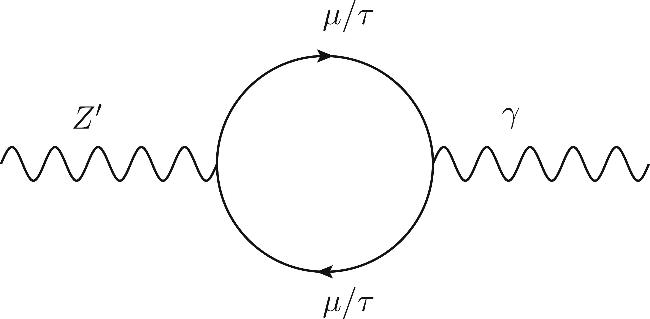
Figure 2. The kinetic mixing between ${Z}^{{\prime} }$ and photon at the one loop with virtual μ ant τ leptons [38]. |
In figure 3, we show in the mχ–gX plane the exclusion limits given by the XENON1T [51] for DM-electron scattering cross section, where the blue, red and green solid lines as well as black solid and dashed lines correspond to ${M}_{Z^{\prime} }=1{0}^{-1}\,{\rm{GeV}},1{0}^{-2}\,{\rm{GeV}},1{0}^{-3}$ GeV and ${M}_{Z^{\prime} }={m}_{\chi }/3$, 3mχ, respectively. This constraint, together with these from low energy precision measurements, puts upper bounds on the new gauge coupling.
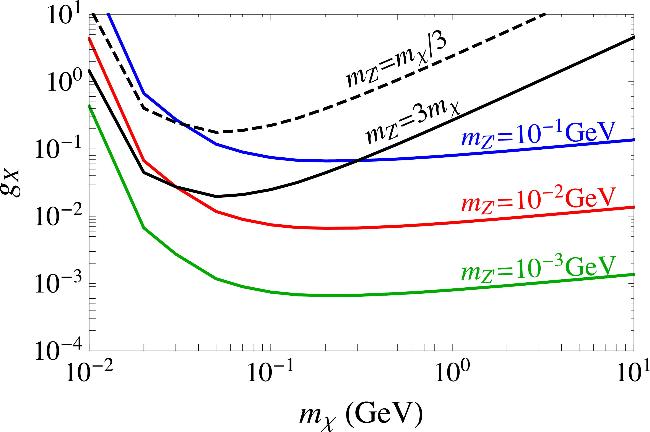
Figure 3. The XENON1T [51] constraints for DM-electron scattering cross section with fixed values of ${M}_{Z^{\prime} }=1{0}^{-1}\,{\rm{GeV}}\,({\rm{blue}}),1{0}^{-2}\,{\rm{GeV}}\,({\rm{red}}),1{0}^{-3}\,{\rm{GeV}}\,({\rm{green}})$ or with ${M}_{Z^{\prime} }={m}_{\chi }/3$ (black solid line), 3mχ(black dashed lines). |
4. Neutrino oscillations
Neutrino oscillation opens an important window for probing new physics beyond the SM. The neutrino-medium interaction can significantly change the behavior of neutrino oscillations [52, 53]. In addition to the SM charged current and neutral current interactions, there can be other non-standard neutrino interactions which can modify the propagation of neutrinos and thus alter the neutrino oscillation probabilities. For useful reviews see e.g. Refs. [54–56] and references cited therein. In the Lμ − Lτ model, the DM-neutrino interaction may induce extra matter effect in neutrino oscillations. We focus on the asymptotic behavior of neutrinos when DM density is large and the ordinary matter effect (i.e. electrons, protons and neutrons) can be ignored, which is similar to the case of dense matter effect [57–59].
When neutrinos propagate in the DM, their evolution equation is modified by the effective potential due to the interactions with the DM through coherent forward elastic scatterings. The effective potential for muon and tau neutrinos are 19 ), we can write down the effective Hamiltonian $\tilde{{ \mathcal H }}$, which differs from the Hamiltonian in vacuum ${ \mathcal H }$, in the flavor basis 23 ) numerically. The best-fit values of the neutrino oscillation parameters in vacuum are summarized in the table 2, which are adopted as inputs in following numerical calculations.
$\begin{eqnarray}{V}_{\chi }=\pm \frac{{g}_{X}^{2}}{{m}_{{Z}^{{\prime} }}^{2}}{n}_{\chi },\end{eqnarray}$
with the positive (negative) sign for muon (tau) neutrino, where nχ is the DM density. The evolution equation of the flavor transition amplitude is $\begin{eqnarray}{\rm{i}}\frac{{\rm{d}}}{{\rm{d}}x}{{\rm{\Psi }}}_{\alpha }=\tilde{{ \mathcal H }}{{\rm{\Psi }}}_{\alpha },\end{eqnarray}$
where $\tilde{{ \mathcal H }}$ is the effective Hamiltonian in DM. Given the effective potential in equation ( $\begin{eqnarray}\begin{array}{rcl}\tilde{{ \mathcal H }} & = & { \mathcal H }+{{ \mathcal H }}^{{\prime} }=\,\frac{1}{2E}\left[V\left(\begin{array}{ccc}{m}_{1}^{2} & & \\ & {m}_{2}^{2} & \\ & & {m}_{3}^{2}\end{array}\right){V}_{}^{\dagger }\right.\\ & & \left.+\left(\begin{array}{ccc}{A}_{CC} & & \\ & {A}_{\chi }^{\,} & \\ & & -{A}_{\chi }^{\,}\end{array}\right)\right],\end{array}\end{eqnarray}$
where ${A}_{\chi }^{\,}=2E{V}_{\chi }$, ACC = 2EVCC with VCC the effective potential coming from the SM charge current interaction. For neutrinos Aχ > 0 and for anti-neutrinos Aχ < 0. V is the 3 × 3 unitary PMNS lepton mixing matrix [60, 61], in which θ12, θ13, θ23 are three mixing angles and δ is the Dirac CP phase [62], $\begin{eqnarray}V=\left(\begin{array}{ccc}{c}_{12}^{\,}{c}_{13}^{\,} & {s}_{12}^{\,}{c}_{13}^{\,} & {s}_{13}^{\,}{{\rm{e}}}_{}^{-{\rm{i}}\delta }\\ -{s}_{12}^{\,}{c}_{23}^{\,}-{c}_{12}^{\,}{s}_{23}^{\,}{s}_{13}^{\,}{{\rm{e}}}_{}^{{\rm{i}}\delta } & {c}_{12}^{\,}{c}_{23}^{\,}-{s}_{12}^{\,}{s}_{23}^{\,}{s}_{13}^{\,}{{\rm{e}}}_{}^{{\rm{i}}\delta } & {s}_{23}^{\,}{c}_{13}^{\,}\\ {s}_{12}^{\,}{s}_{23}^{\,}-{c}_{12}^{\,}{c}_{23}^{\,}{s}_{13}^{\,}{{\rm{e}}}_{}^{{\rm{i}}\delta } & -{c}_{12}^{\,}{s}_{23}^{\,}-{s}_{12}^{\,}{c}_{23}^{\,}{s}_{13}^{\,}{{\rm{e}}}_{}^{{\rm{i}}\delta } & {c}_{23}^{\,}{c}_{13}^{\,}\end{array}\right),\end{eqnarray}$
with ${c}_{ij}^{\,}\equiv \cos {\theta }_{ij}^{\,}$ and ${s}_{ij}^{\,}\equiv \sin {\theta }_{ij}^{\,}$ (for ij = 12, 13, 23). In our case, the effect of the charged current interaction is ignored (ACC = 0) for simplicity. Note that the term proportional to the identity matrix does not affect the neutrino oscillation behaviors, so we can ignore the ${m}_{1}^{2}$ term, the Hamiltonian $\tilde{{ \mathcal H }}$ can be rewritten as, $\begin{eqnarray}\begin{array}{rcl}\tilde{{ \mathcal H }} & = & \frac{1}{2E}\left[V\left(\begin{array}{ccc}0 & & \\ & {\rm{\Delta }}{m}_{21}^{2} & \\ & & {\rm{\Delta }}{m}_{31}^{2}\end{array}\right){V}^{\dagger }\right.\\ & & \left.+\left(\begin{array}{ccc}0 & & \\ & {A}_{\chi }^{\,} & \\ & & -{A}_{\chi }^{\,}\end{array}\right)\right]\\ & = & \frac{1}{2E}\tilde{V}\left(\begin{array}{ccc}{\tilde{m}}_{1}^{2} & & \\ & {\tilde{m}}_{2}^{2} & \\ & & {\tilde{m}}_{3}^{2}\end{array}\right){\tilde{V}}_{}^{\dagger },\end{array}\end{eqnarray}$
where the $\tilde{V}$ is the mixing matrix in DM and the ${\tilde{m}}_{i}^{2}$(i = 1, 2, 3) are the eigenvalues. One can obtain ${\rm{\Delta }}{\tilde{m}}_{ji}^{2}={\tilde{m}}_{j}^{2}-{\tilde{m}}_{i}^{2}$ by solving equation (Table 2. Three-flavor oscillation parameters from a global fit data of current experimental data [63]. Note that ${\rm{\Delta }}{m}_{31}^{2}\lt 0$ for (IO). |
| Normal mass ordering inverted mass ordering | ||
|---|---|---|
| θ12 | 33.82° | 33.82° |
| θ13 | 8.61° | 8.65° |
| θ23 | 49.7° | 49.7° |
| δ | 217° | 280° |
| ${\rm{\Delta }}{m}_{21}^{2}[1{0}^{-5}\,{{\rm{eV}}}^{2}]$ | 7.39 | 7.39 |
| ${\rm{\Delta }}{m}_{31}^{2}[1{0}^{-3}\,{{\rm{eV}}}^{2}]$ | 2.451 | −2.512 |
We show the modulus of the mass-squared differences $| {\rm{\Delta }}{\tilde{m}}_{21}^{2}| $ and $| {\rm{\Delta }}{\tilde{m}}_{31}^{2}| $ as the function of ${A}_{\chi }/| {\rm{\Delta }}{m}_{31}^{2}| $ in the figure 4, where plots in the left-panel and right-panel correspond to the normal and inverted mass hierarchies, respectively. It is helpful to discuss the asymptotic behavior of them. When ∣Aχ∣ → 0, neutrinos are propagating in the ‘vacuum-dominated' region, and there is almost no DM effect in neutrino oscillations. The DM effect becomes significant for $| {A}_{\chi }| \sim | {\rm{\Delta }}{m}_{31}^{2}| $. While ∣Aχ∣ → ∞, in other words, $| {A}_{\chi }| \gg | {\rm{\Delta }}{m}_{31}^{2}| $, the neutrinos are propagating in the ‘DM-dominated' region. Three eigenvalues of $\tilde{{ \mathcal H }}$ are separated and neutrino oscillation can hardly happen in this region.
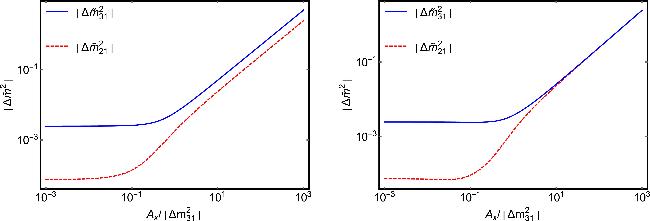
Figure 4. The modulus of the neutrino mass-squared differences in matter $| {\rm{\Delta }}{\tilde{m}}_{21}^{2}| $(red and dashed) and $| {\rm{\Delta }}{\tilde{m}}_{31}^{2}| $(blue and solid) with respect to ${A}_{\chi }/| {\rm{\Delta }}{m}_{31}^{2}| $ in the normal and inverted mass hierarchies, respectively. |
In the figures 5 and 6, we illustrate the evolution behaviors of the matrix elements $| {\tilde{V}}_{\alpha i}| $, which are derived from the eigenvector-eigenvalue identity [64], 26 ) and (27 ) into equation (24 ), we can get numerical values of the nine lepton mixing matrix elements in DM. We can conclude from the figures 5 and 6 that, corrections to $| {\tilde{V}}_{\alpha i}| $ are very small for $| {A}_{\chi }| \ll | {\rm{\Delta }}{m}_{31}^{2}| $. $| {\tilde{V}}_{\alpha i}| $ receive dramatic corrections from the DM when $| {A}_{\chi }| \sim | {\rm{\Delta }}{m}_{31}^{2}| $. For ∣Aχ∣ → ∞, the neutrino flavors decouple from each other.
$\begin{eqnarray}| {\tilde{V}}_{\alpha i}{| }^{2}=\frac{({\lambda }_{i}-{\xi }_{\alpha })({\lambda }_{i}-{\zeta }_{\alpha })}{({\lambda }_{i}-{\lambda }_{j})({\lambda }_{i}-{\lambda }_{k})}=\frac{{\lambda }_{i}^{2}-{\lambda }_{i}({\xi }_{\alpha }+{\zeta }_{\alpha })+{\xi }_{\alpha }{\zeta }_{\alpha }}{({\lambda }_{i}-{\lambda }_{j})({\lambda }_{i}-{\lambda }_{k})}\,,\end{eqnarray}$
where α ∈ {e, μ, τ}, i, j, k ∈ {1, 2, 3} and i ≠ j ≠ k. λi/2E is the eigenvalue of $\tilde{{ \mathcal H }}$. ξα/2E and ζα/2E are the eigenvalues of the 2 × 2 submatrix ${\tilde{{ \mathcal H }}}_{\alpha }$, $\begin{eqnarray}{\tilde{{ \mathcal H }}}_{\alpha }\equiv \left(\begin{array}{cc}{\tilde{{ \mathcal H }}}_{\beta \beta } & {\tilde{{ \mathcal H }}}_{\beta \gamma }\\ {\tilde{{ \mathcal H }}}_{\gamma \beta } & {\tilde{{ \mathcal H }}}_{\gamma \gamma }\end{array}\right)\,,\end{eqnarray}$
which is the residual matrix of $\tilde{H}$ after removing the row α and the column α. It is easy to prove that [64], $\begin{eqnarray}{\xi }_{\alpha }+{\zeta }_{\alpha }=(2E)({\tilde{{ \mathcal H }}}_{\beta \beta }+{\tilde{{ \mathcal H }}}_{\gamma \gamma }),\end{eqnarray}$
$\begin{eqnarray}{\xi }_{\alpha }{\zeta }_{\alpha }={(2E)}^{2}({\tilde{{ \mathcal H }}}_{\beta \beta }{\tilde{{ \mathcal H }}}_{\gamma \gamma }-{\tilde{{ \mathcal H }}}_{\beta \gamma }{\tilde{{ \mathcal H }}}_{\gamma \beta }).\end{eqnarray}$
By substituting equations (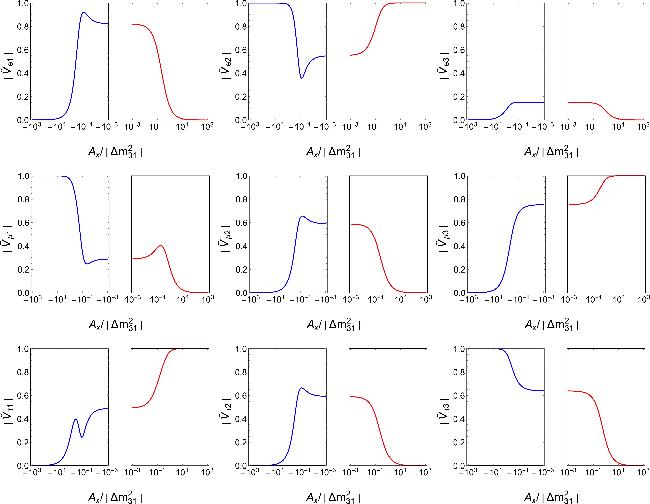
Figure 5. The evolutions of nine effective mixing matrix elements $| {\tilde{V}}_{\alpha i}| $ (for α = e, μ, τ, and i = 1, 2, 3) with respect to the ${A}_{\chi }/| {\rm{\Delta }}{m}_{31}^{2}| $ in the normal hierarchy for both neutrinos (red, right lines) and anti-neutrinos (blue, left lines). |
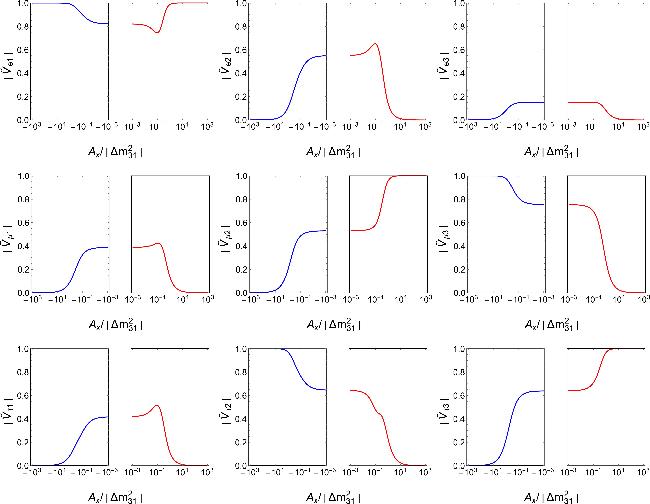
Figure 6. The evolution behaviors of nine effective mixing matrix elements $| {\tilde{V}}_{\alpha i}| $ (for α = e, μ, τ, and i = 1, 2, 3) with respect to the ${A}_{\chi }/| {\rm{\Delta }}{m}_{31}^{2}| $ in the inverted hierarchy for both neutrinos (red, right lines) and anti-neutrinos (blue, left lines). |
Mixing angles in DM can be derived numerically from the PMNS matrix as 24 ).
$\begin{eqnarray}{\tilde{s}}_{12}=\frac{| {\tilde{V}}_{e2}| }{\sqrt{1-| {\tilde{V}}_{e3}{| }^{2}}},\end{eqnarray}$
$\begin{eqnarray}{\tilde{s}}_{13}=| {\tilde{V}}_{e3}| ,\end{eqnarray}$
$\begin{eqnarray}{\tilde{s}}_{23}=\frac{| {\tilde{V}}_{\mu 3}| }{\sqrt{1-| {\tilde{V}}_{e3}{| }^{2}}},\end{eqnarray}$
where $| {\tilde{V}}_{\alpha i}| $ are given in the equation (To get the Jarlskog invariant $\tilde{{ \mathcal J }}$ in DM, which is defined as ${ \mathcal J }\equiv {\rm{Im}}\left({V}_{\alpha i}{V}_{\beta i}^{* }{V}_{\alpha j}^{* }{V}_{\beta j}\right)$×${\sum }_{\gamma ,k}^{\,}{\epsilon }_{\alpha \beta \gamma }{\epsilon }_{ijk}$ (for α, β, γ = e, μ, τ and i, j, k = 1, 2, 3) [65, 66], we use the identity in [67], 31 ).
$\begin{eqnarray}\tilde{{ \mathcal J }}{\rm{\Delta }}{\tilde{m}}_{21}^{2}{\rm{\Delta }}{\tilde{m}}_{31}^{2}{\rm{\Delta }}{\tilde{m}}_{32}^{2}={ \mathcal J }{\rm{\Delta }}{m}_{21}^{2}{\rm{\Delta }}{m}_{31}^{2}{\rm{\Delta }}{m}_{32}^{2},\end{eqnarray}$
where $\tilde{{ \mathcal J }}$ is the Jarlskog in DM and ${ \mathcal J }$ is the Jarlskog in vacuum. The same relationship has been applied to study neutrino oscillations in ordinary matter [68, 69]. The Dirac CP phase δ can be extracted by inserting the explicit expression of Jarlskog, $\begin{eqnarray}{ \mathcal J }={\rm{Im}}({V}_{e1}{V}_{\mu 1}^{* }{V}_{e2}^{* }{V}_{\mu 2})={s}_{23}{c}_{23}{s}_{13}{c}_{13}^{2}{s}_{12}{c}_{12}\sin \delta ,\end{eqnarray}$
into the equation (We show the effective Jarlskog invariant in DM $\tilde{{ \mathcal J }}$ as the function of ${A}_{\chi }/| {\rm{\Delta }}{m}_{31}^{2}| $ in the figure 7 for normal hierarchy (left-panel) and inverted hierarchy (right-panel), respectively. We can see that, $\tilde{{ \mathcal J }}$ approaches to zero for $| {A}_{\chi }| \gg | {\rm{\Delta }}{m}_{31}^{2}| $, this is because the mixing angle ${\tilde{s}}_{13}$ tends to zero in this case.
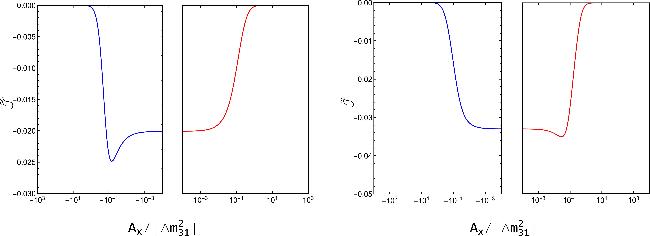
Figure 7. The evolution of the Jarlskog invariant $\tilde{{ \mathcal J }}$ in DM with respect to the ${A}_{\chi }/| {\rm{\Delta }}{m}_{31}^{2}| $ in the normal mass ordering and inverted mass ordering for neutrinos (red curves in the right half panel) and anti-neutrinos (blue curves in the left half panel). In the limit ∣Aχ∣ → ∞, $\tilde{{ \mathcal J }}$ approaches to zero. |
Given all the elements ${\tilde{s}}_{ij}$, ${\tilde{c}}_{ij}$ and the Dirac CP phase $\tilde{\delta }$, we can easily write down the neutrino oscillation probabilities in DM, which is the same as the oscillation probabilities in vacuum up to replacements ${V}_{\alpha i}\to {\tilde{V}}_{\alpha i}$, ${\rm{\Delta }}{m}_{ji}^{2}\to {\rm{\Delta }}{\tilde{m}}_{ji}^{2}$ and $\delta \to \tilde{\delta }$,
$\begin{eqnarray}\begin{array}{rcl}\tilde{P(}{\mathop{\nu }\limits^{(-)}}_{\alpha }^{\,}\to {\mathop{\nu }\limits^{(-)}}_{\beta }^{\,}) & = & {\delta }_{\alpha \beta }^{\,}-4\displaystyle \sum _{j\gt i}^{\,}{\rm{Re}}\left[{\tilde{V}}_{\alpha i}{\tilde{V}}_{\beta i}^{* }{\tilde{V}}_{\alpha j}^{* }{\tilde{V}}_{\beta j}\right]{\sin }^{2}{\tilde{{\rm{\Delta }}}}_{ji}^{\,}\\ & & \pm 2\displaystyle \sum _{j\gt i}^{\,}{\rm{Im}}\left[{\tilde{V}}_{\alpha i}{\tilde{V}}_{\beta i}^{* }{\tilde{V}}_{\alpha j}^{* }{\tilde{V}}_{\beta j}\right]\sin 2{\tilde{{\rm{\Delta }}}}_{ji}^{\,},\end{array}\end{eqnarray}$
where ${\tilde{{\rm{\Delta }}}}_{ji}^{\,}\equiv {\rm{\Delta }}{\tilde{m}}_{ji}^{2}L/4E$ with ${\rm{\Delta }}{\tilde{m}}_{ji}^{2}\equiv {\tilde{m}}_{j}^{2}-{\tilde{m}}_{i}^{2}$ being the effective neutrino mass-squared difference in DM, the Greek letters α, β are the flavor indices run over e, μ, τ, while the Latin letters i, j are the indices of mass eigenstates run over 1, 2, 3. E is the energy of the neutrino/anti-neutrino beam.As illustrations, we show all nine neutrino oscillation probabilities in DM as the function of ${A}_{\chi }/| {\rm{\Delta }}{m}_{31}^{2}| $ for the normal mass hierarchy in the figure 8. We take the parameters listed in the table 2 as inputs and set L/E = 104 [km GeV−1] when making the plot. We can conclude that the DM effect in neutrino oscillations can be significant for a sizable Aχ, but neutrino oscillation may decouple for an ultra-large Aχ. Note that nχ ∼ 0.4 GeV cm−3 on the Earth and ${ \mathcal O }({g}_{\chi })\sim 1{0}^{-3}$, it is unlikely to get a large Aχ except for a super high energy neutrino beam. To estimate the impact of the DM-induced matter effect on neutrino oscillations, we note that the condition ${A}_{\chi }\sim | {\rm{\Delta }}{m}_{31}^{2}| $ can lead to significant matter effect, which corresponds to a DM density ${\rho }_{\chi }\sim \frac{{m}_{\chi }| {\rm{\Delta }}{m}_{31}^{2}| \,{m}_{{Z}^{{\prime} }}^{2}}{2E{g}_{X}^{2}}.$ For typical values of the model parameters and neutrino energies, this density is many orders of magnitude larger than the local DM density near the Earth, nχ ∼ 0.4 GeV cm−3. However, significantly enhanced DM densities could be realized in extreme astrophysical environments, such as the Galactic center, dense subhalos, or compact objects [70], where the DM-induced matter effect could become relevant.
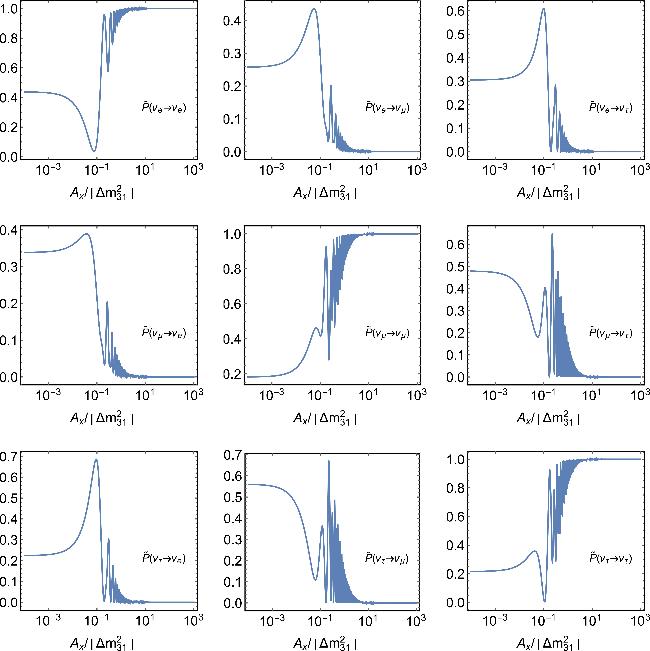


Figure 8. Neutrino oscillation probabilities in DM. In the limit ∣Aχ∣ → ∞, $\tilde{P(}{\nu }_{e}\to {\nu }_{e}),\tilde{P(}{\nu }_{\mu }\to {\nu }_{\mu })$ and $\tilde{P(}{\nu }_{\tau }\to {\nu }_{\tau })$ approach to 1, other channels approach to zero, which means that neutrino is decoherence in this case. |
5. Discussions
If DM couples to active neutrinos, neutrino properties will be affected by additional matter effects when they are travelling in the DM halo. In this paper, we have introduced an additional neutral current interaction between neutrinos and DM by extending the SM with gauged Lμ − Lτ symmetry, which introduce an extra effective potential to the evolution equation of the neutrino flavor transition amplitude. We showed that the high energy neutrino oscillations may undergo a matter dominated stage in a dense DM environment, where the neutrino masses, mixing angles as well as neutrino oscillation probabilities are very different compared with oscillation in vacuum. In particular, when the DM-induced potential Aχ becomes comparable to (or be larger than) $| {\rm{\Delta }}{m}_{31}^{2}| $, neutrino flavor mixings can be strongly suppressed and, in the asymptotic limit $| {A}_{\chi }| \gg | {\rm{\Delta }}{m}_{31}^{2}| $, the three flavor mixngs effectively decouple. Such conditions may naturally be realized in the core-collapse supernovae, where an intense burst of neutrinos is emitted from regions with potentially enhanced DM density near the proton-neutron star. In this case, the DM-induced matter effect could modify flavor conversion inside or near the supernova, leading to an altered neutrino flavor composition observed at Earth compared with standard expectations obtained in the absence of neutrino–DM interactions.