


Motivation.—The Euclidean path integral on the round de Sitter sphere SD,
$\begin{eqnarray}{Z}_{\,\rm{grav}\,}({S}^{D})=\int {\rm{D}}g{{\rm{e}}}^{-{I}_{\,\rm{EH}\,}[g]},\end{eqnarray}$
has long been known to carry subtle pathologies. While Gibbons and Hawking showed that the saddle reproduces the thermodynamic entropy of the cosmological horizon [1], Gibbons, Hawking and Perry noted the indefinite sign of the gravitational action [2], and Polchinski explicitly identified D + 2 negative modes in the conformal sector which generate a universal phase [3]: $\begin{eqnarray}{Z}_{\,\rm{grav}\,}({S}^{D})\sim \exp \left(\frac{{A}_{c}}{4{G}_{N}}\right){{\rm{i}}}^{D+2}{\left|{\det }^{{\prime} }({{\rm{\Delta }}}_{\,\rm{grav}\,})\right|}^{-1/2}.\end{eqnarray}$
Here Ac is the area of the cosmological horizon. The sign is such that IEH[gdS] = −Ac/(4GN), so that ${{\rm{e}}}^{-{I}_{\,\rm{EH}\,}[{g}_{\,\rm{dS}\,}]}$ has the usual entropy-counting form.To resolve the interpretational difficulties posed by the phase iD+2, Maldacena recently proposed a concrete remedy: by coupling gravity to a charged near-extremal black hole equipped with a physical clock, the additional negative modes of the observer reorganize the path integral so that the static-patch density of states becomes real [4].
This proposal has catalyzed a wave of precise investigations into the nature of observers and phases in de Sitter gravity. Regarding the phase structure, Ivo, Maldacena and Sun traced the Euclidean phase to specific physical instabilities of the conformal factor [5], while Shi and Turiaci generalized this analysis to arbitrary Einstein manifolds [6]. Chen, Stanford, Tang and Yang emphasized a sharp tension, showing that the Euclidean path integral carries a robust complex phase that resists simple cancellation, though they argue that a positive density of states is nevertheless recoverable [7], building on earlier classifications of sphere path integrals by law [8] and explicit entropy computations by Anninos et al [9].
Simultaneously, the definition of the observer itself has been formalized algebraically. Harlow, Usatyuk and Zhao identified observers with subalgebras and cyclic states in a closed-universe Hilbert space [10]; Chen further developed this by modeling observers as 'sources' for gravitational Hilbert spaces [11]; and Chen and Xu constructed an explicit algebra for covariant observers [12]. In the holographic context, Akers et al analyzed how such observers map to dual descriptions [13], while Chandrasekaran, Longo, Penington and Witten provided an algebra of observables adapted to the horizon, distinguishing static observers from the global geometry [14]. From a constraints perspective, Horowitz, Marolf and Santos proved that the gravitational constraints alone are insufficient to fix the quantum theory, necessitating explicit observer data [15]. Finally, microscopic proposals where SU(3) confinement sets the vacuum energy offer a concrete realization of gravitational clocks tied to the fundamental vacuum architecture [16, 17].
These developments suggest a natural conceptual picture: once an observer with a clock is included, the de Sitter phase might be brought under control. The main purpose of this Letter is to make this picture precise by identifying which ingredients—gravitational backreaction, informational clocks, or topological structure—are actually responsible for changing the phase, and to formulate this as a criterion on which observers qualify as genuinely gravitational.
Three notions.—We distinguish three logically independent notions that frequently appear under the single label 'observer'.
Worldlines. Any localized subsystem defines a worldline (or worldvolume) in spacetime: examples range from cosmic strings and monopoles to anyons in a quantum Hall fluid or vortices in a superconductor [18–20]. A worldline is a geometric object; by itself it does not yet encode any temporal ordering of internal states.
Informational clocks. In relational and informational approaches to time, a ‘clock' is a subsystem whose internal state provides an intrinsic ordering of distinguishable events [21, 22]. Concretely, we say a subsystem along a worldline carries an informational clock if it has an internal Hilbert space ${{ \mathcal H }}_{\,\rm{clock}\,}$ and undergoes a sequence of operations
$\begin{eqnarray}{U}_{n}:{{ \mathcal H }}_{\,\rm{clock}\,}\to {{ \mathcal H }}_{\,\rm{clock}},\end{eqnarray}$
such that the states ${\{{U}_{n}| {\psi }_{0}\rangle \}}_{n\in {\mathbb{Z}}}$ are distinguishable and naturally ordered, with n serving as a logical or circuit-time parameter. This framework encompasses Page–Wootters relational time, thermal-time constructions, and circuit-based notions of time [21, 22]. Many topological and condensed-matter sectors supply such clocks very naturally: braiding anyons in a fractional quantum Hall state [19], acting with stabilizers in a toric code [23], or tracking reconnection events in a defect network [18, 20].Gravitational observers. The Euclidean de Sitter phase problem, however, is a statement about the index of the Hessian of the gravitational action [3, 5–7]. We call a subsystem a gravitational observer if its action Iobs[g, γ, Φ] has a localized stress tensor that is non-negligible at the de Sitter scale and whose quadratic couplings to metric fluctuations hμν mix with the conformal sector. In other words, the combined Hessian
$\begin{eqnarray}{{\rm{\Delta }}}_{\,\rm{grav+obs}\,},\end{eqnarray}$
has a different index (number of negative directions) from Δgrav alone. Maldacena's black-hole observer is an explicit and well-controlled realization: the additional negative modes live in a joint configuration space of metric and worldline degrees of freedom, and their net effect is to alter the overall phase in a carefully constructed static-patch partition function [4].These three notions are independent: a system may have worldlines without a clock; a clock without appreciable gravitational coupling; or strong gravitational coupling without a large internal Hilbert space. The mechanism of [4] implicitly uses the full intersection: a worldline carrying an informational clock whose fluctuations also share the conformal negative modes, as illustrated schematically in figure 1.
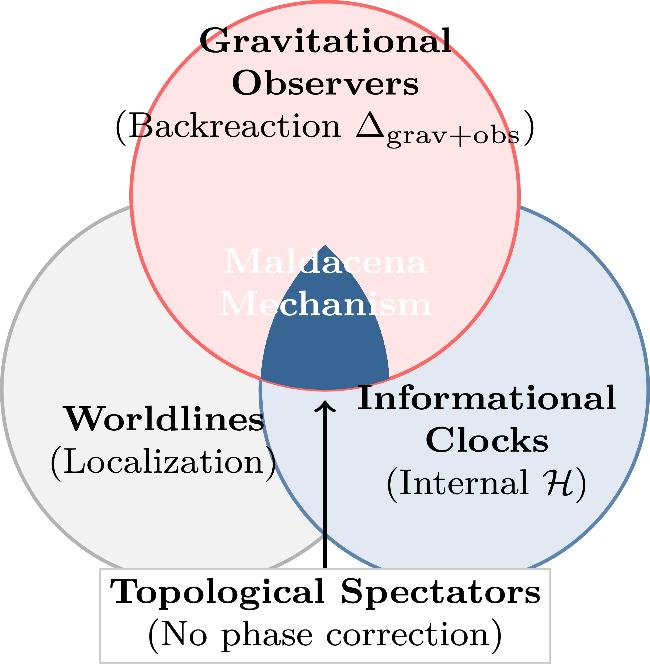


Figure 1. Schematic relation between worldlines, informational clocks, and gravitational observers. The Maldacena mechanism operates only in the triple intersection, where a system both carries a clock and backreacts on the conformal factor so as to share its negative modes. Sectors that have worldlines and clocks but decouple from the metric (bottom overlap) are topological spectators: they can store and order information, but they cannot modify the universal de Sitter phase. |
Topological spectators and factorization.—We now identify a broad class of sectors that, while often rich from the informational point of view, do not affect the de Sitter phase at the level of semiclassical path integrals.
By a topological spectator we mean a sector with fields A whose stress-energy response functions vanish at macroscopic scales. While the microscopic (bare) action Itop[A;g] may depend on the metric, we require that, after integrating out gapped excitations and passing to the infrared effective action ${I}_{\,\rm{top}\,}^{(\,\rm{IR}\,)}[A;g]$ at scales ∼RdS, the induced stress-tensor fluctuations decouple from the geometry. At the quadratic level, this decoupling can be summarized schematically as
$\begin{eqnarray}\displaystyle \frac{\delta {T}_{\mu \nu }}{\delta {g}_{\rho \sigma }}\propto {\left.\displaystyle \frac{{\delta }^{2}{I}_{\,\rm{top}\,}^{(\,\rm{IR}\,)}}{\delta {g}_{\mu \nu }\delta {g}_{\rho \sigma }}\right|}_{{g}_{\,\rm{dS}\,}}\simeq 0,\end{eqnarray}$
so that metric fluctuations and spectator fluctuations do not mix in the total Hessian.These conditions can be phrased as the following working assumption:
Hypothesis (spectator decoupling). Let ${I}_{\,\rm{top}\,}^{(\,\rm{IR}\,)}[A;g]$ be a diffeomorphism-invariant infrared effective functional whose explicit dependence on gμν at the de Sitter saddle is purely topological, in the sense that ${\delta }^{2}{I}_{\,\rm{top}\,}^{(\,\rm{IR}\,)}/\delta g\delta g{| }_{{g}_{\,\rm{dS}\,}}=0$ up to corrections suppressed by powers of ℓ/RdS. Then, after gauge fixing the metric and including the associated Faddeev–Popov ghosts, the full gauge-fixed quadratic form around gdS is block-diagonal between (hμν, ghosts, obs) and the spectator sector A.
Including both an observer sector and a topological spectator, the Euclidean path integral on SD takes the schematic form
$\begin{eqnarray}{Z}_{\,\rm{tot}\,}({S}^{D})=\int {\rm{D}}g{{\rm{e}}}^{-{I}_{\,\rm{EH}\,}[g]}{Z}_{\,\rm{obs}\,}[g]{Z}_{\,\rm{top}\,}[g],\end{eqnarray}$
where $\begin{eqnarray}\begin{array}{rcl}{Z}_{\,\rm{obs}\,}[g] & = & \displaystyle \int {\rm{D}}\gamma {\rm{D}}{\rm{\Phi }}{{\rm{e}}}^{-{I}_{\,\rm{obs}\,}[g,\gamma ,{\rm{\Phi }}]},\\ {Z}_{\,\rm{top}\,}[g] & = & \displaystyle \int {\rm{D}}A{{\rm{e}}}^{-{I}_{\,\rm{top}\,}^{(\,\rm{IR}\,)}[A;g,\ldots \,]}.\end{array}\end{eqnarray}$
Under the spectator hypothesis, Ztop[g] is insensitive to small variations of g about gdS and can be replaced, within the saddle-point expansion, by the constant Ztop(SD) = Ztop[gdS].Expanding around gdS and integrating over Gaussian fluctuations, one finds that the Hessian is block-diagonal, 2 ) with phase iD+2. If a gravitational observer is present, its effect on the phase is entirely contained in ${Z}_{\,\rm{grav}\,}^{(\,\rm{obs}\,)}$; the spectator only multiplies the result by a constant complex factor.
$\begin{eqnarray}{{\rm{\Delta }}}_{\,\rm{tot}\,}=\left(\begin{array}{cc}{{\rm{\Delta }}}_{\,\rm{grav+obs}\,} & 0\\ 0 & {{\rm{\Delta }}}_{\,\rm{top}\,}\end{array}\right),\end{eqnarray}$
and hence the partition function factorizes: $\begin{eqnarray}{Z}_{\,\rm{tot}\,}({S}^{D})={Z}_{\,\rm{grav}\,}^{(\,\rm{obs}\,)}({S}^{D}){Z}_{\,\rm{top}\,}({S}^{D}),\end{eqnarray}$
with $\begin{eqnarray}\begin{array}{rcl}{Z}_{\,\rm{grav}\,}^{(\,\rm{obs}\,)}({S}^{D}) & = & {{\rm{e}}}^{-{I}_{\,\rm{EH}\,}[{g}_{\,\rm{dS}\,}]}{\det {}^{{\prime} }}^{-1/2}({{\rm{\Delta }}}_{\,\rm{grav+obs}\,}),\\ {Z}_{\,\rm{top}\,}({S}^{D}) & = & {\det }^{-1/2}({{\rm{\Delta }}}_{\,\rm{top}\,}).\end{array}\end{eqnarray}$
Writing ${Z}_{\rm{top}\,}=| {Z}_{\,\rm{top}}| {{\rm{e}}}^{{\rm{i}}{\varphi }_{\,\rm{top}\,}}$, we see that the spectator contributes a fixed phase φtop determined by topological data, but does not change the index of the conformal sector. If no gravitational observer is present, ${Z}_{\,\rm{grav}\,}^{(\,\rm{obs}\,)}$ reduces to (Corrections that violate the hypothesis are naturally organized in powers of $\varepsilon \sim {(\ell /{R}_{\,\rm{dS}\,})}^{p}$ for some positive p: they can shift eigenvalues slightly but do not change the number of negative modes until ϵ becomes order unity, at which point the sector ceases to be a spectator in any case. This is the precise sense in which such sectors are spectators with respect to the de Sitter phase: they may carry nontrivial Hilbert spaces and robust informational clocks, but they do not participate in the reorganization of negative modes that underlies the mechanism of [4].
SU(3) as spectator and as clock.—SU(3) Yang–Mills theory offers a concrete illustration of the distinction between informational and gravitational sectors. The Euclidean action on S4 can be written in differential-form notation as
$\begin{eqnarray}{I}_{\,\rm{YM}\,}={\int }_{{S}^{4}}\left[\displaystyle \frac{1}{2{g}_{\,\rm{YM}}^{2}}\rm{Tr}\,(F\wedge \star F)+\displaystyle \frac{{\rm{i}}\theta }{8{\pi }^{2}}\,\rm{Tr}\,(F\wedge F)\right].\end{eqnarray}$
The topological θ-term is strictly metric independent, as the wedge product relies only on the differentiable structure of the manifold; its variation with respect to gμν vanishes identically. The kinetic term depends on the metric via the Hodge star, but in the confining phase the spectrum develops a mass gap ${m}_{\rm{gap}\,}\sim {\ell }_{\,\rm{YM}}^{-1}$. Provided RdS ≫ ℓYM, stress-tensor fluctuations ⟨δTμν(x)δTρσ(y)⟩ are exponentially suppressed by factors of ${{\rm{e}}}^{-{m}_{\,\rm{gap}\,}d(x,y)}$ on de Sitter scales. Consequently, the metric-dependent excitations can be integrated out, leaving only vacuum-energy renormalization and a purely topological infrared effective action ${I}_{\,\rm{top}\,}^{(\,\rm{IR}\,)}$.In this regime the path integral factorizes into the gravitational sector and a discrete sum over instanton numbers $k\in {\pi }_{3}({\rm{SU}}(3))\cong {\mathbb{Z}}$:
$\begin{eqnarray}{Z}_{\,\rm{top}\,}({S}^{4})\approx \displaystyle \sum _{k\in {\mathbb{Z}}}{n}_{k}{{\rm{e}}}^{-{S}_{k}}{{\rm{e}}}^{{\rm{i}}\theta k}.\end{eqnarray}$
The resulting phase is determined purely by θ and the measure degeneracies nk, and is algebraically independent of the conformal factor's unstable modes.Equivalently, this physics can be captured by thin SU(3) center vortices carrying ${{\mathbb{Z}}}_{3}$ magnetic flux. When their tension is negligible relative to the de Sitter scale, these vortices act as test objects: their contributions to the path integral are topological invariants, such as linking and intersection numbers. These worldvolumes support a finite-dimensional Hilbert space of ${{\mathbb{Z}}}_{3}$ charge sectors, allowing them to function as informational clocks or logical qubits. However, because their backreaction on the metric is suppressed at the de Sitter radius, they remain topological spectators and cannot resolve the factor iD+2 in Eq. (2 ).
By contrast, the situation changes in microscopic models where SU(3) confinement fundamentally defines the vacuum architecture and the cosmological constant itself [16, 17]. In this regime, the gauge degrees of freedom are no longer spectators living on a background; they constitute part of the background geometry. The fluctuations of the confining condensate mix directly with the metric sector and contribute to Δgrav+obs, promoting the SU(3) sector from a topological spectator to a true gravitational observer capable of modifying the unstable contour and the associated phase.
Spectator universality class.—The structure leading to equation (9 ) is not special to SU(3) and appears in many familiar systems. Topological field theories such as Chern–Simons and BF theories provide effective descriptions of quantum Hall states, topological insulators and other topologically ordered phases [19, 24]. Their bulk actions are topological functionals of gauge fields, independent of local metric fluctuations, and their nontrivial physics resides in anyon braiding and boundary modes. Lattice topological orders and quantum memories, such as toric-code models, reduce at long distances to similar topological gauge theories [23]. Dilute networks of cosmic strings and other defects, treated in a strict decoupling limit, likewise contribute only topological phases and selection rules to the Euclidean path integral [18, 20].
These examples provide a broad and physically motivated universality class of sectors that satisfy the spectator-decoupling hypothesis and realize the factorized structure (9 ) in concrete systems.
Scope and discussion.—The distinction between gravitational observers and topological spectators places a sharp physical bound on where the Maldacena mechanism can operate. The near-extremal black-hole observer of [4] succeeds because its mass and compactness allow its stress tensor to modify the de Sitter saddle at order unity. By contrast, most of the matter content of a Λ-dominated universe—cold dark matter perturbations, baryonic inhomogeneities, or dilute defects—behave as informational clocks yet topological spectators. They multiply Zgrav by a spectator factor Ztop that leaves the universal gravitational phase iD+2 intact.
This constraint extends naturally to algebraic and holographic perspectives on gravity in a closed universe [10–14]. Enlarging an observer algebra by adjoining internal symmetry sectors, topological orders and code subspaces is essential for information-theoretic questions, yet it leaves the Euclidean de Sitter phase unchanged so long as these sectors do not couple to the conformal factor at quadratic order. The mechanism is genuinely gravitational: it singles out clocks whose fluctuations share the same unstable directions as the metric. Consequently, only sufficiently compact astrophysical objects, or microscopic degrees of freedom that fundamentally set the vacuum energy (as in the confining scenarios of [16, 17]), belong to the special class capable of resolving the imaginary problem.
Conceptually, this disentangles three statements: (i) there exists a worldline; (ii) there exists an internal, informational clock; (iii) there exists a gravitational clock that changes the de Sitter phase. Our contribution is to specify the conditions under which (i) and (ii) are insufficient. We conclude that the act of observation in quantum gravity is not merely the recording of information, but a dynamical process of gravitational backreaction. An observer who does not disturb the geometry cannot define a real history for it. It would be interesting to repeat this analysis in lower-dimensional models, such as de Sitter analogues of Jackiw–Teitelboim gravity coupled to topological matter, and to explore scenarios where topological sectors flow from being spectators to defining the background geometry itself. We hope to report on these in the future.