


1. Introduction
Optical nonreciprocal devices, as core components in photonic quantum information processing, play an irreplaceable role in fields such as unidirectional light transmission, quantum routing, and optical isolation [1–8]. Nonreciprocal optical router can direct individual photons into specific output paths in a nonreciprocal manner (i.e., only allowing transmission in a specific direction) based on their quantum states [8–10]. Thus it demonstrates potential in applications such as optical information processing, optical cloaking, and all-optical integrated circuits [11, 12]. Traditional nonreciprocal devices rely on the magneto-optical effect to break time-reversal symmetry, but the large volume of magneto-optical materials and their dependence on strong magnetic fields severely limit their use in integrated photonic chips [13, 14]. In recent years, magnet-free nonreciprocal schemes have shown significant advantages through novel mechanisms such as nonlinear optical effects [15–17], spatiotemporal modulation [18–20], and Sagnac effects [21–31]. Nonlinear optical effects can induce strong nonreciprocal transmission by using intensity dependent refractive index or gain loss balance to break symmetry. Spatiotemporal modulation enables nonreciprocity through linear time-varying systems, including angular momentum biasing modulation, indirect interband photonic transition modulation, and spatiotemporal coherence modulation. The Sagnac effect enables highly isolated nonreciprocal responses through spinning cavity systems, with novel applications including nonreciprocal phonon lasing, nonreciprocal optomechanical entanglement, nonreciprocal optomechanically induced transparency (OMIT) and nonreciprocal slow-fast light. Notably, the Sagnac effect in ring cavities has achieved optical isolation as high as 99.6% [25], greatly stimulating research interests in OMIT in spinning optomechanical cavities [30]. In particular, OMIT in such systems can be applied to realize nonreciprocal transmission. Therefore, all-optical and magnet-free optomechanical systems serve as ideal platforms for achieving optical nonreciprocal transmission and optical nonreciprocal devices.
As natural carriers of quantum information, photons possess advantages such as long coherence times, low dissipation, and high-speed transmission [32, 33]. However, their weak interaction characteristics make the development of all-optical quantum devices a challenge. In recent years, a novel and fascinating hybrid optomechanical system with strong coupling among excitons, photons, and phonons has been realized in GaAs/AlAs microcavities embedded with quantum wells [34–37]. Notably, whispering-gallery-mode (WGM) quantum well exciton polaritons have been observed in InGaAs microdisk cavities [37]. Microcavity exciton polaritons are formed by strong exciton-photon coupling. They combine the massless nature of photons with the strong nonlinear response of excitons. Thus, the system offers numerous advantages such as strong light-matter coupling, low pump intensity, strong nonlinear effects, and high quality factors [38, 39]. Many novel and unique phenomena have also been discovered in microcavity exciton polaritons [31, 40–47], including room-temperature polariton condensation, superfluidity, bistability, entanglement, and OMIT. These properties hold potential application value for realizing advanced polaritonic devices [48–51], such as polariton diodes, exciton polariton lasers, and polarization-based spin memories. In particular, the spinning cavity optomechanical system has provided an ideal platform for achieving nonreciprocal devices, owing to the nonreciprocal light transmission with high isolation [25, 29–31]. For instance, in an anti-parity-time-symmetric spinning optomechanical system, the nonreciprocal OMIT and nonreciprocal slow-fast light have been studied. The nonreciprocal OMIT with a high isolation ratio is realized by breaking the anti-parity-time symmetry [29]. In a spinning active optomechanical system with gain, nonreciprocal signal amplification has been explored. It can be used to design a nonreciprocal multicolor optical amplifier [30]. In a spinning optomechanical system with cavity exciton polaritons, by adjusting pump fields and couplings among excitons, photons, and phonons, various nonreciprocal amplification-attenuation transmission and fast-slow light effects have been also recently discovered [31]. In spinning microcavity exciton polaritons, strong exciton-photon coupling provides a new method to modulate nonreciprocal photon transmission via OMIT. It enables the design of single photon quantum router schemes based on microcavity exciton polaritons. Consequently, a straightforward question arises: Can OMIT in WGM microcavity exciton polariton systems offer a means to construct a nonreciprocal photonic quantum router? This could serve as a core component for integrated photonic circuits and quantum communication networks, as multi-node interconnection requires the capability to route quantum information.
In this paper, we investigate nonreciprocal OMIT in a WGM ring-shaped microcavity embedded with quantum-well excitons and coupled to a tapered optical fiber. We propose a theoretical scheme for achieving nonreciprocal optical routers based on WGM quantum-well exciton polaritons. Owing to Sagnac effects, the transmission of photon signals along clockwise (CW) and counterclockwise (CCW) directions exhibits distinct characteristics at a special frequency, depicted by transmission spectra and nonreciprocal isolate rates. These distinct characteristics result in CW unidirectional transmission and CCW unidirectional transmission. Therefore, among our designed nonreciprocal routers, the transmission direction, output frequency and intensity can be precisely controlled by adjusting Sagnac effects, pump fields and the coupling of photon, phonon and exciton modes. Our results open new pathways for constructing nonreciprocal optical routers, which may be useful for developing quantum networks and integrated photonic circuits.
2. Model
Motivated by experiments on a WGM microresonator with exciton polaritons [37], we consider a spinning hybrid optomechanical system as shown in figure 1(a), which is constructed by a spinning microresonator and a single-mode tapered fiber. The spinning microresonator is constructed by GaAs materials and contains a quantum well confining excitons and formed by a λ/2-thick GaAs thin layer, which is embedded in an intermediate layer between two AlGaAs thin layers. In quantum wells, there is a strong coupling effect between cavity photons and excitons, which results in exciton polaritons. The microresonator is driven by two pump fields along opposite directions, and also supports a phonon mode with a mechanical frequency ωm and a damping rate γm. Two pump fields with the same intensity and frequency respectively drive two counter propagating WGMs with a frequency ω1,2, i.e., CW and CCW modes. In the tapered optical fiber, the input field ${c}_{1}^{{\rm{in}}}$ and ${c}_{2}^{{\rm{in}}}$ enters the tapered fiber from the left and right side, respectively. When the resonator rotates at a velocity Ω0 along a fixed CCW direction, an optical Sagnac-Fizeau frequency shift ΔSag is generated. It breaks the degeneracy of CW and CCW modes, i.e., ω1(2) = ωc ± ΔSag, where ${{\rm{\Delta }}}_{{\rm{Sag}}}=({n}_{1}R{{\rm{\Omega }}}_{0}{\omega }_{c}/c)[1-1/{n}_{1}^{2}-(\lambda /{n}_{1}){\rm{d}}{n}_{1}/{\rm{d}}\lambda ]$, with the speed c and the wavelengthλ of light, the refractive index n1 and radius R of the resonator, as well as the dispersion term dn1/dλ characterizing the relativistic origin of the Sagnac effect and being small in typical materials such as silica [52].
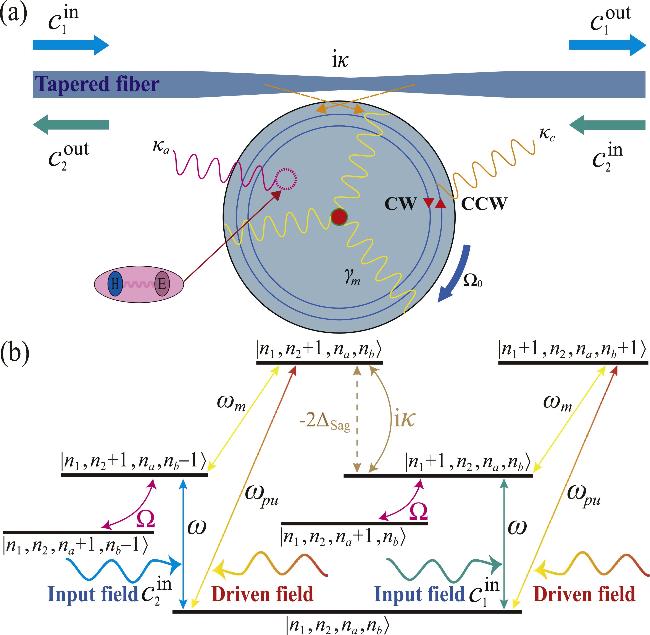
Figure 1. (a) Schematic diagram of a WGM spinning cavity embedded with quantum wells and coupled to a tapered optical fiber. The WGM resonator is constructed by GaAs material, where the quantum wells serve as an intermediate layer between two AlGaAs thin films to trap excitons, enabling strong exciton-photon coupling within quantum wells. The resonator supports mechanical modes, exciton modes, and WGMs (i.e., CW and CCW modes) with a resonant frequency ωm, ωa, and ω1,2, respectively. A resonator rotating at speed Ω0 generates opposite Sagnac-Fizeau frequency shifts ΔSag in the CW and CCW WGMs. The two modes are coupled via dissipative backscattering caused by tapered-fiber scattering with a coupling strength κ. (b) Energy-level scheme for nonreciprocal optomechanically induced transparency with states ∣n1, n2, na, nb⟩, where n1,2,a,b is the excitation number of CW mode photons, CCW mode photons, excitons, and phonons, respectively. |
In the rotating frame at the pump field frequency ωpu, the Hamiltonian of the system can be described as [24, 25, 29, 37, 39, 52]:
$\begin{eqnarray}\begin{array}{rcl}\hat{H} & = & {\hat{H}}_{0}+{\hat{H}}_{{\rm{int}}}+{\hat{H}}_{{\rm{dr}}},\\ {\hat{H}}_{0} & = & \hslash {{\rm{\Delta }}}_{a}{\hat{a}}^{\dagger }\hat{a}+\hslash {\omega }_{m}{\hat{b}}^{\dagger }\hat{b}+\hslash {{\rm{\Delta }}}_{1}{\hat{c}}_{1}^{\dagger }{\hat{c}}_{1}+\hslash {{\rm{\Delta }}}_{2}{\hat{c}}_{2}^{\dagger }{\hat{c}}_{2},\\ {\hat{H}}_{{\rm{int}}} & = & {\rm{i}}\hslash \kappa ({\hat{c}}_{1}^{\dagger }{\hat{c}}_{2}+{\hat{c}}_{2}^{\dagger }{\hat{c}}_{1})+\hslash g({\hat{c}}_{1}^{\dagger }{\hat{c}}_{1}+{\hat{c}}_{2}^{\dagger }{\hat{c}}_{2})({\hat{b}}^{\dagger }+\hat{b)}\\ & & +\hslash {\rm{\Omega }}({\hat{a}}^{\dagger }{\hat{c}}_{1}+{\hat{c}}_{1}^{\dagger }\hat{a}+{\hat{a}}^{\dagger }{\hat{c}}_{2}+{\hat{c}}_{2}^{\dagger }\hat{a)},\\ {\hat{H}}_{{\rm{dr}}} & = & {\rm{i}}\hslash \varepsilon [{c}_{1}^{\dagger }+{c}_{2}^{\dagger }-{\rm{H}}.c.],\end{array}\end{eqnarray}$
where ${\hat{a}}^{\dagger }$ ($\hat{a}$), ${\hat{b}}^{\dagger }$ ($\hat{b}$), ${\hat{{c}_{1}}}^{\dagger }$ ($\hat{{c}_{1}}$) and ${\hat{{c}_{2}}}^{\dagger }$ ($\hat{{c}_{2}}$) is the creation (annihilation) operator of quantum-well excitons, mechanical oscillators, CW modes and CCW modes with a frequency ωa, ωm, ω1 and ω2, respectively. Δa = ωa − ωpu is the pump-exciton detuning and Δ1,2 = ω1,2 − ωpu = Δc ± ΔSag is the detuning between CW (CCW) modes and pump fields, where Δc = ωc − ωpu is the cavity-pump detuning. κ is a dissipative coupling strength between CW and CCW modes, which can be induced by the taper-scattering-induced dissipative backscattering [24]. g is the single-photon optomechanical coupling strength between cavity photons and mechanical oscillators. Ω is the Rabi coupling strength between cavity photons and quantum-well excitons. The driven field Hamiltonian $\hat{{H}_{{\rm{dr}}}}$ describes a coherent driven cavity field with pump intensities $\varepsilon =\sqrt{2{\kappa }_{c}^{ex}{P}_{pu}/\hslash {\omega }_{pu}}$ where ${\kappa }_{c}^{ex}$ is the coupling loss and Ppu is the pump power.The dynamical evolution of operators can be given by the following quantum Heisenberg-Langevin equation: ${\rm{d}}\hat{O}/{\rm{d}}t\,=({\rm{i}}/\hslash )\left[\hat{H},\hat{O}\right]+{ \mathcal L }\left[\hat{O}\right]+\hat{{f}_{O}},$ where ${ \mathcal L }[\hat{O}]=\gamma (2\hat{O}\hat{\rho }{\hat{O}}^{\dagger }\,-{\hat{O}}^{\dagger }\hat{O}\hat{\rho }-\hat{\rho }{\hat{O}}^{\dagger }\hat{O}$ is the Lindblad superoperator with the density matrix operator ρ, $\hat{O}=\{\hat{a},\hat{b},\hat{{c}_{1}},\hat{{c}_{2}}\}$ and γ = {γm, κa, κc}. Here κa, κc and γm are the total decay rates of the exciton modes, CW (CCW) modes and mechanical oscillator modes, respectively. For CW (CCW) modes, the total decay rate has two contributions: one is the cavity intrinsic loss ${\kappa }_{c}^{i}$ and the other is the coupling loss ${\kappa }_{c}^{ex}$, i.e., ${\kappa }_{c}={\kappa }_{c}^{i}+{\kappa }_{c}^{ex}$. $\hat{{f}_{O}}$ is the corresponding noise operator. By introducing a position-like operator of mechanical oscillators $\hat{q}=({\hat{b}}^{\dagger }+\hat{b})/\sqrt{2}$ and a momentum-like operator $\hat{p}={\rm{i}}({\hat{b}}^{\dagger }-\hat{b})/\sqrt{2}$, while using communication relations $[\hat{a},{\hat{a}}^{\dagger }]=1$, $[\hat{c},{\hat{c}}^{\dagger }]=1$, and $[\hat{q},\hat{p}]={\rm{i}}$, the system can be described by following quantum Langevin equations:
$\begin{eqnarray}\begin{array}{rcl}\dot{q} & = & {\omega }_{m}p,\\ \dot{p} & = & -\sqrt{2}g({c}_{1}^{\dagger }{c}_{1}+{c}_{2}^{\dagger }{c}_{2})-{\omega }_{m}q-{\gamma }_{m}p+\xi ,\\ \dot{a} & = & -({\rm{i}}{{\rm{\Delta }}}_{a}+{\kappa }_{a})a-{\rm{i}}{\rm{\Omega }}({c}_{1}+{c}_{2})+\sqrt{2{\kappa }_{a}}{a}_{{\rm{in}}},\\ {\dot{c}}_{1} & = & -[{\rm{i}}({{\rm{\Delta }}}_{1}+\sqrt{2}gq)+{\kappa }_{c}]{c}_{1}+\kappa {c}_{2}-{\rm{i}}{\rm{\Omega }}a+\varepsilon \\ & & +\sqrt{2{\kappa }_{c}^{{\rm{e}}x}}{c}_{1}^{{\rm{in}}},\\ {\dot{c}}_{2} & = & -[{\rm{i}}({{\rm{\Delta }}}_{2}+\sqrt{2}gq)+{\kappa }_{c}]{c}_{2}+\kappa {c}_{1}-{\rm{i}}{\rm{\Omega }}a+\varepsilon \\ & & +\sqrt{2{\kappa }_{c}^{ex}}{c}_{2}^{{\rm{in}}},\end{array}\end{eqnarray}$
where ξ, ain, ${c}_{1}^{{\rm{in}}}$ and ${c}_{2}^{{\rm{in}}}$ are corresponding Markovian noise operators with zero averages and δ correlation functions: $\langle {{c}_{1}^{{\rm{in}}}}^{\dagger }(\omega ^{\prime} ){c}_{1}^{{\rm{in}}}(\omega )\rangle $ = ${S}_{1}^{{\rm{cin}}}(\omega )\delta (\omega -\omega ^{\prime} )$, $\langle {{c}_{2}^{{\rm{in}}}}^{\dagger }(\omega ^{\prime} ){c}_{2}^{{\rm{in}}}(\omega )\rangle $ = ${S}_{2}^{{\rm{cin}}}(\omega )\delta (\omega -\omega ^{\prime} )$, $\langle {a}_{{\rm{in}}}^{\dagger }(\omega ^{\prime} ){a}_{{\rm{in}}}(\omega )\rangle $ = ${S}_{e}^{{\rm{in}}}(\omega )\delta (\omega -\omega ^{\prime} )$, and $\langle \xi (\omega ^{\prime} )\xi (\omega )\rangle $ = ${\gamma }_{m}({n}_{{\rm{t}}{\rm{h}}}+\frac{1}{2})\delta (\omega -\omega ^{\prime} )$. Here ${S}_{1}^{{\rm{cin}}}(\omega )$ and ${S}_{2}^{{\rm{cin}}}(\omega )$ are the input field spectrum of the left and right side of the tapered fiber, respectively. ${S}_{e}^{{\rm{in}}}(\omega )$ is the noise spectrum of excitons. ${n}_{{\rm{t}}{\rm{h}}}=1/[{\rm{\exp }}(\hslash {\omega }_{m}/{k}_{{\rm{B}}}{T})-1]$ is the equilibrium mean thermal phonon number with the Boltzmann constant kB and the environment temperature T. In our system, ${S}_{e}^{{\rm{in}}}(\omega )\approx 0$ due to negligible exciton noises for ℏωa ≫ kBT.To calculate the spectrum of output fields, we consider that the operators can be regarded as the sum of their steady mean values and additional fluctuation operators, i.e., O = Os + δO. Upon substituting it into equation (2 ), one can acquire the steady equation:
$\begin{array}{l}\omega_{m} p_{s}=0 \\\sqrt{2} g\left(\left|c_{1 s}\right|^{2}+\left|c_{2 s}\right|^{2}\right)+\omega_{m} q_{s}+\gamma_{m} p_{s}=0 \\\left(\mathrm{i} \Delta_{a}+\kappa_{a}\right) a_{s}+\mathrm{i} \Omega\left(c_{1 s}+c_{2 s}\right)=0 \\{\left[\mathrm{i}\left(\Delta_{1}+\sqrt{2} g q_{s}\right)+\kappa_{c}\right] c_{1 s}-\kappa c_{2 s}+\mathrm{i} \Omega a_{s}=\varepsilon} \\{\left[\mathrm{i}\left(\Delta_{2}+\sqrt{2} g q_{s}\right)+\kappa_{c}\right] c_{2 s}-\kappa c_{1 s}+\mathrm{i} \Omega a_{s}=\varepsilon}\end{array}$
Upon introducing an effective cavity-pump detuning ${{\rm{\Delta }}}_{c}^{{\prime} }={{\rm{\Delta }}}_{c}+\sqrt{2}g{q}_{s}$, The steady equation becomes linearized equations, and one can analytically obtain steady-state values: ${q}_{s}=-\sqrt{2}g(| {c}_{1s}{| }^{2}+| {c}_{2s}{| }^{2})/{\omega }_{m}$ and c1,2s = ϵ(Δa − iκa)$[{{\rm{\Delta }}}_{2,1}^{{\prime} }-{\rm{i}}(\kappa +{\kappa }_{c})]$/{(iΔa + κa)$[{\kappa }^{2}+({{\rm{\Delta }}}_{1}^{{\prime} }-{\rm{i}}{\kappa }_{c})({{\rm{\Delta }}}_{2}^{{\prime} }-{\rm{i}}{\kappa }_{c})]$ $-{\rm{i}}[{{\rm{\Delta }}}_{1}^{{\prime} }+{{\rm{\Delta }}}_{2}^{{\prime} }-2{\rm{i}}(\kappa +{\kappa }_{s})]{{\rm{\Omega }}}^{2}\}$, where ${{\rm{\Delta }}}_{1,2}^{{\prime} }={{\rm{\Delta }}}_{1,2}\,+\sqrt{2}g{q}_{s}$ = ${{\rm{\Delta }}}_{c}^{{\prime} }\pm {{\rm{\Delta }}}_{{\rm{Sag}}}$. The evolution equation for the fluctuation operator can be described as: $\begin{eqnarray}\begin{array}{rcl}\dot{\delta q} & = & {\omega }_{m}\delta p,\\ \dot{\delta p} & = & -{\omega }_{m}\delta q-{\gamma }_{m}\delta p-\sqrt{2}g({c}_{1s}^{* }\delta {c}_{1}+{c}_{2s}^{* }\delta {c}_{2}+H.c.)+\xi ,\\ \dot{\delta a} & = & -({\rm{i}}{{\rm{\Delta }}}_{a}+{\kappa }_{a})\delta a-{\rm{i}}{\rm{\Omega }}(\delta {c}_{1}+\delta {c}_{2})+\sqrt{2{\kappa }_{a}}{a}_{{\rm{in}}},\\ \dot{\delta {c}_{1}} & = & -({\rm{i}}{{\rm{\Delta }}}_{1}^{{\prime} }+{\kappa }_{c})\delta {c}_{1}-{\rm{i}}\sqrt{2}g{c}_{1s}\delta q+\kappa \delta {c}_{2}-{\rm{i}}{\rm{\Omega }}\delta a\\ & & +\sqrt{2{\kappa }_{c}^{ex}}{c}_{1}^{{\rm{in}}},\\ \dot{\delta {c}_{2}} & = & -({\rm{i}}{{\rm{\Delta }}}_{2}^{{\prime} }+{\kappa }_{c})\delta {c}_{2}-{\rm{i}}\sqrt{2}g{c}_{2s}\delta q+\kappa \delta {c}_{1}-{\rm{i}}{\rm{\Omega }}\delta a\\ & & +\sqrt{2{\kappa }_{c}^{ex}}{c}_{2}^{{\rm{in}}}.\end{array}\end{eqnarray}$
By adopting Fourier transforms $\delta O(\omega )={\int }_{-\infty }^{+\infty }\delta O(t){{\rm{e}}}^{{\rm{i}}\omega t}{\rm{d}}t/\sqrt{2\pi }$, the evolution equation for the fluctuation can be obtained as a linearized quantum Langevin equation: $\begin{eqnarray}{MX}={B},\end{eqnarray}$
where X = (δq, δa, δa†, $\delta {c}_{1},\delta {c}_{1}^{\dagger },\delta {c}_{2}$, $\delta {c}_{2}^{\dagger }{)}^{{\rm{T}}}$ is the vector of quadrature fluctuation operators, B = $(-\xi ,-\sqrt{2{\kappa }_{a}}{a}_{{\rm{in}}}$, $-\sqrt{2{\kappa }_{a}}{a}_{{\rm{in}}}^{\dagger }$, $-\sqrt{2{\kappa }_{c}^{ex}}{c}_{1}^{{\rm{in}}}$, $-\sqrt{2{\kappa }_{c}^{ex}}{{c}_{1}^{{\rm{in}}}}^{\dagger }$, $-\sqrt{2{\kappa }_{c}^{ex}}{c}_{2}^{{\rm{in}}}$, $-\sqrt{2{\kappa }_{c}^{ex}}{{c}_{2}^{{\rm{in}}}}^{\dagger }{)}^{{\rm{T}}}$ is the vector of noises, and the coefficient matrix M is given by $\begin{eqnarray}{M}=\left(\begin{array}{ccccccc}{\tilde{{\rm{\Delta }}}}_{m} & 0 & 0 & -\sqrt{2}g{c}_{1s}^{* } & -\sqrt{2}g{c}_{1s} & -\sqrt{2}g{c}_{2s}^{* } & -\sqrt{2}g{c}_{2s}\\ 0 & {\tilde{{\rm{\Delta }}}}_{a-} & 0 & -{\rm{i}}{\rm{\Omega }} & 0 & -{\rm{i}}{\rm{\Omega }} & 0\\ 0 & 0 & {\tilde{{\rm{\Delta }}}}_{a+} & 0 & {\rm{i}}{\rm{\Omega }} & 0 & {\rm{i}}{\rm{\Omega }}\\ -{\rm{i}}\sqrt{2}g{c}_{1s} & -{\rm{i}}{\rm{\Omega }} & 0 & {\tilde{{\rm{\Delta }}}}_{c1-}^{{\prime} } & 0 & \kappa & 0\\ {\rm{i}}\sqrt{2}g{c}_{1s}^{* } & 0 & {\rm{i}}{\rm{\Omega }} & 0 & {\tilde{{\rm{\Delta }}}}_{c1+}^{{\prime} } & 0 & \kappa \\ -{\rm{i}}\sqrt{2}g{c}_{2s} & -{\rm{i}}{\rm{\Omega }} & 0 & \kappa & 0 & {\tilde{{\rm{\Delta }}}}_{c2-}^{{\prime} } & 0\\ {\rm{i}}\sqrt{2}g{c}_{2s}^{* } & 0 & {\rm{i}}{\rm{\Omega }} & 0 & \kappa & 0 & {\tilde{{\rm{\Delta }}}}_{c2+}^{{\prime} }\end{array}\right).\end{eqnarray}$
Here ${\tilde{{\rm{\Delta }}}}_{m}={\rm{i}}{\gamma }_{m}\omega +{\omega }^{2}-{\omega }_{m}^{2}$, ${\tilde{{\rm{\Delta }}}}_{a\mp }=-{\kappa }_{a}+{\rm{i}}(\omega \mp {{\rm{\Delta }}}_{a})$, ${\tilde{{\rm{\Delta }}}}_{c1\mp }^{{\prime} }=-{\kappa }_{c}+{\rm{i}}(\omega \mp {{\rm{\Delta }}}_{1}^{{\prime} })$ and ${\tilde{{\rm{\Delta }}}}_{c2\mp }^{{\prime} }=-{\kappa }_{c}+{\rm{i}}(\omega \mp {{\rm{\Delta }}}_{2}^{{\prime} })$.
Next, we introduce a standard input-output relation [53], i.e., ${c}_{i}^{{\rm{out}}}(\omega )=\sqrt{2{\kappa }_{c}^{ex}}c(\omega )-{c}_{i}^{{\rm{in}}}(\omega )$, where ${c}_{i}^{{\rm{out}}}$ is the output operator of optical fields. Upon inserting it into the linearized quantum Langevin equation equation (5 ), one can acquire ${c}_{i}^{{\rm{out}}}(\omega )$ and ${{c}_{i}^{{\rm{out}}}}^{\dagger }(\omega )$. Then the spectrum of output fields ${S}_{i}^{{\rm{cout}}}(\omega )=\langle {{c}_{i}^{{\rm{out}}}}^{\dagger }(\omega ){c}_{i}^{{\rm{out}}}(\omega )\rangle $ can be written as: Appendix . Obviously, the output spectrum contains the contribution from input single photon signal fields ${S}_{1}^{{\rm{cin}}}$ and ${S}_{2}^{{\rm{cin}}}$, the fluctuation noise for vacuum fields Sv, the fluctuation noise for exciton modes Se, and the thermal noise for mechanical oscillator modes ST. As the contribution of noises is weak, the output photon signal for the right (left) side of a tapered fiber is mainly determined by the input photon signal of the left (right) side of a tapered fiber, which strongly depends on the corresponding transmissivity Ti. For input photons with the same intensity from two sides of a tapered fiber, i.e., ${S}_{1}^{{\rm{cin}}}(\omega )={S}_{2}^{{\rm{cin}}}(\omega )$, distinct transmissivity T1 and T2 can induce disparate transmission behaviors along CW and CCW directions, which can be used to design nonreciprocal photon routers. Although there is no optical gain, due to the contribution of driven photon fields, output signals compared with input signals can be amplified, i.e., Ti > 1. This is because driven fields and single-photon optomechanical couplings induce stimulated emission of cavity photons. In order to describe the nonreciprocity of routers, we define an isolation ratio (in decibels) $I({\rm{dB}})=10{{\rm{log}}}_{10}({T}_{2}/{T}_{1})$. A negative isolation ratio indicates that photon signals are transmitted along a CW direction and the transmission along a CCW direction is blocked, while a positive isolation ratio indicates that the photon signals are transmitted along a CCW direction and suppressed along a CW direction.
$\begin{eqnarray}\begin{array}{rcl}{S}_{1}^{{\rm{cout}}}(\omega ) & = & {S}_{1}^{{\rm{cin}}}(\omega ){T}_{1}+{S}_{v}+{S}_{e}+{S}_{T},\\ {S}_{2}^{{\rm{cout}}}(\omega ) & = & {S}_{2}^{{\rm{cin}}}(\omega ){T}_{2}+{S}_{v}+{S}_{e}+{S}_{T}.\end{array}\end{eqnarray}$
The specific expressions of T1,2 and Sv,e,T are obtained in the 3. Nonreciprocal photon quantum router
The construction of nonreciprocal optical router is based on the nonreciprocal transmission of photons. The photon signal ${c}_{1}^{{\rm{in}}}$ input from the left side of a tapered fiber can be transmitted along a CW direction in a whispering-gallery microcavity and output from the right side of a tapered fiber, while the photon signal ${c}_{2}^{{\rm{in}}}$ input from the left side of a tapered fiber can be transmitted along a CCW direction and output from the right side. The transmission of photon signals input from different directions can be manipulated by the coupling among photon, phonon and exciton modes as well as Sagnac effects. The transmission can demonstrate disparate behaviors, which generates distinct nonreciprocal transmission, i.e., CW unidirectional transmission and CCW unidirectional transmission. This nonreciprocal transmission can be characterized by the transmissivity T1,2(ω) and the corresponding isolation ratio I(dB). Therefore, we can control the performance of a nonreciprocal router by appropriately adjusting photon-exciton Rabi coupling, pump intensity, photon-phonon single-photon optomechanical coupling and Sagnac effects.
Nonreciprocal transmission for photon signals can be effectively regulated by photon-exciton couplings. In the absence of the photon-exciton Rabi coupling, i.e., Ω = 0, CW nonreciprocal transmission occurs at ω = ω1, where T1 > 1, T2 ≈ 0 and I < 0 [see figures 2(a) and (b)]. Namely, photon signals are transmitted along a CW direction and blocked along a CCW direction. When the photon-exciton is considered, there are abundant nonreciprocal transmission phenomena, i.e., multiple nonreciprocal transmission windows arise at different resonant frequencies. As shown in figure 2(a), for Ω < Ω1 ≈ 2.5ωm, there is only one CW nonreciprocal transmission window at ω = ω1 owing to the negative isolation rate, i.e., I(ω1) < 0. For Ω1 < Ω < Ω2 ≈ 4.1ωm, a new CCW nonreciprocal transmission appears at ω = ω2 where I(ω2) > 0, T1 ≈ 0, and T2 = 1 [also see figure 2(c)], while a new CW nonreciprocal transmission appears at ω = ω3 where I(ω3) < 0, T1 = 1, and T2 < 1 which indicates that photon signals transmitted along a CCW direction are partially blocked. For Ω > Ω2, another new CW nonreciprocal transmission window emerges at ω = ω4 where I(ω4) < 0, T1 > 1, and T2 < 1 which indicates that photon signals transmitted along a CCW direction are partially blocked and photon signals transmitted along a CW direction are amplified [also see figure 2(d)]. As the photon-exciton Rabi coupling increases, the CW nonreciprocal transmission window at ω = ω4 disappears. Moreover, the increasing photon-exciton Rabi coupling results in resonant transmission windows with a frequency ω1,2,4 shift blue and the resonant transmission windows with a frequency ω3 unchanged. Therefore, photon signals with different frequency demonstrate distinct nonreciprocal transmission characteristics. As a result, the frequency and transmitted direction of photon signals can be selected by appropriately adjusting Rabi couplings when they pass by the router.
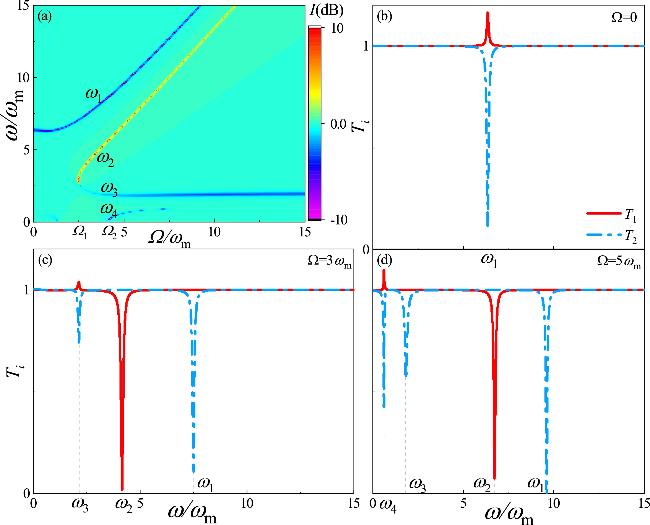
Figure 2. Controlling nonreciprocal photon routers via photon-exciton Rabi coupling. (a) The isolation ratio in Ω − ω plane. (b)–(c) The corresponding transmissivity Ti versus a normalized frequency for different Rabi coupling strengths Ω with ϵ = 103ωm and g = 0.02ωm. Other parameters are Δc = 2ωm, Δsag = − 4ωm, Δa = 0.5ωm, ${\kappa }_{c}^{i}={\kappa }_{c}^{ex}=0.04{\omega }_{m}$, κ = 0.05ωm, κa = 0.1ωm, and γm = 8 × 10⁻⁵ωm. |
The mechanism of nonreciprocal transmission can be explained by the destruction and construction interference between different excitation pathways as shown in figure 1(b). For weak photon-exciton Rabi couplings (i.e., Ω < Ω1), when the cavity is driven by a driven field and a CW input signal optical field ${c}_{1}^{{\rm{in}}}$ at ω = ω1, there are two excitation pathways between states ∣n1, n2, na, nb⟩ and ∣n1 + 1, n2, na, nb⟩. One pathway is the direct pathway ∣n1, n2, na, nb⟩ → ∣n1 + 1, n2, na, nb⟩, i.e., the system absorbs a photon while transitions from ∣n1, n2, na, nb⟩ to ∣n1 + 1, n2, na, nb⟩ driven by CW input fields ${c}_{1}^{{\rm{in}}}$. The other pathway is an indirect pathway ∣n1, n2, na, nb⟩ → ∣n1 + 1, n2, na, nb + 1⟩ → ∣n1 + 1, n2, na, nb⟩, i.e., the system absorbs a photon and a phonon while transitions from ∣n1, n2, na, nb⟩ to ∣n1 + 1, n2, na, nb + 1⟩ driven by driven fields, then emits a phonon and transitions from ∣n1 + 1, n2, na, nb + 1⟩ to ∣n1 + 1, n2, na, nb⟩. The phase difference of two excitation pathways is (2n + 1)π (n is an integer), and the interference between two excitation pathways is destructive. This destructive interference generates an optomechanically induced transparency window in CW light transmission, resulting in the output CCW light being amplified.
When the cavity is driven by a driven field and a CCW input signal optical field ${c}_{2}^{{\rm{in}}}$ at ω = ω2, there are two excitation pathways between states ∣n1, n2, na, nb⟩ and ∣n1, n2 + 1, na, nb − 1⟩. one pathway is a direct pathway ∣n1, n2, na, nb⟩ → ∣n1, n2 + 1, na, nb − 1⟩, i.e., the system absorbs a photon and emits a phonon while transitions from to driven by CW input signal optical fields ∣n1, n2, na, nb⟩ to ∣n1, n2 + 1, na, nb − 1⟩. The other pathway is an indirect pathway ∣n1, n2, na, nb⟩ → ∣n1, n2 + 1, na, nb⟩ →∣n1, n2 + 1, na, nb − 1⟩, i.e., the system absorbs a photon and transitions from ∣n1, n2, na, nb⟩ to ∣n1, n2 + 1, na, nb⟩ driven by driven fields, then emits a phonon and transitions from ∣n1, n2 + 1, na, nb⟩ to ∣n1, n2 + 1, na, nb − 1⟩. The phase difference of two excitation pathways is 2nπ (n is an integer), and the interference between two excitation pathways is constructive. This constructive interference generates an optomechanically induced absorption window in CCW light transmission, resulting that the output CCW light is attenuated. Therefore, nonreciprocal transmission demonstrates as CW unidirectional amplification.
Moreover, exciton-photon Rabi couplings, Sagnac effects, and CW-CCW-mode dissipative couplings can alter the interplay of different quantum states ∣n1, n2, na, nb⟩, and modify the interference condition, then resulting the frequency shift of the output photon signals. In particular, strong exciton-photon Rabi couplings results in that the interference condition can be satisfied at multiple resonant frequencies, i.e., ω = ω1,2,3,4. These quantum constructive and destructive interferences generate multiple nonreciprocal transmission windows as shown in figure 2, where CW nonreciprocal transmission arises at ω = ω1,3,4 and CCW nonreciprocal transmission occurs at ω = ω2.
The nonreciprocal transmission of photon signals can be altered by driven fields as shown in figure 3. As demonstrated in figure 3(a), there are three CW nonreciprocal transmission windows at ω = ω1,3,4 where I(ω1,3,4) < 0 and one CCW nonreciprocal transmission window at ω = ω2 where I(ω2) > 0. In particular, the CW (CCW) nonreciprocal transmission window with a frequency ω1 (ω2) displays a perfect nonreciprocity because the transmission of photon signals along the opposite direction is almost completely blocked as shown in figures 3(b)–(d). These phenomena can be used to realize perfect nonreciprocal routers in which photon signals can be only transmitted along one direction and the transmission along the opposite direction is completely prevented. In addition, for the CW nonreciprocal transmission with resonant frequencies ω3,4, the signal transmission along the opposite direction (i.e., CCW direction) is not completely blocked, and this nonreciprocity is not perfect. Moreover, the driven field intensity does not change the interplay of different quantum states and the interference condition, thus the enhancement of driven field intensities has almost no effect on the resonant frequencies ω1,2,3 for nonreciprocal transmission, where ω1 ≈ 9.6ωm, ω2 ≈ 6.7ωm, and ω3 ≈ 1.7ωm. Meanwhile the nonreciprocal transmission with a resonant frequency ω4 occurs in the region of enough strong driven fields [see figures 3(a) and (d)].
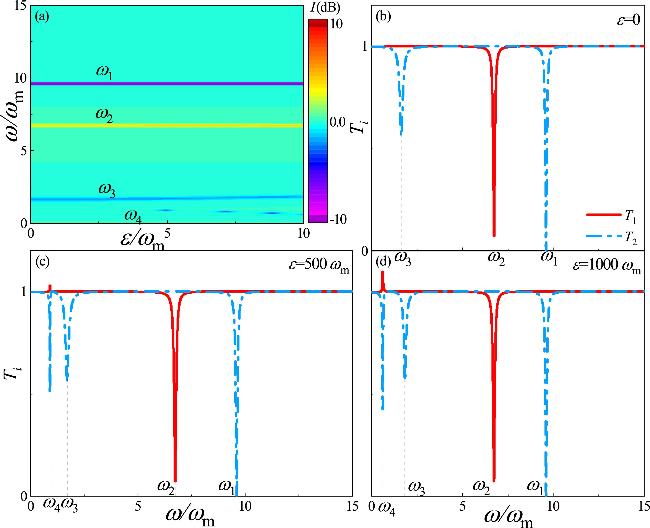
Figure 3. Controlling nonreciprocal photon routers via driven fields. (a) The isolation ratio in ϵ − ω plane. (b)-(c) The corresponding transmissivity Ti versus a normalized frequency for different pump field intensities ϵ with Ω = 5ωm and g = 0.02ωm. Other parameters are same as in figure 2. |
The single-photon optomechanical coupling between photon and phonon modes can also affect the nonreciprocal transmission characteristics of photon signals, which is demonstrated in figure 4. The single-photon optomechanical coupling strength does not change the interplay of different quantum states and the interference condition, thus CW and CCW nonreciprocal transmission windows with resonant frequencies ω1,2 appear at fixed frequencies, i.e., ω1 ≈ 9.6ωm and ω2 ≈ 6.7ωm. The single-photon optomechanical coupling can result in a CW nonreciprocal transmission window with a resonant frequency ω3 that shifts blue, which is clearly depicted by nonreciprocal isolate rates I [see figure 4(a)] and the corresponding transmissivity Ti(ω) [see figures 4(b)–(d)]. Meanwhile a CW nonreciprocal transmission window with a resonant frequency ω4 only appears in the region of weak photon-phonon coupling and shifts red as the photon-phonon coupling increases [figures 4(a) and (d)].
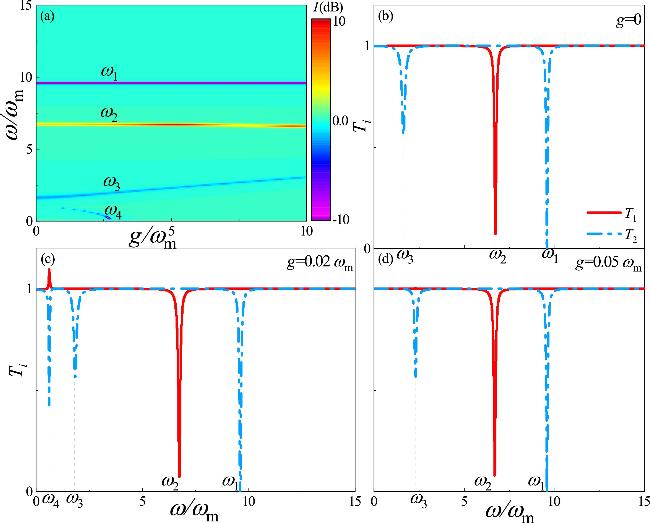
Figure 4. Controlling nonreciprocal photon routers via photon-phonon optomechanical coupling strengths. (a) The isolation ratio in g − ω plane. (b)-(c) The corresponding transmissivity Ti versus a normalized frequency for different optomechanical coupling strengths g with Ω = 5ωm and ϵ = 103ωm. Other parameters are same as in figure 2. |
Generally, routers are typically applicable to multi-port systems. In our proposed scheme, there are two input ports ${c}_{1}^{{\rm{in}}}$ and ${c}_{2}^{{\rm{in}}}$ which are located at the left side and the right side of a tapered optical fiber, respectively. Meanwhile, the optical signal input from the left side of a tapered optical fiber can be transmitted to the right side and then can be selected to be output at different ports with different frequencies, where we can set four ports to respectively output optical signals with a frequency ω = ω1,2,3,4. Similarly, the signal input from the right side of a tapered optical fiber can be output at the left side in the same manner. Experimentally, we can use a frequency selector (i.e., a filter) to selective signals with different frequency output from distinguished ports in experiments [54].
4. Noise analysis
To discuss the influence of noises on the performance of nonreciprocal optical routers, we depict the fluctuation noise for vacuum fields Sv, the fluctuation noise for exciton modes Se and the thermal noise for phonon modes ST in figure 5. As shown in figures 5(a) and (b), driven field intensities can enhance the contribution of vacuum field noises and exciton mode noises, while exciton mode noises are larger than vacuum field noises. These contributions of noises remain insignificant under both strong and weak driven fields, with a maximum value of approximately 9 × 10⁻². Additionally, the reduction of thermal noise is a key factor in evaluating the performance of nonreciprocal routers. As the environmental temperature increases, the number of thermal phonons becomes larger (where the thermal phonon number ${n}_{{\rm{t}}{\rm{h}}}=1/[{\rm{\exp }}(\hslash {\omega }_{m}/{k}_{{\rm{B}}}{T})-1]$), and the thermal noises becomes stronger. Even at relatively high temperatures (T ∼ 10K), i.e., larger thermal phonon numbers (nth ∼ 200), the contribution of thermal noise is extremely weak [figures 5(c)–(d)]. Therefore, the performance of optical routers should not be degraded by noise contributions under current experimental conditions.
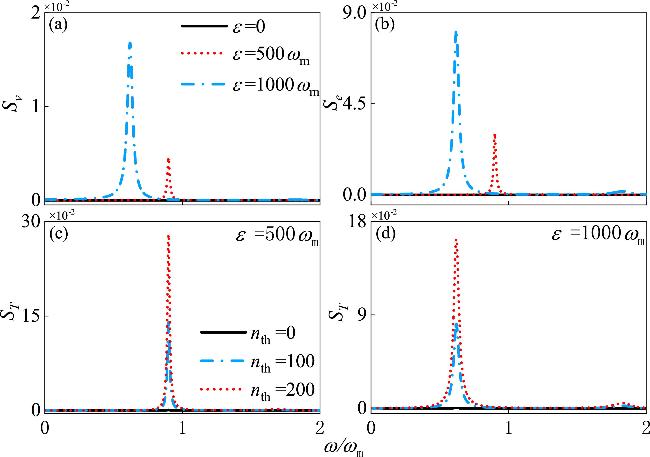


Figure 5. Noise Spectra. (a)–(b) The fluctuation noise for vacuum fields Sv (for exciton modes Se) as function of normalized frequency ω/ωm with different driven field intensities. (c)–(d) Thermal noise as function of normalized frequency ω/ωm with different thermal phonon numbers. Other parameters are the same as in figure 2. |
5. Experimental implementations
Experimentally, such a nonreciprocal optical router can be realized in a spinning hybrid optomechanical system constructed by a GaAs/AlAs WGM microresonator embedded with quantum wells and coupled to a single-mode tapered fiber as shown in figure 1(a), where multiple InGaAs quantum wells with identical thickness are epitaxially grown in a GaAs matrix and bounded by two AlGaAs diffusion barriers [36, 37]. The total thickness of the cavity is approximately 200 nm, while the radius of the resonator is 2 μm. This spinning microresonator can simultaneously support two counter-propagating optical modes (i.e., CW and CCW modes), an exciton mode, and a mechanical mode (phonons). Recently, WGM exciton polaritons and strong exciton-photon coupling have been observed in GaAs microdisk cavities. To realize a nonreciprocal optical router, the Sagnac shift ΔSag ∝ RΩ0 should reach the GHz range, which can be realized by increasing either radius R0 or rotating speed Ω0 for microcavities. The rotating speed should be Ω0 ∼ 150 MHz for a GaAs/AlAs whispering-gallery microresonator with a radius of 2 μm [37] and Ω0 ∼ 30 MHz for a GaAs disk microresonator with a radius of 10 μm [55]. In experiments, the rotation speed can reach 6.6 kHz for a spherical cavity with a radius of 1.1 mm [25]. A higher rotating speed can be realized for a smaller object such as levitated nanoparticles when the rotation speed has reached the GHz range [56, 57]. This technology offers a possibility to realize high rotation speeds in microcavities. Moreover, the optomechanical coupling strength g and the pump intensity ϵ jointly affect the performance of routers [see equation (6 )]. Namely, if gϵ maintains unchanged, the performance of routers should be unaltered. Therefore, we can decrease optomechanical coupling strength g by increasing pump intensities ϵ to achieve the same effect. Reliable performance parameters for quantum wells and WGM spinning microresonator are estimated based on experiments [24, 25, 36–38, 56–58], as shown in table 1. Therefore, our predicted nonreciprocal optical router can be realized under current experimental conditions.
Table 1. A summary of experimentally accessible parameters [24, 25, 36–38, 56–58] and normalized parameters used for numerical simulations. |
| Parameter | Symbol | Value | Value/ωm |
|---|---|---|---|
| Pump power | Ppu | 60 μW | — |
| Refractive index of the resonator | neff | 3.2 | — |
| Radius of the resonator | R | 2 μm | — |
| Rotating speed of the resonator | Ω0 | ∼150 MHz | — |
| Mechanical-mode frequency | ωm/2π | ∼1 GHz | 1 |
| Mechanical damping lifetime/loss | γm/2π | 1/(60 ns) | 0.01 |
| Cavity mode loss | κc/2π | ∼50 MHz | 0.05 |
| Dissipative coupling | κ/2π | ∼5 MHz | 0.005 |
| Exciton mode lifetime/loss | κe/2π | 1/(0.5 ns) | 2 |
| Rabi coupling | Ω/2π | ∼1 GHz | 1 |
| Optomechanical coupling | g/2π | ∼10 MHz | 0.01 |
| Pump intensity | ϵ/2π | ∼1 THz | 1000 |
| Sagnac-Fizeau shift | Δsag/2π | ∼1 GHz | 1 |
| Exciton-pump detuning | Δe/2π | 0.1 THz | 100 |
| Cavity-pump detuning | Δc/2π | 0.1 THz | 100 |
6. Conclusions
In conclusion, we have proposed a theoretical approach for realizing nonreciprocal optical routers with WGM quantum-well exciton polaritons via nonreciprocal OMIT. In such an approach, by combining Sagnac effects, pump fields and the coupling of photon, phonon and exciton modes, the transmission of photon signals along CW and CCW directions exhibits distinct characteristics at a special frequency, resulting in CW unidirectional transmission and CCW unidirectional transmission. Therefore, in our designed nonreciprocal routers, the transmission direction, output frequency and output intensity of photon signals can be precisely controlled. As the temperature increases, the redshift in both the exciton and cavity energy has been observed in the experiment [37]. To reveal the influence of such temperature-induced energy shifts on the performance of nonreciprocal router, a new and more complete model containing temperature effects should be developed. Our engineering nonreciprocal routers may be useful for implementing polaritonic on-chip integrated photonic circuits and have potential applications in developing quantum network and communication securities, which has controllable all-optical logic process and high efficiency operation while could be easily realized in current experimental conditions [24, 25, 36–38, 56–58].
Appendix Special expressions for the spectrum of output fields
In the spectrum of output fields, i.e., equation (7 ), the special expressions of T1, T2, Sv, Se and ST are obtained as:
$\begin{eqnarray}\begin{array}{l}{T}_{1}=| [A{F}_{-}-2{\rm{i}}{g}^{2}(| {c}_{1s}{| }^{2}{G}_{1}-{H}_{1})+{c}_{1s}^{* }{c}_{2s}E+{c}_{2s}^{* }{c}_{1s}E\\ +| {c}_{2s}{| }^{2}({H}_{2}-{\tilde{{\rm{\Delta }}}}_{a+}\{-2\kappa ({\tilde{{\rm{\Delta }}}}_{c1+}^{{\prime} }+2{\kappa }_{c}){{\rm{\Omega }}}^{2}\\ +{\kappa }^{2}[{\tilde{{\rm{\Delta }}}}_{c1-}^{{\prime} }{\tilde{{\rm{\Delta }}}}_{a-}+{{\rm{\Omega }}}^{2}\\ -{\tilde{{\rm{\Delta }}}}_{a-}({\tilde{{\rm{\Delta }}}}_{c1-}^{{\prime} }+2{\kappa }_{c})]+({\tilde{{\rm{\Delta }}}}_{c1+}^{{\prime} }+2{\kappa }_{c})[{\tilde{{\rm{\Delta }}}}_{c1-}^{{\prime} }({\tilde{{\rm{\Delta }}}}_{c2-}^{{\prime} }-{\tilde{{\rm{\Delta }}}}_{c2+}^{{\prime} })\\ \times {\tilde{{\rm{\Delta }}}}_{a-}+({\tilde{{\rm{\Delta }}}}_{c1-}^{{\prime} }+{\tilde{{\rm{\Delta }}}}_{c2-}^{{\prime} }-{\tilde{{\rm{\Delta }}}}_{c2+}^{{\prime} }){{\rm{\Omega }}}^{2}]\})]/d{| }^{2},\end{array}\end{eqnarray}$
$\begin{eqnarray}\begin{array}{rcl}{T}_{2} & = & | [A{F}_{+}+2{\rm{i}}{g}^{2}(| {c}_{1s}{| }^{2}\{{\tilde{{\rm{\Delta }}}}_{a-}{\tilde{{\rm{\Delta }}}}_{a+}^{{\prime} }[({\tilde{{\rm{\Delta }}}}_{c1-}^{{\prime} }-{\tilde{{\rm{\Delta }}}}_{c1+}^{{\prime} }){\tilde{{\rm{\Delta }}}}_{c2+}^{{\prime} }\\ & & \times ({\tilde{{\rm{\Delta }}}}_{c2-}^{{\prime} }+2{\kappa }_{c})+{\kappa }^{2}({\tilde{{\rm{\Delta }}}}_{c2-}^{{\prime} }\\ & & -{\tilde{{\rm{\Delta }}}}_{c2+}^{{\prime} }+2{\kappa }_{c})]-{\tilde{{\rm{\Delta }}}}_{a-}[{\kappa }^{2}\\ & & -2\kappa ({\tilde{{\rm{\Delta }}}}_{c21-}^{{\prime} }+2{\kappa }_{c})-({\tilde{{\rm{\Delta }}}}_{c1-}^{{\prime} }\\ & & -{\tilde{{\rm{\Delta }}}}_{c1+}^{{\prime} }-{\tilde{{\rm{\Delta }}}}_{c2+}^{{\prime} })({\tilde{{\rm{\Delta }}}}_{c2-}^{{\prime} }\\ & & +2{\kappa }_{c})]{{\rm{\Omega }}}^{2}+{H}_{1}\})+| {c}_{1s}{| }^{2}({G}_{2}-{H}_{2})+{c}_{1s}^{* }{c}_{2s}Z\\ & & +{c}_{2s}^{* }{c}_{1s}Z]/d{| }^{2},\end{array}\end{eqnarray}$
$\begin{eqnarray}\begin{array}{rcl}{S}^{v} & = & | 4{\rm{i}}{g}^{2}{\kappa }_{c}[{c}_{1s}^{* }({{\rm{\Omega }}}^{2}+\kappa {\tilde{{\rm{\Delta }}}}_{a-})-{c}_{2s}^{* }({{\rm{\Omega }}}^{2}+{\tilde{{\rm{\Delta }}}}_{a-}{\tilde{{\rm{\Delta }}}}_{c1-}^{{\prime} })]\\ & & \times [-{c}_{2s}^{* }({{\rm{\Omega }}}^{2}+\kappa {\tilde{{\rm{\Delta }}}}_{a+})+{c}_{1s}^{* }({{\rm{\Omega }}}^{2}+{\tilde{{\rm{\Delta }}}}_{c2+}^{{\prime} }{\tilde{{\rm{\Delta }}}}_{a+})]/d{| }^{2},\end{array}\end{eqnarray}$
$\begin{eqnarray}\begin{array}{rcl}{S}^{e} & = & | 4{\rm{i}}{g}^{2}\sqrt{{\kappa }_{a}{\kappa }_{c}}[{c}_{2s}{\rm{\Omega }}(\kappa -{\tilde{{\rm{\Delta }}}}_{c1+}^{{\prime} })+{c}_{1s}(\kappa -{\tilde{{\rm{\Delta }}}}_{c2+}^{{\prime} })]\\ & & \times [-{c}_{2s}({{\rm{\Omega }}}^{2}+\kappa {\tilde{{\rm{\Delta }}}}_{a-})+{c}_{1s}({{\rm{\Omega }}}^{2}+{\tilde{{\rm{\Delta }}}}_{c2-}^{{\prime} }{\tilde{{\rm{\Delta }}}}_{a-})]/d{| }^{2},\end{array}\end{eqnarray}$
$\begin{eqnarray}\begin{array}{rcl}{S}^{T} & = & | 2g\sqrt{{\kappa }_{c}}[-{c}_{2s}({{\rm{\Omega }}}^{2}+\kappa {\tilde{{\rm{\Delta }}}}_{a-})+{c}_{1s}({{\rm{\Omega }}}^{2}+{\tilde{{\rm{\Delta }}}}_{c2-}^{{\prime} }{\tilde{{\rm{\Delta }}}}_{a-})]\\ & & \times [2\kappa {{\rm{\Omega }}}^{2}-{{\rm{\Omega }}}^{2}({\tilde{{\rm{\Delta }}}}_{c1+}^{{\prime} }+{\tilde{{\rm{\Delta }}}}_{c2+}^{{\prime} })+{\kappa }^{2}{\tilde{{\rm{\Delta }}}}_{a+}\\ & & -{\tilde{{\rm{\Delta }}}}_{c1+}^{{\prime} }{\tilde{{\rm{\Delta }}}}_{c2+}^{{\prime} }{\tilde{{\rm{\Delta }}}}_{a+}]/d{| }^{2}{\gamma }_{m}\left({n}_{th}+\frac{1}{2}\right),\end{array}\end{eqnarray}$
where $\begin{eqnarray}\begin{array}{rcl}{F}_{\mp } & = & [-{\tilde{{\rm{\Delta }}}}_{c1\mp }^{{\prime} }{\tilde{{\rm{\Delta }}}}_{c2\mp }^{{\prime} }{\tilde{{\rm{\Delta }}}}_{a\mp }+{\tilde{{\rm{\Delta }}}}_{a\mp }{\kappa }^{2}-({\tilde{{\rm{\Delta }}}}_{c1\mp }^{{\prime} }+{\tilde{{\rm{\Delta }}}}_{c2\mp }^{{\prime} }){{\rm{\Omega }}}^{2}\\ & & +2\kappa {{\rm{\Omega }}}^{2}][{\tilde{{\rm{\Delta }}}}_{a\pm }{\kappa }^{2}-{\tilde{{\rm{\Delta }}}}_{c2+(1-)}^{{\prime} }{\tilde{{\rm{\Delta }}}}_{a\pm }+2\kappa {{\rm{\Omega }}}^{2}\\ & & -({\tilde{{\rm{\Delta }}}}_{c1\pm }^{{\prime} }+{\tilde{{\rm{\Delta }}}}_{c2\pm }^{{\prime} }+2{\kappa }_{c}){{\rm{\Omega }}}^{2}],\end{array}\end{eqnarray}$
$\begin{eqnarray}\begin{array}{rcl}{G}_{1(2)} & = & {\tilde{{\rm{\Delta }}}}_{a-}{\tilde{{\rm{\Delta }}}}_{a+}[({\tilde{{\rm{\Delta }}}}_{c2+(1-)}^{{\prime} }-{\tilde{{\rm{\Delta }}}}_{c2-(1+)}^{{\prime} }){\kappa }^{2}\\ & & +{\tilde{{\rm{\Delta }}}}_{c2(1)-}^{{\prime} }{\tilde{{\rm{\Delta }}}}_{c2(1)+}^{{\prime} }(-{\tilde{{\rm{\Delta }}}}_{c1-(2+)}^{{\prime} }+{\tilde{{\rm{\Delta }}}}_{c1+(2-)}^{{\prime} }\\ & & +2{\kappa }_{c})]+{\tilde{{\rm{\Delta }}}}_{a\mp }[-2{\tilde{{\rm{\Delta }}}}_{c2-(1+)}^{{\prime} }\kappa +{\kappa }^{2}\\ & & +{\tilde{{\rm{\Delta }}}}_{c2-(1+)}^{{\prime} }(-{\tilde{{\rm{\Delta }}}}_{c1-(2+)}^{{\prime} }+{\tilde{{\rm{\Delta }}}}_{c1\pm }^{{\prime} }\\ & & +{\tilde{{\rm{\Delta }}}}_{c2\pm }^{{\prime} }+2{\kappa }_{c})]{{\rm{\Omega }}}^{2},\end{array}\end{eqnarray}$
$\begin{eqnarray}\begin{array}{rcl}{H}_{1(2)} & = & {\tilde{{\rm{\Delta }}}}_{a\pm }\{{\kappa }^{2}+{\tilde{{\rm{\Delta }}}}_{c2+(1-)}^{{\prime} }[{\tilde{{\rm{\Delta }}}}_{c1\pm }^{{\prime} }-{\tilde{{\rm{\Delta }}}}_{c1+(2-)}^{{\prime} }\\ & & +{\tilde{{\rm{\Delta }}}}_{c2\mp }^{{\prime} }-2(\kappa +{\kappa }_{c})]\}{{\rm{\Omega }}}^{2}+(-{\tilde{{\rm{\Delta }}}}_{c1-}^{{\prime} }+{\tilde{{\rm{\Delta }}}}_{c1+}^{{\prime} }\\ & & -{\tilde{{\rm{\Delta }}}}_{c2-}^{{\prime} }+{\tilde{{\rm{\Delta }}}}_{c2+}^{{\prime} }+2{\kappa }_{c}){{\rm{\Omega }}}^{4},\end{array}\end{eqnarray}$
$\begin{eqnarray}\begin{array}{l}E={\tilde{{\rm{\Delta }}}}_{a-}[{\tilde{{\rm{\Delta }}}}_{c1-}^{{\prime} }{\tilde{{\rm{\Delta }}}}_{c2-}^{{\prime} }+{\kappa }^{2}-\kappa ({\tilde{{\rm{\Delta }}}}_{c1+}^{{\prime} }+{\tilde{{\rm{\Delta }}}}_{c2+}^{{\prime} }+2{\kappa }_{c})]{{\rm{\Omega }}}^{2}\\ +({\tilde{{\rm{\Delta }}}}_{c1-}^{{\prime} }-{\tilde{{\rm{\Delta }}}}_{c1+}^{{\prime} }+{\tilde{{\rm{\Delta }}}}_{c2-}^{{\prime} }-{\tilde{{\rm{\Delta }}}}_{c2+}^{{\prime} }-2{\kappa }_{c}){{\rm{\Omega }}}^{4}\\ -{\tilde{{\rm{\Delta }}}}_{a+}\{{\tilde{{\rm{\Delta }}}}_{a-}\kappa [-{\tilde{{\rm{\Delta }}}}_{c1-}^{{\prime} }{\tilde{{\rm{\Delta }}}}_{c2-}^{{\prime} }+{\tilde{{\rm{\Delta }}}}_{c2+}^{{\prime} }({\tilde{{\rm{\Delta }}}}_{c1+}^{{\prime} }+2{\kappa }_{c})]\\ +[-({\tilde{{\rm{\Delta }}}}_{c1-}^{{\prime} }+{\tilde{{\rm{\Delta }}}}_{c2-}^{{\prime} })\kappa +{\kappa }^{2}+{\tilde{{\rm{\Delta }}}}_{c2+}^{{\prime} }({\tilde{{\rm{\Delta }}}}_{c1+}^{{\prime} }+2{\kappa }_{c})]{{\rm{\Omega }}}^{2}\},\end{array}\end{eqnarray}$
$\begin{eqnarray}\begin{array}{rcl}Z & = & \kappa [{\tilde{{\rm{\Delta }}}}_{c2+}^{{\prime} }{\tilde{{\rm{\Delta }}}}_{a-}-{\tilde{{\rm{\Delta }}}}_{a-}\kappa +{\tilde{{\rm{\Delta }}}}_{a+}(-{\tilde{{\rm{\Delta }}}}_{c2-}^{{\prime} }+\kappa -2{\kappa }_{c})]{{\rm{\Omega }}}^{2}\\ & & +(-{\tilde{{\rm{\Delta }}}}_{c2-}^{{\prime} }+{\tilde{{\rm{\Delta }}}}_{c2+}^{{\prime} }-2{\kappa }_{c}){{\rm{\Omega }}}^{4}+{\tilde{{\rm{\Delta }}}}_{c1+}^{{\prime} }({\tilde{{\rm{\Delta }}}}_{c2+}^{{\prime} }{\tilde{{\rm{\Delta }}}}_{a+}\\ & & +{{\rm{\Omega }}}^{2}+{{\rm{\Omega }}}^{2})({\tilde{{\rm{\Delta }}}}_{a-}\kappa +{{\rm{\Omega }}}^{2})\\ & & -{\tilde{{\rm{\Delta }}}}_{c1-}^{{\prime} }({\tilde{{\rm{\Delta }}}}_{a+}\kappa +{{\rm{\Omega }}}^{2})({\tilde{{\rm{\Delta }}}}_{c2-}^{{\prime} }{\tilde{{\rm{\Delta }}}}_{a-}+2{\tilde{{\rm{\Delta }}}}_{a-}{\kappa }_{c}+{{\rm{\Omega }}}^{2}),\end{array}\end{eqnarray}$
$\begin{eqnarray}\begin{array}{rcl}d & = & A{P}_{-}{P}_{+}-2{\rm{i}}{g}^{2}{c}_{2s}[{N}_{1}-({M}_{2}+{K}_{2}){\tilde{{\rm{\Delta }}}}_{a+}]\\ & & +{c}_{1s}[-{N}_{2}-({M}_{1}+{K}_{1}){\tilde{{\rm{\Delta }}}}_{a+}],\end{array}\end{eqnarray}$
$\begin{eqnarray}\begin{array}{rcl}{P}_{\mp } & = & 2\kappa {{\rm{\Omega }}}^{2}-{{\rm{\Omega }}}^{2}({\tilde{{\rm{\Delta }}}}_{c1\mp }^{{\prime} }+{\tilde{{\rm{\Delta }}}}_{c2\mp }^{{\prime} })+{\kappa }^{2}{\tilde{{\rm{\Delta }}}}_{a\mp }\\ & & -{\tilde{{\rm{\Delta }}}}_{c1\mp }^{{\prime} }{\tilde{{\rm{\Delta }}}}_{c2\mp }^{{\prime} }{\tilde{{\rm{\Delta }}}}_{a\mp },\end{array}\end{eqnarray}$
$\begin{eqnarray}\begin{array}{rcl}{N}_{1(2)} & = & ({c}_{1s}^{* }-{c}_{2s}^{* }){{\rm{\Omega }}}^{4}({\tilde{{\rm{\Delta }}}}_{c1-}^{{\prime} }-{\tilde{{\rm{\Delta }}}}_{c1+}^{{\prime} }+{\tilde{{\rm{\Delta }}}}_{c2-}^{{\prime} }-{\tilde{{\rm{\Delta }}}}_{c2+}^{{\prime} })\\ & & +{{\rm{\Omega }}}^{2}\{{c}_{1(2)s}^{* }[{\kappa }^{2}+{\tilde{{\rm{\Delta }}}}_{c1-}^{{\prime} }{\tilde{{\rm{\Delta }}}}_{c2-}^{{\prime} }-\kappa ({\tilde{{\rm{\Delta }}}}_{c1+}^{{\prime} }+{\tilde{{\rm{\Delta }}}}_{c2+}^{{\prime} })]\\ & & +{c}_{2(1)s}^{* }[{\kappa }^{2}-2\kappa {\tilde{{\rm{\Delta }}}}_{c1(2)-}^{{\prime} }\\ & & +{\tilde{{\rm{\Delta }}}}_{c1(2)-}^{{\prime} }({\tilde{{\rm{\Delta }}}}_{c1+}^{{\prime} }-{\tilde{{\rm{\Delta }}}}_{c2(1)-}^{{\prime} }+{\tilde{{\rm{\Delta }}}}_{c2+}^{{\prime} })]\}{\tilde{{\rm{\Delta }}}}_{a-},\end{array}\end{eqnarray}$
$\begin{eqnarray}\begin{array}{rcl}{M}_{2(1)}\,=\, & c & {}_{2(1)s}^{* }{{\rm{\Omega }}}^{2}[{\kappa }^{2}-2\kappa {\tilde{{\rm{\Delta }}}}_{c1(2)+}^{{\prime} }+{\tilde{{\rm{\Delta }}}}_{c1(2)+}^{{\prime} }({\tilde{{\rm{\Delta }}}}_{c1-}^{{\prime} }\\ & & +{\tilde{{\rm{\Delta }}}}_{c2-}^{{\prime} }-{\tilde{{\rm{\Delta }}}}_{c2(1)+}^{{\prime} })]+{c}_{1(2)s}^{* }{{\rm{\Omega }}}^{2}[{\kappa }^{2}-\kappa ({\tilde{{\rm{\Delta }}}}_{c1-}^{{\prime} }\\ & & +{\tilde{{\rm{\Delta }}}}_{c2-}^{{\prime} })+{\tilde{{\rm{\Delta }}}}_{c1+}^{{\prime} }{\tilde{{\rm{\Delta }}}}_{c2+}^{{\prime} }],\end{array}\end{eqnarray}$
$\begin{eqnarray}\begin{array}{rcl}{K}_{2(1)} & = & {c}_{2s}^{* }[{\kappa }^{2}({\tilde{{\rm{\Delta }}}}_{c1-}^{{\prime} }-{\tilde{{\rm{\Delta }}}}_{c1+}^{{\prime} })+{\tilde{{\rm{\Delta }}}}_{c1-}^{{\prime} }{\tilde{{\rm{\Delta }}}}_{c1+}^{{\prime} }({\tilde{{\rm{\Delta }}}}_{c2-}^{{\prime} }-{\tilde{{\rm{\Delta }}}}_{c2+}^{{\prime} })]\\ & & \times {\tilde{{\rm{\Delta }}}}_{a-}+{c}_{1s}^{* }\kappa (-{\tilde{{\rm{\Delta }}}}_{c1-}^{{\prime} }{\tilde{{\rm{\Delta }}}}_{c2-}^{{\prime} }+{\tilde{{\rm{\Delta }}}}_{c1+}^{{\prime} }{\tilde{{\rm{\Delta }}}}_{c2+}^{{\prime} }){\tilde{{\rm{\Delta }}}}_{a-}.\end{array}\end{eqnarray}$