

1. Introduction
Neuronal firing is the core mechanism for information transmission and processing in the biological nervous system, and its electrical activity is determined by transmembrane ion flow, cell membrane structural characteristics, and various intrinsic conductance channels [1, 2]. The classic Hodgkin–Huxley model and subsequent simplified models (such as FitzHugh–Nagumo, Morris–Lecar, etc) have revealed that neurons can generate a wide variety of firing patterns driven by ion channel dynamics, including periodic firing, burst firing, and chaotic activity [3, 4]. These diverse dynamic behaviors not only reflect the nonlinear nature of neurons but also form the basis for neural encoding, network synchronization, rhythm control, and other neural functions [5–8]. With the development of nonlinear science and circuit theory, the dynamic mechanisms of neurons have gradually been mapped onto hardware circuit frameworks. Most of the neuron models have single capacitive variable for the membrane potential, which is derived from the output voltage from single capacitor of the neural circuits. However, this simplification fails to reflect the hierarchical structure of the cell membrane. By using capacitors, resistors, inductors, and nonlinear components to construct neural circuits, it is possible to simulate the transmembrane voltage changes and ion channel responses of neurons with high fidelity. Such neural circuit models not only provide an experimentally accessible platform for analyzing the firing mechanism of biological neurons but also offer important theoretical support for the development of artificial neuromorphic computing hardware.
A memristor is a type of nonlinear electronic component that can adjust its own electrical conductance based on historical changes in current or voltage. Its working mechanism is highly similar to the plasticity characteristic of biological synapses [6, 9–14]. Depending on the different working methods, memristors can be classified into magnetic flux-controlled memristor (MFCM) and charge-controlled memristor (CCM) [15–20], which rely on changes in magnetic flux or charge to achieve regulation. This property enables memristors to simulate chemical synapses, serving as a connection medium between cell membranes in neural circuits. Recent studies have shown that memristor-based neural systems can significantly enrich the nonlinear dynamical behaviors of neural networks, including chaos generation, synchronization regulation, and complex pattern formation, thereby providing new possibilities for neuromorphic computing and nonlinear circuit design [21, 22].
The introduction of memristors in neuromorphic circuits can effectively characterize the weight regulation and temporal dependence characteristics of chemical synapses, providing a key hardware foundation for constructing bionic neurons with information encoding, signal integration, and multi-modal response capabilities [23–25]. Recent research further demonstrates that memristor-enhanced neural networks can effectively improve dynamic richness and adaptive behaviors, and have been successfully applied in practical scenarios such as IoT-based robot navigation and intelligent control systems [26]. The firing behavior of neurons mainly depends on the ion channels on the membrane. These channels achieve the dynamic changes in membrane potential by regulating the transmembrane flow of ions such as sodium, potassium, and calcium [27–30]. The opening and closing states of the channels, protein activity, and permeability directly affect membrane current, thereby determining the instantaneous changes in membrane potential and ultimately regulating the firing pattern of neurons [2, 31]. This encoding ability of ion channels is not only crucial for neural information processing, network synchronization, and synaptic plasticity, but also endows neurons with selective responses to external stimuli and multi-modal firing capabilities [32, 33]. In addition, recent studies have reported that external electromagnetic radiation and stimulating currents can significantly influence the neurodynamics of Hopfield-type neural networks, leading to diverse dynamical regimes including chaos, synchronization, and complex oscillations [34]. However, most existing neural circuit models, when implementing the functions of ion channels, usually simplify them into fixed resistors or a single current source, ignoring the dynamic regulatory effect of the channels, thus making it difficult to fully reproduce the complex firing patterns and energy distribution laws of biological neurons.
The double-membrane neuron is a type of neuron model consisting of two layers: the inner membrane and the outer membrane. Its core purpose is to reproduce the differences in electrical properties and spatial distribution of the membrane layers of biological neurons. Therefore, two capacitance variables and a spatial diffusion term are introduced to describe the physiological activities of the neuron [35]. The membrane potentials of the inner and outer membranes of the double-membrane neuron are represented by parallel capacitors, and the diffusion effect of ions on the membrane surface is combined to make the neural dynamics more similar to the real physiological process [36, 37]. Studies have shown that the ratio of inner and outer membrane capacitance and the diffusion coefficient significantly affect the firing mode and signal transmission characteristics of the neuron [38, 39]. More recent works have further investigated the complex nonlinear dynamics of memristive neural networks and their applications in signal processing, chaotic systems, and intelligent computation [40, 41]. For more research progress on the double-membrane neuron, please refer to recent literatures [16, 42–47].
The classic Davson–Danielli model describes the biological membrane as a sandwich-like structure, with a lipid bilayer as the inner layer and protein layers covering both sides [48]. Although this model has historical significance, it is now generally considered an early conceptual description rather than an accurate structural representation of modern biological membranes. This early structural interpretation emphasized the possibility that membrane components might have a layered organization, providing a useful conceptual framework for understanding the heterogeneity of electrical responses between membrane substructures. Subsequently, the widely accepted fluid mosaic model proposed that the biological membrane consists of liquid lipid bilayers filled with proteins, which can move laterally, highlighting the dynamic and heterogeneous distribution of ion channels and membrane proteins [49, 50]. The fluid mosaic model represents the current mainstream biological understanding of membrane organization. In the present work, the layered perspective suggested by the Davson–Danielli model is adopted only as a phenomenological inspiration for electrical circuit abstraction rather than as a literal biological structural assumption. Although the fluid mosaic model provides a more accurate biological description of membrane organization, the layered perspective suggested by the Davson–Danielli model still offers an intuitive abstract concept for the electrical and circuit-level representation of membrane structure. Based on this multi-level interpretation, a three-layer membrane neuron model circuit representation method was constructed to describe the hierarchical electrical responses within the membrane. This abstraction should be understood as a functional electrical modeling framework rather than a structural biological model of the lipid bilayer. This abstraction does not attempt to replicate the microscopic molecular structure of the lipid bilayer, but aims to capture the inter-layer electrical interactions and energy redistribution mechanisms that may affect the neuronal spike dynamics and signal regulation.
The reliability of neuron models is crucial for computational neuroscience, some theoretical models are helpful to predict and prevent occurrence of nervous disorders [51–55]. The membrane potential of biological neurons is detectable, and its changes depend on the interaction between all channel currents, which their circuit implements can be approached by incorporating different electric components into the paralleled branch circuits. Except the inductor, thermistor [56, 57], nonlinear resistor (NR) [58, 59], Josephson junction [60, 61], MFCM and CCM [62–66] can be used in the branch circuits for activating specific encoding functions in the biophysical neurons. In particular, memristive currents derived from memristor-based channels can be used to describe the effect of electromagnetic induction [67–70] accompanying with the magnetic flux variable and charge variable in the known neuron models. Indeed, two capacitors connected via a memristor can be used to describe the electric activities in a memristive membrane [71–73] of biophysical neurons. Besides the effect of membrane structure on the neural activities, hybrid ion channels [74–76] composed of two or more functional electric components have important impacts on the channel currents and then the firing modes in neural activities are controlled effectively.
Although the existing neuron models can describe the changes in membrane potential and the firing patterns to some extent, they still have several limitations. Firstly, single-membrane or double-membrane models are unable to fully reflect the complex structure of captures possible hierarchical electrical responses in membrane-related circuits. In particular, these simplified models cannot effectively distinguish the heterogeneous electrical responses that may arise from different functional regions within the membrane system under external stimulation. In this work, the proposed model should be regarded as a hierarchical circuit abstraction rather than a literal biological reconstruction of membrane structure, while still being inspired by the layered organization observed in biological membranes to capture their possible functional heterogeneity at the electrical level. Secondly, the encoding effect of ion channels and their role in regulating membrane potential are often overlooked. Based on these issues, this paper proposes a three-membrane neuron model with ion channel shunt function. By introducing three capacitors to represent the sandwich membrane structure, one capacitor to represent the ion channel shunt device, two memristors used as the medium connecting the membrane layers, and combining nonlinear elements and ion channel shunting, it achieves precise regulation of inter-membrane current and energy. At the same time, through deriving the Hamilton energy function to analyze the relationship between energy distribution and firing patterns, investigating the stochastic resonance (SR) characteristics induced by noise, and further designing an adaptive energy control strategy, the active regulation of neuron firing patterns is achieved. This work not only provides a theoretical basis for high-fidelity bionic neuron modeling, but also offers new methods and ideas for the design of future artificial neural circuits and neuromorphic chips.
2. Model description and scheme
Biological neurons can usually be represented by a single capacitor for their membrane potential, but this simplification fails to reflect the complex dynamics between the membrane layers. Li et al proposed a dual-membrane neuron model [36], which expands the range of neuronal firing patterns by separately considering the characteristics of the inner and outer membranes. However, this model fails to explain the negative resting potential of biological neurons and often neglects the encoding effect of ion channels. Based on the Davson–Danielli model in [48], we further proposed a three-membrane neuron model with ion channel encoding capabilities, where the three-layer configuration is introduced as a minimal hierarchical abstraction inspired by membrane structural heterogeneity rather than a strict one-to-one mapping to specific biological layers. The inner layer mainly responsible for rapid responses and integration of ion channel signals, the inter-layer layer undertakes signal transmission and modulation of external stimuli, and the outer layer represents the membrane potential firing characteristics observed experimentally. This hierarchical design not only enables the system to exhibit non-uniform dynamic responses between layers, but also enhances the encoding ability for external stimuli and changes in internal ion channel states, thereby more realistically reproducing the multimodal electrical activity characteristics of biological membranes, as shown in figure 1. The selection of a three-layer structure represents a balance between model simplicity and the ability to capture non-uniform inter-layer dynamics, providing the minimal configuration required to reproduce heterogeneous electrical responses that cannot be achieved by single- or double-membrane models.
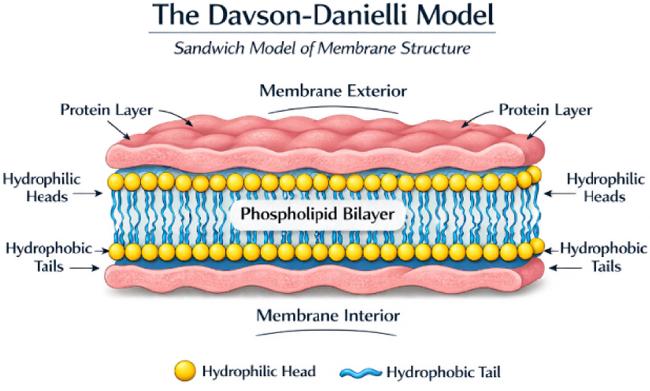
Figure 1. Illustration of cell membrane with sandwich structure (phospholipid bilayer as the bread, proteins as the filling, and carbohydrates as the bottom layer). |
Based on the sandwich structure shown in figure 1, the three capacitors (C1, C2, C3) are connected in parallel with other branch circuits, and memristive elements are used to couple adjacent capacitive layers. The capacitor C4 is introduced as a shunt regulation component to enhance channel-like signal modulation and improve the encoding capability of the circuit. The regulatory effect analogous to ion-channel behavior is mainly realized through the sensing branch, which is used to describe dynamic transmission processes associated with channel-like regulation and electromagnetic induction effects. These two memristors (CCM and MFCM) in the circuit are designed to characterize the coupling medium between different membrane layers, rather than representing biological ion channels. Accordingly, the memristive elements are introduced as functional nonlinear medium to capture possible history-dependent conductive-like responses that may occur in the inter-layer coupling pathways. They are also capable of describing nonlinear memory-dependent response characteristics, including sensitivity to variations in external electric and magnetic field-influenced signals and frequency-selective filtering behavior. As shown in figure 2, the proposed memristor-coupled neural circuit represents a neuromorphic dynamical modeling framework in which the circuit components are employed as abstract functional elements for investigating nonlinear firing dynamics and signal regulation mechanisms.
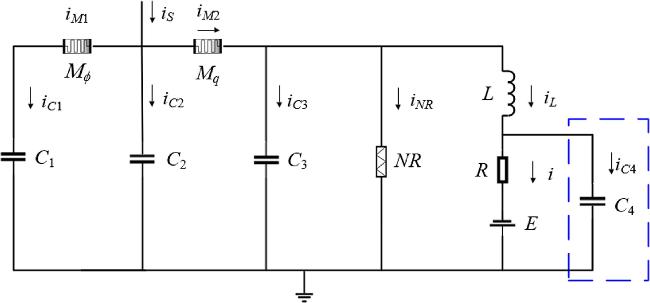
Figure 2. Tri-capacitors neural circuit coupled by memristors. C1, C2, C3, C4 represents capacitors, L represent inductor, R represent resistor, NR represent nonlinear resistor, E represents constant voltage value of the reverse potential of the ion channel. C1 and C2 are connected by a magnetic flux-controlled memristor (MFCM), while C2 and C3 are coupled by a charge-controlled memristor (CCM). |
The capacitor C4 in the dashed box shunts current from the inductive channel, and energy flow is also shunted from the neural circuit. For a CCM, the constitutive relation is given by φ = φ (q), and the corresponding voltage-current relationship can be written as VM = W(q)iM, where W(q) is referred to as the memristance, determined by the internal state variable q. For a MFCM, the constitutive relation is given by q = q(φ), and the corresponding current–voltage relationship can be expressed as iM = M(φ)VM, where M(φ) represents the memductance as a function of magnetic flux φ. The channel currents of the memristors (CCM and MFCM) and the NR are defined by the following formulas respectively5 ), the coherent physical variables presented in equation (4 ) are amenable to description by an equivalent oscillator-like model, as detailed in equation (6 ).9 ), N represents the total number of time steps for the numerical calculation, and ISI is used to estimate the inter-spike interval of the neuron variable x1. To achieve adaptive regulation of the neuronal firing pattern, this paper proposes a control strategy based on energy regulation, which is used to dynamically adjust the parameter c4 of the shunt device. In this model, C4 acts as a shunt element for ion channels, influencing the distribution of membrane potential and allowing for external adjustment. Therefore, the corresponding parameter c4 is selected as the variable for adaptive control. By monitoring the change of system energy H in real time, the control law can dynamically update the value of c4, thereby achieving an adaptive transition from chaotic firing to the target firing pattern. The corresponding control law is shown in equation (10 ).
$\begin{eqnarray}\left\{\begin{array}{rcl}{i}_{\mathrm{NR}} & = & -\displaystyle \frac{1}{\rho }\left(V-\displaystyle \frac{{V}^{3}}{3{V}_{0}^{2}}\right)=-\displaystyle \frac{1}{\rho }\left({V}_{3}-\displaystyle \frac{{V}_{3}^{3}}{3{V}_{0}^{2}}\right),\\ {i}_{M1} & = & M\left(\phi \right){V}_{M1}={A}_{0}\,\cos \left({\delta }_{1}\phi \right)\left({V}_{2}-{V}_{1}\right),\\ \displaystyle \frac{{\rm{d}}\phi }{{\rm{d}}t} & = & {K}_{1}\left({V}_{2}-{V}_{1}\right)-{K}_{2}\phi ,\\ {V}_{M2} & = & W\left(q\right){i}_{M2}=\displaystyle \frac{\csc \left({\delta }_{2}q+\lambda \right){i}_{M2}}{{B}_{0}}={V}_{2}-{V}_{3},\\ \displaystyle \frac{{\rm{d}}q}{{\rm{d}}t} & = & {K}_{3}{i}_{M2}-{K}_{4}q.\end{array}\right.\end{eqnarray}$
The parameters (ρ, V0) are determined by the material properties of the NR, while the parameters (A0, B0, K1, K2, K3, K4, δ1, δ2) depend on the material attributes of the memristors (CCM and MFCM). The fourth and fifth formulas estimate the changes of magnetic flux and charge level in the memristors. The voltage and current in the branch circuit composed of C4 satisfies the following constraint relationships $\begin{eqnarray}\left\{\begin{array}{rcl}i & = & {i}_{L}-{i}_{C4},\\ {V}_{4} & = & {\rm{i}}R-E.\end{array}\right.\end{eqnarray}$
Substitute the value of i from the first line into the second line, and an equation for iC4 can be obtained. $\begin{eqnarray}{i}_{C4}={i}_{L}-\displaystyle \frac{{V}_{4}+E}{R}.\end{eqnarray}$
According to the Kirchhoff's theorem, the coherent relation between the seven physical variables is described by $\begin{eqnarray}\left\{\begin{array}{rcl}{C}_{1}\displaystyle \frac{{\rm{d}}{V}_{1}}{{\rm{d}}t} & = & {i}_{M1},\\ {C}_{2}\displaystyle \frac{{\rm{d}}{V}_{2}}{{\rm{d}}t} & = & {i}_{S}+-{i}_{M1}-{i}_{M2},\\ {C}_{3}\displaystyle \frac{{\rm{d}}{V}_{3}}{{\rm{d}}t} & = & {i}_{M2}-{i}_{L}-{i}_{NR},\\ L\displaystyle \frac{{\rm{d}}{i}_{L}}{{\rm{d}}t} & = & {V}_{3}-{V}_{4},\\ {C}_{4}\displaystyle \frac{{\rm{d}}{V}_{4}}{{\rm{d}}t} & = & {i}_{C4},\\ \displaystyle \frac{{\rm{d}}\phi }{{\rm{d}}t} & = & {K}_{1}\left({V}_{2}-{V}_{1}\right)-{K}_{2}\phi ,\\ \displaystyle \frac{{\rm{d}}q}{{\rm{d}}t} & = & {K}_{3}{i}_{M2}-{K}_{4}q.\end{array}\right.\end{eqnarray}$
The purpose of dimensionless is threefold: (1) to ensure that all variables and parameters in the circuit equations are expressed in a unified normalized form, eliminating inconsistencies caused by different physical units; (2) to facilitate the numerical solution of nonlinear equations containing higher-order nonlinear terms by normalizing all variables; (3) to provide flexibility in practical circuit implementation, where different combinations of physical components can be selected according to dimensional equivalence and safety requirements. Physical variables are converted to dimensionless equivalents via scale transformation to remove the influence of physical unit diversity. $\begin{eqnarray}\left\{\begin{array}{rcl}{x}_{1}=\displaystyle \frac{{V}_{1}}{{V}_{0}},{x}_{2}=\displaystyle \frac{{V}_{2}}{{V}_{0}},x=\displaystyle \frac{V}{{V}_{0}},y=\displaystyle \frac{\rho {i}_{L}}{{V}_{0}},\tau =\displaystyle \frac{t}{\rho {C}_{1}},z=\displaystyle \frac{\phi }{\rho {C}_{1}{V}_{0}}, & & \\ w=\displaystyle \frac{q}{{C}_{1}{V}_{0}},{c}_{1}=\displaystyle \frac{{C}_{1}}{{C}_{2}},{c}_{2}=\displaystyle \frac{{C}_{1}}{{C}_{3}},{c}_{3}=\displaystyle \frac{{\rho }^{2}{C}_{1}}{L},{c}_{4}=\displaystyle \frac{{C}_{1}}{{C}_{4}},b=\displaystyle \frac{R}{\rho }, & & \\ a=\displaystyle \frac{E}{{V}_{0}},\mu =\displaystyle \frac{{i}_{s}\rho }{{V}_{0}},{k}_{1}={K}_{1},{k}_{2}={K}_{2}\rho {C}_{1},{k}_{3}={K}_{3},{k}_{4}={K}_{4}\rho {C}_{1}, & & \\ \alpha =\rho {C}_{1}{V}_{0}{\delta }_{1},\beta ={C}_{1}{V}_{0}{\delta }_{2},{A}_{0}\rho ={B}_{0}\rho =1. & & \end{array}\right.\end{eqnarray}$
In accordance with the definitions in equation ( $\begin{eqnarray}\left\{\begin{array}{rcl}\displaystyle \frac{{\rm{d}}{x}_{1}}{{\rm{d}}\tau } & = & \cos \left(\alpha z\right)\left({x}_{2}-{x}_{1}\right),\\ \displaystyle \frac{{\rm{d}}{x}_{2}}{{\rm{d}}\tau } & = & {c}_{1}\left[\mu -\,\cos \left(\alpha z\right)\left({x}_{2}-{x}_{1}\right)\left.-\,\sin \left(\beta w+\lambda \right)\left({x}_{2}-{x}_{3}\right)\right],\right.\\ \displaystyle \frac{{\rm{d}}{x}_{3}}{{\rm{d}}\tau } & = & {c}_{2}\left[\sin \left(\beta w+\lambda \right)\left({x}_{2}-{x}_{3}\right)-y+{x}_{3}-\displaystyle \frac{1}{3}{{x}_{3}}^{2}\right],\\ \displaystyle \frac{{\rm{d}}y}{{\rm{d}}\tau } & = & {c}_{3}\left({x}_{3}-{x}_{4}\right),\\ \displaystyle \frac{{\rm{d}}{x}_{4}}{{\rm{d}}\tau } & = & {c}_{4}\left[y-b\left({x}_{4}+a\right)\right],\\ \displaystyle \frac{{\rm{d}}z}{{\rm{d}}\tau } & = & {k}_{1}\left({x}_{2}-{x}_{1}\right)-{k}_{2}z,\\ \displaystyle \frac{{\rm{d}}w}{{\rm{d}}\tau } & = & {k}_{3}\,\sin \left(\beta w+\lambda \right)\left({x}_{2}-{x}_{3}\right)-{k}_{4}w.\end{array}\right.\end{eqnarray}$
The neural circuit's field energy W' and its equivalent dimensionless Hamilton energy form are obtainable. $\begin{eqnarray}\left\{\begin{array}{rcl}W^{\prime} & = & {W}_{C1}+{W}_{C2}+{W}_{C3}+{W}_{L}+{W}_{C4}+{W}_{M\phi }+{W}_{Mq}\\ & = & \displaystyle \frac{1}{2}{C}_{1}{V}_{1}^{2}+\displaystyle \frac{1}{2}{C}_{2}{{V}_{2}}^{2}+\displaystyle \frac{1}{2}{C}_{3}{V}_{3}^{2}+\displaystyle \frac{1}{2}L{i}_{L}^{2}+\displaystyle \frac{1}{2}{C}_{4}{V}_{4}^{2}+\displaystyle \frac{1}{2}{i}_{M1}\phi +\displaystyle \frac{1}{2}q{V}_{M2},\\ H & = & \displaystyle \frac{W^{\prime} }{{C}_{1}{V}_{0}^{2}}=\displaystyle \frac{1}{2}{x}_{1}^{2}+\displaystyle \frac{1}{2{c}_{1}}{x}_{2}^{2}+\displaystyle \frac{1}{2{c}_{2}}{x}_{3}^{2}+\displaystyle \frac{1}{2{c}_{3}}{y}^{2}+\displaystyle \frac{1}{2{c}_{4}}{x}_{4}^{2}\\ & & +\displaystyle \frac{1}{2}z\left({x}_{2}-{x}_{1}\right)\cos \left(\alpha z\right)+\displaystyle \frac{1}{2}w\left({x}_{2}-{x}_{3}\right).\end{array}\right.\end{eqnarray}$
The Hamilton energy function H is closely related to the parameters c1, c2, c3, and c4. Once all variables are known, the energy function H can be monitored to identify its correlation with firing modes in electrical activities. Specifically, different values of external forcing μ induce energy exchange between ion channels, prompting energy shifts and mode transitions within neural activities. To investigate the memristor's role between two coupled capacitors, its memristive currents are converted into dimensionless forms accordingly. $\begin{eqnarray}\left\{\begin{array}{lll}{u}_{1} & = & \displaystyle \frac{\rho {i}_{M1}}{{V}_{0}}=\left(x-{x}_{1}\right)\cos \left(\alpha z\right),\\ {u}_{2} & = & \displaystyle \frac{\rho {i}_{M2}}{{V}_{0}}=\left(x-{x}_{2}\right)\sin \left(\beta w+\lambda \right).\end{array}\right.\end{eqnarray}$
Analysis of the two memristive current time series allowed for their distinction from external stimuli and estimation of the memristive media between membrane layers. During the rapid firing process of neurons, time-varying electric fields and magnetic fields are generated. The memristive medium can sense these changes to a certain extent. However, the memristor is also susceptible to external electromagnetic fields in practical applications. To evaluate the SR of the system in a noisy environment, the average energy ⟨H⟩ and the coefficient variation CV can be used as quantitative indicators. $\begin{eqnarray}\left\{\begin{array}{lll}\left\langle H\right\rangle & = & \displaystyle \frac{1}{\tau -{\tau }_{0}}\displaystyle {\int }_{{\tau }_{0}}^{\tau }H\left(\tau \right)\cdot {\rm{d}}\tau \approx \displaystyle \frac{1}{N}\displaystyle \sum _{i=1}^{N}{H}_{i},\\ {\rm{C}}{\rm{V}} & = & \displaystyle \frac{\sqrt{\left\langle {\rm{I}}{\rm{S}}{{\rm{I}}}^{2}\right\rangle -{\left\langle {\rm{I}}{\rm{S}}{\rm{I}}\right\rangle }^{2}}}{\left\langle {\rm{I}}{\rm{S}}{\rm{I}}\right\rangle }.\end{array}\right.\end{eqnarray}$
As shown in equation ( $\begin{eqnarray}\left\{\begin{array}{lll}\displaystyle \frac{{\rm{d}}{c}_{4}}{{\rm{d}}\tau } & = & g{c}_{4}\cdot \vartheta \left(H\left(\tau \right)-\varepsilon \right),\\ \vartheta \left(p\right) & = & 1,p\geqslant 0,\vartheta (p)=0,p\lt 0,\,\tau \gt 3000.\end{array}\right.\end{eqnarray}$
In this control scheme, the proportional threshold ϵ determines the threshold of the total energy of the neuron. The gain parameter g controls the growth rate of c4, and ϑ represents the Heaviside function. When τ > 3000, the adaptive control is activated, and it enables the neuron to be activated during the transient period and presenting a stable firing pattern.3. Numerical results and discussion
The neuron model in equation (6 ) was numerically solved using the fourth-order Runge–Kutta algorithm with a time step of 0.01. The model parameters were set as a = 0.2, b = 1.2, c1 = 0.7, c2 = 0.8, c3 = 0.1, c4 = 0.2, α = 0.5, β = 0.2, k1 = 1, k2 = 0.1, k3 = 1, k4 = 0.1, λ = 0.8. The external stimulus was a periodic signal μ = μ0sin(ωτ), where μ0 is the amplitude and ω is the frequency. To systematically analyze the firing dynamics of the sandwich neuron model with ion channel shunting, by changing the external stimulus frequency ω, we plotted the bifurcation structures of the intracellular, extracellular, and intermembrane potentials in figure 3. Meanwhile, the evolution results of the largest Lyapunov exponent (LLE) under different ω were calculated and presented. By comparing the bifurcation diagrams with the changes in LLE, the emergence of various dynamical states such as burst firing, periodic firing, multi-periodic firing, quasi-periodic firing, and chaotic firing in the system under different stimulus frequencies can be more intuitively revealed.
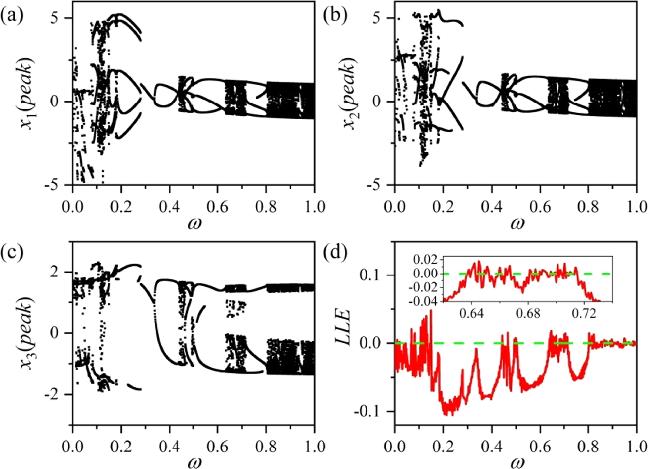
Figure 3. Distribution of peak values for variables x1(a), x2(b), and x3(c), as well as the relationship graph between corresponding LLE(d) and frequency ω. Parameter set as a = 0.2, b =1.2, c1 = 0.7, c2 = 0.8, c3 =0.1, c4 = 0.2, α = 0.5, β = 0.2, k1 = 1, k2 = 0.1, k3 = 1, k4 = 0.1, λ = 0.8, μ0 = 1, initial values (0.1, 0.1, 0.1, 0.1, 0.1, 0.01, 0.01). |
The result in figure 3 systematically shows the firing mode responses of the inner, inter, and outer membranes to variations in external stimulus frequency ω. As the stimulus frequency varies, the system exhibits several typical dynamical regimes, including burst firing, periodic firing, multi-periodic firing, quasi-periodic firing, and chaotic firing. According to the bifurcation diagrams in figures 3(a)–(c), these firing patterns appear within different frequency intervals, indicating that the firing behavior of the neuron is strongly dependent on the frequency of the external stimulus. To improve reproducibility, several representative frequency values are provided to characterize typical firing states observed in the system: burst firing occurs at low frequency (e.g. ω ≈ 0.02), periodic firing appears at intermediate frequency (e.g. ω ≈ 0.4), and chaotic firing is observed at higher frequency (e.g. ω ≈ 0.66). These values are selected as typical examples based on the bifurcation structure and phase-space characteristics, rather than strict boundaries. It should be emphasized that the transitions between different firing regimes are not sharply separated. In particular, quasi-periodic and chaotic states may coexist within certain frequency regions, leading to mixed dynamical behaviors. Therefore, it is not appropriate to define rigid frequency intervals for each regime. Instead, the classification of firing patterns in this work is based on a combined analysis of multiple indicators. Although the bifurcation structures of the three membrane potentials exhibit a similar global trend, subtle differences can still be observed. In particular, the response of the outer membrane potential is the closest to that of the inter-membrane potential, suggesting that these two layers share highly correlated dynamical responses to the external stimulus. The LLE shown in figure 3(d) is used as a quantitative criterion to identify chaotic dynamics, where LLE > 0 indicates the presence of chaos. However, LLE alone cannot distinguish between periodic, quasi-periodic, or burst firing. Therefore, the identification of firing modes is carried out by combining LLE with bifurcation structures, phase portraits (figure 4), and time series (figure 5), which together provide a more reliable characterization of the system dynamics. From a biological perspective, neurons often exhibit frequency-selective responses to external stimuli, where different stimulation frequencies may trigger distinct firing patterns and information encoding processes. The frequency-dependent bifurcation structures observed in figure 3 indicate that variations in the external stimulus frequency can modulate the activation of ion channels and the redistribution of membrane energy, thereby leading to transitions between periodic firing, bursting activity, and chaotic firing. Such frequency-selective dynamics are closely related to neural information processing and rhythm generation in biological neural systems. The result in figure 4 shows the attractor shapes, exploring the system's phase space structure under different firing modes, including the phase trajectories in the (x1, x2) and (x3, y) planes. The results clearly show the typical attractor structures of burst firing, periodic firing, and chaotic firing in the phase space, thereby providing more intuitive dynamical evidence for understanding the firing of the sandwich neuron model under different stimulation conditions.
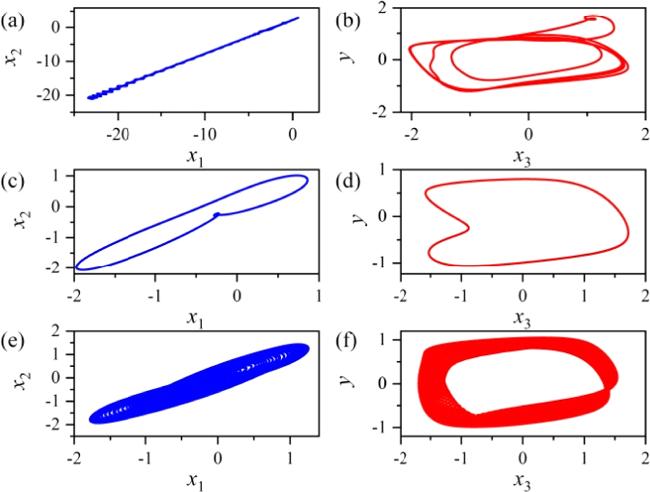
Figure 4. System attractor (x1, x2) and (x3, y). For (a) (b) ω = 0.02; (c) (d) ω = 0.4; (e) (f) ω = 0.66. Parameter set as a = 0.2, b =1.2, c1 = 0.7, c2 = 0.8, c3 =0.1, c4 = 0.2, α = 0.5, β = 0.2, k1 = 1, k2 = 0.1, k3 = 1, k4 = 0.1, λ = 0.8, μ0 = 1, initial values (0.1, 0.1, 0.1, 0.1, 0.1, 0.01, 0.01). |
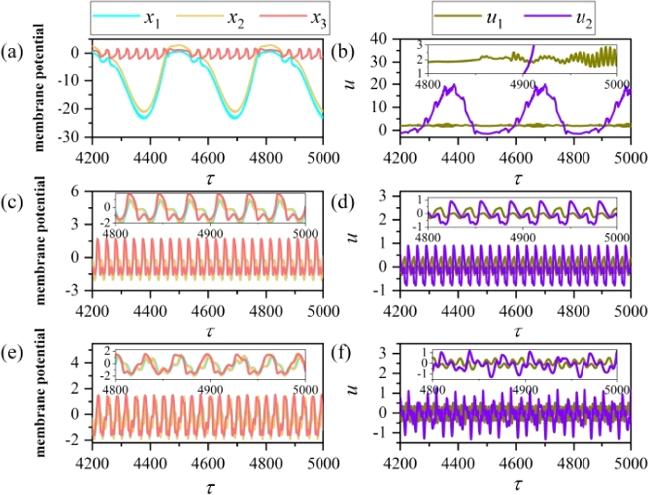
Figure 5. Evolution of the membrane potential (x1, x2, x3) and memristive currents (u1, u2). For (a) (b) ω = 0.02; (c) (d) ω = 0.4; (e) (f) ω = 0.66. Parameter set as a = 0.2, b =1.2, c1 = 0.7, c2 = 0.8, c3 =0.1, c4 = 0.2, α = 0.5, β = 0.2, k1 = 1, k2 = 0.1, k3 = 1, k4 = 0.1, λ = 0.8, μ0 = 1, initial value (0.1, 0.1, 0.1, 0.1, 0.1, 0.01, 0.01). |
From figure 4, it illustrates the phase space attractor structures of neurons in different firing states, revealing the dynamic correlation between extracellular and intracellular membrane potentials. These patterns exhibit significant variation with changes in external stimulation frequency ω. At ω = 0.02, the neuron is in the burst firing state, currently, the attractor in the (x1, x2) plane presents an approximately linear trajectory structure and is accompanied by a large oscillation amplitude, while in the (x3, y) plane, the repetitive burst characteristics of the burst dynamics are more clearly distinguishable. When the frequency is increased to ω = 0.4, the neuron enters the periodic firing mode, both attractors form regular and stable closed periodic orbits, reflecting the periodic dynamics of the system. Further increasing the frequency to ω = 0.66, the system enters the chaotic firing state, and the phase space trajectories in both planes present complex, non-repetitive chaotic attractor forms. To more intuitively depict the temporal characteristics of the three types of firing modes (burst, periodic, and chaotic), we further draw the corresponding membrane potential evolution diagrams and the changes of memristive current over time in figure 5.
Figure 5 illustrates the time series of neuron membrane potentials (different firing states) and memristive current evolution. Results show highly consistent firing sequences and trajectory similarity between the outer and inter-membrane potentials. In contrast, the changes in the inner membrane potential are more significant, especially in the burst firing state, where the potential difference between the inner and outer membranes is the most prominent. This phenomenon reflects the non-uniform response characteristics of the multi-layer membrane potential in the sandwich structure, and indirectly indicates that this sandwich structure may be related to negative resting potential in biological membrane systems. Moreover, the dimensionless memristive current u2 maintains larger amplitude throughout the evolution process, indicating that the current channels between the inner membrane, inter-membrane, and outer membrane persist and exert a significant influence in different firing modes. Larger amplitude of the memristive current also reveals the important modulation effect of ion channel shunting on the dynamics of membrane potential. To further explore the energy evolution characteristics of neurons in burst, periodic, and chaotic firing states and the changes in the proportion of each energy component, we plotted the corresponding energy analysis results in figure 6 to reveal the energy distribution and its changing trend of the sandwich neuron in different dynamic states.
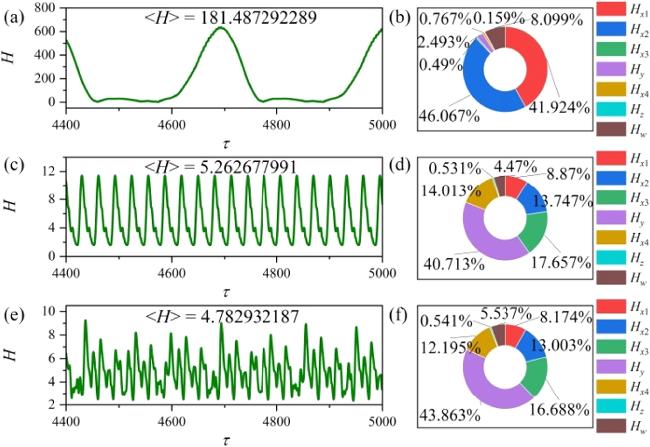
Figure 6. Evolution of the energy function (a), (c), and (e) and energy proportion for each energy term in the neuron presenting with different firing patterns (b), (d), and (f). For (a) (b) ω = 0.02; (c) (d) ω = 0.4; (e) (f) ω = 0.66. Parameter set as a = 0.2, b =1.2, c1 = 0.7, c2 = 0.8, c3 =0.1, c4 = 0.2, α = 0.5, β = 0.2, k1 = 1, k2 = 0.1, k3 = 1, k4 = 0.1, λ = 0.8, μ0 = 1, initials (0.1, 0.1, 0.1, 0.1, 0.1, 0.01, 0.01). |
The results in figure 6 indicate that firing modes are associated with distinct energy levels. Specifically, chaotic firing has the lowest average energy ⟨H⟩, and burst firing has the highest. This is mainly due to the significant increase in the amplitude of the external membrane and inter-membrane potentials in the burst state, which makes the overall energy of the system significantly higher than that of the periodic state and the chaotic state. By further analyzing the distribution of energy proportions, in burst firing, the energy Hx1 and Hx2 account for more than 80% of the total energy, indicating that this is the key reason for the increase in burst energy. In contrast, Hy constitutes the largest energy proportion in chaotic and periodic firing, while Hz is the smallest. Chaotic firing in the neuron shows higher Hy, Hz, and Hw proportions than periodic firing, and lower Hx1, Hx2, Hx3, and Hx4 proportions. These energy distribution differences reveal fundamental changes in coupling strength and membrane layer energy participation across the sandwich neuron model's dynamic states. From a functional perspective, the relatively lower average energy observed in the chaotic firing state may provide potential advantages for neural information processing. Compared with burst firing, chaotic firing maintains complex dynamical responses without requiring large energy accumulation in the membrane channels. This lower energy level implies that the neuron can sustain irregular yet responsive firing activities with reduced energy consumption. Such a property may be beneficial for improving the efficiency of neural signal processing, while still preserving high sensitivity to external perturbations and stimuli. To clarify the relationship between firing modes, memristor parameters, and shunt device parameter C4, figures 7 and 8 plot the bifurcation structure of the external membrane potential, showing the influence of parameters (α, β, λ, c4) and (k1, k2, k3, k4). These results reveal the sensitivity of parameter changes to the system's dynamic evolution.
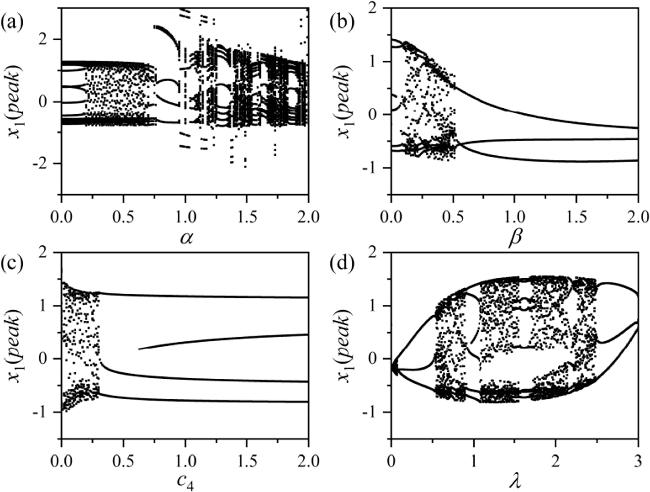
Figure 7. Distribution peaks for the variable x1. For (a) c4 = 0.2, β = 0.2, λ = 0.8; (b) c4 = 0.2, α = 0.5, λ = 0.8; (c) α = 0.5, β = 0.2, λ = 0.8; (d) c4 = 0.2, α = 0.5, β = 0.2. Parameter set as a = 0.2, b =1.2, c1 = 0.7, c2 = 0.8, c3 =0.1, k1 = 1, k2 = 0.1, k3 = 1, k4 = 0.1, μ0 = 1, ω = 0.66, initial values (0.1, 0.1, 0.1, 0.1, 0.1, 0.01, 0.01). |
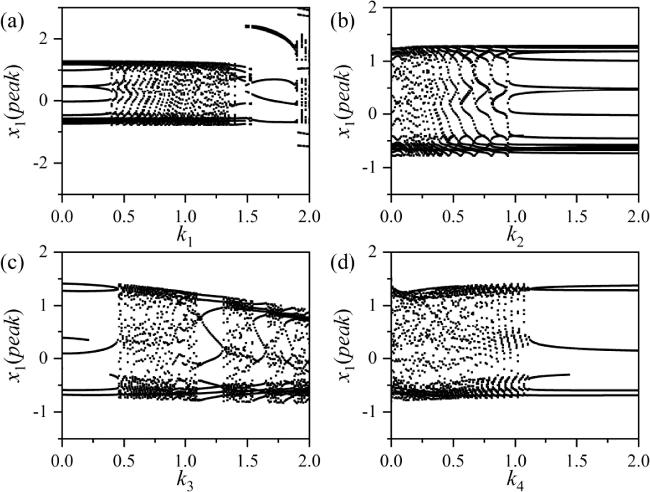
Figure 8. Distribution of peaks for the variable x1. For (a) k2 = 0.1, k3 = 1, k4 = 0.1; (b) k1 = 1, k3 = 1, k4 = 0.1; (c) k1 = 1, k2 = 0.1, k4 = 0.1; (d) k1 = 1, k2 = 0.1, k3 = 1. Parameter set as a = 0.2, b =1.2, c1 = 0.7, c2 = 0.8, c3 =0.1, c4 = 0.2, α = 0.5, β = 0.2, λ = 0.8, μ0 = 1, ω = 0.66, initial values (0.1, 0.1, 0.1, 0.1, 0.1, 0.01, 0.01). |
Neuronal firing modes are significantly regulated by memristor parameters and shunt device parameter C4, as demonstrated in figures 7 and 8. A gradual increase in β, c4, k2, and k4 causes the system to transition from chaotic to periodic firing, showcasing a typical dynamic trend from irregular to regular behavior. In contrast, the bifurcation structure of other parameters is more complex, presenting diverse nonlinear behaviors such as periodic windows, quasi-periodic and chaotic alternations, indicating significant differences in the system's sensitivity to different parameters. It is particularly important to note the bifurcation change of parameter λ. Since the parameter λ is determined by the material properties of CCM, the achievable range of its values has physical constraint. When λ = π/2, the memristive function in the system satisfies sin(βq + π/2) = cos(βq), meaning that the response form of the memristor element transitions from sine type to cosine type, representing a fundamental change in its internal mechanism from the material implementation perspective. Therefore, the actual adjustable range of λ should be reasonably limited to (0, π/2). This further emphasizes the consistency requirement between parameter selection and device physical properties. Overall, parameters differ in their ability to regulate firing characteristics, reflecting their distinct functional roles in the model's dynamic modulation. To simulate potential external electromagnetic field disturbances, Gaussian white noise is added to memristive state variables z and w, representing stochastic electromagnetic effects on the coupling medium between membrane layers. Specifically, noise in the w channel represents fluctuations due to external electric field variations, while noise in the z channel corresponds to fluctuations caused by external magnetic field disturbances. These random disturbances are modeled as Gaussian white noise to simulate the influence of real world environmental factors on the system's dynamics. The CV and ⟨H⟩ were used to quantitatively evaluate SR under noise-driven conditions. Figure 9 shows the statistical analysis on energy average and coherence degree, revealing the nonlinear synergy between noise intensity and system response.
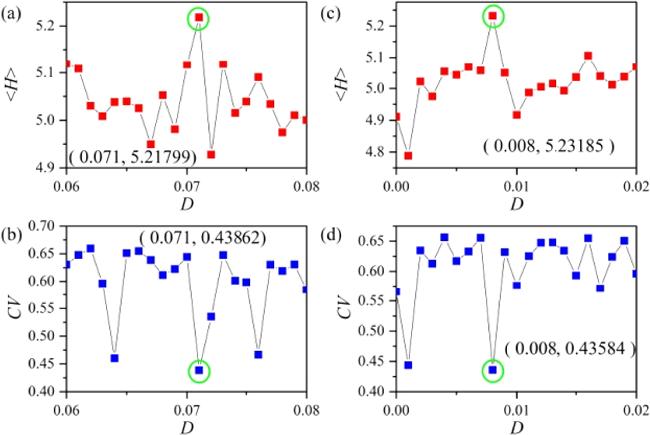
Figure 9. Distribution of CV and ⟨H⟩ values versus noise intensity D. For (a) (b) noise excitation on variable z; (c) (d) noise excitation on variable w. Parameter set as a = 0.2, b = 1.2, c1 = 0.7, c2 = 0.8, c3 = 0.1, c4 = 0.2, α = 0.5, β = 0.2, k1 = 1, k2 = 0.1, k3 = 1, k4 = 0.1, λ = 0.8, μ0 = 1, ω = 0.66, initial values (0.1, 0.1, 0.1, 0.1, 0.1, 0.01, 0.01). |
It should be noted that SR is introduced here as a diagnostic feature to evaluate the reliability and responsiveness of the memristive neural circuit, rather than as a direct indicator of biological function. According to figure 9, the neuron model generates SR at appropriate noise intensities, marked by the minimum CV and maximum average energy ⟨H⟩. When noise is applied to the z channel, SR occurs near D = 0.071, and a larger noise is required for the system to respond, while when noise acts on the w channel, the optimal SR noise intensity is approximately D = 0.008. In contrast, the w channel is more sensitive to noise, and the noise amplitude required to trigger SR is smaller. This difference may be related to the role of the memristive current u2 in the inter-membrane coupling process. As shown in figure 5, the memristive current associated with the memristor Mq presents relatively large variations during the dynamical evolution. Since the inter-membrane voltage is jointly determined by u1, u2, and the external stimulus μ, stochastic perturbations acting on the internal state variable w can directly influence the magnitude of u2. Such variations can more easily induce fluctuations in the inter-membrane voltage, which are further transmitted to the outer membrane potential. Therefore, the w channel shows stronger noise sensitivity, while the z channel plays a relatively weaker role in this voltage redistribution process. Figure 10 depicts the system response to simultaneous, identical noise excitation of both memristive variables. Compared to single-channel noise, this dual-channel noise alters the neuron's overall dynamic characteristics, reflecting multi-channel noise's combined modulation effect on system behavior.
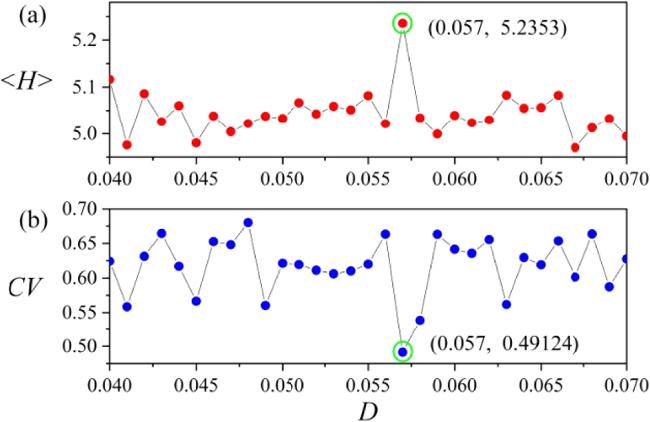
Figure 10. Distribution of CV and ⟨H⟩ values versus noise intensity D, and the noise is applied to the variables z and w. Parameter set as a = 0.2, b = 1.2, c1 = 0.7, c2 = 0.8, c3 = 0.1, c4 = 0.2, α = 0.5, β = 0.2, k1 = 1, k2 = 0.1, k3 = 1, k4 = 0.1, λ = 0.8, μ0 = 1, ω = 0.66, initial value (0.1, 0.1, 0.1, 0.1, 0.1, 0.01, 0.01). |
In summary, the observed SR phenomena confirm that the proposed circuit can reliably process stochastic inputs and maintain coherent responses, and multi-channel noise can enhance the energy response of the system. It is worth noting that when the two memristive variables in equation (6 ) are simultaneously stimulated by the same type of noise, the system will also exhibit SR at moderate noise intensities. Currently, the optimal noise intensity lies between the values corresponding to single-channel z noise and single-channel w noise. Multi-channel noise causes significant changes in the system's dynamic characteristics compared to single-channel noise, with the average energy ⟨H⟩ being higher. This indicates that multi-channel noise can enhance the energy response of SR, but it also reduces the stability of the system. Thus, SR in this work serves as a quantitative indicator of circuit reliability and dynamic robustness, rather than a direct representation of neuronal information processing.
To further achieve the automatic selection and regulation of the neuronal firing mode, this paper designs an adaptive control method based on energy feedback using equation (10 ) to adjust the parameter c4 of the shunt device in real time. The results are shown in figure 11.
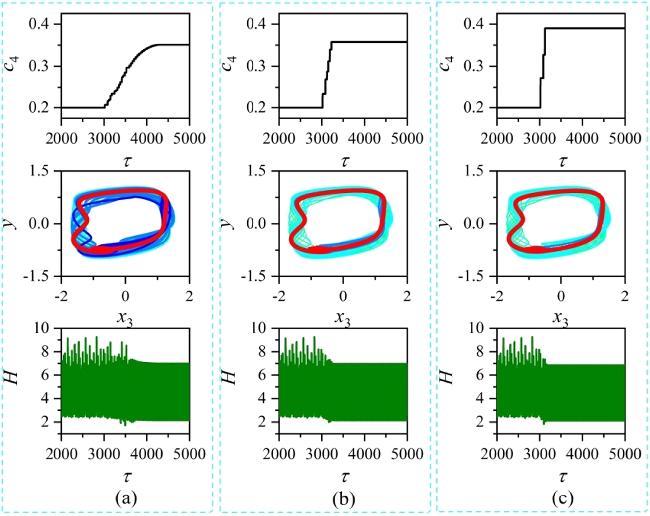


Figure 11. Growth of parameter c4, phase portraits and evolution of Hamilton energy H. For (a) g = 0.01; (b) g = 0.05; (c) g = 0.1. Parameter set as a = 0.2, b = 1.2, c1 = 0.7, c2 = 0.8, c3 = 0.1, c4(τ=0) = 0.2, α = 0.5, β = 0.2, k1 = 1, k2 = 0.1, k3 = 1, k4 = 0.1, λ = 0.8, μ0 = 1, ω = 0.66, ϵ = 7, initial value (0.1, 0.1, 0.1, 0.1, 0.1, 0.01, 0.01). |
Figure 11 shows the regulating effect of the adaptive energy control strategy. Under the appropriate threshold ϵ, this adaptive criterion can successfully guide the chaotic firing to the periodic firing state. When the gain parameter g = 0.01, the system requires approximately 1274.76 = (4274.76 − 3000) time units to converge to the stable value c4 = 0.35087. As the gain parameter g increases, the transient time required for convergence is significantly shortened. In figure 11(b), the transient time drops to 228.07 = (3228.07 − 3000), and in figure 11(c), it further decreases to 123.73 = (3123.73 − 3000). At the same time, the value of c4 after stabilization shows an upward trend, increasing from 0.35739 in figure 11(b) to 0.38968 in figure 11(c). These results indicate that the adaptive control law based on energy feedback can effectively regulate the neuronal firing mode and achieve an orderly transition from chaos to periodic behavior. Adjusting the gain parameter g flexibly controls the adjustment speed; a larger g means faster convergence to the target state and a higher final converged value of c4.
The response characteristics of different membrane layers under external stimuli were systematically investigated by constructing a sandwich-structured neural circuit model in this paper. From a structural perspective, the biological membrane can be further refined into the inner membrane, outer membrane, and the intermediate medium between them, where distinct interfaces exist between adjacent regions. Therefore, three capacitors (C1, C2, C3) are introduced in parallel to represent this layered configuration and to capture the influence of interfacial and medium heterogeneity on neuronal electrical activity. Three capacitors (C1, C2, C3) in the model represent the membrane potentials of the inner membrane, inter-membrane region, and outer membrane, while C4 is used as a shunt element for ion channels to enhance the encoding ability of membrane potential for the dynamics of ion channels. The memristor is used as the medium for connections (between the outer membrane and the inter-membrane region) and (between the inter-membrane region and the inner membrane), and in fact, considering the material diversity of the cell membrane, linear resistors, NR or memristors with different form definitions can be used to connect the two capacitors. The external stimulus current μ is applied to the inter-membrane region to simulate the potential disturbances that the phospholipid bilayer may generate under transmembrane electrical signals or external electrical stimulation. It is worth noting that μ can also be applied at any membrane layer position as per research needs to characterize more diverse forms of external input. The numerical simulation results indicate that the sandwich neuron structure with ion channel encoding can generate differentiated dynamic responses between layers. The firing sequences of the intracellular potential and the intercellular potential are highly consistent, and the trajectory similarity is significant. However, the behavior of the extracellular potential deviates significantly from the former two. The non-uniform inter-layer response characteristics to some extent reveal the possible correlation between the sandwich membrane structure and the negative resting potential bias in biological membrane systems. The energy analysis further shows that burst firing corresponds to the highest energy level, while the chaotic state has the lowest energy. The energy proportion of different membrane potential components varies significantly with the firing mode. The noise study reveals that the system can exhibit SR under z-channel, w-channel, and dual-channel noise conditions, and the w-channel is the most sensitive to noise. Finally, the introduction of an adaptive energy control scheme can effectively adjust the parameter c4 of the shunt device to achieve adaptive conversion from chaotic to periodic firing, and the convergence time can be shortened by setting the gain parameters. In summary, this sandwich neuron model can realistically reproduce the multimodal dynamic phenomena commonly observed in experiments and demonstrates the potential value of ion channel shunting and energy feedback regulation in the selection of neural activities.
Indeed, cell membrane of biological neurons has complex anatomical structure and physical descriptions of ion channels distribution are crucial for proposal of more reliable biophysical neuron models, furthermore, reliable control schemes can be used to control the neural activities in single neurons and clustered neurons in the network. From a circuit and engineering perspective, the neuron circuit serves not only as a physical abstraction for analyzing neuronal electrical activity, but also as a foundation for designing equivalent signal processing systems. In this sense, the proposed three-capacitor coupled structure with clear physical interpretation can function not only as a neuron model but also as an energy storage unit and a signal generation module. By extending the parallel capacitor configuration, the circuit can store more electric field energy and potentially act as a multi-channel signal source with controllable amplitude and frequency outputs. In the proposed neural circuit [77], three capacitors can shunt different output voltages in the amplitude and frequency, and they can save the field energy and each capacitor can be selected for potential application in signal sources, therefore, control of neural circuits composed of multi-capacitors become important. The sub-branch circuit composed of capacitor C4 shunts energy from the neural circuit and a part of electrical signals are filtered via the capacitor, and it indicates energy shunting can control the neural activities. On the other hand, energy injection can modify the neural activities effectively [78] in a neural circuit, and safe control of neural circuits can be further used to guide the movements of electromechanical arms [79–81].
It should be noted that the neuron circuit proposed in this work is constructed based on the physical concept of a sandwich structure, with the main objective of introducing this structural framework and investigating the neuronal firing behaviors under ion-channel shunting control. The model is essentially a neuron circuit model developed from a physical modeling perspective rather than a detailed biophysical reconstruction of real neurons. Therefore, several limitations remain. For example, the present study mainly focuses on physical thought and numerical simulations, and experimental validation of the proposed circuit model has not yet been carried out. In addition, the sandwich structure and the ion-channel shunting mechanism are simplified representations intended to capture essential dynamical characteristics rather than exact physiological processes. Future work will focus on further exploring the limitations of the model, establishing possible circuit implementations, and investigating more realistic physiological mechanisms to improve the applicability of the proposed framework.
4. Conclusions
Based on the Davson–Danielli sandwich model, this paper proposes a three-membrane neuron model with ion channel encoding function. Using memristors (CCM and MFCM) as the medium, it realizes the hierarchical regulation and encoding of membrane potential. The introduction of memristors not only can sense the changes of external electric field and magnetic field generated during rapid firing, but also can play a filtering role, selectively regulating the signal frequency, thereby enhancing the neuron's response ability to external stimuli. In the model, the inner membrane mainly responsible for rapid response and integration of ion channel current signals, the inter-membrane membrane is responsible for signal transmission and modulation of external stimuli, and the outer membrane reflects the membrane potential firing characteristics observed in experiments (membrane clamp). The design of the sandwich structure not only draws on the layered characteristics of biological cell membranes, but also endows the neural circuit with functional differences of multi-layer membranes, enabling the system to present non-uniform dynamic responses between layers, and to some extent, revealing the possible correlation between the sandwich membrane structure and the negative resting potential in biological membrane systems. The numerical simulation results show that the introduction of ion channel shunting significantly enhances the sensitivity of the inner membrane, enabling the neuron to generate multi-level responses to external stimuli, thereby promoting the emergence of various firing modes, including periodic firing, burst firing, quasi-periodic and chaotic firing. The Hamilton energy analysis shows that burst firing corresponds to the highest energy level, and chaotic firing has the lowest energy. The energy proportion for each membrane potential component changes significantly with the firing mode, revealing the regulatory role of energy distribution on firing behavior. The noise analysis indicates that the system can generate SR under single-channel and double-channel noise conditions, where the w channel is the most sensitive to noise, and the noise intensity required to trigger SR is the lowest. By introducing an adaptive control strategy based on Hamilton energy, the parameters c4 of the shunting device can be dynamically adjusted to achieve the active conversion from chaos to target periodic firing, and the gain parameters can be adjusted to control the convergence speed and stabilize the membrane potential. Overall, the proposed sandwich neuron model provides a new perspective for understanding the relationship between membrane structure, ion channel shunting, and energy regulation in neuronal firing dynamics. The results demonstrate that the hierarchical membrane structure combined with memristive regulation can effectively reproduce rich firing behaviors and reveal the underlying energy mechanisms of neural activity. However, it should be noted that the present study mainly focuses on theoretical modeling and numerical simulations. The physical realization of the proposed circuit structure and the experimental verification of the memristive membrane mechanism remain to be further investigated. In addition, the biological interpretation of some parameters in the model still requires more experimental evidence for validation. Future work will focus on extending the proposed model to larger neural networks and exploring its potential applications in neuromorphic circuits and hardware implementations. Further studies may also investigate the interaction between multi-layer membrane structures and different types of synaptic coupling, as well as the practical implementation of the proposed neuron circuit using analog or FPGA-based hardware platforms.