

1. Introduction
With these experimental advances for exploring the non-equilibrium dynamics of confined quantum systems such as ultracold atoms [1–3], Rydberg atoms [4], superconducting qubits [5], and ion traps [6, 7], an in-depth study of the dynamics of quantum many-body systems far from thermodynamic equilibrium becomes possible. Dynamical quantum phase transitions (DQPTs) have recently emerged as an interesting phenomenon within this regime [8–14], which serve as a nonequilibrium counterpart to equilibrium phase transitions. The concept of DQPTs arises from the analogy between the equilibrium partition function of a system and the Loschmidt amplitude, which measures the overlap between an initial state and its time-evolved state [8, 15–23]. As equilibrium phase transitions are signaled by non-analyticities in thermal free energy, DQPTs are revealed through nonanalytical behavior in dynamical free energy [21, 24–35], with real time serving as the control parameter [14, 25, 31, 36–42]. The non-analyticity in quantum state evolution is accompanied by universal critical exponents, unveiling scaling behavior and universality class patterns near quantum critical times [8, 43–45]. Furthermore, analogous to order parameters in equilibrium quantum phase transitions, a dynamical topological order parameter has been proposed to capture DQPTs [43, 46–48]. Experimentally, DQPT has been realized on various quantum simulators, such as ultracold atoms [49], trapped ions [50], superconducting quantum circuits [51], etc [52–55].
DQPTs were originally proposed in the context of quench dynamics within a nearest-neighbor transverse field Ising model [8, 9, 43, 56], where the transverse field of the system Hamiltonian is suddenly changed. It was later extended to finite-time slow quench processes [57–62]. Due to the critical slowing-down effect near a quantum phase transition, crossing the critical point at any finite rate inevitably excites the system, thereby making quantum coherence an essential feature of such transitions-a behavior captured by the Kibble–Zurek mechanism [57–59, 63–65]. Notably, quantum coherence not only restores DQPTs that would otherwise be destroyed by thermal fluctuations, but can also give rise to entirely new DQPTs that are independent of the equilibrium quantum critical point [66]. In recent years, periodically driven systems have opened a new avenue for exploring DQPTs [36, 67–74]. Unlike conventional quench dynamics, periodic driving allows Hamiltonian parameters to be modulated in diverse ways [67], leading to a wide range of experimental schemes and platforms for realizing driven settings. Although numerous studies have examined DQPTs from various perspectives, a comprehensive understanding of their underlying mechanisms remains elusive.
To address this issue, this work studies DQPTs in a one-dimensional (1D) Ising model driven by a periodic transverse field. Using time-dependent perturbation theory, we examine the roles of the driving intensity and frequency, which elucidates the underlying mechanism of DQPTs. Our results show that the driving frequency is crucial for the occurrence of DQPTs. Specifically, a DQPT arises when the driving frequency resonates with the energy-level transition frequency of the system. The driving strength, together with the critical mode and its energy gap, governs the timescale required for the DQPTs to occur, satisfying the scaling law $\tau \propto {{\rm{\Delta }}}_{{k}_{c}}{\lambda {}^{{\prime} }}^{-1}\csc {k}_{c}$. Furthermore, we show that low-frequency perturbations that cross the equilibrium critical point can also induce DQPTs, whereas high-frequency drives strongly suppress the evolution of the system.
The structure of this paper is as follows: section 2 introduces the periodically driven Ising model and reviews the basic concepts of DQPT. In section 3 , we elucidate the roles of frequency and strength of the drive on DQPT when the system remains within the same equilibrium phase. Section 4 investigates the influences of periodic driving on DQPTs when the system crosses the equilibrium quantum critical point. Finally, section 5 closes the paper with some concluding remarks.
2. Model and periodic driving protocol
The Hamiltonian of the 1D transverse field Ising model is
$\begin{eqnarray}\hat{H}=-\frac{J}{2}\displaystyle \sum _{j=1}^{N}[{\hat{\sigma }}_{j}^{z}{\hat{\sigma }}_{j+1}^{z}+\lambda {\hat{\sigma }}_{j}^{x}],\end{eqnarray}$
where ${\hat{\sigma }}_{j}^{\alpha }$(α = x, y, z) is the spin-1/2 Pauli operator at lattice site j and the periodic boundary condition is imposed as ${\hat{\sigma }}_{N+1}^{\alpha }={\hat{\sigma }}_{1}^{\alpha }$. Here we only consider that N is even. J is longitudinal spin-spin coupling, and we set J = 1 as the overall energy scale without loss of generality. λ is a dimensionless parameter measuring the strength of the transverse field with respect to the longitudinal spin-spin coupling. Driven by the transverse field λ, a quantum phase transition from the ferromagnetic (FM) phase (λ < 1) to the paramagnetic (PM) phase (λ > 1), which is known as the Ising transition, occurs at the critical point of λc = 1.This Hamiltonian is integrable and can be mapped to a system of free fermions and therefore be solved exactly. By applying the Jordan–Wigner transformation and the Fourier transformation, the Hamiltonian converts from spin operators into spinless fermionic operators as [75]
$\begin{eqnarray}\hat{H}=\displaystyle \sum _{k\gt 0}\left(\begin{array}{cc}{\hat{c}}_{k}^{\dagger } & {\hat{c}}_{-k}\end{array}\right)\left(\begin{array}{cc}\lambda -{\rm{\cos }}k & -{\rm{i}}{\rm{\sin }}k\\ {\rm{i}}{\rm{\sin }}k & -\lambda +{\rm{\cos }}k\end{array}\right)\left(\begin{array}{c}{\hat{c}}_{k}\\ {\hat{c}}_{-k}^{\dagger }\end{array}\right),\end{eqnarray}$
where ${\hat{c}}_{k}$ and ${\hat{c}}_{k}^{\dagger }$ are respectively fermion annihilation and creation operators for mode k = (2n − 1)π/N with n = 1, 2, ⋯ , N/2, corresponding to antiperiodic boundary conditions when N is even. Each ${\hat{H}}_{k}$ acts on a two-dimensional Hilbert space generated by $\{{\hat{c}}_{k}^{\dagger }{\hat{c}}_{-k}^{\dagger }| 0\rangle ,\,| 0\rangle \}$, where ∣0⟩ is the vacuum of the Jordan–Wigner fermions ${\hat{c}}_{k}$ and ${\hat{c}}_{-k}$, and can be represented in that basis by a Pauli matrix: $\begin{eqnarray}{\hat{H}}_{k}=(\lambda -\cos k){\hat{\sigma }}^{z}+\sin k{\hat{\sigma }}^{y}.\end{eqnarray}$
The energy levels of ${\hat{H}}_{k}$ are
$\begin{eqnarray}{\varepsilon }_{k}^{\pm }=\pm {\varepsilon }_{k}=\pm \sqrt{{(\lambda -\cos k)}^{2}+{\sin }^{2}k},\end{eqnarray}$
with the corresponding eigenvectors $\begin{eqnarray}\begin{array}{rcl}| {\varepsilon }_{k}^{+}\rangle & = & \left[{\rm{i}}{\rm{\sin }}\frac{{\theta }_{k}}{2}+{\rm{\cos }}\frac{{\theta }_{k}}{2}{\hat{c}}_{k}^{\dagger }{\hat{c}}_{-k}^{\dagger }\right]| 0\rangle ,\\ | {\varepsilon }_{k}^{-}\rangle & = & \left[{\rm{\cos }}\frac{{\theta }_{k}}{2}+{\rm{i}}{\rm{\sin }}\frac{{\theta }_{k}}{2}{\hat{c}}_{k}^{\dagger }{\hat{c}}_{-k}^{\dagger }\right]| 0\rangle ,\end{array}\end{eqnarray}$
where ∣0⟩ is the vacuum state. The angle θk, which is generally complex, is determined by $\tan {\theta }_{k}=\sin k/(\lambda -\cos k)$.At time t < 0, the system is prepared in the ground state
$\begin{eqnarray}| G\rangle {=\bigotimes }_{k\gt 0}| {\varepsilon }_{k}^{-}\rangle .\end{eqnarray}$
A periodic perturbation is then switched on at t = 0, characterized by the transverse field $\begin{eqnarray}\lambda (t)=\lambda +{\lambda }^{{\prime} }\cos (\omega t),\end{eqnarray}$
with amplitude ${\lambda }^{{\prime} }$ and frequency ω. In the following, we will consider three types of driving protocols based on the instantaneous value of λ(t) relative to the static critical point λc = 1: (i) λ(t) < 1 for all t, i.e. $\lambda +{\lambda }^{{\prime} }\lt 1$, where the instantaneous ground state remains entirely in the FM phase; (ii) λ(t) > 1 for all t, i.e. $\lambda -{\lambda }^{{\prime} }\gt 1$, where the instantaneous ground state remains entirely in the PM phase; (iii) λ(t) crosses λc = 1, i.e. $\lambda -{\lambda }^{{\prime} }\lt 1\lt \lambda +{\lambda }^{{\prime} }$, where the instantaneous ground state undergoes a phase transition. For convenience, we label these protocols by the corresponding static phase(s) involved. It is worth noting that periodically driven systems can exhibit Floquet or topological phase transitions, which are governed by the quasienergy spectrum of the Floquet Hamiltonian [69, 79–81]. The associated phase diagrams are typically parameterized by driving parameters such as frequency and amplitude. Nevertheless, the present work focuses on the real-time dynamics of the system and aims to investigate the emergence of DQPTs during the driving process.The dynamics of the system are governed by the perturbed Hamiltonian $\hat{H}(t)$, and the system state at time t is determined by (ℏ = 1)
$\begin{eqnarray}| \psi (t)\rangle ={ \mathcal T }\exp \left[-{\rm{i}}{\int }_{0}^{t}\hat{H}({t}^{{\prime} }){\rm{d}}{t}^{{\prime} }\right]| G\rangle ,\end{eqnarray}$
where ${ \mathcal T }$ denotes the time-ordering operator. The instantaneous state can be expressed in a tensor product form as ∣ψ(t)⟩=k>0∣ψk(t)⟩, where each mode evolves as $\begin{eqnarray}| {\psi }_{k}(t)\rangle =({v}_{k}(t)+{u}_{k}(t){c}_{k}^{\dagger }{c}_{-k}^{\dagger })| 0\rangle .\end{eqnarray}$
The coefficients uk(t) and vk(t) can be obtained by solving the differential equation $\begin{eqnarray}\frac{{\rm{d}}}{{\rm{d}}t}\left(\begin{array}{c}{u}_{k}(t)\\ {v}_{k}(t)\end{array}\right)=-{\rm{i}}\left(\begin{array}{cc}\lambda (t)-\cos k & -{\rm{i}}\sin k\\ {\rm{i}}\sin k & -\lambda (t)+\cos k\end{array}\right)\left(\begin{array}{c}{u}_{k}(t)\\ {v}_{k}(t)\end{array}\right).\end{eqnarray}$
The main goal of this paper is to investigate DQPT induced by periodic driving. The theory of DQPT is built upon the Loschmidt overlap amplitude,
$\begin{eqnarray}{ \mathcal G }(t)=\langle G| \psi (t)\rangle =\displaystyle \prod _{k\gt 0}\langle {\varepsilon }_{k}^{-}| {\psi }_{k}(t)\rangle ,\end{eqnarray}$
which measures the overlap between the time-evolved and initial states. A DQPT is signaled by the vanishing of this amplitude, indicating orthogonality between ∣ψ(t)⟩ and ∣G⟩. This criticality is identified by a non-analytic cusp in the dynamical free energy density, or the rate function, $\begin{eqnarray}r(t)=-\frac{1}{\pi }{\int }_{0}^{\pi }{\rm{d}}k\mathrm{ln}| \langle {\varepsilon }_{k}^{-}| {\psi }_{k}(t)\rangle {| }^{2},\end{eqnarray}$
serving as the counterpart of the free energy in equilibrium phase transitions. Moreover, DQPTs are endowed with topological properties, characterized by the winding number defined as [78] $\begin{eqnarray}\nu (t)=\frac{1}{2\pi }{\int }_{0}^{\pi }\frac{\partial {\phi }_{k}^{G}(t)}{\partial k}{\rm{d}}k,\end{eqnarray}$
which undergoes a quantized jump at the critical times of the DQPT. The underlying geometric phase is defined as $\begin{eqnarray}{\phi }_{k}^{G}(t)={\phi }_{k}(t)-{\phi }_{k}^{D}(t),\end{eqnarray}$
where $\begin{eqnarray}{\phi }_{k}(t)=\arg {{ \mathcal G }}_{k}(t),\end{eqnarray}$
is the total phase, and $\begin{eqnarray}{\phi }_{k}^{D}(t)=-{\int }_{0}^{t}\langle {\psi }_{k}({t}^{{\prime} })| {\hat{H}}_{k}({t}^{{\prime} })| {\psi }_{k}({t}^{{\prime} })\rangle {\rm{d}}{t}^{{\prime} }\end{eqnarray}$
is the dynamical phase.Due to the time-dependent nature of the Hamiltonian, an analytical solution to equation (10 ) is not feasible. We therefore solve the equation numerically to obtain exact results, which serve as the basis for investigating DQPTs in the periodically driven Ising model. To gain deeper insight into the underlying mechanisms of these dynamical phase transitions, we complement the numerical approach with a time-dependent perturbation analysis.
3. The influence of periodic driving within the same phase
In this section, we explore the emergence of DQPTs driven by periodic driving within the FM phase ($\lambda +{\lambda }^{{\prime} }\lt 1$) or PM phase ($\lambda -{\lambda }^{{\prime} }\gt 1$). First, we investigate the effects of the driving frequency for a given magnitude ${\lambda }^{{\prime} }=0.1$. Figure 1 illustrates the time evolution of the Loschmidt echo rate function and the winding number for different frequencies. The results demonstrate a critical dependence of DQPTs on the driving frequency. Pronounced non-analytic signatures are observed only when the driving frequency ω is tuned to a specific regime, for instance, ω = 2 for λ = 0.5 (FM phase) or ω = 4 for λ = 2 (PM phase). Under these resonant conditions, the rate function exhibits clear oscillatory behavior with periodic cusp singularities. Concurrently, the winding number, which remains quantized during the dynamics, undergoes discrete integer jumps precisely at the critical times where the cusps appear. The simultaneous occurrence of these features provides definitive evidence for a DQPT. By contrast, when the driving frequency is detuned from these specific values, the rate function stays close to zero throughout the evolution, indicating that the system does not evolve significantly from its initial state, and no DQPT occurs. These observations underscore that the resonant frequency plays a crucial role in the occurrence of DQPT.
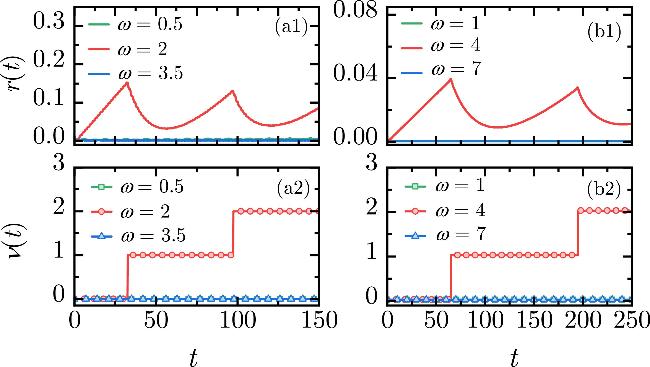
Figure 1. Time evolution of the rate function r(t) and the winding number ν(t) under different driving frequencies. Panels (a1-a2) depict the magnetic field initially fixed within the FM phase λ = 0.5. Panels (b1-b2) depict the magnetic field initially fixed within the PM phase λ = 2. The driving strength is ${\lambda }^{{\prime} }=0.1$ for all the cases. |
A comparison between the results of periodic driving and sudden quench dynamics is essential. Although a sudden quench performed within a given phase of the Ising model cannot induce a DQPT [75, 76], we demonstrate here that a periodic perturbation applied within the same phase can indeed trigger a DQPT, provided that the driving frequency is tuned into an appropriate range. This crucial frequency dependence originates from transitions among the system's energy levels, revealing the physical mechanism behind DQPT.
As clarified by time-dependent perturbation theory (see Appendix A for details), a periodic perturbation can efficiently drive transitions between energy levels only when its frequency resonates with the intrinsic energy gap of the system. In contrast, off-resonant perturbations have negligible effects, leaving the system essentially unchanged. For example, to induce transitions between the energy levels of the k mode, whose energy gap is Δk = 2ϵk, the driving frequency must satisfy ω = 2ϵk. Such resonant driving is necessary for the system to evolve far from its initial state and undergo a DQPT. From the energy dispersion ${\varepsilon }_{k}=\sqrt{{\lambda }^{2}-2\lambda \cos k+1}$, the energy gap Δk = 2ϵk varies over the interval 2∣λ − 1∣ < Δk < 2∣λ + 1∣ as k goes from 0 to π. Therefore, whenever the driving frequency lies within this interval, it can always resonate with the energy gap of some mode–specifically, the critical mode ${k}_{c}=\arccos \left(\frac{{\lambda }^{2}+1-{\omega }^{2}/4}{2\lambda }\right)$–thereby inducing a DQPT. We refer to the frequency range of 2∣λ − 1∣ < ω < 2∣λ + 1∣ as the resonant region. It should be noted that perturbations with the boundary frequencies 2∣λ − 1∣ and 2∣λ + 1∣ do not induce a DQPT, because the corresponding critical modes are π and 0, respectively. In these cases, the Hamiltonians before and after the perturbation commute, so the initial ground state remains unchanged and does not evolve, let alone undergo a DQPT.
Interestingly, this DQPT is governed by a deeper topological mechanism. To reveal this mechanism, we focus on the Floquet Hamiltonian: B . This Hamiltonian defines a vector ${\boldsymbol{d}}(k)=\left(0,-\frac{{\lambda }^{{\prime} }\sin {\theta }_{k}}{2},-\frac{{\delta }_{k}}{2}\right)$, whose trajectory as a function of k forms a closed curve confined to the y–z plane. The number of times this vector encircles the origin of the y–z plane as k varies from −π to π defines a winding number:
$\begin{eqnarray}{\hat{H}}_{k}^{{\rm{F}}}=-\frac{{\delta }_{k}}{2}{\tilde{\sigma }}_{k}^{z}-\frac{{\lambda }^{{\prime} }\sin {\theta }_{k}}{2}{\tilde{\sigma }}_{k}^{y},\end{eqnarray}$
where ${\tilde{\sigma }}_{k}^{z}=| {\varepsilon }_{k}^{+}\rangle \langle {\varepsilon }_{k}^{+}| -| {\varepsilon }_{k}^{-}\rangle \langle {\varepsilon }_{k}^{-}| $, ${\tilde{\sigma }}_{k}^{x}=| {\varepsilon }_{k}^{+}\rangle \langle {\varepsilon }_{k}^{-}| +| {\varepsilon }_{k}^{-}\rangle \langle {\varepsilon }_{k}^{+}| $, and ${\tilde{\sigma }}_{k}^{y}=-{\rm{i}}| {\varepsilon }_{k}^{+}\rangle \langle {\varepsilon }_{k}^{-}| +{\rm{i}}| {\varepsilon }_{k}^{-}\rangle \langle {\varepsilon }_{k}^{+}| $. Here δk = ω − 2ϵk denotes the detuning of the driving frequency. A detailed derivation is provided in Appendix $\begin{eqnarray}W=-\frac{1}{2\pi {\rm{i}}}{\int }_{-\pi }^{\pi }\frac{\partial }{\partial k}\arg {\boldsymbol{r}}(k)\,{\rm{d}}k,\end{eqnarray}$
where r(k) = dy(k) + idz(k). In figure 2, we plot the winding number as a function of ω. Strikingly, we find that when the driving frequency enters the resonant region 2∣λ − 1∣ < ω < 2∣λ + 1∣—where DQPTs occur—the system is driven into a topologically nontrivial Floquet phase. In other words, the DQPTs considered here are triggered by Floquet topological phases: DQPTs occur if and only if the effective Floquet Hamiltonian ${\hat{H}}_{k}^{{\rm{F}}}$ is topologically nontrivial, and vice versa. The resonance condition is fundamentally equivalent to the boundary condition for entering a nontrivial topological Floquet phase, and the observed Rabi-flipping DQPT constitutes the dynamical manifestation of this underlying topological structure. This finding is fully consistent with the results of Ref. [77], where such behavior was identified and termed a Floquet DQPT.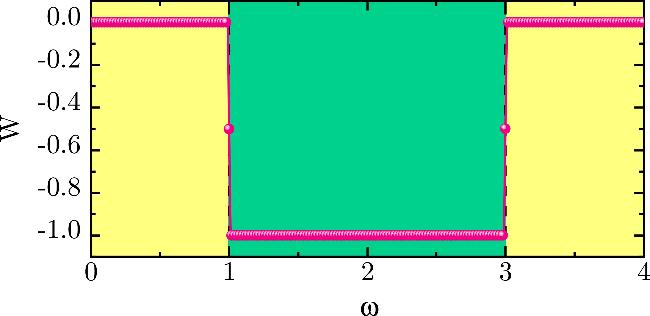
Figure 2. The winding number W as a function of ω for λ = 0.5 and ${\lambda }^{{\prime} }=0.1$. |
Next, we examine how the strength of the perturbation influences DQPTs. Figure 3 shows the effect of varying the perturbation strength on the first critical time at which DQPTs occur for a fixed resonant frequency. It is observed that as the strength ${\lambda }^{{\prime} }$ increases, the first critical time becomes shorter. This trend holds consistently in both the FM and PM phases. We interpret this first critical time as the characteristic time τ required to induce the DQPT.
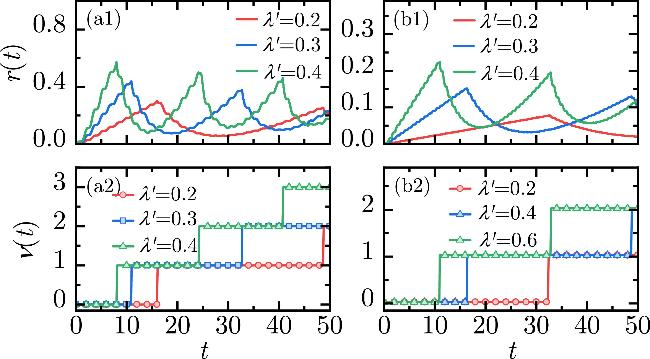
Figure 3. Time evolution of the rate function r(t) and the winding number ν(t) under different disturbance intensities. Panels (a1-a2) depict the evolutionary process within the FM phase, where λ = 0.5, ω = 2. Panels (b1-b2) depict the evolutionary process within the PM phase, where λ = 2, ω = 4. |
To establish a quantitative relationship between driving strength ${\lambda }^{{\prime} }$ and DQPT onset time τ, we analyze their scaling behavior. Figure 4 shows the dependence of τ on the perturbation strength ${\lambda }^{{\prime} }$ at a fixed resonant frequency, with the system initialized in the FM phase (λ = 0, ω = 2) and the PM phase (λ = 2, ω = 4). In our numerical calculations, ${\lambda }^{{\prime} }$ is restricted to the interval $0\lt {\lambda }^{{\prime} }\lt 1$, which ensures $0+{\lambda }^{{\prime} }\lt 1$ (FM phase) and $2-{\lambda }^{{\prime} }\gt 1$ (PM phase), so that the system remains entirely within the corresponding phase. In both cases, the time required to induce a DQPT scales inversely with the perturbation strength, following $\tau \sim c{\lambda {}^{{\prime} }}^{-1}$. This inverse scaling can be understood within perturbation theory (see appendix for details). The amplitude of the excited state evolves as ${a}_{k}^{+}(t)\approx {\lambda }^{{\prime} }\sin {\theta }_{k}t$ (see appendix for details), implying that the characteristic time for exciting the system scales as $t\propto {({\lambda }^{{\prime} }| \sin {\theta }_{k}| )}^{-1}$. This excitation causes the return probability to the ground state to vanish, thereby inducing a DQPT. Since the DQPT is governed by the critical mode kc, the onset time τ corresponds precisely to the energy-level-transition time at kc: $\tau \propto {({\lambda }^{{\prime} }| \sin {\theta }_{{k}_{c}}| )}^{-1}$. Using the relation $\sin {\theta }_{k}=\sin k/{\varepsilon }_{k}=2\sin k/{{\rm{\Delta }}}_{k}$, we derive the scaling law for the DQPT onset time:
$\begin{eqnarray}\tau \propto {{\rm{\Delta }}}_{{k}_{c}}{\lambda {}^{{\prime} }}^{-1}\csc {k}_{c},\end{eqnarray}$
where ${{\rm{\Delta }}}_{{k}_{c}}$ denotes the energy gap corresponding to the critical mode kc. This relationship indicates that a larger energy gap results in a longer DQPT onset time τ, since it directly extends the duration needed for the system to undergo the underlying energy-level transition. Remarkably, an arbitrarily weak perturbation is sufficient to induce a DQPT, provided the evolution time is sufficiently long. However, if the critical mode is kc = 0 or π, the onset time τ diverges, and consequently no DQPT occurs–consistent with our earlier conclusion. Conversely, the onset time is minimized when the critical mode is kc = π/2.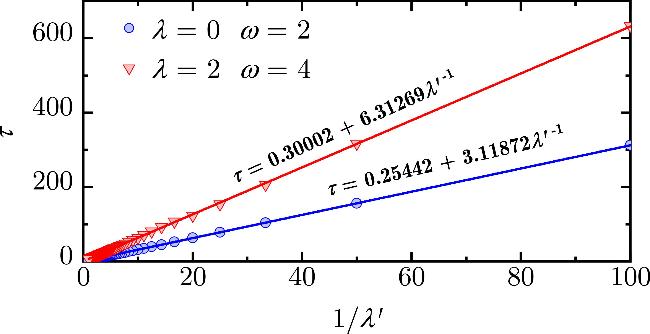
Figure 4. The scaling relation between the DQPT onset time τ and the driving strength ${\lambda }^{{\prime} }$ under resonant driving. |
For the representative FM case (λ = 0, ω = 2), all modes except k = 0 and k = π become critical and are capable of inducing DQPTs. Among these, the critical mode kc = π/2 yields the shortest onset time: ${\tau }_{1}\propto 2{\lambda {}^{{\prime} }}^{-1}$. In contrast, for the PM phase (λ = 2, ω = 4), the critical mode is ${k}_{c}=\arccos (1/4)$, leading to an onset time: ${\tau }_{2}\propto 16/(\sqrt{15}\,{\lambda }^{{\prime} })$. Consequently, the time required to trigger a DQPT in the PM phase is approximately twice that in the FM phase, as illustrated in figure 4. This observation provides clear confirmation of the scaling law presented in equation (19 ).
A natural question is whether increasing the intensity of the detuning perturbation can induce a DQPT. To address this, we calculate the rate function for different perturbation intensities, as shown in figure 5. It can be seen that the rate function increases with the perturbation strength in both the FM and PM phases, but the cusp singularity cannot be observed, indicating that DQPTs cannot be induced solely by enhancing the detuning perturbation.
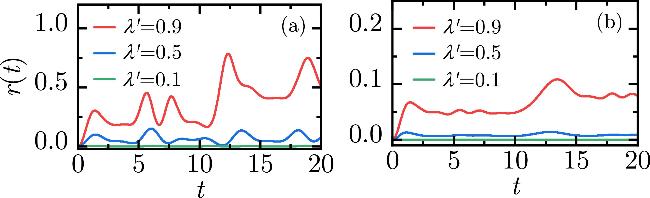
Figure 5. The time evolution of the rate function in the (a) FM (λ = 0) and (b) PM (λ = 2) phases for different driving intensities. The frequency is ω = 0.5 for all cases. |
4. The influence of periodic driving across the critical point
In this section, we examine perturbations that drive the system across the critical point at λc = 1, specifically in the regime where λ < 1 and $\lambda +{\lambda }^{{\prime} }\gt 1$. Since figure 1 established that any driving with frequency within the resonance interval 2∣λ − 1∣ < ω < 2∣λ + 1∣ invariably induces a DQPT, we focus here on off-resonant frequencies outside this range. Figure 6 shows the time evolution of the Loschmidt echo rate function and the winding number for the protocol $\lambda (t)=0.5+2\cos (\omega t)$, with ω = 0.5 (low frequency) and ω = 6 (high frequency). The results demonstrate that low-frequency interphase perturbations can indeed induce DQPTs, as signaled by the characteristic cusp singularities in the rate function and discrete jumps in the winding number. In contrast, under the influence of high-frequency interphase perturbations, the system does not evolve significantly, let alone DQPTs.
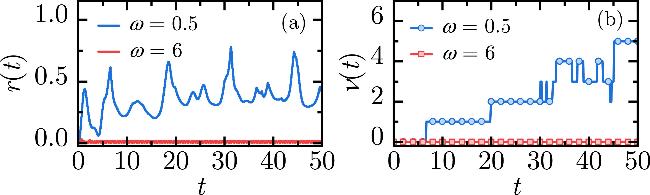


Figure 6. The time evolution of the rate function (a) and the winding number (b) at different drive frequencies when the transverse magnetic field crosses the quantum critical point, where λ = 0.5 and ${\lambda }^{{\prime} }=2$. |
It is well known that an interphase quench, which corresponds to the limiting case of ω = 0 in our setup, guarantees a DQPT [47, 60, 75]. In this light, our findings indicate that, while low-frequency perturbations maintain this behavior, high-frequency driving can effectively suppress the occurrence of DQPTs. This distinction can be understood from the following physical picture. Under low-frequency driving, the system evolves slowly enough to respond to the changing Hamiltonian. Although the driving frequency lies outside the resonant regime, crossing the critical point λc = 1 inevitably excites the system. At the critical point, the ground state becomes degenerate and the energy gap closes. According to the Kibble–Zurek mechanism [82–84], the vanishing gap renders adiabatic dynamics impossible, leading to unavoidable excitations that manifest as topological defects in the ordered phase. In the slow-driving regime, these defects are highly coherent and exhibit well-defined momentum-space correlations. During subsequent unitary evolution, these coherent excitations accumulate global phases and, at specific times, they would interfere destructively, causing the Loschmidt echo to vanish—a definitive signature of a DQPT. Conversely, under high-frequency driving, the system enters a saturation regime where defect densities become large [85], but the excitations are incoherent and lack ordered phase relations. This incoherence, combined with the strong suppression of coherent dynamics by the rapid drive, prevents global quantum interference. Thus, even though a high density of defects is created, no DQPT emerges.
5. Conclusions
This work investigated DQPTs induced by periodic driving in a 1D Ising model, with emphasis on the rate function and the winding number. We found that, unlike sudden quenches, periodic perturbations applied within the same phase can induce a DQPT provided the driving frequency is resonant with the energy-level transition frequency of the system. This resonant effect originates from drive-induced transitions between the system's energy levels and is intimately connected to Floquet topological phases: when the driving frequency lies within the resonant region, the effective Floquet Hamiltonian acquires a nontrivial winding number, signaling the emergence of a topologically distinct nonequilibrium phase. The occurrence of DQPTs precisely coincides with this topological transition. The timescale for the occurrence of a DQPT is governed by the perturbation strength, the critical mode, and its associated energy gap, following the scaling relation $\tau \propto {{\rm{\Delta }}}_{{k}_{c}}{\lambda {}^{{\prime} }}^{-1}\csc {k}_{c}$. Furthermore, we examined perturbations that cross the equilibrium critical point, demonstrating that low-frequency drives can trigger DQPTs, whereas high-frequency drives strongly suppress the system's evolution. Compared with conventional quench protocols, periodic perturbations offer a more refined means of controlling DQPTs, thereby providing a new perspective for the study of nonequilibrium dynamics in quantum many-body systems.
Appendix A Time-dependent perturbation theory
Under a transverse field perturbation, the Hamiltonian for mode k can be decomposed into two parts:
$\begin{eqnarray}{\hat{H}}_{k}(t)={\hat{H}}_{k}+{\hat{H}}_{k}^{{\prime} }(t),\end{eqnarray}$
where, $\begin{eqnarray}{\hat{H}}_{k}=\left(\begin{array}{cc}\lambda -{\rm{\cos }}k & -{\rm{i}}{\rm{\sin }}k\\ {\rm{i}}{\rm{\sin }}k & -\lambda +{\rm{\cos }}k\end{array}\right),\end{eqnarray}$
denotes the unperturbed Hamiltonian, and $\begin{eqnarray}{\hat{H}}_{k}^{{\prime} }(t)=\left(\begin{array}{cc}{\lambda }^{{\prime} }\cos \omega t & 0\\ 0 & -{\lambda }^{{\prime} }\cos \omega t\end{array}\right),\end{eqnarray}$
represents the time dependent perturbation. The time-evolved state under this perturbation can be represented as $\begin{eqnarray}| {\psi }_{k}(t)\rangle ={a}_{k}^{+}(t){{\rm{e}}}^{-{\rm{i}}{\varepsilon }_{k}t}| {\varepsilon }_{k}^{+}\rangle +{a}_{k}^{-}(t){{\rm{e}}}^{{\rm{i}}{\varepsilon }_{k}t}| {\varepsilon }_{k}^{-}\rangle .\end{eqnarray}$
The coefficient ${a}_{k}^{\pm }(t)$ admit a perturbative expansion: $\begin{eqnarray}{a}_{k}^{\pm }(t)={a}_{k}^{\pm (0)}(t)+{a}_{k}^{\pm (1)}(t)+\cdots \,{,}\end{eqnarray}$
where ${a}_{k}^{\pm (0)}(t)$ and ${a}_{k}^{\pm (1)}(t)$ denote the zeroth- and the first-order perturbation corrections respectively. In the weak-driving regime where ${\lambda }^{{\prime} }\lt 1$, the higher-order terms can be neglected, and the dynamical behavior of the system can be accurately described by the first-order term. The evolution of the perturbation coefficients satisfies the following equations $\begin{eqnarray}{\dot{a}}_{k}^{\pm (0)}(t)=0,\end{eqnarray}$
and $\begin{eqnarray}{\dot{a}}_{k}^{\pm (1)}(t)=-{\rm{i}}{a}_{k}^{\pm (0)}{\hat{{H}^{{\prime} }}}_{k}^{\pm ,\pm }(t)-{\rm{i}}{a}_{k}^{\mp (0)}{{\rm{e}}}^{\pm {\rm{i}}2{\varepsilon }_{k}t}{\hat{{H}^{{\prime} }}}_{k}^{\pm ,\mp }(t),\end{eqnarray}$
where ${\hat{{H}^{{\prime} }}}_{k}^{\pm ,\pm }(t)=\langle {\varepsilon }_{k}^{\pm }| {\hat{H}}_{k}^{{\prime} }(t)| {\varepsilon }_{k}^{\pm }\rangle =\pm \cos {\theta }_{k}{\lambda }^{{\prime} }\cos \omega t$ and ${\hat{{H}^{{\prime} }}}_{k}^{\pm ,\mp }(t)=\langle {\varepsilon }_{k}^{\pm }| {\hat{H}}_{k}^{{\prime} }(t)| {\varepsilon }_{k}^{\mp }\rangle =\pm {\rm{i}}\sin {\theta }_{k}{\lambda }^{{\prime} }\cos \omega t$. For the initial ground state $| {\varepsilon }_{k}^{-}\rangle $, the zeroth-order coefficients are $\begin{eqnarray}{a}_{k}^{+(0)}=0,\,\,{a}_{k}^{-(0)}=1,\end{eqnarray}$
and first-order approximation coefficients are given by $\begin{eqnarray}\begin{array}{rcl}{a}_{k}^{+(1)} & = & {\lambda }^{{\prime} }{\rm{\sin }}{\theta }_{k}\left[\frac{{{\rm{e}}}^{{\rm{i}}(2{\varepsilon }_{k}-\omega )t}-1}{{\rm{i}}(2{\varepsilon }_{k}-\omega )}+\frac{{{\rm{e}}}^{{\rm{i}}(2{\varepsilon }_{k}+\omega )t}-1}{{\rm{i}}(2{\varepsilon }_{k}+\omega )}\right],\\ {a}_{k}^{-(1)} & = & {\rm{i}}{\lambda }^{{\prime} }\cos {\theta }_{k}\frac{{\rm{\sin }}\omega t}{\omega }.\end{array}\end{eqnarray}$
When the driving frequency resonates with the system transition frequency, i.e. ω = 2ϵk, the first-order coefficients simplify to $\begin{eqnarray}\begin{array}{rcl}{a}_{k}^{+(1)} & \approx & {\lambda }^{{\prime} }\sin {\theta }_{k}t,\\ {a}_{k}^{-(1)} & \approx & 0,\end{array}\end{eqnarray}$
where the high-frequency oscillation terms have been neglected. This shows that under resonant driving, the probability amplitude of the excited state grows linearly in time, indicating that the system undergoes a transition into the excited state. The timescale for this transition is inversely proportional to the perturbation strength $\begin{eqnarray}{t}_{k}\propto {\lambda {}^{{\prime} }}^{-1}\csc {\theta }_{k}.\end{eqnarray}$
According to the definition of $\sin {\theta }_{k}=\frac{\sin k}{{\varepsilon }_{k}}=\frac{2\sin k}{{{\rm{\Delta }}}_{k}}$, this transition timescale is jointly determined by energy gap and perturbation strength: $\begin{eqnarray}{t}_{k}\propto {{\rm{\Delta }}}_{k}{\lambda {}^{{\prime} }}^{-1}\csc k.\end{eqnarray}$
Appendix B Floquet Hamiltonian
In the interaction picture, the Hamiltonian takes the form
$\begin{eqnarray}\begin{array}{rcl}{\hat{H}}_{k}^{I}(t) & = & {{\rm{e}}}^{{\rm{i}}{\hat{H}}_{k}t}{\hat{H}}_{k}^{{\prime} }(t){{\rm{e}}}^{-{\rm{i}}{\hat{H}}_{k}t}\\ & = & {\lambda }^{{\prime} }{\rm{\cos }}\omega t\left[{\rm{\cos }}{\theta }_{k}{\tilde{\sigma }}_{k}^{z}-{\rm{\sin }}{\theta }_{k}\left({\tilde{\sigma }}_{k}^{y}{\rm{\cos }}(2{\varepsilon }_{k}t)-{\tilde{\sigma }}_{k}^{x}{\rm{\sin }}(2{\varepsilon }_{k}t)\right)\right],\end{array}\end{eqnarray}$
where ${\tilde{\sigma }}_{k}^{z}=| {\varepsilon }_{k}^{+}\rangle \langle {\varepsilon }_{k}^{+}| -| {\varepsilon }_{k}^{-}\rangle \langle {\varepsilon }_{k}^{-}| $, ${\tilde{\sigma }}_{k}^{x}=| {\varepsilon }_{k}^{+}\rangle \langle {\varepsilon }_{k}^{-}| +| {\varepsilon }_{k}^{-}\rangle \langle {\varepsilon }_{k}^{+}| $ and ${\tilde{\sigma }}_{k}^{y}=-{\rm{i}}| {\varepsilon }_{k}^{+}\rangle \langle {\varepsilon }_{k}^{-}| +{\rm{i}}| {\varepsilon }_{k}^{-}\rangle \langle {\varepsilon }_{k}^{+}| $. $| {\varepsilon }_{k}^{\pm }\rangle $ is the eigenvector of ${\hat{H}}_{k}$ with the corresponding eigenvalue ${\varepsilon }_{k}^{\pm }$. Ignoring high-frequency oscillations and employing the rotating wave approximation, the interaction-picture Hamiltonian simplifies to $\begin{eqnarray}{\hat{H}}_{k}^{I}(t)=-\frac{{\lambda }^{{\prime} }\sin {\theta }_{k}}{2}\left[{\tilde{\sigma }}_{k}^{y}\cos ({\delta }_{k}t)+{\tilde{\sigma }}_{k}^{x}\sin ({\delta }_{k}t)\right].\end{eqnarray}$
In a rotating frame defined by ${\hat{U}}_{R}(t)={{\rm{e}}}^{-{\rm{i}}{\delta }_{k}t{\tilde{\sigma }}_{k}^{z}/2}$, one obtains a time-independent effective Hamiltonian ${\hat{H}}_{k}^{{\rm{F}}}\,={\hat{U}}_{R}^{\dagger }(t){\hat{H}}_{k}^{I}(t){\hat{U}}_{R}(t)+{\rm{i}}{\dot{\hat{U}}}_{R}^{\dagger }(t){\hat{U}}_{R}(t)$: $\begin{eqnarray}{\hat{H}}_{k}^{{\rm{F}}}=-\frac{{\delta }_{k}}{2}{\tilde{\sigma }}_{k}^{z}-\frac{{\lambda }^{{\prime} }\sin {\theta }_{k}}{2}{\tilde{\sigma }}_{k}^{y}.\end{eqnarray}$
This Hamiltonian can be interpreted as the Floquet Hamiltonian.