

1. Introduction
High-order harmonic generation (HHG) is a nonlinear and non-perturbative optical phenomenon. It typically occurs during the interaction of intense laser fields with gaseous, liquid, or solid media [1–5]. For gaseous systems, the HHG process can be well described by the semiclassical three-step model [6], which provides an intuitive physical picture of the underlying mechanism. In the first step, electrons are tunnel ionized from atoms or molecules by an intense laser field. In the second step, the free electrons are accelerated by the laser field and gain kinetic energy. In the third step, when the laser field reverses its direction, the electrons may be driven back to the parent ion and recombine, releasing their kinetic energy in the form of high-energy photons, thereby giving rise to high-order harmonics. Within this framework, HHG is governed by strong-field electron dynamics. The ionization time sets the initial phase and momentum distribution of the electron wave packet, while propagation in the laser field leads to trajectory-dependent phase accumulation described by the semiclassical action. Interference between different trajectories shapes the harmonic spectrum and phase, enabling the emitted harmonics to encode sub-cycle electron dynamics in intense laser fields [7–9]. As a result, HHG converts near-infrared laser radiation into extreme-ultraviolet and soft-x-ray radiation and has become a primary method for generating attosecond pulses [10–12]. Attosecond pulses provide unprecedented temporal resolution, making them powerful tools for probing and controlling ultrafast electron dynamics [13–16].
To date, extensive research has focused on the generation of linearly polarized high-order harmonics [17–19]. In recent years, however, increasing attention has been paid to elliptically polarized high-order harmonics owing to their potential applications in probing the chirality of matter and magnetic circular dichroism [20–22]. As a result, the generation of high-order harmonics with controllable ellipticity has emerged as an active area of research. Methods for generating high-order harmonics with nonzero ellipticity can be classified into two categories: modifying the medium and tailoring the driving laser field. Considerable theoretical and experimental progress has been made in generating elliptically polarized harmonics using specially prepared media. For example, elliptically polarized harmonics can be produced by preparing the target in a ring-current state [23–25]. It has also been proposed that elliptically polarized high-order harmonics can be generated from twisted electron wave packets carrying quantized orbital angular momentum [26]. Moreover, schemes based on molecular prealignment [27, 28] or gas mixtures [29–31] have been demonstrated to generate elliptically polarized harmonics. However, these approaches typically require prior manipulation of the medium, which introduces additional experimental complexity. Another approach to generating elliptically polarized high-order harmonics relies on tailored laser fields. Owing to angular momentum conservation, the most straightforward approach to generating harmonics with nonzero ellipticity is to employ an elliptically polarized driving field. However, the harmonic yield decreases rapidly as the ellipticity of the driving field increases, which significantly limits the efficiency and practical applicability of this approach [32, 33]. Two-color driving fields, by introducing an additional frequency component and extra degrees of freedom, provide enhanced flexibility for controlling the HHG process. Both theoretical and experimental studies have further investigated bichromatic counter-rotating circularly polarized driving fields [34–37], as well as co-rotating circularly polarized two-color fields [38, 39], interacting with various media to generate elliptically polarized harmonics. These approaches generally require two driving lasers with nearly perfect circular polarization, which poses substantial experimental challenges. Elliptically polarized harmonics with controllable helicity have also been demonstrated using noncollinear driving fields [21, 40–42]. Despite their effectiveness, the increased experimental complexity associated with these schemes hinders their widespread implementation. By contrast, orthogonal two-color (OTC) fields, composed of two mutually orthogonal linearly polarized components, offer a comparatively simple driving configuration. It has been demonstrated that, when interacting with an isotropic medium, OTC fields generate only linearly polarized high-order harmonics [43, 44]. Consequently, the development of a simple and robust method for producing elliptically polarized high-order harmonics remains an open and important problem.
In this work, we propose and theoretically demonstrate a scheme for generating elliptically polarized high-order harmonics from CO2 molecules driven by symmetry-broken two-color laser fields. Specifically, the symmetry-broken two-color field consists of a linearly polarized second-harmonic field and a fundamental field with tunable ellipticity, forming an effective two-dimensional asymmetric driving field. Our results show that elliptically polarized high-order harmonics with the same helicity over a broad spectral range can be generated from unaligned CO2 molecules. High-order harmonics with large ellipticity can be achieved by tuning the ellipticity of the fundamental field in the two-color driving configuration. Moreover, the ellipticity of the generated harmonics can be further controlled by adjusting the relative phase of the two-color fields. Our theoretical analysis reveals that the generation of harmonics with nonzero ellipticity originates from the intrinsic asymmetry of the symmetry-broken two-color field, which induces an intensity imbalance between the left- and right-rotating components of the emitted harmonics.
2. Theoretical method
In this work, the harmonic emission is calculated within the framework of the widely accepted Lewenstein model [45]. The induced dipole moments along the x and y directions at time t are calculated using the following integral [atomic units (a.u.) are used throughout unless otherwise noted]:
$\begin{eqnarray}\begin{array}{rcl}{{\boldsymbol{D}}}_{x}(t,\theta ) & = & {\rm{i}}{\displaystyle \int }_{-\infty }^{t}{\rm{d}}{{t}}_{{i}}{\left[\frac{\pi }{\delta +{\rm{i}}({t}-{{t}}_{{i}})/2}\right]}^{3/2}\times {\boldsymbol{E}}({{t}}_{{i}})\\ & & \times {{\boldsymbol{d}}}_{x}[{{\boldsymbol{p}}}_{s}({t}_{i},t)-{\boldsymbol{A}}({t}_{i}),\theta ]\times \exp (-{\rm{i}}S({t}_{i},t))\\ & & \times {{\boldsymbol{d}}}_{x}^{* }[{{\boldsymbol{p}}}_{s}({t}_{i},t)-{\boldsymbol{A}}(t),\theta ]+{\rm{c.c.}},\end{array}\end{eqnarray}$
and $\begin{eqnarray}\begin{array}{rcl}{{\boldsymbol{D}}}_{y}(t,\theta ) & = & {\rm{i}}{\displaystyle \int }_{-\infty }^{t}{\rm{d}}{{t}}_{{i}}{\left[\frac{\pi }{\delta +{\rm{i}}({t}-{{t}}_{{i}})/2}\right]}^{3/2}\times {\boldsymbol{E}}({{t}}_{{i}})\\ & & \times {{\boldsymbol{d}}}_{y}[{{\boldsymbol{p}}}_{s}({t}_{i},t)-{\boldsymbol{A}}({t}_{i}),\theta ]\times \exp (-{\rm{i}}S({t}_{i},t))\\ & & \times {{\boldsymbol{d}}}_{y}^{* }[{{\boldsymbol{p}}}_{s}({t}_{i},t)-{\boldsymbol{A}}(t),\theta ]+{\rm{c.c.}},\end{array}\end{eqnarray}$
where E(t) represents the electric field of the laser pulse, and ti denotes the time of ionization. θ represents the angle between the molecule axis and the polarization direction of the x component of the driving field. δ is a small positive constant used in calculation. S(ti, t) is the quasiclassical action, which is given by $\begin{eqnarray}{S}({t}_{i},t)={\int }_{{t}_{i}}^{t}\left\{\frac{{[{{\boldsymbol{p}}}_{s}({t}_{i},t)-{\boldsymbol{A}}({t}^{{\prime} })]}^{2}}{2}+{{I}}_{p}\right\}{\rm{d}}{t}^{{\prime} },\end{eqnarray}$
where ${{\boldsymbol{p}}}_{s}({t}_{i},t)=\frac{1}{t-{t}_{i}}{\int }_{{t}_{i}}^{t}{\boldsymbol{A}}({t}^{{\prime} }){\rm{d}}{t}^{{\prime} }$ is the stationary canonical momentum. ${\boldsymbol{A}}(t)=-{\int }_{-\infty }^{t}{\boldsymbol{E}}({t}^{{\prime} }){\rm{d}}{t}^{{\prime} }$ is the vector potential of the laser field. Ip is the ionization potential of the target. The transition dipole moment between the ground state and the continuum state is defined as $\begin{eqnarray}{\boldsymbol{d}}[{\boldsymbol{p}}({t}_{i})]=\langle {{\boldsymbol{p}}}_{{s}}-{\boldsymbol{A}}({t}_{i})| {\boldsymbol{r}}| {\rm{\Psi }}\rangle ,\end{eqnarray}$
and $\begin{eqnarray}{{\boldsymbol{d}}}^{* }[{\boldsymbol{p}}(t)]=\langle {\rm{\Psi }}| {\boldsymbol{r}}| {{\boldsymbol{p}}}_{{s}}-{\boldsymbol{A}}(t)\rangle .\end{eqnarray}$
Here $\Psi$ represents the ground-state wave function of the molecule, which is extracted using the Gaussian software package [46]. In this work, CO2 is taken as a representative molecular system for the calculations. r denotes the electron coordinate. To get the harmonic electric field ${{\boldsymbol{E}}}_{x}^{{\rm{hhg}}}$ and ${{\boldsymbol{E}}}_{y}^{{\rm{hhg}}}$ in the frequency domain, we calculate the second derivative of the time-dependent dipole moment in the x and y directions, i.e. the dipole acceleration ${\ddot{{\boldsymbol{D}}}}_{x}(t)$ and ${\ddot{{\boldsymbol{D}}}}_{y}(t)$, and perform Fourier transform: $\begin{eqnarray}{{\boldsymbol{E}}}_{x}^{{\rm{hhg}}}=\int {\ddot{{\boldsymbol{D}}}}_{x}(t){{\rm{e}}}^{(-{\rm{i}}{\rm{\Omega }}{t})}{\rm{d}}{t},\end{eqnarray}$
and $\begin{eqnarray}{{\boldsymbol{E}}}_{y}^{{\rm{hhg}}}=\int {\ddot{{\boldsymbol{D}}}}_{y}(t){{\rm{e}}}^{(-{\rm{i}}{\rm{\Omega }}{t})}{\rm{d}}{t}.\end{eqnarray}$
Here Ω is the frequency of high-order harmonics. The harmonic intensity of the x and y components are given by $\begin{eqnarray}{I}_{x}^{{\rm{hhg}}}=| {{\boldsymbol{E}}}_{x}^{{\rm{hhg}}}{| }^{2},\end{eqnarray}$
and $\begin{eqnarray}{I}_{y}^{{\rm{hhg}}}=| {{\boldsymbol{E}}}_{y}^{{\rm{hhg}}}{| }^{2}.\end{eqnarray}$
To analyze the spectral and polarization properties of high-order harmonics, the harmonic electric field can be decomposed into two circularly polarized components, referred to as left- and right-rotating circularly polarized components. The left-rotating component ${{\boldsymbol{E}}}_{L}^{{\rm{hhg}}}$ and right-rotating component ${{\boldsymbol{E}}}_{R}^{{\rm{hhg}}}$ are defined as $\begin{eqnarray}{{\boldsymbol{E}}}_{L}^{{\rm{hhg}}}=\frac{({{\boldsymbol{E}}}_{x}^{{\rm{hhg}}}-{\rm{i}}{{\boldsymbol{E}}}_{y}^{{\rm{hhg}}})}{\sqrt{2}},\end{eqnarray}$
and $\begin{eqnarray}{{\boldsymbol{E}}}_{R}^{{\rm{hhg}}}=\frac{({{\boldsymbol{E}}}_{x}^{{\rm{hhg}}}+{\rm{i}}{{\boldsymbol{E}}}_{y}^{{\rm{hhg}}})}{\sqrt{2}}.\end{eqnarray}$
The harmonic intensities of the left- and right-rotating components can be obtained by ${I}_{L/R}^{{\rm{hhg}}}=| {{\boldsymbol{E}}}_{L/R}^{{\rm{hhg}}}{| }^{2}$. The ellipticity of high-order harmonics can be given as follows: $\begin{eqnarray}\varepsilon =\frac{| {{\boldsymbol{E}}}_{L}^{{\rm{hhg}}}| -| {{\boldsymbol{E}}}_{R}^{{\rm{hhg}}}| }{| {{\boldsymbol{E}}}_{L}^{{\rm{hhg}}}| +| {{\boldsymbol{E}}}_{R}^{{\rm{hhg}}}| }.\end{eqnarray}$
The sign of the ellipticity ϵ determines the helicity of the emitted high-order harmonics. When ϵ > 0, the harmonics are left-rotating circularly polarized. Conversely, when ϵ < 0, the harmonics are right-rotating circularly polarized. For ϵ = ±1, the harmonics exhibit circular polarization.3. Results and discussions
In our simulations, we employ a two-dimensional driving laser field ${\boldsymbol{E}}(t)={E}_{x}(t)\hat{{\boldsymbol{x}}}+{E}_{y}(t)\hat{{\boldsymbol{y}}}$, which is expressed as
$\begin{eqnarray}{E}_{x}(t)={E}_{\omega }f(t)\cos (\omega t+\varphi ),\end{eqnarray}$
and $\begin{eqnarray}{E}_{y}(t)=-\xi {E}_{\omega }f(t)\sin (\omega t+\varphi )+{E}_{2\omega }f(t)\cos (2\omega t).\end{eqnarray}$
Here, Ex(t) and Ey(t) denote the electric-field components along the x and y directions, respectively. Eω and E2ω are the amplitudes of the fundamental and the second-harmonic fields. The envelope function f(t) is chosen to be trapezoidal, consisting of a two-cycle turn-on, a six-cycle plateau, and a two-cycle turn-off, with all cycles defined with respect to the optical period of the fundamental field. φ denotes the relative phase between the fundamental and second-harmonic fields. The parameter ξ characterizes the ellipticity of the fundamental component. When ξ = 0, both field components are linearly polarized and mutually orthogonal, corresponding to an OTC field. The wavelength of the fundamental field is 800 nm. The peak intensities of the fundamental field along the x direction and the second-harmonic field along the y direction are ${I}_{x}^{800}=1\times 1{0}^{14}\,{\rm{W}}\,{{\rm{cm}}}^{-2}$ and ${I}_{y}^{400}=1\,\times 1{0}^{14}\,{\rm{W}}\,{{\rm{cm}}}^{-2}$, respectively. Figure 1 shows the two-dimensional representation of the combined electric-field components along the x and y directions for a two-color field consisting of a fundamental field with an ellipticity of ξ = 0.3 and a linearly polarized second harmonic field, with a relative phase of φ = 0.3π. The red solid line corresponds to the x-component, while the blue dashed line represents the y-component. While the peak intensity of the x component is identical in each half optical cycle, that of the y component differs between successive half cycles, leading to a temporal asymmetry of the driving field. In the experiment, by placing a single quarter-wave plate in the fundamental beam path, the desired driving field can be generated.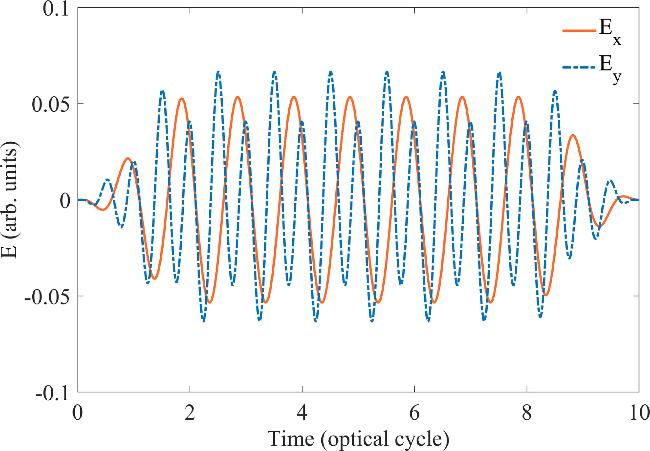
Figure 1. Schematic of the two-dimensional laser electric field in the x (red solid line) and y (blue dashed line) directions. The ellipticity of the fundamental field is ξ = 0.3, and the relative phase between the two-color fields is φ = 0.3π. |
On the basis of the Lewenstein model described in the previous section, we present the alignment-angle-dependent harmonic intensities generated by an OTC field and by a combined two-color field consisting of linearly and elliptically polarized components, respectively. The parameters of the combined two-color field are the same as those used in figure 1. In our calculation, the molecular alignment angle θ of CO2 is scanned from 0∘ to 180∘ with a step of 5∘. As shown in figure 2(a), in the OTC field, the high-order harmonic intensity exhibits a pronounced modulation as the molecular alignment angle varies. Specifically, the harmonic intensity generated from CO2 molecules displays a symmetric distribution with respect to the alignment angle around 90∘. This symmetry originates from the πg symmetry of the highest occupied molecular orbital of CO2. Accordingly, as the molecular alignment angle varies from 0∘ to 180∘, the induced time-dependent dipole moment exhibits mirror symmetry about 90∘, which leads to the observed symmetric variation of the harmonic intensity [47]. For clarity, the 25th-order harmonic intensity as a function of the molecular alignment angle in the OTC field is shown in figure 2(c). One can see that the intensity of the 25th-order harmonic first increases, then decreases, and subsequently increases again as the angle varies from 0∘ to 90∘. When the alignment angle ranges from 90∘ to 180∘, the variation trend of the harmonic intensity is reversed. Overall, the harmonic intensity exhibits mirror symmetry with respect to 90∘. By contrast, in the OTC field, the distribution of the harmonic ellipticity as a function of the molecular alignment angle shows an antisymmetric behavior with respect to 90∘, as shown in figure 2(e). In particular, harmonics with nonzero ellipticity are mainly generated at alignment angles where the harmonic intensity is extremely weak. As a result, owing to the antisymmetric distribution of the harmonic ellipticity with respect to the molecular alignment angle, the contributions from different alignment angles cancel each other upon angular averaging, leading to an overall linearly polarized high-order harmonic emission in the OTC field.
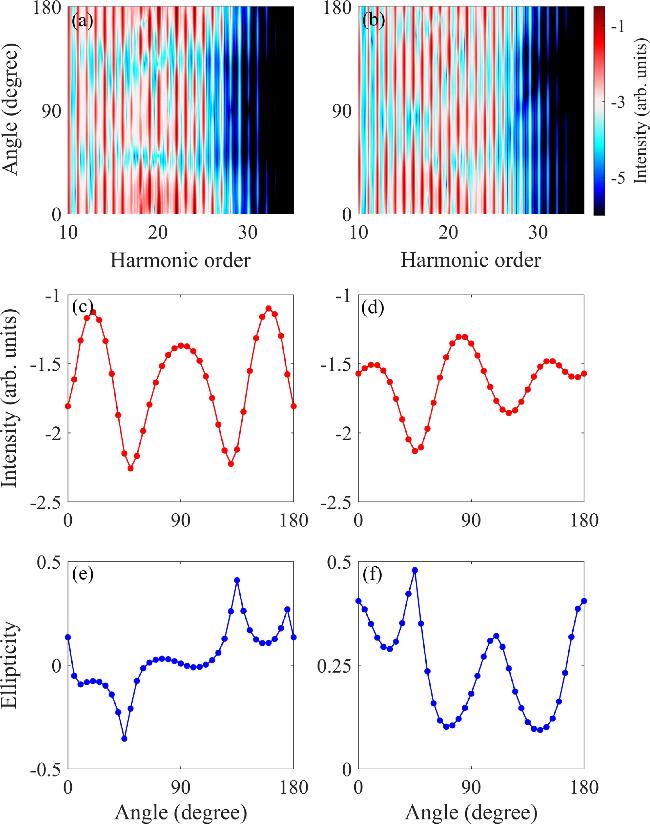
Figure 2. The harmonic intensities as functions of the molecular alignment angle and harmonic order in (a) the OTC field and (b) the combined two-color linearly and elliptically polarized field. The intensity of the 25th-order harmonic as a function of the molecular alignment angle in (c) the OTC laser field and (d) the combined two-color linearly and elliptically polarized field. The harmonic intensity is presented in logarithmic units. The ellipticity of the 25th-order harmonic as a function of the molecular alignment angle in (e) the OTC laser field and (f) the combined two-color linearly and elliptically polarized field. |
In figure 2(b), we present the harmonic intensity generated by a combined two-color driving field consisting of linearly and elliptically polarized components as a function of the molecular alignment angle and harmonic order. Compared with the results obtained under the OTC field shown in figure 2(a), the harmonic intensity distribution loses its symmetry, owing to the intrinsic spatiotemporal asymmetry of the driving laser field. As shown in figure 2(d), the 25th-order harmonic intensity exhibits a pronounced dependence on the molecular alignment angle, and its variation is no longer mirror-symmetric with respect to 90∘. Moreover, as the molecular alignment angle varies from 0∘ to 180∘, the harmonic ellipticity retains the same sign over the entire angular range as shown in figure 2(f), indicating the generation of elliptically polarized high-order harmonics with a well-defined and fixed helicity. To gain physical insight into the elliptically polarized harmonics, we performed a Gabor transform of the harmonic intensity and ellipticity. Figure 3(a) shows the time–frequency distribution of the harmonic intensity, where two emission bursts appear within each optical cycle. Because the temporal symmetry of the driving laser field is broken, the first emission burst is significantly stronger than the second near the cutoff region. Consequently, the dominant harmonic contribution near the cutoff originates from the first emission burst. In the two-dimensional driving field, the laser field rotates in opposite directions in two successive half optical cycles, leading to harmonics with opposite circular polarizations emitted from these two half cycles. As shown in figure 3(b), the harmonics associated with the first emission burst exhibit positive ellipticity near the cutoff region. Combining figures 3(a) and (b), we find that the harmonics near the cutoff are mainly contributed by the first emission burst, which exhibits a large ellipticity with the same helicity. Consequently, the coherent superposition of harmonic emissions from all molecular alignment angles preserves this helicity, resulting in elliptically polarized high-order harmonics. The harmonics generated over all molecular alignment angles are therefore equivalent to those emitted from an ensemble of unaligned molecules. In the following, we focus on the polarization properties of high-order harmonics generated from unaligned molecules driven by the combined two-color linearly and elliptically polarized field.
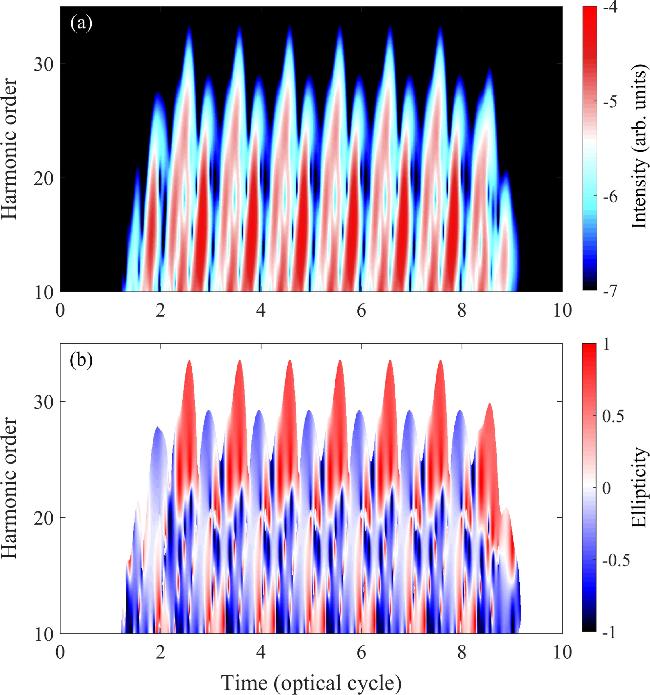
Figure 3. (a) A time–frequency distribution of the high-order harmonics under the combined two-color linearly and elliptically polarized field. The color map represents the time–frequency distribution in the logarithmic scale. (b) The time–frequency distribution of the harmonic ellipticity. |
To investigate the polarization properties of harmonics generated from unaligned molecules in the combined two-color linearly and elliptically polarized driving field, we coherently superpose the harmonic electric fields corresponding to all molecular alignment angles ${{\boldsymbol{E}}}_{{\rm{tot}}}^{{\rm{hhg}}}\,={\sum }_{\theta ={0}^{\circ }}^{18{0}^{\circ }}{{\boldsymbol{E}}}^{{\rm{hhg}}}(\theta ).$ Here, ${{\boldsymbol{E}}}_{{\rm{tot}}}^{{\rm{hhg}}}$ denotes the total harmonic electric field emitted from unaligned molecules. In the case of the OTC laser field, the intensity difference between the left- and right-rotating circularly polarized components of the total harmonics is negligibly small, and the ellipticity remains close to zero. Thus, the harmonics generated in the OTC field are predominantly linearly polarized. This result is consistent with previous theoretical and experimental studies [43, 44]. Figure 4(a) shows the harmonic spectra of the left- and right-rotating circularly polarized components of the total harmonics generated under the combined two-color field. A pronounced intensity difference between the two circular components is clearly observed. The fundamental component of the driving field is elliptically polarized with left-rotating helicity. In the plateau region, the left-rotating circular component tends to be stronger for a majority of harmonic orders, although the intensity difference remains within one order of magnitude. In the cutoff region, the intensity difference between the left- and right-rotating circularly polarized components exceeds one order of magnitude. This indicates the generation of highly elliptically polarized high-order harmonics with the same helicity over a broad spectral range in the cutoff region. Due to the intrinsic asymmetry of the laser field, the left- and right-rotating circularly polarized components of the harmonics acquire unequal contributions depending on the molecular alignment angle. However, the polarization helicity remains unchanged over the entire alignment-angle range. Consequently, the contributions from different alignment angles add constructively rather than canceling each other, resulting in the generation of high-order harmonics with a large ellipticity from unaligned molecules. Previous studies have revealed multi-orbital effects in aligned molecules [48, 49]. In contrast, the present study focuses on unaligned CO2 molecules, for which the contributions from lower-lying occupied molecular orbitals are expected to be significantly weaker and can therefore be neglected. To quantitatively analyze the harmonic polarization, we present the ellipticity as a function of the harmonic order ranging from the 10th to the 35th order in figure 4(b). It can be observed that in the plateau region, the sign of the harmonic ellipticity cannot remain the same, preventing the maintenance of a single helicity over a broad spectral range. In contrast, in the cutoff region, the sign of the harmonic ellipticity remains the same, indicating that the harmonics maintain the same helicity over a broad spectral range, which is favorable for the generation of elliptically polarized attosecond pulses.
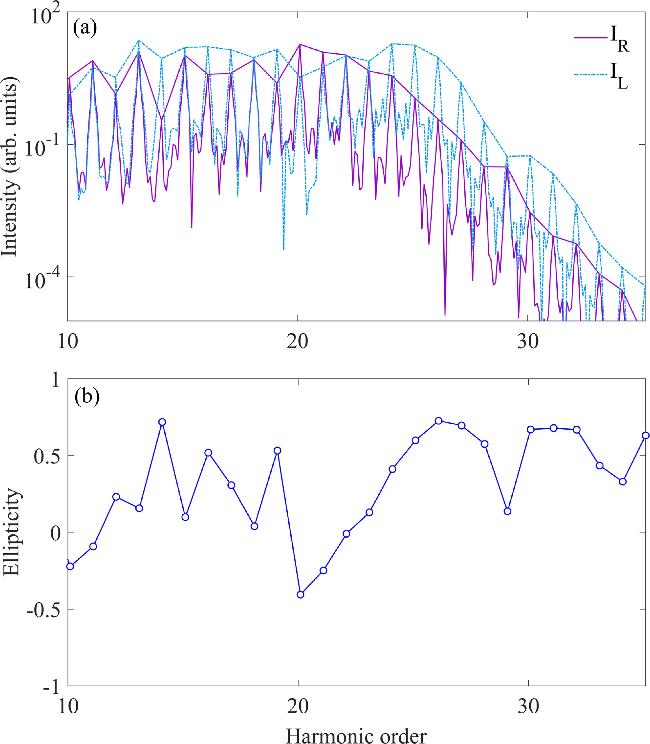
Figure 4. (a) High-order harmonic spectra of the left- (blue dashed lines) and right-rotating (purple solid lines) components of the total harmonic emission from unaligned CO2 molecules. (b) Harmonic ellipticity of the emission from unaligned CO2 molecules for harmonic orders 10–35. The laser field parameters are the same as those used in figure 1. |
To evaluate the robustness of our scheme, we investigate the dependence of the harmonic ellipticity on the ellipticity of the fundamental driving field. Specifically, in our calculation, we scan the fundamental field ellipticity ξ from 0 to 1 in steps of 0.05. Figure 5(a) shows the dependence of the ellipticity of the 25th-order harmonic on the fundamental field ellipticity for unaligned molecules. It can be observed that when the fundamental field is elliptically polarized, the sign of the harmonic ellipticity remains unchanged, indicating that the harmonics preserve the same helicity throughout the entire ellipticity range of the driving field. As the ellipticity of the fundamental field increases from 0 to 1, the ellipticity of the 25th-order harmonic exhibits a corresponding variation. In addition, when the ellipticity of the fundamental field is relatively low (ξ < 0.5), harmonics with relatively high ellipticity (ϵ > 0.7) can be obtained. This significantly relaxes the experimental requirements, demonstrating that elliptically polarized high-order harmonics can be generated without employing a highly elliptic driving laser field. Figure 5(b) presents the harmonic ellipticities from the 10th- to the 35th-order as functions of fundamental field ellipticity ξ and harmonic order. When the ellipticity of the fundamental field ξ is below 0.5, harmonics with ellipticities ϵ exceeding 0.5 can be generated near the cutoff region. In addition, the harmonics near the cutoff consistently maintain the same helicity for a given ellipticity of the fundamental field. This demonstrates that our scheme exhibits strong robustness against variations in the fundamental field ellipticity. Overall, the results indicate that moderate fluctuations in the ellipticity of the fundamental driving field do not affect the helicity of the elliptically polarized high-order harmonics near the cutoff region. Our scheme generates the ellipticity of high-order harmonics primarily through the spatiotemporal asymmetry of the driving laser field. As a result, it is largely insensitive to the symmetry properties of molecular orbitals, making it applicable to a wide range of molecular systems.
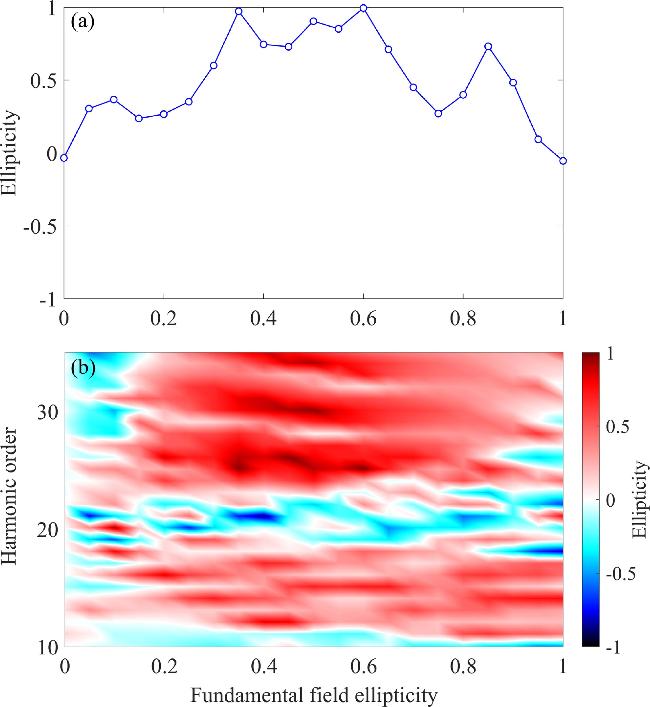
Figure 5. (a) The ellipticity of the 25th-order harmonic for unaligned CO2 molecules as a function of the fundamental field ellipticity ξ. (b) The ellipticity of the harmonics for unaligned CO2 molecules as a function of the fundamental field ellipticity and the harmonic order. The relative phase of the two-color field is φ = 0.3π. |
It has been demonstrated that the relative phase between the two components of the combined two-color field plays a crucial role in the generation of high-order harmonics [50–52]. To examine the influence of the driving-field relative phase φ on the polarization properties of harmonics generated from unaligned molecules, we analyze the ellipticity of the 10th–35th order harmonics as a function of the relative phase and harmonic order, as shown in figure 6. By varying the relative phase φ from 0 to π with a step of 0.05π, the ellipticity of harmonics can be efficiently tuned. The ellipticity is periodically modulated by the relative phase with a period of $\frac{\pi }{2}$. By performing an intensity-weighted average of the ellipticity over the 24th–30th order harmonics for each value of the relative phase φ, one can find that the averaged harmonic ellipticity near the cutoff region varies from −0.4 to 0.6. For each fixed relative phase, the harmonic ellipticity near the cutoff region maintains the same sign, enabling the generation of elliptically polarized high-order harmonics with the same helicity over a broad spectral range. As the relative phase varies, the sign of the harmonic ellipticity near the cutoff region reverses. The helicity of the cutoff region harmonics can thus be controlled, which is advantageous for the generation of elliptically polarized attosecond pulses with a desired helicity. In our calculation, we scanned the second-harmonic intensity jitter within 10%, which is readily measurable and controllable in experiments. The ellipticity of the generated harmonics remains stable within this fluctuation range. To further examine the effect of focal-volume averaging [53, 54], we averaged the harmonic emission over the intensity distribution and found that the averaging does not prevent the generation of elliptically polarized harmonics. Noted that bicircular laser fields and noncollinear schemes have been widely used to generate circularly polarized high-order harmonics. In comparison, our symmetry-broken two-color approach provides a simpler experimental implementation by avoiding the requirement of a purely circularly polarized driving field, while enabling tunable ellipticity over a broad spectral range for unaligned molecules. Compared with the scheme based on molecular prealignment, the present approach can produce harmonics with larger ellipticity. Although the achieved ellipticity remains lower than that obtained using bichromatic counter-rotating circularly polarized driving fields, which typically produce harmonics with alternating helicities, the present method maintains a constant helicity over a relatively broad spectral range. Nevertheless, the scheme still relies on a two-color configuration, and increasing the ellipticity of the fundamental field to obtain elliptically polarized harmonics generally reduces the harmonic yield. Optimizing the trade-off among harmonic ellipticity, emission efficiency, and experimental complexity therefore remains an important direction for future work.
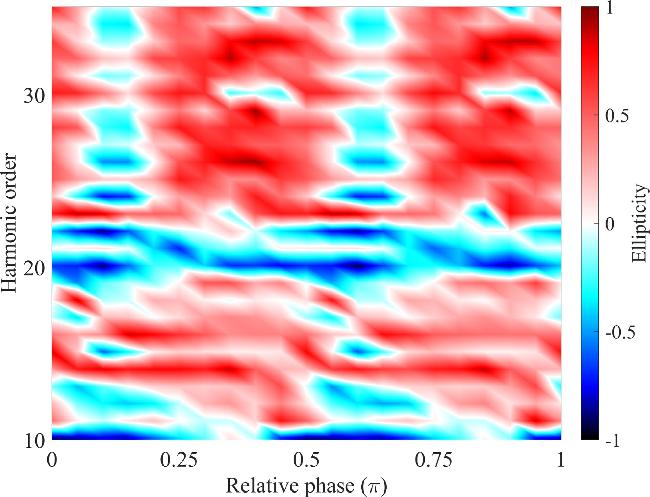


Figure 6. The ellipticity of harmonics for unaligned CO2 molecules as a function of the relative phase and the harmonic order. The ellipticity of the fundamental field is ξ = 0.3. |
4. Conclusions
In summary, we have investigated the polarization properties of high-order harmonics generated from CO2 molecules driven by a combined two-color linearly and elliptically polarized field. We find that the harmonics emitted at each molecular alignment angle possess a nonzero ellipticity with the same helicity, which collectively results in the generation of elliptically polarized high-order harmonics from unaligned molecules. Notably, highly elliptically polarized high-order harmonics can be obtained even when the ellipticity of the fundamental driving field is relatively small. By varying the ellipticity of the fundamental field, the harmonics near the cutoff region are shown to preserve the same helicity, demonstrating the robustness of the scheme and relaxing the requirements on tailoring the driving laser field. Furthermore, the harmonic ellipticity can be efficiently controlled by tuning the relative phase between the two components of the combined two-color field. The harmonic ellipticity exhibits a periodic dependence on the relative phase of the driving field with a period of $\frac{\pi }{2}$. Importantly, the proposed scheme does not rely on molecular alignment, which significantly simplifies the experimental implementation. This work thus provides a robust and experimentally feasible approach for generating tunable elliptically polarized high-order harmonics, with potential applications in the study of chirality and magnetic circular dichroism.