

1. Introduction
Synchronization refers to the most fundamental and important phenomenon in the cooperative behavior of complex systems [1–3]. The phenomenon of synchronization has attracted widespread attention from many disciplines, such as math [4], physics [5], chemistry [6], biology [7], even social sciences [8], etc. Christiaan Huygens first documented synchronization phenomenon in the 17th century [9]. He reported that two pendulum clocks mounted on the same supporting beam, after initially oscillating with independent phases, gradually entered a state of anti-phase synchronization—their pendulums swinging persistently in opposite directions. To date, the existing theoretical works on synchronization predominantly concern limit-cycle systems; in contrast, its manifestation within Hamiltonian (conservative) systems is far less studied [10].
Measure synchronization (MS) as a collective dynamical behavior in coupled Hamiltonian systems was discovered by Hampton and Zanette [11]. They found that two coupled Hamiltonian systems experience a critical dynamical phase transition from a state in which the two Hamiltonian systems visit different phase space domains to a state in which the two Hamiltonian systems cover phase space domains with identical invariant measure as the coupling strength increases. The discovery of MS provides a new perspective for the study of Hamiltonian dynamics, which has theoretical significance and potentially practical value [12–14]. More recently, the first validation experiment of MS was carried out with camphor rotors [15].
In previous investigations, MS under three different categories of Hamiltonian systems have been explored, i.e. classical Hamiltonian systems [11], quantum Hamiltonian systems [16, 17, 18], and hybrid quantum–classical Hamiltonian systems [19]. For MS in classical Hamiltonian systems, such as coupled φ4 systems [20], coupled pendulums [21], and two-species bosonic Josephson junctions [22], the critical dynamical phase transition behavior of MS with increased coupling strength have been identified. In contrast, for MS in quantum Hamiltonian systems, such as MS in a quantum many body systems [18], it had been found that the critical dynamical phase transition behavior of MS is replaced by a crossover behavior, therefore no critical coupling strength in achieving MS can be unambiguously defined. Furthermore, when extending to a hybrid quantum–classical Hamiltonian system, we have found that the appearance of MS is still a crossover behavior [19].
The aforementioned research on MS has focused on directly-coupled Hamiltonian systems. However, in practical coupled dynamical systems, complete isolation is often infeasible, and interactions inevitably occur through environmental mediation. Consequently, indirect coupling schemes are prevalent and hold significant theoretical value. Coupled systems under indirect coupling schemes have been investigated extensively, revealing a rich variety of phenomena such as explosive synchronization [23], collective dynamics [24], and oscillation death [25]. Inspired by the complex dynamics enabled by indirect coupling in these systems, we extend this trend to the realm of MS. Here, we focus specifically on MS within an indirectly-coupled hybrid quantum–classical system, where the interaction is mediated by a quantum medium. Studying this quantum-mediated scenario is of particular interest. The quantum mediator can bridge classical synchronization phenomena with quantum control, opening yet another pathway to explore hybrid quantum–classical dynamics [19]. Furthermore, it models the physical interactions inherent in real-world quantum platforms, such as cavity optomechanics [26], quantum circuits [27], and quantum sensing [28], thereby providing theoretical insight for advancing these technologies.
This paper is organized as follows. Section 2 describes the indirectly-coupled hybrid system. Section 3 presents the results and analysis of MS in the system. Finally, the conclusions are summarized in section 4 .
2. Indirectly-coupled hybrid system
We consider a system of three distinct boson species, labeled a, b, and c, occupying two single-particle states, L and R. The main results of this paper are largely independent of the specific nature of these states. One method to realize this system is by trapping ultracold atoms in a double-well potential [29]. Alternatively, it could be implemented by populating three atomic hyperfine states and coupling them linearly [30]. A solid-state alternative is to employ spinor exciton-polaritons condensates [31]. Following a treatment for establishing hybrid quantum–classical systems [19, 32], where the quantum fluctuations of the a and b boson species are assumed negligible (validating the c-number approximation), we derive a new hybrid quantum–classical system. It consists of two classical Hamiltonians, Ha and Hb, coupled indirectly via a quantum mediator, ${\hat{H}}_{{\rm{c}}{\rm{o}}{\rm{u}}{\rm{p}}}$. The indirectly-coupled hybrid system can be written as $H={H}_{a}\rm{+}\,{H}_{b}\,\rm{+}{\hat{H}}_{\,\rm{coup}\,}$ with
$\begin{eqnarray*}\begin{array}{r}{H}_{a}=-{J}_{a}{N}_{a}\sqrt{1-{z}_{a}^{2}}\cos {\varphi }_{a}\,\rm{+}\,\frac{{U}_{a}}{4}{N}_{a}^{2}{z}_{a}^{2},\end{array}\end{eqnarray*}$
$\begin{eqnarray*}\begin{array}{r}{H}_{b}=-{J}_{b}{N}_{b}\sqrt{1-{z}_{b}^{2}}\cos {\varphi }_{b}\,\rm{+}\,\frac{{U}_{b}}{4}{N}_{b}^{2}{z}_{b}^{2},\end{array}\end{eqnarray*}$
$\begin{eqnarray}\begin{array}{rcl}{\hat{H}}_{\mathrm{coup}} & = & -{J}_{c}\left({\hat{c}}_{L}^{\dagger }{\hat{c}}_{R}+{\hat{c}}_{L}{\hat{c}}_{R}^{\dagger }\right)\\ & & +\displaystyle \frac{{U}_{c}}{2}\left[{\hat{c}}_{L}^{\dagger }{\hat{c}}_{L}\left({\hat{c}}_{L}^{\dagger }{\hat{c}}_{L}-1\right)\right.\\ & & +\left.{\hat{c}}_{R}^{\dagger }{\hat{c}}_{R}\left({\hat{c}}_{R}^{\dagger }{\hat{c}}_{R}-1\right)\right]\\ & & +K\left({\hat{c}}_{L}^{\dagger }{\hat{c}}_{L}-{\hat{c}}_{R}^{\dagger }{\hat{c}}_{R}\right)\left({J}_{a}{z}_{a}+{J}_{b}{z}_{b}\right),\end{array}\end{eqnarray}$
where za(b) and φa(b) are conjugate variables for classical Hamiltonian system Ha(b). They are termed as the population imbalance and the phase difference for the classical Hamiltonian system a and b. Ja(b), Na(b) and Ua(b) are parameters of the classical Hamiltonian systems. For the quantum mediator, ${\hat{c}}_{L(R)}^{\dagger }\left({\hat{c}}_{L(R)}\right)$ are quantum operators, whereas Jc, Uc and K are parameters. Notice here ${\hat{H}}_{{\rm{c}}{\rm{o}}{\rm{u}}{\rm{p}}}$ acts as indirect-coupling mediator for the two classical Hamiltonian systems Ha and Hb. The last term is the coupling term with a parameter K in front, which denotes the coupling strength in between the quantum mediator and the two classical Hamiltonian systems. In atomic systems, K is tunable via Feshbach resonance [33], whereas in solid-state polariton systems, it is controlled by engineering spin–orbit coupling [31].The hybrid quantum–classical dynamics are solved as follows, for the quantum dynamics, the time-dependent Schr$\ddot{{\rm{o}}}$dinger equation is solved.
$\begin{eqnarray}\begin{array}{r}{\rm{i}}\hslash {\partial }_{t}| {\rm{\Psi }}\rangle =\hat{H}(t)| {\rm{\Psi }}\rangle .\end{array}\end{eqnarray}$
For classical dynamics, the Hamiltonian equations are solved, $\begin{eqnarray}\begin{array}{rcl}{\dot{z}}_{a} & = & -2{J}_{a}\sqrt{1-{z}_{a}^{2}}\sin {\varphi }_{a},\\ {\dot{\varphi }}_{a} & = & -2{J}_{a}{{\rm{\Lambda }}}_{a}{z}_{a}\\ & & +2{J}_{a}\frac{{z}_{a}}{\sqrt{1-{z}_{a}^{2}}}\cos {\varphi }_{a}\,\rm{+}\,2K{J}_{a}\left\langle {\hat{z}}_{c}\right\rangle ,\\ {\dot{z}}_{b} & = & -2{J}_{b}\sqrt{1-{z}_{b}^{2}}\sin {\varphi }_{b},\\ {\dot{\varphi }}_{b} & = & -2{J}_{b}{{\rm{\Lambda }}}_{b}{z}_{b}\\ & & +2{J}_{b}\frac{{z}_{b}}{\sqrt{1-{z}_{b}^{2}}}\cos {\varphi }_{b}\,\rm{+}\,2K{J}_{b}\left\langle {\hat{z}}_{c}\right\rangle .\end{array}\end{eqnarray}$
Notice here the Hamiltonian equations have incorporated the quantum feedback $\langle {\hat{z}}_{c}\rangle =\langle \left({\hat{c}}_{L}^{\dagger }{\hat{c}}_{L}-{\hat{c}}_{R}^{\dagger }{\hat{c}}_{R}\right)/2\rangle $. In above equations, we have introduced the dimensionless parameters, ${{\rm{\Lambda }}}_{a}\equiv {N}_{a}{U}_{a}/\left(2{J}_{a}\right)$, ${{\rm{\Lambda }}}_{b}\equiv {N}_{b}{U}_{b}/\left(2{J}_{b}\right)$. The time dependence of $\hat{H}(t)$ stems from the time-dependence variables za and zb, which account for reciprocal feedback from classical dynamics.For numerical methods, we employ the fourth-order Runge–Kutta method in solving Hamiltonian equations. The time dependent Schr$\ddot{{\rm{o}}}$dinger equation is solved by the Crank–Nicolson method [34]. The numerical solutions of equations (2 ) and (3 ) conserve the total energy of the hybrid system in all the numerical results reported in this paper. Such total energy conservation implies energy exchange between the quantum and classical subsystems.
3. Measure synchronization
As a distinctive synchronization phenomenon occurring in coupled Hamiltonian systems, MS was originally defined under the condition of each coupled Hamiltonian systems being identity. The only distinguishing feature within such coupled Hamiltonian systems setup lies in the differences on initial conditions. To fulfill the above requirements, for solving the Hamiltonian equation (3 ), we set the parameters as follows: Λa = Λb = 1.5, and Ja = Jb = 1. All parameters in Hamiltonian equations are thus identical, whereas the initial conditions shall be different. The initial conditions are chosen as za = 0.2, zb = 0.1, φa = φb = 0. Regarding quantum mediator, we set the parameters as follows: Jc = 1, Uc = 0.5. The characteristic Rabi oscillation time is given by tRabi = π/Jc. Furthermore, for the quantum mediator, the initial quantum state is chosen as a two mode coherent state, under the occupation number representation (Fock basis), it is written as follows [35]
$\begin{eqnarray}\begin{array}{rcl}\left|{\rm{\Psi }}\left({\theta }_{c},{\varphi }_{c}\right)\right\rangle & = & \frac{1}{\sqrt{N!}}{({\alpha }_{L}{a}_{L}^{\dagger }+{\alpha }_{R}{a}_{R}^{\dagger })}^{N}\left|0\right\rangle \\ & = & \displaystyle \sum _{k=0}^{N}{\left(\genfrac{}{}{0.0pt}{}{N}{k}\right)}^{1/2}{\left[\cos \left({\theta }_{c}/2\right)\right]}^{k}{\left[\sin \left({\theta }_{c}/2\right)\right]}^{N-k}\\ & & \times \,{{\rm{e}}}^{{\rm{i}}\left(N-k\right){\varphi }_{c}}\left|k,N-k\right\rangle .\end{array}\end{eqnarray}$
The initial conditions are ${\theta }_{c}=\arccos \left(0.3\right)$, φc = 0 and N = 6.The transition from non-MS state to MS state with increased coupling strength K is shown in figures 1(a)–(f). For coupling strength K = 0, which means the two classical Hamiltonian systems are uncoupled, their phase space trajectories are two periodic curves, as shown in figure 1(a), with one in black representing classical Hamiltonian system a, and the other in red representing the classical Hamiltonian system b. When increasing the coupling strength K, we observe that the two periodic curves are replaced by two phase space domains, e.g. figure 1(b) for K = 0.01. As coupling strength keeps increasing, we notice that the external border of the inner phase space domain approaches the internal border of the outer phase space domain, until they closely touch as shown in figure 1(c) for K = 0.021. Further increasing K, the two phase space domains will partially overlapped, as shown in figure 1(d) for K = 0.023 70. Until K reaches a critical coupling strength Kc = 0.023 71, a sudden transition occurs in the phase space picture, with both phase space domains completely overlapped [figure 1(e)], which indicates occurrence of MS [11]. Continuing to increase the coupling strength K, the MS states persist, as shown in figure 1(f) for K = 0.05. Different from the directly-coupled classical Hamiltonian case [22], in achieving MS for the above indirectly-coupled hybrid systems, there is a window for partially overlapped phase space domains before the MS transition [figure 1(d)]. We have found that the critical coupling strength strongly depends on the initial conditions being chosen for both the classical systems and the quantum mediator, but the overlapped phase-space domain feature persists.
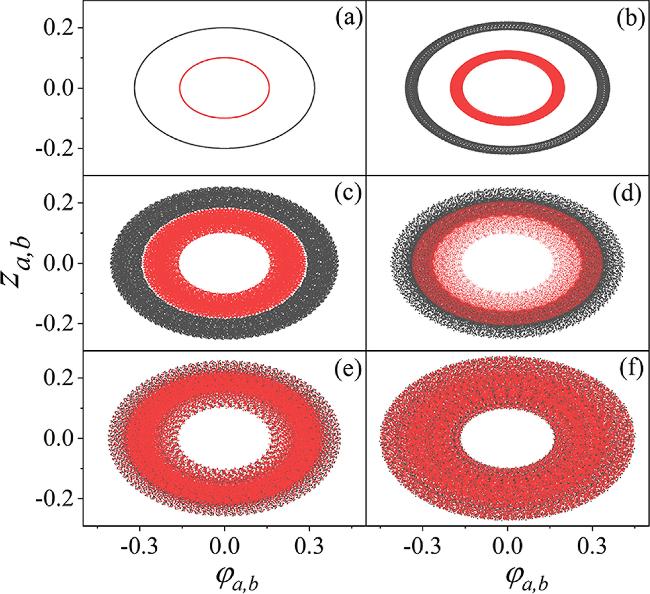
Figure 1. Phase space domains of the two indirectly-coupled classical Hamiltonian systems. The black phase space domain is for the classical Hamiltonian system a, while the red phase space domain is for the classical Hamiltonian system b. (a) K = 0, (b) K = 0.01, (c) K = 0.021, (d) K = 0.02370, (e) K = 0.02371, and (f) K = 0.05. |
To quantify the transition process as described above, we employ the order parameter M for MS [34, 36, 37], which is defined as
$\begin{eqnarray}\begin{array}{r}M=\frac{1}{{\sum }_{i,j}^{N}{c}_{i,j}}\displaystyle \sum _{i,j}^{N}{c}_{i,j}\frac{{({n}_{i,j}-{n}_{i,j}^{{\prime} })}^{2}}{{({n}_{i,j}+{n}_{i,j}^{{\prime} })}^{2}},\end{array}\end{eqnarray}$
where the phase space domain of the classical Hamiltonian system is divided into N × N unites, ni,j and ${n}_{i,j}^{{\prime} }$ count the number of times for two classical Hamiltonian systems'(a and b) orbits evolve to reach the same cell (i, j). The coefficient ci,j = 0 if neither orbit has passed through the cell $\left(i,j\right)$, ci,j = 1 if at least one of the two orbits that has passed through the cell $\left(i,j\right)$. Value of M is in between 0 and 1. For MS states, M = 0, while for non-MS states, M ≠ 0. Figure 2 shows the results of M versus the coupling strength K. For two indirectly-coupled classical Hamiltonian systems via the quantum mediator, the order parameter M equals 1 for small coupling strength K, indicating the complete separation of the two phase space domains. This state persists until the coupling strength reaches K = 0.021. As the coupling strength increases further, when K exceeds 0.021, M gradually decreases from 1, which corresponds to the partially overlapped phase space domains [the gray region]. When the coupling strength K increases further, M suddenly drops to 0 at Kc = 0.023 71 [marked by dashed line], indicating the occurrence of MS transition. As a comparison, we also show the result of two-directly coupled classical Hamiltonian systems [22]. We note that at the critical coupling strength K = 0.002 63, M suddenly drops from 1 to 0, which indicates the occurrence of MS transition. A distinctive feature of the MS transition in the indirectly-coupled hybrid system—absent in its direct-coupled counterpart—is the emergence of a partially overlapped phase space domain [the gray region in figure 2] prior to MS transition, a hallmark imparted by the quantum mediator. Further comparison shows that the critical coupling strength under indirect coupling scheme is 10 times larger than that under direct coupling scheme, indicating that a much stronger coupling strength is required for achieving MS in the indirectly-coupled scheme.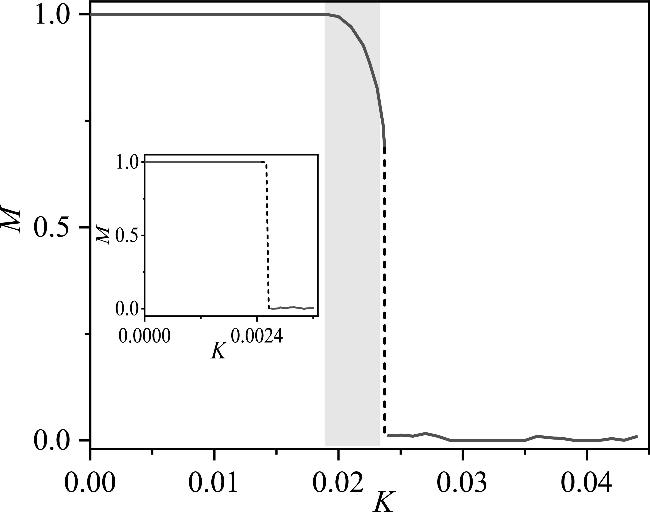
Figure 2. The order parameter M versus the coupling strength K for the two indirectly-coupled classical Hamiltonian systems. In the inset we depict M versus the coupling strength K for the two directly-coupled classical Hamiltonian systems. |
In order to analyze the role of quantum mediator in the MS transition of two indirectly-coupled hybrid systems, we calculate following physical quantities under different coupling strength K. The energy evolution of the two indirectly-coupled classical Hamiltonian systems are denoted by Ea,b(t) = Ha,b(t). The energy evolution of the quantum mediator is calculated as follows, ${E}_{c}(t)=\langle {\rm{\Psi }}\left(t\right)| {\hat{H}}_{c}| {\rm{\Psi }}\left(t\right)\rangle $, here ${\hat{H}}_{c}$ = $-{J}_{c}\left({\hat{c}}_{L}^{\dagger }{\hat{c}}_{R}+{\hat{c}}_{L}{\hat{c}}_{R}^{\dagger }\right)$ + $\frac{{U}_{c}}{2}({\hat{c}}_{L}^{\dagger }{\hat{c}}_{L}\left({\hat{c}}_{L}^{\dagger }{\hat{c}}_{L}-1\right)$ + ${\hat{c}}_{R}^{\dagger }{\hat{c}}_{R}\left({\hat{c}}_{R}^{\dagger }{\hat{c}}_{R}-1\right))$ with $\left|{\rm{\Psi }}\left(t\right)\right\rangle $ the evolved quantum state. Quantum fluctuation evolution of energy for the quantum mediator is calculated as ${\sigma }_{E}^{2}(t)=\langle \hat{{H}_{c}^{2}}\rangle -{\langle \hat{{H}_{c}}\rangle }^{2}$. In figure 3(a1), for K = 0, the energies for the classical Hamiltonian systems remain constant in the absence of coupling. As the coupling strength increases, the energies for the two classical Hamiltonian systems begin to vary and approach each other over time [figures 3(b1)–(c1)]. When K increases upto K = 0.023 70, as shown in figure 3(d1), the energy curves appear partially overlapped, this corresponds to the partially overlapped phase space domain, as shown in figure 1(d). In figure 3(e1), with the critical strength Kc = 0.023 71, we find that Ea,b(t) suddenly has the same range of energy variation, the two classical Hamiltonian systems reach complete energy exchange through the quantum mediator. Keep increase the coupling strength upto K = 0.05, the energies Ea(t) and Eb(t) of the two classical Hamiltonian systems continue to vary within the same range, but exhibit more pronounced fluctuations [see figure 3(f1)]. We also calculate the energy evolution Ec(t) and quantum fluctuation ${\sigma }_{E}^{2}(t)$ of the quantum mediator. When coupling strength K = 0, the energy of quantum mediator and its quantum fluctuation are unchanged over time [figures 3(a2) and (a3)]. As the coupling strength increases, Ec(t) and ${\sigma }_{E}^{2}(t)$ begin to oscillate over time, the period of the oscillations coincide with the energy exchanging periods as shown in figures 3(a1)–(f1). Interestingly, we notice that both the quantum energy Ec(t) and quantum fluctuations ${\sigma }_{E}^{2}(t)$ are stabilized during the time window when the classical energies Ea(t) and Eb(t) overlap. This suggests that the stabilization of quantum energy and fluctuations could be the reason behind the classical phase-space domains overlap. Furthermore, both quantities show no discernible change across the MS transition. In summary, our results show MS is achieved through a complete energy exchange between indirectly-coupled classical Hamiltonian systems, facilitated by the quantum medium.
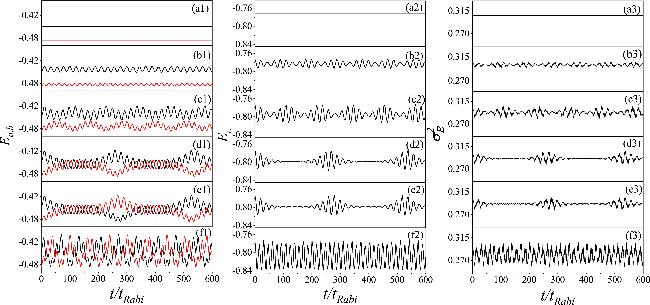
Figure 3. Time evolution of various physical quantities under different coupling strength K. The left panel depicts energies of the two indirectly-coupled classical Hamiltonian systems, black line represents Ea(t) of the classical Hamiltonian system a, and red line represents Eb(t) of the classical Hamiltonian system b. Middle panel depicts the energy evolution of the quantum mediator Ec(t). The right panel depicts the quantum fluctuation of energy ${\sigma }_{E}^{2}(t)$. For different rows, (a1)–(a3) K = 0, (b1)–(b3) K = 0.01, (c1)–(c3) K = 0.021, (d1)–(d3) K = 0.02370, (e1)–(e3) K = 0.02371, and (f1)–(f3) K = 0.05. |
To characterize the MS dynamical phase transition, we plot the average energies of the two classical Hamiltonian systems and the energy of quantum mediator as functions of the coupling strength K in figure 4. The average energy is calculated as follows
$\begin{eqnarray}\begin{array}{r}\bar{{E}_{i}}=\frac{1}{T}{\displaystyle \int }_{0}^{T}{E}_{i}\left(t\right){\rm{d}}t,\end{array}\end{eqnarray}$
where i = (a, b, c), and we can also calculate averaged quantum fluctuation of energy through $\bar{{\sigma }_{E}^{2}}=\frac{1}{T}{\int }_{0}^{T}{\sigma }_{E}^{2}{\rm{d}}t$. Figure 4(a) presents the averaged energies ${\bar{E}}_{a}$ (black line) and ${\bar{E}}_{b}$ (red line) versus the coupling strength K, corresponding to the classical Hamiltonian systems a and b, respectively. For the two indirectly-coupled classical Hamiltonian systems, when the coupling strength is below the critical strength Kc = 0.023 71, the averaged energies ${\bar{E}}_{a}\ne {\bar{E}}_{b}$, and the system is in the non-MS state. As the coupling strength is further increased upto the critical coupling strength Kc, it can be observed that the average energies of the two systems suddenly become the same ${\bar{E}}_{a}={\bar{E}}_{b}$, indicating the occurrence of MS. With a further increase in the coupling strength, the averaged energies of the two classical Hamiltonian systems remain the same. Remarkably, unlike the crossover behavior of MS transition characterized in the previous hybrid quantum–classical systems [19], the averaged energies in figure 4(a) of the indirectly-coupled hybrid system exhibit an abrupt jump from non-MS to MS. The abrupt energy jump at the MS onset in figure 4(a) is a hallmark of the critical dynamical phase transition, analogous to the behavior in the directly-coupled systems [see inset]. This indicates that the MS transition in the quantum-mediated hybrid system is a critical dynamical phase transition. Furthermore, it is shown that the averaged energy ${\bar{E}}_{c}$ of the quantum mediator decreases with increasing coupling strength K, as shown in figure 4(b). The averaged quantum fluctuation of energy $\bar{{\sigma }_{E}^{2}}$ for the quantum mediator also decreases as K increases, as shown in figure 4(c). Surprisingly, both curves exhibit a turning point at the critical coupling strength of MS.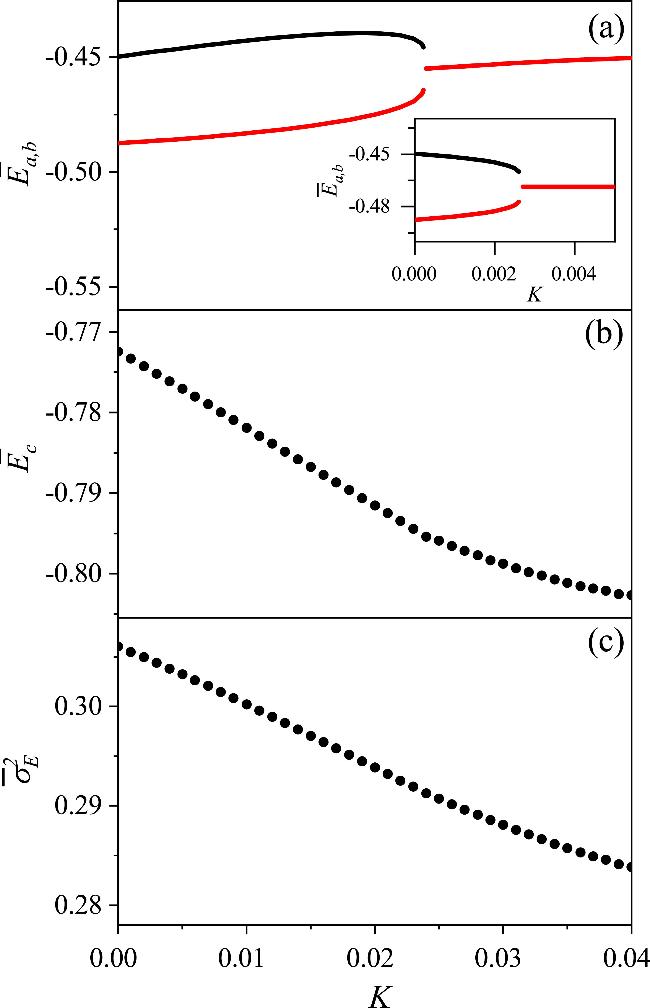
Figure 4. Time averaged physical quantities versus the coupling strength K. (a) Averaged energies ${\bar{E}}_{a,b}$ of the two indirectly-coupled classical Hamiltonian systems. Inset: averaged energies ${\bar{E}}_{a,b}$ of the directly-coupled classical Hamiltonian systems; (b) averaged energies ${\bar{E}}_{c}$ of the quantum mediator; (c) averaged quantum fluctuation of energy $\bar{{\sigma }_{E}^{2}}$. |
To explore the synchronous mechanism behind MS in the two indirectly-coupled classical Hamiltonian systems, we analyze their frequency spectra [21]. Figures 5(a)–(b) show the Fast Fourier transform results of za(t) and zb(t) for the two indirectly-coupled classical Hamiltonian systems, where figure 5(a) presents the the frequency spectra of classical Hamiltonian system a and figure 5(b) presents the frequency spectra of classical Hamiltonian system b. In the uncoupled case, it is found that the two classical Hamiltonian systems only have one peak each, indicating that each of the uncoupled Hamiltonian systems exhibits periodic motion. When coupling strength K is less than the critical coupling strength Kc, the spectral distributions are different from each other, and the system does not reach MS. As the coupling strength increases to Kc = 0.023 71, the spectral distribution undergoes an apparent critical transition, the extracted frequencies first contract and then burst out at the critical coupling strength, signaling the onset of MS. Beyond the critical coupling strength Kc, we notice that the two indirectly-coupled classical Hamiltonian systems are frequency locked with each other. Similar frequency locking scenario of directly-coupled classical Hamiltonian system are also shown in figures 5(c)–(d) as a comparing group. These results indicate that for the indirectly- and directly-coupled classical Hamiltonian systems, the synchronous mechanism behind MS is frequency locking. Furthermore, the frequency spectra provide clear evidence of the critical dynamical phase transition, similar behavior has also been observed in directly-coupled camphor rotors [14].
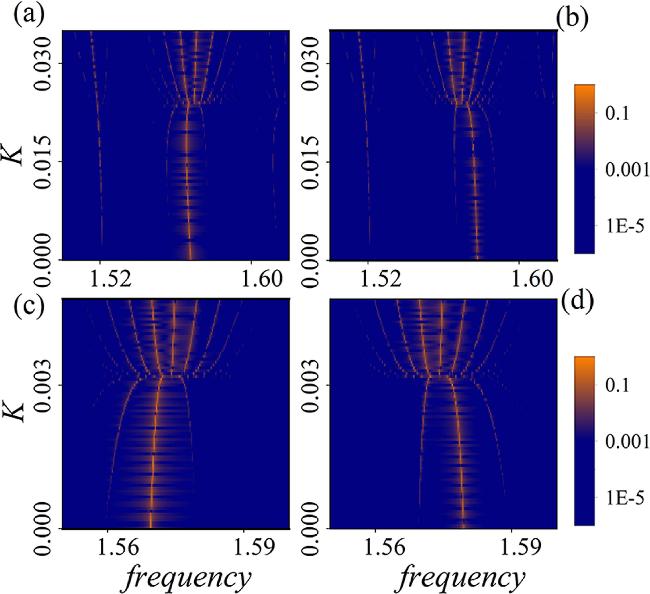


Figure 5. Absolute value of the frequency spectra zi(f) in a logarithmic scale versus coupling strength K (fast Fourier transform of the displacement angle zi(t) for the two classical Hamiltonian systems, with i = a, b). (a)–(b), the fast Fourier transforms results for za(t), zb(t) of the two indirectly-coupled classical Hamiltonian systems, respectively. (c)–(d) The fast Fourier transforms results for za(t), zb(t) of the two directly-coupled Hamiltonian systems, respectively. |
4. Conclusion
This paper investigates the MS transition in two indirectly-coupled classical Hamiltonian systems via a quantum mediator. By analyzing phase space domains, order parameter, energies characteristics, quantum fluctuations, and frequency spectra, the underlying physics mechanism of the MS transition are explored. The results demonstrate that the quantum-mediated coupling not only facilitates MS but also introduces distinct intermediate dynamics—namely, the gradual merging of phase space domains—which differs from abrupt transitions in terms of phase space domains, as are often seen in direct-coupling scheme. Notably, both frequency spectrum analysis and energy-based calculations confirm that the MS transition retains clear signatures of a critical dynamical phase transition, analogous to those observed in directly-coupled classical Hamiltonian systems, suggesting a universal synchronization mechanism across coupling schemes.