In the present work, we aim to investigate the cosmological dynamics of Ricci inverse gravity, a modified theory of gravity constructed from the anti-curvature tensor defined as the matrix inverse of the Ricci tensor. Working within a spatially flat Friedmann–Robertson–Walker background, we derive the modified field equations and analyze their implications for nonsingular bouncing cosmologies. By adopting a well-motivated parametrization of the Hubble parameter, we demonstrate that the theory naturally admits regular bouncing solutions characterized by a smooth transition from a contracting phase to an expanding one without encountering curvature singularities. The energy density and pressure remain finite throughout the evolution, with the pressure taking negative values that drive both the bounce and the subsequent accelerated expansion. We perform a detailed analysis of the energy conditions and find persistent violations of the null and strong energy conditions, while the dominant energy condition is satisfied within the considered parameter space. The equation of state parameter evolves dynamically and asymptotically approaches ω → −1, indicating a late-time de-Sitter like accelerating phase that mimics ΛCDM behavior without introducing an explicit cosmological constant. Our results highlight the potential of anti-curvature based modifications of gravity as a viable framework for addressing the initial singularity problem and explaining late-time cosmic acceleration within a unified geometric setup.
Fatemah Mofarreh, M Farasat Shamir, Adnan Malik, Wedad Albalawi, Aishah Alshehri. Existence of bouncing universe in Ricci inverse gravity[J]. Communications in Theoretical Physics, 2026, 78(7): 075402. DOI: 10.1088/1572-9494/ae5f7c
1. Introduction
The expansion of the Universe has been a central theme in cosmology since the advent of General Relativity (GR). For a long time, it was believed that cosmic expansion was slowing down due to gravitational attraction. This view was fundamentally revised in the late 1990s, when observations of distant type Ia supernovae revealed that the Universe is undergoing an accelerated expansion [1, 2]. This discovery was subsequently supported by measurements of cosmic microwave background anisotropies [3] and large-scale structure observations [4], establishing cosmic acceleration as a key feature of modern cosmology. Observational evidence indicates that ordinary baryonic matter accounts for only a small fraction of the total energy content of the Universe, while dark matter and dark energy dominate the cosmic energy budget. In particular, dark energy is widely regarded as the primary driver of late-time acceleration and is characterized by a strong negative pressure. Current data suggest that nearly 96% of the total energy density of the Universe consists of dark matter and dark energy, with the equation of state (EoS) parameter of the latter lying close to ω ≃ −1 [5].
These observations have motivated extensive investigations of modified theories of gravity as alternatives to the cosmological constant paradigm. Such theories provide new mechanisms for cosmic acceleration and offer potential insights into high-curvature and quantum-gravity regimes. A wide variety of curvature-based and matter-coupled modifications of GR have been explored in the literature [6–16]. Among them, theories involving explicit couplings between geometry and matter have attracted particular interest due to their rich cosmological phenomenology. Harko et al [17] introduced the f(R, T) theory of gravity, in which the gravitational action depends on both the Ricci scalar and the trace of the energy-momentum tensor, leading to non-conservation of the matter sector. Related extensions, such as $f({ \mathcal G },T)$ gravity, have also been studied and shown to produce non-geodesic motion of test particles due to additional curvature-matter couplings [18]. While f(R) gravity represents the simplest extension of GR, constructing viable models consistent with both cosmological and local gravity constraints remains challenging [19].
In addition to late-time acceleration, the standard big-bang cosmological model faces conceptual challenges such as the initial singularity, the horizon problem, and trans-Planckian issues. Bouncing cosmological scenarios provide an appealing alternative by replacing the big bang with a smooth transition from a contracting to an expanding phase. Unlike earlier oscillatory universe models, which suffered from ambiguities such as cusp behavior and angular-momentum barriers [20], nonsingular bouncing cosmologies offer a consistent resolution of the initial singularity problem. A notable advantage of bouncing models is their ability to naturally avoid the trans-Planckian problem, as the physical wavelengths of cosmological perturbations can remain well above the Planck scale throughout the evolution [21]. Different classes of bouncing scenarios have been proposed, each characterized by distinct contracting phases and perturbation spectra [22, 23]. While issues such as the Belinskii–Khalatnikov–Lifshitz instability may arise during contraction [24], several mechanisms have been developed to suppress anisotropies and ensure stable evolution [25–28]. Consequently, the study of bouncing cosmologies has become an active area of research in modified gravity [29–36].
Bouncing cosmologies in modified gravity have been extensively investigated in recent literature using diverse approaches and frameworks, highlighting their robustness as viable alternatives to the standard singular cosmological scenario [37–40]. Bouncing solutions have been discussed using f(R) gravity in both metric and Palatini formalisms, where it has been shown that the big-bang singularity can be replaced by a cosmic bounce [41, 42]. More recently, Singh et al [43] proposed a parametrized Hubble function in f(R, T) gravity that satisfies the necessary bouncing conditions and leads to singularity-free cosmological evolution. Gauss–Bonnet-based bouncing models have also been explored, demonstrating that higher-curvature corrections can significantly alter cosmic dynamics and give rise to de Sitter-like bouncing solutions [44]. Bouncing cosmologies and stability analysis in symmetric teleparallel f(Q) gravity have been discussed with some stable exact solutions [45]. Motivated from these interesting discussions and literature, this paper is devoted to study bouncing cosmological universe in the framework of Ricci invesre gravity. For this purpose, we consider a well known form of Hubble parameter [43]. The paper is organized as follows. In section 2, we briefly review the formulation of Ricci inverse gravity and derive the modified field equations for a flat FRW background. In section 3, we analyze the energy conditions and investigate the realization of nonsingular bouncing cosmologies using a parametrized Hubble function. The evolution of thermodynamic quantities and cosmological parameters is discussed in detail. Finally, in section 4, we summarize our main findings and outline possible directions for future research.
2. Ricci invesre gravity: some important preliminaries
The concept of an anti-curvature tensor, introduced as the matrix inverse of the Ricci tensor, offers a compelling avenue for formulating gravitational theories that extend beyond GR. Models constructed within this framework must be examined carefully to ensure their theoretical consistency, particularly with respect to ghost-type instabilities and their impact on cosmological and astrophysical phenomena such as the propagation of gravitational waves, the evolution of matter perturbations, and agreement with the Newtonian limit. In this setting, one can consider a wide family of gravitational actions built from curvature and anti-curvature invariants and derive the corresponding dynamical equations that govern the evolution of the Universe. It has been established that when the Lagrangian includes positive or negative powers of the anti-curvature scalar, a generalized no-go theorem prevents the Universe from evolving from a decelerated phase to an accelerated one, thereby excluding a broad class of cosmological models [46]. Although this obstruction can be proven explicitly in simple scale-free models, more elaborate Lagrangian constructions have been shown to circumvent the theorem, motivating continued exploration of anti-curvature-based gravity theories as potential sources of new cosmological behavior. The anti-curvature tensor Aab is defined as the inverse of the Ricci tensor Rab through the relation
An important aspect here is that the theory is constrained with no-go theorem [46–48], i.e. any Lagrangian $f({ \mathcal R },{ \mathcal A })$ function of the curvature and anticurvature scalars that contains terms proportional to ${ \mathcal A }$, cannot contain both a decelerated and an acceleration cosmic expansion. As a result, such models may be excluded as viable candidates for dark energy. Notably, this theorem is relatively straightforward to establish, as both A and A−1 become singular at an epoch lying between the phases of decelerated and accelerated expansion. The modified field equations are as follows [46]
where a(t) denotes the scale factor, while ρ and p correspond to the energy density and pressure, respectively. We further use the Hubble parameter and its derivative to simplify the field equations
$\begin{eqnarray}-\,\left(3{H}^{2}+2\dot{H}\right)-\frac{\gamma }{Y}-\frac{\gamma }{2}\left(\frac{1}{3X}+\frac{3}{Y}\right)+\frac{\gamma }{2}\,{ \mathcal D }=p,\end{eqnarray}$
where
$\begin{eqnarray}{ \mathcal D }=-\frac{\ddot{Y}}{{Y}^{3}}+\frac{2{\dot{Y}}^{2}}{{Y}^{4}}-\frac{X}{{Y}^{2}}+\frac{\dot{a}}{a}\frac{\dot{Y}}{{Y}^{3}}-\frac{1}{9}\frac{\ddot{X}}{{X}^{3}}+\frac{2}{9}\frac{{\dot{X}}^{2}}{{X}^{4}},\end{eqnarray}$
and with X, Y given above. It is worth emphasizing that the conditions X ≠ 0 and Y ≠ 0 must be satisfied to ensure the invertibility of the Ricci tensor on the FRW background, which is a necessary requirement for the consistency of Ricci inverse gravity.
3. Energy conditions and bouncing cosmology
Energy conditions, expressed in terms of the basic thermodynamic variables, energy density and pressure constitute a fundamental component of theoretical cosmology. They serve as powerful diagnostic tools for probing key results in gravitational physics, including the Hawking–Penrose singularity theorems and the generalized second law of black hole thermodynamics [49]. Within relativistic cosmology, these conditions have been extensively employed to derive meaningful constraints on the admissible behavior of spacetime geometry and cosmic matter fields [50]. Traditionally, five distinct energy conditions have been discussed in the literature, namely:
The trace energy condition (TEC) restricts the sign of the trace of the energy–momentum tensor, with the exact formulation depending on the chosen metric signature. Although the TEC was actively studied during the 1960s, subsequent analyses revealed that realistic equations of state, particularly stiff matter models relevant to compact astrophysical objects such as neutron stars violate this condition [51]. Consequently, the TEC has lost its relevance and is no longer commonly employed in modern cosmological investigations. In contrast, the remaining four energy conditions continue to play a central role in assessing the physical plausibility of cosmological models. In general, a consistent cosmological framework requires a non-negative energy density, while allowing for negative pressure, which may indicate the presence of nonstandard or exotic forms of matter. Importantly, violations of certain energy conditions do not automatically signal inconsistencies; rather, they can underpin a variety of nontrivial cosmological phenomena. However, such violations may also be accompanied by instabilities or ghost-like excitations, particularly in theories involving canonical scalar fields.
Among all energy conditions, the strong energy condition (SEC) has received the greatest attention in contemporary research. It is well established that inflationary scenarios necessitate the violation of the SEC [51], and observational data supporting the accelerated expansion of the Universe provide compelling evidence for its breakdown on cosmological scales [50]. Moreover, replacing the initial big-bang singularity with a nonsingular bouncing phase generally requires the violation of the SEC [20]. Finally, violations of the dominant energy condition (DEC) are commonly associated with models featuring a large negative cosmological constant or the appearance of superluminal propagation modes [52].
3.1. Bouncing cosmology in Ricci inverse setup
Over the past two decades, cosmological scenarios that replace the initial big-bang singularity with a nonsingular 'big bounce' have attracted sustained attention. In such models, the Universe undergoes a smooth transition from a contracting phase to an expanding one, thereby avoiding the breakdown of spacetime at early times. Modified theories of gravity provide a particularly appealing framework for realizing this behavior, as they can naturally alter the high-curvature regime and allow the big-bang singularity to be replaced by a bounce [53–57]. The key features of a bouncing universe are commonly inferred from the behavior of the scale factor and the Hubble parameter. Typically, the scale factor decreases during contraction to a finite, nonzero minimum before increasing again, signaling the onset of expansion. An equivalent indicator of a bounce is provided by the Hubble parameter, which vanishes at a specific instant and subsequently changes sign. From a mathematical perspective, the occurrence of a bounce requires the existence of a finite cosmic time at which the scale factor reaches its minimum value.
Another characteristic feature of bouncing cosmologies in the context of FLRW spacetime is the temporary violation of the null energy condition (NEC) in the neighborhood of the bounce. In addition, the EoS parameter often assumes negative values during this phase. In particular, bouncing models with ω ≃ −1 are compatible with the observed accelerated expansion of the Universe [5]. Beyond resolving the initial singularity, bouncing cosmologies offer several conceptual advantages, including the suppression of chaotic mixmaster dynamics, geodesic completeness of spacetime evolution, improved handling of the flatness and smoothness problems, resolution of the horizon problem, and a natural explanation for the low entropy characterizing the onset of the expanding phase [58].
In this sub-section, we investigate cosmological solutions within the framework of Ricci invesre gravity. Following [43], we adopt a well-known functional form for the Hubble parameter given by
where the parameter α may be interpreted either as a scaling factor or as a control parameter governing the dynamical phase of the evolution. The chosen parametrization of the Hubble parameter is not arbitrary but is motivated by its proven ability to generate non-singular bouncing solutions in modified gravity frameworks. Since Ricci inverse gravity modifies the geometric sector rather than introducing new matter fields, using a well-tested functional form allows us to isolate and highlight the role of inverse Ricci corrections in producing a bounce. Moreover, the logarithmic structure ensures smooth behavior of H(t), enabling finite curvature scalars and avoiding singularities. Although alternative parametrizations of the Hubble parameter are possible, we restrict our attention to the form given in equation (18), since it has already led to physically interesting results in the context of $f({ \mathcal R },T)$ gravity [43]. It is worth noting that, due to the mathematical complexity of equation (18), a closed-form analytical expression for the corresponding scale factor cannot be obtained through direct integration. Nevertheless, an appropriate scale factor can still be constructed by employing a suitable Taylor expansion of the inverse tangent function appearing in the Hubble parameter.
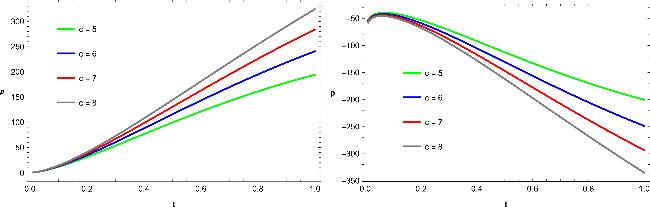
Now we discuss the evolution of energy density and pressure profiles by using Hubble parameter (18). The field equations are further simplified manipulating equation (18). The behavior of energy density and pressure profiles using the parameterized form of Hubble parameter (18) is shown in figure 1. The profiles are shown for different values of the model parameter c = 5, 6, 7, and 8, while the remaining parameters are fixed at α = 5, β = 0.5, γ = 0.0005, ξ = 0.2, and ζ = 2. These plots provide insight into the influence of inverse Ricci curvature corrections on the cosmological dynamics in the vicinity of the bouncing regime. From the left panel of figure 1, it is evident that the energy density ρ remains finite and positive throughout the evolution. Near the bounce epoch, ρ starts from a small value and increases monotonically with cosmic time, indicating a smooth transition from the bouncing phase to the post-bounce expanding universe. The absence of divergences or discontinuities in ρ reflects the regular nature of the cosmological solution and supports the non-singular behavior of the model. Furthermore, the magnitude of ρ increases with increasing values of the parameter c, suggesting that this parameter plays a significant role in enhancing the effective gravitational contribution induced by the inverse Ricci terms. The right panel of figure 1 illustrates the corresponding evolution of the pressure p. Unlike the energy density, the pressure remains negative over the entire time interval considered and decreases monotonically as the Universe evolves. In the vicinity of the bounce, the pressure exhibits relatively small negative values, while at later times it becomes increasingly negative. The dependence on the parameter c is again apparent, with larger values of c leading to a steeper decrease in the pressure magnitude. This behavior indicates that the inverse curvature corrections strongly influence the effective cosmic pressure. The combined evolution of ρ and p demonstrates a smooth and well-controlled cosmological dynamics. Both quantities evolve continuously across the bouncing phase without exhibiting any abrupt transitions or pathological behavior. The monotonic increase of ρ accompanied by the monotonic decrease of p suggests a stable effective fluid description within the Ricci Inverse gravity framework. In nutshell, figure 1 shows that the adopted parameter set leads to a regular cosmological evolution characterized by finite energy density and sustained negative pressure. The parameter c significantly affects the magnitude and evolution of these quantities, thereby influencing the post-bounce dynamics.
Figure 1. Energy density and pressure profiles with α = 5; β = 0.5; γ = 0.0005; ξ = 0.2; ζ = 2; c = 5(); c = 6(); c = 7(); c = 8().
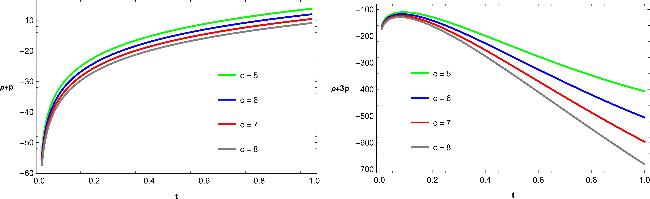
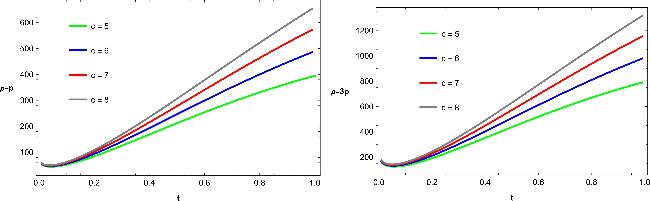
Figure 2 illustrates the evolution of the NEC, represented by ρ + p, and the SEC, represented by ρ + 3p. From the left panel, it is observed that ρ + p remains negative throughout the considered time interval for all values of c. Although ρ + p increases monotonically with time, it does not cross into the positive region, indicating a persistent violation of the NEC during the cosmic evolution. The magnitude of the violation is stronger near the bounce and gradually weakens as time progresses. Furthermore, increasing the parameter c leads to a more pronounced negative value of ρ + p, demonstrating that larger values of c enhance the deviation from standard energy condition behavior. The right panel of figure 2 shows the evolution of ρ + 3p, corresponding to the SEC. Similar to the NEC case, ρ + 3p remains negative over the entire time domain for all values of c. The quantity exhibits a monotonic decrease with cosmic time, with larger values of c producing a steeper decline. This sustained negativity of ρ + 3p suggests that the effective cosmic fluid generated by Ricci Inverse gravity does not satisfy the SEC, particularly during the post-bounce expansion phase. Figure 3 presents the evolution of the DEC, represented by ρ − p, and the TEC, represented by ρ − 3p. From the left panel, it is evident that ρ − p remains positive throughout the evolution for all considered values of c. After a brief minimum near the bounce, ρ − p increases monotonically with time, indicating that the DEC is consistently satisfied. The magnitude of ρ − p increases with increasing c, showing that the parameter c strengthens the dominance of energy density over pressure. The right panel of figure 3 displays the behavior of ρ − 3p. This quantity remains positive and increases monotonically with cosmic time for all values of c. Larger values of c again correspond to higher magnitudes, emphasizing the sensitivity of the trace of the effective energy-momentum tensor to the inverse Ricci curvature corrections. The positivity of ρ − 3p throughout the evolution indicates that the TEC is satisfied within the considered parameter space. The violation of the NEC and SEC is a necessary condition for realizing a non-singular bounce in most cosmological frameworks. In our model, these violations arise effectively from the geometric modification (inverse Ricci terms) rather than exotic matter fields. This suggests that the bounce is driven by effective geometric fluid behavior, avoiding the need for phantom fields. The persistence of these violations supports both the bouncing phase and late-time acceleration, while the satisfaction of the DEC indicates that the model remains physically reasonable within the explored parameter space.
Figure 3. Evolution of DEC and TEC with α = 5; β = 0.5; γ = 0.0005; ξ = 0.2; ζ = 2; c = 5(); c = 6(); c = 7(); c = 8().
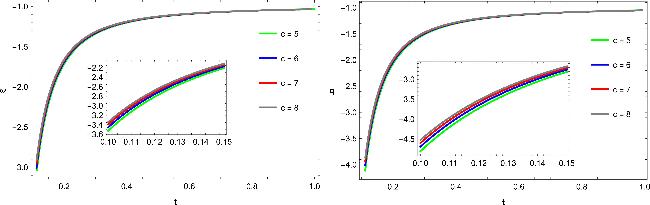
The left panel of figure 4 shows the evolution of the EoS parameter ω. At early times, ω assumes large negative values, indicating a strongly non-standard effective fluid behavior near the bouncing phase. As cosmic time increases, ω evolves smoothly and monotonically, gradually approaching the value ω → −1 at late times. This asymptotic behavior suggests that the effective cosmic fluid tends toward a cosmological constant like regime during the post-bounce expansion. The inset plot highlights the early-time behavior of ω, where slight deviations among different values of c are visible. Larger values of c correspond to marginally higher values of ω, indicating that the parameter c controls the rate at which the EoS parameter approaches the late-time asymptotic regime. The right panel of figure 4 depicts the evolution of the deceleration parameter q. At early times, q is strongly negative, signaling a rapidly accelerating expansion immediately after the bounce. As the Universe evolves, q increases monotonically and approaches q → −1 at late times. This behavior is consistent with a transition toward a de Sitter-like expansion phase. The inset emphasizes the early-time dynamics, where the deceleration parameter exhibits sensitivity to the parameter c. Specifically, higher values of c lead to slightly less negative values of q, indicating a mild moderation of the acceleration rate. The smooth and continuous evolution of both ω and q across the entire time interval indicates the absence of abrupt transitions or instabilities in the cosmic dynamics. The monotonic behavior further suggests that the cosmological evolution is well-controlled within the Ricci Inverse gravity framework. The combined evolution of ω and q demonstrates that the model naturally interpolates between a strongly accelerating early phase and a late-time accelerated expansion characterized by a cosmological-constant-like behavior. The late-time approach ω → −1 is of particular importance. In standard cosmology, ω = −1 corresponds to an effective cosmological constant (vacuum energy), for which the pressure exactly satisfies p = −ρ. Therefore, the tendency of the Ricci Inverse gravity effective fluid toward ω ≃ −1 indicates that the model dynamically mimics a ΛCDM-like dark-energy phase at late times, providing a natural mechanism for sustained accelerated expansion without introducing an explicit cosmological constant by hand. Likewise, the asymptotic behavior q → −1 has a clear physical interpretation. The value q = −1 characterizes exact de Sitter expansion, for which H = constant and the scale factor grows exponentially, a(t) ∝ eHt. Hence, the evolution of q toward −1 in figure 4 confirms that the post-bounce universe tends toward a de Sitter-like accelerating attractor. The simultaneous convergence of (ω, q) toward (−1, −1) therefore indicates that the late-time dynamics of the model becomes effectively vacuum-dominated and approaches a stable accelerating regime.
Figure 4. Evolution of EoS and deceleration parameters with α = 5; β = 0.5; γ = 0.0005; ξ = 0.2; ζ = 2; c = 5(); c = 6(); c = 7(); c = 8().
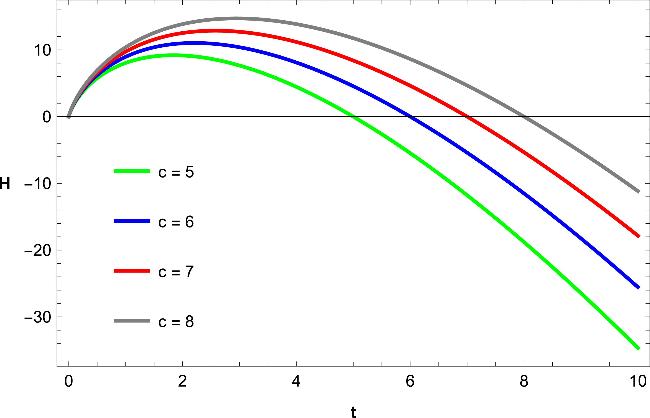
For a successful bouncing model, the Hubble parameter passes through H = 0 where the bouncing point occurs. After that it should be showing an increasing behavior H > 0 (expansion phase). These features of a bouncing model are well justified from the left plot of figure 4. It is clear from equation (18) that first bounce occurs at t = 0. The exact analytic calculation of second bounce is difficult to calculate. However, using Taylor series expansion of inverse Tangent function up to third term, the time for second bounce may be calculated as
This approximate future bounce time is exactly the same as already reported [43]. However, the exact values are evident in the plot where the second bounce occurs. Here we have obtained the behavior for the scaling parameter α = 1. However, in the next sub-section, we will see the corresponding change in the behavior of Hubble parameter by changing its value. It is also clear from figure 4 that future bounce time is dependent upon the model parameter c. The bounce time gets increased for a larger value of c. Moreover, in present scenario there would be no more further bounce as the curves will not cut the t axis again (though not described in the figure 4).
Finally, it is worthwhile to briefly comment on the expected behavior of cosmological perturbations within the present framework. Although a full perturbative analysis is beyond the scope of this work, some qualitative insights can be inferred from the background dynamics. The smooth and continuous evolution of the Hubble parameter, energy density, and pressure suggests that the background solution is free from pathological instabilities. Moreover, the controlled violation of the null and SECs, arising effectively from geometric modifications rather than exotic matter fields, indicates that the bounce is driven by an effective fluid with well-behaved properties. In typical bouncing scenarios, such NEC violation can lead to gradient or ghost instabilities; however, in modified gravity frameworks these issues may be alleviated due to the purely geometric origin of the effective stress-energy sector. Additionally, the monotonic and stable evolution of the EoS and deceleration parameters points toward a dynamically stable late-time attractor. Nevertheless, a complete assessment of scalar, vector, and tensor perturbations, including the analysis of sound speed and absence of ghost degrees of freedom, is required to fully establish the stability of the model. We hope to address this in a future work.
Figure 5. Evolution of Hubble parameter with α = 5; β = 0.5; γ = 0.0005; ξ = 0.2; ζ = 2; c = 5(); c = 6(); c = 7(); c = 8().
4. Summary and conclusions
In this work, we have explored the cosmological implications of Ricci inverse gravity, a modified theory of gravity constructed from the anti-curvature tensor defined as the inverse of the Ricci tensor. Restricting our analysis to a spatially flat FRW background, we derived the modified Friedmann equations and examined the resulting cosmic dynamics using a well-motivated parametrization of the Hubble parameter capable of generating nonsingular bouncing solutions. Due to the highly nonlinear structure of the modified field equations in Ricci inverse gravity, obtaining closed-form analytical solutions is extremely challenging. Therefore, we adopt a semi-analytical and numerical approach to extract the physical behavior of cosmological quantities. The approximate analytical expression for the second bounce [equation (19)] provides additional insight and is consistent with previously reported results. The combination of analytical reasoning and numerical analysis ensures a reliable description of the model dynamics. The evolution of the effective energy density, pressure, energy conditions, EoS parameter, and deceleration parameter is analyzed in detail in order to assess the physical consistency and cosmological viability of the model. The principal outcomes of our analysis can be summarized as follows:
The modified field equations of Ricci inverse gravity admit regular and nonsingular cosmological solutions, provided the invertibility conditions $X=\dot{H}+{H}^{2}\ne 0$ and $Y=\dot{H}+3{H}^{2}\ne 0$ are satisfied throughout the cosmic evolution.
A nonsingular cosmological bounce occurs at finite cosmic time, characterized by the vanishing of the Hubble parameter H = 0 and a smooth transition from a contracting to an expanding phase, without any divergences in curvature or thermodynamic quantities.
The effective energy density remains finite and positive during the entire evolution, indicating the absence of pathological behavior near the bouncing epoch and supporting a consistent effective-fluid description.
The effective pressure is negative throughout the evolution, playing a crucial role in driving both the bouncing phase and the subsequent accelerated expansion.
The NEC and SEC are persistently violated, as required for a successful bounce and late-time acceleration, while the DEC is satisfied within the explored parameter space.
The EoS parameter evolves smoothly and asymptotically approaches ω → −1 at late times, indicating that the effective cosmic fluid dynamically mimics a cosmological-constant-like behavior.
The deceleration parameter approaches q → −1, confirming that the post-bounce universe tends toward a stable de Sitter-like accelerating attractor.
The model parameter c significantly influences the timing of the bounce, the magnitude of the energy density and pressure, and the strength of energy-condition violations, providing a tunable handle on the cosmic dynamics.
In nutshell, the present study demonstrates that Ricci inverse gravity offers a viable framework for realizing nonsingular bouncing cosmologies without the need for exotic matter fields or the explicit introduction of a cosmological constant. The model naturally produces a smooth bounce, sustained accelerated expansion, and late-time dynamics closely resembling those of the standard ΛCDM scenario, while maintaining regular behavior of the energy density and pressure. These features highlight the potential of anti-curvature-based modifications of gravity in addressing fundamental issues such as the initial cosmological singularity and the origin of late-time cosmic acceleration. Future investigations should extend the present background-level analysis to include cosmological perturbations, in order to examine the stability of scalar, vector, and tensor modes and to study the propagation of gravitational waves in Ricci inverse gravity. Moreover, confronting the model with observational data from large-scale structure, cosmic microwave background anisotropies, and gravitational-wave measurements will be essential for establishing its phenomenological viability. Exploring more general anti-curvature Lagrangians may further reveal novel cosmological behavior beyond the Ricci inverse setup considered in this work.
The authors extend their appreciation to the Deanship of Scientific Research and Libraries in Princess Nourah bint Abdulrahman University for funding this research work through the Research Group Project, Grant No. RG-1445-0036.
AstashenokA V, CapozzielloS, de LaurentisM, OdintsovS D2015 Extreme neutron stars from extended theories of gravity J. Cosmol. Astropart. Phys. JCAP01(2015)001
GhoshM, AktasC, ChattopadhyayS2026 Analytical study of bouncing cosmology in f(Q, C) gravity with generalized infrared cutoffs Fortschr. Phys.74 e70083