

1. Introduction
Cavity optomagnonics has emerged as a powerful platform for exploring magneto-optical interactions between optical whispering gallery modes (WGMs) and magnon modes in ferrimagnetic yttrium iron garnet (YIG) systems [1-5]. Benefiting from intrinsic magneto-optical coupling, a variety of phenomena have been demonstrated, including coherent optical-to-microwave conversion [6, 7], magnon entanglement [8, 9], magnon-induced transparency [10], magnon lasers [11], and photon-magnon blockade [12, 13]. Among these, magnon-induced Brillouin light scattering (BLS) plays a central role, enabling coherent photon-magnon interactions via inelastic scattering processes that generate frequency-shifted sidebands and polarization conversion [14-18]. However, despite its versatility, BLS itself does not introduce directional asymmetry and therefore cannot directly lead to nonreciprocal transport.
Pioneering studies on the quantum transport and scattering of single photons in engineered photonic systems have laid the foundation for controllable light-matter interactions [19-21]. Nonreciprocal phenomena, arising from the breaking of time-reversal symmetry, have attracted significant attention across a wide range of physical systems and applications [22-28]. Among these, nonreciprocal transmission represents a fundamental functionality for controlling asymmetric light propagation and has been extensively investigated in diverse physical platforms, including metamaterials, nonlinear optics, parity-time-symmetric systems, cavity optomechanics, waveguide quantum electrodynamics, and topological photonics [29-36]. Similar advances have also been extended to hybrid light-matter systems such as cavity magnonics and cavity optomagnonics [37-40]. Various physical mechanisms have been demonstrated by exploiting chiral light-matter interactions and nonreciprocal coupling [41-44], and quantum effects such as chiral quantum squeezing [45], as well as nonlinear effects such as magnon Kerr nonlinearity [46, 47] also provide viable routes to achieve nonreciprocity. In particular, spinning optical resonators have been recognized as an effective approach to lifting the degeneracy between clockwise (CW) and counterclockwise (CCW) modes via the Sagnac effect, thereby enabling intrinsic nonreciprocity [48]. Notably, the strength of this nonreciprocity can be externally controlled through the rotation rate, providing a flexible and dynamically tunable mechanism for symmetry breaking [49-53]. For instance, a unidirectional pump in a WGM cavity can leverage backward Brillouin scattering to establish nonreciprocal photon-phonon coupling, leading to an optical isolator where signal transmission is permitted in one direction but completely absorbed in the opposite direction [54]. Complementing this, the Sagnac effect in a spinning resonator, when combined with Stokes and anti-Stokes scattering, enables a nonreciprocal photonic transistor capable of multifunctional operations such as unidirectional amplification and controllable fast-slow light [55]. However, existing approaches typically rely on a single mechanism, making it challenging to simultaneously achieve flexible tunability, multifunctional operation, and broadband nonreciprocal control within a single platform.
Here, we address this limitation by proposing a cavity optomagnonic system where magnon-induced BLS is combined with spinning-induced Sagnac effects in a waveguide-resonator configuration. Compared with the schemes in [54] and [55], which typically achieve nonreciprocity in a single frequency band, our scheme enables tunable multi-band nonreciprocal transport through the interplay of magnon-induced scattering and Sagnac-induced mode splitting. In this hybrid platform, the Sagnac effect breaks the symmetry between counter-propagating modes while BLS provides a tunable photon-magnon interaction channel, enabling multi-band nonreciprocal transport that can be actively switched via system parameters and offers a versatile, externally tunable route toward multifunctional photonic devices without relying on structural chirality or strong Kerr nonlinearity.
2. Model and method
As depicted in figure 1, the considered cavity optomagnonic system consists of a one-dimensional waveguide coupled to two spinning optical WGM resonators. These resonators simultaneously support magnetostatic magnon modes (magnons) and optical WGMs (photons) and are driven by strong pump fields. The system can be experimentally realized as a whispering-gallery polaritonic microdisk. The WGM sustains two cavity modes associated with CW and CCW propagation directions, which experience different Sagnac-Fizeau shifts due to the Sagnac effect [56, 57]. In this case, the frequencies can be expressed as ωCW = ωc - ΔF and ωCCW = ωc + ΔF, where
$\begin{eqnarray}\begin{array}{r}{{\rm{\Delta }}}_{{\rm{F}}}=\frac{nR{\rm{\Omega }}{\omega }_{c}}{c}\left(1-\frac{1}{{n}^{2}}-\frac{\lambda }{n}\frac{{\rm{d}}n}{{\rm{d}}\lambda }\right).\end{array}\end{eqnarray}$
Here, n and R represent the refractive index and radius of the resonator, respectively. c and $\lambda$ are the speed and wavelength of light in vacuum, respectively. Ω is the angular velocity that induces rotational motion in the resonator with resonant frequency ωc. The dispersion term dn/d$\lambda$, associated with the relativistic nature of the Sagnac effect, exhibits minimal magnitudes in conventional materials (typically below 1%). The Hamiltonian of the cavity optomagnonic system takes the form (assuming ℏ = 1) $\begin{eqnarray}\begin{array}{rcl}H & = & {H}_{{\rm{com}}}+{H}_{{\rm{w}}},\\ {H}_{{\rm{com}}} & = & \displaystyle \sum _{j=1,2}[({\omega }_{a}\pm {{\rm{\Delta }}}_{{\rm{F}}j}){a}_{j\alpha }^{\dagger }{a}_{j\alpha }+({\omega }_{b}\pm {{\rm{\Delta }}}_{{\rm{F}}j}){b}_{j\alpha }^{\dagger }{b}_{j\alpha }\\ & & +{\omega }_{m}{m}_{j}^{\dagger }{m}_{j}]+\displaystyle \sum _{j=1,2}{G}_{0}({a}_{j\alpha }^{\dagger }{b}_{j\alpha }{m}_{j}^{\dagger }+{a}_{j\alpha }{b}_{j\alpha }^{\dagger }{m}_{j})\\ & & +\displaystyle \sum _{j=1,2}{\rm{i}}{E}_{j}({a}_{j\alpha }^{\dagger }{{\rm{e}}}^{-{\rm{i}}{\omega }_{d}t}-{a}_{j\alpha }{{\rm{e}}}^{{\rm{i}}{\omega }_{d}t}),\\ {H}_{{\rm{w}}} & = & \displaystyle \int {\rm{d}}x\{-{\rm{i}}{v}_{g}{c}_{{\rm{R}}}^{\dagger }(x)\frac{{\rm{d}}}{{\rm{d}}x}{c}_{{\rm{R}}}(x)+{\rm{i}}{v}_{g}{c}_{{\rm{L}}}^{\dagger }(x)\frac{{\rm{d}}}{{\rm{d}}x}{c}_{{\rm{L}}}(x)\}\\ & & +\displaystyle \int {\rm{d}}x{V}_{j}\delta (x-{x}_{j})[{c}_{{\rm{R}}}^{\dagger }(x){b}_{j\alpha }+{c}_{{\rm{L}}}^{\dagger }(x){b}_{j\alpha }+{\rm{H.c.}}],\end{array}\end{eqnarray}$
where ajα, bjα and mj (${a}_{j\alpha }^{\dagger }$ , ${b}_{j\alpha }^{\dagger }$ and ${m}_{j}^{\dagger }$ , j = 1, 2, α = CW, CCW) refer to the photon and magnon annihilation (creation) operators of the TE and TM modes of the WGMs and the magnon mode for the jth resonator, respectively. ωa, ωb and ωm are their resonance frequencies, which satisfy the relation |ωb - ωa| = ωm. The magnon mode mj in each resonator, modeled as the lowest-order Kittel-type ferromagnetic resonance, is nonchiral and couples symmetrically to the CW and CCW WGMs [58]. The Sagnac-Fizeau shifts enter as ωa,b ΔFj, where the minus (plus) sign corresponds to the CW (CCW) propagation direction in the jth spinning resonator. For simplicity, we neglect Rayleigh backscattering and other imperfections that would mix CW and CCW optical modes and produce additional standing-wave splitting. The feasibility of our scheme is evaluated with reference to the experimental parameters in [2, 3, 54], where the magnon frequency is ωm/2$\pi$ = 6.75 GHz and its damping rate is κm/2$\pi$ = 20 MHz. G0 is the optomagnonic coupling rate. cR/L(x) denote the bosonic annihilation operators for the right- or left-traveling photon along the waveguide at position x. vg is the group velocity of the photon and Vj represents the coupling strength between the jth resonator and the plasmonic waveguide. In our model, the guided modes of the one-dimensional waveguide couple only to the TM modes via the Vj-terms in Hw. This selective coupling is further supported by polarization-selective nanophotonic designs, where only TM modes are engineered to couple to waveguides while TE modes are suppressed [59]. The TE modes are excited solely by a local classical driving Ej at each resonator and do not propagate along the waveguide, as indicated by the red arrows in figure 1.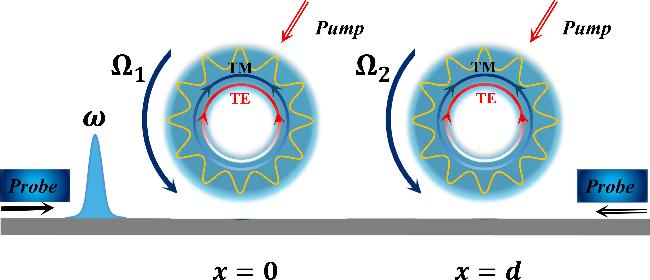
Figure 1. A cavity optomagnonic system consisting of a one-dimensional waveguide and two spinning optical WGM resonators with rotation speeds Ω1 and Ω2. The pump field (red arrows) drives the transverse electric (TE) optical mode in each resonator. The probe fields (blue arrows) are injected from the left and right sides of the waveguide, corresponding to forward and backward propagation, respectively. The resonators, which simultaneously support two optical WGMs and a magnon mode, are side-coupled to the waveguide and separated by a distance d. |
To eliminate the time dependence of the driving terms in the Hamiltonian Hcom, the unitary transformation $U={\rm{\exp }}[-{\rm{i}}{\omega }_{d}({a}_{j\alpha }^{\dagger }{a}_{j\alpha }+{b}_{j\alpha }^{\dagger }{b}_{j\alpha })t]$ is employed to yield a transformed Hamiltonian ${H}^{{\prime} }={U}^{\dagger }HU-{\rm{i}}\frac{{\rm{d}}{U}^{\dagger }}{{\rm{d}}t}U$ expressed as
$\begin{eqnarray}\begin{array}{rcl}{H}_{{\rm{com}}}^{{\prime} } & = & \displaystyle \sum _{j=1,2}\{({{\rm{\Delta }}}_{a}\pm {{\rm{\Delta }}}_{{\rm{F}}j}){a}_{j\alpha }^{\dagger }{a}_{j\alpha }\\ & & +({{\rm{\Delta }}}_{b}\pm {{\rm{\Delta }}}_{{\rm{F}}j}){b}_{j\alpha }^{\dagger }{b}_{j\alpha }+{\omega }_{m}{m}_{j}^{\dagger }{m}_{j}\\ & & +{G}_{0}({a}_{j\alpha }^{\dagger }{b}_{j\alpha }{m}_{j}^{\dagger }+{a}_{j\alpha }{b}_{j\alpha }^{\dagger }{m}_{j})+{\rm{i}}{E}_{j}({a}_{j\alpha }^{\dagger }-{a}_{j\alpha })\},\end{array}\end{eqnarray}$
with Δa = ωa - ωd and Δb = ωb - ωd being the detunings between the WGMs and the driving field. The Heisenberg equations of motion for the optomagnonic system take the form $\begin{eqnarray}\begin{array}{rcl}\frac{{\rm{d}}}{{\rm{d}}t}{a}_{j\alpha } & = & -{\rm{i}}\left({{\rm{\Delta }}}_{a}\pm {{\rm{\Delta }}}_{{\rm{F}}j}\right){a}_{j\alpha }-\frac{{\kappa }_{a}}{2}{a}_{j\alpha }-{\rm{i}}{G}_{0}{b}_{j\alpha }{m}_{j}^{\dagger }-{\rm{i}}{E}_{j}\\ & & +\sqrt{{\kappa }_{a}}{a}_{j\alpha }^{{\rm{in}}},\end{array}\end{eqnarray}$
$\begin{eqnarray}\begin{array}{rcl}\frac{{\rm{d}}}{{\rm{d}}t}{b}_{j\alpha } & = & -{\rm{i}}\left({{\rm{\Delta }}}_{b}\pm {{\rm{\Delta }}}_{{\rm{F}}j}\right){b}_{j\alpha }-\frac{{\kappa }_{b}}{2}{b}_{j\alpha }-{\rm{i}}{G}_{0}{a}_{j\alpha }{m}_{j}\\ & & +\sqrt{{\kappa }_{b}}{b}_{j\alpha }^{{\rm{in}}},\end{array}\end{eqnarray}$
$\begin{eqnarray}\frac{{\rm{d}}}{{\rm{d}}t}{m}_{j}=-{\rm{i}}{\omega }_{m}{m}_{j}-\frac{{\kappa }_{m}}{2}{m}_{j}-{\rm{i}}{G}_{0}{a}_{j\alpha }^{\dagger }{b}_{j\alpha }+\sqrt{{\kappa }_{m}}{m}_{j}^{{\rm{in}}},\end{eqnarray}$
κa, κb and κm are the decay rates of the cavity modes and the magnon mode, respectively. Here ${a}_{j\alpha }^{{\rm{in}}}$ , ${b}_{j\alpha }^{{\rm{in}}}$ and ${m}_{j}^{{\rm{in}}}$ are the input noise operators associated with the optical and magnonic baths, which have zero mean, $\langle {a}_{j\alpha }^{{\rm{in}}}\rangle \,=\langle {b}_{j\alpha }^{{\rm{in}}}\rangle =\langle {m}_{j}^{{\rm{in}}}\rangle =0$ .We decompose each system operator into a steady-state component and a fluctuation term, expressed as o = ⟨o$\rangle$ + δo (o = ajα, bjα, mj), where ⟨o$\rangle$ denotes the classical mean value under strong pumping and δo represents the quantum noise around this equilibrium. When the TE modes ajα are resonantly pumped by a strong field (i.e. Δa = 0) to maximize the probability of BLS scattering, the TE modes can be treated classically as ⟨ajα$\rangle$ = 2Ej/(κa 2iΔFj). By substituting ajα with ⟨ajα$\rangle$ into equations (4 )-(6 ) and introducing the slowly moving operator $\delta o\to \delta o{{\rm{e}}}^{{\rm{i}}{\omega }_{d}t}$ [60], the linearized quantum Langevin equations for the quantum fluctuations of the operators can be obtained as
$\begin{eqnarray}\frac{{\rm{d}}}{{\rm{d}}t}\delta {b}_{j\alpha }=-{\rm{i}}({{\rm{\Delta }}}_{b}+{\omega }_{d}\pm {{\rm{\Delta }}}_{{\rm{F}}j})\delta {b}_{j\alpha }-\frac{{\kappa }_{b}}{2}\delta {b}_{j\alpha }-{\rm{i}}{G}_{j}\delta {m}_{j},\end{eqnarray}$
$\begin{eqnarray}\frac{{\rm{d}}}{{\rm{d}}t}\delta {m}_{j}=-{\rm{i}}({\omega }_{m}+{\omega }_{d})\delta {m}_{j}-\frac{{\kappa }_{m}}{2}\delta {m}_{j}-{\rm{i}}{G}_{j}^{* }\delta {b}_{j\alpha },\end{eqnarray}$
where Gj = G0⟨ajα$\rangle$ is the effective optomagnonic coupling strength, which can be tuned by the external driving field.The linearized effective non-Hermitian Hamiltonian Heff in real space can be given by
$\begin{eqnarray}\begin{array}{rcl}{H}_{{\rm{eff}}} & = & \displaystyle \int {\rm{d}}x\{-{\rm{i}}{v}_{g}{c}_{{\rm{R}}}^{\dagger }(x)\frac{{\rm{d}}}{{\rm{d}}x}{c}_{{\rm{R}}}(x)+{\rm{i}}{v}_{g}{c}_{{\rm{L}}}^{\dagger }(x)\frac{{\rm{d}}}{{\rm{d}}x}{c}_{{\rm{L}}}(x)\}\\ & & +\displaystyle \sum _{j=1,2}\{({{\rm{\Delta }}}_{b}+{\omega }_{d}\pm {{\rm{\Delta }}}_{{\rm{F}}j}-{\rm{i}}\frac{{\kappa }_{b}}{2}){b}_{j\alpha }^{\dagger }{b}_{j\alpha }\\ & & +({\omega }_{m}+{\omega }_{d}-{\rm{i}}\frac{{\kappa }_{m}}{2}){m}_{j}^{\dagger }{m}_{j}+{G}_{j}({b}_{j\alpha }{m}_{j}^{\dagger }+{b}_{j\alpha }^{\dagger }{m}_{j})\\ & & +\displaystyle \int {\rm{d}}x{V}_{j}\delta (x-{x}_{j})[{c}_{{\rm{R}}}^{\dagger }(x){b}_{j\alpha }+{c}_{{\rm{L}}}^{\dagger }(x){b}_{j\alpha }+{\rm{H.c.}}]\}.\end{array}\end{eqnarray}$
Consider a single photon with incident energy Ek = vgk from the left end of the waveguide. Given the conservation of excitation number in the system, the eigenstate within the single-excitation subspace takes the form
$\begin{eqnarray}\begin{array}{rcl}| {E}_{k}\rangle & = & \displaystyle \int {\rm{d}}x[{{\rm{\Phi }}}_{{\rm{R}}}^{+}(x){c}_{{\rm{R}}}^{\dagger }(x)+{{\rm{\Phi }}}_{{\rm{L}}}^{+}(x){c}_{{\rm{L}}}^{\dagger }(x)]| O\rangle \\ & & +\displaystyle \sum _{j=1,2}({\varepsilon }_{j\alpha }{b}_{j\alpha }^{\dagger }+{u}_{j}{m}_{j}^{\dagger })| O\rangle ,\end{array}\end{eqnarray}$
|O$\rangle$ represents the vacuum state of the waveguide and the cavities, and does not indicate magnon excitation. The parameter ϵjα represents the quantum amplitude of the single-photon excitation in the jth cavity mode. uj is the probability amplitude for a single photon occupying the magnon mode. The single-photon wave functions ${{\rm{\Phi }}}_{{\rm{R}}}^{+}(x)$ and ${{\rm{\Phi }}}_{{\rm{L}}}^{+}(x)$ , which describe the right- and left-propagating guided modes in the waveguide, can be expressed as follows [61] $\begin{eqnarray}{{\rm{\Phi }}}_{{\rm{R}}}^{+}(x)={{\rm{e}}}^{{\rm{i}}kx}[\theta (-x)+a\theta (x)\theta (d-x)+t\theta (x-d)],\end{eqnarray}$
$\begin{eqnarray}{{\rm{\Phi }}}_{{\rm{L}}}^{+}(x)={{\rm{e}}}^{-{\rm{i}}kx}[r\theta (-x)+b\theta (x)\theta (d-x)].\end{eqnarray}$
Here, θ(x) is the step function with θ(x) = 1 for x ≥ 0 and θ(x) = 0 for x < 0. t and r are the transmission and reflection amplitudes, respectively. a and b represent the probability amplitudes of the photons between the resonators. According to the eigenvalue equation H|Ek$\rangle$ = Ek|Ek$\rangle$, the transmission and reflection amplitudes for the forward and backward directions are as follows $\begin{eqnarray}{t}_{f}=\frac{[2{G}_{1}^{2}{{\rm{\Delta }}}_{1}+\left({A}_{1-}-{{\rm{\Delta }}}_{1}^{2}\right){{\rm{\Delta }}}_{3}][2{G}_{2}^{2}{{\rm{\Delta }}}_{2}+\left({A}_{2+}-{{\rm{\Delta }}}_{2}^{2}\right){{\rm{\Delta }}}_{4}]}{P},\end{eqnarray}$
$\begin{eqnarray}{t}_{b}=\frac{[2{G}_{1}^{2}{{\rm{\Delta }}}_{1}+\left({A}_{1+}-{{\rm{\Delta }}}_{1}^{2}\right){{\rm{\Delta }}}_{3}][2{G}_{2}^{2}{{\rm{\Delta }}}_{2}+\left({A}_{2-}-{{\rm{\Delta }}}_{2}^{2}\right){{\rm{\Delta }}}_{4}]}{P},\end{eqnarray}$
$\begin{eqnarray}{r}_{f}=\frac{2\left({{\rm{e}}}^{2{\rm{i}}\theta }{B}_{+}+2{G}_{1}^{2}{G}_{2}^{2}\left({\rm{i}}{{\rm{e}}}^{2{\rm{i}}\theta }{{\rm{\Gamma }}}_{2}{{\rm{\Delta }}}_{1}+{{\rm{\Gamma }}}_{1}[C+{\rm{i}}{{\rm{\Delta }}}_{2}]\right)+{D}_{-}\right)}{P},\end{eqnarray}$
$\begin{eqnarray}{r}_{b}=\frac{2\left({B}_{-}+2{G}_{1}^{2}{G}_{2}^{2}\left({\rm{i}}{{\rm{\Gamma }}}_{2}{{\rm{\Delta }}}_{1}+{{\rm{\Gamma }}}_{1}[C+{\rm{i}}{{\rm{e}}}^{2{\rm{i}}\theta }{{\rm{\Delta }}}_{2}]\right)+{{\rm{e}}}^{2{\rm{i}}\theta }{D}_{+}\right)}{P},\end{eqnarray}$
where $\begin{eqnarray*}\begin{array}{rcl}{A}_{1-} & = & {({{\rm{\Delta }}}_{{\rm{F}}1}-{\rm{i}}{{\rm{\Gamma }}}_{1})}^{2},\quad {A}_{2-}={({{\rm{\Delta }}}_{{\rm{F}}2}-{\rm{i}}{{\rm{\Gamma }}}_{2})}^{2},\\ {A}_{1+} & = & {({{\rm{\Delta }}}_{{\rm{F}}1}+{\rm{i}}{{\rm{\Gamma }}}_{1})}^{2},\quad {A}_{2+}={({{\rm{\Delta }}}_{{\rm{F}}2}+{\rm{i}}{{\rm{\Gamma }}}_{2})}^{2},\\ {B}_{+} & = & {\rm{i}}{G}_{2}^{2}{{\rm{\Gamma }}}_{2}[{({{\rm{\Gamma }}}_{1}+{\rm{i}}{{\rm{\Delta }}}_{1})}^{2}+{{\rm{\Delta }}}_{{\rm{F}}1}^{2}]{{\rm{\Delta }}}_{3},\\ {B}_{-} & = & {\rm{i}}{G}_{2}^{2}{{\rm{\Gamma }}}_{2}[{({{\rm{\Gamma }}}_{1}-{\rm{i}}{{\rm{\Delta }}}_{1})}^{2}+{{\rm{\Delta }}}_{{\rm{F}}1}^{2}]{{\rm{\Delta }}}_{3},\\ C & = & \left(-1+{{\rm{e}}}^{2{\rm{i}}\theta }\right){{\rm{\Gamma }}}_{2},\\ {D}_{-} & = & {\rm{i}}{G}_{1}^{2}{{\rm{\Gamma }}}_{1}[{({{\rm{\Gamma }}}_{2}-{\rm{i}}{{\rm{\Delta }}}_{2})}^{2}+{{\rm{\Delta }}}_{{\rm{F}}2}^{2}]{{\rm{\Delta }}}_{4},\\ {D}_{+} & = & {\rm{i}}{G}_{1}^{2}{{\rm{\Gamma }}}_{1}[{({{\rm{\Gamma }}}_{2}+{\rm{i}}{{\rm{\Delta }}}_{2})}^{2}+{{\rm{\Delta }}}_{{\rm{F}}2}^{2}]{{\rm{\Delta }}}_{4},\\ P & = & [{({{\rm{\Gamma }}}_{1}-{\rm{i}}{{\rm{\Delta }}}_{1})}^{2}+{{\rm{\Delta }}}_{{\rm{F}}1}^{2}]{{\rm{\Delta }}}_{3}\\ & & \times \left(2{G}_{2}^{2}\left({\rm{i}}{{\rm{\Gamma }}}_{2}+{{\rm{\Delta }}}_{2}\right)+[{({{\rm{\Gamma }}}_{2}-{\rm{i}}{{\rm{\Delta }}}_{2})}^{2}+{{\rm{\Delta }}}_{{\rm{F}}2}^{2}]{{\rm{\Delta }}}_{4}\right)\\ & & +4{G}_{1}^{2}{G}_{2}^{2}[{{\rm{\Gamma }}}_{1}(C+{\rm{i}}{{\rm{\Delta }}}_{2})+{{\rm{\Delta }}}_{1}\left({\rm{i}}{{\rm{\Gamma }}}_{2}+{{\rm{\Delta }}}_{2}\right)]\\ & & +2{G}_{1}^{2}\left({\rm{i}}{{\rm{\Gamma }}}_{1}+{{\rm{\Delta }}}_{1}\right)[{({{\rm{\Gamma }}}_{2}-{\rm{i}}{{\rm{\Delta }}}_{2})}^{2}+{{\rm{\Delta }}}_{{\rm{F}}2}^{2}]{{\rm{\Delta }}}_{4}.\end{array}\end{eqnarray*}$
Here, Δ1 = Δ2 = ω - Δb - ωd + iκb/2, Δ3 = Δ4 =ω - ωm - ωd + iκm/2, ${{\rm{\Gamma }}}_{j}=2{V}_{j}^{2}/{v}_{g}$ represents the decay rate into the waveguide mode, θ = kd is the phase shift between two resonators. According to the formula above, the transmission Tf(b) = |tf(b)|2 and the reflection Rf(b) = |rf(b)|2 are obtained for the forward and backward directions.3. Results and discussion
To systematically study the scattering behavior of single photons in cavity optomagnonic systems, we investigate the single photon scattering spectra and conduct a comprehensive analysis of these spectra in relation to coupling conditions and system parameters. In our system, two strong driving fields with different amplitudes resonantly drive the TE modes of two resonators at the same frequency. Consequently, we define a unified detuning parameter Δ ≡ ω - ωm - ωd to characterize the frequency offset of the incident photon frequency ω relative to the combined frequency ωm + ωd.
3.1. Tunability of nonreciprocal transmission via Sagnac-Fizeau shifts and effective optomagnonic coupling strengths
To clearly observe the influence of the Sagnac-Fizeau shifts and the effective optomagnonic coupling strengths on transmission, we plot the transmissions Tf (red dashed lines) and Tb (blue solid lines) for the forward and backward directions as functions of the detuning Δ for different values of the Sagnac-Fizeau shifts ΔFj and the effective optomagnonic coupling strengths Gj, as shown in figure 2. When the Sagnac-Fizeau shifts ΔF1 = ΔF2 (i.e. the two cavities rotate in the same direction) and the effective optomagnonic coupling strengths satisfy G1 = G2, the transmissions are equal in both directions, which implies the system is reciprocal, as shown in figure 2(a). In contrast, in figure 2(b), where the effective optomagnonic coupling strengths satisfy G1 ≠ G2, the transmission spectra for the forward and backward directions exhibit remarkably different features around the detunings Δ = 0.05. For example, Tf reaches its minimum value, Tb attains its maximum, and conversely, Tf is at its maximum, Tb is at its minimum around the detunings of Δ = -0.05. The emergence of bidirectional double-band nonreciprocal transmission demonstrates a breakdown in system reciprocity. Meanwhile, comparing figure 2(c) with figure 2(a), where the Sagnac-Fizeau shifts ΔF1 < ΔF2 (indicating opposite rotation directions for the two cavities) and the effective optomagnonic coupling strengths satisfy G1 = G2, we can see that the double-band nonreciprocal transmission phenomenon emerges in the vicinity of Δ = 0.04. The multi-band nonreciprocity observed in figure 2(d) originates from the simultaneous asymmetry in Sagnac-Fizeau shifts and effective optomagnonic coupling strengths. Unequal Sagnac-Fizeau shifts (ΔF1 < ΔF2) separate the effective resonance frequencies of the two cavities, creating multiple frequency-distinct scattering channels. Meanwhile, the mismatch in the effective optomagnonic coupling strengths (G1 ≠ G2) leads to different resonance linewidths and depths for each channel. As a result, the interference conditions associated with these channels become nonidentical. The superposition of these frequency-separated and unequally weighted scattering processes generates additional transmission dips, thereby transforming the double-band structure into a multi-band nonreciprocal response. Thus, the independent and synergistic control of the Sagnac effect and the optomagnonic coupling strength provide a versatile mechanism to engineer and tailor the nonreciprocal optical response.
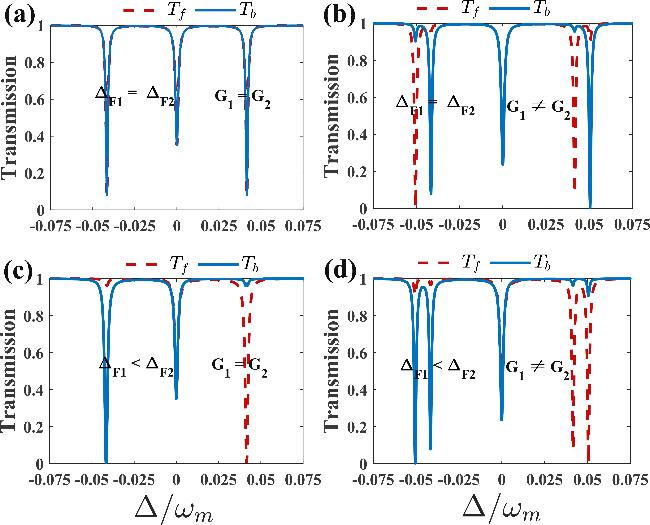
Figure 2. Transmissions Tf and Tb as a function of the detuning Δ for different ΔFj and Gj. (a) ΔF1 = ΔF2 = 18, G1 = 10 and G2 = 10, (b) ΔF1 = ΔF2 = 18, G1 = 15 and G2 = 10, (c) ΔF1 = -18 and ΔF2 = 18, G1 = 10 and G2 = 10, (d) ΔF1 = -18 and ΔF2 = 18, G1 = 15 and G2 = 10. All other parameters are set to Γ1 = Γ2 = 0.3, κb1 = κb2 = 0.1 normalized by κm throughout this work, and θ = $\pi$. |
Having established the combined effect of the Sagnac-Fizeau shifts ΔFj and the effective optomagnonic coupling strengths Gj on nonreciprocity in figure 2, we now systematically isolate the role of each parameter by varying the Sagnac-Fizeau shifts while holding the effective optomagnonic coupling strengths (figure 3), and vice versa (figure 4). In figures 3(a) and (b), we show the transmissions Tf and Tb as a function of the detuning Δ and the Sagnac-Fizeau shift ΔF1 when the effective optomagnonic coupling strengths G1 ≠ G2. For both positive and negative values of the Sagnac-Fizeau shift ΔF1, the low-transmission regions (dotted circles) in figure 3(a) correspond to the high-transmission regions (dotted circles) in figure 3(b), and conversely, the high-transmission regions (dashed circles) in figure 3(a) correspond to the low-transmission regions (dashed circles) in figure 3(b). And as the Sagnac-Fizeau shift ΔF1 increases, one of the low-transmission regions exhibits a red-shift (blue-shift) for the forward (backward) direction, while the other (boxed areas) remains unchanged, as shown in figure 3(a) (figure 3(b)). Obviously, multi-band nonreciprocal transmission can be achieved over a wide range of Sagnac-Fizeau shifts and detunings. Since the Sagnac-Fizeau shift ΔF1 is directly proportional to the rotation rate Ω1, this result indicates that the nonreciprocal transmission is robust against moderate variations or imperfect control of the resonator rotation speed. When the two cavities rotate in the opposite direction (i.e. ΔF1 < ΔF2), figure 4 illustrates the transmission spectra for the forward and backward directions versus detuning Δ and the effective optomagnonic coupling strength G2. For Δ > 0, the two low-transmission regions (dotted boxes) in figure 4(a) correspond to high-transmission regions (dotted boxes) in figure 4(b). Similarly, for Δ < 0, the two high-transmission regions (dashed boxes) in figure 4(a) correspond to low-transmission regions (dashed boxes) in figure 4(b). With increasing G2, a blue-shifted (red-shifted) low-transmission band in figure 4(a) (figure 4(b)) crosses a stationary band at the point where G1 = G2, causing the nonreciprocal transmission to evolve from an initial multi-band regime to a double-band regime (see figure 2(c)), and then revert to a multi-band regime. Therefore, the independent and synergistic control of the Sagnac-Fizeau effect and the effective optomagnonic coupling strength fundamentally govern the emergence and evolution of nonreciprocal transmission, serving as a powerful and versatile mechanism for tunably engineering tailored optical nonreciprocity across multiple spectral bands.
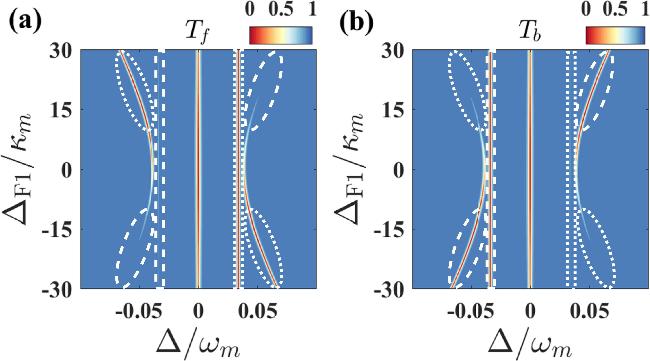
Figure 3. Transmissions Tf and Tb as a function of the detuning Δ and the Sagnac-Fizeau shift ΔF1 for the forward and backward directions. ΔF2 = 18, G1 = 15, G2 = 10 and other parameters are the same as in figure 2. |
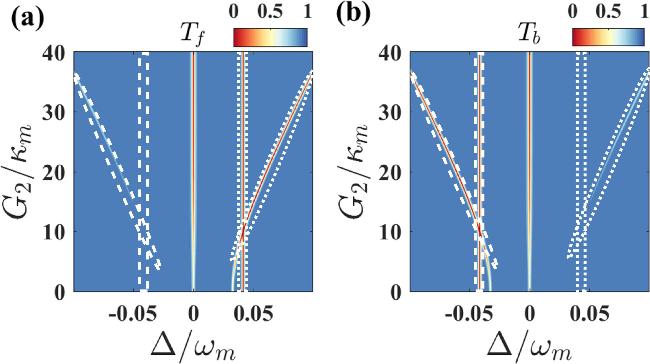
Figure 4. Transmissions Tf and Tb as a function of the detuning Δ and effective optomagnonic coupling strength G2 for the forward and backward directions. ΔF1 = -18, ΔF2 = 18, G1 = 10 and other parameters are the same as in figure 2. |
Subsequently, figure 5 shows the forward and backward transmissions Tf and Tb as both the detuning Δ and the intrinsic loss rate κb vary. Figures 5(a) and (b) clearly exhibit a pronounced asymmetry in the transmission spectra in the vicinity of Δ ≃ 0.05. As κb increases, low transmissions appear in the forward (backward) direction around Δ ≃ 0.05 (Δ ≃ -0.05) and are marked by dotted circle regions (dashed circle regions), whereas high transmissions emerge in the backward (forward) direction within the same detuning range. When the decay rate κb gradually exceeds approximately 1.4, the transmissions in the vicinity of Δ ≃ 0.05 increase strongly and the nonreciprocal contrast gradually degrades. These results indicate that nonreciprocal transmission is realized over wide ranges of decay rates with high isolation contrast.
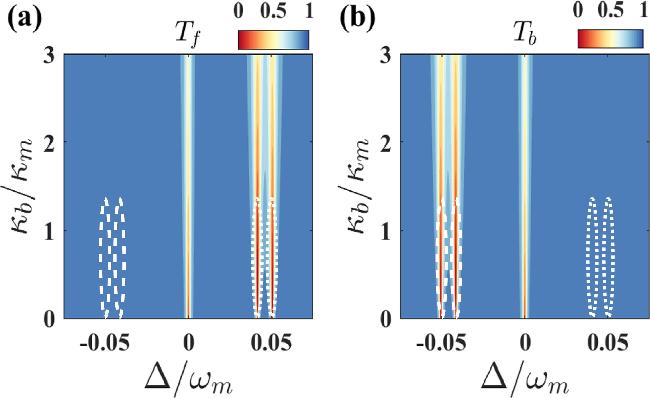
Figure 5. Transmissions Tf and Tb as a function of the detuning Δ and the decay rate κb for the forward and backward directions. Other parameters are the same as in figure 2(d). |
3.2. Tunable unidirectional reflectionlessness engineered via phase shift and coupling modulation
In figure 6, we plot the reflections Rf and Rb as a function of the detuning Δ for different values of the phase shifts, Sagnac-Fizeau shifts, effective optomagnonic coupling strengths, and decay rates. As shown in figures 6(a) and (b), when the phase shift θ = 0.5$\pi$, the double-band unidirectional reflectionless phenomenon is observed. In this regime, the reflection peaks and valleys for the forward (Rf) and backward (Rb) directions can be inverted by swapping the Sagnac-Fizeau shifts ΔF1 and ΔF2. When the effective optomagnonic coupling strengths are unequal, figures 6(c) and (d) show that increasing the effective optomagnonic coupling strength G1 induces a transition from single-band to double-band unidirectional reflectionlessness. This result highlights the critical role of the effective optomagnonic coupling strength in achieving spectral controllability. Enhancing the effective optomagnonic coupling strength (strengthening photon-magnon conversion) suppresses reflection completely (Rf = 0) at two detunings and substantially widens the spectral separation between reflection minima. Here we choose ΔF1 = ΔF2 = 1 κm as a representative example with small symmetric Sagnac-Fizeau shifts and have verified numerically that the G1-driven transition from single- to double-band unidirectional reflectionlessness persists for other small or moderate values of ΔFj. The intercavity distance can also modulate unidirectional reflectionlessness. By tuning the phase shift to θ = 0.95$\pi$ and precisely adjusting other system parameters, a triple-band unidirectional reflectionless phenomenon can be realized, as shown in figure 6(e). However, when the phase shift increases to θ = $\pi$, the central reflectionless band vanishes, leaving a double-band unidirectional reflectionless spectrum in figure 6(f). Therefore, the multi-band unidirectional reflectionlessness can be flexibly controlled by manipulating Sagnac-Fizeau shifts and phase shifts, effective optomagnonic coupling strengths, and decay rates.
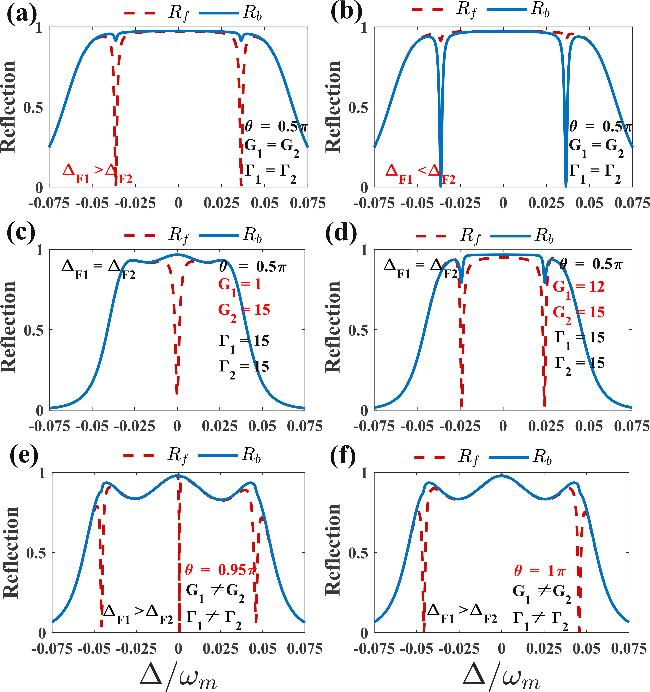
Figure 6. Reflections Rf and Rb as a function of detuning Δ for different system parameters. The specific parameters are set to (a) θ = 0.5$\pi$, ΔF1 = 6, ΔF2 = 1, G1 = G2 = 20 and Γ1 = Γ2 = 20, (b) θ = 0.5$\pi$, ΔF1 = 1, ΔF2 = 6, G1 = G2 = 20 and Γ1 = Γ2 = 20, (c) θ = 0.5$\pi$, ΔF1 = ΔF2 = 1, G1 = 1, G2 = 15 and Γ1 = Γ2 = 15, (d) θ = 0.5$\pi$, ΔF1 = ΔF2 = 1, G1 = 12, G2 = 15 and Γ1 = Γ2 = 15, (e) θ = 0.95$\pi$, ΔF1 = 6, ΔF2 = 1, G1 = 17, G2 = 20, Γ1 = 1 and Γ2 = 15, (f) θ = $\pi$, ΔF1 = 6, ΔF2 = 1, G1 = 17, G2 = 20, Γ1 = 1 and Γ2 = 15. |
To gain deeper insight, we independently plot reflections Rf and Rb versus detuning Δ and phase shift θ for the parameter sets G1 = G2 = 20, Γ1 = Γ2 = 20 and G1 = 17, G2 = 20, Γ1 = 1, Γ2 = 15 in figure 7. As shown in figures 7(a) and (b), where the effective optomagnonic coupling strengths satisfy G1 = G2 and the decay rates satisfy Γ1 = Γ2, the low-reflection regions (dotted circles) near phase shifts 0.5$\pi$ and 1.5$\pi$ in figure 7(a) correspond to the high-reflection regions (dotted circles) in figure 7(b), respectively. Under these conditions, double-band unidirectional reflectionlessness can be observed across multiple phase shift ranges, as exemplified in figure 6(a). From figures 7(c) and (d), it can be clearly observed that when the effective optomagnonic coupling strengths and decay rates are unequal, (G1 ≠ G2, Γ1 ≠ Γ2), the triple-band and double-band unidirectional reflectionless phenomena periodically emerge and transform over a wide range as the phase continuously increases (see figures 6(e) and (f)). Consequently, unidirectional reflectionlessness is achievable not only under different coupling conditions but can also be extended to multi-band regimes through active phase-shift modulation.
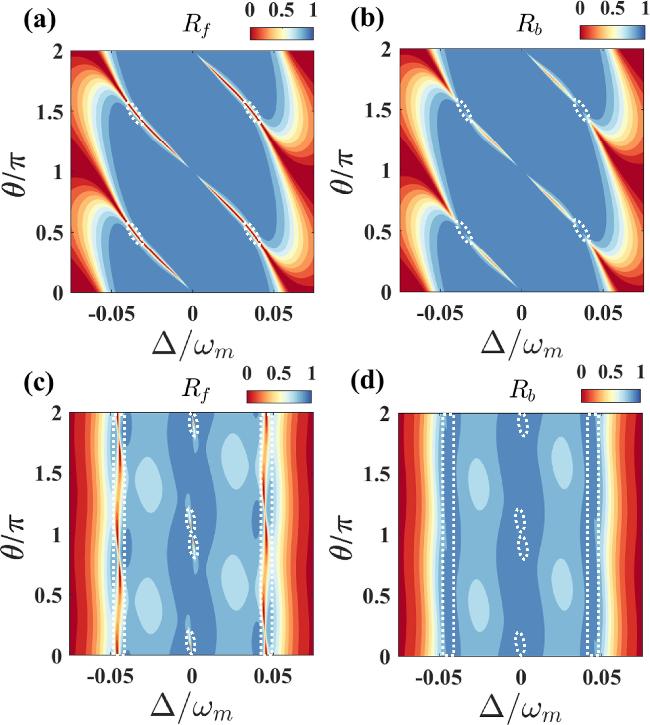
Figure 7. (a) and (b) Reflections Rf and Rb as a function of detuning Δ and phase shift θ when G1 = G2 = 20 and Γ1 = Γ2 = 20. (c) and (d) Reflections Rf and Rb as a function of detuning Δ and phase shift θ when G1 = 17, G2 = 20 and Γ1 = 1, Γ2 = 15. The parameters ΔF1 = 6 and ΔF2 = 1. |
Next, we plot the reflection spectra for the forward and backward directions as a function of the effective optomagnonic coupling strength G2 and detuning Δ in figure 8. As shown in figures 8(a) and (b), the low-reflection regions (dotted circles) in the forward direction correspond to high-reflection regions in the backward direction near the detuning values Δ = 0.05. Notably, near detuning Δ = 0, the unidirectional reflectionlessness remains stable over a wide range of effective optomagnonic coupling strength G2, as this feature is fundamentally determined by the magnon-resonance condition. According to equations (15 ) and (16 ), the coupling G2 modifies the amplitudes of various photon-magnon scattering pathways, but does not shift the magnon resonance itself. Therefore, dynamic tuning of the effective optomagnonic coupling strength enables flexible switching between double- and triple-band unidirectional reflectionlessness, providing a versatile platform for designing phase-sensitive controllable devices. In figures 9(a) and (b), we find that the low-reflection regions (dotted circles) in figure 9(a) correspond to the high-reflection regions in figure 9(b), and this correspondence is localized near small Sagnac-Fizeau shifts, while excessive detuning leads to the disappearance of the nonreciprocal phenomenon. Therefore, the triple-band unidirectional reflectionlessness can be achieved only under a relatively small Sagnac-Fizeau shift. Nevertheless, considering that ΔF1 is proportional to Ω1, this still allows for a finite tolerance to variations in the rotation rate within the small-shift regime.
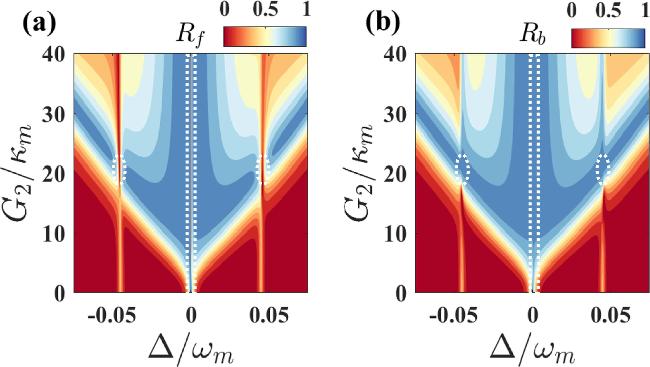
Figure 8. Reflections Rf and Rb as a function of detuning Δ and the effective optomagnonic coupling strength G2 when the phase shift θ = 0.95$\pi$. Other parameters are the same as in figure 6(e). |
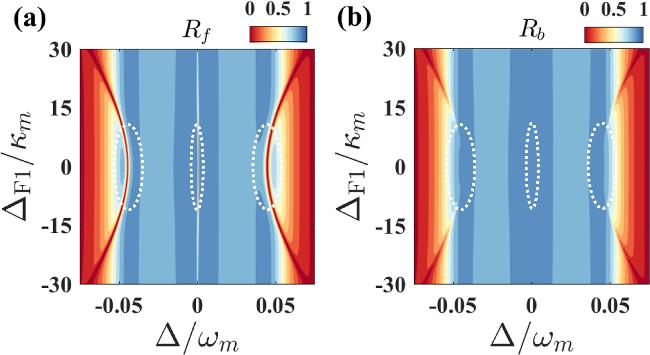
Figure 9. Reflections Rf and Rb with the variable Sagnac-Fizeau shift ΔF1 and detuning Δ when the phase shift θ = 0.95$\pi$. Other parameters are the same as those in figure 6(e). |
Figure 10 presents the forward and backward reflections Rf and Rb as functions of the detuning Δ and the intrinsic decay rate κb, where the evolution of the unidirectional reflectionlessness bands is clearly visible. Specifically, when the decay rate κb ranges from 0 to 0.3, the triple-band unidirectional reflectionless response appears, as indicated by the dashed regions. The inset in figure 10(a) zooms in on the central band near Δ ≃ 0. As κb continues to increase, the dual-band unidirectional reflectionlessness appears, and the contrast ratio is also gradually reduced. These observations indicate that multi-band unidirectional reflectionlessness can be obtained within a very narrow range of decay rates, while an excessively large internal decay rate ultimately suppresses the reflectionless bands and limits the achievable nonreciprocal performance.
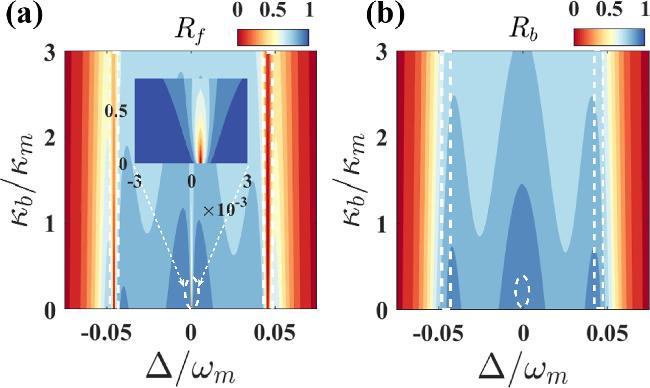


Figure 10. Reflections Rf and Rb with the variable decay rate κb and detuning Δ when the phase shift θ = 0.95$\pi$. Other parameters are the same as those in figure 6(e). |
From an experimental perspective, the proposed scheme can be implemented using two microdisks supporting high-Q TM modes and a long-lived magnetostatic mode evanescently coupled to a common tapered optical fiber, by combining the tapered-fiber coupling techniques demonstrated in optomagnonic YIG resonators [2, 3] with multi-resonator waveguide geometries studied in [62, 63]. The key challenges are to align and stabilize two high-Q YIG optomagnonic resonators along a common waveguide and to independently control their rotation rates Ω1 and Ω2, and both requirements are compatible with current techniques for tapered-fiber coupling and nanopositioning of YIG whispering-gallery resonators [31, 64]. Stable rotation of motor-driven spinning microresonators at Ω/2$\pi$ ≈ 6.6 kHz has been experimentally demonstrated [57, 65], while rotation in the kHz-MHz regime has been theoretically predicted in microcavity systems with different radii [66, 67]. Quantitatively, for the magnon frequency used here, ωm/2$\pi$ = 6.75 GHz, one has ℏωm/kB ≈ 0.32 K. Thus, the thermal magnon occupation is large at room temperature, but can be reduced to nth ≪ 1 in dilution refrigerators operating at tens of millikelvin, as already demonstrated in cavity-magnonics experiments with YIG spheres coupled to superconducting resonators [68, 69]. A similar treatment of thermal noise is adopted in Brillouin-based nonreciprocal photonic devices [54], and optomagnonic Brillouin-cooling schemes have been proposed to further lower the magnon occupancy in YIG [70], supporting the feasibility of our proposal, with thermal noise quantitatively estimated to be negligible compared to the coherent signal and thus not affecting the nonreciprocal transport properties.
4. Conclusion
We present a scheme to control nonreciprocal transmission in a cavity optomagnonic system that contains a one-dimensional waveguide and two spinning optical resonators supporting a magnetic mode and WGMs. By breaking time-reversal symmetry via the Sagnac effect, we achieve controllable and bidirectional nonreciprocal transmission, which is tuned by the effective optomagnonic coupling strengths and Sagnac-Fizeau shifts for CW and CCW cavity rotations. Furthermore, we also obtain single-, double-, and triple-band unidirectional reflectionlessness by tuning the effective optomagnonic coupling strengths, decay rates, and phase shifts. Based on a rotation-induced mechanism that offers an externally tunable approach for nonreciprocal photon transport, this work paves the way for using cavity optomagnonic systems to develop novel nonreciprocal quantum optical devices.