Welcome to visit Communications in Theoretical Physics,
Particle Physics and Quantum Field Theory

Complete UV resonances of SMEFT dim-9 operators for short-range neutrinoless double beta decay

  • Hao-Lin Li 5 ,
  • Yu-Han Ni 7 ,
  • Ming-Lei Xiao , 4, * ,
  • Jiang-Hao Yu 1, 2, 3, 6 ,
  • Xiao-Long Zheng 1, 2, 3
Expand
  • 1School of Fundamental Physics and Mathematical Sciences, Hangzhou Institute for Advanced Study, UCAS, Hangzhou 310024, China
  • 2Institute of Theoretical Physics, Chinese Academy of Sciences, Beijing 100190, China
  • 3School of Physical Sciences, University of Chinese Academy of Sciences, Beijing 100049, China
  • 4School of Science, Sun Yat-Sen University, Shenzhen 518107, China
  • 5School of Physics, Sun Yat-Sen University, Guangzhou 510275, China
  • 6International Center for Theoretical Physics Asia-Pacific, Beijing/Hangzhou, China
  • 7School of Science and Engineering, The Chinese University of Hong Kong, Shenzhen 518172, China

*Author to whom any correspondence should be addressed.

Received date: 2026-03-22

  Revised date: 2026-05-14

  Accepted date: 2026-05-14

  Online published: 2026-06-23

Supported by

National Key Research and Development Program of Chinahttp://dx.doi.org/10.13039/501100012166(2020YFC2201501)

National Natural Science Foundation of Chinahttp://dx.doi.org/10.13039/501100001809(12347105)

Shenzhen Science and Technology Program(JCYJ20240813150911015)

Copyright

© 2026 Institute of Theoretical Physics CAS, Chinese Physical Society and IOP Publishing. All rights, including for text and data mining, AI training, and similar technologies, are reserved.
This article is available under the terms of the IOP-Standard License.

Abstract

We present a systematic classification of tree-level ultraviolet (UV) completions for dimension-nine SMEFT operators relevant to short-range neutrinoless double beta decay ($0\nu\beta\beta$). Using the SMEFT J-basis framework, we categorize distinct UV completions, including both all-boson and boson-fermion-boson topologies. A primary objective is the identification of minimal UV realizations, defined as the smallest set of genuine heavy degrees of freedom required to generate each operator. Out of the 505 unique mediator combinations identified, 440 are found to be minimal, with 12 cases necessitating only two distinct heavy species. While our findings reproduce the scalar- and fermion-mediated results in the literature, we extend earlier studies of vector representations by providing a complete compilation of 324 minimal UV completions featuring vector resonances within the short-range dim-9 SMEFT classification.

Cite this article

Hao-Lin Li , Yu-Han Ni , Ming-Lei Xiao , Jiang-Hao Yu , Xiao-Long Zheng . Complete UV resonances of SMEFT dim-9 operators for short-range neutrinoless double beta decay[J]. Communications in Theoretical Physics, 2026 , 78(8) : 085201 . DOI: 10.1088/1572-9494/ae6e2e

1. Introduction

Neutrinoless double beta decay ($0\nu\beta\beta$) is a highly sensitive probe of lepton-number violation (LNV) and the Majorana nature of neutrinos [3-8]. Observing this transition would establish LNV dynamics beyond the standard model (SM) and help explain the origin of neutrino masses [9]. From the perspective of effective field theory (EFT), the underlying physics is organized systematically in an expansion of operator dimensions [10-16], with the dimension-seven sector understood in its complete nonredundant form [14, 15], and long-range mechanisms separated from genuinely short-range contributions encoded in local contact operators [17-20]. The latter provides a particularly direct bridge between experimental half-life limits and ultraviolet (UV) dynamics. They also raise a practical question: how can one organize the short-distance operators, together with the heavy mediators that generate them, in a gauge-invariant way before electroweak symmetry breaking?
In many UV scenarios, the dominant short-range contribution is encoded in dimension-nine interactions involving two electrons and four quarks. Their matching and renormalization group evolution down to hadronic scales can be treated systematically in the low-energy EFT [21-26]. However, constructing a complete description of the dimension-nine sector in the unbroken phase is technically subtle. Once electroweak invariance is imposed, six-fermion structures admit several inequivalent color and weak-isospin contractions, and accounting for these variations becomes complex in the presence of repeated fields, permutation symmetry, and SM-like contributions. Moreover, the UV interpretation of a 'tree-level completion' is dependent upon explicit power counting. A mediator exchange that is tree-level in a diagrammatic sense may still rely on higher-dimensional interaction vertices, in which case it is subleading in a controlled UV expansion.
An early approach to UV classification was the systematic 'topological decomposition' of short-range dimension-nine operators presented in [1]; see also [27-29] for related analyses, [30] for tree-level completions of $\Delta L = 2$ operators up to dim-11 without vector mediators, [31] for a recent scalar/fermion analysis of dim-9 UV models in which the dim-9 contribution can dominate, [2] for vector representations and gauge-boson embeddings relevant to $0\nu\beta\beta$, and [32] for the recent extension to dim-11. By enumerating tree-level topologies and classifying the quantum numbers of potential mediators, this work established a useful benchmark for the short-range dim-9 sector and serves as a reference for connecting $0\nu\beta\beta$ to collider-oriented models [33-37]. However, because that language is organized after electroweak symmetry breaking, it does not resolve the full spectrum of inequivalent UV completions associated with a given low-energy structure by itself. A purely broken-phase classification does not make the electroweak embedding unique, nor does it cleanly separate genuinely distinct electroweak completions from redundancies introduced by contractions, permutations, or SM-like propagating fields. This also clarifies the relation of our vector results to earlier work: [1] includes vector exchange at the level of broken-phase topological decompositions and electric-charge/color assignments, while [2] systematizes the allowed vector representations and their gauge-boson embeddings. Here, by contrast, vector mediators are classified together with the scalar and fermion channels in the unbroken electroweak SMEFT, with explicit $\mathrm{SU}(2)_L$ and color embeddings and a subsequent minimal-UV organization. This is precisely where an organization in the unbroken phase becomes valuable: it makes the role of electroweak embedding explicit and provides a clean framework in which completeness questions can be posed and answered under controlled assumptions.
In this work we carry out a systematic classification of the short-range dim-9 UV dictionary in the unbroken electroweak phase, based on the $J$-basis framework. Starting from the dim-9 six-fermion SMEFT operator types relevant to short-range $0\nu\beta\beta$, we analyze the local operator space channel by channel and extract the corresponding UV mediator assignments. For a chosen partition of external legs, this is done by diagonalizing the relevant Poincaré and SM gauge Casimirs. This yields a direct resonance dictionary without manual diagram enumeration. The resulting operator-type-level UV dictionary is complete in the unbroken phase and, in sectors with repeated fields and nontrivial permutation symmetry, less prone to omissions than a purely manual topological decomposition [38-40]. We also provide the Mathematica code built on our previous basis construction program ABC4EFT to automatically generate tree-level UV dictionaries for arbitrary SMEFT operator types.
Beyond the complete UV dictionary itself, the two main new results of this paper are as follows. First, we identify the minimal UV realizations of each operator type-the smallest set of genuinely distinct heavy mediators required after SM-like fields have been removed by field redefinitions. The complete short-range classification yields $505$ distinct heavy-mediator combinations, of which $440$ are minimal-$12$ requiring only two and $428$ requiring three genuinely new heavy fields. Second, we identify the massive-vector channels that survive as leading dim-9 short-range realizations. This yields $324$ minimal UV realizations featuring vector resonances. A cross-check against the broken-phase classification of [1] shows that, after the strict first-generation projection, the scalar short-range sector is fully reproduced. The paper is organized as follows. Section 2 sets up the short-range SMEFT description and introduces the $J$-basis framework. Section 3 presents the operator-level UV dictionary, its minimal UV realizations (section 3.2). We conclude in section 4 with a summary and outlook.

2. Short-range $0\nu\beta\beta$ in SMEFT and the $J$-basis framework

2.1. Short-range dim-9 operator space in SMEFT

As discussed in the Introduction, neutrinoless double beta decay can receive short-range contributions from heavy virtual fields well above the electroweak scale. In this section we set up the EFT description of this short-range sector and specify the precise operator space that the subsequent UV classification is built upon. Our focus is exclusively on the genuinely short-range dim-9 six-fermion sector of SMEFT: we do not revisit the long-range neutrino-exchange picture, nor the full hierarchy of $\Delta L = 2$ operators at $d = 5$ or $d = 7$, but instead address the UV classification of the dim-9 operator space in the unbroken phase.
From the EFT point of view, the $\Delta L = 2$ interactions above the electroweak scale are organized as
$align}\mathcal{L}_{\mathrm{SMEFT}}^{\Delta L = 2}=\sum_{\substack{d = 5,7,9,\ldots \\ a}$
where the first gauge-invariant contribution appears at $d = 5$ as the Weinberg operator [10], while the higher odd-dimensional operators encode progressively shorter-distance realizations of $\Delta L = 2$ [11-14]. After electroweak symmetry breaking the relevant operators are matched onto the $\Delta L = 2$ low-energy EFT, and subsequently onto hadronic and nuclear degrees of freedom:
$align}\mathcal{L}_{\mathrm{SMEFT}}^{\Delta L = 2}\xrightarrow[\mu \simeq m_W]{\text{EWSB and matching}}\mathcal{L}_{\mathrm{LEFT}}^{\Delta L = 2}\xrightarrow[\mu \sim {\mathcal {O}}\left(1\text{-}2\right)\,\mathrm{GeV}]{\text{hadronic matching}$
The low-energy parametrization of the resulting hadronic and leptonic currents was established in [18, 19], while more recent EFT analyses have clarified the matching and renormalization-group structure of the short-range sector [20, 21, 24]. In the present paper we focus on the first step in equation (2): the classification of gauge-invariant SMEFT operators and of their UV mediator content. The subsequent matchings-onto the low-energy quark-lepton EFT and ultimately onto hadronic and nuclear degrees of freedom-are required for phenomenological predictions but are not rederived here; the nuclear matrix elements and isotope-dependent half-life formulas are therefore treated as downstream inputs. It is worth noting why the dim-9 sector plays a distinguished role in this hierarchy. At $d = 5$ the Weinberg operator generates the standard light-neutrino-exchange ('long-range') mechanism [10]. Higher-dimensional $\Delta L = 2$ operators can also induce nonlocal or mixed realizations once electroweak symmetry is broken [11, 12]. By contrast, the first local six-fermion operators that encode genuinely short-range quark-level contributions arise systematically at $d = 9$ [17, 20, 28], making this the natural entry point for a complete UV classification of the short-range sector. Here 'genuinely' distinguishes the pure six-fermion operators that are irreducible at $d = 9$ from effective six-fermion vertices generated by lower-dimensional $\Delta L = 2$ operators-such as the dim-5 Weinberg operator or dim-7 operators involving Higgs fields-through Higgs vacuum expectation value insertions, whose Wilson coefficients are already fixed by the lower-dimensional couplings [11, 12].
In the present work we restrict attention to the SMEFT description in the unbroken electroweak phase with
$equation*$
and to the genuinely short-range part of the $0\nu\beta\beta$ amplitude. At low energies this sector is represented by local six-fermion operators of schematic form
$align$
Since the corresponding local amplitude is suppressed only by $\Lambda^{-5}$, short-range $0\nu\beta\beta$ provides a particularly direct bridge between low-energy searches and heavy mediator physics near the TeV scale. In the unbroken phase, however, the structure is more than this single quark-level operator might suggest. This variety is already visible at the operator-type level. Restricting to the pure six-fermion sector relevant for genuine short-range dim-9 mechanisms, the SMEFT operator types are
$\begin{align} &d_{\mathbb{C}}^{\dagger 2} L^{\dagger 2} Q^{\dagger 2}, \qquad L^{\dagger 2} Q^{2} u_{\mathbb{C}}^{2}, \qquad d_{\mathbb{C}}^\dagger L^{\dagger 2} Q Q^\dagger u_{\mathbb{C}}, \nonumber\\ &d_{\mathbb{C}}^{\dagger 2} e_{\mathbb{C}} L^\dagger Q^\dagger u_{\mathbb{C}}, \qquad d_{\mathbb{C}}^\dagger e_{\mathbb{C}} L^\dagger Q u_{\mathbb{C}}^{2}, \qquad d_{\mathbb{C}}^{\dagger 2} e_{\mathbb{C}}^{2} u_{\mathbb{C}}^{2}.\end{align}$
After electroweak symmetry breaking, these classes project onto the familiar quark-level chirality structures used in the broken-phase analyses of [1, 11, 28, 29]. At the operator-type level; they cover the genuine dim-9 short-range six-fermion sector in the unbroken phase. For the present paper, the genuine short-range dim-9 sector is therefore defined in terms of this gauge-invariant SMEFT operator space rather than a single broken-phase quark operator. Once Lorentz, weak-isospin, and color contractions are fully resolved, the six operator types in equation (4) generate a total of $48$ independent dim-9 operators; this counting is consistent with the general SMEFT basis analyses of [16, 41].
The UV classification in the unbroken-phase dim-9 sector is considerably more intricate than at lower dimensions for three related reasons. First, at the operator-type level, the six-fermion external states generically involve repeated quark or lepton fields, so Fermi statistics restricts the allowed Lorentz, $SU(3)_C$, and $SU(2)_L$ contractions. Second, at the gauge-embedding level, a single broken-phase chirality structure can descend from several inequivalent $\mathrm{SU}(2)_L$ or color contractions, each associated with a different set of UV mediators. Third, at the UV-interpretation level, not every distinct mediator assignment represents a genuinely new heavy-field configuration: an SM-like channel can sometimes be traded for an off-shell SM insertion and absorbed by a field redefinition.
It is important to emphasize that the operator types in equation (4) do not yet coincide with the full operator basis. Once identical fermion multiplets appear repeatedly, Fermi statistics correlates Lorentz, $\mathrm{SU}(2)_L$, color, and flavor structures, so that only a subset of formally admissible contractions survives as independent operators, which is what we called the $F$-basis in the framework of Young Tensor Method [41, 42]. These constraints are incorporated in the basis construction used below and will later play an important role in distinguishing genuinely distinct UV channels8.
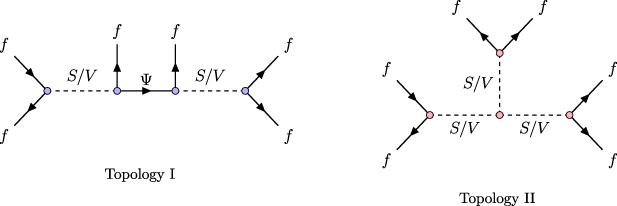
Broken-phase topological decompositions, as explored in [1] (see also [43] for the $d = 5$ case), offer a useful guide to the generic tree structures relevant for short-range $0\nu\beta\beta$. For genuine dim-9 six-fermion mechanisms, there are two kinds of three-propagator topologies shown in figure 1. Topology I contains a boson-fermion-boson chain, whereas Topology II contains three bosonic propagators. What these topologies do not determine is which electroweak representations flow in the internal lines; this is precisely why the SMEFT operator-level organization introduced below is needed. These topologies provide the diagrammatic matching templates for the short-range sector, which provides the partition information for the $J$-basis analysis for the SMEFT operators of the type listed in equation (4) as will be discussed in the next section.
Figure 1. The two generic three-propagator tree topologies relevant for genuine short-range $d = 9$ $0\nu\beta\beta$ operators. External lines ($f$) are SM fermions, while the internal lines denote heavy bosonic or fermionic mediators. Blue and red dots indicate gauge-invariant interaction vertices in Topology I and Topology II, respectively. In the present paper these topologies are embedded into an analysis performed in the unbroken electroweak phase, so that inequivalent $\mathrm{SU}(2)_L$ and color channels are kept separate before symmetry breaking.
To summarize: the UV classification pursued in the rest of this paper consists of identifying, for each independent dim-9 SMEFT operator types in of equation (4), all sets of heavy mediators that can generate it through a connected tree-level graph with renormalizable vertices. The precise criteria-including tree closure and leading-power constraints-are specified in section 2.3.

2.2. $J$-basis organization of the local operator space

The central technical ingredient of the present work is the $J$-basis organization of the SMEFT operator space. Its role here is to keep the UV classification in the unbroken phase, where the full electroweak structure of the operator space is retained. This is the essential difference from a broken-phase or LEFT-oriented description: in the latter, distinct SMEFT completions may already be merged into the same low-energy quark-level structure, whereas in the SMEFT $J$-basis they remain separated as inequivalent weak-isospin channels.
The method used here is part of a broader on-shell and group-theoretic program developed in earlier works [41, 42]. The operator-amplitude correspondence established in [44-46] provides the foundation for turning the local-operator problem into a finite-dimensional algebraic one. Systematic constructions of complete higher-dimensional SMEFT bases then supplied the independent and complete operator spaces on which the method acts [39-42, 47]. On this foundation, the generalized partial-wave framework for arbitrary multi-particle channels [48, 49] and the bottom-up UV-resonance program [50, 51] lead directly to the $J$-basis interpretation used here. The present paper applies this logic to the dim-9 $\Delta L = 2$ six-fermion sector relevant for short-range $0\nu\beta\beta$.
In a zoo of SMEFT operator bases in [42, 47], different bases emphasize different aspects of the EFT: the $Y$-basis ensures algebraic independence, the $P$-basis makes the flavor and permutation structure of repeated fields manifest, while the $J$-basis reorganizes the independent operator space according to conserved channel quantum numbers and thereby prepares the UV interpretation. To be more specific, it reorganizes the EFT operators within a complete and independent basis such that the corresponding local on-shell amplitudes carry definite quantum numbers for different groups of particles, which we refer to as channels. Owing to this correspondence, these quantum numbers may be interpreted as those of UV particles appearing in diagrammatic matching. In this way, the UV interpretation is reduced to a problem in representation theory.
To define the $J$-basis, one must first specify all channels, which is equivalent to choosing a partition. By virtue of the amplitude-operator correspondence, the fields appearing in an operator are identified with the external particles in the local on-shell amplitude generated by that operator. Mathematically, a partition is a collection of subsets, $\mathcal{P} = \{I_1,\ldots,I_m\}$, where each $I_i\subset \{1,\ldots,N\}$ and where $1,\ldots,N$ label the external particles. These subsets are required to satisfy two conditions: first, $\bigcup_{r = 1}^{m} I_r = \{1,\ldots,N\}$; second, any two subsets must be either disjoint or nested, i.e. $I_r\cap I_s = \varnothing$, $I_r\subset I_s$, or $I_s\subset I_r$. This definition extends the familiar channel decomposition of ordinary $2\to2$ partial waves to general tree-level multi-particle factorizations. Diagrammatically, the subset notation $\mathcal{P}$ is equivalent to a tree diagram with fixed external particles in a top-down matching computation. It is precisely this correspondence between partitions and tree diagrams that later enables the quantum numbers associated with a channel $I_i$ to be interpreted as those of the corresponding mediator in the tree diagram.
For the short-range six-fermion sector considered in equation (4), the relevant partitions are those compatible with Topology I and Topology II in figure 1; together they exhaust the tree-level UV realization of interest. Representative examples are shown in table 1. The leftmost column displays the tree diagrams obtained by fixing all external legs in the topologies of figure 1, the middle column gives our partition notation explicitly as sets of subsets, and the rightmost column records the corresponding decomposition label in the broken-phase classification of [1], after selecting the physical $uudd\,ee$ component.
Table 1. Representative channel assignments for the two six-fermion tree topologies. Each row shows one explicit external-fermion assignment together with a simplified notation $\mathcal P = \{I_1,I_2,I_3\}$, in which the three $I_r$ are identified with the three propagator channels of the tree and written directly in terms of the corresponding fermion currents. The last column gives the corresponding decomposition label in the broken-phase classification of [1], i.e. after selecting the physical $uudd\,ee$ component of the electroweak multiplets. Repeated identical endpoint currents are distinguished by the subscripts $L$ and $R$.
Topology Partition Broken-phase label of [1]
$\mathcal P_\textrm{I}^{(a)} = \{I_1,I_2,I_3\}$,$I_1 = (Q\,u_{\mathbb{C}})$,$I_2 = (Q\,u_{\mathbb{C}})\,Q^\dagger = d_{\mathbb{C}}^\dagger(L^\dagger L^\dagger)$,$I_3 = (L^\dagger L^\dagger)$ #1-ii-a:$(Q\,u_{\mathbb{C}})\,(Q^\dagger)\,(d_{\mathbb{C}}^\dagger)\,(L^\dagger L^\dagger)$

$\mathcal P_\textrm{I}^{(b)} = \{I_1,I_2,I_3\}$,$I_1 = (Q\,u_{\mathbb{C}})$,$I_2 = (Q\,u_{\mathbb{C}})\,d_{\mathbb{C}}^\dagger = L^\dagger(L^\dagger Q^\dagger)$,$I_3 = (L^\dagger Q^\dagger)$ #2-i-a:$(Q\,u_{\mathbb{C}})\,(d_{\mathbb{C}}^\dagger)\,(L^\dagger)\,(L^\dagger Q^\dagger)$

$\mathcal P_\textrm{II}^{(a)} = \{I_1,I_2,I_3\}$,$I_1 = (Q\,u_{\mathbb{C}})_{L}$,$I_2 = (L^\dagger L^\dagger)$,$I_3 = (Q\,u_{\mathbb{C}})_{R}$ #1:$(Q\,u_{\mathbb{C}})\,(L^\dagger L^\dagger)\,(Q\,u_{\mathbb{C}})$

$\mathcal P_\textrm{II}^{(b)} = \{I_1,I_2,I_3\}$,$I_1 = (L^\dagger d_{\mathbb{C}}^\dagger)$,$I_2 = (L^\dagger Q^\dagger)$,$I_3 = (Q\,u_{\mathbb{C}})$ #2:$(L^\dagger d_{\mathbb{C}}^\dagger)\,(L^\dagger Q^\dagger)\,(Q\,u_{\mathbb{C}})$
Through the operator-amplitude correspondence, the same partition can be applied to the associated on-shell contact amplitude. For a fixed partition $\mathcal P$, the relevant statement is the correspondence between the finite-dimensional local operator space and the associated local amplitude space,
$\begin{align} \mathcal{O}_a \;\longleftrightarrow\; \mathcal{M}_a\left(\left\{\Psi\right\}_{\mathcal{P}}\right).\end{align}$
Here, $\mathcal{M}_a(\{\Psi\}_{\mathcal{P}})$ denotes the local on-shell amplitude corresponding to $\mathcal{O}_a$ in the chosen channel partition. What we need from the generalized partial-wave framework [48, 49] is therefore not a dynamical scattering expansion, but the channel-wise Casimir construction on the amplitude side. Since the operator-amplitude map preserves the relevant symmetry representations, the spin and gauge quantum numbers extracted there can be transferred back directly to the finite-dimensional operator space $\mathcal{V}_\textrm{SR}^{(9)}$.
For each channel $I$ we define the partial kinematic generators by summing over the legs belonging to that channel, $P_I^\mu = \sum_{i\in I}p_i^\mu$ and $M_I^{\mu\nu} = \sum_{i\in I}M_i^{\mu\nu}$, where $M_i^{\mu\nu}$ denotes the Lorentz generator acting on the $i$th external leg in the on-shell representation of the contact amplitude. From these generators one constructs the partial Pauli-Lubanski vector
$\begin{align} W_I^\mu = \frac12 \epsilon^{\mu\nu\rho\sigma} P_{I,\nu}\, M_{I,\rho\sigma}, \qquad W_I^2 = W_{I,\mu}W_I^\mu,\end{align}$
which measures the Lorentz spin carried in the channel. Similarly, for each SM gauge factor $G$ one defines the partial generators
$\begin{align} T_I^{A,\left(G\right)} = \sum_{i\in I}T_i^{A,\left(G\right)}, \qquad C_{2,I}^{\left(G\right)} = T_I^{A,\left(G\right)}T_I^{A,\left(G\right)}.\end{align}$
More generally, we denote by $C_{n,I}^{(G)}$ the independent Casimir operators required to distinguish the relevant irreducible representations in channel $I$; for $\mathrm{SU}(3)_C$ this includes the cubic Casimir whenever distinct color irreps share the same quadratic eigenvalue. For the abelian factor $U(1)_Y$, there is no nontrivial Casimir. Instead, the hypercharge flowing in channel $I$ is simply the additive label $ Y_I = \sum_{i\in I}Y_i $, which is fixed once the external legs in that channel are specified. After choosing a basis for the local amplitude space $\mathcal{M}_\textrm{loc}^{(9)}(\{\Psi\}_{\mathcal{P}})$, the operators $W_I^2$ and $C_{n,I}^{(G)}$ are represented by finite-dimensional matrices. For compatible channels $I,J\in\mathcal{P}$ (i.e. disjoint or nested), the partial Lorentz and gauge Casimirs commute on this amplitude space [50]:
$\begin{align} \left[W_I^2,W_J^2\right] = \left[W_I^2,C_{m,J}^{\left(G^{^{\prime}}\right)}\right] = \left[C_{n,I}^{\left(G\right)},C_{m,J}^{\left(G^{^{\prime}}\right)}\right] = 0.\end{align}$
This is the algebraic reflection of the fact that a tree-level intermediate state carries simultaneously definite spin and gauge quantum numbers in every channel. The set $\{W_I^2,\,C_{n,I}^{(G)}\}_{I\in\mathcal{P},\,G}$ therefore defines a commuting family of matrices on $\mathcal{M}_\textrm{loc}^{(9)}(\{\Psi\}_{\mathcal{P}})$, which can be diagonalized simultaneously. The corresponding common eigenamplitudes satisfy
$\begin{align} W_I^2\,\mathcal{M}_{\alpha}^{\left(\mathcal{P}\right)} & = -s_I\,J_I\left(J_I+1\right)\, \mathcal{M}_{\alpha}^{\left(\mathcal{P}\right)},\end{align}$
$\begin{align} C_{n,I}^{\left(G\right)}\,\mathcal{M}_{\alpha}^{\left(\mathcal{P}\right)} & = C_n^{\left(G\right)}\!\left(\mathbf{r}_I^{\left(G\right)}\right)\, \mathcal{M}_{\alpha}^{\left(\mathcal{P}\right)},\nonumber\\ G & = \mathrm{SU}\left(3\right)_C,\,\mathrm{SU}\left(2\right)_L,\end{align}$
for every channel $I\in\mathcal{P}$. Transporting this common eigenbasis back through the operator-amplitude correspondence defines the $J$-basis on the operator side. Expanded on the original operator basis, it takes the form [50, 51]
$\begin{align} \mathcal{O}_{\alpha}^{\left(\mathcal{P}\right)} = \sum_a \mathcal{K}_{\alpha a}^{\left(\mathcal{P}\right)}\,\mathcal{O}_a,\end{align}$
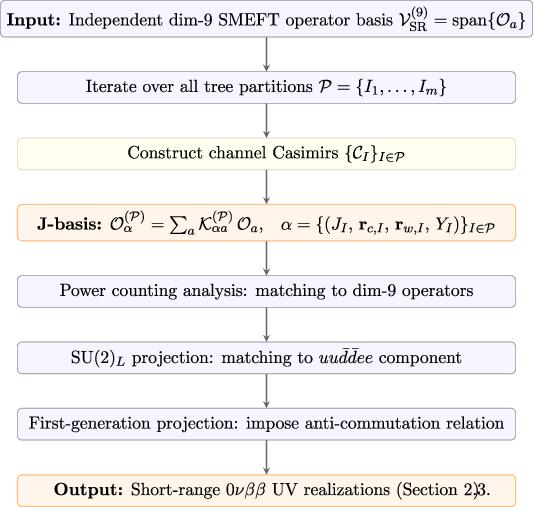
where $\mathcal{K}^{(\mathcal{P})}$ is the change-of-basis matrix induced by the simultaneous diagonalization on the amplitude side. The sequence of steps leading from the independent operator space to the channel-wise UV data is summarized in figure 2.
Figure 2. Schematic workflow of the $J$-basis method. Starting from an independent operator basis, one iterates over all tree partitions, representing the corresponding commuting Casimir operators on the local amplitude space, and finds their common eigenbasis to obtain the $J$-basis operators whose eigenvalues encode the admissible UV mediator quantum numbers. The yellow box indicates the construction of the commuting Casimir family; the orange boxes highlight the core diagonalization step and its output. The final three boxes indicate the additional physical filters used in the strict short-range $0\nu\beta\beta$ classification.
The common eigenbasis obtained in this way has a direct UV interpretation. For each channel $I$, the eigenvalues determine the full one-particle label $(J_I,\,\mathbf{r}_{c,I},\,\mathbf{r}_{w,I},\,Y_I)$: the partial Pauli-Lubanski Casimir fixes the spin, the non-abelian gauge Casimirs fix the $\mathrm{SU}(3)_C$ and $\mathrm{SU}(2)_L$ representations, and the hypercharge is fixed additively from the external legs. In this sense, the $J$-basis converts the search for admissible tree-level mediator quantum numbers into a channel-wise eigenvalue problem on a finite-dimensional local operator space.
The remaining step is to determine which sets of algebraically admissible channel labels can actually be assembled into genuine UV realizations with connected tree structure and the correct power counting. This is the task of the next subsection.

2.3. From channel quantum numbers to ultraviolet realizations

The output of the $J$-basis diagonalization for a given partition $\mathcal{P}$ may be summarized as
$\begin{align} \mathcal{O}_{\alpha}^{\left(\mathcal{P}\right)} \quad \longmapsto \quad \left\{J_I,\, \mathbf{r}_{c,I},\, \mathbf{r}_{w,I},\, Y_I\right\}_{I\in\mathcal{P}},\end{align}$
which assigns a candidate one-particle label to every channel of the chosen tree partition. For the dim-9 short-range $0\nu\beta\beta$ problem, however, this algebraic output is only the starting point. The reason is physical: the classification is carried out in electroweak-complete SMEFT in the unbroken phase, whereas the observable $0\nu\beta\beta$ process is described after electroweak symmetry breaking and picks out the specific broken-phase component $uudd\,ee$. Before a channel assignment is retained in the physical catalog, we therefore impose three additional filters: leading-power counting, projection to the physical weak component, and the strict first-generation constraints.
Leading-power counting. The first filter keeps only channels that can contribute already at order $\Lambda^{-5}$ through gauge-invariant renormalizable interactions. For scalar and fermion mediators this introduces no additional subtlety: once the channel quantum numbers admit the required renormalizable vertices, the corresponding tree contributes directly to the dim-9 six-fermion sector. Massive vectors are different. A vector channel that is algebraically allowed by the $J$-basis need not be a leading dim-9 realization, because its endpoint couplings may first appear only through higher-dimensional operators. The characteristic problematic case is a same-chirality fermion-fermion-vector endpoint, for which the first nonvanishing local interaction is the dim-5 tensor-current coupling
$align$
Such an endpoint is one power of $\Lambda$ more suppressed than a renormalizable current coupling, so a branch that would otherwise look like a dim-9 tree is demoted to $d\unicode{x2A7E} 10$ and is not counted as a leading short-range realization. The physical question is therefore not whether vector exchange is allowed, but whether the corresponding channel can be realized by a genuinely renormalizable tree already at leading order. In the explicit dim-9 scan this subtlety affects only a small subset of vector-mediated classifications, and in every surviving case the same heavy-field content also admits an ordinary renormalizable tree realization. The role of the power-counting filter is thus to remove nonleading tensor-current routes without discarding vector multiplets that genuinely contribute already at dim 9.
Projection to the physical weak component. The second filter appears when one descends from the electroweak-complete SMEFT operator to the broken-phase process. An operator that is perfectly admissible in the unbroken phase need not contribute to $0\nu\beta\beta$, because the latter probes only the particular weak component $uu\bar{d}\bar{d}\,ee$. In this step the detailed $\mathrm{SU}(2)_L$ contractions matter. Weak-singlet contractions of identical doublets can project away the required state entirely: an $LL$ or $L^\dagger L^\dagger$ singlet contains no $ee$, while a $QQ$ or $Q^\dagger Q^\dagger$ singlet contains no $dd$ or $uu$. The weak structure must therefore be followed through the full completion, and only those branches with a nonvanishing $uu\bar{d}\bar{d}\,ee$ projection are retained in the physical short-range catalog.
First-generation projection. After the weak projection has selected the physical component, one must still impose the additional constraints that arise because the physical $0\nu\beta\beta$ channel involves repeated first-generation fermions. Once the external fields are fixed to $u$, $d$, and $e$, fermion-exchange antisymmetry becomes a genuine selection rule: the relevant amplitudes must respect the combined Lorentz, color, and weak symmetry properties of identical quark or lepton pairs. As a result, some UVs that are admissible for generic flavor assignments vanish identically in the first-generation limit. This last filter is therefore applied at the level of complete tree realizations rather than individual channels, because the cancellation can depend on how the repeated external lines are tied together across the full diagram.
The short-range dim-9 catalog studied in section 3 is obtained only after all three filters have been imposed. The $J$-basis thus supplies the complete algebraic channel data, while the subsequent power-counting, weak-projection, and first-generation steps identify the subset that contributes to the physical $0\nu\beta\beta$ process.

3. Ultraviolet realizations of the dim-9 operator space

This section first fixes the convention for handling SM-like UV fields and then summarizes the heavy-resonance content and minimal-UV classification of the short-range dim-9 operator space, including the surviving massive-vector sector.

3.1. SM-like fields and the field-redefinition convention

Before presenting the short-range classification, a clear interpretational convention must be established. The underlying bottom-up EFT framework-incorporating operator-amplitude correspondence and field redefinition reductions-was systematically developed in [47, 50]. In the following, we adopt only the essential conventions required for the dimension-nine short-range classification.
A subtle but essential consideration involves channels with quantum numbers-spanning spin and all gauge symmetries-that coincides with those of SM fields; we define these as 'SM-like' channels. In many cases, a heavy degree of freedom is not strictly required in such a channel for the generation of a short-range process. Instead, the target effective operator may emerge from the field redefinition reduction of a sibling operator type-one involving fewer fields but containing additional derivatives-where the SM field of the same representation mediates the interaction. Consequently, these SM-like channels are typically excluded from the count of genuine heavy degrees of freedom when identifying minimal UV realizations.
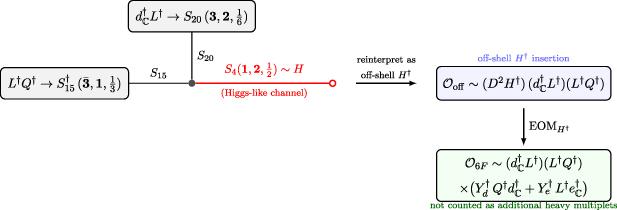
A dim-9 example. A representative example is a Higgs-like insertion taken from the operator type $d_{\mathbb{C}}^{\dagger 2}L^{\dagger 2}Q^{\dagger 2}$. In this Topology II completion the bilinears $d_{\mathbb{C}}^\dagger L^\dagger$ and $L^\dagger Q^\dagger$ are matched to the channels $S_{20}\,(\mathbf{3},\mathbf{2},1/6)$ and $S_{15}^\dagger\,(\bar{\mathbf{3}},\mathbf{1},1/3)$, while the color-singlet part of $d_{\mathbb{C}}^\dagger Q^\dagger$ carries the Higgs quantum numbers $S_{4}\,(\mathbf{1},\mathbf{2},1/2)\sim H$. Once the genuinely heavy lines $S_{15}^\dagger$ and $S_{20}$ are integrated out, the remaining $S_4$ channel may be reinterpreted as an off-shell $H^\dagger$ insertion rather than as an additional heavy resonance in the UV spectrum.
The second viewpoint produces an operator of the form
$\begin{align} \mathcal O_\textrm{off} \sim \left(D^2 H^\dagger\right)\,\left(d_{\mathbb{C}}^\dagger Q^\dagger\right)\left(L^\dagger L^\dagger\right),\end{align}$
where only the operator type is displayed and the detailed Lorentz, color, and weak-index contractions are suppressed. This operator is redundant in our on-shell operator basis convention. It can be removed by the Higgs field redefinition
$\begin{align} H^\dagger \;\rightarrow\; H^\dagger + \frac{c}{\Lambda^5}\left(d_{\mathbb{C}}^\dagger Q^\dagger\right)\left(L^\dagger L^\dagger\right),\end{align}$
When applying this field redefinition to the kinetic term of the Higgs fields, it will generate the term that cancels the ${\mathcal {O}}_\textrm{off}$ in equation (14) in the Lagrangian, while the Higgs Yukawa term generates the six-fermion operators in our basis. Schematically, this is equivalent to the replacement of $D^2 H^\dagger$ with equation of motion (EOM) of the Higgs field at the renormalizable level in the off-shell operator when truncating to dimension nine:
$\begin{align} & D^2 H^\dagger \;\sim\; \frac{\partial V\left(H\right)}{\partial H} \, + \, Y_d^\dagger\,Q^\dagger d_{\mathbb{C}}^\dagger \, + \, Y_e^\dagger\,L^\dagger e_{\mathbb{C}}^\dagger \,+\,\cdots ,\end{align}$
$\begin{align} & \mathcal O_\textrm{off} \;\xrightarrow{\mathrm{EOM}_{H^\dagger}}\; \left(d_{\mathbb{C}}^\dagger L^\dagger\right)\left(L^\dagger Q^\dagger\right) \left(Y_d^\dagger\,Q^\dagger d_{\mathbb{C}}^\dagger + Y_e^\dagger\,L^\dagger e_{\mathbb{C}}^\dagger\right) \,+\,\cdots ,\end{align}$
where the ellipses again denote bosonic terms or structures outside the short-range six-fermion sector. The process is illustrated in figure 3. The $Y_d^\dagger$ term is the piece that feeds the short-range six-fermion sector relevant to $0\nu\beta\beta$. These schematic relations make explicit why one can omit the heavy Higgs-like mediator in the UV theory while still obtaining the six-fermion operator of interest.
Figure 3. Illustrative Higgs-like SM channel in a Topology II factorization of the operator type $d_{\mathbb{C}}^{\dagger 2}L^{\dagger 2}Q^{\dagger 2}$. The bilinears $L^\dagger Q^\dagger$ and $d_{\mathbb{C}}^\dagger L^\dagger$ are matched to $S_{15}^\dagger(\bar{\mathbf{3}},\mathbf{1},1/3)$ and $S_{20}(\mathbf{3},\mathbf{2},1/6)$, while the color-singlet part of $d_{\mathbb{C}}^\dagger Q^\dagger$ is carried by the Higgs-like channel $S_4(\mathbf{1},\mathbf{2},1/2)\sim H$. Reinterpreting this line as an off-shell $H^\dagger$ insertion and applying the Higgs EOM returns the short-range branch shown in the green box, whose $Y_d^\dagger$ term reproduces $d_{\mathbb{C}}^{\dagger 2}L^{\dagger 2}Q^{\dagger 2}$.
The aforementioned example illustrates the reduction of an SM-like insertion, although not every SM-like channel is of this kind. In reducing to the minimal UV set, having the gauge quantum numbers of an SM multiplet is a necessary, but not sufficient, criterion for removal. An SM-like heavy mediator must nevertheless be retained in the UV theory if replacing it by its SM counterpart in the diagram fails to generate a local amplitude corresponding to the six-fermion operators, or if the original heavy mediator is a fermion and a mass insertion is required in order for the resulting local amplitude to remain at dimension nine.
Relation to long-range contributions. The difference between the present short-range minimal-UV convention and the broken-phase organization of [1, 29] is partly tied to the role of Standard-Model-like propagating fields. In the present work we focus exclusively on the genuine short-range dim-9 six-fermion sector, and we define the minimal UV content as the new heavy-field content that remains after SM-like fields have been removed by field redefinitions. By contrast, in the diagrammatic organization of [1], internal lines whose quantum numbers coincide with those of SM fields are not automatically quotiented out, because in certain topologies such branches can also be reinterpreted as contributions to long-range $0\nu\beta\beta$ amplitudes. Indeed, in their figure 2, diagrams (a)-(c) correspond to long-range contributions with light-neutrino exchange between two point-like vertices, while diagram (d) represents purely heavy-particle short-range exchange. From the perspective adopted here, such SM-like contributions do not contribute to the genuinely new heavy-field content of the short-range dim-9 classification, and are therefore removed in the definition of minimal UV realizations. The resulting difference is thus of organizational convention, rather than a contradiction in the underlying short-range channel analysis.
With this convention in place, we now summarize the heavy-resonance content of the dim-9 operator space before turning to the minimal-UV classification.
Heavy-resonance content and comparison. Table 2 lists all the heavy mediator species that appear in at least one tree-level completion of the dim-9 $0\nu\beta\beta$ operators. The list covers the full dim-9 operator space, including sectors beyond the purely short-range six-fermion one; the restriction to the short-range subset is imposed in the subsequent discussion.
Table 2. Heavy resonances in the pure short-range dim-9 six-fermion sector. Blue entries first appear at dim-9, while gray bosonic entries carry Standard-Model quantum numbers. Parentheses give the bolded numbers for the $SU(3)_C$ and $SU(2)_L$ representation dimensions together with the unbolded $U(1)_Y$ hypercharge, a convention adopted throughout the paper.
Scalar $S_{2}\ (\mathbf{1},\ \mathbf{1},\ 1)$, $S_{3}\ (\mathbf{1},\ \mathbf{1},\ 2)$, $\textcolor{gray}{S_{4}\ (\mathbf{1},\ \mathbf{2},\ 1/2)}$, $S_{8}\ (\mathbf{1},\ \mathbf{3},\ 1)$ $S_{14}\ (\mathbf{3},\ \mathbf{1},\ -4/3)$, $S_{15}\ (\mathbf{3},\ \mathbf{1},\ -1/3)$, $S_{16}\ (\mathbf{3},\ \mathbf{1},\ 2/3)$, $S_{20}\ (\mathbf{3},\ \mathbf{2},\ 1/6)$ $S_{21}\ (\mathbf{3},\ \mathbf{2},\ 7/6)$, $S_{22}\ (\mathbf{3},\ \mathbf{3},\ -1/3)$, $S_{27}\ (\mathbf{6},\ \mathbf{1},\ -2/3)$, $S_{28}\ (\mathbf{6},\ \mathbf{1},\ 1/3)$ $S_{29}\ (\mathbf{6},\ \mathbf{1},\ 4/3)$, $S_{34}\ (\mathbf{6},\ \mathbf{3},\ 1/3)$, $S_{39}\ (\mathbf{8},\ \mathbf{2},\ 1/2)$
Fermion $F_{1}\ (\mathbf{1},\ \mathbf{1},\ 0)$, $F_{3}\ (\mathbf{1},\ \mathbf{2},\ 1/2)$, $F_{5}\ (\mathbf{1},\ \mathbf{3},\ 0)$, $F_{10}\ (\mathbf{3},\ \mathbf{1},\ -1/3)$ $F_{11}\ (\mathbf{3},\ \mathbf{1},\ 2/3)$, $F_{12}\ (\mathbf{3},\ \mathbf{2},\ -5/6)$, $F_{13}\ (\mathbf{3},\ \mathbf{2},\ 1/6)$, $F_{14}\ (\mathbf{3},\ \mathbf{2},\ 7/6)$ $F_{16}\ (\mathbf{3},\ \mathbf{3},\ -1/3)$, $F_{17}\ (\mathbf{3},\ \mathbf{3},\ 2/3)$, $F_{23}\ (\mathbf{6},\ \mathbf{1},\ 1/3)$, $F_{24}\ (\mathbf{6},\ \mathbf{2},\ -1/6)$$\textcolor{blue}{F^{(9)}_{3}\ (\mathbf{3},\ \mathbf{1},\ -4/3)}$, $\textcolor{blue}{F^{(9)}_{4}\ (\mathbf{3},\ \mathbf{1},\ 5/3)}$, $\textcolor{blue}{F^{(9)}_{5}\ (\mathbf{8},\ \mathbf{1},\ 0)}$, $\textcolor{blue}{F^{(9)}_{6}\ (\mathbf{8},\ \mathbf{2},\ 1/2)}$ $\textcolor{blue}{F^{(9)}_{7}\ (\mathbf{8},\ \mathbf{3},\ 0)}$, $\textcolor{blue}{F^{(9)}_{8}\ (\mathbf{6},\ \mathbf{2},\ 5/6)}$, $\textcolor{blue}{F^{(9)}_{9}\ (\mathbf{6},\ \mathbf{3},\ 1/3)}$

Vector $\textcolor{gray}{V_{1}\ (\mathbf{1},\ \mathbf{1},\ 0)}$, $V_{2}\ (\mathbf{1},\ \mathbf{1},\ 1)$, $V_{5}\ (\mathbf{1},\ \mathbf{2},\ 3/2)$, $\textcolor{gray}{V_{6}\ (\mathbf{1},\ \mathbf{3},\ 0)}$ $V_{13}\ (\mathbf{3},\ \mathbf{1},\ 2/3)$, $V_{16}\ (\mathbf{3},\ \mathbf{2},\ -5/6)$, $V_{17}\ (\mathbf{3},\ \mathbf{2},\ 1/6)$, $V_{20}\ (\mathbf{3},\ \mathbf{3},\ 2/3)$ $V_{27}\ (\mathbf{6},\ \mathbf{2},\ -1/6)$, $V_{28}\ (\mathbf{6},\ \mathbf{2},\ 5/6)$, $\textcolor{gray}{V_{30}\ (\mathbf{8},\ \mathbf{1},\ 0)}$, $V_{31}\ (\mathbf{8},\ \mathbf{1},\ 1)$ $V_{32}\ (\mathbf{8},\ \mathbf{3},\ 0)$
The resonances shown in blue were absent in the previous analysis of effective operators at dimension eight and below. Their appearance only at dimension nine is itself phenomenologically notable, since it is only at this order that these mediator quantum numbers first enter the $0\nu\beta\beta$ problem. Several of the genuinely new fermionic entries carry nontrivial color representations, including the octet states $F^{(9)}_{5}(\mathbf{8},\mathbf{1},0)$, $F^{(9)}_{6}(\mathbf{8},\mathbf{2},1/2)$, and $F^{(9)}_{7}(\mathbf{8},\mathbf{3},0)$, as well as the sextet states $F^{(9)}_{8}(\mathbf{6},\mathbf{2},5/6)$ and $F^{(9)}_{9}(\mathbf{6},\mathbf{3},1/3)$. A particularly useful example is the color-octet fermion $F^{(9)}_{5}(\mathbf{8},\mathbf{1},0)$, whose SM quantum numbers coincide with those of the gluino. In the vector sector, some of these channels point rather directly to familiar UV frameworks, such as the extra gauge bosons of left-right symmetric models or vector leptoquark models; see, for example, [52, 53]. These examples show that classifying the quantum numbers of heavy particles before electroweak symmetry breaking helps identify their embedding in well-known UV-complete models.
The detailed resonance-to-operator maps for this pure short-range sector are collected in appendix A. As a controlled cross-check, we briefly record the comparison with the broken-phase classification of [1] in the same Topology-I notation. After the strict first-generation projection relevant to the physical $uu\bar{d}\bar{d}\,ee$ channel, the genuine short-range scalar sector is fully reproduced in both the SSS and SFS channels. The additional content of the present analysis is the electroweak-level treatment of the surviving massive-vector sector and the organization of the short-range catalog in terms of minimal UV realizations, whose precise definition is given in the next subsection.
In addition, we provide a Mathematica function, GetUVsForType, as an add-on to the basis-construction program ABC4EFT, which is available in the GitHub repository. The function incorporates all the steps shown in figure 2, as well as the subtleties related to field redefinitions discussed in this section, and iterates over all possible partitions to generate UV models. The output is given in the form of a list of new fields together with a list of interaction vertices. Moreover, the function is not restricted to dimension-nine SMEFT operators; in principle, it can be applied to general SMEFT operators containing up to eight fields. Details of its usage, including the input and output formats, are provided in the example notebook in the repository.

3.2. Minimal ultraviolet realizations

Constructing a UV completion requires specifying the quantum numbers and renormalizable interactions of new fields. Since the coupling structures are typically fixed by gauge symmetry and spin, the minimality of a UV model is governed by the number of unique particle species required, rather than the number of propagators in a particular Feynman topology. The concept of a minimal UV realization arises because the initial list of completions may overcount the genuinely new heavy content in several ways.

($\text { ● }$)First, a single UV degree of freedom may appear multiple times within a given diagram, manifesting as either the field itself or its conjugate. For example, a configuration derived from a $J$-basis might involve mediators such as ${A,B,B}$ or ${A,B,B^\dagger}$; we consolidate these into the set $\{A,B\}$, as the primary information for new physics searches is the required set of distinct heavy multiplets.

($\text { ● }$)Second, as discussed previously, SM-like channels do not strictly necessitate genuine heavy degrees of freedom. Such mediators are redundant in our framework and are thus removed from the minimal UV realizations.

($\text { ● }$)Third, we apply a minimality filter based on subset relations. If a UV realization $\{A,B\}$ is already sufficient to generate a given operator, a completion involving an additional degree of freedom, such as $\{A,B,C\}$, is considered non-minimal and is excluded from our list of minimal UV realizations.

To illustrate this classification concretely, table 3 displays a few representative completion families. In each block, the first row identifies a minimal UV core, while the subsequent gray rows list non-minimal supersets constructed by appending additional mediators to that same heavy-field set. This organization highlights the nested structure of the UV realizations, where more complex configurations are shown to be redundant extensions of the underlying minimal core.
Table 3. Sample UV completion families from the strict first-generation short-range dim-9 classification. In each block, the first row is a minimal-UV classification and the gray rows list non-minimal supersets built on the same family.
Operator Mediator 1 Mediator 2 Mediator 3
$d_{\mathbb{C}}^{\dagger} L^{\dagger 2} Q Q^{\dagger} u_{\mathbb{C}}$ $F_{10}\ (\mathbf{3},\ \mathbf{1},\ -1/3)$ $V_{17}\ (\mathbf{3},\ \mathbf{2},\ 1/6)$
$\textcolor{gray}{F_{10}\ (\mathbf{3},\ \mathbf{1},\ -1/3)}$ $\textcolor{gray}{V_{13}\ (\mathbf{3},\ \mathbf{1},\ 2/3)}$ $\textcolor{gray}{V_{17}\ (\mathbf{3},\ \mathbf{2},\ 1/6)}$
$\textcolor{gray}{F_{10}\ (\mathbf{3},\ \mathbf{1},\ -1/3)}$ $\textcolor{gray}{V_{16}\ (\mathbf{3},\ \mathbf{2},\ -5/6)}$ $\textcolor{gray}{V_{17}\ (\mathbf{3},\ \mathbf{2},\ 1/6)}$
$\textcolor{gray}{S_{15}\ (\mathbf{3},\ \mathbf{1},\ -1/3)}$ $\textcolor{gray}{F_{10}\ (\mathbf{3},\ \mathbf{1},\ -1/3)}$ $\textcolor{gray}{V_{17}\ (\mathbf{3},\ \mathbf{2},\ 1/6)}$
$\textcolor{gray}{S_{20}\ (\mathbf{3},\ \mathbf{2},\ 1/6)}$ $\textcolor{gray}{F_{10}\ (\mathbf{3},\ \mathbf{1},\ -1/3)}$ $\textcolor{gray}{V_{17}\ (\mathbf{3},\ \mathbf{2},\ 1/6)}$

$d_{\mathbb{C}}^{\dagger} L^{\dagger 2} Q Q^{\dagger} u_{\mathbb{C}}$ $S_{4}\ (\mathbf{1},\ \mathbf{2},\ 1/2)$ $F_{5}\ (\mathbf{1},\ \mathbf{3},\ 0)$
$\textcolor{gray}{S_{4}\ (\mathbf{1},\ \mathbf{2},\ 1/2)}$ $\textcolor{gray}{F_{5}\ (\mathbf{1},\ \mathbf{3},\ 0)}$ $\textcolor{gray}{V_{17}\ (\mathbf{3},\ \mathbf{2},\ 1/6)}$
$\textcolor{gray}{S_{4}\ (\mathbf{1},\ \mathbf{2},\ 1/2)}$ $\textcolor{gray}{F_{5}\ (\mathbf{1},\ \mathbf{3},\ 0)}$ $\textcolor{gray}{V_{20}\ (\mathbf{3},\ \mathbf{3},\ 2/3)}$
$\textcolor{gray}{S_{4}\ (\mathbf{1},\ \mathbf{2},\ 1/2)}$ $\textcolor{gray}{S_{20}\ (\mathbf{3},\ \mathbf{2},\ 1/6)}$ $\textcolor{gray}{F_{5}\ (\mathbf{1},\ \mathbf{3},\ 0)}$
$\textcolor{gray}{S_{4}\ (\mathbf{1},\ \mathbf{2},\ 1/2)}$ $\textcolor{gray}{S_{22}\ (\mathbf{3},\ \mathbf{3},\ -1/3)}$ $\textcolor{gray}{F_{5}\ (\mathbf{1},\ \mathbf{3},\ 0)}$

$d_{\mathbb{C}}^{\dagger} e_{\mathbb{C}} L^{\dagger} Q u_{\mathbb{C}}^{2}$ $S_{29}\ (\mathbf{6},\ \mathbf{1},\ 4/3)$ $V_{13}\ (\mathbf{3},\ \mathbf{1},\ 2/3)$
$\textcolor{gray}{S_{29}\ (\mathbf{6},\ \mathbf{1},\ 4/3)}$ $\textcolor{gray}{F^{(9)}_{4}\ (\mathbf{3},\ \mathbf{1},\ 5/3)}$ $\textcolor{gray}{V_{13}\ (\mathbf{3},\ \mathbf{1},\ 2/3)}$
$\textcolor{gray}{S_{29}\ (\mathbf{6},\ \mathbf{1},\ 4/3)}$ $\textcolor{gray}{F^{(9)}_{8}\ (\mathbf{6},\ \mathbf{2},\ 5/6)}$ $\textcolor{gray}{V_{13}\ (\mathbf{3},\ \mathbf{1},\ 2/3)}$
$\textcolor{gray}{S_{29}\ (\mathbf{6},\ \mathbf{1},\ 4/3)}$ $\textcolor{gray}{F_{14}\ (\mathbf{3},\ \mathbf{2},\ 7/6)}$ $\textcolor{gray}{V_{13}\ (\mathbf{3},\ \mathbf{1},\ 2/3)}$
$\textcolor{gray}{S_{29}\ (\mathbf{6},\ \mathbf{1},\ 4/3)}$ $\textcolor{gray}{F_{23}\ (\mathbf{6},\ \mathbf{1},\ 1/3)}$ $\textcolor{gray}{V_{13}\ (\mathbf{3},\ \mathbf{1},\ 2/3)}$

$d_{\mathbb{C}}^{\dagger 2} e_{\mathbb{C}} L^{\dagger} Q^{\dagger} u_{\mathbb{C}}$ $S_{15}\ (\mathbf{3},\ \mathbf{1},\ -1/3)$ $S_{27}\ (\mathbf{6},\ \mathbf{1},\ -2/3)$
$\textcolor{gray}{S_{15}\ (\mathbf{3},\ \mathbf{1},\ -1/3)}$ $\textcolor{gray}{S_{27}\ (\mathbf{6},\ \mathbf{1},\ -2/3)}$ $\textcolor{gray}{F^{(9)}_{3}\ (\mathbf{3},\ \mathbf{1},\ -4/3)}$
$\textcolor{gray}{S_{15}\ (\mathbf{3},\ \mathbf{1},\ -1/3)}$ $\textcolor{gray}{S_{27}\ (\mathbf{6},\ \mathbf{1},\ -2/3)}$ $\textcolor{gray}{F_{12}\ (\mathbf{3},\ \mathbf{2},\ -5/6)}$
$\textcolor{gray}{S_{15}\ (\mathbf{3},\ \mathbf{1},\ -1/3)}$ $\textcolor{gray}{S_{27}\ (\mathbf{6},\ \mathbf{1},\ -2/3)}$ $\textcolor{gray}{F_{23}\ (\mathbf{6},\ \mathbf{1},\ 1/3)}$
$\textcolor{gray}{S_{15}\ (\mathbf{3},\ \mathbf{1},\ -1/3)}$ $\textcolor{gray}{S_{27}\ (\mathbf{6},\ \mathbf{1},\ -2/3)}$ $\textcolor{gray}{F_{24}\ (\mathbf{6},\ \mathbf{2},\ -1/6)}$
Table 4 provides a systematic count of the UV realizations for the six short-range dimension-nine operator types. We characterize each realization by $N_\textrm{med}$, the number of distinct heavy multiplets required after applying the minimality criteria discussed above. A realization is classified as minimal if no proper subset of its heavy-field content is sufficient to generate the same short-range operator type.
Table 4. Summary of the minimal-UV counting for the short-range dim-9 classification.
Operator type UV classifications Minimal UV $N_\textrm{med} = 2$ $N_\textrm{med} = 3$ Min. UV with $V$
$L^{\dagger 2}Q^{2}u_{\mathbb{C}}^{2}$ 40 40 0 40 32
$d_{\mathbb{C}}^\dagger L^{\dagger 2}QQ^\dagger u_{\mathbb{C}}$ 195 153 8 145 127
$d_{\mathbb{C}}^\dagger e_{\mathbb{C}}L^\dagger Q u_{\mathbb{C}}^{2}$ 102 83 3 80 62
$d_{\mathbb{C}}^{\dagger 2}L^{\dagger 2}Q^{\dagger 2}$ 40 40 0 40 0
$d_{\mathbb{C}}^{\dagger 2}e_{\mathbb{C}}L^\dagger Q^\dagger u_{\mathbb{C}}$ 102 98 1 97 83
$d_{\mathbb{C}}^{\dagger 2}e_{\mathbb{C}}^{2}u_{\mathbb{C}}^{2}$ 26 26 0 26 20

Total 505 440 12 428 324
Applying these criteria to the first-generation SMEFT operators, we identify 440 minimal UV realizations out of a total of 505 unique mediator combinations. The reduction from 505 to 440 reflects the elimination of non-minimal cases-specifically, 77 realizations that effectively reduce to a more economical set of only 12 distinct two-mediator combinations ($N_\textrm{med} = 2$). The vast majority of the minimal realizations (428 out of 440) strictly necessitate three distinct heavy species ($N_\textrm{med} = 3$). Notably, no $N_\textrm{med} = 1$ case survives the requirement of a genuine six-fermion tree-level completion.
The operator-by-operator breakdown reveals that most classes are driven toward $N_\textrm{med} = 3$ once the full first-generation flavor, color, and $SU(2)_L$ constraints are imposed. Only certain mixed-chirality operators retain a small number of $N_\textrm{med} = 2$ realizations, whereas other classes exclusively require three distinct mediators. In this framework, $N_\textrm{med}$ serves as a direct measure of the UV economy for each operator type, indicating the minimum beyond-SM complexity required for its generation.
The complete operator-by-operator classification, organized by minimal UV cores and their non-minimal extensions, is collected in appendix B. In this form, the catalog serves as a practical starting point for UV model building: one may first choose the minimal UV core compatible with a target operator type, and subsequently incorporate non-minimal extensions as required by specific model assumptions. This result thus provides a systematic reference for connecting short-range $0\nu\beta\beta$ operators to their potential BSM origins.

4. Summary and conclusions

In this work, we have performed a systematic classification of tree-level UV completions for short-range $0\nu\beta\beta$ based on $d = 9$ six-fermion effective operators within the SMEFT framework. With the $J$-basis analysis, we established a rigorous mapping between the independent operator basis and their tree-level UV origins, indexed by the spin and gauge representations of the channels that define each tree topology. By working in the unbroken phase, our analysis identifies the genuine heavy degrees of freedom most relevant to future collider searches. To ensure phenomenological consistency with low-energy $0\nu\beta\beta$ processes, we focus on first-generation SMEFT operators that match onto the $uu\bar{d}\bar{d}ee$ sector of the LEFT.
We presented a comprehensive compilation of 505 distinct combinations of mediators. We merge diverse tree-level topologies into single instances whenever they utilize the same set of heavy fields, as the specific internal connection patterns are of secondary importance for a model-independent survey. Requiring a minimal UV realization, in the sense that removing any mediator from the list prevents the generation of the operator of interest, we find that 428 cases are irreducible, while the remaining 77 reduce to 12 distinct two-mediator combinations. Notably, while our results reproduce the all-scalar and scalar-fermion-scalar completions found in [1] and complement the vector analysis of [2], this study identifies 324 minimal UV configurations featuring vector resonances within a complete short-range dim-9 SMEFT classification. This majority share suggests that new physics models incorporating heavy vectors represent a significant class of theories capable of generating short-range $0\nu\beta\beta$.

Appendix A Detailed short-range resonance tables

For completeness we collect here the resonance-to-operator maps for the pure short-range dim-9 sector, namely the operator types containing six fermion fields only. The operator shorthand is the same as in section 2, and the resonance labels are aligned with the summary list in table 2.

Table 5. Short-range resonance-to-operator map: scalar sector.
Scalar
$\left(SU(3)_C,\ SU(2)_L,\ U(1)_Y\right)$ Operator types
$S_{2}\ (\mathbf{1},\ \mathbf{1},\ 1)$ $L^{\dagger 2} Q^{2} u_{\mathbb{C}}^{2}$ $d_{\mathbb{C}}^\dagger L^{\dagger 2} Q Q^\dagger u_{\mathbb{C}}$ $d_{\mathbb{C}}^{\dagger 2} L^{\dagger 2} Q^{\dagger 2}$
$S_{3}\ (\mathbf{1},\ \mathbf{1},\ 2)$ $d_{\mathbb{C}}^{\dagger 2} e_{\mathbb{C}}^{2} u_{\mathbb{C}}^{2}$
$S_{4}\ (\mathbf{1},\ \mathbf{2},\ 1/2)$ $L^{\dagger 2} Q^{2} u_{\mathbb{C}}^{2}$ $d_{\mathbb{C}}^\dagger L^{\dagger 2} Q Q^\dagger u_{\mathbb{C}}$ $d_{\mathbb{C}}^\dagger e_{\mathbb{C}} L^\dagger Q u_{\mathbb{C}}^{2}$ $d_{\mathbb{C}}^{\dagger 2} L^{\dagger 2} Q^{\dagger 2}$ $d_{\mathbb{C}}^{\dagger 2} e_{\mathbb{C}} L^\dagger Q^\dagger u_{\mathbb{C}}$
$S_{8}\ (\mathbf{1},\ \mathbf{3},\ 1)$ $L^{\dagger 2} Q^{2} u_{\mathbb{C}}^{2}$ $d_{\mathbb{C}}^\dagger L^{\dagger 2} Q Q^\dagger u_{\mathbb{C}}$ $d_{\mathbb{C}}^{\dagger 2} L^{\dagger 2} Q^{\dagger 2}$
$S_{14}\ (\mathbf{3},\ \mathbf{1},\ -4/3)$ $L^{\dagger 2} Q^{2} u_{\mathbb{C}}^{2}$ $d_{\mathbb{C}}^\dagger e_{\mathbb{C}} L^\dagger Q u_{\mathbb{C}}^{2}$ $d_{\mathbb{C}}^{\dagger 2} e_{\mathbb{C}}^{2} u_{\mathbb{C}}^{2}$
$S_{15}\ (\mathbf{3},\ \mathbf{1},\ -1/3)$ $L^{\dagger 2} Q^{2} u_{\mathbb{C}}^{2}$ $d_{\mathbb{C}}^\dagger L^{\dagger 2} Q Q^\dagger u_{\mathbb{C}}$ $d_{\mathbb{C}}^\dagger e_{\mathbb{C}} L^\dagger Q u_{\mathbb{C}}^{2}$ $d_{\mathbb{C}}^{\dagger 2} L^{\dagger 2} Q^{\dagger 2}$ $d_{\mathbb{C}}^{\dagger 2} e_{\mathbb{C}} L^\dagger Q^\dagger u_{\mathbb{C}}$ $d_{\mathbb{C}}^{\dagger 2} e_{\mathbb{C}}^{2} u_{\mathbb{C}}^{2}$
$S_{16}\ (\mathbf{3},\ \mathbf{1},\ 2/3)$ $d_{\mathbb{C}}^{\dagger 2} L^{\dagger 2} Q^{\dagger 2}$ $d_{\mathbb{C}}^{\dagger 2} e_{\mathbb{C}} L^\dagger Q^\dagger u_{\mathbb{C}}$ $d_{\mathbb{C}}^{\dagger 2} e_{\mathbb{C}}^{2} u_{\mathbb{C}}^{2}$
$S_{20}\ (\mathbf{3},\ \mathbf{2},\ 1/6)$ $d_{\mathbb{C}}^\dagger L^{\dagger 2} Q Q^\dagger u_{\mathbb{C}}$ $d_{\mathbb{C}}^\dagger e_{\mathbb{C}} L^\dagger Q u_{\mathbb{C}}^{2}$ $d_{\mathbb{C}}^{\dagger 2} L^{\dagger 2} Q^{\dagger 2}$ $d_{\mathbb{C}}^{\dagger 2} e_{\mathbb{C}} L^\dagger Q^\dagger u_{\mathbb{C}}$
$S_{21}\ (\mathbf{3},\ \mathbf{2},\ 7/6)$ $d_{\mathbb{C}}^\dagger e_{\mathbb{C}} L^\dagger Q u_{\mathbb{C}}^{2}$
$S_{22}\ (\mathbf{3},\ \mathbf{3},\ -1/3)$ $L^{\dagger 2} Q^{2} u_{\mathbb{C}}^{2}$ $d_{\mathbb{C}}^\dagger L^{\dagger 2} Q Q^\dagger u_{\mathbb{C}}$ $d_{\mathbb{C}}^{\dagger 2} L^{\dagger 2} Q^{\dagger 2}$
$S_{39}\ (\mathbf{8},\ \mathbf{2},\ 1/2)$ $L^{\dagger 2} Q^{2} u_{\mathbb{C}}^{2}$ $d_{\mathbb{C}}^\dagger L^{\dagger 2} Q Q^\dagger u_{\mathbb{C}}$ $d_{\mathbb{C}}^\dagger e_{\mathbb{C}} L^\dagger Q u_{\mathbb{C}}^{2}$ $d_{\mathbb{C}}^{\dagger 2} L^{\dagger 2} Q^{\dagger 2}$ $d_{\mathbb{C}}^{\dagger 2} e_{\mathbb{C}} L^\dagger Q^\dagger u_{\mathbb{C}}$
$S_{27}\ (\mathbf{6},\ \mathbf{1},\ -2/3)$ $d_{\mathbb{C}}^{\dagger 2} L^{\dagger 2} Q^{\dagger 2}$ $d_{\mathbb{C}}^{\dagger 2} e_{\mathbb{C}} L^\dagger Q^\dagger u_{\mathbb{C}}$ $d_{\mathbb{C}}^{\dagger 2} e_{\mathbb{C}}^{2} u_{\mathbb{C}}^{2}$
$S_{28}\ (\mathbf{6},\ \mathbf{1},\ 1/3)$ $L^{\dagger 2} Q^{2} u_{\mathbb{C}}^{2}$ $d_{\mathbb{C}}^{\dagger 2} L^{\dagger 2} Q^{\dagger 2}$
$S_{29}\ (\mathbf{6},\ \mathbf{1},\ 4/3)$ $L^{\dagger 2} Q^{2} u_{\mathbb{C}}^{2}$ $d_{\mathbb{C}}^\dagger e_{\mathbb{C}} L^\dagger Q u_{\mathbb{C}}^{2}$ $d_{\mathbb{C}}^{\dagger 2} e_{\mathbb{C}}^{2} u_{\mathbb{C}}^{2}$
$S_{34}\ (\mathbf{6},\ \mathbf{3},\ 1/3)$ $L^{\dagger 2} Q^{2} u_{\mathbb{C}}^{2}$ $d_{\mathbb{C}}^{\dagger 2} L^{\dagger 2} Q^{\dagger 2}$
Table 5. (Continued.) Short-range resonance-to-operator map, fermion sector.
Fermion

$\left(SU(3)_C,\ SU(2)_L,\ U(1)_Y\right)$ Operator types
$F_{1}\ (\mathbf{1},\ \mathbf{1},\ 0)$ $L^{\dagger 2} Q^{2} u_{\mathbb{C}}^{2}$ $d_{\mathbb{C}}^\dagger L^{\dagger 2} Q Q^\dagger u_{\mathbb{C}}$ $d_{\mathbb{C}}^\dagger e_{\mathbb{C}} L^\dagger Q u_{\mathbb{C}}^{2}$ $d_{\mathbb{C}}^{\dagger 2} L^{\dagger 2} Q^{\dagger 2}$ $d_{\mathbb{C}}^{\dagger 2} e_{\mathbb{C}} L^\dagger Q^\dagger u_{\mathbb{C}}$ $d_{\mathbb{C}}^{\dagger 2} e_{\mathbb{C}}^{2} u_{\mathbb{C}}^{2}$
$F_{3}\ (\mathbf{1},\ \mathbf{2},\ 1/2)$ $d_{\mathbb{C}}^\dagger L^{\dagger 2} Q Q^\dagger u_{\mathbb{C}}$ $d_{\mathbb{C}}^\dagger e_{\mathbb{C}} L^\dagger Q u_{\mathbb{C}}^{2}$ $d_{\mathbb{C}}^{\dagger 2} e_{\mathbb{C}} L^\dagger Q^\dagger u_{\mathbb{C}}$
$F_{5}\ (\mathbf{1},\ \mathbf{3},\ 0)$ $L^{\dagger 2} Q^{2} u_{\mathbb{C}}^{2}$ $d_{\mathbb{C}}^\dagger L^{\dagger 2} Q Q^\dagger u_{\mathbb{C}}$ $d_{\mathbb{C}}^{\dagger 2} L^{\dagger 2} Q^{\dagger 2}$
$F^{(9)}_{3}\ (\mathbf{3},\ \mathbf{1},\ -4/3)$ $d_{\mathbb{C}}^{\dagger 2} e_{\mathbb{C}} L^\dagger Q^\dagger u_{\mathbb{C}}$ $d_{\mathbb{C}}^{\dagger 2} e_{\mathbb{C}}^{2} u_{\mathbb{C}}^{2}$
$F_{10}\ (\mathbf{3},\ \mathbf{1},\ -1/3)$ $L^{\dagger 2} Q^{2} u_{\mathbb{C}}^{2}$ $d_{\mathbb{C}}^\dagger L^{\dagger 2} Q Q^\dagger u_{\mathbb{C}}$ $d_{\mathbb{C}}^\dagger e_{\mathbb{C}} L^\dagger Q u_{\mathbb{C}}^{2}$ $d_{\mathbb{C}}^{\dagger 2} e_{\mathbb{C}} L^\dagger Q^\dagger u_{\mathbb{C}}$ $d_{\mathbb{C}}^{\dagger 2} e_{\mathbb{C}}^{2} u_{\mathbb{C}}^{2}$
$F_{11}\ (\mathbf{3},\ \mathbf{1},\ 2/3)$ $d_{\mathbb{C}}^\dagger L^{\dagger 2} Q Q^\dagger u_{\mathbb{C}}$ $d_{\mathbb{C}}^{\dagger 2} L^{\dagger 2} Q^{\dagger 2}$
$F^{(9)}_{4}\ (\mathbf{3},\ \mathbf{1},\ 5/3)$ $d_{\mathbb{C}}^\dagger e_{\mathbb{C}} L^\dagger Q u_{\mathbb{C}}^{2}$ $d_{\mathbb{C}}^{\dagger 2} e_{\mathbb{C}}^{2} u_{\mathbb{C}}^{2}$
$F_{12}\ (\mathbf{3},\ \mathbf{2},\ -5/6)$ $L^{\dagger 2} Q^{2} u_{\mathbb{C}}^{2}$ $d_{\mathbb{C}}^\dagger L^{\dagger 2} Q Q^\dagger u_{\mathbb{C}}$ $d_{\mathbb{C}}^\dagger e_{\mathbb{C}} L^\dagger Q u_{\mathbb{C}}^{2}$ $d_{\mathbb{C}}^{\dagger 2} L^{\dagger 2} Q^{\dagger 2}$ $d_{\mathbb{C}}^{\dagger 2} e_{\mathbb{C}} L^\dagger Q^\dagger u_{\mathbb{C}}$
$F_{13}\ (\mathbf{3},\ \mathbf{2},\ 1/6)$ $d_{\mathbb{C}}^{\dagger 2} L^{\dagger 2} Q^{\dagger 2}$ $d_{\mathbb{C}}^{\dagger 2} e_{\mathbb{C}} L^\dagger Q^\dagger u_{\mathbb{C}}$
$F_{14}\ (\mathbf{3},\ \mathbf{2},\ 7/6)$ $L^{\dagger 2} Q^{2} u_{\mathbb{C}}^{2}$ $d_{\mathbb{C}}^\dagger L^{\dagger 2} Q Q^\dagger u_{\mathbb{C}}$ $d_{\mathbb{C}}^\dagger e_{\mathbb{C}} L^\dagger Q u_{\mathbb{C}}^{2}$ $d_{\mathbb{C}}^{\dagger 2} e_{\mathbb{C}} L^\dagger Q^\dagger u_{\mathbb{C}}$
$F_{16}\ (\mathbf{3},\ \mathbf{3},\ -1/3)$ $L^{\dagger 2} Q^{2} u_{\mathbb{C}}^{2}$ $d_{\mathbb{C}}^\dagger L^{\dagger 2} Q Q^\dagger u_{\mathbb{C}}$
$F_{17}\ (\mathbf{3},\ \mathbf{3},\ 2/3)$ $d_{\mathbb{C}}^\dagger L^{\dagger 2} Q Q^\dagger u_{\mathbb{C}}$ $d_{\mathbb{C}}^{\dagger 2} L^{\dagger 2} Q^{\dagger 2}$
$F^{(9)}_{5}\ (\mathbf{8},\ \mathbf{1},\ 0)$ $L^{\dagger 2} Q^{2} u_{\mathbb{C}}^{2}$ $d_{\mathbb{C}}^\dagger L^{\dagger 2} Q Q^\dagger u_{\mathbb{C}}$ $d_{\mathbb{C}}^\dagger e_{\mathbb{C}} L^\dagger Q u_{\mathbb{C}}^{2}$ $d_{\mathbb{C}}^{\dagger 2} L^{\dagger 2} Q^{\dagger 2}$ $d_{\mathbb{C}}^{\dagger 2} e_{\mathbb{C}} L^\dagger Q^\dagger u_{\mathbb{C}}$ $d_{\mathbb{C}}^{\dagger 2} e_{\mathbb{C}}^{2} u_{\mathbb{C}}^{2}$
$F^{(9)}_{6}\ (\mathbf{8},\ \mathbf{2},\ 1/2)$ $d_{\mathbb{C}}^\dagger L^{\dagger 2} Q Q^\dagger u_{\mathbb{C}}$ $d_{\mathbb{C}}^\dagger e_{\mathbb{C}} L^\dagger Q u_{\mathbb{C}}^{2}$ $d_{\mathbb{C}}^{\dagger 2} e_{\mathbb{C}} L^\dagger Q^\dagger u_{\mathbb{C}}$
$F^{(9)}_{7}\ (\mathbf{8},\ \mathbf{3},\ 0)$ $L^{\dagger 2} Q^{2} u_{\mathbb{C}}^{2}$ $d_{\mathbb{C}}^\dagger L^{\dagger 2} Q Q^\dagger u_{\mathbb{C}}$ $d_{\mathbb{C}}^{\dagger 2} L^{\dagger 2} Q^{\dagger 2}$
$F_{23}\ (\mathbf{6},\ \mathbf{1},\ 1/3)$ $d_{\mathbb{C}}^\dagger L^{\dagger 2} Q Q^\dagger u_{\mathbb{C}}$ $d_{\mathbb{C}}^\dagger e_{\mathbb{C}} L^\dagger Q u_{\mathbb{C}}^{2}$ $d_{\mathbb{C}}^{\dagger 2} e_{\mathbb{C}} L^\dagger Q^\dagger u_{\mathbb{C}}$ $d_{\mathbb{C}}^{\dagger 2} e_{\mathbb{C}}^{2} u_{\mathbb{C}}^{2}$
$F_{24}\ (\mathbf{6},\ \mathbf{2},\ -1/6)$ $d_{\mathbb{C}}^{\dagger 2} L^{\dagger 2} Q^{\dagger 2}$ $d_{\mathbb{C}}^{\dagger 2} e_{\mathbb{C}} L^\dagger Q^\dagger u_{\mathbb{C}}$
$F^{(9)}_{8}\ (\mathbf{6},\ \mathbf{2},\ 5/6)$ $L^{\dagger 2} Q^{2} u_{\mathbb{C}}^{2}$ $d_{\mathbb{C}}^\dagger e_{\mathbb{C}} L^\dagger Q u_{\mathbb{C}}^{2}$
$F^{(9)}_{9}\ (\mathbf{6},\ \mathbf{3},\ 1/3)$ $d_{\mathbb{C}}^\dagger L^{\dagger 2} Q Q^\dagger u_{\mathbb{C}}$
Table 5. (Continued.) Short-range resonance-to-operator map, vector sector.
Vector

$\left(SU(3)_C,\ SU(2)_L,\ U(1)_Y\right)$ Operator types
$V_{1}\ (\mathbf{1},\ \mathbf{1},\ 0)$ $d_{\mathbb{C}}^\dagger L^{\dagger 2} Q Q^\dagger u_{\mathbb{C}}$
$V_{2}\ (\mathbf{1},\ \mathbf{1},\ 1)$ $d_{\mathbb{C}}^\dagger L^{\dagger 2} Q Q^\dagger u_{\mathbb{C}}$ $d_{\mathbb{C}}^\dagger e_{\mathbb{C}} L^\dagger Q u_{\mathbb{C}}^{2}$ $d_{\mathbb{C}}^{\dagger 2} e_{\mathbb{C}} L^\dagger Q^\dagger u_{\mathbb{C}}$ $d_{\mathbb{C}}^{\dagger 2} e_{\mathbb{C}}^{2} u_{\mathbb{C}}^{2}$
$V_{5}\ (\mathbf{1},\ \mathbf{2},\ 3/2)$ $d_{\mathbb{C}}^\dagger e_{\mathbb{C}} L^\dagger Q u_{\mathbb{C}}^{2}$ $d_{\mathbb{C}}^{\dagger 2} e_{\mathbb{C}} L^\dagger Q^\dagger u_{\mathbb{C}}$
$V_{6}\ (\mathbf{1},\ \mathbf{3},\ 0)$ $d_{\mathbb{C}}^\dagger L^{\dagger 2} Q Q^\dagger u_{\mathbb{C}}$
$V_{13}\ (\mathbf{3},\ \mathbf{1},\ 2/3)$ $L^{\dagger 2} Q^{2} u_{\mathbb{C}}^{2}$ $d_{\mathbb{C}}^\dagger L^{\dagger 2} Q Q^\dagger u_{\mathbb{C}}$ $d_{\mathbb{C}}^\dagger e_{\mathbb{C}} L^\dagger Q u_{\mathbb{C}}^{2}$ $d_{\mathbb{C}}^{\dagger 2} e_{\mathbb{C}} L^\dagger Q^\dagger u_{\mathbb{C}}$ $d_{\mathbb{C}}^{\dagger 2} e_{\mathbb{C}}^{2} u_{\mathbb{C}}^{2}$
$V_{16}\ (\mathbf{3},\ \mathbf{2},\ -5/6)$ $d_{\mathbb{C}}^\dagger L^{\dagger 2} Q Q^\dagger u_{\mathbb{C}}$ $d_{\mathbb{C}}^{\dagger 2} e_{\mathbb{C}} L^\dagger Q^\dagger u_{\mathbb{C}}$
$V_{17}\ (\mathbf{3},\ \mathbf{2},\ 1/6)$ $L^{\dagger 2} Q^{2} u_{\mathbb{C}}^{2}$ $d_{\mathbb{C}}^\dagger L^{\dagger 2} Q Q^\dagger u_{\mathbb{C}}$ $d_{\mathbb{C}}^\dagger e_{\mathbb{C}} L^\dagger Q u_{\mathbb{C}}^{2}$ $d_{\mathbb{C}}^{\dagger 2} e_{\mathbb{C}} L^\dagger Q^\dagger u_{\mathbb{C}}$
$V_{20}\ (\mathbf{3},\ \mathbf{3},\ 2/3)$ $L^{\dagger 2} Q^{2} u_{\mathbb{C}}^{2}$ $d_{\mathbb{C}}^\dagger L^{\dagger 2} Q Q^\dagger u_{\mathbb{C}}$
$V_{30}\ (\mathbf{8},\ \mathbf{1},\ 0)$ $d_{\mathbb{C}}^\dagger L^{\dagger 2} Q Q^\dagger u_{\mathbb{C}}$
$V_{31}\ (\mathbf{8},\ \mathbf{1},\ 1)$ $d_{\mathbb{C}}^\dagger L^{\dagger 2} Q Q^\dagger u_{\mathbb{C}}$ $d_{\mathbb{C}}^\dagger e_{\mathbb{C}} L^\dagger Q u_{\mathbb{C}}^{2}$ $d_{\mathbb{C}}^{\dagger 2} e_{\mathbb{C}} L^\dagger Q^\dagger u_{\mathbb{C}}$ $d_{\mathbb{C}}^{\dagger 2} e_{\mathbb{C}}^{2} u_{\mathbb{C}}^{2}$
$V_{32}\ (\mathbf{8},\ \mathbf{3},\ 0)$ $d_{\mathbb{C}}^\dagger L^{\dagger 2} Q Q^\dagger u_{\mathbb{C}}$
$V_{27}\ (\mathbf{6},\ \mathbf{2},\ -1/6)$ $d_{\mathbb{C}}^\dagger L^{\dagger 2} Q Q^\dagger u_{\mathbb{C}}$ $d_{\mathbb{C}}^\dagger e_{\mathbb{C}} L^\dagger Q u_{\mathbb{C}}^{2}$
$V_{28}\ (\mathbf{6},\ \mathbf{2},\ 5/6)$ $d_{\mathbb{C}}^\dagger L^{\dagger 2} Q Q^\dagger u_{\mathbb{C}}$ $d_{\mathbb{C}}^{\dagger 2} e_{\mathbb{C}} L^\dagger Q^\dagger u_{\mathbb{C}}$

Appendix B Complete short-range UV catalog by operator type

The complete short-range dim-9 catalog is listed below by SMEFT operator type, with the first row in each block giving a minimal UV realization and the gray rows listing its non-minimal supersets.

Table 6. Short-range UV catalog for $L^{\dagger 2} Q^{2} u_{\mathbb{C}}^{2}$.
Operator type: $L^{\dagger 2} Q^{2} u_{\mathbb{C}}^{2}$
Mediator 1 Mediator 2 Mediator 3
$F^{(9)}_{5}\ (\mathbf{8},\ \mathbf{1},\ 0)$ $V_{13}\ (\mathbf{3},\ \mathbf{1},\ 2/3)$ $V_{17}\ (\mathbf{3},\ \mathbf{2},\ 1/6)$
$F^{(9)}_{7}\ (\mathbf{8},\ \mathbf{3},\ 0)$ $V_{17}\ (\mathbf{3},\ \mathbf{2},\ 1/6)$ $V_{20}\ (\mathbf{3},\ \mathbf{3},\ 2/3)$
$F^{(9)}_{8}\ (\mathbf{6},\ \mathbf{2},\ 5/6)$ $V_{13}\ (\mathbf{3},\ \mathbf{1},\ 2/3)$ $V_{17}\ (\mathbf{3},\ \mathbf{2},\ 1/6)$
$F^{(9)}_{8}\ (\mathbf{6},\ \mathbf{2},\ 5/6)$ $V_{17}\ (\mathbf{3},\ \mathbf{2},\ 1/6)$ $V_{20}\ (\mathbf{3},\ \mathbf{3},\ 2/3)$
$F_{12}\ (\mathbf{3},\ \mathbf{2},\ -5/6)$ $V_{13}\ (\mathbf{3},\ \mathbf{1},\ 2/3)$ $V_{17}\ (\mathbf{3},\ \mathbf{2},\ 1/6)$
$F_{12}\ (\mathbf{3},\ \mathbf{2},\ -5/6)$ $V_{17}\ (\mathbf{3},\ \mathbf{2},\ 1/6)$ $V_{20}\ (\mathbf{3},\ \mathbf{3},\ 2/3)$
$F_{1}\ (\mathbf{1},\ \mathbf{1},\ 0)$ $V_{13}\ (\mathbf{3},\ \mathbf{1},\ 2/3)$ $V_{17}\ (\mathbf{3},\ \mathbf{2},\ 1/6)$
$F_{5}\ (\mathbf{1},\ \mathbf{3},\ 0)$ $V_{17}\ (\mathbf{3},\ \mathbf{2},\ 1/6)$ $V_{20}\ (\mathbf{3},\ \mathbf{3},\ 2/3)$
$S_{29}\ (\mathbf{6},\ \mathbf{1},\ 4/3)$ $F^{(9)}_{8}\ (\mathbf{6},\ \mathbf{2},\ 5/6)$ $V_{13}\ (\mathbf{3},\ \mathbf{1},\ 2/3)$
$S_{29}\ (\mathbf{6},\ \mathbf{1},\ 4/3)$ $F^{(9)}_{8}\ (\mathbf{6},\ \mathbf{2},\ 5/6)$ $V_{20}\ (\mathbf{3},\ \mathbf{3},\ 2/3)$
$S_{29}\ (\mathbf{6},\ \mathbf{1},\ 4/3)$ $F_{14}\ (\mathbf{3},\ \mathbf{2},\ 7/6)$ $V_{13}\ (\mathbf{3},\ \mathbf{1},\ 2/3)$
$S_{29}\ (\mathbf{6},\ \mathbf{1},\ 4/3)$ $F_{14}\ (\mathbf{3},\ \mathbf{2},\ 7/6)$ $V_{20}\ (\mathbf{3},\ \mathbf{3},\ 2/3)$
$S_{29}\ (\mathbf{6},\ \mathbf{1},\ 4/3)$ $S_{34}\ (\mathbf{6},\ \mathbf{3},\ 1/3)$ $F^{(9)}_{8}\ (\mathbf{6},\ \mathbf{2},\ 5/6)$
$S_{34}\ (\mathbf{6},\ \mathbf{3},\ 1/3)$ $F^{(9)}_{8}\ (\mathbf{6},\ \mathbf{2},\ 5/6)$ $V_{17}\ (\mathbf{3},\ \mathbf{2},\ 1/6)$
$S_{34}\ (\mathbf{6},\ \mathbf{3},\ 1/3)$ $F_{16}\ (\mathbf{3},\ \mathbf{3},\ -1/3)$ $V_{17}\ (\mathbf{3},\ \mathbf{2},\ 1/6)$
$S_{39}\ (\mathbf{8},\ \mathbf{2},\ 1/2)$ $F^{(9)}_{5}\ (\mathbf{8},\ \mathbf{1},\ 0)$ $V_{13}\ (\mathbf{3},\ \mathbf{1},\ 2/3)$
$S_{39}\ (\mathbf{8},\ \mathbf{2},\ 1/2)$ $F^{(9)}_{5}\ (\mathbf{8},\ \mathbf{1},\ 0)$ $V_{17}\ (\mathbf{3},\ \mathbf{2},\ 1/6)$
$S_{39}\ (\mathbf{8},\ \mathbf{2},\ 1/2)$ $F^{(9)}_{7}\ (\mathbf{8},\ \mathbf{3},\ 0)$ $V_{17}\ (\mathbf{3},\ \mathbf{2},\ 1/6)$
$S_{39}\ (\mathbf{8},\ \mathbf{2},\ 1/2)$ $F^{(9)}_{7}\ (\mathbf{8},\ \mathbf{3},\ 0)$ $V_{20}\ (\mathbf{3},\ \mathbf{3},\ 2/3)$
$S_{39}\ (\mathbf{8},\ \mathbf{2},\ 1/2)$ $F_{14}\ (\mathbf{3},\ \mathbf{2},\ 7/6)$ $V_{13}\ (\mathbf{3},\ \mathbf{1},\ 2/3)$
$S_{39}\ (\mathbf{8},\ \mathbf{2},\ 1/2)$ $F_{14}\ (\mathbf{3},\ \mathbf{2},\ 7/6)$ $V_{20}\ (\mathbf{3},\ \mathbf{3},\ 2/3)$
$S_{39}\ (\mathbf{8},\ \mathbf{2},\ 1/2)$ $F_{16}\ (\mathbf{3},\ \mathbf{3},\ -1/3)$ $V_{17}\ (\mathbf{3},\ \mathbf{2},\ 1/6)$
$S_{39}\ (\mathbf{8},\ \mathbf{2},\ 1/2)$ $V_{13}\ (\mathbf{3},\ \mathbf{1},\ 2/3)$ $V_{17}\ (\mathbf{3},\ \mathbf{2},\ 1/6)$
$S_{39}\ (\mathbf{8},\ \mathbf{2},\ 1/2)$ $V_{17}\ (\mathbf{3},\ \mathbf{2},\ 1/6)$ $V_{20}\ (\mathbf{3},\ \mathbf{3},\ 2/3)$
$S_{4}\ (\mathbf{1},\ \mathbf{2},\ 1/2)$ $F_{14}\ (\mathbf{3},\ \mathbf{2},\ 7/6)$ $V_{13}\ (\mathbf{3},\ \mathbf{1},\ 2/3)$
$S_{4}\ (\mathbf{1},\ \mathbf{2},\ 1/2)$ $F_{14}\ (\mathbf{3},\ \mathbf{2},\ 7/6)$ $V_{20}\ (\mathbf{3},\ \mathbf{3},\ 2/3)$
$S_{4}\ (\mathbf{1},\ \mathbf{2},\ 1/2)$ $F_{16}\ (\mathbf{3},\ \mathbf{3},\ -1/3)$ $V_{17}\ (\mathbf{3},\ \mathbf{2},\ 1/6)$
$S_{4}\ (\mathbf{1},\ \mathbf{2},\ 1/2)$ $F_{1}\ (\mathbf{1},\ \mathbf{1},\ 0)$ $V_{13}\ (\mathbf{3},\ \mathbf{1},\ 2/3)$
$S_{4}\ (\mathbf{1},\ \mathbf{2},\ 1/2)$ $F_{1}\ (\mathbf{1},\ \mathbf{1},\ 0)$ $V_{17}\ (\mathbf{3},\ \mathbf{2},\ 1/6)$
$S_{4}\ (\mathbf{1},\ \mathbf{2},\ 1/2)$ $F_{5}\ (\mathbf{1},\ \mathbf{3},\ 0)$ $V_{17}\ (\mathbf{3},\ \mathbf{2},\ 1/6)$
$S_{4}\ (\mathbf{1},\ \mathbf{2},\ 1/2)$ $F_{5}\ (\mathbf{1},\ \mathbf{3},\ 0)$ $V_{20}\ (\mathbf{3},\ \mathbf{3},\ 2/3)$
$S_{4}\ (\mathbf{1},\ \mathbf{2},\ 1/2)$ $S_{8}\ (\mathbf{1},\ \mathbf{3},\ 1)$ $F_{14}\ (\mathbf{3},\ \mathbf{2},\ 7/6)$
$S_{4}\ (\mathbf{1},\ \mathbf{2},\ 1/2)$ $S_{8}\ (\mathbf{1},\ \mathbf{3},\ 1)$ $F_{16}\ (\mathbf{3},\ \mathbf{3},\ -1/3)$
$S_{4}\ (\mathbf{1},\ \mathbf{2},\ 1/2)$ $V_{13}\ (\mathbf{3},\ \mathbf{1},\ 2/3)$ $V_{17}\ (\mathbf{3},\ \mathbf{2},\ 1/6)$
$S_{4}\ (\mathbf{1},\ \mathbf{2},\ 1/2)$ $V_{17}\ (\mathbf{3},\ \mathbf{2},\ 1/6)$ $V_{20}\ (\mathbf{3},\ \mathbf{3},\ 2/3)$
$S_{8}\ (\mathbf{1},\ \mathbf{3},\ 1)$ $S_{29}\ (\mathbf{6},\ \mathbf{1},\ 4/3)$ $F_{14}\ (\mathbf{3},\ \mathbf{2},\ 7/6)$
$S_{8}\ (\mathbf{1},\ \mathbf{3},\ 1)$ $S_{29}\ (\mathbf{6},\ \mathbf{1},\ 4/3)$ $S_{34}\ (\mathbf{6},\ \mathbf{3},\ 1/3)$
$S_{8}\ (\mathbf{1},\ \mathbf{3},\ 1)$ $S_{34}\ (\mathbf{6},\ \mathbf{3},\ 1/3)$ $F_{16}\ (\mathbf{3},\ \mathbf{3},\ -1/3)$
$S_{8}\ (\mathbf{1},\ \mathbf{3},\ 1)$ $S_{39}\ (\mathbf{8},\ \mathbf{2},\ 1/2)$ $F_{14}\ (\mathbf{3},\ \mathbf{2},\ 7/6)$
$S_{8}\ (\mathbf{1},\ \mathbf{3},\ 1)$ $S_{39}\ (\mathbf{8},\ \mathbf{2},\ 1/2)$ $F_{16}\ (\mathbf{3},\ \mathbf{3},\ -1/3)$
Table 7. Short-range UV catalog for $d_{\mathbb{C}}^\dagger L^{\dagger 2} Q Q^\dagger u_{\mathbb{C}}$.
Operator type: $d_{\mathbb{C}}^\dagger L^{\dagger 2} Q Q^\dagger u_{\mathbb{C}}$
Mediator 1 Mediator 2 Mediator 3
$F_{10}\ (\mathbf{3},\ \mathbf{1},\ -1/3)$ $V_{17}\ (\mathbf{3},\ \mathbf{2},\ 1/6)$
$\textcolor{gray}{F_{10}\ (\mathbf{3},\ \mathbf{1},\ -1/3)}$ $\textcolor{gray}{V_{13}\ (\mathbf{3},\ \mathbf{1},\ 2/3)}$ $\textcolor{gray}{V_{17}\ (\mathbf{3},\ \mathbf{2},\ 1/6)}$
$\textcolor{gray}{F_{10}\ (\mathbf{3},\ \mathbf{1},\ -1/3)}$ $\textcolor{gray}{V_{16}\ (\mathbf{3},\ \mathbf{2},\ -5/6)}$ $\textcolor{gray}{V_{17}\ (\mathbf{3},\ \mathbf{2},\ 1/6)}$
$\textcolor{gray}{S_{15}\ (\mathbf{3},\ \mathbf{1},\ -1/3)}$ $\textcolor{gray}{F_{10}\ (\mathbf{3},\ \mathbf{1},\ -1/3)}$ $\textcolor{gray}{V_{17}\ (\mathbf{3},\ \mathbf{2},\ 1/6)}$
$\textcolor{gray}{S_{20}\ (\mathbf{3},\ \mathbf{2},\ 1/6)}$ $\textcolor{gray}{F_{10}\ (\mathbf{3},\ \mathbf{1},\ -1/3)}$ $\textcolor{gray}{V_{17}\ (\mathbf{3},\ \mathbf{2},\ 1/6)}$
$F_{16}\ (\mathbf{3},\ \mathbf{3},\ -1/3)$ $V_{17}\ (\mathbf{3},\ \mathbf{2},\ 1/6)$
$\textcolor{gray}{F_{16}\ (\mathbf{3},\ \mathbf{3},\ -1/3)}$ $\textcolor{gray}{V_{16}\ (\mathbf{3},\ \mathbf{2},\ -5/6)}$ $\textcolor{gray}{V_{17}\ (\mathbf{3},\ \mathbf{2},\ 1/6)}$
$\textcolor{gray}{F_{16}\ (\mathbf{3},\ \mathbf{3},\ -1/3)}$ $\textcolor{gray}{V_{17}\ (\mathbf{3},\ \mathbf{2},\ 1/6)}$ $\textcolor{gray}{V_{20}\ (\mathbf{3},\ \mathbf{3},\ 2/3)}$
$\textcolor{gray}{F_{16}\ (\mathbf{3},\ \mathbf{3},\ -1/3)}$ $\textcolor{gray}{V_{17}\ (\mathbf{3},\ \mathbf{2},\ 1/6)}$ $\textcolor{gray}{V_{27}\ (\mathbf{6},\ \mathbf{2},\ -1/6)}$
$\textcolor{gray}{F_{16}\ (\mathbf{3},\ \mathbf{3},\ -1/3)}$ $\textcolor{gray}{V_{17}\ (\mathbf{3},\ \mathbf{2},\ 1/6)}$ $\textcolor{gray}{V_{32}\ (\mathbf{8},\ \mathbf{3},\ 0)}$
$\textcolor{gray}{F_{16}\ (\mathbf{3},\ \mathbf{3},\ -1/3)}$ $\textcolor{gray}{V_{6}\ (\mathbf{1},\ \mathbf{3},\ 0)}$ $\textcolor{gray}{V_{17}\ (\mathbf{3},\ \mathbf{2},\ 1/6)}$
$\textcolor{gray}{S_{20}\ (\mathbf{3},\ \mathbf{2},\ 1/6)}$ $\textcolor{gray}{F_{16}\ (\mathbf{3},\ \mathbf{3},\ -1/3)}$ $\textcolor{gray}{V_{17}\ (\mathbf{3},\ \mathbf{2},\ 1/6)}$
$\textcolor{gray}{S_{22}\ (\mathbf{3},\ \mathbf{3},\ -1/3)}$ $\textcolor{gray}{F_{16}\ (\mathbf{3},\ \mathbf{3},\ -1/3)}$ $\textcolor{gray}{V_{17}\ (\mathbf{3},\ \mathbf{2},\ 1/6)}$
$\textcolor{gray}{S_{39}\ (\mathbf{8},\ \mathbf{2},\ 1/2)}$ $\textcolor{gray}{F_{16}\ (\mathbf{3},\ \mathbf{3},\ -1/3)}$ $\textcolor{gray}{V_{17}\ (\mathbf{3},\ \mathbf{2},\ 1/6)}$
$\textcolor{gray}{S_{4}\ (\mathbf{1},\ \mathbf{2},\ 1/2)}$ $\textcolor{gray}{F_{16}\ (\mathbf{3},\ \mathbf{3},\ -1/3)}$ $\textcolor{gray}{V_{17}\ (\mathbf{3},\ \mathbf{2},\ 1/6)}$
$\textcolor{gray}{S_{8}\ (\mathbf{1},\ \mathbf{3},\ 1)}$ $\textcolor{gray}{F_{16}\ (\mathbf{3},\ \mathbf{3},\ -1/3)}$ $\textcolor{gray}{V_{17}\ (\mathbf{3},\ \mathbf{2},\ 1/6)}$
$S_{15}\ (\mathbf{3},\ \mathbf{1},\ -1/3)$ $V_{17}\ (\mathbf{3},\ \mathbf{2},\ 1/6)$
$\textcolor{gray}{S_{15}\ (\mathbf{3},\ \mathbf{1},\ -1/3)}$ $\textcolor{gray}{F^{(9)}_{5}\ (\mathbf{8},\ \mathbf{1},\ 0)}$ $\textcolor{gray}{V_{17}\ (\mathbf{3},\ \mathbf{2},\ 1/6)}$
$\textcolor{gray}{S_{15}\ (\mathbf{3},\ \mathbf{1},\ -1/3)}$ $\textcolor{gray}{F^{(9)}_{6}\ (\mathbf{8},\ \mathbf{2},\ 1/2)}$ $\textcolor{gray}{V_{17}\ (\mathbf{3},\ \mathbf{2},\ 1/6)}$
$\textcolor{gray}{S_{15}\ (\mathbf{3},\ \mathbf{1},\ -1/3)}$ $\textcolor{gray}{F_{12}\ (\mathbf{3},\ \mathbf{2},\ -5/6)}$ $\textcolor{gray}{V_{17}\ (\mathbf{3},\ \mathbf{2},\ 1/6)}$
$\textcolor{gray}{S_{15}\ (\mathbf{3},\ \mathbf{1},\ -1/3)}$ $\textcolor{gray}{F_{1}\ (\mathbf{1},\ \mathbf{1},\ 0)}$ $\textcolor{gray}{V_{17}\ (\mathbf{3},\ \mathbf{2},\ 1/6)}$
$\textcolor{gray}{S_{15}\ (\mathbf{3},\ \mathbf{1},\ -1/3)}$ $\textcolor{gray}{F_{3}\ (\mathbf{1},\ \mathbf{2},\ 1/2)}$ $\textcolor{gray}{V_{17}\ (\mathbf{3},\ \mathbf{2},\ 1/6)}$
$\textcolor{gray}{S_{15}\ (\mathbf{3},\ \mathbf{1},\ -1/3)}$ $\textcolor{gray}{V_{17}\ (\mathbf{3},\ \mathbf{2},\ 1/6)}$ $\textcolor{gray}{V_{27}\ (\mathbf{6},\ \mathbf{2},\ -1/6)}$
$S_{22}\ (\mathbf{3},\ \mathbf{3},\ -1/3)$ $V_{17}\ (\mathbf{3},\ \mathbf{2},\ 1/6)$
$\textcolor{gray}{S_{22}\ (\mathbf{3},\ \mathbf{3},\ -1/3)}$ $\textcolor{gray}{F^{(9)}_{6}\ (\mathbf{8},\ \mathbf{2},\ 1/2)}$ $\textcolor{gray}{V_{17}\ (\mathbf{3},\ \mathbf{2},\ 1/6)}$
$\textcolor{gray}{S_{22}\ (\mathbf{3},\ \mathbf{3},\ -1/3)}$ $\textcolor{gray}{F^{(9)}_{7}\ (\mathbf{8},\ \mathbf{3},\ 0)}$ $\textcolor{gray}{V_{17}\ (\mathbf{3},\ \mathbf{2},\ 1/6)}$
$\textcolor{gray}{S_{22}\ (\mathbf{3},\ \mathbf{3},\ -1/3)}$ $\textcolor{gray}{F_{12}\ (\mathbf{3},\ \mathbf{2},\ -5/6)}$ $\textcolor{gray}{V_{17}\ (\mathbf{3},\ \mathbf{2},\ 1/6)}$
$\textcolor{gray}{S_{22}\ (\mathbf{3},\ \mathbf{3},\ -1/3)}$ $\textcolor{gray}{F_{3}\ (\mathbf{1},\ \mathbf{2},\ 1/2)}$ $\textcolor{gray}{V_{17}\ (\mathbf{3},\ \mathbf{2},\ 1/6)}$
$\textcolor{gray}{S_{22}\ (\mathbf{3},\ \mathbf{3},\ -1/3)}$ $\textcolor{gray}{F_{5}\ (\mathbf{1},\ \mathbf{3},\ 0)}$ $\textcolor{gray}{V_{17}\ (\mathbf{3},\ \mathbf{2},\ 1/6)}$
$\textcolor{gray}{S_{22}\ (\mathbf{3},\ \mathbf{3},\ -1/3)}$ $\textcolor{gray}{V_{17}\ (\mathbf{3},\ \mathbf{2},\ 1/6)}$ $\textcolor{gray}{V_{27}\ (\mathbf{6},\ \mathbf{2},\ -1/6)}$
$S_{39}\ (\mathbf{8},\ \mathbf{2},\ 1/2)$ $F^{(9)}_{7}\ (\mathbf{8},\ \mathbf{3},\ 0)$
$\textcolor{gray}{S_{20}\ (\mathbf{3},\ \mathbf{2},\ 1/6)}$ $\textcolor{gray}{S_{39}\ (\mathbf{8},\ \mathbf{2},\ 1/2)}$ $\textcolor{gray}{F^{(9)}_{7}\ (\mathbf{8},\ \mathbf{3},\ 0)}$
$\textcolor{gray}{S_{22}\ (\mathbf{3},\ \mathbf{3},\ -1/3)}$ $\textcolor{gray}{S_{39}\ (\mathbf{8},\ \mathbf{2},\ 1/2)}$ $\textcolor{gray}{F^{(9)}_{7}\ (\mathbf{8},\ \mathbf{3},\ 0)}$
$\textcolor{gray}{S_{39}\ (\mathbf{8},\ \mathbf{2},\ 1/2)}$ $\textcolor{gray}{F^{(9)}_{7}\ (\mathbf{8},\ \mathbf{3},\ 0)}$ $\textcolor{gray}{V_{17}\ (\mathbf{3},\ \mathbf{2},\ 1/6)}$
$\textcolor{gray}{S_{39}\ (\mathbf{8},\ \mathbf{2},\ 1/2)}$ $\textcolor{gray}{F^{(9)}_{7}\ (\mathbf{8},\ \mathbf{3},\ 0)}$ $\textcolor{gray}{V_{20}\ (\mathbf{3},\ \mathbf{3},\ 2/3)}$
$S_{4}\ (\mathbf{1},\ \mathbf{2},\ 1/2)$ $F_{5}\ (\mathbf{1},\ \mathbf{3},\ 0)$
$\textcolor{gray}{S_{4}\ (\mathbf{1},\ \mathbf{2},\ 1/2)}$ $\textcolor{gray}{F_{5}\ (\mathbf{1},\ \mathbf{3},\ 0)}$ $\textcolor{gray}{V_{17}\ (\mathbf{3},\ \mathbf{2},\ 1/6)}$
$\textcolor{gray}{S_{4}\ (\mathbf{1},\ \mathbf{2},\ 1/2)}$ $\textcolor{gray}{F_{5}\ (\mathbf{1},\ \mathbf{3},\ 0)}$ $\textcolor{gray}{V_{20}\ (\mathbf{3},\ \mathbf{3},\ 2/3)}$
$\textcolor{gray}{S_{4}\ (\mathbf{1},\ \mathbf{2},\ 1/2)}$ $\textcolor{gray}{S_{20}\ (\mathbf{3},\ \mathbf{2},\ 1/6)}$ $\textcolor{gray}{F_{5}\ (\mathbf{1},\ \mathbf{3},\ 0)}$
$\textcolor{gray}{S_{4}\ (\mathbf{1},\ \mathbf{2},\ 1/2)}$ $\textcolor{gray}{S_{22}\ (\mathbf{3},\ \mathbf{3},\ -1/3)}$ $\textcolor{gray}{F_{5}\ (\mathbf{1},\ \mathbf{3},\ 0)}$
$S_{4}\ (\mathbf{1},\ \mathbf{2},\ 1/2)$ $S_{8}\ (\mathbf{1},\ \mathbf{3},\ 1)$
$\textcolor{gray}{S_{4}\ (\mathbf{1},\ \mathbf{2},\ 1/2)}$ $\textcolor{gray}{S_{8}\ (\mathbf{1},\ \mathbf{3},\ 1)}$ $\textcolor{gray}{F_{12}\ (\mathbf{3},\ \mathbf{2},\ -5/6)}$
$\textcolor{gray}{S_{4}\ (\mathbf{1},\ \mathbf{2},\ 1/2)}$ $\textcolor{gray}{S_{8}\ (\mathbf{1},\ \mathbf{3},\ 1)}$ $\textcolor{gray}{F_{14}\ (\mathbf{3},\ \mathbf{2},\ 7/6)}$
$\textcolor{gray}{S_{4}\ (\mathbf{1},\ \mathbf{2},\ 1/2)}$ $\textcolor{gray}{S_{8}\ (\mathbf{1},\ \mathbf{3},\ 1)}$ $\textcolor{gray}{F_{16}\ (\mathbf{3},\ \mathbf{3},\ -1/3)}$
$\textcolor{gray}{S_{4}\ (\mathbf{1},\ \mathbf{2},\ 1/2)}$ $\textcolor{gray}{S_{8}\ (\mathbf{1},\ \mathbf{3},\ 1)}$ $\textcolor{gray}{F_{17}\ (\mathbf{3},\ \mathbf{3},\ 2/3)}$
$S_{8}\ (\mathbf{1},\ \mathbf{3},\ 1)$ $S_{39}\ (\mathbf{8},\ \mathbf{2},\ 1/2)$
$\textcolor{gray}{S_{8}\ (\mathbf{1},\ \mathbf{3},\ 1)}$ $\textcolor{gray}{S_{39}\ (\mathbf{8},\ \mathbf{2},\ 1/2)}$ $\textcolor{gray}{F_{12}\ (\mathbf{3},\ \mathbf{2},\ -5/6)}$
$\textcolor{gray}{S_{8}\ (\mathbf{1},\ \mathbf{3},\ 1)}$ $\textcolor{gray}{S_{39}\ (\mathbf{8},\ \mathbf{2},\ 1/2)}$ $\textcolor{gray}{F_{14}\ (\mathbf{3},\ \mathbf{2},\ 7/6)}$
$\textcolor{gray}{S_{8}\ (\mathbf{1},\ \mathbf{3},\ 1)}$ $\textcolor{gray}{S_{39}\ (\mathbf{8},\ \mathbf{2},\ 1/2)}$ $\textcolor{gray}{F_{16}\ (\mathbf{3},\ \mathbf{3},\ -1/3)}$
$\textcolor{gray}{S_{8}\ (\mathbf{1},\ \mathbf{3},\ 1)}$ $\textcolor{gray}{S_{39}\ (\mathbf{8},\ \mathbf{2},\ 1/2)}$ $\textcolor{gray}{F_{17}\ (\mathbf{3},\ \mathbf{3},\ 2/3)}$
$F^{(9)}_{6}\ (\mathbf{8},\ \mathbf{2},\ 1/2)$ $V_{13}\ (\mathbf{3},\ \mathbf{1},\ 2/3)$ $V_{17}\ (\mathbf{3},\ \mathbf{2},\ 1/6)$
$F^{(9)}_{6}\ (\mathbf{8},\ \mathbf{2},\ 1/2)$ $V_{13}\ (\mathbf{3},\ \mathbf{1},\ 2/3)$ $V_{31}\ (\mathbf{8},\ \mathbf{1},\ 1)$
$F^{(9)}_{6}\ (\mathbf{8},\ \mathbf{2},\ 1/2)$ $V_{17}\ (\mathbf{3},\ \mathbf{2},\ 1/6)$ $V_{20}\ (\mathbf{3},\ \mathbf{3},\ 2/3)$
$F^{(9)}_{6}\ (\mathbf{8},\ \mathbf{2},\ 1/2)$ $V_{17}\ (\mathbf{3},\ \mathbf{2},\ 1/6)$ $V_{30}\ (\mathbf{8},\ \mathbf{1},\ 0)$
$F^{(9)}_{6}\ (\mathbf{8},\ \mathbf{2},\ 1/2)$ $V_{17}\ (\mathbf{3},\ \mathbf{2},\ 1/6)$ $V_{32}\ (\mathbf{8},\ \mathbf{3},\ 0)$
$F^{(9)}_{6}\ (\mathbf{8},\ \mathbf{2},\ 1/2)$ $V_{20}\ (\mathbf{3},\ \mathbf{3},\ 2/3)$ $V_{31}\ (\mathbf{8},\ \mathbf{1},\ 1)$
$F^{(9)}_{6}\ (\mathbf{8},\ \mathbf{2},\ 1/2)$ $V_{30}\ (\mathbf{8},\ \mathbf{1},\ 0)$ $V_{31}\ (\mathbf{8},\ \mathbf{1},\ 1)$
$F^{(9)}_{6}\ (\mathbf{8},\ \mathbf{2},\ 1/2)$ $V_{31}\ (\mathbf{8},\ \mathbf{1},\ 1)$ $V_{32}\ (\mathbf{8},\ \mathbf{3},\ 0)$
$F^{(9)}_{9}\ (\mathbf{6},\ \mathbf{3},\ 1/3)$ $V_{17}\ (\mathbf{3},\ \mathbf{2},\ 1/6)$ $V_{20}\ (\mathbf{3},\ \mathbf{3},\ 2/3)$
$F^{(9)}_{9}\ (\mathbf{6},\ \mathbf{3},\ 1/3)$ $V_{17}\ (\mathbf{3},\ \mathbf{2},\ 1/6)$ $V_{27}\ (\mathbf{6},\ \mathbf{2},\ -1/6)$
$F^{(9)}_{9}\ (\mathbf{6},\ \mathbf{3},\ 1/3)$ $V_{20}\ (\mathbf{3},\ \mathbf{3},\ 2/3)$ $V_{28}\ (\mathbf{6},\ \mathbf{2},\ 5/6)$
$F^{(9)}_{9}\ (\mathbf{6},\ \mathbf{3},\ 1/3)$ $V_{27}\ (\mathbf{6},\ \mathbf{2},\ -1/6)$ $V_{28}\ (\mathbf{6},\ \mathbf{2},\ 5/6)$
$F_{10}\ (\mathbf{3},\ \mathbf{1},\ -1/3)$ $V_{13}\ (\mathbf{3},\ \mathbf{1},\ 2/3)$ $V_{16}\ (\mathbf{3},\ \mathbf{2},\ -5/6)$
$F_{14}\ (\mathbf{3},\ \mathbf{2},\ 7/6)$ $V_{13}\ (\mathbf{3},\ \mathbf{1},\ 2/3)$ $V_{16}\ (\mathbf{3},\ \mathbf{2},\ -5/6)$
$F_{14}\ (\mathbf{3},\ \mathbf{2},\ 7/6)$ $V_{13}\ (\mathbf{3},\ \mathbf{1},\ 2/3)$ $V_{28}\ (\mathbf{6},\ \mathbf{2},\ 5/6)$
$F_{14}\ (\mathbf{3},\ \mathbf{2},\ 7/6)$ $V_{13}\ (\mathbf{3},\ \mathbf{1},\ 2/3)$ $V_{31}\ (\mathbf{8},\ \mathbf{1},\ 1)$
$F_{14}\ (\mathbf{3},\ \mathbf{2},\ 7/6)$ $V_{16}\ (\mathbf{3},\ \mathbf{2},\ -5/6)$ $V_{20}\ (\mathbf{3},\ \mathbf{3},\ 2/3)$
$F_{14}\ (\mathbf{3},\ \mathbf{2},\ 7/6)$ $V_{20}\ (\mathbf{3},\ \mathbf{3},\ 2/3)$ $V_{28}\ (\mathbf{6},\ \mathbf{2},\ 5/6)$
$F_{14}\ (\mathbf{3},\ \mathbf{2},\ 7/6)$ $V_{20}\ (\mathbf{3},\ \mathbf{3},\ 2/3)$ $V_{31}\ (\mathbf{8},\ \mathbf{1},\ 1)$
$F_{14}\ (\mathbf{3},\ \mathbf{2},\ 7/6)$ $V_{2}\ (\mathbf{1},\ \mathbf{1},\ 1)$ $V_{13}\ (\mathbf{3},\ \mathbf{1},\ 2/3)$
$F_{14}\ (\mathbf{3},\ \mathbf{2},\ 7/6)$ $V_{2}\ (\mathbf{1},\ \mathbf{1},\ 1)$ $V_{20}\ (\mathbf{3},\ \mathbf{3},\ 2/3)$
$F_{16}\ (\mathbf{3},\ \mathbf{3},\ -1/3)$ $V_{16}\ (\mathbf{3},\ \mathbf{2},\ -5/6)$ $V_{20}\ (\mathbf{3},\ \mathbf{3},\ 2/3)$
$F_{23}\ (\mathbf{6},\ \mathbf{1},\ 1/3)$ $V_{13}\ (\mathbf{3},\ \mathbf{1},\ 2/3)$ $V_{17}\ (\mathbf{3},\ \mathbf{2},\ 1/6)$
$F_{23}\ (\mathbf{6},\ \mathbf{1},\ 1/3)$ $V_{13}\ (\mathbf{3},\ \mathbf{1},\ 2/3)$ $V_{28}\ (\mathbf{6},\ \mathbf{2},\ 5/6)$
$F_{23}\ (\mathbf{6},\ \mathbf{1},\ 1/3)$ $V_{17}\ (\mathbf{3},\ \mathbf{2},\ 1/6)$ $V_{27}\ (\mathbf{6},\ \mathbf{2},\ -1/6)$
$F_{23}\ (\mathbf{6},\ \mathbf{1},\ 1/3)$ $V_{27}\ (\mathbf{6},\ \mathbf{2},\ -1/6)$ $V_{28}\ (\mathbf{6},\ \mathbf{2},\ 5/6)$
$F_{3}\ (\mathbf{1},\ \mathbf{2},\ 1/2)$ $V_{13}\ (\mathbf{3},\ \mathbf{1},\ 2/3)$ $V_{17}\ (\mathbf{3},\ \mathbf{2},\ 1/6)$
$F_{3}\ (\mathbf{1},\ \mathbf{2},\ 1/2)$ $V_{17}\ (\mathbf{3},\ \mathbf{2},\ 1/6)$ $V_{20}\ (\mathbf{3},\ \mathbf{3},\ 2/3)$
$F_{3}\ (\mathbf{1},\ \mathbf{2},\ 1/2)$ $V_{1}\ (\mathbf{1},\ \mathbf{1},\ 0)$ $V_{17}\ (\mathbf{3},\ \mathbf{2},\ 1/6)$
$F_{3}\ (\mathbf{1},\ \mathbf{2},\ 1/2)$ $V_{1}\ (\mathbf{1},\ \mathbf{1},\ 0)$ $V_{2}\ (\mathbf{1},\ \mathbf{1},\ 1)$
$F_{3}\ (\mathbf{1},\ \mathbf{2},\ 1/2)$ $V_{2}\ (\mathbf{1},\ \mathbf{1},\ 1)$ $V_{13}\ (\mathbf{3},\ \mathbf{1},\ 2/3)$
$F_{3}\ (\mathbf{1},\ \mathbf{2},\ 1/2)$ $V_{2}\ (\mathbf{1},\ \mathbf{1},\ 1)$ $V_{20}\ (\mathbf{3},\ \mathbf{3},\ 2/3)$
$F_{3}\ (\mathbf{1},\ \mathbf{2},\ 1/2)$ $V_{2}\ (\mathbf{1},\ \mathbf{1},\ 1)$ $V_{6}\ (\mathbf{1},\ \mathbf{3},\ 0)$
$F_{3}\ (\mathbf{1},\ \mathbf{2},\ 1/2)$ $V_{6}\ (\mathbf{1},\ \mathbf{3},\ 0)$ $V_{17}\ (\mathbf{3},\ \mathbf{2},\ 1/6)$
$S_{15}\ (\mathbf{3},\ \mathbf{1},\ -1/3)$ $F^{(9)}_{5}\ (\mathbf{8},\ \mathbf{1},\ 0)$ $V_{13}\ (\mathbf{3},\ \mathbf{1},\ 2/3)$
$S_{15}\ (\mathbf{3},\ \mathbf{1},\ -1/3)$ $F^{(9)}_{6}\ (\mathbf{8},\ \mathbf{2},\ 1/2)$ $V_{31}\ (\mathbf{8},\ \mathbf{1},\ 1)$
$S_{15}\ (\mathbf{3},\ \mathbf{1},\ -1/3)$ $F_{10}\ (\mathbf{3},\ \mathbf{1},\ -1/3)$ $V_{13}\ (\mathbf{3},\ \mathbf{1},\ 2/3)$
$S_{15}\ (\mathbf{3},\ \mathbf{1},\ -1/3)$ $F_{12}\ (\mathbf{3},\ \mathbf{2},\ -5/6)$ $V_{27}\ (\mathbf{6},\ \mathbf{2},\ -1/6)$
$S_{15}\ (\mathbf{3},\ \mathbf{1},\ -1/3)$ $F_{12}\ (\mathbf{3},\ \mathbf{2},\ -5/6)$ $V_{2}\ (\mathbf{1},\ \mathbf{1},\ 1)$
$S_{15}\ (\mathbf{3},\ \mathbf{1},\ -1/3)$ $F_{12}\ (\mathbf{3},\ \mathbf{2},\ -5/6)$ $V_{31}\ (\mathbf{8},\ \mathbf{1},\ 1)$
$S_{15}\ (\mathbf{3},\ \mathbf{1},\ -1/3)$ $F_{1}\ (\mathbf{1},\ \mathbf{1},\ 0)$ $V_{13}\ (\mathbf{3},\ \mathbf{1},\ 2/3)$
$S_{15}\ (\mathbf{3},\ \mathbf{1},\ -1/3)$ $F_{23}\ (\mathbf{6},\ \mathbf{1},\ 1/3)$ $V_{13}\ (\mathbf{3},\ \mathbf{1},\ 2/3)$
$S_{15}\ (\mathbf{3},\ \mathbf{1},\ -1/3)$ $F_{23}\ (\mathbf{6},\ \mathbf{1},\ 1/3)$ $V_{27}\ (\mathbf{6},\ \mathbf{2},\ -1/6)$
$S_{15}\ (\mathbf{3},\ \mathbf{1},\ -1/3)$ $F_{3}\ (\mathbf{1},\ \mathbf{2},\ 1/2)$ $V_{2}\ (\mathbf{1},\ \mathbf{1},\ 1)$
$S_{15}\ (\mathbf{3},\ \mathbf{1},\ -1/3)$ $S_{20}\ (\mathbf{3},\ \mathbf{2},\ 1/6)$ $F^{(9)}_{6}\ (\mathbf{8},\ \mathbf{2},\ 1/2)$
$S_{15}\ (\mathbf{3},\ \mathbf{1},\ -1/3)$ $S_{20}\ (\mathbf{3},\ \mathbf{2},\ 1/6)$ $F_{10}\ (\mathbf{3},\ \mathbf{1},\ -1/3)$
$S_{15}\ (\mathbf{3},\ \mathbf{1},\ -1/3)$ $S_{20}\ (\mathbf{3},\ \mathbf{2},\ 1/6)$ $F_{23}\ (\mathbf{6},\ \mathbf{1},\ 1/3)$
$S_{15}\ (\mathbf{3},\ \mathbf{1},\ -1/3)$ $S_{20}\ (\mathbf{3},\ \mathbf{2},\ 1/6)$ $F_{3}\ (\mathbf{1},\ \mathbf{2},\ 1/2)$
$S_{15}\ (\mathbf{3},\ \mathbf{1},\ -1/3)$ $S_{20}\ (\mathbf{3},\ \mathbf{2},\ 1/6)$ $S_{39}\ (\mathbf{8},\ \mathbf{2},\ 1/2)$
$S_{15}\ (\mathbf{3},\ \mathbf{1},\ -1/3)$ $S_{39}\ (\mathbf{8},\ \mathbf{2},\ 1/2)$ $F^{(9)}_{5}\ (\mathbf{8},\ \mathbf{1},\ 0)$
$S_{15}\ (\mathbf{3},\ \mathbf{1},\ -1/3)$ $S_{39}\ (\mathbf{8},\ \mathbf{2},\ 1/2)$ $F_{12}\ (\mathbf{3},\ \mathbf{2},\ -5/6)$
$S_{15}\ (\mathbf{3},\ \mathbf{1},\ -1/3)$ $V_{13}\ (\mathbf{3},\ \mathbf{1},\ 2/3)$ $V_{31}\ (\mathbf{8},\ \mathbf{1},\ 1)$
$S_{15}\ (\mathbf{3},\ \mathbf{1},\ -1/3)$ $V_{2}\ (\mathbf{1},\ \mathbf{1},\ 1)$ $V_{13}\ (\mathbf{3},\ \mathbf{1},\ 2/3)$
$S_{20}\ (\mathbf{3},\ \mathbf{2},\ 1/6)$ $F^{(9)}_{5}\ (\mathbf{8},\ \mathbf{1},\ 0)$ $V_{13}\ (\mathbf{3},\ \mathbf{1},\ 2/3)$
$S_{20}\ (\mathbf{3},\ \mathbf{2},\ 1/6)$ $F^{(9)}_{5}\ (\mathbf{8},\ \mathbf{1},\ 0)$ $V_{17}\ (\mathbf{3},\ \mathbf{2},\ 1/6)$
$S_{20}\ (\mathbf{3},\ \mathbf{2},\ 1/6)$ $F^{(9)}_{6}\ (\mathbf{8},\ \mathbf{2},\ 1/2)$ $V_{13}\ (\mathbf{3},\ \mathbf{1},\ 2/3)$
$S_{20}\ (\mathbf{3},\ \mathbf{2},\ 1/6)$ $F^{(9)}_{6}\ (\mathbf{8},\ \mathbf{2},\ 1/2)$ $V_{20}\ (\mathbf{3},\ \mathbf{3},\ 2/3)$
$S_{20}\ (\mathbf{3},\ \mathbf{2},\ 1/6)$ $F^{(9)}_{6}\ (\mathbf{8},\ \mathbf{2},\ 1/2)$ $V_{30}\ (\mathbf{8},\ \mathbf{1},\ 0)$
$S_{20}\ (\mathbf{3},\ \mathbf{2},\ 1/6)$ $F^{(9)}_{6}\ (\mathbf{8},\ \mathbf{2},\ 1/2)$ $V_{32}\ (\mathbf{8},\ \mathbf{3},\ 0)$
$S_{20}\ (\mathbf{3},\ \mathbf{2},\ 1/6)$ $F^{(9)}_{7}\ (\mathbf{8},\ \mathbf{3},\ 0)$ $V_{17}\ (\mathbf{3},\ \mathbf{2},\ 1/6)$
$S_{20}\ (\mathbf{3},\ \mathbf{2},\ 1/6)$ $F^{(9)}_{7}\ (\mathbf{8},\ \mathbf{3},\ 0)$ $V_{20}\ (\mathbf{3},\ \mathbf{3},\ 2/3)$
$S_{20}\ (\mathbf{3},\ \mathbf{2},\ 1/6)$ $F^{(9)}_{9}\ (\mathbf{6},\ \mathbf{3},\ 1/3)$ $V_{17}\ (\mathbf{3},\ \mathbf{2},\ 1/6)$
$S_{20}\ (\mathbf{3},\ \mathbf{2},\ 1/6)$ $F^{(9)}_{9}\ (\mathbf{6},\ \mathbf{3},\ 1/3)$ $V_{28}\ (\mathbf{6},\ \mathbf{2},\ 5/6)$
$S_{20}\ (\mathbf{3},\ \mathbf{2},\ 1/6)$ $F_{10}\ (\mathbf{3},\ \mathbf{1},\ -1/3)$ $V_{16}\ (\mathbf{3},\ \mathbf{2},\ -5/6)$
$S_{20}\ (\mathbf{3},\ \mathbf{2},\ 1/6)$ $F_{16}\ (\mathbf{3},\ \mathbf{3},\ -1/3)$ $V_{16}\ (\mathbf{3},\ \mathbf{2},\ -5/6)$
$S_{20}\ (\mathbf{3},\ \mathbf{2},\ 1/6)$ $F_{17}\ (\mathbf{3},\ \mathbf{3},\ 2/3)$ $V_{16}\ (\mathbf{3},\ \mathbf{2},\ -5/6)$
$S_{20}\ (\mathbf{3},\ \mathbf{2},\ 1/6)$ $F_{17}\ (\mathbf{3},\ \mathbf{3},\ 2/3)$ $V_{28}\ (\mathbf{6},\ \mathbf{2},\ 5/6)$
$S_{20}\ (\mathbf{3},\ \mathbf{2},\ 1/6)$ $F_{17}\ (\mathbf{3},\ \mathbf{3},\ 2/3)$ $V_{32}\ (\mathbf{8},\ \mathbf{3},\ 0)$
$S_{20}\ (\mathbf{3},\ \mathbf{2},\ 1/6)$ $F_{17}\ (\mathbf{3},\ \mathbf{3},\ 2/3)$ $V_{6}\ (\mathbf{1},\ \mathbf{3},\ 0)$
$S_{20}\ (\mathbf{3},\ \mathbf{2},\ 1/6)$ $F_{1}\ (\mathbf{1},\ \mathbf{1},\ 0)$ $V_{13}\ (\mathbf{3},\ \mathbf{1},\ 2/3)$
$S_{20}\ (\mathbf{3},\ \mathbf{2},\ 1/6)$ $F_{1}\ (\mathbf{1},\ \mathbf{1},\ 0)$ $V_{17}\ (\mathbf{3},\ \mathbf{2},\ 1/6)$
$S_{20}\ (\mathbf{3},\ \mathbf{2},\ 1/6)$ $F_{23}\ (\mathbf{6},\ \mathbf{1},\ 1/3)$ $V_{17}\ (\mathbf{3},\ \mathbf{2},\ 1/6)$
$S_{20}\ (\mathbf{3},\ \mathbf{2},\ 1/6)$ $F_{23}\ (\mathbf{6},\ \mathbf{1},\ 1/3)$ $V_{28}\ (\mathbf{6},\ \mathbf{2},\ 5/6)$
$S_{20}\ (\mathbf{3},\ \mathbf{2},\ 1/6)$ $F_{3}\ (\mathbf{1},\ \mathbf{2},\ 1/2)$ $V_{13}\ (\mathbf{3},\ \mathbf{1},\ 2/3)$
$S_{20}\ (\mathbf{3},\ \mathbf{2},\ 1/6)$ $F_{3}\ (\mathbf{1},\ \mathbf{2},\ 1/2)$ $V_{1}\ (\mathbf{1},\ \mathbf{1},\ 0)$
$S_{20}\ (\mathbf{3},\ \mathbf{2},\ 1/6)$ $F_{3}\ (\mathbf{1},\ \mathbf{2},\ 1/2)$ $V_{20}\ (\mathbf{3},\ \mathbf{3},\ 2/3)$
$S_{20}\ (\mathbf{3},\ \mathbf{2},\ 1/6)$ $F_{3}\ (\mathbf{1},\ \mathbf{2},\ 1/2)$ $V_{6}\ (\mathbf{1},\ \mathbf{3},\ 0)$
$S_{20}\ (\mathbf{3},\ \mathbf{2},\ 1/6)$ $F_{5}\ (\mathbf{1},\ \mathbf{3},\ 0)$ $V_{17}\ (\mathbf{3},\ \mathbf{2},\ 1/6)$
$S_{20}\ (\mathbf{3},\ \mathbf{2},\ 1/6)$ $F_{5}\ (\mathbf{1},\ \mathbf{3},\ 0)$ $V_{20}\ (\mathbf{3},\ \mathbf{3},\ 2/3)$
$S_{20}\ (\mathbf{3},\ \mathbf{2},\ 1/6)$ $S_{22}\ (\mathbf{3},\ \mathbf{3},\ -1/3)$ $F^{(9)}_{6}\ (\mathbf{8},\ \mathbf{2},\ 1/2)$
$S_{20}\ (\mathbf{3},\ \mathbf{2},\ 1/6)$ $S_{22}\ (\mathbf{3},\ \mathbf{3},\ -1/3)$ $F^{(9)}_{9}\ (\mathbf{6},\ \mathbf{3},\ 1/3)$
$S_{20}\ (\mathbf{3},\ \mathbf{2},\ 1/6)$ $S_{22}\ (\mathbf{3},\ \mathbf{3},\ -1/3)$ $F_{16}\ (\mathbf{3},\ \mathbf{3},\ -1/3)$
$S_{20}\ (\mathbf{3},\ \mathbf{2},\ 1/6)$ $S_{22}\ (\mathbf{3},\ \mathbf{3},\ -1/3)$ $F_{3}\ (\mathbf{1},\ \mathbf{2},\ 1/2)$
$S_{20}\ (\mathbf{3},\ \mathbf{2},\ 1/6)$ $S_{22}\ (\mathbf{3},\ \mathbf{3},\ -1/3)$ $S_{39}\ (\mathbf{8},\ \mathbf{2},\ 1/2)$
$S_{20}\ (\mathbf{3},\ \mathbf{2},\ 1/6)$ $S_{39}\ (\mathbf{8},\ \mathbf{2},\ 1/2)$ $F^{(9)}_{5}\ (\mathbf{8},\ \mathbf{1},\ 0)$
$S_{20}\ (\mathbf{3},\ \mathbf{2},\ 1/6)$ $S_{39}\ (\mathbf{8},\ \mathbf{2},\ 1/2)$ $F_{17}\ (\mathbf{3},\ \mathbf{3},\ 2/3)$
$S_{20}\ (\mathbf{3},\ \mathbf{2},\ 1/6)$ $V_{13}\ (\mathbf{3},\ \mathbf{1},\ 2/3)$ $V_{16}\ (\mathbf{3},\ \mathbf{2},\ -5/6)$
$S_{20}\ (\mathbf{3},\ \mathbf{2},\ 1/6)$ $V_{13}\ (\mathbf{3},\ \mathbf{1},\ 2/3)$ $V_{28}\ (\mathbf{6},\ \mathbf{2},\ 5/6)$
$S_{20}\ (\mathbf{3},\ \mathbf{2},\ 1/6)$ $V_{16}\ (\mathbf{3},\ \mathbf{2},\ -5/6)$ $V_{20}\ (\mathbf{3},\ \mathbf{3},\ 2/3)$
$S_{20}\ (\mathbf{3},\ \mathbf{2},\ 1/6)$ $V_{17}\ (\mathbf{3},\ \mathbf{2},\ 1/6)$ $V_{30}\ (\mathbf{8},\ \mathbf{1},\ 0)$
$S_{20}\ (\mathbf{3},\ \mathbf{2},\ 1/6)$ $V_{17}\ (\mathbf{3},\ \mathbf{2},\ 1/6)$ $V_{32}\ (\mathbf{8},\ \mathbf{3},\ 0)$
$S_{20}\ (\mathbf{3},\ \mathbf{2},\ 1/6)$ $V_{1}\ (\mathbf{1},\ \mathbf{1},\ 0)$ $V_{17}\ (\mathbf{3},\ \mathbf{2},\ 1/6)$
$S_{20}\ (\mathbf{3},\ \mathbf{2},\ 1/6)$ $V_{20}\ (\mathbf{3},\ \mathbf{3},\ 2/3)$ $V_{28}\ (\mathbf{6},\ \mathbf{2},\ 5/6)$
$S_{20}\ (\mathbf{3},\ \mathbf{2},\ 1/6)$ $V_{6}\ (\mathbf{1},\ \mathbf{3},\ 0)$ $V_{17}\ (\mathbf{3},\ \mathbf{2},\ 1/6)$
$S_{22}\ (\mathbf{3},\ \mathbf{3},\ -1/3)$ $F^{(9)}_{6}\ (\mathbf{8},\ \mathbf{2},\ 1/2)$ $V_{31}\ (\mathbf{8},\ \mathbf{1},\ 1)$
$S_{22}\ (\mathbf{3},\ \mathbf{3},\ -1/3)$ $F^{(9)}_{7}\ (\mathbf{8},\ \mathbf{3},\ 0)$ $V_{20}\ (\mathbf{3},\ \mathbf{3},\ 2/3)$
$S_{22}\ (\mathbf{3},\ \mathbf{3},\ -1/3)$ $F^{(9)}_{9}\ (\mathbf{6},\ \mathbf{3},\ 1/3)$ $V_{20}\ (\mathbf{3},\ \mathbf{3},\ 2/3)$
$S_{22}\ (\mathbf{3},\ \mathbf{3},\ -1/3)$ $F^{(9)}_{9}\ (\mathbf{6},\ \mathbf{3},\ 1/3)$ $V_{27}\ (\mathbf{6},\ \mathbf{2},\ -1/6)$
$S_{22}\ (\mathbf{3},\ \mathbf{3},\ -1/3)$ $F_{12}\ (\mathbf{3},\ \mathbf{2},\ -5/6)$ $V_{27}\ (\mathbf{6},\ \mathbf{2},\ -1/6)$
$S_{22}\ (\mathbf{3},\ \mathbf{3},\ -1/3)$ $F_{12}\ (\mathbf{3},\ \mathbf{2},\ -5/6)$ $V_{2}\ (\mathbf{1},\ \mathbf{1},\ 1)$
$S_{22}\ (\mathbf{3},\ \mathbf{3},\ -1/3)$ $F_{12}\ (\mathbf{3},\ \mathbf{2},\ -5/6)$ $V_{31}\ (\mathbf{8},\ \mathbf{1},\ 1)$
$S_{22}\ (\mathbf{3},\ \mathbf{3},\ -1/3)$ $F_{16}\ (\mathbf{3},\ \mathbf{3},\ -1/3)$ $V_{20}\ (\mathbf{3},\ \mathbf{3},\ 2/3)$
$S_{22}\ (\mathbf{3},\ \mathbf{3},\ -1/3)$ $F_{3}\ (\mathbf{1},\ \mathbf{2},\ 1/2)$ $V_{2}\ (\mathbf{1},\ \mathbf{1},\ 1)$
$S_{22}\ (\mathbf{3},\ \mathbf{3},\ -1/3)$ $F_{5}\ (\mathbf{1},\ \mathbf{3},\ 0)$ $V_{20}\ (\mathbf{3},\ \mathbf{3},\ 2/3)$
$S_{22}\ (\mathbf{3},\ \mathbf{3},\ -1/3)$ $S_{39}\ (\mathbf{8},\ \mathbf{2},\ 1/2)$ $F_{12}\ (\mathbf{3},\ \mathbf{2},\ -5/6)$
$S_{22}\ (\mathbf{3},\ \mathbf{3},\ -1/3)$ $V_{20}\ (\mathbf{3},\ \mathbf{3},\ 2/3)$ $V_{31}\ (\mathbf{8},\ \mathbf{1},\ 1)$
$S_{22}\ (\mathbf{3},\ \mathbf{3},\ -1/3)$ $V_{2}\ (\mathbf{1},\ \mathbf{1},\ 1)$ $V_{20}\ (\mathbf{3},\ \mathbf{3},\ 2/3)$
$S_{39}\ (\mathbf{8},\ \mathbf{2},\ 1/2)$ $F^{(9)}_{5}\ (\mathbf{8},\ \mathbf{1},\ 0)$ $V_{13}\ (\mathbf{3},\ \mathbf{1},\ 2/3)$
$S_{39}\ (\mathbf{8},\ \mathbf{2},\ 1/2)$ $F^{(9)}_{5}\ (\mathbf{8},\ \mathbf{1},\ 0)$ $V_{17}\ (\mathbf{3},\ \mathbf{2},\ 1/6)$
$S_{39}\ (\mathbf{8},\ \mathbf{2},\ 1/2)$ $F_{14}\ (\mathbf{3},\ \mathbf{2},\ 7/6)$ $V_{13}\ (\mathbf{3},\ \mathbf{1},\ 2/3)$
$S_{39}\ (\mathbf{8},\ \mathbf{2},\ 1/2)$ $F_{14}\ (\mathbf{3},\ \mathbf{2},\ 7/6)$ $V_{20}\ (\mathbf{3},\ \mathbf{3},\ 2/3)$
$S_{39}\ (\mathbf{8},\ \mathbf{2},\ 1/2)$ $V_{13}\ (\mathbf{3},\ \mathbf{1},\ 2/3)$ $V_{17}\ (\mathbf{3},\ \mathbf{2},\ 1/6)$
$S_{39}\ (\mathbf{8},\ \mathbf{2},\ 1/2)$ $V_{17}\ (\mathbf{3},\ \mathbf{2},\ 1/6)$ $V_{20}\ (\mathbf{3},\ \mathbf{3},\ 2/3)$
$S_{4}\ (\mathbf{1},\ \mathbf{2},\ 1/2)$ $F_{14}\ (\mathbf{3},\ \mathbf{2},\ 7/6)$ $V_{13}\ (\mathbf{3},\ \mathbf{1},\ 2/3)$
$S_{4}\ (\mathbf{1},\ \mathbf{2},\ 1/2)$ $F_{14}\ (\mathbf{3},\ \mathbf{2},\ 7/6)$ $V_{20}\ (\mathbf{3},\ \mathbf{3},\ 2/3)$
$S_{4}\ (\mathbf{1},\ \mathbf{2},\ 1/2)$ $F_{1}\ (\mathbf{1},\ \mathbf{1},\ 0)$ $V_{13}\ (\mathbf{3},\ \mathbf{1},\ 2/3)$
$S_{4}\ (\mathbf{1},\ \mathbf{2},\ 1/2)$ $F_{1}\ (\mathbf{1},\ \mathbf{1},\ 0)$ $V_{17}\ (\mathbf{3},\ \mathbf{2},\ 1/6)$
$S_{4}\ (\mathbf{1},\ \mathbf{2},\ 1/2)$ $S_{15}\ (\mathbf{3},\ \mathbf{1},\ -1/3)$ $F_{12}\ (\mathbf{3},\ \mathbf{2},\ -5/6)$
$S_{4}\ (\mathbf{1},\ \mathbf{2},\ 1/2)$ $S_{15}\ (\mathbf{3},\ \mathbf{1},\ -1/3)$ $F_{1}\ (\mathbf{1},\ \mathbf{1},\ 0)$
$S_{4}\ (\mathbf{1},\ \mathbf{2},\ 1/2)$ $S_{15}\ (\mathbf{3},\ \mathbf{1},\ -1/3)$ $S_{20}\ (\mathbf{3},\ \mathbf{2},\ 1/6)$
$S_{4}\ (\mathbf{1},\ \mathbf{2},\ 1/2)$ $S_{20}\ (\mathbf{3},\ \mathbf{2},\ 1/6)$ $F_{17}\ (\mathbf{3},\ \mathbf{3},\ 2/3)$
$S_{4}\ (\mathbf{1},\ \mathbf{2},\ 1/2)$ $S_{20}\ (\mathbf{3},\ \mathbf{2},\ 1/6)$ $F_{1}\ (\mathbf{1},\ \mathbf{1},\ 0)$
$S_{4}\ (\mathbf{1},\ \mathbf{2},\ 1/2)$ $S_{20}\ (\mathbf{3},\ \mathbf{2},\ 1/6)$ $S_{22}\ (\mathbf{3},\ \mathbf{3},\ -1/3)$
$S_{4}\ (\mathbf{1},\ \mathbf{2},\ 1/2)$ $S_{22}\ (\mathbf{3},\ \mathbf{3},\ -1/3)$ $F_{12}\ (\mathbf{3},\ \mathbf{2},\ -5/6)$
$S_{4}\ (\mathbf{1},\ \mathbf{2},\ 1/2)$ $V_{13}\ (\mathbf{3},\ \mathbf{1},\ 2/3)$ $V_{17}\ (\mathbf{3},\ \mathbf{2},\ 1/6)$
$S_{4}\ (\mathbf{1},\ \mathbf{2},\ 1/2)$ $V_{17}\ (\mathbf{3},\ \mathbf{2},\ 1/6)$ $V_{20}\ (\mathbf{3},\ \mathbf{3},\ 2/3)$
$S_{8}\ (\mathbf{1},\ \mathbf{3},\ 1)$ $F_{12}\ (\mathbf{3},\ \mathbf{2},\ -5/6)$ $V_{17}\ (\mathbf{3},\ \mathbf{2},\ 1/6)$
$S_{8}\ (\mathbf{1},\ \mathbf{3},\ 1)$ $F_{12}\ (\mathbf{3},\ \mathbf{2},\ -5/6)$ $V_{27}\ (\mathbf{6},\ \mathbf{2},\ -1/6)$
$S_{8}\ (\mathbf{1},\ \mathbf{3},\ 1)$ $F_{12}\ (\mathbf{3},\ \mathbf{2},\ -5/6)$ $V_{2}\ (\mathbf{1},\ \mathbf{1},\ 1)$
$S_{8}\ (\mathbf{1},\ \mathbf{3},\ 1)$ $F_{12}\ (\mathbf{3},\ \mathbf{2},\ -5/6)$ $V_{31}\ (\mathbf{8},\ \mathbf{1},\ 1)$
$S_{8}\ (\mathbf{1},\ \mathbf{3},\ 1)$ $F_{14}\ (\mathbf{3},\ \mathbf{2},\ 7/6)$ $V_{16}\ (\mathbf{3},\ \mathbf{2},\ -5/6)$
$S_{8}\ (\mathbf{1},\ \mathbf{3},\ 1)$ $F_{14}\ (\mathbf{3},\ \mathbf{2},\ 7/6)$ $V_{28}\ (\mathbf{6},\ \mathbf{2},\ 5/6)$
$S_{8}\ (\mathbf{1},\ \mathbf{3},\ 1)$ $F_{14}\ (\mathbf{3},\ \mathbf{2},\ 7/6)$ $V_{2}\ (\mathbf{1},\ \mathbf{1},\ 1)$
$S_{8}\ (\mathbf{1},\ \mathbf{3},\ 1)$ $F_{14}\ (\mathbf{3},\ \mathbf{2},\ 7/6)$ $V_{31}\ (\mathbf{8},\ \mathbf{1},\ 1)$
$S_{8}\ (\mathbf{1},\ \mathbf{3},\ 1)$ $F_{16}\ (\mathbf{3},\ \mathbf{3},\ -1/3)$ $V_{27}\ (\mathbf{6},\ \mathbf{2},\ -1/6)$
$S_{8}\ (\mathbf{1},\ \mathbf{3},\ 1)$ $F_{16}\ (\mathbf{3},\ \mathbf{3},\ -1/3)$ $V_{32}\ (\mathbf{8},\ \mathbf{3},\ 0)$
$S_{8}\ (\mathbf{1},\ \mathbf{3},\ 1)$ $F_{16}\ (\mathbf{3},\ \mathbf{3},\ -1/3)$ $V_{6}\ (\mathbf{1},\ \mathbf{3},\ 0)$
$S_{8}\ (\mathbf{1},\ \mathbf{3},\ 1)$ $F_{17}\ (\mathbf{3},\ \mathbf{3},\ 2/3)$ $V_{16}\ (\mathbf{3},\ \mathbf{2},\ -5/6)$
$S_{8}\ (\mathbf{1},\ \mathbf{3},\ 1)$ $F_{17}\ (\mathbf{3},\ \mathbf{3},\ 2/3)$ $V_{28}\ (\mathbf{6},\ \mathbf{2},\ 5/6)$
$S_{8}\ (\mathbf{1},\ \mathbf{3},\ 1)$ $F_{17}\ (\mathbf{3},\ \mathbf{3},\ 2/3)$ $V_{32}\ (\mathbf{8},\ \mathbf{3},\ 0)$
$S_{8}\ (\mathbf{1},\ \mathbf{3},\ 1)$ $F_{17}\ (\mathbf{3},\ \mathbf{3},\ 2/3)$ $V_{6}\ (\mathbf{1},\ \mathbf{3},\ 0)$
$S_{8}\ (\mathbf{1},\ \mathbf{3},\ 1)$ $V_{16}\ (\mathbf{3},\ \mathbf{2},\ -5/6)$ $V_{17}\ (\mathbf{3},\ \mathbf{2},\ 1/6)$
$S_{8}\ (\mathbf{1},\ \mathbf{3},\ 1)$ $V_{27}\ (\mathbf{6},\ \mathbf{2},\ -1/6)$ $V_{28}\ (\mathbf{6},\ \mathbf{2},\ 5/6)$
$S_{8}\ (\mathbf{1},\ \mathbf{3},\ 1)$ $V_{2}\ (\mathbf{1},\ \mathbf{1},\ 1)$ $V_{6}\ (\mathbf{1},\ \mathbf{3},\ 0)$
$S_{8}\ (\mathbf{1},\ \mathbf{3},\ 1)$ $V_{31}\ (\mathbf{8},\ \mathbf{1},\ 1)$ $V_{32}\ (\mathbf{8},\ \mathbf{3},\ 0)$
Table 8. Short-range UV catalog for $d_{\mathbb{C}}^\dagger e_{\mathbb{C}} L^\dagger Q u_{\mathbb{C}}^{2}$.
Operator type: $d_{\mathbb{C}}^\dagger e_{\mathbb{C}} L^\dagger Q u_{\mathbb{C}}^{2}$
Mediator 1 Mediator 2 Mediator 3
$F_{12}\ (\mathbf{3},\ \mathbf{2},\ -5/6)$ $V_{17}\ (\mathbf{3},\ \mathbf{2},\ 1/6)$
$\textcolor{gray}{F_{12}\ (\mathbf{3},\ \mathbf{2},\ -5/6)}$ $\textcolor{gray}{V_{13}\ (\mathbf{3},\ \mathbf{1},\ 2/3)}$ $\textcolor{gray}{V_{17}\ (\mathbf{3},\ \mathbf{2},\ 1/6)}$
$\textcolor{gray}{F_{12}\ (\mathbf{3},\ \mathbf{2},\ -5/6)}$ $\textcolor{gray}{V_{17}\ (\mathbf{3},\ \mathbf{2},\ 1/6)}$ $\textcolor{gray}{V_{27}\ (\mathbf{6},\ \mathbf{2},\ -1/6)}$
$\textcolor{gray}{F_{12}\ (\mathbf{3},\ \mathbf{2},\ -5/6)}$ $\textcolor{gray}{V_{17}\ (\mathbf{3},\ \mathbf{2},\ 1/6)}$ $\textcolor{gray}{V_{31}\ (\mathbf{8},\ \mathbf{1},\ 1)}$
$\textcolor{gray}{F_{12}\ (\mathbf{3},\ \mathbf{2},\ -5/6)}$ $\textcolor{gray}{V_{2}\ (\mathbf{1},\ \mathbf{1},\ 1)}$ $\textcolor{gray}{V_{17}\ (\mathbf{3},\ \mathbf{2},\ 1/6)}$
$\textcolor{gray}{F_{12}\ (\mathbf{3},\ \mathbf{2},\ -5/6)}$ $\textcolor{gray}{V_{5}\ (\mathbf{1},\ \mathbf{2},\ 3/2)}$ $\textcolor{gray}{V_{17}\ (\mathbf{3},\ \mathbf{2},\ 1/6)}$
$\textcolor{gray}{S_{15}\ (\mathbf{3},\ \mathbf{1},\ -1/3)}$ $\textcolor{gray}{F_{12}\ (\mathbf{3},\ \mathbf{2},\ -5/6)}$ $\textcolor{gray}{V_{17}\ (\mathbf{3},\ \mathbf{2},\ 1/6)}$
$\textcolor{gray}{S_{21}\ (\mathbf{3},\ \mathbf{2},\ 7/6)}$ $\textcolor{gray}{F_{12}\ (\mathbf{3},\ \mathbf{2},\ -5/6)}$ $\textcolor{gray}{V_{17}\ (\mathbf{3},\ \mathbf{2},\ 1/6)}$
$\textcolor{gray}{S_{39}\ (\mathbf{8},\ \mathbf{2},\ 1/2)}$ $\textcolor{gray}{F_{12}\ (\mathbf{3},\ \mathbf{2},\ -5/6)}$ $\textcolor{gray}{V_{17}\ (\mathbf{3},\ \mathbf{2},\ 1/6)}$
$\textcolor{gray}{S_{4}\ (\mathbf{1},\ \mathbf{2},\ 1/2)}$ $\textcolor{gray}{F_{12}\ (\mathbf{3},\ \mathbf{2},\ -5/6)}$ $\textcolor{gray}{V_{17}\ (\mathbf{3},\ \mathbf{2},\ 1/6)}$
$S_{15}\ (\mathbf{3},\ \mathbf{1},\ -1/3)$ $V_{17}\ (\mathbf{3},\ \mathbf{2},\ 1/6)$
$\textcolor{gray}{S_{15}\ (\mathbf{3},\ \mathbf{1},\ -1/3)}$ $\textcolor{gray}{F^{(9)}_{5}\ (\mathbf{8},\ \mathbf{1},\ 0)}$ $\textcolor{gray}{V_{17}\ (\mathbf{3},\ \mathbf{2},\ 1/6)}$
$\textcolor{gray}{S_{15}\ (\mathbf{3},\ \mathbf{1},\ -1/3)}$ $\textcolor{gray}{F^{(9)}_{6}\ (\mathbf{8},\ \mathbf{2},\ 1/2)}$ $\textcolor{gray}{V_{17}\ (\mathbf{3},\ \mathbf{2},\ 1/6)}$
$\textcolor{gray}{S_{15}\ (\mathbf{3},\ \mathbf{1},\ -1/3)}$ $\textcolor{gray}{F_{10}\ (\mathbf{3},\ \mathbf{1},\ -1/3)}$ $\textcolor{gray}{V_{17}\ (\mathbf{3},\ \mathbf{2},\ 1/6)}$
$\textcolor{gray}{S_{15}\ (\mathbf{3},\ \mathbf{1},\ -1/3)}$ $\textcolor{gray}{F_{1}\ (\mathbf{1},\ \mathbf{1},\ 0)}$ $\textcolor{gray}{V_{17}\ (\mathbf{3},\ \mathbf{2},\ 1/6)}$
$\textcolor{gray}{S_{15}\ (\mathbf{3},\ \mathbf{1},\ -1/3)}$ $\textcolor{gray}{F_{3}\ (\mathbf{1},\ \mathbf{2},\ 1/2)}$ $\textcolor{gray}{V_{17}\ (\mathbf{3},\ \mathbf{2},\ 1/6)}$
$\textcolor{gray}{S_{15}\ (\mathbf{3},\ \mathbf{1},\ -1/3)}$ $\textcolor{gray}{V_{17}\ (\mathbf{3},\ \mathbf{2},\ 1/6)}$ $\textcolor{gray}{V_{27}\ (\mathbf{6},\ \mathbf{2},\ -1/6)}$
$S_{29}\ (\mathbf{6},\ \mathbf{1},\ 4/3)$ $V_{13}\ (\mathbf{3},\ \mathbf{1},\ 2/3)$
$\textcolor{gray}{S_{29}\ (\mathbf{6},\ \mathbf{1},\ 4/3)}$ $\textcolor{gray}{F^{(9)}_{4}\ (\mathbf{3},\ \mathbf{1},\ 5/3)}$ $\textcolor{gray}{V_{13}\ (\mathbf{3},\ \mathbf{1},\ 2/3)}$
$\textcolor{gray}{S_{29}\ (\mathbf{6},\ \mathbf{1},\ 4/3)}$ $\textcolor{gray}{F^{(9)}_{8}\ (\mathbf{6},\ \mathbf{2},\ 5/6)}$ $\textcolor{gray}{V_{13}\ (\mathbf{3},\ \mathbf{1},\ 2/3)}$
$\textcolor{gray}{S_{29}\ (\mathbf{6},\ \mathbf{1},\ 4/3)}$ $\textcolor{gray}{F_{14}\ (\mathbf{3},\ \mathbf{2},\ 7/6)}$ $\textcolor{gray}{V_{13}\ (\mathbf{3},\ \mathbf{1},\ 2/3)}$
$\textcolor{gray}{S_{29}\ (\mathbf{6},\ \mathbf{1},\ 4/3)}$ $\textcolor{gray}{F_{23}\ (\mathbf{6},\ \mathbf{1},\ 1/3)}$ $\textcolor{gray}{V_{13}\ (\mathbf{3},\ \mathbf{1},\ 2/3)}$
$F^{(9)}_{4}\ (\mathbf{3},\ \mathbf{1},\ 5/3)$ $V_{13}\ (\mathbf{3},\ \mathbf{1},\ 2/3)$ $V_{31}\ (\mathbf{8},\ \mathbf{1},\ 1)$
$F^{(9)}_{4}\ (\mathbf{3},\ \mathbf{1},\ 5/3)$ $V_{2}\ (\mathbf{1},\ \mathbf{1},\ 1)$ $V_{13}\ (\mathbf{3},\ \mathbf{1},\ 2/3)$
$F^{(9)}_{4}\ (\mathbf{3},\ \mathbf{1},\ 5/3)$ $V_{2}\ (\mathbf{1},\ \mathbf{1},\ 1)$ $V_{5}\ (\mathbf{1},\ \mathbf{2},\ 3/2)$
$F^{(9)}_{4}\ (\mathbf{3},\ \mathbf{1},\ 5/3)$ $V_{5}\ (\mathbf{1},\ \mathbf{2},\ 3/2)$ $V_{31}\ (\mathbf{8},\ \mathbf{1},\ 1)$
$F^{(9)}_{5}\ (\mathbf{8},\ \mathbf{1},\ 0)$ $V_{13}\ (\mathbf{3},\ \mathbf{1},\ 2/3)$ $V_{17}\ (\mathbf{3},\ \mathbf{2},\ 1/6)$
$F^{(9)}_{5}\ (\mathbf{8},\ \mathbf{1},\ 0)$ $V_{13}\ (\mathbf{3},\ \mathbf{1},\ 2/3)$ $V_{31}\ (\mathbf{8},\ \mathbf{1},\ 1)$
$F^{(9)}_{5}\ (\mathbf{8},\ \mathbf{1},\ 0)$ $V_{17}\ (\mathbf{3},\ \mathbf{2},\ 1/6)$ $V_{31}\ (\mathbf{8},\ \mathbf{1},\ 1)$
$F^{(9)}_{8}\ (\mathbf{6},\ \mathbf{2},\ 5/6)$ $V_{13}\ (\mathbf{3},\ \mathbf{1},\ 2/3)$ $V_{17}\ (\mathbf{3},\ \mathbf{2},\ 1/6)$
$F^{(9)}_{8}\ (\mathbf{6},\ \mathbf{2},\ 5/6)$ $V_{17}\ (\mathbf{3},\ \mathbf{2},\ 1/6)$ $V_{27}\ (\mathbf{6},\ \mathbf{2},\ -1/6)$
$F_{12}\ (\mathbf{3},\ \mathbf{2},\ -5/6)$ $V_{2}\ (\mathbf{1},\ \mathbf{1},\ 1)$ $V_{5}\ (\mathbf{1},\ \mathbf{2},\ 3/2)$
$F_{12}\ (\mathbf{3},\ \mathbf{2},\ -5/6)$ $V_{5}\ (\mathbf{1},\ \mathbf{2},\ 3/2)$ $V_{27}\ (\mathbf{6},\ \mathbf{2},\ -1/6)$
$F_{12}\ (\mathbf{3},\ \mathbf{2},\ -5/6)$ $V_{5}\ (\mathbf{1},\ \mathbf{2},\ 3/2)$ $V_{31}\ (\mathbf{8},\ \mathbf{1},\ 1)$
$F_{1}\ (\mathbf{1},\ \mathbf{1},\ 0)$ $V_{13}\ (\mathbf{3},\ \mathbf{1},\ 2/3)$ $V_{17}\ (\mathbf{3},\ \mathbf{2},\ 1/6)$
$F_{1}\ (\mathbf{1},\ \mathbf{1},\ 0)$ $V_{2}\ (\mathbf{1},\ \mathbf{1},\ 1)$ $V_{13}\ (\mathbf{3},\ \mathbf{1},\ 2/3)$
$F_{1}\ (\mathbf{1},\ \mathbf{1},\ 0)$ $V_{2}\ (\mathbf{1},\ \mathbf{1},\ 1)$ $V_{17}\ (\mathbf{3},\ \mathbf{2},\ 1/6)$
$S_{15}\ (\mathbf{3},\ \mathbf{1},\ -1/3)$ $F^{(9)}_{5}\ (\mathbf{8},\ \mathbf{1},\ 0)$ $V_{13}\ (\mathbf{3},\ \mathbf{1},\ 2/3)$
$S_{15}\ (\mathbf{3},\ \mathbf{1},\ -1/3)$ $F^{(9)}_{6}\ (\mathbf{8},\ \mathbf{2},\ 1/2)$ $V_{31}\ (\mathbf{8},\ \mathbf{1},\ 1)$
$S_{15}\ (\mathbf{3},\ \mathbf{1},\ -1/3)$ $F_{10}\ (\mathbf{3},\ \mathbf{1},\ -1/3)$ $V_{13}\ (\mathbf{3},\ \mathbf{1},\ 2/3)$
$S_{15}\ (\mathbf{3},\ \mathbf{1},\ -1/3)$ $F_{12}\ (\mathbf{3},\ \mathbf{2},\ -5/6)$ $V_{27}\ (\mathbf{6},\ \mathbf{2},\ -1/6)$
$S_{15}\ (\mathbf{3},\ \mathbf{1},\ -1/3)$ $F_{12}\ (\mathbf{3},\ \mathbf{2},\ -5/6)$ $V_{2}\ (\mathbf{1},\ \mathbf{1},\ 1)$
$S_{15}\ (\mathbf{3},\ \mathbf{1},\ -1/3)$ $F_{12}\ (\mathbf{3},\ \mathbf{2},\ -5/6)$ $V_{31}\ (\mathbf{8},\ \mathbf{1},\ 1)$
$S_{15}\ (\mathbf{3},\ \mathbf{1},\ -1/3)$ $F_{1}\ (\mathbf{1},\ \mathbf{1},\ 0)$ $V_{13}\ (\mathbf{3},\ \mathbf{1},\ 2/3)$
$S_{15}\ (\mathbf{3},\ \mathbf{1},\ -1/3)$ $F_{23}\ (\mathbf{6},\ \mathbf{1},\ 1/3)$ $V_{13}\ (\mathbf{3},\ \mathbf{1},\ 2/3)$
$S_{15}\ (\mathbf{3},\ \mathbf{1},\ -1/3)$ $F_{23}\ (\mathbf{6},\ \mathbf{1},\ 1/3)$ $V_{27}\ (\mathbf{6},\ \mathbf{2},\ -1/6)$
$S_{15}\ (\mathbf{3},\ \mathbf{1},\ -1/3)$ $F_{3}\ (\mathbf{1},\ \mathbf{2},\ 1/2)$ $V_{2}\ (\mathbf{1},\ \mathbf{1},\ 1)$
$S_{15}\ (\mathbf{3},\ \mathbf{1},\ -1/3)$ $S_{20}\ (\mathbf{3},\ \mathbf{2},\ 1/6)$ $F^{(9)}_{6}\ (\mathbf{8},\ \mathbf{2},\ 1/2)$
$S_{15}\ (\mathbf{3},\ \mathbf{1},\ -1/3)$ $S_{20}\ (\mathbf{3},\ \mathbf{2},\ 1/6)$ $F_{10}\ (\mathbf{3},\ \mathbf{1},\ -1/3)$
$S_{15}\ (\mathbf{3},\ \mathbf{1},\ -1/3)$ $S_{20}\ (\mathbf{3},\ \mathbf{2},\ 1/6)$ $F_{23}\ (\mathbf{6},\ \mathbf{1},\ 1/3)$
$S_{15}\ (\mathbf{3},\ \mathbf{1},\ -1/3)$ $S_{20}\ (\mathbf{3},\ \mathbf{2},\ 1/6)$ $F_{3}\ (\mathbf{1},\ \mathbf{2},\ 1/2)$
$S_{15}\ (\mathbf{3},\ \mathbf{1},\ -1/3)$ $S_{20}\ (\mathbf{3},\ \mathbf{2},\ 1/6)$ $S_{39}\ (\mathbf{8},\ \mathbf{2},\ 1/2)$
$S_{15}\ (\mathbf{3},\ \mathbf{1},\ -1/3)$ $S_{39}\ (\mathbf{8},\ \mathbf{2},\ 1/2)$ $F^{(9)}_{5}\ (\mathbf{8},\ \mathbf{1},\ 0)$
$S_{15}\ (\mathbf{3},\ \mathbf{1},\ -1/3)$ $S_{39}\ (\mathbf{8},\ \mathbf{2},\ 1/2)$ $F_{12}\ (\mathbf{3},\ \mathbf{2},\ -5/6)$
$S_{15}\ (\mathbf{3},\ \mathbf{1},\ -1/3)$ $V_{13}\ (\mathbf{3},\ \mathbf{1},\ 2/3)$ $V_{31}\ (\mathbf{8},\ \mathbf{1},\ 1)$
$S_{15}\ (\mathbf{3},\ \mathbf{1},\ -1/3)$ $V_{2}\ (\mathbf{1},\ \mathbf{1},\ 1)$ $V_{13}\ (\mathbf{3},\ \mathbf{1},\ 2/3)$
$S_{20}\ (\mathbf{3},\ \mathbf{2},\ 1/6)$ $S_{21}\ (\mathbf{3},\ \mathbf{2},\ 7/6)$ $F^{(9)}_{6}\ (\mathbf{8},\ \mathbf{2},\ 1/2)$
$S_{20}\ (\mathbf{3},\ \mathbf{2},\ 1/6)$ $S_{21}\ (\mathbf{3},\ \mathbf{2},\ 7/6)$ $F_{3}\ (\mathbf{1},\ \mathbf{2},\ 1/2)$
$S_{20}\ (\mathbf{3},\ \mathbf{2},\ 1/6)$ $S_{21}\ (\mathbf{3},\ \mathbf{2},\ 7/6)$ $S_{29}\ (\mathbf{6},\ \mathbf{1},\ 4/3)$
$S_{20}\ (\mathbf{3},\ \mathbf{2},\ 1/6)$ $S_{29}\ (\mathbf{6},\ \mathbf{1},\ 4/3)$ $F_{14}\ (\mathbf{3},\ \mathbf{2},\ 7/6)$
$S_{20}\ (\mathbf{3},\ \mathbf{2},\ 1/6)$ $S_{29}\ (\mathbf{6},\ \mathbf{1},\ 4/3)$ $F_{23}\ (\mathbf{6},\ \mathbf{1},\ 1/3)$
$S_{20}\ (\mathbf{3},\ \mathbf{2},\ 1/6)$ $S_{39}\ (\mathbf{8},\ \mathbf{2},\ 1/2)$ $F^{(9)}_{6}\ (\mathbf{8},\ \mathbf{2},\ 1/2)$
$S_{20}\ (\mathbf{3},\ \mathbf{2},\ 1/6)$ $S_{39}\ (\mathbf{8},\ \mathbf{2},\ 1/2)$ $F_{14}\ (\mathbf{3},\ \mathbf{2},\ 7/6)$
$S_{21}\ (\mathbf{3},\ \mathbf{2},\ 7/6)$ $F^{(9)}_{4}\ (\mathbf{3},\ \mathbf{1},\ 5/3)$ $V_{2}\ (\mathbf{1},\ \mathbf{1},\ 1)$
$S_{21}\ (\mathbf{3},\ \mathbf{2},\ 7/6)$ $F^{(9)}_{4}\ (\mathbf{3},\ \mathbf{1},\ 5/3)$ $V_{31}\ (\mathbf{8},\ \mathbf{1},\ 1)$
$S_{21}\ (\mathbf{3},\ \mathbf{2},\ 7/6)$ $F^{(9)}_{6}\ (\mathbf{8},\ \mathbf{2},\ 1/2)$ $V_{17}\ (\mathbf{3},\ \mathbf{2},\ 1/6)$
$S_{21}\ (\mathbf{3},\ \mathbf{2},\ 7/6)$ $F^{(9)}_{6}\ (\mathbf{8},\ \mathbf{2},\ 1/2)$ $V_{31}\ (\mathbf{8},\ \mathbf{1},\ 1)$
$S_{21}\ (\mathbf{3},\ \mathbf{2},\ 7/6)$ $F^{(9)}_{8}\ (\mathbf{6},\ \mathbf{2},\ 5/6)$ $V_{17}\ (\mathbf{3},\ \mathbf{2},\ 1/6)$
$S_{21}\ (\mathbf{3},\ \mathbf{2},\ 7/6)$ $F_{3}\ (\mathbf{1},\ \mathbf{2},\ 1/2)$ $V_{17}\ (\mathbf{3},\ \mathbf{2},\ 1/6)$
$S_{21}\ (\mathbf{3},\ \mathbf{2},\ 7/6)$ $F_{3}\ (\mathbf{1},\ \mathbf{2},\ 1/2)$ $V_{2}\ (\mathbf{1},\ \mathbf{1},\ 1)$
$S_{21}\ (\mathbf{3},\ \mathbf{2},\ 7/6)$ $S_{29}\ (\mathbf{6},\ \mathbf{1},\ 4/3)$ $F^{(9)}_{4}\ (\mathbf{3},\ \mathbf{1},\ 5/3)$
$S_{21}\ (\mathbf{3},\ \mathbf{2},\ 7/6)$ $S_{29}\ (\mathbf{6},\ \mathbf{1},\ 4/3)$ $F^{(9)}_{8}\ (\mathbf{6},\ \mathbf{2},\ 5/6)$
$S_{21}\ (\mathbf{3},\ \mathbf{2},\ 7/6)$ $V_{17}\ (\mathbf{3},\ \mathbf{2},\ 1/6)$ $V_{31}\ (\mathbf{8},\ \mathbf{1},\ 1)$
$S_{21}\ (\mathbf{3},\ \mathbf{2},\ 7/6)$ $V_{2}\ (\mathbf{1},\ \mathbf{1},\ 1)$ $V_{17}\ (\mathbf{3},\ \mathbf{2},\ 1/6)$
$S_{29}\ (\mathbf{6},\ \mathbf{1},\ 4/3)$ $F^{(9)}_{4}\ (\mathbf{3},\ \mathbf{1},\ 5/3)$ $V_{5}\ (\mathbf{1},\ \mathbf{2},\ 3/2)$
$S_{29}\ (\mathbf{6},\ \mathbf{1},\ 4/3)$ $F^{(9)}_{8}\ (\mathbf{6},\ \mathbf{2},\ 5/6)$ $V_{27}\ (\mathbf{6},\ \mathbf{2},\ -1/6)$
$S_{29}\ (\mathbf{6},\ \mathbf{1},\ 4/3)$ $F_{14}\ (\mathbf{3},\ \mathbf{2},\ 7/6)$ $V_{5}\ (\mathbf{1},\ \mathbf{2},\ 3/2)$
$S_{29}\ (\mathbf{6},\ \mathbf{1},\ 4/3)$ $F_{23}\ (\mathbf{6},\ \mathbf{1},\ 1/3)$ $V_{27}\ (\mathbf{6},\ \mathbf{2},\ -1/6)$
$S_{29}\ (\mathbf{6},\ \mathbf{1},\ 4/3)$ $V_{5}\ (\mathbf{1},\ \mathbf{2},\ 3/2)$ $V_{27}\ (\mathbf{6},\ \mathbf{2},\ -1/6)$
$S_{39}\ (\mathbf{8},\ \mathbf{2},\ 1/2)$ $F^{(9)}_{5}\ (\mathbf{8},\ \mathbf{1},\ 0)$ $V_{13}\ (\mathbf{3},\ \mathbf{1},\ 2/3)$
$S_{39}\ (\mathbf{8},\ \mathbf{2},\ 1/2)$ $F^{(9)}_{5}\ (\mathbf{8},\ \mathbf{1},\ 0)$ $V_{31}\ (\mathbf{8},\ \mathbf{1},\ 1)$
$S_{39}\ (\mathbf{8},\ \mathbf{2},\ 1/2)$ $F^{(9)}_{6}\ (\mathbf{8},\ \mathbf{2},\ 1/2)$ $V_{17}\ (\mathbf{3},\ \mathbf{2},\ 1/6)$
$S_{39}\ (\mathbf{8},\ \mathbf{2},\ 1/2)$ $F^{(9)}_{6}\ (\mathbf{8},\ \mathbf{2},\ 1/2)$ $V_{31}\ (\mathbf{8},\ \mathbf{1},\ 1)$
$S_{39}\ (\mathbf{8},\ \mathbf{2},\ 1/2)$ $F_{12}\ (\mathbf{3},\ \mathbf{2},\ -5/6)$ $V_{5}\ (\mathbf{1},\ \mathbf{2},\ 3/2)$
$S_{39}\ (\mathbf{8},\ \mathbf{2},\ 1/2)$ $F_{14}\ (\mathbf{3},\ \mathbf{2},\ 7/6)$ $V_{13}\ (\mathbf{3},\ \mathbf{1},\ 2/3)$
$S_{39}\ (\mathbf{8},\ \mathbf{2},\ 1/2)$ $F_{14}\ (\mathbf{3},\ \mathbf{2},\ 7/6)$ $V_{5}\ (\mathbf{1},\ \mathbf{2},\ 3/2)$
$S_{39}\ (\mathbf{8},\ \mathbf{2},\ 1/2)$ $V_{13}\ (\mathbf{3},\ \mathbf{1},\ 2/3)$ $V_{17}\ (\mathbf{3},\ \mathbf{2},\ 1/6)$
$S_{39}\ (\mathbf{8},\ \mathbf{2},\ 1/2)$ $V_{5}\ (\mathbf{1},\ \mathbf{2},\ 3/2)$ $V_{31}\ (\mathbf{8},\ \mathbf{1},\ 1)$
$S_{4}\ (\mathbf{1},\ \mathbf{2},\ 1/2)$ $F_{12}\ (\mathbf{3},\ \mathbf{2},\ -5/6)$ $V_{5}\ (\mathbf{1},\ \mathbf{2},\ 3/2)$
$S_{4}\ (\mathbf{1},\ \mathbf{2},\ 1/2)$ $F_{14}\ (\mathbf{3},\ \mathbf{2},\ 7/6)$ $V_{13}\ (\mathbf{3},\ \mathbf{1},\ 2/3)$
$S_{4}\ (\mathbf{1},\ \mathbf{2},\ 1/2)$ $F_{14}\ (\mathbf{3},\ \mathbf{2},\ 7/6)$ $V_{5}\ (\mathbf{1},\ \mathbf{2},\ 3/2)$
$S_{4}\ (\mathbf{1},\ \mathbf{2},\ 1/2)$ $F_{1}\ (\mathbf{1},\ \mathbf{1},\ 0)$ $V_{13}\ (\mathbf{3},\ \mathbf{1},\ 2/3)$
$S_{4}\ (\mathbf{1},\ \mathbf{2},\ 1/2)$ $F_{1}\ (\mathbf{1},\ \mathbf{1},\ 0)$ $V_{2}\ (\mathbf{1},\ \mathbf{1},\ 1)$
$S_{4}\ (\mathbf{1},\ \mathbf{2},\ 1/2)$ $F_{3}\ (\mathbf{1},\ \mathbf{2},\ 1/2)$ $V_{17}\ (\mathbf{3},\ \mathbf{2},\ 1/6)$
$S_{4}\ (\mathbf{1},\ \mathbf{2},\ 1/2)$ $F_{3}\ (\mathbf{1},\ \mathbf{2},\ 1/2)$ $V_{2}\ (\mathbf{1},\ \mathbf{1},\ 1)$
$S_{4}\ (\mathbf{1},\ \mathbf{2},\ 1/2)$ $S_{15}\ (\mathbf{3},\ \mathbf{1},\ -1/3)$ $F_{12}\ (\mathbf{3},\ \mathbf{2},\ -5/6)$
$S_{4}\ (\mathbf{1},\ \mathbf{2},\ 1/2)$ $S_{15}\ (\mathbf{3},\ \mathbf{1},\ -1/3)$ $F_{1}\ (\mathbf{1},\ \mathbf{1},\ 0)$
$S_{4}\ (\mathbf{1},\ \mathbf{2},\ 1/2)$ $S_{15}\ (\mathbf{3},\ \mathbf{1},\ -1/3)$ $S_{20}\ (\mathbf{3},\ \mathbf{2},\ 1/6)$
$S_{4}\ (\mathbf{1},\ \mathbf{2},\ 1/2)$ $S_{20}\ (\mathbf{3},\ \mathbf{2},\ 1/6)$ $F_{14}\ (\mathbf{3},\ \mathbf{2},\ 7/6)$
$S_{4}\ (\mathbf{1},\ \mathbf{2},\ 1/2)$ $S_{20}\ (\mathbf{3},\ \mathbf{2},\ 1/6)$ $F_{3}\ (\mathbf{1},\ \mathbf{2},\ 1/2)$
$S_{4}\ (\mathbf{1},\ \mathbf{2},\ 1/2)$ $V_{13}\ (\mathbf{3},\ \mathbf{1},\ 2/3)$ $V_{17}\ (\mathbf{3},\ \mathbf{2},\ 1/6)$
$S_{4}\ (\mathbf{1},\ \mathbf{2},\ 1/2)$ $V_{2}\ (\mathbf{1},\ \mathbf{1},\ 1)$ $V_{5}\ (\mathbf{1},\ \mathbf{2},\ 3/2)$
Table 9. Short-range UV catalog for $d_{\mathbb{C}}^{\dagger 2} L^{\dagger 2} Q^{\dagger 2}$.
Operator type: $d_{\mathbb{C}}^{\dagger 2} L^{\dagger 2} Q^{\dagger 2}$
Mediator 1 Mediator 2 Mediator 3
$S_{15}\ (\mathbf{3},\ \mathbf{1},\ -1/3)$ $S_{20}\ (\mathbf{3},\ \mathbf{2},\ 1/6)$ $F^{(9)}_{5}\ (\mathbf{8},\ \mathbf{1},\ 0)$
$S_{15}\ (\mathbf{3},\ \mathbf{1},\ -1/3)$ $S_{20}\ (\mathbf{3},\ \mathbf{2},\ 1/6)$ $F_{13}\ (\mathbf{3},\ \mathbf{2},\ 1/6)$
$S_{15}\ (\mathbf{3},\ \mathbf{1},\ -1/3)$ $S_{20}\ (\mathbf{3},\ \mathbf{2},\ 1/6)$ $F_{1}\ (\mathbf{1},\ \mathbf{1},\ 0)$
$S_{15}\ (\mathbf{3},\ \mathbf{1},\ -1/3)$ $S_{20}\ (\mathbf{3},\ \mathbf{2},\ 1/6)$ $F_{24}\ (\mathbf{6},\ \mathbf{2},\ -1/6)$
$S_{15}\ (\mathbf{3},\ \mathbf{1},\ -1/3)$ $S_{20}\ (\mathbf{3},\ \mathbf{2},\ 1/6)$ $S_{39}\ (\mathbf{8},\ \mathbf{2},\ 1/2)$
$S_{15}\ (\mathbf{3},\ \mathbf{1},\ -1/3)$ $S_{27}\ (\mathbf{6},\ \mathbf{1},\ -2/3)$ $F_{12}\ (\mathbf{3},\ \mathbf{2},\ -5/6)$
$S_{15}\ (\mathbf{3},\ \mathbf{1},\ -1/3)$ $S_{27}\ (\mathbf{6},\ \mathbf{1},\ -2/3)$ $F_{24}\ (\mathbf{6},\ \mathbf{2},\ -1/6)$
$S_{15}\ (\mathbf{3},\ \mathbf{1},\ -1/3)$ $S_{39}\ (\mathbf{8},\ \mathbf{2},\ 1/2)$ $F^{(9)}_{5}\ (\mathbf{8},\ \mathbf{1},\ 0)$
$S_{15}\ (\mathbf{3},\ \mathbf{1},\ -1/3)$ $S_{39}\ (\mathbf{8},\ \mathbf{2},\ 1/2)$ $F_{12}\ (\mathbf{3},\ \mathbf{2},\ -5/6)$
$S_{20}\ (\mathbf{3},\ \mathbf{2},\ 1/6)$ $S_{22}\ (\mathbf{3},\ \mathbf{3},\ -1/3)$ $F^{(9)}_{7}\ (\mathbf{8},\ \mathbf{3},\ 0)$
$S_{20}\ (\mathbf{3},\ \mathbf{2},\ 1/6)$ $S_{22}\ (\mathbf{3},\ \mathbf{3},\ -1/3)$ $F_{13}\ (\mathbf{3},\ \mathbf{2},\ 1/6)$
$S_{20}\ (\mathbf{3},\ \mathbf{2},\ 1/6)$ $S_{22}\ (\mathbf{3},\ \mathbf{3},\ -1/3)$ $F_{24}\ (\mathbf{6},\ \mathbf{2},\ -1/6)$
$S_{20}\ (\mathbf{3},\ \mathbf{2},\ 1/6)$ $S_{22}\ (\mathbf{3},\ \mathbf{3},\ -1/3)$ $F_{5}\ (\mathbf{1},\ \mathbf{3},\ 0)$
$S_{20}\ (\mathbf{3},\ \mathbf{2},\ 1/6)$ $S_{22}\ (\mathbf{3},\ \mathbf{3},\ -1/3)$ $S_{39}\ (\mathbf{8},\ \mathbf{2},\ 1/2)$
$S_{20}\ (\mathbf{3},\ \mathbf{2},\ 1/6)$ $S_{34}\ (\mathbf{6},\ \mathbf{3},\ 1/3)$ $F_{17}\ (\mathbf{3},\ \mathbf{3},\ 2/3)$
$S_{20}\ (\mathbf{3},\ \mathbf{2},\ 1/6)$ $S_{34}\ (\mathbf{6},\ \mathbf{3},\ 1/3)$ $F_{24}\ (\mathbf{6},\ \mathbf{2},\ -1/6)$
$S_{20}\ (\mathbf{3},\ \mathbf{2},\ 1/6)$ $S_{39}\ (\mathbf{8},\ \mathbf{2},\ 1/2)$ $F^{(9)}_{5}\ (\mathbf{8},\ \mathbf{1},\ 0)$
$S_{20}\ (\mathbf{3},\ \mathbf{2},\ 1/6)$ $S_{39}\ (\mathbf{8},\ \mathbf{2},\ 1/2)$ $F^{(9)}_{7}\ (\mathbf{8},\ \mathbf{3},\ 0)$
$S_{20}\ (\mathbf{3},\ \mathbf{2},\ 1/6)$ $S_{39}\ (\mathbf{8},\ \mathbf{2},\ 1/2)$ $F_{17}\ (\mathbf{3},\ \mathbf{3},\ 2/3)$
$S_{22}\ (\mathbf{3},\ \mathbf{3},\ -1/3)$ $S_{27}\ (\mathbf{6},\ \mathbf{1},\ -2/3)$ $F_{12}\ (\mathbf{3},\ \mathbf{2},\ -5/6)$
$S_{22}\ (\mathbf{3},\ \mathbf{3},\ -1/3)$ $S_{27}\ (\mathbf{6},\ \mathbf{1},\ -2/3)$ $F_{24}\ (\mathbf{6},\ \mathbf{2},\ -1/6)$
$S_{22}\ (\mathbf{3},\ \mathbf{3},\ -1/3)$ $S_{39}\ (\mathbf{8},\ \mathbf{2},\ 1/2)$ $F^{(9)}_{7}\ (\mathbf{8},\ \mathbf{3},\ 0)$
$S_{22}\ (\mathbf{3},\ \mathbf{3},\ -1/3)$ $S_{39}\ (\mathbf{8},\ \mathbf{2},\ 1/2)$ $F_{12}\ (\mathbf{3},\ \mathbf{2},\ -5/6)$
$S_{27}\ (\mathbf{6},\ \mathbf{1},\ -2/3)$ $S_{34}\ (\mathbf{6},\ \mathbf{3},\ 1/3)$ $F_{24}\ (\mathbf{6},\ \mathbf{2},\ -1/6)$
$S_{4}\ (\mathbf{1},\ \mathbf{2},\ 1/2)$ $S_{15}\ (\mathbf{3},\ \mathbf{1},\ -1/3)$ $F_{12}\ (\mathbf{3},\ \mathbf{2},\ -5/6)$
$S_{4}\ (\mathbf{1},\ \mathbf{2},\ 1/2)$ $S_{15}\ (\mathbf{3},\ \mathbf{1},\ -1/3)$ $F_{1}\ (\mathbf{1},\ \mathbf{1},\ 0)$
$S_{4}\ (\mathbf{1},\ \mathbf{2},\ 1/2)$ $S_{15}\ (\mathbf{3},\ \mathbf{1},\ -1/3)$ $S_{20}\ (\mathbf{3},\ \mathbf{2},\ 1/6)$
$S_{4}\ (\mathbf{1},\ \mathbf{2},\ 1/2)$ $S_{20}\ (\mathbf{3},\ \mathbf{2},\ 1/6)$ $F_{17}\ (\mathbf{3},\ \mathbf{3},\ 2/3)$
$S_{4}\ (\mathbf{1},\ \mathbf{2},\ 1/2)$ $S_{20}\ (\mathbf{3},\ \mathbf{2},\ 1/6)$ $F_{1}\ (\mathbf{1},\ \mathbf{1},\ 0)$
$S_{4}\ (\mathbf{1},\ \mathbf{2},\ 1/2)$ $S_{20}\ (\mathbf{3},\ \mathbf{2},\ 1/6)$ $F_{5}\ (\mathbf{1},\ \mathbf{3},\ 0)$
$S_{4}\ (\mathbf{1},\ \mathbf{2},\ 1/2)$ $S_{20}\ (\mathbf{3},\ \mathbf{2},\ 1/6)$ $S_{22}\ (\mathbf{3},\ \mathbf{3},\ -1/3)$
$S_{4}\ (\mathbf{1},\ \mathbf{2},\ 1/2)$ $S_{22}\ (\mathbf{3},\ \mathbf{3},\ -1/3)$ $F_{12}\ (\mathbf{3},\ \mathbf{2},\ -5/6)$
$S_{4}\ (\mathbf{1},\ \mathbf{2},\ 1/2)$ $S_{22}\ (\mathbf{3},\ \mathbf{3},\ -1/3)$ $F_{5}\ (\mathbf{1},\ \mathbf{3},\ 0)$
$S_{4}\ (\mathbf{1},\ \mathbf{2},\ 1/2)$ $S_{8}\ (\mathbf{1},\ \mathbf{3},\ 1)$ $F_{12}\ (\mathbf{3},\ \mathbf{2},\ -5/6)$
$S_{4}\ (\mathbf{1},\ \mathbf{2},\ 1/2)$ $S_{8}\ (\mathbf{1},\ \mathbf{3},\ 1)$ $F_{17}\ (\mathbf{3},\ \mathbf{3},\ 2/3)$
$S_{8}\ (\mathbf{1},\ \mathbf{3},\ 1)$ $S_{27}\ (\mathbf{6},\ \mathbf{1},\ -2/3)$ $F_{12}\ (\mathbf{3},\ \mathbf{2},\ -5/6)$
$S_{8}\ (\mathbf{1},\ \mathbf{3},\ 1)$ $S_{27}\ (\mathbf{6},\ \mathbf{1},\ -2/3)$ $S_{34}\ (\mathbf{6},\ \mathbf{3},\ 1/3)$
$S_{8}\ (\mathbf{1},\ \mathbf{3},\ 1)$ $S_{34}\ (\mathbf{6},\ \mathbf{3},\ 1/3)$ $F_{17}\ (\mathbf{3},\ \mathbf{3},\ 2/3)$
$S_{8}\ (\mathbf{1},\ \mathbf{3},\ 1)$ $S_{39}\ (\mathbf{8},\ \mathbf{2},\ 1/2)$ $F_{12}\ (\mathbf{3},\ \mathbf{2},\ -5/6)$
$S_{8}\ (\mathbf{1},\ \mathbf{3},\ 1)$ $S_{39}\ (\mathbf{8},\ \mathbf{2},\ 1/2)$ $F_{17}\ (\mathbf{3},\ \mathbf{3},\ 2/3)$
Table 10. Short-range UV catalog for $d_{\mathbb{C}}^{\dagger 2} e_{\mathbb{C}} L^\dagger Q^\dagger u_{\mathbb{C}}$.
Operator type: $d_{\mathbb{C}}^{\dagger 2} e_{\mathbb{C}} L^\dagger Q^\dagger u_{\mathbb{C}}$
Mediator 1 Mediator 2 Mediator 3
$S_{15}\ (\mathbf{3},\ \mathbf{1},\ -1/3)$ $S_{27}\ (\mathbf{6},\ \mathbf{1},\ -2/3)$
$\textcolor{gray}{S_{15}\ (\mathbf{3},\ \mathbf{1},\ -1/3)}$ $\textcolor{gray}{S_{27}\ (\mathbf{6},\ \mathbf{1},\ -2/3)}$ $\textcolor{gray}{F^{(9)}_{3}\ (\mathbf{3},\ \mathbf{1},\ -4/3)}$
$\textcolor{gray}{S_{15}\ (\mathbf{3},\ \mathbf{1},\ -1/3)}$ $\textcolor{gray}{S_{27}\ (\mathbf{6},\ \mathbf{1},\ -2/3)}$ $\textcolor{gray}{F_{12}\ (\mathbf{3},\ \mathbf{2},\ -5/6)}$
$\textcolor{gray}{S_{15}\ (\mathbf{3},\ \mathbf{1},\ -1/3)}$ $\textcolor{gray}{S_{27}\ (\mathbf{6},\ \mathbf{1},\ -2/3)}$ $\textcolor{gray}{F_{23}\ (\mathbf{6},\ \mathbf{1},\ 1/3)}$
$\textcolor{gray}{S_{15}\ (\mathbf{3},\ \mathbf{1},\ -1/3)}$ $\textcolor{gray}{S_{27}\ (\mathbf{6},\ \mathbf{1},\ -2/3)}$ $\textcolor{gray}{F_{24}\ (\mathbf{6},\ \mathbf{2},\ -1/6)}$
$F^{(9)}_{3}\ (\mathbf{3},\ \mathbf{1},\ -4/3)$ $V_{16}\ (\mathbf{3},\ \mathbf{2},\ -5/6)$ $V_{31}\ (\mathbf{8},\ \mathbf{1},\ 1)$
$F^{(9)}_{3}\ (\mathbf{3},\ \mathbf{1},\ -4/3)$ $V_{2}\ (\mathbf{1},\ \mathbf{1},\ 1)$ $V_{16}\ (\mathbf{3},\ \mathbf{2},\ -5/6)$
$F^{(9)}_{3}\ (\mathbf{3},\ \mathbf{1},\ -4/3)$ $V_{2}\ (\mathbf{1},\ \mathbf{1},\ 1)$ $V_{5}\ (\mathbf{1},\ \mathbf{2},\ 3/2)$
$F^{(9)}_{3}\ (\mathbf{3},\ \mathbf{1},\ -4/3)$ $V_{5}\ (\mathbf{1},\ \mathbf{2},\ 3/2)$ $V_{31}\ (\mathbf{8},\ \mathbf{1},\ 1)$
$F^{(9)}_{6}\ (\mathbf{8},\ \mathbf{2},\ 1/2)$ $V_{13}\ (\mathbf{3},\ \mathbf{1},\ 2/3)$ $V_{17}\ (\mathbf{3},\ \mathbf{2},\ 1/6)$
$F^{(9)}_{6}\ (\mathbf{8},\ \mathbf{2},\ 1/2)$ $V_{13}\ (\mathbf{3},\ \mathbf{1},\ 2/3)$ $V_{31}\ (\mathbf{8},\ \mathbf{1},\ 1)$
$F^{(9)}_{6}\ (\mathbf{8},\ \mathbf{2},\ 1/2)$ $V_{16}\ (\mathbf{3},\ \mathbf{2},\ -5/6)$ $V_{17}\ (\mathbf{3},\ \mathbf{2},\ 1/6)$
$F^{(9)}_{6}\ (\mathbf{8},\ \mathbf{2},\ 1/2)$ $V_{16}\ (\mathbf{3},\ \mathbf{2},\ -5/6)$ $V_{31}\ (\mathbf{8},\ \mathbf{1},\ 1)$
$F_{10}\ (\mathbf{3},\ \mathbf{1},\ -1/3)$ $V_{13}\ (\mathbf{3},\ \mathbf{1},\ 2/3)$ $V_{16}\ (\mathbf{3},\ \mathbf{2},\ -5/6)$
$F_{10}\ (\mathbf{3},\ \mathbf{1},\ -1/3)$ $V_{13}\ (\mathbf{3},\ \mathbf{1},\ 2/3)$ $V_{17}\ (\mathbf{3},\ \mathbf{2},\ 1/6)$
$F_{14}\ (\mathbf{3},\ \mathbf{2},\ 7/6)$ $V_{13}\ (\mathbf{3},\ \mathbf{1},\ 2/3)$ $V_{16}\ (\mathbf{3},\ \mathbf{2},\ -5/6)$
$F_{14}\ (\mathbf{3},\ \mathbf{2},\ 7/6)$ $V_{13}\ (\mathbf{3},\ \mathbf{1},\ 2/3)$ $V_{28}\ (\mathbf{6},\ \mathbf{2},\ 5/6)$
$F_{14}\ (\mathbf{3},\ \mathbf{2},\ 7/6)$ $V_{13}\ (\mathbf{3},\ \mathbf{1},\ 2/3)$ $V_{31}\ (\mathbf{8},\ \mathbf{1},\ 1)$
$F_{14}\ (\mathbf{3},\ \mathbf{2},\ 7/6)$ $V_{2}\ (\mathbf{1},\ \mathbf{1},\ 1)$ $V_{13}\ (\mathbf{3},\ \mathbf{1},\ 2/3)$
$F_{14}\ (\mathbf{3},\ \mathbf{2},\ 7/6)$ $V_{2}\ (\mathbf{1},\ \mathbf{1},\ 1)$ $V_{5}\ (\mathbf{1},\ \mathbf{2},\ 3/2)$
$F_{14}\ (\mathbf{3},\ \mathbf{2},\ 7/6)$ $V_{5}\ (\mathbf{1},\ \mathbf{2},\ 3/2)$ $V_{16}\ (\mathbf{3},\ \mathbf{2},\ -5/6)$
$F_{14}\ (\mathbf{3},\ \mathbf{2},\ 7/6)$ $V_{5}\ (\mathbf{1},\ \mathbf{2},\ 3/2)$ $V_{28}\ (\mathbf{6},\ \mathbf{2},\ 5/6)$
$F_{14}\ (\mathbf{3},\ \mathbf{2},\ 7/6)$ $V_{5}\ (\mathbf{1},\ \mathbf{2},\ 3/2)$ $V_{31}\ (\mathbf{8},\ \mathbf{1},\ 1)$
$F_{23}\ (\mathbf{6},\ \mathbf{1},\ 1/3)$ $V_{13}\ (\mathbf{3},\ \mathbf{1},\ 2/3)$ $V_{17}\ (\mathbf{3},\ \mathbf{2},\ 1/6)$
$F_{23}\ (\mathbf{6},\ \mathbf{1},\ 1/3)$ $V_{13}\ (\mathbf{3},\ \mathbf{1},\ 2/3)$ $V_{28}\ (\mathbf{6},\ \mathbf{2},\ 5/6)$
$F_{3}\ (\mathbf{1},\ \mathbf{2},\ 1/2)$ $V_{13}\ (\mathbf{3},\ \mathbf{1},\ 2/3)$ $V_{17}\ (\mathbf{3},\ \mathbf{2},\ 1/6)$
$F_{3}\ (\mathbf{1},\ \mathbf{2},\ 1/2)$ $V_{16}\ (\mathbf{3},\ \mathbf{2},\ -5/6)$ $V_{17}\ (\mathbf{3},\ \mathbf{2},\ 1/6)$
$F_{3}\ (\mathbf{1},\ \mathbf{2},\ 1/2)$ $V_{2}\ (\mathbf{1},\ \mathbf{1},\ 1)$ $V_{13}\ (\mathbf{3},\ \mathbf{1},\ 2/3)$
$F_{3}\ (\mathbf{1},\ \mathbf{2},\ 1/2)$ $V_{2}\ (\mathbf{1},\ \mathbf{1},\ 1)$ $V_{16}\ (\mathbf{3},\ \mathbf{2},\ -5/6)$
$S_{15}\ (\mathbf{3},\ \mathbf{1},\ -1/3)$ $F^{(9)}_{3}\ (\mathbf{3},\ \mathbf{1},\ -4/3)$ $V_{2}\ (\mathbf{1},\ \mathbf{1},\ 1)$
$S_{15}\ (\mathbf{3},\ \mathbf{1},\ -1/3)$ $F^{(9)}_{3}\ (\mathbf{3},\ \mathbf{1},\ -4/3)$ $V_{31}\ (\mathbf{8},\ \mathbf{1},\ 1)$
$S_{15}\ (\mathbf{3},\ \mathbf{1},\ -1/3)$ $F^{(9)}_{5}\ (\mathbf{8},\ \mathbf{1},\ 0)$ $V_{13}\ (\mathbf{3},\ \mathbf{1},\ 2/3)$
$S_{15}\ (\mathbf{3},\ \mathbf{1},\ -1/3)$ $F^{(9)}_{5}\ (\mathbf{8},\ \mathbf{1},\ 0)$ $V_{31}\ (\mathbf{8},\ \mathbf{1},\ 1)$
$S_{15}\ (\mathbf{3},\ \mathbf{1},\ -1/3)$ $F_{10}\ (\mathbf{3},\ \mathbf{1},\ -1/3)$ $V_{13}\ (\mathbf{3},\ \mathbf{1},\ 2/3)$
$S_{15}\ (\mathbf{3},\ \mathbf{1},\ -1/3)$ $F_{1}\ (\mathbf{1},\ \mathbf{1},\ 0)$ $V_{13}\ (\mathbf{3},\ \mathbf{1},\ 2/3)$
$S_{15}\ (\mathbf{3},\ \mathbf{1},\ -1/3)$ $F_{1}\ (\mathbf{1},\ \mathbf{1},\ 0)$ $V_{2}\ (\mathbf{1},\ \mathbf{1},\ 1)$
$S_{15}\ (\mathbf{3},\ \mathbf{1},\ -1/3)$ $F_{23}\ (\mathbf{6},\ \mathbf{1},\ 1/3)$ $V_{13}\ (\mathbf{3},\ \mathbf{1},\ 2/3)$
$S_{15}\ (\mathbf{3},\ \mathbf{1},\ -1/3)$ $S_{20}\ (\mathbf{3},\ \mathbf{2},\ 1/6)$ $F^{(9)}_{5}\ (\mathbf{8},\ \mathbf{1},\ 0)$
$S_{15}\ (\mathbf{3},\ \mathbf{1},\ -1/3)$ $S_{20}\ (\mathbf{3},\ \mathbf{2},\ 1/6)$ $F_{13}\ (\mathbf{3},\ \mathbf{2},\ 1/6)$
$S_{15}\ (\mathbf{3},\ \mathbf{1},\ -1/3)$ $S_{20}\ (\mathbf{3},\ \mathbf{2},\ 1/6)$ $F_{1}\ (\mathbf{1},\ \mathbf{1},\ 0)$
$S_{15}\ (\mathbf{3},\ \mathbf{1},\ -1/3)$ $S_{20}\ (\mathbf{3},\ \mathbf{2},\ 1/6)$ $F_{24}\ (\mathbf{6},\ \mathbf{2},\ -1/6)$
$S_{15}\ (\mathbf{3},\ \mathbf{1},\ -1/3)$ $S_{20}\ (\mathbf{3},\ \mathbf{2},\ 1/6)$ $S_{39}\ (\mathbf{8},\ \mathbf{2},\ 1/2)$
$S_{15}\ (\mathbf{3},\ \mathbf{1},\ -1/3)$ $S_{39}\ (\mathbf{8},\ \mathbf{2},\ 1/2)$ $F^{(9)}_{5}\ (\mathbf{8},\ \mathbf{1},\ 0)$
$S_{15}\ (\mathbf{3},\ \mathbf{1},\ -1/3)$ $S_{39}\ (\mathbf{8},\ \mathbf{2},\ 1/2)$ $F_{12}\ (\mathbf{3},\ \mathbf{2},\ -5/6)$
$S_{15}\ (\mathbf{3},\ \mathbf{1},\ -1/3)$ $V_{13}\ (\mathbf{3},\ \mathbf{1},\ 2/3)$ $V_{31}\ (\mathbf{8},\ \mathbf{1},\ 1)$
$S_{15}\ (\mathbf{3},\ \mathbf{1},\ -1/3)$ $V_{2}\ (\mathbf{1},\ \mathbf{1},\ 1)$ $V_{13}\ (\mathbf{3},\ \mathbf{1},\ 2/3)$
$S_{20}\ (\mathbf{3},\ \mathbf{2},\ 1/6)$ $F^{(9)}_{5}\ (\mathbf{8},\ \mathbf{1},\ 0)$ $V_{13}\ (\mathbf{3},\ \mathbf{1},\ 2/3)$
$S_{20}\ (\mathbf{3},\ \mathbf{2},\ 1/6)$ $F^{(9)}_{5}\ (\mathbf{8},\ \mathbf{1},\ 0)$ $V_{31}\ (\mathbf{8},\ \mathbf{1},\ 1)$
$S_{20}\ (\mathbf{3},\ \mathbf{2},\ 1/6)$ $F^{(9)}_{6}\ (\mathbf{8},\ \mathbf{2},\ 1/2)$ $V_{13}\ (\mathbf{3},\ \mathbf{1},\ 2/3)$
$S_{20}\ (\mathbf{3},\ \mathbf{2},\ 1/6)$ $F^{(9)}_{6}\ (\mathbf{8},\ \mathbf{2},\ 1/2)$ $V_{16}\ (\mathbf{3},\ \mathbf{2},\ -5/6)$
$S_{20}\ (\mathbf{3},\ \mathbf{2},\ 1/6)$ $F_{13}\ (\mathbf{3},\ \mathbf{2},\ 1/6)$ $V_{16}\ (\mathbf{3},\ \mathbf{2},\ -5/6)$
$S_{20}\ (\mathbf{3},\ \mathbf{2},\ 1/6)$ $F_{14}\ (\mathbf{3},\ \mathbf{2},\ 7/6)$ $V_{16}\ (\mathbf{3},\ \mathbf{2},\ -5/6)$
$S_{20}\ (\mathbf{3},\ \mathbf{2},\ 1/6)$ $F_{14}\ (\mathbf{3},\ \mathbf{2},\ 7/6)$ $V_{28}\ (\mathbf{6},\ \mathbf{2},\ 5/6)$
$S_{20}\ (\mathbf{3},\ \mathbf{2},\ 1/6)$ $F_{14}\ (\mathbf{3},\ \mathbf{2},\ 7/6)$ $V_{2}\ (\mathbf{1},\ \mathbf{1},\ 1)$
$S_{20}\ (\mathbf{3},\ \mathbf{2},\ 1/6)$ $F_{14}\ (\mathbf{3},\ \mathbf{2},\ 7/6)$ $V_{31}\ (\mathbf{8},\ \mathbf{1},\ 1)$
$S_{20}\ (\mathbf{3},\ \mathbf{2},\ 1/6)$ $F_{1}\ (\mathbf{1},\ \mathbf{1},\ 0)$ $V_{13}\ (\mathbf{3},\ \mathbf{1},\ 2/3)$
$S_{20}\ (\mathbf{3},\ \mathbf{2},\ 1/6)$ $F_{1}\ (\mathbf{1},\ \mathbf{1},\ 0)$ $V_{2}\ (\mathbf{1},\ \mathbf{1},\ 1)$
$S_{20}\ (\mathbf{3},\ \mathbf{2},\ 1/6)$ $F_{24}\ (\mathbf{6},\ \mathbf{2},\ -1/6)$ $V_{16}\ (\mathbf{3},\ \mathbf{2},\ -5/6)$
$S_{20}\ (\mathbf{3},\ \mathbf{2},\ 1/6)$ $F_{24}\ (\mathbf{6},\ \mathbf{2},\ -1/6)$ $V_{28}\ (\mathbf{6},\ \mathbf{2},\ 5/6)$
$S_{20}\ (\mathbf{3},\ \mathbf{2},\ 1/6)$ $F_{3}\ (\mathbf{1},\ \mathbf{2},\ 1/2)$ $V_{13}\ (\mathbf{3},\ \mathbf{1},\ 2/3)$
$S_{20}\ (\mathbf{3},\ \mathbf{2},\ 1/6)$ $F_{3}\ (\mathbf{1},\ \mathbf{2},\ 1/2)$ $V_{16}\ (\mathbf{3},\ \mathbf{2},\ -5/6)$
$S_{20}\ (\mathbf{3},\ \mathbf{2},\ 1/6)$ $S_{39}\ (\mathbf{8},\ \mathbf{2},\ 1/2)$ $F^{(9)}_{6}\ (\mathbf{8},\ \mathbf{2},\ 1/2)$
$S_{20}\ (\mathbf{3},\ \mathbf{2},\ 1/6)$ $S_{39}\ (\mathbf{8},\ \mathbf{2},\ 1/2)$ $F_{14}\ (\mathbf{3},\ \mathbf{2},\ 7/6)$
$S_{20}\ (\mathbf{3},\ \mathbf{2},\ 1/6)$ $V_{13}\ (\mathbf{3},\ \mathbf{1},\ 2/3)$ $V_{16}\ (\mathbf{3},\ \mathbf{2},\ -5/6)$
$S_{20}\ (\mathbf{3},\ \mathbf{2},\ 1/6)$ $V_{13}\ (\mathbf{3},\ \mathbf{1},\ 2/3)$ $V_{28}\ (\mathbf{6},\ \mathbf{2},\ 5/6)$
$S_{20}\ (\mathbf{3},\ \mathbf{2},\ 1/6)$ $V_{16}\ (\mathbf{3},\ \mathbf{2},\ -5/6)$ $V_{31}\ (\mathbf{8},\ \mathbf{1},\ 1)$
$S_{20}\ (\mathbf{3},\ \mathbf{2},\ 1/6)$ $V_{2}\ (\mathbf{1},\ \mathbf{1},\ 1)$ $V_{16}\ (\mathbf{3},\ \mathbf{2},\ -5/6)$
$S_{27}\ (\mathbf{6},\ \mathbf{1},\ -2/3)$ $F^{(9)}_{3}\ (\mathbf{3},\ \mathbf{1},\ -4/3)$ $V_{16}\ (\mathbf{3},\ \mathbf{2},\ -5/6)$
$S_{27}\ (\mathbf{6},\ \mathbf{1},\ -2/3)$ $F^{(9)}_{3}\ (\mathbf{3},\ \mathbf{1},\ -4/3)$ $V_{5}\ (\mathbf{1},\ \mathbf{2},\ 3/2)$
$S_{27}\ (\mathbf{6},\ \mathbf{1},\ -2/3)$ $F_{12}\ (\mathbf{3},\ \mathbf{2},\ -5/6)$ $V_{17}\ (\mathbf{3},\ \mathbf{2},\ 1/6)$
$S_{27}\ (\mathbf{6},\ \mathbf{1},\ -2/3)$ $F_{12}\ (\mathbf{3},\ \mathbf{2},\ -5/6)$ $V_{5}\ (\mathbf{1},\ \mathbf{2},\ 3/2)$
$S_{27}\ (\mathbf{6},\ \mathbf{1},\ -2/3)$ $F_{23}\ (\mathbf{6},\ \mathbf{1},\ 1/3)$ $V_{17}\ (\mathbf{3},\ \mathbf{2},\ 1/6)$
$S_{27}\ (\mathbf{6},\ \mathbf{1},\ -2/3)$ $F_{23}\ (\mathbf{6},\ \mathbf{1},\ 1/3)$ $V_{28}\ (\mathbf{6},\ \mathbf{2},\ 5/6)$
$S_{27}\ (\mathbf{6},\ \mathbf{1},\ -2/3)$ $F_{24}\ (\mathbf{6},\ \mathbf{2},\ -1/6)$ $V_{16}\ (\mathbf{3},\ \mathbf{2},\ -5/6)$
$S_{27}\ (\mathbf{6},\ \mathbf{1},\ -2/3)$ $F_{24}\ (\mathbf{6},\ \mathbf{2},\ -1/6)$ $V_{28}\ (\mathbf{6},\ \mathbf{2},\ 5/6)$
$S_{27}\ (\mathbf{6},\ \mathbf{1},\ -2/3)$ $V_{16}\ (\mathbf{3},\ \mathbf{2},\ -5/6)$ $V_{17}\ (\mathbf{3},\ \mathbf{2},\ 1/6)$
$S_{27}\ (\mathbf{6},\ \mathbf{1},\ -2/3)$ $V_{5}\ (\mathbf{1},\ \mathbf{2},\ 3/2)$ $V_{28}\ (\mathbf{6},\ \mathbf{2},\ 5/6)$
$S_{39}\ (\mathbf{8},\ \mathbf{2},\ 1/2)$ $F^{(9)}_{5}\ (\mathbf{8},\ \mathbf{1},\ 0)$ $V_{13}\ (\mathbf{3},\ \mathbf{1},\ 2/3)$
$S_{39}\ (\mathbf{8},\ \mathbf{2},\ 1/2)$ $F^{(9)}_{5}\ (\mathbf{8},\ \mathbf{1},\ 0)$ $V_{31}\ (\mathbf{8},\ \mathbf{1},\ 1)$
$S_{39}\ (\mathbf{8},\ \mathbf{2},\ 1/2)$ $F^{(9)}_{6}\ (\mathbf{8},\ \mathbf{2},\ 1/2)$ $V_{17}\ (\mathbf{3},\ \mathbf{2},\ 1/6)$
$S_{39}\ (\mathbf{8},\ \mathbf{2},\ 1/2)$ $F^{(9)}_{6}\ (\mathbf{8},\ \mathbf{2},\ 1/2)$ $V_{31}\ (\mathbf{8},\ \mathbf{1},\ 1)$
$S_{39}\ (\mathbf{8},\ \mathbf{2},\ 1/2)$ $F_{12}\ (\mathbf{3},\ \mathbf{2},\ -5/6)$ $V_{17}\ (\mathbf{3},\ \mathbf{2},\ 1/6)$
$S_{39}\ (\mathbf{8},\ \mathbf{2},\ 1/2)$ $F_{12}\ (\mathbf{3},\ \mathbf{2},\ -5/6)$ $V_{5}\ (\mathbf{1},\ \mathbf{2},\ 3/2)$
$S_{39}\ (\mathbf{8},\ \mathbf{2},\ 1/2)$ $F_{14}\ (\mathbf{3},\ \mathbf{2},\ 7/6)$ $V_{13}\ (\mathbf{3},\ \mathbf{1},\ 2/3)$
$S_{39}\ (\mathbf{8},\ \mathbf{2},\ 1/2)$ $F_{14}\ (\mathbf{3},\ \mathbf{2},\ 7/6)$ $V_{5}\ (\mathbf{1},\ \mathbf{2},\ 3/2)$
$S_{39}\ (\mathbf{8},\ \mathbf{2},\ 1/2)$ $V_{13}\ (\mathbf{3},\ \mathbf{1},\ 2/3)$ $V_{17}\ (\mathbf{3},\ \mathbf{2},\ 1/6)$
$S_{39}\ (\mathbf{8},\ \mathbf{2},\ 1/2)$ $V_{5}\ (\mathbf{1},\ \mathbf{2},\ 3/2)$ $V_{31}\ (\mathbf{8},\ \mathbf{1},\ 1)$
$S_{4}\ (\mathbf{1},\ \mathbf{2},\ 1/2)$ $F_{12}\ (\mathbf{3},\ \mathbf{2},\ -5/6)$ $V_{17}\ (\mathbf{3},\ \mathbf{2},\ 1/6)$
$S_{4}\ (\mathbf{1},\ \mathbf{2},\ 1/2)$ $F_{12}\ (\mathbf{3},\ \mathbf{2},\ -5/6)$ $V_{5}\ (\mathbf{1},\ \mathbf{2},\ 3/2)$
$S_{4}\ (\mathbf{1},\ \mathbf{2},\ 1/2)$ $F_{14}\ (\mathbf{3},\ \mathbf{2},\ 7/6)$ $V_{13}\ (\mathbf{3},\ \mathbf{1},\ 2/3)$
$S_{4}\ (\mathbf{1},\ \mathbf{2},\ 1/2)$ $F_{14}\ (\mathbf{3},\ \mathbf{2},\ 7/6)$ $V_{5}\ (\mathbf{1},\ \mathbf{2},\ 3/2)$
$S_{4}\ (\mathbf{1},\ \mathbf{2},\ 1/2)$ $F_{1}\ (\mathbf{1},\ \mathbf{1},\ 0)$ $V_{13}\ (\mathbf{3},\ \mathbf{1},\ 2/3)$
$S_{4}\ (\mathbf{1},\ \mathbf{2},\ 1/2)$ $F_{1}\ (\mathbf{1},\ \mathbf{1},\ 0)$ $V_{2}\ (\mathbf{1},\ \mathbf{1},\ 1)$
$S_{4}\ (\mathbf{1},\ \mathbf{2},\ 1/2)$ $F_{3}\ (\mathbf{1},\ \mathbf{2},\ 1/2)$ $V_{17}\ (\mathbf{3},\ \mathbf{2},\ 1/6)$
$S_{4}\ (\mathbf{1},\ \mathbf{2},\ 1/2)$ $F_{3}\ (\mathbf{1},\ \mathbf{2},\ 1/2)$ $V_{2}\ (\mathbf{1},\ \mathbf{1},\ 1)$
$S_{4}\ (\mathbf{1},\ \mathbf{2},\ 1/2)$ $S_{15}\ (\mathbf{3},\ \mathbf{1},\ -1/3)$ $F_{12}\ (\mathbf{3},\ \mathbf{2},\ -5/6)$
$S_{4}\ (\mathbf{1},\ \mathbf{2},\ 1/2)$ $S_{15}\ (\mathbf{3},\ \mathbf{1},\ -1/3)$ $F_{1}\ (\mathbf{1},\ \mathbf{1},\ 0)$
$S_{4}\ (\mathbf{1},\ \mathbf{2},\ 1/2)$ $S_{15}\ (\mathbf{3},\ \mathbf{1},\ -1/3)$ $S_{20}\ (\mathbf{3},\ \mathbf{2},\ 1/6)$
$S_{4}\ (\mathbf{1},\ \mathbf{2},\ 1/2)$ $S_{20}\ (\mathbf{3},\ \mathbf{2},\ 1/6)$ $F_{14}\ (\mathbf{3},\ \mathbf{2},\ 7/6)$
$S_{4}\ (\mathbf{1},\ \mathbf{2},\ 1/2)$ $S_{20}\ (\mathbf{3},\ \mathbf{2},\ 1/6)$ $F_{3}\ (\mathbf{1},\ \mathbf{2},\ 1/2)$
$S_{4}\ (\mathbf{1},\ \mathbf{2},\ 1/2)$ $V_{13}\ (\mathbf{3},\ \mathbf{1},\ 2/3)$ $V_{17}\ (\mathbf{3},\ \mathbf{2},\ 1/6)$
$S_{4}\ (\mathbf{1},\ \mathbf{2},\ 1/2)$ $V_{2}\ (\mathbf{1},\ \mathbf{1},\ 1)$ $V_{5}\ (\mathbf{1},\ \mathbf{2},\ 3/2)$
Table 11. Short-range UV catalog for $d_{\mathbb{C}}^{\dagger 2} e_{\mathbb{C}}^{2} u_{\mathbb{C}}^{2}$.
Operator type: $d_{\mathbb{C}}^{\dagger 2} e_{\mathbb{C}}^{2} u_{\mathbb{C}}^{2}$
Mediator 1 Mediator 2 Mediator 3
$F^{(9)}_{4}\ (\mathbf{3},\ \mathbf{1},\ 5/3)$ $V_{13}\ (\mathbf{3},\ \mathbf{1},\ 2/3)$ $V_{31}\ (\mathbf{8},\ \mathbf{1},\ 1)$
$F^{(9)}_{4}\ (\mathbf{3},\ \mathbf{1},\ 5/3)$ $V_{2}\ (\mathbf{1},\ \mathbf{1},\ 1)$ $V_{13}\ (\mathbf{3},\ \mathbf{1},\ 2/3)$
$F^{(9)}_{5}\ (\mathbf{8},\ \mathbf{1},\ 0)$ $V_{13}\ (\mathbf{3},\ \mathbf{1},\ 2/3)$ $V_{31}\ (\mathbf{8},\ \mathbf{1},\ 1)$
$F_{1}\ (\mathbf{1},\ \mathbf{1},\ 0)$ $V_{2}\ (\mathbf{1},\ \mathbf{1},\ 1)$ $V_{13}\ (\mathbf{3},\ \mathbf{1},\ 2/3)$
$S_{15}\ (\mathbf{3},\ \mathbf{1},\ -1/3)$ $F^{(9)}_{3}\ (\mathbf{3},\ \mathbf{1},\ -4/3)$ $V_{2}\ (\mathbf{1},\ \mathbf{1},\ 1)$
$S_{15}\ (\mathbf{3},\ \mathbf{1},\ -1/3)$ $F^{(9)}_{3}\ (\mathbf{3},\ \mathbf{1},\ -4/3)$ $V_{31}\ (\mathbf{8},\ \mathbf{1},\ 1)$
$S_{15}\ (\mathbf{3},\ \mathbf{1},\ -1/3)$ $F^{(9)}_{5}\ (\mathbf{8},\ \mathbf{1},\ 0)$ $V_{13}\ (\mathbf{3},\ \mathbf{1},\ 2/3)$
$S_{15}\ (\mathbf{3},\ \mathbf{1},\ -1/3)$ $F^{(9)}_{5}\ (\mathbf{8},\ \mathbf{1},\ 0)$ $V_{31}\ (\mathbf{8},\ \mathbf{1},\ 1)$
$S_{15}\ (\mathbf{3},\ \mathbf{1},\ -1/3)$ $F_{10}\ (\mathbf{3},\ \mathbf{1},\ -1/3)$ $V_{13}\ (\mathbf{3},\ \mathbf{1},\ 2/3)$
$S_{15}\ (\mathbf{3},\ \mathbf{1},\ -1/3)$ $F_{1}\ (\mathbf{1},\ \mathbf{1},\ 0)$ $V_{13}\ (\mathbf{3},\ \mathbf{1},\ 2/3)$
$S_{15}\ (\mathbf{3},\ \mathbf{1},\ -1/3)$ $F_{1}\ (\mathbf{1},\ \mathbf{1},\ 0)$ $V_{2}\ (\mathbf{1},\ \mathbf{1},\ 1)$
$S_{15}\ (\mathbf{3},\ \mathbf{1},\ -1/3)$ $F_{23}\ (\mathbf{6},\ \mathbf{1},\ 1/3)$ $V_{13}\ (\mathbf{3},\ \mathbf{1},\ 2/3)$
$S_{15}\ (\mathbf{3},\ \mathbf{1},\ -1/3)$ $S_{27}\ (\mathbf{6},\ \mathbf{1},\ -2/3)$ $F^{(9)}_{3}\ (\mathbf{3},\ \mathbf{1},\ -4/3)$
$S_{15}\ (\mathbf{3},\ \mathbf{1},\ -1/3)$ $S_{27}\ (\mathbf{6},\ \mathbf{1},\ -2/3)$ $F_{23}\ (\mathbf{6},\ \mathbf{1},\ 1/3)$
$S_{15}\ (\mathbf{3},\ \mathbf{1},\ -1/3)$ $V_{13}\ (\mathbf{3},\ \mathbf{1},\ 2/3)$ $V_{31}\ (\mathbf{8},\ \mathbf{1},\ 1)$
$S_{15}\ (\mathbf{3},\ \mathbf{1},\ -1/3)$ $V_{2}\ (\mathbf{1},\ \mathbf{1},\ 1)$ $V_{13}\ (\mathbf{3},\ \mathbf{1},\ 2/3)$
$S_{27}\ (\mathbf{6},\ \mathbf{1},\ -2/3)$ $S_{29}\ (\mathbf{6},\ \mathbf{1},\ 4/3)$ $F_{23}\ (\mathbf{6},\ \mathbf{1},\ 1/3)$
$S_{29}\ (\mathbf{6},\ \mathbf{1},\ 4/3)$ $F^{(9)}_{4}\ (\mathbf{3},\ \mathbf{1},\ 5/3)$ $V_{13}\ (\mathbf{3},\ \mathbf{1},\ 2/3)$
$S_{29}\ (\mathbf{6},\ \mathbf{1},\ 4/3)$ $F_{23}\ (\mathbf{6},\ \mathbf{1},\ 1/3)$ $V_{13}\ (\mathbf{3},\ \mathbf{1},\ 2/3)$
$S_{3}\ (\mathbf{1},\ \mathbf{1},\ 2)$ $F^{(9)}_{3}\ (\mathbf{3},\ \mathbf{1},\ -4/3)$ $V_{2}\ (\mathbf{1},\ \mathbf{1},\ 1)$
$S_{3}\ (\mathbf{1},\ \mathbf{1},\ 2)$ $F^{(9)}_{3}\ (\mathbf{3},\ \mathbf{1},\ -4/3)$ $V_{31}\ (\mathbf{8},\ \mathbf{1},\ 1)$
$S_{3}\ (\mathbf{1},\ \mathbf{1},\ 2)$ $F^{(9)}_{4}\ (\mathbf{3},\ \mathbf{1},\ 5/3)$ $V_{2}\ (\mathbf{1},\ \mathbf{1},\ 1)$
$S_{3}\ (\mathbf{1},\ \mathbf{1},\ 2)$ $F^{(9)}_{4}\ (\mathbf{3},\ \mathbf{1},\ 5/3)$ $V_{31}\ (\mathbf{8},\ \mathbf{1},\ 1)$
$S_{3}\ (\mathbf{1},\ \mathbf{1},\ 2)$ $S_{27}\ (\mathbf{6},\ \mathbf{1},\ -2/3)$ $F^{(9)}_{3}\ (\mathbf{3},\ \mathbf{1},\ -4/3)$
$S_{3}\ (\mathbf{1},\ \mathbf{1},\ 2)$ $S_{27}\ (\mathbf{6},\ \mathbf{1},\ -2/3)$ $S_{29}\ (\mathbf{6},\ \mathbf{1},\ 4/3)$
$S_{3}\ (\mathbf{1},\ \mathbf{1},\ 2)$ $S_{29}\ (\mathbf{6},\ \mathbf{1},\ 4/3)$ $F^{(9)}_{4}\ (\mathbf{3},\ \mathbf{1},\ 5/3)$

HLL is supported by the National Natural Science Foundation of China under Grant No. 1250050417 and by the start-up funding of Sun Yat-Sen University under Grant No. 74130-12255013. MLX is supported by the National Natural Science Foundation of China under Grant No. 12405123, 2025HYSPT0709, by the Fundamental Research Funds for the Central Universities at Sun Yat-Sen University under Grant No. 25hytd001, and by the Shenzhen Science and Technology Program under Grant No. JCYJ20240813150911015. YHN is supported by the University Development Fund of The Chinese University of Hong Kong, Shenzhen, under Grant No. UDF01003912. JHY is supported by the National Natural Science Foundation of China under Grants Nos. 12347105, 12375099, and 12447101, and by the National Key Research and Development Program of China under Grants Nos. 2020YFC2201501 and 2021YFA0718304.

1
BonnetF, HirschM, OtaT, WinterW2013Systematic decomposition of the neutrinoless double beta decay operatorJ. High Energy Phys.JHEP03(2013)055

DOI

2
FonsecaR M, HirschM2017Gauge vectors and double beta decayPhys. Rev. D95 035033

DOI

3
ZeldovichY B, KhlopovM Y1981Study of the neutrino mass in a double beta-decayJETP Lett.34 141205

4
SchechterJ, ValleJ W F1982Neutrinoless double-beta decay in SU(2) x U(1) theoriesPhys. Rev. D25 2951

DOI

5
RodejohannW2011Neutrino-less double beta decay and particle physicsInt. J. Mod. Phys. E20 18332730

DOI

6
DeppischF F, HirschM, PásH2012Neutrinoless double beta decay and physics beyond the standard modelJ. Phys. G: Nucl. Part. Phys.39 124007

DOI

7
DolinskiM J, PoonA W P, RodejohannW2019Neutrinoless double-beta decay: status and prospectsAnnu. Rev. Nucl. Part. Sci.69 219251

DOI

8
EngelJ, MenéndezJ2017Status and future of nuclear matrix elements for neutrinoless double-beta decay: a reviewRep. Prog. Phys.80 046301

DOI

9
AgostiniM, BenatoG, DetwilerJ A, MenendezJ, VissaniF2023Toward the discovery of matter creation with neutrinoless double-beta decayRev. Mod. Phys.95 025002

DOI

10
WeinbergS1979Baryon and lepton nonconserving processesPhys. Rev. Lett.43 15661570

DOI

11
BabuK S, LeungC N2001Classification of effective neutrino mass operatorsNucl. Phys. B619 667689

DOI

12
de GouveaA, JenkinsJ2008A survey of lepton number violation via effective operatorsPhys. Rev. D77 013008

DOI

13
BonnetF, HernandezD, OtaT, WinterW2009Neutrino masses from higher than $d = 5$ effective operatorsJ. High Energy Phys.JHEP10(2009)076

DOI

14
LehmanL2014Extending the standard model effective field theory with the complete set of dimension-7 operatorsPhys. Rev. D90 125023

DOI

15
LiaoY, MaX-D2016Renormalization group evolution of dimension-seven baryon- and lepton-number-violating operatorsJ. High Energy Phys.JHEP11(2016)043

DOI

16
LiaoY, MaX-D2020An explicit construction of the dimension-9 operator basis in the standard model effective field theoryJ. High Energy Phys.JHEP11(2020)152

DOI

17
PrezeauG, Ramsey-MusolfM, VogelP2003Neutrinoless double-beta decay and effective field theoryPhys. Rev. D68 034016

DOI

18
PasH, HirschM, Klapdor-KleingrothausH V, KovalenkoS G1999Towards a superformula for neutrinoless double beta decayPhys. Lett. B453 194208

DOI

19
PasH, HirschM, Klapdor-KleingrothausH V, KovalenkoS G2001A Superformula for neutrinoless double beta decay. II: the short-range partPhys. Lett. B498 3539

DOI

20
CiriglianoV, DekensW, de VriesJ, GraesserM L, MereghettiE, PastoreS, van KolckU2018New leading contribution to neutrinoless double-beta decayPhys. Rev. Lett.120 202001

DOI

21
CiriglianoV, DekensW, de VriesJ, GraesserM L, MereghettiE2018A neutrinoless double beta decay master formula from effective field theoryJ. High Energy Phys.JHEP12(2018)097

DOI

22
CiriglianoV, DekensW, GraesserM, MereghettiE2017Neutrinoless double beta decay and chiral SU(3)Phys. Lett. B769 460507

DOI

23
DekensW, de VriesJ, FuyutoK, MereghettiE, ZhouG2020Sterile neutrinos and neutrinoless double beta decay in effective field theoryJ. High Energy Phys.JHEP06(2020)097

DOI

24
GonzalezM, HirschM, KovalenkoS G2016QCD running in neutrinoless double beta decay: short-range mechanismsPhys. Rev. D93 013017

DOI

25
CiriglianoV, DekensW, de VriesJ, HoferichterM, MereghettiE2021Toward complete leading-order predictions for neutrinoless double beta decayPhys. Rev. Lett.126 172002

DOI

26
CiriglianoV, DekensW, de VriesJ, HoferichterM, MereghettiE2021Determining the leading-order contact term in neutrinoless double $\beta$ decayJ. High Energy Phys.JHEP05(2021)289

DOI

27
del AguilaF, ApariciA, BhattacharyaS, SantamariaA, WudkaJ2012Effective Lagrangian approach to neutrinoless double beta decay and neutrino massesJ. High Energy Phys.JHEP06(2012)146

DOI

28
GraesserM L2017An electroweak basis for neutrinoless double $\beta$ decayJ. High Energy Phys.JHEP08(2017)099

DOI

29
HeloJ C, HirschM, OtaT, dos SantosF A P2015Double beta decay and neutrino mass modelsJ. High Energy Phys.JHEP05(2015)092

DOI

30
GargalionisJ, VolkasR R2021Exploding operators for Majorana neutrino masses and beyondJ. High Energy Phys.JHEP01(2021)074

DOI

31
EsserF, GráfL, HatiC2026Cartography of LNV dim-9 SMEFT: implications for radiative neutrino masses and $0\nu\beta\beta$(arXiv:2602.18395)

32
LiS-Y, DingG-J2026Systematical decomposition of dimension-11 short-range neutrinoless double beta decay operators(arXiv:2602.02152)

33
GrafL, DeppischF F, IachelloF, KotilaJ2018Short-range neutrinoless double beta decay mechanismsPhys. Rev. D98 095023

DOI

34
DeppischF F, GrafL, HarzJ, HuangW-C2018Neutrinoless double beta decay and the baryon asymmetry of the UniversePhys. Rev. D98 055029

DOI

35
TelloV, NemevsekM, NestiF, SenjanovicG, VissaniF2011Left-right symmetry: from LHC to neutrinoless double beta decayPhys. Rev. Lett.106 151801

DOI

36
HarzJ, Ramsey-MusolfM J, ShenT, Urrutia-QuirogaS2024TeV-scale Lepton number violation: connecting leptogenesis, neutrinoless double beta decay and collidersPhys. Rev. D110 035008

DOI

37
AngelP W, RoddN L, VolkasR R2013Origin of neutrino masses at the LHC: $\Delta L = 2$ effective operators and their ultraviolet completionsPhys. Rev. D87 073007

DOI

38
GrzadkowskiB, IskrzynskiM, MisiakM, RosiekJ2010Dimension-six terms in the standard model LagrangianJ. High Energy Phys.JHEP10(2010)085

DOI

39
HenningB, LuX, MeliaT, MurayamaH2016Hilbert series and operator bases with derivatives in effective field theoriesCommun. Math. Phys.347 363388

DOI

40
MurphyC W2020Dimension-8 operators in the standard model effective field theoryJ. High Energy Phys.JHEP10(2020)174

DOI

41
LiH-L, RenZ, XiaoM-L, YuJ-H, ZhengY-H2021Complete set of dimension-nine operators in the standard model effective field theoryPhys. Rev. D104 015025

DOI

42
LiH-L, RenZ, ShuJ, XiaoM-L, YuJ-H, ZhengY-H2021Complete set of dimension-eight operators in the standard model effective field theoryPhys. Rev. D104 015026

DOI

43
BonnetF, HirschM, OtaT, WinterW2012Systematic study of the $d = 5$ Weinberg operator at one-loop orderJ. High Energy Phys.JHEP07(2012)153

DOI

44
MaT, ShuJ, XiaoM-L2023Standard model effective field theory from on-shell amplitudesChin. Phys. C47 063105

DOI

45
DurieuxG, KitaharaT, ShadmiY, WeissY2020The electroweak effective field theory from on-shell amplitudesJ. High Energy Phys.JHEP01(2020)119

DOI

46
HenningB, MeliaT2019Constructing effective field theories via their harmonicsPhys. Rev. D100 016015

DOI

47
LiH-L, RenZ, XiaoM-L, YuJ-H, ZhengY-H2022Operators for generic effective field theory at any dimension: on-shell amplitude basis constructionJ. High Energy Phys.JHEP04(2022)140

DOI

48
JiangM, ShuJ, XiaoM-L, ZhengY-H2021Partial wave amplitude basis and selection rules in effective field theoriesPhys. Rev. Lett.126 011601

DOI

49
ShuJ, XiaoM-L, ZhengY-H2023Constructing the general partial wave and renormalization in effective field theoryPhys. Rev. D107 095040

DOI

50
LiH-L, NiY-H, XiaoM-L, YuJ-H2022The bottom-up EFT: complete UV resonances of the SMEFT operatorsJ. High Energy Phys.JHEP11(2022)170

DOI

51
LiH-L, NiY-H, XiaoM-L, YuJ-H2024Complete UV resonances of the dimension-8 SMEFT operatorsJ. High Energy Phys.JHEP05(2024)238

DOI

52
LiG, Ramsey-MusolfM, VasquezJ C2021Left-right symmetry and leading contributions to neutrinoless double beta decayPhys. Rev. Lett.126 151801

DOI

53
LiG, YuJ-H, ZhaoX2024Complementary LHC searches for UV resonances of the $0\nu\beta\beta$ decay operatorsPhys. Rev. D109 055012

DOI

Outlines

/