

1. Introduction
Bose-Einstein condensates (BECs) in ultracold atomic gases are a highly controllable platform for quantum computing, which has been the central focus in experimental and theoretical studies [1-4]. Ever since the spin-orbit coupling (SOC) between two hyperfine states was achieved in bosonic systems experimentally [5-9], many exotic ground states and dynamical properties caused by SOC and interactions have been widely explored in this field [10-15]. The interplay between non-linearity and dispersion also results in exotic solitons, including circularly symmetric solitons, circularly asymmetric solitons [16] and multi-ring solitons [17]. It has been found that SOC provides an opportunity to explore various topological defects and new quantum phases due to the relationship between spin and motional degrees of freedom [18-20].
Enormous novel quantum changes are based on the SOC (NIST [5], Rashba [21, 22], Weyl [23], or spin-tensor-momentum coupling types [24-28]), which makes the internal states coupled to their motion through SU(2) Pauli matrices. To give a clear description of internal coupling between three-component condensates, SU(3) SOC, in which the spin operator is related to Gell-Mann matrices, is proposed in spin-1 ultracold atomic gases [29, 30]. Owing to the coupling among all the internal states, rich quantum phenomena are exhibited in SU(3) SOC Bose gases, including double quantum spin vortices [31], the relaxation process of spin current [32], skyrmions, spiral texture [33], sixfold symmetric configurations [34], and transverse stripe lattice phases [35].
Recently, different ground states and dynamical structures of SOC condensates are induced by various forms of artificial gauge fields, such as harmonic traps [36], toroidal traps [37, 38], Bessel potentials [39] and periodic lattice [40-43]. A spatially periodic artificial gauge field is considered to be an effective approach for stabilizing solitons [44]. Moreover, the radially periodic potential has attracted tremendous interest because of its high controllability. The opposite angular momenta [45] and vortex-ring quantum droplets [46] are created in BECs under radially periodic potential. It has been found that the two-dimensional (2D) radially periodic potential can not only stabilize self-sustained states [47], but also lead to new bound states [48, 49]. However, little work has been done on the SU(3) Bose gases in a radially periodic potential, which we attempt to address in this paper.
Although there have been many previous studies of SOC, most work focuses on researching hard-core interaction, where the interaction of atoms can be tuned via Feshbach resonance [50, 51]. However, soft-core interaction, which is realized in Rydberg-dressed ultracold atomic system, can also be an ideal platform for studying novel quantum phases [35, 52-59]. Previous studies have shown that Rydberg-dressing interaction may lead to different dynamical behaviors [52, 54, 55], including the transition between superfluid and insulating states, novel topological defects [57, 58], and properties of quantum quenches [56, 59]. Therefore, with the addition of soft-core long-range interaction, what types of ground-state configurations emerge in the system of SU(3) BECs trapped in a radially periodic potential?
Motivated by such rich physics, in this paper we consider SU(3) SOC BECs with soft-core long-range interaction trapped in radially periodic potential. We investigate the effects of soft-core interactions, spin-dependent interactions, and the external trap on the ground state structure of such a system. In the absence of a soft-core interaction, our results show that the system has a rich variety of ground state phases, such as typical vortex, domain wall (DW) and hexagonal vortex lattice. It is found that the spontaneous breaking of symmetry and isolated density peaks occur in the system with the addition of soft-core interaction. We show that the radially periodic potential, spin-orbit-coupling and soft-core interactions support a variety of ground state phases, such as typical vortex, DW, isolated density peaks and hexagonal vortex lattice.
This work is organized as follows. In section 2 , we present the theoretical model of SU(3) spin-orbit coupled BECs with soft-core long-range interaction trapped in a 2D radially periodic potential. By solving the coupled Gross-Pitaevskii (GP) equations, the ground state phases induced by the combined effects of the external potential, ferromagnetic and antiferromagnetic spin-dependent interactions are shown in section 3 . In addition, we discuss the phase diagram with the addition of soft-core long-range interactions for different cases in section 3 . Finally, in section 4 , the main results of the present work are summarized.
2. Theoretical model
We consider an SU(3) spin-orbit coupled BEC with soft-core long-range interactions trapped by a 2D radially periodic potential. The Hamiltonian of such a system can be described by r
$\begin{align} \mathcal{H}& = \int \mathrm{d}\boldsymbol{r}\boldsymbol{\Phi}^\dagger \left( -\frac{\hslash^2 \nabla^2}{2M}+\mathcal{V}_\textup{SO}+V_\mathrm{ext}\left(\boldsymbol{r}\right)\right)\boldsymbol{\Phi} \nonumber\\ &\quad +\frac{1}{2}\int \mathrm{d}\boldsymbol{r}\left(\textit{g}_0n^2+\textit{g}_2|\textbf{F}|^2\right) +\frac{1}{2}\int \mathrm{d}\boldsymbol{r}\mathrm{d}\boldsymbol{r}^{^{\prime}} \nonumber\\ & \quad \times \sum_{\substack{i,j = 0,\pm1}}\Phi^{*}_{i}\left(\boldsymbol{r}\right)\Phi^{*}_{j}\left(\boldsymbol{r}^{^{\prime}}\right)U_{ij}\left(\boldsymbol{r}-\boldsymbol{r}^{^{\prime}}\right)\Phi_{j}\left(\boldsymbol{r}^{^{\prime}}\right)\Phi_{i}\left(\boldsymbol{r}\right), \end{align}$
where the order parameter of spinor Bose gas $\boldsymbol{\Phi} = [\Phi_{1}(\boldsymbol{r}),\Phi_{0}(\boldsymbol{r}),\Phi_{-1}(\boldsymbol{r})]^{\top}$ normalized by total particle number $N = \int \mathrm{d}\boldsymbol{r}\boldsymbol{\Phi}^\dagger\boldsymbol{\Phi}$ with $\boldsymbol{r} = (x,y)$, M is the atomic mass, $n = \sum_{i = 0,\pm1}n_i(n_i = |\Phi_i|^2)$ is the total density of system. $\mathcal{V}_\textup{SO} = \kappa(\lambda_xk_x+\lambda_yk_y)$ represents the internal couplings among three-component atoms, $(k_{x},k_y)$ is the two dimensional momentum operator, κ is the SOC strength, the spin matrices of SU(3) which are relevant to the Gell-Mann matrices are described by the generators of the SU(3) group. In this case, the spin matrices of SU(3) are $\begin{eqnarray} \lambda_x = \left( \begin{array}{ccc} 0 & 1 & 1 \\ 1 & 0 & 1 \\ 1 & 1 & 0 \\ \end{array} \right), \lambda_y = \left( \begin{array}{ccc} 0 & -\mathrm{i} & \mathrm{i} \\ \mathrm{i} & 0 & -\mathrm{i} \\ -\mathrm{i} & \mathrm{i} & 0 \\ \end{array} \right).\end{eqnarray}$
The parameters $\textit{g}_0 = \frac{4\pi\hslash^2(a_0+2a_2) }{3M}$ and $\textit{g}_2 = \frac{4\pi\hslash^2(a_2-a_0)}{3M}$ denote the strengths of density-density and spin-spin interactions with a0 and a2 corresponding the s-wave scattering lengths of total spin-0 and spin-2 atoms, respectively. The spin density vector of the condensate is $\boldsymbol{F} = (F_x,F_y,F_z)$, which can be written as $\begin{equation} \begin{aligned} F_x & = \frac{\hbar}{\sqrt{2}} \Bigg[ \Phi_0^* \left(\Phi_1 + \Phi_{-1}\right) + \Phi_0 \left(\Phi_1^* + \Phi_{-1}^*\right) \Bigg], \\ F_y & = \frac{\mathrm{i}\hbar}{\sqrt{2}} \Bigg[ \Phi_0^* \left(\Phi_1 - \Phi_{-1}\right) - \Phi_0 \left(\Phi_1^* - \Phi_{-1}^*\right) \Bigg], \\ F_z & = \hbar \left( |\Phi_1|^2 - |\Phi_{-1}|^2 \right), \end{aligned}\end{equation}$
and the transverse magnetization is defined as $F_+ = F_x+\mathrm{i}F_y$. The non-local potential can be written as $U_{ij}(\boldsymbol{r}) = \widetilde{C}_{6}^{(ij)}/(R_c^{6}+|\boldsymbol{r}|^6)$, where $\widetilde{C}_{6}^{(ij)}$ represents the Rydberg interaction strength and Rc characterizes the blockade radius [34]. The quasi-2D radially periodic potentials in this paper can be expressed by $\begin{eqnarray} V_\mathrm{ext}\left(r\right) = V_0 \cos\left(\omega r\right),\end{eqnarray}$
where $r = \sqrt{x^2+y^2}$, $\omega$ is the frequency of trap, $V_0 \gt 0$ is the depth of external potential. To explain the effects of SOC and soft-core interaction, we focus on equal soft-core long-range interaction between atoms $\widetilde{C}_{6}^{(ij)} = \widetilde{C}_6$. In order to accurately describe the external potential we consider, it is necessary to give an intuitive picture of 2D external potential in figure 1.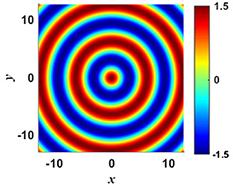
Figure 1. Schematic illustration of the 2D profile of the radially periodic potential $V_\mathrm{ext}(r) = 1.5\cos(1.5r), r = \sqrt{x^2+y^2}$. |
We numerically minimize the Hamiltonian in equation (1 ) by the method of imaginary time propagation [60]. In the numerical calculations, the units for time, length, and energy are measured in $\frac{1}{\omega_{\bot}}$, $\sqrt{\frac{\hbar}{M\omega_{\bot}}}$ and $\hbar\omega_{\bot}$ respectively, with $\omega_{\bot}$ being the frequency of radially periodic trap. The energy functional is written as
$\begin{align} E &= \frac{1}{2} \iint \mathrm{d}x\mathrm{d}y \Bigg\{\sum_i \left[ |\nabla \Phi_i|^2 + 2V_\mathrm{ext} n + \textit{g}_0 n^2 \right] \nonumber\\ &\quad + \textit{g}_2 \left[ n_1^2 + n_{-1}^2 + 2(n_1 n_0 + n_{-1} n_0 - n_1 n_{-1} \right.\nonumber\\ & \quad \left.- n_1 n_{-1} - \Phi_1^* \Phi_0^2 \Phi_1^* + \Phi_1 \Phi_0^{*2} \Phi_1) \right] \nonumber\\ & \quad + 2\kappa \left[ -\mathrm{i}(\Phi_0^* + \Phi_{-1}^*) \partial x + (\Phi_0^* - \Phi_{-1}^*) \partial y \right] \Phi_1 \nonumber\\ & \quad + 2\kappa \left[ -\mathrm{i}(\Phi_1^* + \Phi_{-1}^*) \partial x + (\Phi_{-1} - \Phi_1^*) \partial y \right] \Phi_0 \nonumber\\ & \quad + 2\kappa \left[ -\mathrm{i}(\Phi_1^* + \Phi_0^*) \partial x + (\Phi_1^* - \Phi_0^*) \partial y \right] \Phi_{-1} \Bigg\} \nonumber\\ & \quad + \frac{1}{2} \iint \mathrm{d}x\mathrm{d}y \iint \mathrm{d}x^{^{\prime}}\mathrm{d}y^{^{\prime}} \nonumber\\ & \quad \times \sum_{i,j = 0,\pm 1} \Phi_i^*(\boldsymbol{r}) \Phi_j^*(\boldsymbol{r}^{^{\prime}}) U_{ij}(\boldsymbol{r}-\boldsymbol{r}^{^{\prime}}) \Phi_j(\boldsymbol{r}^{^{\prime}}) \Phi_i(\boldsymbol{r}).\end{align}$
We adopt many different initial functions and propagate it to get a stationary state, and the stationary states achieved here are stable.3. Results and discussion
3.1. Ground states in the absence of soft-core interaction
We first consider the ground states of the system in the absence of soft-core long-range interactions, i.e. $\widetilde{C}_6 = 0$. In this case, we demonstrate the ground states of SU(3) spin-orbit coupled BEC trapped by the radially periodic potential in figures 2(a) and (b) with fixed SOC strength κ = 2, but different frequency of the external potential. The system is in phase mixing by observing the density distributions of Φ1 and $\Phi_{\text{total}}$ in figure 2(a) for ferromagnetic interaction. The periodic ring structure and threefold-degenerate magnetized phase is formed with spatial translational symmetry preserved, and the ground states occupy one single minimum in the momentum space, as can be seen in figure 2(a). There is no typical vortex structure in figure 2(a) according to the phase diagram of Φ1 and the transverse magnetization. In order to observe more clearly, we present the local expansion plot of transverse magnetization in the sixth column of figure 2.
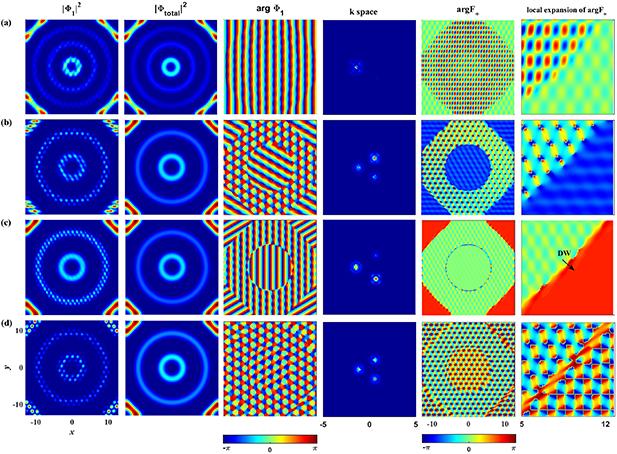
Figure 2. Typical ground state density and phase distribution of SU(3) spin-orbit-coupled BECs trapped in the radially periodic potential (a) $V_\mathrm{ext} = 1.5\cos(1.5r)$ and (b), (c) $V_\mathrm{ext} = 1.5\cos(1r)$ with the strength of spin-orbit coupling (a), (b) κ = 2, (c) κ = 2.5 and zero soft-core interaction. The corresponding momentum distribution, transverse magnetization and the local expansion of the transverse magnetization are exhibited in the fourth, fifth and last column. The spin-independent interaction and the spin-dependent interaction are chosen as $\textit{g}_0 = 10$, $\textit{g}_2 = -1$. (d) The ground state density and phase distribution of SU(3) spin-orbit coupled BEC trapped in radially periodic potential for the antiferromagnetic spin interaction $\textit{g}_2 = 1$, other parameters are same as figure 2(b). Domain wall (DW) structure is marked by an arrow in figure 2(c). |
By changing the frequency of the external trap $V_\mathrm{ext} = 1.5\cos(r)$ in figure 2(b), the discontinuous circular structure of ground states appears in Φ1 and we note that the ground state distributions of three components are similar. Differently from figure 2(a), isolated lumps form in each ring of the radially periodic potential, as shown by the density configurations of figure 2(b). Meanwhile, threefold-degenerate magnetized phases are preserved in the interior of the trap, but different phase behavior occurred in the annular region, implying the emergence of a vortex lattice, which can be confirmed by the local expansion of transverse magnetization in figure 2(b). In this case, three minima are occupied in the momentum space, which is unstable in SU(2) spin-orbit coupled BECs. As the strength of SOC increases to κ = 2.5, we find a similar ground state structure in figure 2(c), where a threefold-degenerate phase emerges in the center and ring region of the potential. As shown in the transverse magnetization distribution of Figure 2(c), the condensate forms two distinct spin domains: a central domain with phase ≈ 0 (green) and corner domains with phase $\approx \pi$(red), separated by a clear DW structure (highlighted by the black arrow). In this case, atomic spins tend to arrange in parallel for ferromagnetic interaction, but SOC makes the spin direction change with the direction of particle motion. Therefore the DWs emerge in condensate to balance ferromagnetic interaction with SU(3) SOC.
We now turn our attention to the ground states in the antiferromagnetic interaction case. Our numerical results reveal the presence of vortices with topological charge $Q = +1$ (phase increases by 2π counterclockwise) and antivortices with $Q = -1$ (phase increases by 2π clockwise), which are marked by a black circle (vortex) and a white circle (antivortex) in the local expansion of argΦ1, as can be seen in figure 3(d). This can be understood by the fact that the hexagonal vortex lattice coordinates the competition between the antiferromagnetic interaction energy, the SOC kinetic energy and the strong circular constrained potential energy.
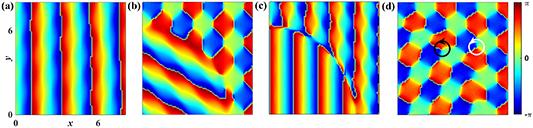
Figure 3. Corresponding enlarged views of phase diagrams for the cases of figures 2(a)-(d). In panel (d), a black circle denotes a vortex and a white circle denotes an antivortex. |
3.2. Ground states with the addition of soft-core interaction
3.2.1. Ferromagnetic spin interaction.
Next, we investigate the effect of the soft-core long-range interaction potential on the ground states for the case of ferromagnetic spin interaction. Different ground state structures are exhibited in figures 4(a) and (b) with varied Rydberg blockade radius $R_c = 1$ and $R_c = 3$. The phase exhibits a uniform linear gradient along the radial direction, reflecting the spatially periodic phase modulation of the stripe phase without vortex topological defects, as shown in the phase diagram of figure 4(a). Due to the suppression of the radially periodic potential by the soft-core long-range interaction, we find that the spontaneous breaking of symmetry occurs in the density of Φ1, which can be seen in figure 4(a). The increase of the Rydberg blockade radius leads to the emergence of isolated density peaks at the locations of periodic potential, as shown in figure 4(b), which can be explained by the fact that a wider range of soft-core interaction reduces trapping confinement. According to the phase and transverse magnetization distributions in figure 4(b), the arrangement of vortices is more affected by the radially periodic potential, which is different from the case of $R_c = 1$ in figure 4(a).
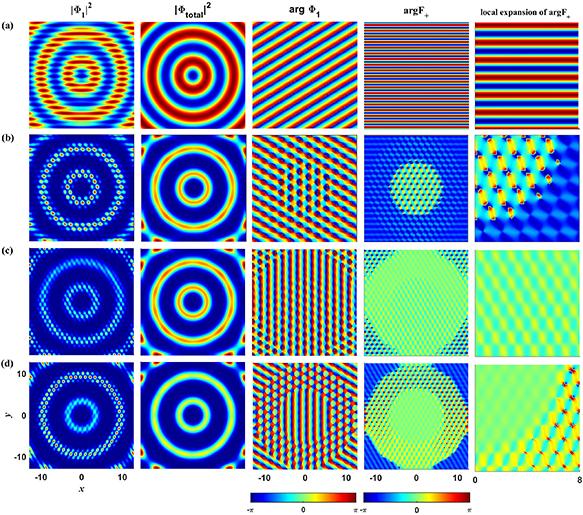
Figure 4. Typical ground state density and phase distributions of SU(3) spin-orbit-coupled BECs trapped in radially periodic potential (a)-(c) $V_\mathrm{ext} = 1.5\cos(1r)$ (d) $V_\mathrm{ext} = 2\cos(1r)$ with fixed soft-core long-range interaction $\widetilde{C}_6 = 800$ for varied blockade radius (a) $R_c = 1$ (b)-(d) $R_c = 3$. The spin-independent and the spin-dependent interactions are chosen as $\textit{g}_0 = 10$, $\textit{g}_2 = -1$, the strengths of spin-orbit coupling are taken as (a), (b) κ = 2, (c), (d) κ = 2.5. |
With increasing the SOC strength to κ = 2.5, a threefold-degenerate magnetized phase occurs in the interior of the radially periodic potential with a stronger SOC for the ferromagnetic spin interaction, as shown in figure 4(c). If we consider the effect of potential, the deeper trap leads to the stable existence of more atoms in each ring, which can be observed by comparing between figures 4(c) and (d).
3.2.2. Antiferromagnetic spin interaction.
In addition, we study the ground states of the system with a soft-core long-range interaction for the case of the antiferromagnetic spin interaction. Different ground state phases are described in figures 5(a) and (b) with varied Rydberg blockade radius $R_c = 1$ and $R_c = 3$ for fixed antiferromagnetic spin interaction $\textit{g}_0 = 1$. If we pay attention to the phase and transverse magnetization distributions in figure 5(a), we find that there is no vortex or topological singularity in the system. The stationary states with a stripe phase form because the antiferromagnetic spin interaction restricts the change of spin direction. With the increase of the Rydberg blockade radius to $R_c = 3$, a wider range of effective long-range interaction potential leads to isolated density peaks, which is similar to figure 4(b). In this case, a vortex lattice emerges in such a system due to the existence of the soft-core long-range interaction.
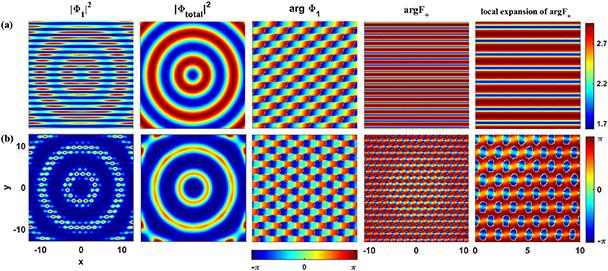


Figure 5. Typical ground state density and phase distributions of SU(3) spin-orbit-coupled BECs trapped in the radially periodic potential (a), (b) $V_\mathrm{ext} = 1.5\cos(1r)$ with fixed soft-core long-range interaction $\widetilde{C}_6 = 800$ and varied blockade radius (a) $R_c = 1$ (b) $R_c = 3$. The spin-independent and spin-dependent interactions are chosen as $\textit{g}_0 = 10$, $\textit{g}_2 = 1$, the strength of spin-orbit coupling is taken as κ = 2. |
4. Conclusion
In this paper, we have investigated the ground states of SU(3) SOC BECs with soft-core interaction trapped in the radially periodic potential. Our results show that the interplay between SOC, soft-core interaction, and radially periodic potential can give rise to a rich variety of ground-state configurations. It is found that vortices, DWs and hexagonal vortex lattices can be formed in the absence of effective soft-core interaction potential. Under the influence of soft-core long-range interaction, different density configurations and symmetries can be observed for such a system. Our results further enrich our knowledge on the SU(3) SOC BECs in radially periodic potential, which may be extended in the field of data storage, with the radially periodic potential used for encoding data separately.