

1. Introduction
Semiconductor quantum dots (QDs) are prototypical zero-dimensional nanostructures in which charge carriers are confined in all three spatial directions. Owing to their discrete energy spectra, atom-like optical transitions, and size-tunable electronic properties, QDs have attracted sustained interest for both fundamental studies and technological applications, including infrared photodetectors, lasers, solar cells, and quantum information devices [1-4]. The ability to engineer confinement at the nanoscale makes QDs an ideal platform for tailoring electronic structure and optical response through external parameters such as geometry [5, 6], material composition [7-9], and confinement potential [10-12].
From a theoretical perspective, a wide variety of confinement models have been explored to describe carrier localization in QDs. Commonly studied examples include the parabolic potential [13], Gaussian and exponential confinements [14, 15], Rosen-Morse axial potential [16, 17], Kratzer-Coulomb potential [18, 19], Tietz potential [20], Woods-Saxon type [21], and Coulomb- and Hellmann-type potentials [22, 23]. Each model captures different physical aspects of realistic nanostructures and offers distinct levels of analytical tractability. Among them, the inverse-quadratic Hellmann (IQH) potential has recently attracted attention due to its flexible radial profile, which interpolates between Coulombic and short-range behaviors and allows effective tuning of confinement strength and characteristic length scales. Importantly, the IQH potential admits analytical or quasi-analytical solutions for the Schrödinger equation (SE), providing valuable physical insight into confined states and transition mechanisms [24-26].
Beyond purely radial confinement, angular-dependent potentials play a crucial role in describing non-spherical and ring-like nanostructures. In particular, ring-shaped (RS) potentials introduce an additional angular confinement that redistributes the probability density away from the polar axis and modifies the degeneracy and spacing of energy levels. Such RS contributions have been shown to induce pronounced anisotropy in wavefunction (WF) localization and to alter optical selection rules [27, 28]. Motivated by these features, combining an IQH radial confinement with an RS angular term offers a promising route to construct a versatile and physically transparent model that captures both radial tunability and angular reshaping of quantum states. This combined IQH-RS potential (IQHRSP) forms the basis of the present work. It is worth noting that, although angular-dependent confinement may induce certain ring-like features in the energy spectrum, the present system remains a three-dimensional QD rather than a true quantum ring structure [29, 30].
Optical absorption is one of the most sensitive probes of quantum confinement in low-dimensional systems [31-35]. In QDs, both intra-band and inter-band optical transitions provide direct information about energy-level structure, WF overlap, and symmetry properties [24-26]. Intra-band absorption typically occurs in the infrared or terahertz range and is strongly influenced by Pauli blocking and temperature-dependent occupation factors, whereas inter-band absorption involves higher photon energies and reflects the combined effects of band gaps, joint density of states, and dipole coupling [36-38]. Understanding how confinement geometry and potential shape affect these optical processes is essential for designing QD-based optoelectronic devices with tailored spectral characteristics. Recent studies on low-dimensional quantum systems have emphasized the role of non-central and anisotropic confinement in tuning carrier localization and optical transitions. Such tailored potentials can significantly modify absorption spectra, including spectral shifts and intensity redistribution [39, 40], highlighting the importance of analytically tractable models.
Despite extensive studies on optical absorption in QDs under various confinement models, the combined influence of IQH radial confinement and RS angular modulation on both intra- and inter-band optical absorption remains largely unexplored. In particular, a fully analytical treatment that links confinement parameters to energy spectra, WF localization, and optical transition strengths within a unified framework is still lacking. Addressing this gap is important not only for clarifying the role of angular confinement in optical activity but also for establishing analytically solvable models that can serve as reliable standards for more complex numerical approaches.
In this work, we present a comprehensive theoretical study of intra- and inter-band optical absorption in GaAs QDs confined by an IQH RS potential. The electronic structure is obtained analytically using the Nikiforov-Uvarov (NU) method [21, 41-43], enabling closed-form expressions for energy levels and WFs. Based on these solutions, the optical absorption coefficient (OAC) is evaluated within the electric-dipole approximation. We demonstrate that the RS angular contribution significantly reshapes the energy spectrum and WF localization, leading to reduced level spacing and modified optical selection rules. Furthermore, we show that confinement depth and characteristic length provide efficient control over both the position and intensity of absorption peaks. These results highlight the versatility of the IQHRSP model for engineering optical responses in QDs.
2. Exact analytical treatment of the IQHRSP QD
We consider a spherical semiconductor QD in which charge carriers are confined by an IQHRSP. This confinement model is constructed by extending the IQH potential [24] through the inclusion of a RS angular term [27, 28]. The resulting potential simultaneously incorporates the radial features of the IQH profile and the angular anisotropy characteristic of RS confinement. It is given by
$\begin{align} V\left(r,\theta\right) = -V_0\left(-\frac{r_0}{r} + \frac{r_0^2}{r^2} \mathrm{e}^{-r/r_0}\right) +\frac{\beta}{r^2}\cot^2\theta ,\end{align}$
where V0 determines the radial confinement depth, while β characterizes the RS angular contribution. In the present formulation, these parameters are related to the confinement strength $V_{0i}$ $(i = e,h)$ via $V_0 = V_{0i}$ and $\beta = V_{0i}r_0^2$, ensuring that both the depth and geometry of the potential are controlled by physically transparent quantities.A key advantage of the IQHRSP is that it preserves the separability of the SE in spherical coordinates, allowing an exact analytical treatment of both the angular and radial degrees of freedom. The stationary envelope function can therefore be written as 2 ) into the SE yields two decoupled eigenvalue problems
$\begin{align} \psi_{n\ell m}\left(r,\theta,\phi\right) = R_{n\ell}\left(r\right)\Theta\left(\theta\right)\mathrm{e}^{\mathrm{i}m\phi}/\sqrt{2\pi},\end{align}$
where m is the magnetic quantum number. Substituting equation ($align$
$align$
The radial confinement enters through the effective potential 3 ) is transformed into 6 ) admits exact solutions in terms of associated Legendre functions,
$\begin{align} V_\textrm{eff}\left(r\right) = -V_0\left(-\frac{r_0}{r} + \frac{r_0^2}{r^2} \mathrm{e}^{-r/r_0}\right) +\frac{\hbar^2\nu}{2m^*r^2},\end{align}$
where the second term acts as an effective centrifugal barrier determined self-consistently by the angular eigenvalue ν. Importantly, this form retains an analytically solvable structure, enabling closed-form expressions for both the energy spectrum and the eigenfunctions. Introducing the variable $x = \cos\theta$, the angular equation ($\begin{align} \frac{\mathrm{d}^2\Theta}{\mathrm{d}x^2} -\frac{2x}{1-x^2}\frac{\mathrm{d}\Theta}{\mathrm{d}x} +\frac{\nu_1\left(1-x^2\right)-m_1^2}{\left(1-x^2\right)^2}\Theta = 0,\end{align}$
with $\begin{align} \nu_1 = \nu+\frac{2m^*\beta}{\hbar^2},\qquad m_1^2 = m^2+\frac{2m^*\beta}{\hbar^2}.\end{align}$
Equation ($\begin{align} \Theta_{\ell,m}\left(\cos\theta\right) = A_{\ell,m} P_{\ell_1}^{m_1}\left(\cos\theta\right),\end{align}$
with normalization $\begin{align} A_{\ell,m} = \sqrt{\frac{2\ell_1+1}{2} \frac{\left(\ell_1-m_1\right)!}{\left(\ell_1+m_1\right)!}},\end{align}$
and eigenvalue condition $\begin{align} \nu_1 = \ell_1\left(\ell_1+1\right),\end{align}$
where $\ell_1 = \ell+m_1-m$ with $\ell$ being the orbital quantum number. This exact angular solution explicitly incorporates the RS contribution through the renormalized quantum numbers m1 and $\ell_1$. It is important to note that, due to the presence of the angular-dependent term in the confinement potential, the system no longer possesses strict spherical symmetry. As a consequence, the orbital quantum number $\ell$ is not a rigorous good quantum number, and the corresponding eigenstates should, in general, be regarded as mixtures of different angular momentum components [44]. Nevertheless, within the present analytically solvable framework, the quantum number $\ell$ can still be used as an effective labeling index that reflects the dominant angular character of the state. Accordingly, the notations s, p, and d adopted in this work refer to the leading orbital contribution and are used for convenience in describing the transition pathways.With the separation constant ν fixed analytically, the radial equation reduces to 11 ) belongs to a class of exactly solvable second-order differential equations and can be treated analytically using the NU method [21, 41-43]. The normalized radial eigenfunctions are obtained as
$\begin{align} \frac{\mathrm{d}^2R_{n\ell}}{\mathrm{d}r^2} +\frac{2}{r}\frac{\mathrm{d}R_{n\ell}}{\mathrm{d}r} +\frac{-\xi_1 r^2+\xi_2 r-\xi_3}{r^2}R_{n\ell} = 0,\end{align}$
where $\begin{align} \xi_1 & = -\frac{2m^*}{\hbar^2} \left(E_{n\ell}-\frac{V_0}{2}\right),\end{align}$
$\begin{align} \xi_2 & = \frac{4m^*V_0r_0}{\hbar^2},\end{align}$
$\begin{align} \xi_3 & = \frac{2m^*V_0r_0^2}{\hbar^2}+\nu.\end{align}$
Equation ($\begin{align} R_{n\ell}\left(r\right) = N_{n\ell}\, r^{\left(\chi-1\right)/2} \mathrm{e}^{-\sqrt{\xi_1}r} L_n^{\chi}\left(2\sqrt{\xi_1}r\right),\end{align}$
with $\chi = \sqrt{1+4({2m^*V_0r_0^2}/{\hbar^2}+\nu)}$ and $\begin{align} N_{n\ell} = \sqrt{\frac{\left[2\sqrt{\frac{2m^*}{\hbar^2} \left(\frac{V_0}{2}-E_{n\ell}\right)}\right]^{\chi+2}n!} {\left(2n+\chi+1\right)\left(n+\chi\right)!}} .\end{align}$
The corresponding discrete energy spectrum is given explicitly by $\begin{align} E_{n\ell} = \frac{V_0}{2} -\frac{2m^*}{\hbar^2} \frac{\left(2V_0r_0\right)^2}{\left[2n+1+\chi\right]^2}.\end{align}$
The availability of closed-form expressions for both eigenvalues and eigenfunctions highlights the analytic solvability of the IQHRSP model. The explicit dependence of $E_{n\ell}$ on V0 and r0 provides direct physical insight into how confinement strength and geometry control the energy spectrum and, consequently, the optical transition energies analyzed in the following sections. In the limit β → 0, the RS contribution vanishes, yielding $m_1\to m$ and $\ell_1\to\ell$, and the model reduces smoothly to the IQH potential [24].
Figure 1 highlights that tuning β via the RS component provides an additional geometric control parameter which simultaneously impacts level positioning, spatial localization, and optical transition pathways in the IQHRSP QD. It shows that the inclusion of the RS angular term $(\beta\neq 0)$ alters both the effective confinement and the spatial localization of the low-lying states. For $(\beta\neq 0)$, the enhanced centrifugal contribution increases the separation constant ν and shifts $V_\textrm{eff}(r)$ upward, which drives the discrete levels toward higher energies and displaces the corresponding radial probability densities $|R_{n\ell}(r)|^{2}r^{2}$ to larger r. In contrast, when $(\beta = 0)$, the effective barrier is reduced, and the WFs extend more uniformly toward the center of the dot. From an optical perspective, these qualitative trends are relevant for two main reasons. First, the upward shift and compression of the discrete spectrum for $(\beta\neq 0)$ reduce the energy spacing between adjacent shells, indicating that both intra- and inter-band resonances will emerge at lower photon energies. Second, the modified spatial overlap between states satisfying $\ell_1\rightarrow\ell_1\pm 1$ directly influences the dipole matrix elements and thus the intensity of allowed transitions. The Fermi level $E_{\mathrm{F}} = -0.01\,\mathrm{eV}$ indicated in the figure serves as an occupation reference, showing which initial and final states remain Pauli-allowed in subsequent absorption calculations. These features may resemble those found in quantum ring systems, however, they originate here from angular modulation of the confinement potential rather than from a RS geometry.
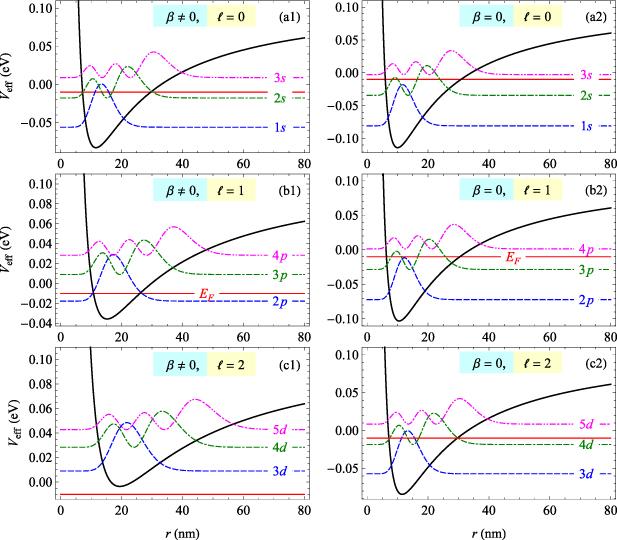
Figure 1. Effective potential $V_\textrm{eff}(r)$ and radial densities $|R_{n\ell}(r)|^{2}r^{2}$ for (a1), (a2) $\ell = 0$, (b1), (b2) $\ell = 1$, and (c1), (c2) $\ell = 2$. Left panels: IQHRSP with RS term $(\beta\neq 0)$; right panels: β = 0. Parameters: $m_e^{*} = 0.067m_0$, V0 = 228 meV, $r_{0} = 10$ nm. Red lines mark $E_\textrm{F} = -0.01$ eV. |
3. OAC in IQHRSP QD
When a confined quantum system interacts with an electromagnetic field of photon energy $\hbar\Omega$, optical transitions are induced between discrete eigenstates, giving rise to light absorption. For an incident radiation characterized by the amplitude E0, the corresponding light intensity is expressed as $I_0 = c\epsilon_0 n_r E_0^2/2$ [32], where c is the speed of light, nr is the refractive index of the surrounding medium, and ϵ0 is the vacuum permittivity. Within the dipole approximation and linear-response regime, the OAC can be written as [31-35]
$\begin{align} \alpha\left(\Omega\right) = \frac{\hbar\Omega}{I_0 V} \sum_{i,f} W_{fi}\,\left[\,f\left(E_i\right)-f\left(E_f\right)\right],\end{align}$
where V denotes the system volume, and the summation extends over all initial states $|i\rangle = |n,\ell,m\rangle$ and final states $|\,f\,\rangle = |n^{^{\prime}},\ell^{^{\prime}},m^{^{\prime}}\rangle$. The factors $f(E_{i/f}) = [1+\exp((E_{i/f}-E_\textrm{F})/k_\mathrm{B} T)]^{-1}$ represent the Fermi-Dirac occupation probabilities, accounting for quantum statistical effects through the Fermi level $E_\textrm{F}$ and temperature T.The transition probability per unit time between two states is determined by Fermi's golden rule
$\begin{align} W_{fi} = \frac{2\pi}{\hbar}E_0^2 |d_{fi}|^2 \delta\left(E_{fi}-\hbar\Omega\right),\end{align}$
where $E_{fi} = E_f-E_i$ is the transition energy and $d_{fi} = e\langle\, f\,|\boldsymbol{e}\cdot\boldsymbol{r}|i\rangle$ is the electric dipole matrix element. The unit vector e specifies the polarization direction of the incident field, while the Dirac delta function enforces energy conservation during the optical transition. For interband transitions, the dipole matrix element should formally include both Bloch and envelope contributions. In this work, the Bloch part is treated as an effective constant, while the envelope-function overlap governs the transition probability. This approximation allows a unified description of intra- and inter-band absorption and does not affect the qualitative trends discussed below.For light polarized along the z-axis, the dipole operator reduces to $\boldsymbol{e}\cdot\boldsymbol{r} = r\cos\theta$, and the dipole matrix element factorizes into angular and radial contributions
$\begin{align} d_{fi} = e\langle \,f\,|r\cos\theta|i\rangle = e\,\delta_{m^{^{\prime}},m}\,I_{\theta}\,I_r,\end{align}$
where the angular integral $\begin{align} I_{\theta} = \sqrt{\frac{\left(\ell_1+1\right)^2-m_1^2}{\left(2\ell_1+1\right)\left(2\ell_1+3\right)}}\delta_{\ell_1^{^{\prime}},\ell_1+1} + \sqrt{\frac{\ell_1^2-m_1^2}{4\ell_1^2-1}}\delta_{\ell_1^{^{\prime}},\ell_1-1},\end{align}$
explicitly encodes the dipole selection rule $\ell^{^{\prime}}_1 = \ell_1\pm1$, while the radial overlap integral is given by $\begin{align} I_r& = N_{n\ell}N_{n^{^{\prime}}\ell^{^{\prime}}} \begin{pmatrix} n^{^{\prime}}+\chi^{^{\prime}}\\ n^{^{\prime}} \end{pmatrix} \begin{pmatrix} n+\chi\\ n \end{pmatrix} \frac{\Gamma\left(\zeta\right)}{\kappa^\zeta}\nonumber\\ &\quad\times F_{2}\left[\zeta,-n^{^{\prime}},-n; \chi^{^{\prime}}+1,\chi+1; \frac{\mu^{^{\prime}}}{\kappa},\frac{\mu}{\kappa}\right],\end{align}$
with $\zeta = (\chi^{^{\prime}}+\chi)/2+3$, $\mu = 2\sqrt{\xi_1}$, and $\kappa = \sqrt{\xi_1^{^{\prime}}}+\sqrt{\xi_1}$. Here, Γ denotes the Gamma function, the binomial coefficients arise from the normalization of the radial WFs, and F2 is the Appell hypergeometric function [45].Equation (18 ) thus provides a microscopic description of optical absorption in the confined system. Optical transitions contribute to absorption only when two conditions are simultaneously satisfied: (i) the initial and final states obey the Pauli exclusion principle through the occupation difference $\Delta f = f(E_i)-f(E_f)$, and (ii) the photon energy matches the transition energy via $\delta(E_{fi}-\hbar\Omega)$. The overall absorption strength is further governed by the dipole matrix element, which reflects both the symmetry of the eigenstates and their spatial overlap, as well as the polarization of the incident radiation.
4. Results and discussion
To examine the impact of IQHRSP confinement on intra- and inter-band optical absorption, we calculate the OAC spectra of GaAs QDs using standard material parameters [46, 47]: $m_e^* = 0.067m_0$, $m_h^* = 0.079m_0$, $E_g = 1.607$ eV, $n_r = 3.2$, and $V_{0h} = 0.67V_{0e}$ with $V_{0e} = 228$ meV. Spectral broadening is introduced by replacing the Dirac delta in equation (18 ) with a Lorentzian of width 2 meV. Unless otherwise stated, calculations are performed for m = 0, providing a realistic basis for analyzing confinement-induced modifications of optical absorption. It should be noted that electron-hole Coulomb interaction [48] is neglected in the present model. Its inclusion would lead to excitonic corrections, mainly resulting in a red-shift of interband transition energies without altering the qualitative trends discussed here.
Figure 2 provides a direct comparison of the intra-band OAC spectra at T = 0 for $\ell = 0$, showing how the RS angular term reshapes the set of Pauli-allowed transitions. At zero temperature, only excitations from occupied states below $E_\textrm{F}$ to empty states above it are permitted, so the optical response is determined by the relative ordering of s- and p-shells identified in figure 1.
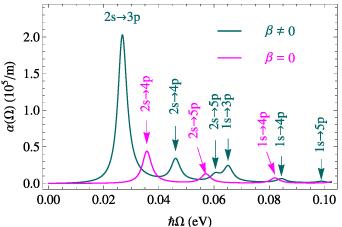
Figure 2. Intra-band OAC spectra at T = 0 for $\ell = 0$ with and without the RS angular term, evaluated at $V_0 = V_{0e}$ and r0 = 10 nm. The case $(\beta\neq 0)$ exhibits modified peak locations and redistributed spectral weight compared to the β = 0 limit. |
In the β = 0 case, the $E_\textrm{F}$ is located above the 2p and 3p shells but still below the 4p states (see figure 1(b2)). As a result, only transitions ending in the 4p shell remain Pauli-allowed at T = 0. Consequently, only transitions that terminate in the first available p-levels contribute to the spectrum. These channels include $1s\rightarrow 4p$, $2s\rightarrow 4p$, and $2s\rightarrow 5p$, which account for the limited set of resonances observed in the β = 0 spectrum. The sparse structure reflects the relatively large energy spacing and reduced number of accessible final states in the absence of angular coupling. When the RS term is introduced $(\beta\neq 0)$, the modified separation constant ν shifts certain p-shells upward, placing more of them above $E_\textrm{F}$. This activates additional transitions such as $1s\rightarrow 3p$ and $2s\rightarrow 3p$, which are Pauli-blocked in the β = 0 limit. In addition, channels involving higher p-shells (e.g. $1s\rightarrow 4p$ and $2s\rightarrow 4p$) remain active. The appearance of extra resonances directly reflects the reduced energy spacing induced by the RS angular contribution.
Differences in intensity are also apparent. The $(\beta\neq 0)$ spectra exhibit stronger peak amplitudes than the β = 0 case, indicating that the RS term enhances the relevant dipole matrix elements through altered spatial overlap between initial s- and final p-states. Therefore, the RS term not only expands the number of optically accessible channels but also strengthens the oscillator strengths of the corresponding transitions.
Figure 3 illustrates the temperature dependence of intra-band OAC spectra for different orbital quantum numbers $\ell$, with the Fermi level fixed at $E_\textrm{F} = -0.01$ eV. As indicated in figure 1, this choice places $E_\textrm{F}$ between the 2s-3s and 2p-3p shells, thereby providing a convenient reference to distinguish Pauli-allowed and Pauli-blocked transitions. The comparison between T = 0 and T = 300 K directly reveals how thermal population modifies the intra-band optical response without altering the underlying energy spectrum.
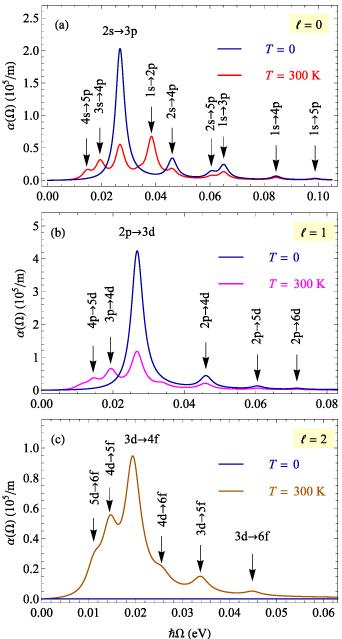
Figure 3. Intra-band OAC spectra for $\ell = 0$, 1, and 2 calculated at $V_0 = V_{0e}$ and r0 = 10 nm, shown for T = 0 and T = 300 K to illustrate the effect of thermal occupation on optically allowed transitions. |
For $\ell = 0$ (figure 3(a)), the absorption at T = 0 is dominated by the $2s\to 3p$ transition, since lower channels such as $1s\to 2p$ are blocked by full occupation, while higher-energy processes involving 3s or 4s remain inactive because both participating states lie above $E_\textrm{F}$. When the temperature increases to 300 K, partial thermal depopulation of the 2p level and population of higher s-states activate additional channels, including $1s\to 2p$, $3s\to 4p$, and $4s\to5p$. Some of these transitions appear as distinct new peaks, while others overlap due to nearly degenerate transition energies. It notes that, temperature affects only the peak intensities through Fermi-Dirac factors, whereas peak positions remain fixed by the energy differences $\hbar\Omega = E_{fi}$. A similar but progressively stronger thermal effect is observed for $\ell = 1$ (figure 3(b)) At T = 0, the optical response is essentially governed by the $2p\rightarrow 3d$ transition, as higher-p shells remain unoccupied and thus inactive. At finite temperature, partial occupation of the 3p and 4p levels enables additional transitions such as $3p\rightarrow 4d$ and $4p\rightarrow 5d$, leading to a richer multi-peak structure in the spectrum. For $\ell = 2$ (figure 3(c)), all relevant d-states lie above $E_\textrm{F}$, resulting in a complete suppression of intra-band absorption at T = 0. Thermal excitation at 300 K partially populates these states, unlocking a sequence of $d\rightarrow f$-type transitions and producing a pronounced absorption response that is entirely temperature-induced.
Thus, figure 3 highlights two key physical roles of temperature. First, thermal excitation lifts Pauli blocking and activates otherwise forbidden intra-band channels, substantially reshaping the absorption spectra. Second, as $\ell$ increases, the reduced radial energy spacing leads to a systematic redshift and spectral compression, making the temperature-dependent intra-band OAC a sensitive probe of both orbital structure and carrier statistics in confined quantum systems.
Figure 4 shows the inter-band OAC in IQHRSP QD spectra at T = 300 K, corresponding to optical transitions between states in different energy bands. Compared with the intra-band response, the spectra are characterized by absorption peaks at much higher photon energies and with significantly larger amplitudes, reflecting the band-to-band nature of the excitations. For $\ell = 0,1,$ and 2, the dominant contributions arise from the lowest dipole-allowed channels, namely $2s\rightarrow 3p$, $2p\rightarrow 3d$, and $3d\rightarrow 4f$, respectively. The pronounced blue-shift of the inter-band resonances originates from the requirement that the transition energy $\hbar\Omega = E_{fi}$ must overcome both the confinement-induced level spacing and the semiconductor band gap. The enhanced peak amplitudes result from the combined effect of the $\hbar\Omega$ prefactor in equation (18 ), the increased joint density of states, and the stronger overlap between valence- and conduction-band envelope functions. In GaAs QDs, differences in effective mass and orbital symmetry between the two bands further amplify the dipole matrix elements dfi, yielding higher oscillator strengths than those associated with intra-band processes.
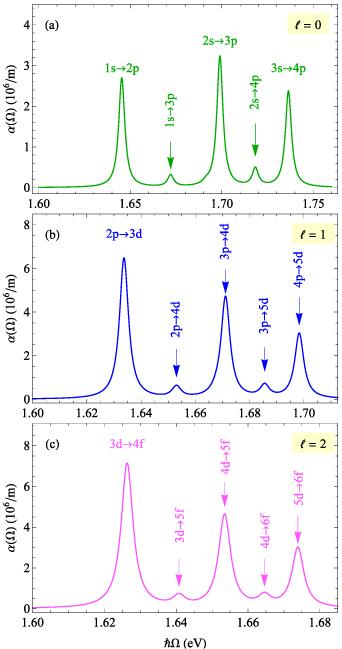
Figure 4. Inter-band OAC spectra calculated at T = 300 K for $V_0 = V_{0e}$ and r0 = 10 nm. The remaining parameters are identical to those used in figure 3. |
A direct comparison with figure 3 clarifies the distinct physical roles of temperature and band structure. While intra-band absorption is strongly regulated by Fermi-Dirac occupation factors f(E) and the thermal lifting of Pauli blocking, inter-band absorption is governed primarily by band-to-band energy differences and confinement-modified WF overlap, with temperature playing only a secondary role. Besides, it is worth noting that the enhancement of inter-band absorption observed here is consistent with earlier results obtained for QDs confined by the IQH potential [24, 25, 49]. In that case, the stronger inter-band response was attributed mainly to the intrinsic band-to-band character of the transitions. In contrast, within the IQHRSP model, similar enhancement arises from a smooth radial modulation combined with angular coupling, which reshapes level spacing and WF localization. This distinction highlights that, beyond reproducing known trends, the IQHRSP model introduces an additional angular degree of freedom, providing a more versatile route for tailoring inter-band optical properties compared to purely radial confinement models.
Figure 5 shows the dependence of the OAC spectra on the characteristic length r0 for both intra-band (a) and inter-band (b) $1s\to 2p$ transitions. A systematic red-shift of the absorption peaks is observed as r0 increases, accompanied by a gradual reduction in peak amplitude. These trends follow directly from equation (18 ), where the peak position is determined by the transition energy $E_{fi} = E_f-E_i$, while the intensity scales with the factor $\Delta f/V$. As r0 increases, the confinement becomes weaker, and the QD effectively expands. Consequently, both the initial and final energy levels shift downward, and their separation decreases, leading to a reduced transition energy and hence lower photon energies. At the same time, the inset of figure 5 shows that $\Delta f/V$ decreases monotonically with r0, explaining the observed suppression of the absorption intensity. Physically, the enlarged spatial extent of the wavefunctions at larger r0 reduces quantum confinement and weakens the spatial overlap between the 1s and 2p states. This results in smaller dipole matrix elements and lower oscillator strengths for both intra- and inter-band processes. The combined red-shift and intensity reduction are consistent with earlier studies employing different confinement models [19, 25], while the present IQHRSP model further highlights how the interplay between radial size modulation and angular confinement provides additional flexibility in controlling optical absorption in QDs.
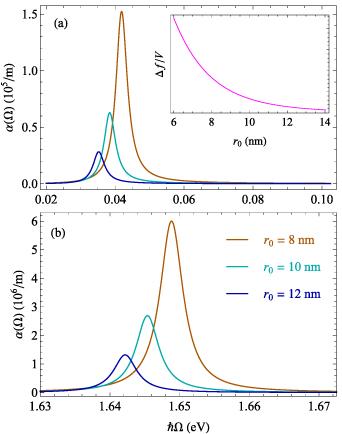
Figure 5. OAC spectra of the (a) intra-band and (b) inter-band $1s\to 2p$ transitions as a function of r0. The inset shows the dependence of $\Delta f/V$ on r0. Other parameters are the same as in figure 3. |
Figure 6 depicts the evolution of the OAC spectra for intra-band (a) and inter-band (b) $1s\to 2p$ transitions as the confinement depth V0 varies within the range $0.8V_{0e}$-$1.2V_{0e}$. Two clear trends can be identified: a systematic shift of the absorption peaks toward higher photon energies and a non-monotonic variation of their amplitudes. With increasing V0, both intra- and inter-band resonances undergo a pronounced blue shift. This behavior directly reflects the increase of the transition energy Efi under stronger confinement, as dictated by equation (18 ). A deeper potential well pushes the discrete energy levels apart, thereby requiring a larger photon energy $\hbar\Omega$ to activate the $1s\to 2p$ transition. The shift is observed in both panels, confirming that the energetic position of the absorption peaks is primarily governed by confinement-enhanced level spacing, regardless of whether the transition is intra- or inter-band. In contrast, the peak amplitudes exhibit a non-monotonic dependence on V0. As V0 increases from $0.8V_{0e}$, the absorption intensity initially rises, reaches a maximum, and then decreases as V0 approaches $1.2V_{0e}$. The inset of figure 6(a) reveals that the occupancy factor Δf follows the same non-monotonic trend over the examined interval. Since the peak height scales directly with Δf in equation (18 ), this behavior provides a direct physical explanation for the observed variation in absorption strength. The competition between enhanced confinement, which increases level separation, and redistribution of carrier occupation ultimately controls the optical response amplitude.
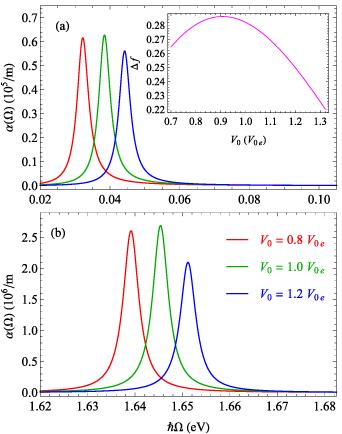


Figure 6. OAC spectra for $1s\to 2p$ intra- (a) and inter-band (b) transitions at various V0. Inset: Δf vs V0. Other parameters as in figure 3. |
A comparison between intra- and inter-band transitions further highlights their distinct physical origins. While both exhibit similar blue-shift behavior with increasing V0, the inter-band spectra occur at substantially higher photon energies and display stronger absorption peaks. This difference arises from the additional contribution of the band gap and the larger joint density of states associated with band-to-band transitions, which amplify the optical response when favorable population differences are present. These findings are broadly consistent with earlier studies on confinement-controlled optical absorption in QDs [19, 25], where increasing V0 was shown to induce a blue shift of the absorption peaks. Previous works have reported both monotonic and non-monotonic variations of the absorption amplitude with V0, depending on the specific confinement model and parameter range. In this respect, the present IQHRSP results reveal a clear non-monotonic dependence within the explored interval, emphasizing the sensitivity of Δf to confinement depth. Despite quantitative differences among models, the present IQHRSP results further demonstrate that the interplay between confinement depth and occupation factors provides an additional mechanism for tuning both the spectral position and intensity of optical absorption in QDs.
5. Conclusions
We have carried out a detailed theoretical analysis of intra- and inter-band optical absorption in GaAs QDs confined by an IQHRSP. By employing the NU method to determine the electronic structure and a dipole interaction model to evaluate the optical response, we clarified the role of RS angular confinement in shaping the absorption characteristics of low-dimensional systems. Our results demonstrate that the angular contribution inherent to the IQHRSP profile significantly modifies the energy-level structure and WF localization, leading to reduced level spacing and altered optical selection rules. Intra-band absorption is found to be strongly influenced by Pauli blocking and temperature-dependent occupation factors, with thermal excitation activating additional channels while leaving the intrinsic transition energies unchanged. In contrast, inter-band absorption is governed primarily by band-to-band energy differences, the joint density of states, and enhanced dipole coupling, resulting in higher photon energies and stronger absorption features.
We further showed that the characteristic confinement parameters, including the dot size and potential depth, offer effective control over both the spectral position and intensity of absorption peaks. While the overall trends are consistent with earlier studies based on alternative non-parabolic confinement models, the present work highlights distinctive effects arising from the combined radial modulation and angular coupling of the IQHRSP. These findings underscore the versatility of RS confinement for engineering optical responses in semiconductor QDs and provide useful insight for the design of tunable optoelectronic and photonic devices.